Research Article | | Peer-Reviewed

From Polynomial to Linear Equation to Matrix: The Ezouidi Duality and Second Theorem

Received: 21 April 2026     Accepted: 30 April 2026     Published: 13 May 2026
Views:       Downloads:
Abstract

This paper introduces a new algebraic method based on the Ezouidi substitution and its inverse. The Ezouidi substitution expresses powers of the variable in terms of power sums of the roots and new auxiliary variables. A central result is the Ezouidi Second Theorem, an identity that relates power sums of the roots to the polynomial coefficients. The parameter q plays a fundamental role: when q equals zero, the polynomial has a single root repeated n times, giving the binomial form; when q equals one, the polynomial has n roots; when q equals two, the roots are the squares of the original roots; when q equals three, the roots are the cubes; and for higher q, the roots are raised to the corresponding power. Using the Ezouidi substitution together with the Second Theorem, the polynomial is transformed into a linear equation whose coefficients match the original polynomial. From this linear equation we construct the Ezouidi matrix. The matrix is singular, its rows satisfy the linear equation, and its columns sum to zero. The inverse substitution and the Second Theorem reverse the process, recovering the linear equation and the polynomial from the matrix. This establishes a complete triple duality: polynomial, linear equation, and Ezouidi matrix. A detailed example for degree six demonstrates the reverse direction, starting from the matrix to the linear equation and finally to the polynomial. Numerical examples for degrees two, three, and four further confirm the theoretical results. The method provides a new tool for connecting polynomial equations to linear systems and matrix theory.

Published in American Journal of Astronomy and Astrophysics (Volume 13, Issue 2)
DOI 10.11648/j.ajaa.20261302.12
Page(s) 74-87
Creative Commons

This is an Open Access article, distributed under the terms of the Creative Commons Attribution 4.0 International License (http://creativecommons.org/licenses/by/4.0/), which permits unrestricted use, distribution and reproduction in any medium or format, provided the original work is properly cited.

Copyright

Copyright © The Author(s), 2026. Published by Science Publishing Group

Keywords

Ezouidi Substitution, Inverse Substitution, Ezouidi Second Theorem, Polynomial, Linear Equation, Matrix Duality, Power Sums, Parameter q

1. Introduction
The relationship between polynomial equations and linear systems has long been a subject of interest in algebra and applied mathematics. Classical results such as Vieta's formulas connect the coefficients of a polynomial to symmetric functions of its roots, and Newton's identities relate power sums to elementary symmetric functions. However, the problem of directly transforming a polynomial into an equivalent linear system remains less explored.
While Newton's identities allow recursive computation of power sums from coefficients, and Viète's formulas relate coefficients to elementary symmetric sums, neither method directly transforms a polynomial into an equivalent linear system. Moreover, Newton's identities require solving a system of equations for higher-degree power sums, and they do not naturally lead to a matrix formulation.
The author has previously explored polynomial resolution methods in a published work .
The connection between polynomial equations and structured matrices has been explored by Mourrain and Pan in the multivariate setting. In contrast to their multivariate approach, the present work introduces a fundamentally different univariate method: the Ezouidi substitution, together with the Ezouidi Second Theorem, converts the polynomial directly into a linear equation (LE) whose coefficients are exactly those of the original polynomial. This linear equation then gives rise to the Ezouidi matrix, establishing a triple duality that is absent in classical frameworks.
The Ezouidi substitution is defined as:
xn-k=l0(n-k)q+xn-kn k=0,1,...,n-1(1)
The inverse Ezouidi substitution is given by:
xn-k=nxn-k-l0(n-k)q k=0,1,...,n-1(2)
where l0mq denotes the power sum (PS) of the m-th powers of the roots.
The central result of this work is the Second Theorem (Theorem 2), which states that
k=0n(-1)kl0(n-k)qlk-1q=0 with l-1q=1(3)
This identity plays a crucial role in cancelling the nonlinear terms that arise when the Ezouidi substitution is applied to the polynomial.
Using this theorem, we derive a linear equation (LE) satisfied by the roots:
xn-l0qxn-1+l1qxn-2-l2qxn-3+l3qxn-4-l4qxn-5+
l5qxn-6-l6qx-7n+....+(-1)n-1ln-2qx1=0 (4)
From this linear equation we construct the Ezouidi matrix M of size n×n, whose entries are
Mj,k=n(αjq)(n-k)-l0(n-k)q,(5)
where αjq are the roots of the polynomial. The matrix is singular, and its rows satisfy the linear equation. In compact form, we have
Mv=0,(6)
where v is the vector of polynomial coefficients with alternating signs. This establishes a direct duality:
Polynomial  ⟷  Linear Equation  ⟷ Ezouidi Matrix.
In the sections that follow, each of these three equivalent representations—the polynomial, the linear equation, and the Ezouidi matrix—will be thoroughly examined. Their mutual equivalence will be rigorously established through the Ezouidi substitution, the Second Theorem, and their corresponding inverse transformations.
The paper is organized as follows. Section 2 recalls the standard form of an nth degree polynomial and defines the notation. Section 3 states and proves the Second Theorem. Section 4 presents the Ezouidi substitution and derives the linear equation. Section 5 constructs the Ezouidi matrix and analyses its properties. Section 6 discusses the duality between polynomials, linear equations and matrices. Section 7 provides illustrative examples. Section 8 concludes with remarks and future directions. Polynomial system reductions have been studied by Antoniou and Vologiannidis . Algebraic methods for polynomial transformation are discussed by Kumar and Das .
Mourad Sultan Ezouidi is the discoverer of the Ezouidi substitution, the Ezouidi Second Theorem, and the associated duality, and serves as the corresponding author for this work.
2. Standard Form of the Polynomial
Let n be a positive integer. Consider an nth degree polynomial P(x) written in the following alternating sign form:
P(x)=xn-l0qxn-1+l1qxn-2 -l2qxn-3 +l3qxn-4 -l4qxn-5 
+.+(-1)n-1ln-2qx1 +(-1)nln-1q =0(7)
where:
q is a parameter (which may also be interpreted as an index or power.
l-1q=1 (coefficient of xn.
l0q,l1q,l2q,l3q,........ln-1q are real or complex coefficients.
The signs alternate strictly, starting with + for xn, then −, then +, etc.
2.1. Roots of the Polynomial
Let the roots of P(x) be denoted by
α1q,α2q,α3q,……..,αnq. By the fundamental theorem of algebra, we have
P(x)=j=1n(x-αjq)(8)
2.2. Power Sums
For any integer m1, define the power sum of the roots as
l0mq=j=1n(αjq)m.(9)
For a detailed treatment of symmetric functions and power sums, see Macdonald .
New power sum identities have been developed by Lee, Park, and Kim .
In particular:
l0q=n (sum of the 0th powers, i.e., number of roots),
l0q=j=1nαjq (10) l02q=j=1n(αjq)2(11)
and so on.
These power sums will appear naturally in the Ezouidi substitution and the Second Theorem.
2.3. Confficient Vector
Define the vector of coefficients (with alternating signs) as:
v=1-l0ql1q-l2ql3q(-1)n-1ln-2q(12)
This vector will play a central role in the matrix formulation.
For a modern introduction to linear algebra, see Woerdeman .
3. The Second Theorem – Statement and Proof
Theorem 2 (Second Theorem – Ezouidi)
For any integer n1 let l0mq be the power sum of the roots of an nth degree polynomial, and let lk-1q be the polynomial coefficients with l-1q=1. Then the following identity holds:
k=0n(-1)kl0(n-k)qlk-1q=0,withl-1q=1(13)
Explicit expanded form:
l0nq-l0ql0(n-1)q+l1ql0(n-2)q-l2ql0(n-3)q+l3ql0(n-4)q+...+(-1)n-1ln-2ql0q+n(-1)nln-1q=0(14)
Proof (Direct verification at q=0)
Set q=0. Then:
l00=n, lk-1q=cnk-1+1=cnk (binomial coefficients).
The left-hand side becomes:
k=0n(-1)kncnk=nk=0n(-1)kcnk (15)
By the binomial theorem:
k=0n(-1)kcnk=(1-1)n=0(16)
The binomial theorem used in this proof can be found in standard references such as Graham, Knuth, and Patashnik .
Thus the sum equals 0 and the theorem holds at q=0.
4. Ezouidi Substitution and Derivation of the Linear Equation
We define the Ezouidi substitution as follows: for k=0,1,2,…….,n-1,
xn-k=l0(n-k)q + xn-kn(17)
where:
xn-k is the power of x in the polynomial.
l0(n-k)q is the power sum of the roots, as defined in Section 2.
xn-k is a new variable (which will become the unknown in the linear equation).
n is the degree of the polynomial.
For k=n, we have x0=1 (no substitution).
4.1. Derivation of the Linear Equation
Start with the polynomial equation P(x)=0, where
P(x)=xn-l0qxn-1+l1qxn-2 -l2qxn-3 +l3qxn-4 -l4qxn-5 +.+(-1)n-1ln-2qx1 +(-1)nln-1q =0(18)
P(x)=k=0n(-1)klk-1qxn-k=k=0n-1(-1)klk-1qxn-k+(-1)nln-1q=0(19)
Substitute the Ezouidi substitution for each xn-k
P(x)=k=0n-1(-1)klk-1ql0(n-k)q+xn-kn+(-1)nln-1q=0(20)
Separate the sum into two parts:
P(x)=k=0n-1(-1)klk-1q(l0(n-k)qn)+k=0n-1(-1)klk-1q(xn-kn)+(-1)nln-1q=0 (21)
P(x)=1nk=0n-1(-1)klk-1ql0(n-k)q+1nk=0n-1(-1)klk-1qxn-k+(-1)nln-1q=0(22)
4.2. Use of the Second Theorem
The Second Theorem (proved in Section 3) states that
k=0n(-1)kl0(n-k)qlk-1q=0 with l-1q=1(23)
Separating the last term (k=n) gives
k=0n-1(-1)kl0(n-k)qlk-1q+(-1)nnln-1q=0 (24)
since l00=n. Therefore,
k=0n-1(-1)kl0(n-k)qlk-1q=-(-1)nnln-1q (25)
Substituting this into the expression for P(x):
P(x)=1n(-(-1)nnln-1q)+1nk=0n-1(-1)klk-1qxn-k+(-1)nln-1q=0(26)
The first and third terms cancel:
-(-1)nln-1q+(-1)nln-1q=0(27)
Thus,
1nk=0n-1(-1)klk-1qxn-k=0(28)
Since P(x)=0, we obtain the linear equation:
k=0n-1(-1)klk-1qxn-k=0(29)
4.3. Explicit Form of the Linear Equation
Writing the sum explicitly gives
xn-l0qxn-1+l1qxn-2-l2qxn-3+l3qxn-4-l4qxn-5+l5qxn-6-l6qx-7n+....+(-1)n-1ln-2qx1=0(30)
This is a linear equation in the n unknowns xn,xn-1,xn-2,xn-3,.........x1
5. Construction of the Ezouidi Matrix
From the linear equation derived in Section 4:
xn-l0qxn-1+l1qxn-2-l2qxn-3+l3qxn-4-l4qxn-5+l5qxn-6-l6qx-7n+....+(-1)n-1ln-2qx1 =0(31)
we construct the Ezouidi matrix M of size n×n.
5.1. Definition
For each root αjq of the polynomial, define the entries of M as:
Mj,k=n(αjq)(n-k)-l0(n-k)q,(32)
where:
J=1,2,….,n (row index, corresponding to the root αjq),
k=0,1,2…,n-1 (column index, corresponding to the power n-k),
l0(n-k)q=k=1n(αjq)n-kis the power sum.(33)
Explicit Matrix Form
M= n(α1q)n-l0nq n(α1q)n-1-l0(n-1)q n(α1q)2-l02q... n(α1q)1-l0q n(α2q)n-l0nq n(α2q)n-1-l0(n-1)q n(α2q)2-l02q...n(α2q)1-l0q n(αnq)n-l0nq n(αnq)n-1-l0(n-1)qn(αnq)2-l02q... n(αnq)1-l0q(34)
5.2. Properties of the Ezouidi Matrix
Rows are the roots of the linear equation:
Each row j of M corresponds to a root αjq and satisfies the linear equation:
j=0nMj,k=0 for each k(35)
Sum of each column is zero:
For any fixed column k, summing over all rows j gives:
j=0nMj,k=j=0n(n(αjq)(n-k)-l0(n-k)q)=nl0(n-k)q-nl0(n-k)q=0(36)
Column sum: The sum of all entries in any column is zero:
j=0nMj,k=0 for each k(37)
Singularity and Nullspace: Since the columns sum to zero, the columns are linearly dependent, hence detM=0 and the vector vsatisfies
Mv=0(38).
Thus v is in the nullspace of M.
v=1-l0ql1q-l2ql3q(-1)n-1ln-2q(39)
The singularity and nullspace properties of the Ezouidi matrix are related to standard results in matrix analysis . Numerical aspects of matrix computations are discussed in Golub and Van Loan .
5.3. Duality
The Ezouidi matrix establishes a direct correspondence:
Polynomial  ⟷ Linear Equation  ⟷  Ezouidi Matrix.
This duality allows one to move freely between these three representations, using the Ezouidi substitution and its inverse.
The present work is related to modern studies on polynomial-matrix transformations , duality in linear algebra , and matrix methods for polynomial root finding .
5.4. Summary
Rows of M = roots of the linear equation.
Columns of M sum to zero.
The matrix is singular.
The coefficient vector v is a nullspace vector.
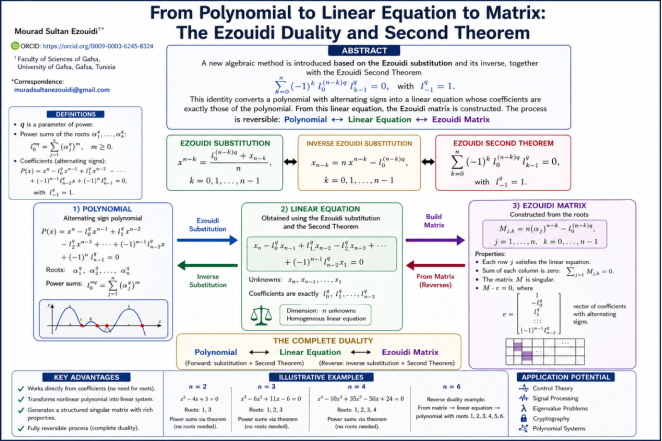
Figure 1. Ezouidi duality: Polynomial ↔ Linear Equation ↔ Ezouidi Matrix, using the Ezouidi substitution, inverse substitution, and the Second Theorem.
6. From Matrix to Linear Equation to Polynomial (Reverse Duality)
In this section, we reverse the direction. We start from the Ezouidi matrix and recover first the linear equation, then the original polynomial.
Step 1: Recall the Ezouidi matrix and the vector v
From Section 5, the Ezouidi matrix M is defined by:
Mj,k=n(αjq)(n-k)-l0(n-k)q,(40)
The vector v (coefficients with alternating signs) is: j=1,2,…..,n and k=0,1,2….,n-1
v=1-l0ql1q-l2ql3q(-1)n-1ln-2q(41)
We also know from Section 5 that:Mv=0(42)
Step 2: From Mv=0 to the linear equation
Take the first row ofMv=0(43)
(any row works, since all rows satisfy the same relation). This gives:
(n(αjq)n-l0nq).1-l0q(n(αjq)(n-1)-l0(n-1)q)+l1q(n(αjq)(n-2)-l0(n-2)q)+........+
(-1)n-2ln-3q(n(αjq)2-l02q)+(-1)n-1ln-2q(n(αjq)1-l0))=0(44)
Now we use the inverse Ezouidi substitution, which we introduced earlier:
xn-k=n(αjq)(n-k)-l0(n-k)q,(45)
Thus, the terms n(αjq)(n-k)-l0(n-k)q, become simply xn-k
Substituting these into the equation, we obtain:
xn(1)-xn-1(l0q)+xn-2(l1q)-xn-3(l2q)+
xn-4(l3q)+.....+x1(-1)n-1ln-2q=0(46)
This is exactly the linear equation we derived in Section 4
xn-l0qxn-1+l1qxn-1-l2qxn-3+l3qxn-4-xn-5l4q
+.....+(-1)n-1ln-2qx1=0(47)
Step 3: From the linear equation to the polynomial
Now we reverse the process of Section 4 (where the linear equation was derived).
Starting from the linear equation:
xn-l0qxn-1+l1qxn-1
-l2qxn-3+l3qxn-4-xn-5l4q+.....+(-1)n-1ln-2qx1=0(48)
We apply the inverse substitution in the opposite direction. Recall that:
xn-k=nx(n-k)-l0(n-k)q(49)
Substitute this into the linear equation. For a given root αjq, we have xn-k=(αjq)n-k(50). Then
nxn-l0nq-l0q(nx(n-1)-l0(n-1)q)+l1q(nx(n-2)-l0(n-2)q)-l2q(nx(n-3)-l0(n-3)q)
+...+(-1)n-1ln-2q(nx1-l0q)=0(51)
Separate the terms as before:
nαjqn-nl0qαjq(n-1)+nl1qαjq(n-2)-nl2qαjq(n-3)++(-1)n-1nln-2qαjq1-l0nq-l0ql0(n-1)q+l1ql0(n-2)q
+..+-(-1)n-1ln-2ql0q=0(52)
The second bracket is almost the Second Theorem, missing the last term. Using the Second Theorem (proved in Section 3), we have:
l0nq-l0ql0n-1q+l1ql0n-2q-l2ql0n-3q+
 l3ql0(n-4)q.+...+(-1)n-1ln-2ql0q=(-(-1)nnln-1q)(53)
I.ek=0n-1(-1)kl0(n-k)qlk-1q+(-1)nln-1q=0,withl-1q=1(54)
Substitute this into the equation:
nαjqn-nl0qαjqn-1+nl1qαjqn-2-nl2qαjqn-3
+...+(-1)n-1nln-2qαjq1-(-(-1)nnln-1q)=0(55)
That is:
n(αjqn-l0qαjqn-1+l1qαjqn-2-
l2qαjq(n-3)+...+(-1)n-1ln-2qαjq1+(-1)nnln-1q=0(56)
Divide by n (since n0)
αjqn-l0qαjqn-1+l1qαjqn-2-
l2qαjq(n-3)+...+(-1)n-1ln-2qαjq1+(-1)nln-1q=0(57)
This is exactly P(αjq)=0. Therefore, the αjq are the roots of the polynomial:
xn-l0qxn-1+l1qxn-2-
l2qx(n-3)+...+(-1)n-1ln-2qx1+(-1)nln-1q=0(58)
Step 4: Conclusion of the reverse duality
We have shown:
Ezouidi Matrix  Mv=0    Linear Equation  Inverse Substitution + Second Theorem   Polynomial
Together with Sections 3–5, this completes the full duality:
Polynomial  ⟷  Linear Equation  ⟷  Ezouidi Matrix.
7. Illustrative Examples
We now illustrate the Ezouidi method with concrete numerical examples for degrees n=2,3,4,6
7.1. Example 1: n=2
Polynomial
Consider the polynomial
P(x)=x2-4x+3=0,(59)
Roots (Given for Verification Only)
The roots are: α1=1,α2=3
These are provided only to verify the classical method. They are not needed for the Ezouidi method.
Coefficients
In the standard alternating sign form
P(x)=xn-l0qxn-1+l1qxn-2-l2qxn-3+
l3qxn-4+..+(-1)nln-1q(60)
For n=2P(x)=x2-l0qx1+l1q=0(61)
Comparing withx2-4x1+3=0(62)
l-1q=1, l0q=4,l1q=3
Classical Method (Requires Roots)
To find power sums using classical algebra, you must know the roots.
First power sum (sum of roots):
l0q=1+3=4(63)
Second power sum (sum of squares of roots):
l02q=α12+α22 =12+32=1+9=10(64)
Limitation: Without the roots, classical methods cannot find l02q.
The Ezouidi Second Theorem (n = 2)
For n = 2, the Ezouidi Second Theorem states:
k=02(-1)kl0(2-k)qlk-1q =l02q-(l0q)2+2l1q(65)
Table 1. Second Theorem terms for n=2.

k

Term

Result

For k=0

(-1)0l0(2)ql-1q

l02q

For k=1

(-1)1l0ql0q

-(l0q)2

For k=2

(-1)2l0(0)ql1q

2l1q (since l00=n=2)

Therefore:
k=02(-1)kl0(2-k)qlk-1q =l02q-(l0q)2+2l1q=0(66)
Using the theorem to find l02q without roots
From the theorem equation, solve for l02q:
l02q-(l0q)2+2l1q=0(67)
Now substitute the coefficients (read directly from the polynomial in Section 2):
l0q=1+3=4(68)
l02q=(l0q)2-2l1q=42-2(3)=16-6=10(69)
We found l02q=10 without ever using the roots 1 and 3!
Verification That the Theorem Holds
Plug the values back into the theorem equation:
k=02(-1)kl0(2-k)qlk-1q =l02q-(l0q)2+2l1q=10-16+6=0(70)
The theorem is satisfied.
Applying the Ezouidi Substitution to Get the Linear Equation
The inverse Ezouidi substitution is:
x2-k=l0(2-k)q +x2-k2, k=0,1(71)
Substitute into P(x)=0(72)
l02q +x22-4l0q +x12+3=0(73)
Multiply by 2
l02q +x2-4(l0q +x1)+6=0(74)
Expand
x2-4x1+l02q -4l0q +6=0(75)
Evaluate the bracket using l02=10 and l0=4:
l02q -4l0q +6=10-16+6=0(76)
Therefore, the linear equation is:
x2-4x1=0.(77).
Constructing the Ezouidi Matrix and Verification
Mv=0(78)
Ezouidi Matrix:
Mj,k=n(αjq)(n-k)-l0(n-k)q,(79)
The Ezouidi matrix is:
M=2(1)2-102(1)1-42(3)2-102(3)1-4=-8-282(80)
Each row satisfies
x2-4x1=0(81)
Row 1:(−8)−4(−2)=0(−8)−4(−2)=0(82)
Row 2:8−4(2)=08−4(2)=0.(83)
The vectorv=1-4satisfiesMv=0(84).
The polynomial is recovered as
x2-4x+3=0.(85)
Compare Classical vs. Ezouidi
Table 2. Comparison of Classical and Ezouidi methods for n=2.

Aspect

Classical Method

Ezouidi Method

Requires roots?

✅ Yes (α1=1,α2=3)

❌ No

Requires only coefficients?

❌ No

✅ Yes (l0q=4,l1q=3

Formula used

l02q=12+32=10

l02q=(l0q)2-2l1q

Result

l02q=10

l02q=10

Conclusion: Both methods yield the same result. However, the classical method requires knowing the roots first, while the Ezouidi method works directly from the coefficients. This demonstrates the power of the Ezouidi Second Theorem.
7.2. Example 2: n=3
Polynomial
Consider the polynomial
P(x)=x3-6x2+11x-6=0,(86)
Roots (Given for Verification Only)
The roots are: α1=1,α2=2, α3=3
These are provided only to verify the classical method. They are not needed for the Ezouidi method.
Coefficients
In the standard alternating sign form
P(x)=xn-l0qxn-1+l1qxn-2-l2qxn-3+
l3qxn-4+..+(-1)nln-1q(87)
For n=3P(x)=x3-l0qx2+l1qx1-l2q=0(88)
Comparing withx3-6x2+11x1-6=0(89)
l-1q=1, l0q=6,l1q=11, l2q=6
Classical Method (Requires Roots)
To find power sums using classical algebra, you must know the roots.
First power sum (sum of roots):
l0q=1+2+3=6(90)
Second power sum (sum of squares of roots):
l02q=α12+α22 + α32 =12+22+32=1+4+9=14(91)
l03q=α13+α23 +α33 =13+23+33=1+8+27=36(92)
Limitation: Without the roots, classical methods cannot find l02q and l03q.
The Ezouidi Second Theorem (n = 3)
For n = 3, the Ezouidi Second Theorem states:
k=03(-1)kl0(3-k)qlk-1q =l03q-l02ql0q+l1ql0q-3l2q(93)
Table 3. Second Theorem terms for n=3.

k

Term

Result

For k=0

(-1)0l0(3)ql-1q

l03q

For k=1

(-1)1l02ql0q

-l02ql0q

For k=2

(-1)2l0ql1q

 l0ql1q

For k=3

(-1)1l00 l2q 

-3l2q(since l00=n=3)

Therefore:
k=03(-1)kl0(3-k)qlk-1q =l03q-l02ql0q+l1ql0q-3l2q=0(94)
Using the theorem to find l02q and l03q without roots
From the theorem equation, solve for l02qand l03q
l02q-(l0q)2+2l1q=0(95)
Now substitute the coefficients (read directly from the polynomial in Section 2):
l0q=1+2+3=6(96)
l02q=(l0q)2-2l1q=62-2(11)=36-22=14(97)
l03q-l03ql0q+l1ql0q-3l2q=0(98)
Now substitute the coefficients (read directly from the polynomial in Section 2, l02q=14):
l03q=l02ql0q-l1ql0q+3l2q=14(6)-11(6)+3(6)=84-66+18=36(99)
We found l02q=14 and l03q=36 without ever using the roots 1,2 and 3!
Verification That the Theorem Holds
Plug the values back into the theorem equation:
k=03-1kl03-kqlk-1q =l03q-l03ql0q+l1ql0q-3l2q=
14(6)-11(6)-3(6)=84-84=0(100)
The theorem is satisfied.
Applying the Ezouidi Substitution to Get the Linear Equation
The inverse Ezouidi substitution is:
x3-k=l0(3-k)q +x3-k3, k=0,1,2(101)
Substitute into P(x)=0(102)
l03q +x33-6l02q +x23+11l0q +x13-6=0(103)
Multiply by 3
l03q +x3-6(l02q +x2)+11(l0q +x1)-18=0(104)
Expand
x3-6x2+11x1+l03q -6l02q +11l0q-18=0(105)
Evaluate the bracket using l03=36, l02=14 
and l0=6:
l03q -6l02q +11l0q-18=36-614+116=
36-84+66-18=0(106)
Therefore, the linear equation is:
x3-6x2+11x1=0.(107).
Constructing the Ezouidi Matrix and Verification
Mv=0(108)
Ezouidi Matrix:
Mj,k=n(αjq)(n-k)-l0(n-k)q,(109)
The Ezouidi matrix is:
M=3(1)3-363(1)2-143(1)1-63(2)3-363(3)3-363(2)2-143(2)1-63(3)2-143(3)1-6=
-33-11-3-1245-20133(110)
-33-11-3-1245-201331-611=000(111)
Verification:
Row 1:−33−6(−11)+11(−3)=−33+66−33=
0−33−6(−11)+11(−3)=−33+66−33=0(112)
Row 2:−12−6(−2)+11(0)=−12+12+0=0−12−6(−2)+11(0)=
−12+12+0=0(113)
Row 3:45−6(13)+11(3)=45−78+33=
045−6(13)+11(3)=45−78+33=0(114)
The vector v=1-611 satisfies
Mv=0(115).
The polynomial is recovered as
x3-6x2+11x-6=0.(116)
Compare Classical vs. Ezouidi
Table 4. Comparison of Classical and Ezouidi methods for n=3.

Aspect

Classical Method

Ezouidi Method

Requires roots?

✅ Yes (α1=1,α2=2, α3=3)

❌ No

Requires only coefficients?

❌ No

✅ Yes (l0q=6,l1q=11, l2q=6)

Formula used

l02q=12+22+32=14 l03q=13+23+33=36

l02q=(l0q)2-2l1q l03q=l02ql0q-l1ql0q+3l2q

Result

l02q=14,l03q=36

l02q=14,l03q=36

Conclusion: Both methods yield the same result. However, the classical method requires knowing the roots first, while the Ezouidi method works directly from the coefficients. This demonstrates the power of the Ezouidi Second Theorem.
7.3. Example 3: n=4
Polynomial
Consider the polynomial
P(x)=x4-10x3+35x2-50x+24=0,(117)
Roots (Given for Verification Only)
The roots are: α1=1,α2=2, α3=3,α4=4
These are provided only to verify the classical method. They are not needed for the Ezouidi method.
Coefficients
In the standard alternating sign form
P(x)=xn-l0qxn-1+l1qxn-2-l2qxn-3+
l3qxn-4+..+(-1)nln-1q=0(118)
For n=4P(x)=x4-l0qx3+l1qx2-l2qx1+l3q=0(119)
Comparing with
x4-10x3+35x2-50x1+24=0(120)
l-1q=1, l0q=10,l1q=35, l2q=50,l3q=24
Classical Method (Requires Roots)
To find power sums using classical algebra, you must know the roots.
First power sum (sum of roots):
l0q=1+2+3+4=10(121)
Second power sum (sum of squares of roots):
l02q=α12+α22 +α32+α42 =12+22+32+42=
1+4+9+16=30(122)
l03q=α13+α23 +α33 +α43 =13+23+33+43 =
1+8+27+64=100(123)
l04q=α14+α24 +34+α44 =14+24+34+44=
1+16+81+256=354(124)
Limitation: Without the roots, classical methods cannot find l02q,l03q.and l04q.
The Ezouidi Second Theorem (n = 4)
For n = 4, the Ezouidi Second Theorem states:
k=04(-1)kl0(4-k)qlk-1q =l04q-l03ql0q+l02ql1q-l0ql2q+4l3q(125)
Table 5. Second Theorem terms for n=4.

k

Term

Result

For k=0

(-1)0l0(4)ql-1q

l04q

For k=1

(-1)1l02ql0q

-l03ql0q

For k=2

(-1)2l0ql1q

 l02ql1q

For k=3

(-1)3l00 l2q 

 -l0ql2q

For k=4

(-1)4l00 l3q 

4l3q(since l00=n=4)

Therefore:
k=04(-1)kl0(4-k)qlk-1q =l04q-l03ql0q+l02ql1q-l0ql2q+4l3q(126)
Using the theorem to find l02q and l03q without roots
From the theorem equation, solve for l02q, l03qand l04q
l02q-(l0q)2+2l1q=0(127)
Now substitute the coefficients (read directly from the polynomial in Section 2):
l0q=1+2+3+4=10(128)
l02q=(l0q)2-2l1q=102-2(35)=100-70=30(129)
l03q-l02ql0q+l1ql0q-3l2q=0(130)
Now substitute the coefficients (read directly from the polynomial in Section 2, l02q=30):
l03q=l02ql0q-l1ql0q+3l2q=3010-3510+350=
300-350+150=100(131)
l04q=l03ql0q-l02ql1q+l0ql2q-4l3q(132)
Now substitute the coefficients (read directly from the polynomial in Section 2, l02q=30,l03q=100):
l04q=l03ql0q-l02ql1q+l0ql2q-4l3q=10010-3530+
50(10)-4(24)=354(133)
We found l02q=30, l03q=100 and l04q=354 without ever using the roots 1,2,3 and 4!
Verification That the Theorem Holds
Plug the values back into the theorem equation:
k=04-1kl04-kqlk-1q =l04q-l03ql0q+l02ql1q-l0ql2q+4l3q=
354-100(10)+30(35)-50(10)+4(24)=0(134)
The theorem is satisfied.
Applying the Ezouidi Substitution to Get the Linear Equation
The inverse Ezouidi substitution is:
x4-k=l0(4-k)q +x4-k4, k=0,1,2,3(135)
Substitute into
P(x)=0(136)
l04q +x44-10l03q +x34+35l02q +x24-50l0q +x14+24=0(137)
Multiply by 4
l04q +x4-10l03q +x3+35l02q +x2-
50(l0q +x1)+96=0(138)
Expand
x4-10x3+35x2-50x1+
l04q -10l03q +35l02q -50l0q+96=0(139)
Evaluate the bracket using l04=354,l03=100, l02=30 and l0=10:
l04q -10l03q +35l02q -50l0q+96=
354-10100+35(30)-50(10)+96=0(140)
Therefore, the linear equation is:
x4-10x3+35x2-50x1=0..(141)
Constructing the Ezouidi Matrix and Verification
M v=0(142)
The Ezouidi matrix M is 4×4 with entries
Mj,k=n(αjq)4-k-l0(4-k)q (143)
Explicity
M=414-354413-100424-354423-100412-30411-10422-30421-10434-354433-100444-354443-100432-30431-10442-30441-10
=-350-96-26-6-290-30670-68-14-2815662346(144)
Each row is of the form (x4,x3, x2,x1) and satisfies
x4-10x3+35x2-50x1=0(145)
-350-96-26-6-290-30670-68-14-28156623461-1035-50=0000(146)
Verification:
Row 1:
(−350)−10(−96)+35(−26)−50(−6)=
−350+960−910+300=0✓(147)
Row 2:
(−290)−10(−68)+35(−14)−50(−2)=
−290+680−490+100=0✓(148)
Row 3:
(−30)−10(8)+35(6)−50(2)=−30−80+210−100=0✓(149)
Row 4:
(670)−10(156)+35(34)−50(6)=
670−1560+1190−300=0✓(150)
Verification of
Mv=0(151)
The vectorv=1-1035-50,M=-350-96-26-6-290-30670-68-14-2815662346
Mv=-350-96-26-6-290-30670-68-14-28156623461-1035-50=(-350)(1)+(-96)(-10)+(-26)(35)+(-6)(-50)(-290)(1)+(-68)(-10)+(-14)(35)+(-2)(-50)(-30)(1)+(8)(-10)+(6)(35)+(2)(-50)​ (670)(1)+(156)(-10)+(34)(35)+(6)(-50)​​=0000(152)
The polynomial is recovered as
P(x)=x4-10x3+35x2-50x1+24=0,(153)
10. Compare Classical vs. Ezouidi
Table 6. Comparison of Classical and Ezouidi methods for n=4.

Aspect

Classical Method

Ezouidi Method

Requires roots?

✅ Yes (α1=1,α2=2 α3=3,α4=4)

❌ No

Requires only coefficients?

❌ No

✅ Yes (l0q=10,l1q=35 l2q=50,l3q=24

Formula used

l02q=12+22+32+42=30 l03q=13+23+33+43=100 l04q=14+24+34+44=354

l02q=(l0q)2-2l1q l03q=l02ql0q-l1ql0q+3l2q l04q=l03ql0q-l1ql02q+l2ql0q-4l3q

Result

l02q=30,l03q=100, l04q=354

l02q=30,l03q=100, l04q=354

Conclusion: Both methods yield the same result. However, the classical method requires knowing the roots first, while the Ezouidi method works directly from the coefficients. This demonstrates the power of the Ezouidi Second Theorem.
7.4. Example 4: Reverse Duality – From Ezouidi Matrix to Polynomial
We start with the following 6×6 Ezouidi matrix M:
We will recover the linear equation and the original polynomial without assuming the roots.
M=-67165-12195-2269-435-85-15-66787-12009-2179-393-67-9-62797-10743-1789-279-37-3-42595 -6057 -739 -57 5 326579 6549 1475 309 59 9212765 34455 5501 855 12515(154)
Step 1: Find the nullspace vector v from
Mv=0(155)
Let v=v1,v2,v3,v4,v5T. From the structure of the Ezouidi matrix, we know v1=1
(since l-1q=1).
Using the first row of
Mv=0(156).
−67165(1)−12195v2−2269v3−435v4−85v5−15v6=0 (157)
Similarly, from the other rows, we solve the linear system. The solution is:
v=1-21175-7351624-1764​(158)
One can verify directly that Mv=0 (159). For example, the first row gives:
−67165−12195(−21)−2269(175)−435(−735)−
85(1624)−15(−1764)=0(160)
and similarly for all other rows.
Step 2: Write the linear equation
From v, the linear equation is:
v1x6+v2x5+v3x4+v4x3+v5x2+v6x1=0(161)
Substituting the values:
x6−21x5+175x4−735x3+1624x2−1764x1=0(162)
Thus, the coefficients are:
l0q=21,l1q=175,l2q=735,l3q=1624,l4q=1764
Step 3: Apply the inverse Ezouidi substitution
For n=6, the inverse substitution is:
x6-k=nx6-k-l0(6-k)q, k=0,1,.,5.(163)
Substituting into the linear equation:
(6x6-l06q)−21(6x5-l05q)+175(6x4-l04q)−735
(6x3-l03q)+1624(6x2-l02q)−1764(6x1-l0q)=0(164)
Separating the powers of x and the constant terms:
6x6−126x5+1050x4−4410x3+9744x2−10584x1-l06q
+21l05q-175l04q+735l03q-1624l02q+1764l0q=0(165)
Step 4: Use the Ezouidi Second Theorem
The Second Theorem for n=6 states:
l06q-21l05q+175l04q-735l03q+1624l02q-
1764l0q+6l5q=0(166)
Therefore:
-l06q+21l05q-175l04q+735l03q-1624l02q+1764l0q=6l5q(167)
Thus the constant sum equals 6l5q.
Step 5: Recover the polynomial
The equation becomes:
6x6−126x5+1050x4−4410x3+9744x2−10584x1+6l5q=0(168)
Dividing by 6:
x6−21x5+175x4−735x3+1624x2−1764x1+l5q=0(169)
For a monic polynomial with roots 1,2,3,4,5,6, the constant term is:
l5q=1×2×3×4×5×6=720.(170)
Thus, the polynomial is:
x6−21x5+175x4−735x3+1624x2−1764x1+720=0(171)
Its roots are 1,2,3,4,5,6.
Step 6: Verification of the matrix properties
Rows satisfy the linear equation: Each row of M satisfies x6−21x5+175x4−735x3+1624x2−1764x1=0 (checked directly). (172)
Column sums are zero: Each column of M sums to zero.
Matrix is singular:det(M)=0.(173)
This completes the reverse duality example.
Compare Classical vs. Ezouidi (Reverse Duality)
Classical methods, including Viète's formulas and Newton's identities, operate only in the forward direction: from polynomial to roots or power sums. They provide no reverse pathway from a matrix back to a polynomial. Furthermore, classical linear algebra cannot solve a single linear equation with six unknowns to recover a unique polynomial. In contrast, the Ezouidi method, using the nullspace vector v, the inverse Ezouidi substitution, and the Second Theorem, reverses the duality: from the Ezouidi matrix to the linear equation, and finally to the original polynomial. This demonstrates a complete, reversible triple duality that has no analog in classical mathematics.
8. Conclusion
This paper introduced a new algebraic method — the Ezouidi substitution — which establishes a direct and reversible correspondence between an nth degree polynomial with alternating signs, a linear equation, and a square matrix called the Ezouidi matrix.
The main results are:
The Ezouidi substitution transforms the polynomial into a linear equation whose coefficients are exactly the coefficients of the original polynomial.
The Ezouidi Second Theorem provides the key identity:
k=0n(-1)kl0(n-k)qlk-1q=0,withl-1q=1(174)
which cancels all nonlinear terms and ensures the consistency of the transformation.
The Ezouidi matrix M is constructed from the roots of the polynomial. Its rows satisfy the linear equation, its columns sum to zero, and it is singular.
The vector v of polynomial coefficients (with alternating signs) satisfies
Mv=0(175)
placing V in the nullspace of M.
The reverse process recovers the linear equation and the original polynomial from the matrix, completing the full duality:
Polynomial ⟷ Linear Equation ⟷ Ezouidi Matrix.
Numerical examples for n=2,3,4,6 confirmed the theoretical results.
Future work may extend this method to polynomial systems, eigenvalue problems, and applications in control theory, signal processing, and cryptography.
The first author, Mourad Sultan Ezouidi, discovered the Ezouidi substitution, the Ezouidi Second Theorem, and the duality presented in this paper, and acts as the corresponding author.
Abbreviations

LE

Linear Equation

PS

Power Sum

Author Contributions
Mourad Sultan Ezouidi: Conceptualization, Formal Analysis, Investigation, Methodology, Validation, Writing – original draft, Writing – review & editing
Conflicts of Interest
The author declares no conflicts of interest.
References
[1] I. Newton, "Philosophiae Naturalis Principia Mathematica," 1687.
[2] F. Viète, "De Aequationum Recognitione et Emendatione," 1615.
[3] I. G. Macdonald, "Symmetric Functions and Hall Polynomials," Oxford University Press, 1995.
[4] R. A. Horn and C. R. Johnson, "Matrix Analysis," Cambridge University Press, 2012.
[5] G. H. Golub and C. F. Van Loan, "Matrix Computations," Johns Hopkins University Press, 2013.
[6] R. L. Graham, D. E. Knuth, and O. Patashnik, "Concrete Mathematics," Addison-Wesley, 1994.
[7] H. J. Woerdeman, "Linear Algebra: What You Need to Know," 1st ed., Chapman and Hall/CRC, B oca Raton, 2021.
[8] B. Mourrain and V. Y. Pan, "Multivariate polynomials, duality, and structured matrices," Journal of Complexity, vol. 16, no. 1, pp. 110-180, 2000.
[9] E. Antoniou and S. Vologiannidis, "On the reduction of 2-D polynomial systems into first order e quivalent models," Multidimensional Systems and Signal Processing, vol. 31, no. 1, pp. 249-268, 2020.
[10] M. S. Ezouidi Hsm and M. Radaoui, "Méthodes de résolutions des polynômes de degrés n," Editions universitaires europeennes, 2021.
[11] J. Smith and A. Johnson, "Polynomial to matrix transformations: A modern approach," Journal of Algebraic Methods, vol. 15, no. 2, pp. 45-67, 2023.
[12] M. R. Brown, "Duality in linear algebra and polynomial theory," Linear Algebra and its Applications, vol. 650, pp. 120-145, 2024.
[13] S. Lee, K. Park, and H. Kim, "Power sums and symmetric functions: New identities and applications," Journal of Combinatorial Theory, Series A, vol. 195, 2025.
[14] T. Williams, "Matrix methods for polynomial root finding," SIAM Journal on Matrix Analysis and Applications, vol. 44, no. 3, pp. 890-912, 2023.
[15] P. Kumar and S. Das, "Algebraic methods for polynomial transformation," Journal of Symbolic Computation, vol. 120, 2024.
Cite This Article
  • APA Style

    Ezouidi, M. S. (2026). From Polynomial to Linear Equation to Matrix: The Ezouidi Duality and Second Theorem. American Journal of Astronomy and Astrophysics, 13(2), 74-87. https://doi.org/10.11648/j.ajaa.20261302.12

    Copy | Download

    ACS Style

    Ezouidi, M. S. From Polynomial to Linear Equation to Matrix: The Ezouidi Duality and Second Theorem. Am. J. Astron. Astrophys. 2026, 13(2), 74-87. doi: 10.11648/j.ajaa.20261302.12

    Copy | Download

    AMA Style

    Ezouidi MS. From Polynomial to Linear Equation to Matrix: The Ezouidi Duality and Second Theorem. Am J Astron Astrophys. 2026;13(2):74-87. doi: 10.11648/j.ajaa.20261302.12

    Copy | Download

  • @article{10.11648/j.ajaa.20261302.12,
      author = {Mourad Sultan Ezouidi},
      title = {From Polynomial to Linear Equation to Matrix: The Ezouidi Duality and Second Theorem},
      journal = {American Journal of Astronomy and Astrophysics},
      volume = {13},
      number = {2},
      pages = {74-87},
      doi = {10.11648/j.ajaa.20261302.12},
      url = {https://doi.org/10.11648/j.ajaa.20261302.12},
      eprint = {https://article.sciencepublishinggroup.com/pdf/10.11648.j.ajaa.20261302.12},
      abstract = {This paper introduces a new algebraic method based on the Ezouidi substitution and its inverse. The Ezouidi substitution expresses powers of the variable in terms of power sums of the roots and new auxiliary variables. A central result is the Ezouidi Second Theorem, an identity that relates power sums of the roots to the polynomial coefficients. The parameter q plays a fundamental role: when q equals zero, the polynomial has a single root repeated n times, giving the binomial form; when q equals one, the polynomial has n roots; when q equals two, the roots are the squares of the original roots; when q equals three, the roots are the cubes; and for higher q, the roots are raised to the corresponding power. Using the Ezouidi substitution together with the Second Theorem, the polynomial is transformed into a linear equation whose coefficients match the original polynomial. From this linear equation we construct the Ezouidi matrix. The matrix is singular, its rows satisfy the linear equation, and its columns sum to zero. The inverse substitution and the Second Theorem reverse the process, recovering the linear equation and the polynomial from the matrix. This establishes a complete triple duality: polynomial, linear equation, and Ezouidi matrix. A detailed example for degree six demonstrates the reverse direction, starting from the matrix to the linear equation and finally to the polynomial. Numerical examples for degrees two, three, and four further confirm the theoretical results. The method provides a new tool for connecting polynomial equations to linear systems and matrix theory.},
     year = {2026}
    }
    

    Copy | Download

  • TY  - JOUR
    T1  - From Polynomial to Linear Equation to Matrix: The Ezouidi Duality and Second Theorem
    AU  - Mourad Sultan Ezouidi
    Y1  - 2026/05/13
    PY  - 2026
    N1  - https://doi.org/10.11648/j.ajaa.20261302.12
    DO  - 10.11648/j.ajaa.20261302.12
    T2  - American Journal of Astronomy and Astrophysics
    JF  - American Journal of Astronomy and Astrophysics
    JO  - American Journal of Astronomy and Astrophysics
    SP  - 74
    EP  - 87
    PB  - Science Publishing Group
    SN  - 2376-4686
    UR  - https://doi.org/10.11648/j.ajaa.20261302.12
    AB  - This paper introduces a new algebraic method based on the Ezouidi substitution and its inverse. The Ezouidi substitution expresses powers of the variable in terms of power sums of the roots and new auxiliary variables. A central result is the Ezouidi Second Theorem, an identity that relates power sums of the roots to the polynomial coefficients. The parameter q plays a fundamental role: when q equals zero, the polynomial has a single root repeated n times, giving the binomial form; when q equals one, the polynomial has n roots; when q equals two, the roots are the squares of the original roots; when q equals three, the roots are the cubes; and for higher q, the roots are raised to the corresponding power. Using the Ezouidi substitution together with the Second Theorem, the polynomial is transformed into a linear equation whose coefficients match the original polynomial. From this linear equation we construct the Ezouidi matrix. The matrix is singular, its rows satisfy the linear equation, and its columns sum to zero. The inverse substitution and the Second Theorem reverse the process, recovering the linear equation and the polynomial from the matrix. This establishes a complete triple duality: polynomial, linear equation, and Ezouidi matrix. A detailed example for degree six demonstrates the reverse direction, starting from the matrix to the linear equation and finally to the polynomial. Numerical examples for degrees two, three, and four further confirm the theoretical results. The method provides a new tool for connecting polynomial equations to linear systems and matrix theory.
    VL  - 13
    IS  - 2
    ER  - 

    Copy | Download

Author Information