
 ,
FestusManiriho,
Jean Nduwamungu*,
Nelly Elias Bapfakurera,
Judith Uwihirwe,
Esaie Dufitimana
,
FestusManiriho,
Jean Nduwamungu*,
Nelly Elias Bapfakurera,
Judith Uwihirwe,
Esaie Dufitimana
Agroforestry is widely promoted as an ecosystem-based adaptation strategy to enhance climate resilience, restore degraded landscapes, and support smallholder livelihoods. However, empirical evidence on how project-supported agroforestry interventions influence tree species composition, stocking density, and biomass accumulation remains limited. This study assessed tree and shrub diversity, stocking density, and aboveground biomass across different agroforestry practices in Kayonza District, Eastern Rwanda, comparing project intervention sites supported by the LDCF II Ecosystem-based Adaptation approach project with no intervention areas. Using systematic band transects covering 26 sampling units, all woody species were inventoried and measured for diameter and height, and aboveground biomass was estimated using an allometric equation. A total of 39 species were recorded in no-intervention areas and 36 species in intervention areas, with both systems dominated by a small number of widely preferred species, including Eucalyptus spp., Grevillea robusta, Mangifera indica, Persea americana, Euphorbia tirucalli, and Senna spp. Tree and shrub density was four times higher in intervention areas (172 stems ha-1) than in non-intervention areas (43 stems ha-1), while diameter class distributions were dominated by small trees (<10cm DBH) in both zones. Despite smaller average tree sizes, intervention areas exhibited substantially higher aboveground biomass (15.33 t ha-1) compared to no-intervention areas (4.51 t ha-1), largely due to higher stocking density and wider adoption of biomass-efficient practices. Scattered trees on farm consistently ranked highest in biomass contribution across both zones. These findings demonstrate that targeted agroforestry interventions can rapidly enhance landscape-level biomass and carbon sequestration potential, even at early stages of tree establishment. To sustain and maximize these benefits, future interventions should prioritize agroforestry practice diversification, adaptive management, greater integration of native species and long-term monitoring to balance productivity, biodiversity, and income.
| Published in | American Journal of Agriculture and Forestry (Volume 14, Issue 1) |
| DOI | 10.11648/j.ajaf.20261401.12 |
| Page(s) | 8-17 |
| Creative Commons |
This is an Open Access article, distributed under the terms of the Creative Commons Attribution 4.0 International License (http://creativecommons.org/licenses/by/4.0/), which permits unrestricted use, distribution and reproduction in any medium or format, provided the original work is properly cited. |
| Copyright |
Copyright © The Author(s), 2026. Published by Science Publishing Group |
Post-intervention, Agroforestry Species, Aboveground Biomass, Agroforestry Practices, Agroforestry Systems in Rwanda
 assumptions was required. So, a nonparametric Kruskal-Wallis test was used to identify specific differences in DHB and stem biomass among species within the various agroforestry system practices. The Kruskal-Wallis test was performed using IBM SPSS Statistics (Version 27). The mean number of stems and the distribution of DBH classes were also determined using IBM SPSS Statistics (Version 27).
  3.2. Trees and Shrubs Stocking and Diameter Classes
 Agroforestry Practice | Project intervention areas | No-intervention areas | ||
|---|---|---|---|---|
Percent of Trees (%) | Above ground Biomass (kg/ha) | Percent of Trees (%) | Aboveground Biomass (kg/ha) | |
Scattered trees on farm | 44.2 | 6735.7 | 36.1 | 1246.8 |
Home garden | 17.3 | 3094.6 | 1.8 | 62.8 |
Intercropping | 15 | 1354.5 | 9 | 261.7 |
Roadside trees | 5.5 | 1069 | 0.4 | 22 |
Boundary planting | 11.3 | 952.4 | 5.3 | 162.1 |
Small woodlots | 6.5 | 229.2 | 40.5 | 391.4 |
Silvopastoral | - | - | 6.6 | 80.1 |
Others | 0.2 | 3.1 | 0.3 | 1.1 |
Practice | Species | Project intervention zone | No intervention zone | ||||||
|---|---|---|---|---|---|---|---|---|---|
DBH (cm) | AGB (Kg/stem) | DBH (cm) | AGB (Kg/stem) | ||||||
Mean | Std.* Dev. | Mean | Std. Dev | Mean | Std. Dev | Mean | Std. Dev | ||
Home garden | Eucalyptus spp | 8 | 2 | 19 | 10.5 | 0.0 | 0.0 | 0 | 0 |
Euphorbia tirucalli | 9 | 0 | 20.5 | 2.1 | 0.0 | 0.0 | 0 | 0 | |
Grevillea robusta | 12.1 | 6.2 | 65.1 | 72.3 | 21.4 | 3.7 | 181.7 | 75.3 | |
Mangifera indica | 9.7 | 2.7 | 28.1 | 19.9 | 16.9 | 1.8 | 100.6 | 27.1 | |
Persea americana | 11.1 | 5.9 | 51.7 | 59.3 | 20.9 | 7.6 | 185.8 | 150 | |
Senna spp | 0 | 0 | 0 | 0 | 7.9 | 3.3 | 18.5 | 17.5 | |
Intercropping | Eucalyptus spp | 18 | 0 | 108 | 0 | 8.8 | 4.8 | 31.4 | 61.7 |
Euphorbia tirucalli | 11.3 | 5.3 | 51 | 60.2 | 4.5 | 0.0 | 3.8 | 0 | |
Grevillea robusta | 8.9 | 3 | 24.5 | 19.4 | 11.6 | 5.1 | 52.1 | 51 | |
Mangifera indica | 6.5 | 0.7 | 10.5 | 2.1 | 9.5 | 5.1 | 35.7 | 44.9 | |
Persea americana | 0 | 0 | 0 | 0 | 12.6 | 8.8 | 92.1 | 174.8 | |
Senna spp. | 6 | 0 | 9 | 0 | 0.0 | 0.0 | 0 | 0 | |
Boundary planting | Eucalyptus spp. | 0 | 0 | 0 | 0 | 9.3 | 0.0 | 22.6 | 0 |
Euphorbia tirucalli | 11.5 | 4.3 | 47.5 | 55.8 | 6.4 | 2.2 | 10.9 | 11 | |
Grevillea robusta | 11.1 | 3.4 | 39.6 | 25.8 | 10.5 | 4.5 | 39.7 | 39.6 | |
Mangifera indica | 10.4 | 1.1 | 32 | 8.4 | 0.0 | 0.0 | 0 | 0 | |
Persea americana | 27 | 0 | 303 | 0 | 14.2 | 0.2 | 63.7 | 2.4 | |
Senna spp. | 9.3 | 2.8 | 24.5 | 15.4 | 0.0 | 0.0 | 0 | 0 | |
Scattered trees | Eucalyptus spp | 14 | 7.7 | 95.5 | 146.5 | 8.2 | 6.9 | 41.2 | 95.6 |
Euphorbia tirucalli | 12.3 | 4.4 | 57.8 | 62.3 | 11.4 | 8.0 | 72.5 | 119.5 | |
Grevillea robusta | 12.6 | 4.6 | 60.5 | 60.4 | 13.6 | 8.2 | 96.9 | 128.2 | |
Mangifera indica | 15.7 | 4.5 | 93.9 | 58.1 | 13.2 | 8.6 | 100.2 | 216.3 | |
Persea americana | 14 | 9.9 | 120.2 | 186.3 | 18.3 | 8.3 | 164.9 | 177.8 | |
Senna spp | 9.8 | 4.9 | 38.3 | 51.7 | 5.5 | 2.9 | 9.6 | 15.5 | |
Small woodlots | Eucalyptus spp | 8.2 | 3 | 20 | 19.6 | 7.6 | 3.9 | 20.8 | 35.4 |
Euphorbia tirucalli | 0 | 0 | 0 | 0 | 3.1 | 0.1 | 1.4 | 0.1 | |
Grevillea robusta | 9.3 | 1.3 | 21.3 | 9 | 13.8 | 7.3 | 83.7 | 72.5 | |
Mangifera indica | 0 | 0 | 0 | 0 | 0.0 | 0.0 | 0 | 0 | |
Persea americana | 0 | 0 | 0 | 0 | 18.3 | 5.9 | 136 | 107.9 | |
Senna spp | 0 | 0 | 0 | 0 | 6.0 | 0.0 | 7.6 | 0 | |
Trees on road | Eucalyptus spp | 0 | 0 | 0 | 0 | 0.0 | 0.0 | 0 | 0 |
Euphorbia tirucalli | 10.7 | 2.4 | 34.5 | 19 | 0.0 | 0.0 | 0 | 0 | |
Grevillea robusta | 9 | 4.4 | 27.3 | 30.9 | 21.8 | 11.7 | 232.2 | 248.3 | |
Mangifera indica | 0 | 0 | 0 | 0 | 0.0 | 0.0 | 0 | 0 | |
Persea americana | 0 | 0 | 0 | 0 | 0.0 | 0.0 | 0 | 0 | |
Senna spp | 18.1 | 11.1 | 189 | 254 | 0.0 | 0.0 | 0 | 0 | |
Silvopastoral | Eucalyptus spp | 0 | 0 | 0 | 0 | 13.5 | 7.5 | 78.3 | 96.6 |
Euphorbia tirucalli | 0 | 0 | 0 | 0 | 12.2 | 3.8 | 49.4 | 37.4 | |
Grevillea robusta | 0 | 0 | 0 | 0 | 9.0 | 3.6 | 25.2 | 20 | |
Mangifera indica | 0 | 0 | 0 | 0 | 0.0 | 0.0 | 0 | 0 | |
Persea americana | 0 | 0 | 0 | 0 | 0.0 | 0.0 | 0 | 0 | |
Senna spp | 0 | 0 | 0 | 0 | 0.0 | 0.0 | 0 | 0 | |
Project intervention areas | No intervention areas | ||
|---|---|---|---|
Agroforestry practice | Mean Biomass Rank | Agroforestry practice | Mean Biomass Rank |
Small woodlot | 12.67 | Trees on the road | 13.25 |
Trees on the road | 19.92 | Silvopastoral | 17.58 |
Intercropping | 23.08 | Boundary planting | 18.67 |
Home garden | 23.92 | Small woodlot | 21.92 |
Boundary planting | 26.92 | Intercropping | 22.58 |
Scattered trees on farm | 35.50 | Home garden | 25.50 |
Scattered trees on farm | 31.00 | ||
AGB | Above-ground Biomass |
DBH | Diameter at Breast Height |
EbA | Ecosystem-based Adaptation |
GEF | Global Environment Facility |
LDCF | Least Developed Countries Fund |
MINILAF | Ministry of Lands and Forestry |
REMA | Rwanda Environmental Authority |
SDGs | Sustainable Development Goals |
spp | Species |
TBS | Tree-based System |
UNEP | United Nations Environmental Program |
| [1] | Albrecht, A. and Kandji, S. T. (2003) Carbon sequestration in tropical agroforestry systems. Agriculture, Ecosystems and Environment, 99, 15-27. |
| [2] | Bapfakurera, E. N., Nduwamungu, J., Nyberg, G., & Kilawe, C. J. (2024). Assessment of stocking, productivity, and aboveground biomass of tree species used as fuelwood in Rwanda’s agricultural landscapes. Trees, Forests and People, 16 (March), 100552. |
| [3] | Collier, P., Conway, G., & Venables, T. (2008). Climate change and Africa. Oxford Review of Economic Policy, 24(2), 337–353. |
| [4] | Dagar, J. C., Gupta, S. R., & Teketay, D. (2020). Agroforestry for Degraded Landscapes: Recent Advances and Emerging Challenges -Vol. 1. In Agroforestry for Degraded Landscapes: Recent Advances and Emerging Challenges. |
| [5] | East African Community, (2011). East African Community Climate Change Policy (EACCCP). |
| [6] | FAO and UNEP. (2020). The State of the World’s Forests 2020. Forests, biodiversity and people. Rome. In Geographical Review (Vol. 14, Issue 1). |
| [7] | Ferraz Filho, A. C., Scolforo, J. R. S., & Mola-Yudego, B. (2014). The coppice-with-standards silvicultural system as applied to Eucalyptus plantations - a review. Journal of Forestry Research, 25(2), 237–248. |
| [8] | Franzel, S., Coe, R., Cooper, P., Place, F., & Scherr, S. (2001). Assessing the adoption potential of agroforestry practices in sub-Saharan Africa. Agricultural Systems, 69(1-2), 37-62. |
| [9] | Gupta, G. S. (2019). Land Degradation and Challenges of Food Security. Review of European Studies, 11(1), 63. |
| [10] | Henry, M., Picard, N., Trotta, C., Manlay, R. J., Valentini, R., Bernoux, M. & Saint-André, L. (2011) Estimating tree biomass of sub-Saharan African forests: a review of available allometricequations. Silva Fennica 45(3B): 477–569. |
| [11] | Inter aid Malawi. (2017). Agroforestry practice: Guidelines for pruning Senna spectabilis. |
| [12] | Kalema, J., and Hamilton, A. (2020). Field guide to the forest trees of Uganda: for identification and conservation. In Field guide to the forest trees of Uganda: for identification and conservation. |
| [13] | Kayonza, (2018). Kayonza district development strategy (DDS) 2017-2024. |
| [14] | Kuyah, S., Dietz, J., Muthuri, C., Jamnadass, R., Mwangi, P., Coe, R., Neufeldt, H. (2012) Allometric equations for estimating biomass in agricultural landscapes: II. Belowground biomass. Agriculture, Ecosystems and Environment 158 (2012) 225–234. |
| [15] | Lamb, D. (1998). Large-scale Ecological Restoration of Degraded Tropical Forest Lands: The Potential Role of Timber Plantations. 6(3), 271–279. |
| [16] | Li, C., Yang, M., Li, Z., & Wang, B. (2021). How will rwandan land use/land cover change under high population pressure and changing climate? Applied Sciences (Switzerland), 11(12). |
| [17] | Ministry of Lands and Forestry (MINILAF), (2018). Rwanda National Forestry Policy 2018. |
| [18] | Muhoza, R. N., Imaniriho, D., Nshimiyimana, A., Nkunzabo, E., Ntezimana, N. J., & Batera, N. (2023). The effect of Teaching Aids on Students’ Performance in Biology Subject in O’level Secondary Schools in Kayonza District. Journal of Research Innovation and Implications in Education, 7, 124–133. |
| [19] | Mukuralinda A., Ndayambaje J. D., M. Iiyama M., Ndoli A., Musana B. S., G. & S. L. (2016). Taking to scale tree-based systems in rwanda to enhance food security, restore degraded land, improve resilience to climate change and sequester carbon. April 2017. |
| [20] | Nair, P. K. R., Nair, V. D., B. Kumar, B. M, Haile, S. G. (2009) Soil carbon sequestration in tropical agroforestry systems: a feasibility appraisal. Environmental Science & Policy, 1099-1111. |
| [21] | Nair, P. K. R. (2011). Agroforestry Systems and Environmental Quality: Introduction. Journal of Environmental Quality, Vol. 40, Issue 3: pp. 784-790. |
| [22] | Ndayambaje, J. D., Mugiraneza, T., & Mohren, G. M. J. (2014). Woody biomass on farms and in the landscapes of Rwanda. Agroforestry Systems, 88(1), 101–124. |
| [23] | Orwa C, A Mutua, Kindt R., Jamnadass R, S. A. (2009). Senna spectabilis (DC.) H. S. Irwin and R. C. Barneby Fabaceae - Caesalpinioideae. 0, 1–5. |
| [24] | Regreening Africa. (2023). Outcome Story for Rwanda: Establishment of Agroforestry Task Force to implement national agroforestry strategy. World Agroforestry, Nairobi, Kenya. |
| [25] | Rwanda Environment Management Authority (REMA), (2021). Rwanda State of Environment and Outlook Report 2021. Rwanda Environment Management Authority, Kigali. |
| [26] | REMA, (2023) Compiled Final Evaluation Report for LDCF II project. Kigali. |
| [27] | Ruticumugambi, J. A., Kaplin, B., Blondeel, H., Mukuralinda, A., Ndoli, A., Verdoodt, A., Rutebuka, J., Imanirareba, E., Uwizeyimana, V., Gatesi, J., Nkurikiye, J. B., Verbeeck, H., Verheyen, K., & Vancoillie, F. (2024). Diversity and composition of agroforestry species in two agro-ecological zones of Rwanda. Agroforestry Systems, 98(6), 1421–1443. |
| [28] | UNDP (2023). Ecosystem Restoration: Country Dossier - South Africa. United Nations Development Programme: New York. |
| [29] | United Nations Economic Commission for Africa (UNECA), (2017). Assessing the Impact of Climate Change on Agricultural Production, Trade and Food Security in the East African Community. African Climate Policy Centre (ACPC), July 1–150. |
| [30] | USAID, (2018). Improving Ecosystem Management to Strengthen Resilience to Extreme Weather in the Philippines: An Ecosystem-based Adaptation Approach. Washington, DC 20523. |
| [31] | Wheeler, T., & Von Braun, J. (2013). Climate change impacts on global food security. Science, 341(6145), 508–513. |
| [32] | Zomer, R., Neufeldt, H., Xu, J., Ahrends, A., Bossio, D., Trabucco, A., Noordwijk, M., Wang, M. (2016). Global Tree Cover and Biomass Carbon on Agricultural Land: The contribution of agroforestry to global and national carbon budgets. Scientific Reports 6, 29987(2016). |
APA Style
Sebasore, J. P., FestusManiriho, Nduwamungu, J., Bapfakurera, N. E., Uwihirwe, J., et al. (2026). Post-intervention Analysis: Tree Species Diversity and Biomass Production in Agroforestry Systems Under Project Intervention and No-intervention Areas in Eastern Rwanda. American Journal of Agriculture and Forestry, 14(1), 8-17. https://doi.org/10.11648/j.ajaf.20261401.12
ACS Style
Sebasore, J. P.; FestusManiriho; Nduwamungu, J.; Bapfakurera, N. E.; Uwihirwe, J., et al. Post-intervention Analysis: Tree Species Diversity and Biomass Production in Agroforestry Systems Under Project Intervention and No-intervention Areas in Eastern Rwanda. Am. J. Agric. For. 2026, 14(1), 8-17. doi: 10.11648/j.ajaf.20261401.12
AMA Style
Sebasore JP, FestusManiriho, Nduwamungu J, Bapfakurera NE, Uwihirwe J, et al. Post-intervention Analysis: Tree Species Diversity and Biomass Production in Agroforestry Systems Under Project Intervention and No-intervention Areas in Eastern Rwanda. Am J Agric For. 2026;14(1):8-17. doi: 10.11648/j.ajaf.20261401.12
@article{10.11648/j.ajaf.20261401.12,
  author = {Jean Pierre Sebasore and FestusManiriho and Jean Nduwamungu and Nelly Elias Bapfakurera and Judith Uwihirwe and Esaie Dufitimana},
  title = {Post-intervention Analysis: Tree Species Diversity and Biomass Production in Agroforestry Systems Under Project Intervention and No-intervention Areas in Eastern Rwanda},
  journal = {American Journal of Agriculture and Forestry},
  volume = {14},
  number = {1},
  pages = {8-17},
  doi = {10.11648/j.ajaf.20261401.12},
  url = {https://doi.org/10.11648/j.ajaf.20261401.12},
  eprint = {https://article.sciencepublishinggroup.com/pdf/10.11648.j.ajaf.20261401.12},
  abstract = {Agroforestry is widely promoted as an ecosystem-based adaptation strategy to enhance climate resilience, restore degraded landscapes, and support smallholder livelihoods. However, empirical evidence on how project-supported agroforestry interventions influence tree species composition, stocking density, and biomass accumulation remains limited. This study assessed tree and shrub diversity, stocking density, and aboveground biomass across different agroforestry practices in Kayonza District, Eastern Rwanda, comparing project intervention sites supported by the LDCF II Ecosystem-based Adaptation approach project with no intervention areas. Using systematic band transects covering 26 sampling units, all woody species were inventoried and measured for diameter and height, and aboveground biomass was estimated using an allometric equation. A total of 39 species were recorded in no-intervention areas and 36 species in intervention areas, with both systems dominated by a small number of widely preferred species, including Eucalyptus spp., Grevillea robusta, Mangifera indica, Persea americana, Euphorbia tirucalli, and Senna spp. Tree and shrub density was four times higher in intervention areas (172 stems ha-1) than in non-intervention areas (43 stems ha-1), while diameter class distributions were dominated by small trees (-1) compared to no-intervention areas (4.51 t ha-1), largely due to higher stocking density and wider adoption of biomass-efficient practices. Scattered trees on farm consistently ranked highest in biomass contribution across both zones. These findings demonstrate that targeted agroforestry interventions can rapidly enhance landscape-level biomass and carbon sequestration potential, even at early stages of tree establishment. To sustain and maximize these benefits, future interventions should prioritize agroforestry practice diversification, adaptive management, greater integration of native species and long-term monitoring to balance productivity, biodiversity, and income.},
 year = {2026}
}
TY  - JOUR
T1  - Post-intervention Analysis: Tree Species Diversity and Biomass Production in Agroforestry Systems Under Project Intervention and No-intervention Areas in Eastern Rwanda
AU  - Jean Pierre Sebasore
AU  - FestusManiriho
AU  - Jean Nduwamungu
AU  - Nelly Elias Bapfakurera
AU  - Judith Uwihirwe
AU  - Esaie Dufitimana
Y1  - 2026/01/30
PY  - 2026
N1  - https://doi.org/10.11648/j.ajaf.20261401.12
DO  - 10.11648/j.ajaf.20261401.12
T2  - American Journal of Agriculture and Forestry
JF  - American Journal of Agriculture and Forestry
JO  - American Journal of Agriculture and Forestry
SP  - 8
EP  - 17
PB  - Science Publishing Group
SN  - 2330-8591
UR  - https://doi.org/10.11648/j.ajaf.20261401.12
AB  - Agroforestry is widely promoted as an ecosystem-based adaptation strategy to enhance climate resilience, restore degraded landscapes, and support smallholder livelihoods. However, empirical evidence on how project-supported agroforestry interventions influence tree species composition, stocking density, and biomass accumulation remains limited. This study assessed tree and shrub diversity, stocking density, and aboveground biomass across different agroforestry practices in Kayonza District, Eastern Rwanda, comparing project intervention sites supported by the LDCF II Ecosystem-based Adaptation approach project with no intervention areas. Using systematic band transects covering 26 sampling units, all woody species were inventoried and measured for diameter and height, and aboveground biomass was estimated using an allometric equation. A total of 39 species were recorded in no-intervention areas and 36 species in intervention areas, with both systems dominated by a small number of widely preferred species, including Eucalyptus spp., Grevillea robusta, Mangifera indica, Persea americana, Euphorbia tirucalli, and Senna spp. Tree and shrub density was four times higher in intervention areas (172 stems ha-1) than in non-intervention areas (43 stems ha-1), while diameter class distributions were dominated by small trees (-1) compared to no-intervention areas (4.51 t ha-1), largely due to higher stocking density and wider adoption of biomass-efficient practices. Scattered trees on farm consistently ranked highest in biomass contribution across both zones. These findings demonstrate that targeted agroforestry interventions can rapidly enhance landscape-level biomass and carbon sequestration potential, even at early stages of tree establishment. To sustain and maximize these benefits, future interventions should prioritize agroforestry practice diversification, adaptive management, greater integration of native species and long-term monitoring to balance productivity, biodiversity, and income.
VL  - 14
IS  - 1
ER  -
College of Agriculture, Forestry and Food Science (CAFF), University of Rwanda, Musanze, Rwanda
Rwanda Forestry Authority (RFA), Huye, Rwanda
College of Agriculture, Forestry and Food Science (CAFF), University of Rwanda, Musanze, Rwanda
College of Agriculture, Forestry and Food Science (CAFF), University of Rwanda, Musanze, Rwanda
Rwanda Institute for Conservation Agriculture (RICA), Kigali, Rwanda
Higher Education Institute of Ruhengeri (INES), Musanze, Rwanda
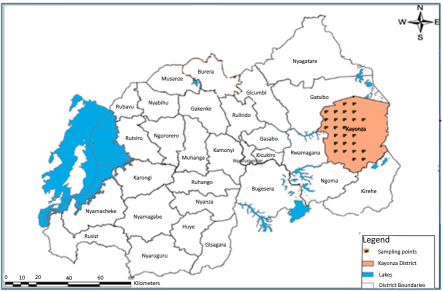
Figure 1. The study area in Rwanda showing the location of sampling points.
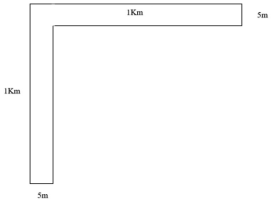
Figure 2. Transect band used as a sampling unit.
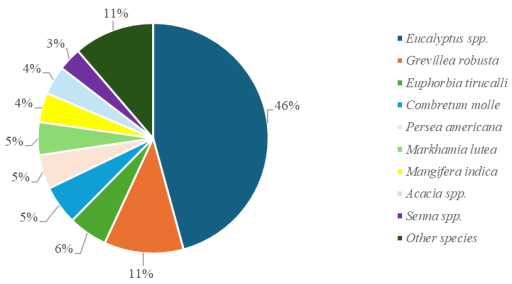
Figure 3. Dominant tree and shrub species inventoried in the no project intervention areas.
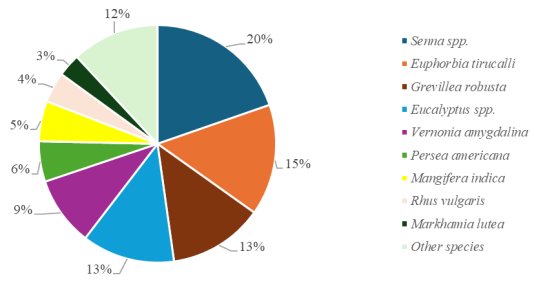
Figure 4. Dominant tree and shrub species inventoried in the project intervention areas.
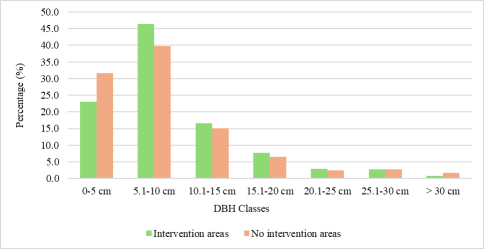
Figure 5. DBH classes distribution in intervention and no intervention zones.

Information


 Share This Article
 Twitter
 Linked In
 Facebook
 Copy
Copy Download