Abstract
This study examined the role of Artificial Intelligence (AI) in entrepreneurial decision-making, with a focus on the human–AI interface in startups and small businesses. As AI technologies become more embedded in entrepreneurial ecosystems, it is essential to understand how entrepreneurs interpret, adapt, and apply AI-driven insights alongside human judgment. Employing a mixed-methods approach of survey, the research explored how entrepreneurs integrate AI into strategic and operational decisions, as well as the perceived benefits and limitations of this integration. Findings indicated that AI enhances decision-making efficiency, provides predictive insights, and supports opportunity recognition, yet challenges remain in areas such as trust, contextual interpretation, and system accessibility for resource-constrained ventures. Entrepreneurs emphasized the need to balance machine-generated intelligence with human intuition and domain expertise to avoid over-reliance on automated systems. The study contributes to the growing literature on AI in entrepreneurship by highlighting the conditions under which human–AI collaboration is most effective. It further offers practical insights for entrepreneurs seeking to integrate AI tools, policymakers aiming to design supportive ecosystems, and developers building AI systems tailored to the realities of startups and small enterprises. Ultimately, the research underscored the importance of promoting a symbiotic relationship between human decision-makers and AI technologies to achieve sustainable entrepreneurial outcomes.
|
Published in
|
American Journal of Artificial Intelligence (Volume 10, Issue 1)
|
|
DOI
|
10.11648/j.ajai.20261001.24
|
|
Page(s)
|
158-171 |
|
Creative Commons
|

This is an Open Access article, distributed under the terms of the Creative Commons Attribution 4.0 International License (http://creativecommons.org/licenses/by/4.0/), which permits unrestricted use, distribution and reproduction in any medium or format, provided the original work is properly cited.
|
|
Copyright
|
Copyright © The Author(s), 2026. Published by Science Publishing Group
|
Keywords
Artificial Intelligence, Entrepreneurial Decision-Making, Human–AI Interface, Startups, Small Businesses
1. Introduction
Artificial Intelligence (AI) has long captured human imagination, with early notions of intelligent machines appearing in mythology and literature, but its scientific foundation was firmly established in the twentieth century. AI, in contemporary terms, refers to computer systems capable of performing tasks that ordinarily require human intelligence, such as learning, reasoning, problem-solving, and decision-making. Its two most influential branches, machine learning and deep learning, form the backbone of modern applications. Machine learning relies on algorithms that learn from data to improve performance over time, while deep learning employs multilayered neural networks capable of handling more complex, unstructured tasks such as image recognition and natural language processing
| [1] | Jarrahi, M. H., Lutz, C., & Newlands, G. (2022). Artificial intelligence, human intelligence and hybrid intelligence based on mutual augmentation. Big Data & Society, 9(2), 20539517221142824. |
[1]
.
Following cycles of progress and setbacks, AI has advanced significantly with the rise of big data, powerful computing, and breakthroughs in these learning techniques. These developments have transformed AI into a practical tool capable of analyzing vast datasets, solving complex problems, and augmenting human intelligence in real-world settings
| [2] | Kubatko, O. V., Ozims, S. C., & Voronenko, V. I. (2024). Influence of artificial intelligence on business decision-making. |
[2]
.
In contemporary business environments, AI has emerged as a transformative driver of efficiency, innovation, and competitive advantage. By integrating technologies such as predictive analytics, natural language processing, and robotics, AI enables organizations to optimize operations, reduce costs, and accelerate decision-making. For entrepreneurs, particularly in startups and small businesses, decision-making entails evaluating uncertain opportunities, managing scarce resources, and allocating efforts strategically. The infusion of AI tools into this process allows for data-driven insights that complement, rather than replace, the entrepreneur’s vision and intuition
| [3] | Obschonka, M., & Audretsch, D. B. (2020). Artificial intelligence and big data in entrepreneurship: A new era has begun. Small Business Economics, 55, 529-539. |
[3]
.
Despite these opportunities, challenges remain in embedding AI into entrepreneurial decision-making. Ethical concerns, data privacy risks, and potential biases in algorithmic outputs highlight the need for responsible integration. Moreover, while AI systems can generate insights with remarkable precision, they cannot replicate the tacit knowledge, contextual awareness, and creativity entrepreneurs bring to strategic choices. This dynamic underscores the importance of the human–AI interface, defined as the interactive space where human judgment and machine intelligence converge to shape outcomes
| [4] | Abdallah, R. M. D. J. A. (2020). The impact of entrepreneurial orientation on business performance: The moderating role of artificial intelligence (Master’s thesis, Princess Sumaya University for Technology, Jordan). |
[4]
.
Against this backdrop, this study investigated the role of AI in entrepreneurial decision-making, focusing on how startups and small businesses engage with the human–AI interface. By exploring both the benefits and the limitations of AI adoption in entrepreneurial contexts, it provides insights into how technology and human judgment can be balanced to foster innovation, resilience, and sustainable growth in emerging ventures
| [5] | Dhamija, P., & Bag, S. (2020). Role of artificial intelligence in the operations environment: A review and bibliometric analysis. The TQM Journal, 32(4), 869-896. |
[5]
.
2. Review of Relevant Literature
2.1. Historical Background
The historical development of Artificial Intelligence (AI) can be traced back to ancient times when human imagination envisioned intelligent machines through myths and stories. For instance, Greek mythology introduced Talos, a bronze automaton that could think and act independently, while later works like Mary Shelley's Frankenstein in 1818 explored the concept of human-created intelligence. However, the formal foundations of AI emerged in the 20th century, particularly with Alan Turing's groundbreaking contributions. In 1950, Turing proposed the Turing Test as a measure of machine intelligence, arguing that if a machine could mimic human conversation convincingly, it could be considered intelligent. Thus, AI as a formal field was established at the Dartmouth Conference in 1956, where John McCarthy coined the term "Artificial Intelligence" and, alongside pioneers like Marvin Minsky and Herbert Simon, envisioned machines capable of reasoning, learning, and problem-solving
| [6] | McCarthy, J., Minsky, M. L., Rochester, N., & Shannon, C. E. (2006). A proposal for the Dartmouth summer research project on artificial intelligence, August 31, 1955. AI Magazine, 27(4), 12-12. |
[6]
.
The 1960s and 1970s saw significant progress with developments like Shakey the Robot, the first machine to combine movement with reasoning, and the creation of expert systems designed to simulate human expertise in specific fields. However, limited computing power and challenges in handling real-world data led to the AI Winter in the mid-1970s, as funding and interest declined. AI experienced a revival in the 1980s with advancements in machine learning algorithms and renewed interest in expert systems, only to face another setback by the late 1980s due to their limitations. AI's ability to process unstructured data and solve complex problems has transformed industries, including healthcare, finance, and transportation
| [7] | Russell, S. J., & Norvig, P. (2016). Artificial intelligence: A modern approach. Pearson. |
[7]
. Today, AI continues to evolve, with advancements in Artificial General Intelligence (AGI) and an emphasis on ethical and responsible AI development. The rise of AI in decision-making processes has enabled businesses to harness data for efficiency, innovation, and predictive analytics. From its early conceptual roots to its current real-world applications, AI has reshaped how organizations operate and strategize.
Artificial intelligence (AI) and robotics are revolutionary technologies that are fundamentally transforming how businesses function. AI can be described as machine-driven, structured, and organized information that draws from human insights, including learning, reasoning, and self-correction. AI enables precise decision-making while saving time and reducing costs. Its capabilities include data analysis, forecasting, and identifying trends. Technologically, AI integrates elements like cloud computing, connected devices, robots, computers, and digital content with various business processes, systems, and daily operations. AI-driven advancements have thrived in the past and continue to shape the present, with significant implications for the future, particularly in marketing. Businesses are increasingly adopting AI software to enhance efficiency, reduce costs, expedite processes, and improve overall productivity. Organizations that incorporate AI tools will gain a competitive advantage as technology continues to evolve rapidly
| [8] | Brynjolfsson, E., & McAfee, A. (2017). The business of artificial intelligence. Harvard Business Review, 7(1), 1-2. |
[8]
.
The two primary categories of AI learning are machine learning and deep learning. Machine learning mimics human learning by accumulating experience and leveraging existing data to build knowledge. With each iteration, the learning process becomes more refined and effective. Machine learning focuses on recognizing patterns that serve as the foundation for algorithms, though it is often considered a basic form of AI. Deep learning, on the other hand, is a more advanced subset of machine learning. It involves building neural networks that enable AI to learn more complex tasks. Human intervention is often required in deep learning, as AI relies on examples to learn how to address intricate problems. This form of learning is used to develop sophisticated systems capable of solving multifaceted challenges
| [9] | Shan Wang, Fang Wang, Zhen Zhu, Jingxuan Wang, Tam Tran, Zhao Du, Artificial intelligence in education: A systematic literature review, Expert Systems with Applications, Volume 252, Part A, 2024, 124167,
https://doi.org/10.1016/j.eswa.2024.124167 |
[9]
.
Despite its transformative potential, integrating AI into organizational decision-making presents several challenges. Data privacy and security are significant concerns, as AI relies heavily on sensitive information. Ethical issues, such as the responsible and transparent use of AI, must be addressed to ensure that decisions align with societal norms and values
| [10] | Kamila MK, Jasrotia SS (2025), "Ethical issues in the development of artificial intelligence: recognizing the risks". International Journal of Ethics and Systems, Vol. 41 No. 1 pp. 45-63, https://doi.org/10.1108/IJOES-05-2023-0107 |
[10]
.
The adoption of AI in business decision-making holds the promise of revolutionizing operations and strategies. By improving efficiency, accuracy, and fostering innovation, AI empowers organizations to leverage data for well-informed decisions in a constantly changing and competitive environment. Nevertheless, businesses must navigate AI integration responsibly, balancing its use with considerations of ethics, data security, and workforce development. As AI technologies continue to advance, the future of decision-making will be redefined, driving significant change across industries
| [11] | Brynjolfsson, E. (2014). The second machine age: Work, progress, and prosperity in a time of brilliant technologies (Vol. 236). WW Norton & Company. |
[11]
.
Artificial Intelligence (AI) has become a critical driver of innovation and efficiency in the modern business environment. It refers to the development of computer systems and algorithms capable of performing tasks that typically require human intelligence, such as data analysis, learning, problem-solving, and decision-making. AI technologies include machine learning, predictive analytics, natural language processing, and robotics, among others.
In entrepreneurial decision-making, AI plays an increasingly significant role by providing tools that improve accuracy, speed, and strategic insights. Decision-making in entrepreneurship involves identifying opportunities, analyzing risks, and allocating resources to achieve business objectives. Traditionally, these processes have relied heavily on human judgment, intuition, and limited data analysis tools. However, with the rise of AI, entrepreneurs are now able to leverage data-driven decision-making, enhancing their ability to compete and thrive in dynamic markets. While AI has the capacity to process data and predict outcomes with remarkable precision, the human-AI interface remains critical in entrepreneurial decision-making. This interface represents the collaboration between human intuition and AI-generated insights. Entrepreneurs must interpret, validate, and contextualize AI outputs to align them with their business goals and external realities
| [12] | Davenport, T. H., & Mittal, N. (2022). How generative AI is changing creative work. Harvard Business Review, 14. |
[12]
.
2.2. Theoretical Review
Two pivotal theories developed to address the need for a balance between social and technical elements within organizations, and also explain how users come to accept and use new technologies are the Socio-Technical Systems Theory (STS) and Technology Acceptance Model (TAM), respectively. The Socio-Technical Systems Theory (STS), which was initially developed in the 1950s by Eric Trist, Ken Bamforth, and their colleagues at the Tavistock Institute in United Kingdom, arose from their research on coal mining in the UK, where they observed that the introduction of new technologies into the workplace often led to unforeseen social consequences, such as employee dissatisfaction and productivity issues. They argued that organizations are not just technical entities but also social systems, and the success of any system depends on optimizing both elements simultaneously
| [13] | Trist, E. L., & Bamforth, K. W. (2000). Some social and psychological consequences of the longwall method of coal-getting. Technology, Organizations and Innovation, 1, 79. |
[13]
.
The core idea of STS is that organizations must be understood and managed as a combination of social and technical systems. Social systems encompass human elements like employees, teams, organizational culture, and management, while technical systems refer to tools, processes, technology, and machinery. The theory emphasizes that both these systems must work in harmony to achieve optimal outcomes. One key concept in STS is "joint optimization," which means that both the social and technical components of a system should be designed and optimized together, rather than separately. This requires a holistic view of the organization, where both human behavior and technological capabilities are seen as interconnected and interdependent. For instance, when implementing AI or automation tools, it is not enough to simply ensure that the technology works well; the social aspects, such as employee training, job roles, and organizational culture, must be considered to ensure that employees can effectively interact with and benefit from the technology
| [14] | Wilson, H. J., & Daugherty, P. R. (2018). Collaborative intelligence: Humans and AI are joining forces. Harvard Business Review, 96(4), 114-123. |
[14]
.
Additionally, STS focuses on adaptability, recognizing that systems are not static but must evolve over time. As technology advances or social needs change, both the social and technical components of an organization must adapt
| [1] | Jarrahi, M. H., Lutz, C., & Newlands, G. (2022). Artificial intelligence, human intelligence and hybrid intelligence based on mutual augmentation. Big Data & Society, 9(2), 20539517221142824. |
[1]
. STS is also concerned with worker empowerment and the role of human agency in technical systems. It advocates for designing systems that allow employees to have input and control over how technology is integrated into their work, which helps mitigate resistance and promote greater engagement with new tools and processes
| [15] | Bailey, D. E., Leonardi, P. M., & Barley, S. R. (2012). The lure of the virtual. Organization Science, 23(5), 1485-1504. |
| [16] | Berente, N., Lyytinen, K., Yoo, Y., & King, J. L. (2016). Routines as shock absorbers during organizational transformation: Integration, control, and NASA’s enterprise information system. Organization Science, 27(3), 551-572. |
[15, 16]
. Over time, STS has been applied to various fields beyond manufacturing and industry, including healthcare, education, and, most recently, entrepreneurial settings, where technology like artificial intelligence plays an increasingly significant role. The theory continues to be relevant as businesses increasingly adopt AI and other advanced technologies, emphasizing the need to integrate these tools with human decision-making to achieve optimal results
| [17] | Shneiderman, B. (2022). Human-centered AI. Oxford University Press. |
| [18] | Raisch, S., & Krakowski, S. (2021). Artificial intelligence and management: The automation-augmentation paradox. Academy of Management Review, 46(1), 192-210. |
[17, 18]
.
In essence, STS provides a framework for understanding and managing the complexities of modern organizations, particularly in environments where both social dynamics and technology play a central role in shaping outcomes. It is this integrated approach that makes STS particularly valuable in understanding the relationship between humans and AI in entrepreneurial decision-making, as both elements must work together to foster innovation and drive business success
| [19] | Faraj, S., Pachidi, S., & Sayegh, K. (2018). Working and organizing in the age of the learning algorithm. Information and Organization, 28(1), 62-70. |
[19]
.
The Technology Acceptance Model (TAM), developed by Davis (1985), is another widely recognized theory that explains how users come to accept and use new technologies. TAM is built on the premise that Perceived Ease Of Use (PEOU) and Perceived Usefulness (PU) are the primary factors that influence technology adoption. According to TAM, if technology is perceived to be easy to use and useful in helping users achieve their goals, they are more likely to accept and integrate the technology into their routine activities
| [20] | Davis, F. D. (1985). A technology acceptance model for empirically testing new end-user information systems: Theory and results (Doctoral dissertation, Massachusetts Institute of Technology). |
[20]
. In TAM, Perceived Ease Of Use refers to the degree to which a person believes that using a particular system would be free from effort, while Perceived Usefulness refers to the degree to which a person believes that using the system would enhance their job performance or fulfill a need. These two variables directly affect the behavioral intention to use the technology, which in turn influences actual usage behavior. Over time, TAM has been expanded to include additional constructs, such as subjective norms and external variables, to better capture the complexity of technology acceptance in different contexts
| [21] | Venkatesh, V., & Davis, F. D. (2000). A theoretical extension of the technology acceptance model: Four longitudinal field studies. Management science, 46(2), 186-204. |
[21]
.
The simplicity and adaptability of TAM make it a versatile model for examining technology acceptance in various fields, including business, healthcare, and education. It is especially useful in understanding the factors that drive or inhibit the adoption of new technologies in organizational contexts
| [22] | Kalayou, M. H., Endehabtu, B. F., & Tilahun, B. (2020). The applicability of the modified technology acceptance model (TAM) on the sustainable adoption of eHealth systems in resource-limited settings. Journal of Multidisciplinary Healthcare, 1827-1837. |
[22]
. The Technology Acceptance Model (TAM) is highly relevant to the study of Artificial Intelligence (AI) in entrepreneurial decision-making. As AI tools become more prevalent in the business world, understanding how entrepreneurs and their teams perceive and adopt these technologies is critical for successful implementation. In the context of small businesses and startups, TAM can provide valuable insights into the factors that influence entrepreneurs' willingness to incorporate AI into their decision-making processes
| [3] | Obschonka, M., & Audretsch, D. B. (2020). Artificial intelligence and big data in entrepreneurship: A new era has begun. Small Business Economics, 55, 529-539. |
[3]
.
Another critical theory, which integrates several models of technology acceptance, is the Unified Theory of Acceptance and Use of Technology (UTAUT) proposed by Venkatesh, Morris, Davis, and Davis in 2003. This theory integrates the Technology Acceptance Model (TAM), the Theory of Planned Behavior (TPB), and the Innovation Diffusion Theory (IDT), among others. UTAUT aims to provide a unified framework for understanding the factors that influence user acceptance of technology. The theory identifies four key constructs that directly impact technology acceptance and use: performance expectancy, effort expectancy, social influence, and facilitating conditions. In addition to these core constructs, UTAUT also incorporates moderators such as age, gender, experience, and voluntariness of use, which can influence the relationships between the constructs and technology acceptance. UTAUT has been widely used across different sectors to study technology adoption and use, and its comprehensive nature allows it to address various factors influencing acceptance across different contexts
| [23] | Venkatesh et al (2003) user acceptance of information Technology: Towards a unified view (ATAUT). MIS Quarterly. 27(3), 425-478. |
[23]
.
The Unified Theory of Acceptance and Use of Technology (UTAUT) provide a robust framework for understanding the factors influencing AI adoption in entrepreneurial decision-making. As AI technologies are increasingly integrated into small businesses and startups, the UTAUT framework offers insights into how entrepreneurs and their teams perceive, accept, and ultimately use AI systems to enhance business decisions
| [24] | Williams, M. D., Rana, N. P., & Dwivedi, Y. K. (2015). The unified theory of acceptance and use of technology (UTAUT): A literature review. Journal of Enterprise Information Management, 28(3), 443-488. |
[24]
. Additionally, UTAUT acknowledges that moderators like age, gender, and experience can influence the acceptance of AI. For instance, younger entrepreneurs may be more inclined to adopt new technologies such as AI, as they are generally more comfortable with digital tools. Similarly, entrepreneurs with prior experience in using technology may have higher confidence in adopting AI solutions
| [25] | Yawised, K., Apasrawirote, D., Chatrangsan, M., & Muneesawang, P. (2022). Factors affecting SMEs’ intention to adopt a mobile travel application based on the unified theory of acceptance and use of technology (UTAUT-2). Emerging Science Journal, 4, 207-224. |
[25]
.
In essence, the Unified Theory of Acceptance and Use of Technology (UTAUT) offer a comprehensive framework for understanding the factors that drive AI adoption in entrepreneurial decision-making. By focusing on performance expectancy, effort expectancy, social influence, and facilitating conditions, entrepreneurs and business leaders can identify the key drivers of AI adoption and tailor their strategies to encourage acceptance. Ensuring that AI tools are perceived as useful, easy to use, socially endorsed, and supported by adequate resources can significantly enhance the likelihood of successful AI integration, leading to better decision-making and improved business outcomes
| [26] | Wamba S. F, M. M. Wu, Land Sivaraja. U. 2020). Big data analytics and firm performance, Journal of Business Research 112, 107-118. |
[26]
.
2.3. Empirical Review
The empirical review explores existing research that examines the role of Artificial Intelligence (AI) in shaping decision-making processes in startups and small businesses. Over the years, AI technologies have become pivotal in entrepreneurship, assisting in data analysis, predicting trends, enhancing customer engagement, and streamlining operations. Despite the promises, the adoption of AI in entrepreneurial decision-making is influenced by various factors, including resource availability, knowledge of AI, and the readiness of entrepreneurs to integrate AI tools into their strategies
| [27] | Feng, J., Han, P., Zheng, W., & Kamran, A. (2022). Identifying the factors affecting strategic decision-making ability to boost entrepreneurial performance: A hybrid structural equation modeling-artificial neural network approach. Frontiers in Psychology, 13, 1038604. |
[27]
.
AI is a product of entrepreneurship and continues to promote entrepreneurial activities. It is very germane for entrepreneurship as it acts as a “catalyst” and "leveler" for small businesses. It enables them shrink costs, computerize routine tasks, and favorably compete with bigger businesses. For instance, by providing custom-made customer experiences and data-driven insights, AI accelerates streamlines operations, decision-making, and fosters innovation in product design and marketing. The caveat, however, is that despite its significant advantages, AI is not a replacement for human judgment.
Entrepreneurial decision-making is often complex, uncertain, and time-sensitive, especially in startups and small businesses where resources are limited, and mistakes can be costly. Even though the adoption of Artificial Intelligence (AI) in business has received increasing scholarly and practical attention, the majority of research focuses on large corporations with substantial resources and established infrastructures. Startups and small businesses, by contrast, operate in environments characterized by uncertainty, resource scarcity, and heightened vulnerability to market shifts. These firms often lack the technical expertise, financial capacity, and institutional support to fully harness AI’s potential, creating a fundamental tension between the promise of AI and the practical realities of entrepreneurial practice
| [28] | Abuzaid, A. N., & Alsbou, M. K. K. (2024, April). AI and Entrepreneurship: Enablers, Obstacles, and Startups’ Role in Shaping the Future Economy. In 2024 International Conference on Knowledge Engineering and Communication Systems (ICKECS) (Vol. 1, pp. 1-6). IEEE. |
[28]
.
Furthermore, existing studies have largely examined AI as a technological tool rather than as part of an interactive system involving human cognition, judgment, and intuition. This limited view neglects the complex human–AI interface, where entrepreneurial decisions are not merely the outcome of algorithmic recommendations but the result of dynamic interpretation, contextualization, and human sense-making. Consequently, there remains a lack of empirical evidence on how entrepreneurs in startups and small enterprises integrate AI into their decision-making, how they navigate challenges such as trust, bias, and interpretability, and how they balance machine intelligence with experiential knowledge
| [29] | Lee, B., Kim, B., & Ivan, U. V. (2023). Enhancing the competitiveness of AI technology-based startups in the digital era. Administrative Sciences, 14(1), 6. |
[29]
.
This gap in knowledge poses both theoretical and practical problems. Theoretically, it limits our understanding of how human–AI collaboration shapes entrepreneurial processes and outcomes. Practically, it constrains the ability of entrepreneurs, policymakers, and AI developers to design systems and strategies that meet the distinct needs of startups and small firms. Addressing this problem is therefore essential for advancing research on AI in entrepreneurship and for enabling smaller enterprises to effectively leverage AI in ways that enhance innovation, competitiveness, and sustainability.
2.4. Conceptual Framework
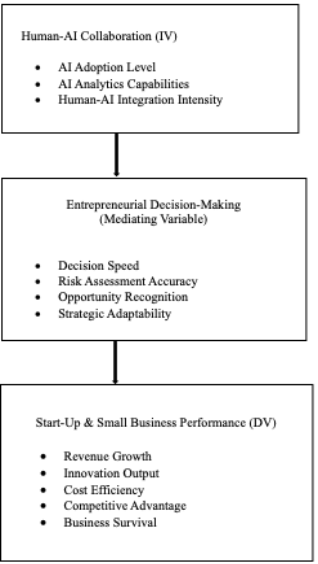
The conceptual framework in
Figure 1 explains how Human–AI collaboration, which acts as an Independent Variable (IV) influences entrepreneurial start-ups and small business performance, herein known as the Dependent Variable (DV) through entrepreneurial decision-making, which acts as the Mediating Variable (MV). In this framework, human entrepreneurs adopt artificial intelligence tools to improve business decisions making. Improved decisions then enhance organizational performance with respect to innovation, profitability, competitiveness and efficiency. In essence, the link between the variables is such that human-AI collaboration does not only enhance the speed, quality, and accuracy of entrepreneurial decisions but also leads to effective entrepreneurial decision making. For instance, AI techniques analyze large datasets which are often very difficult if processed manually. Then, entrepreneurs easily interpret these insights and employ strategic judgment. Oftentimes, human–AI collaborations do not influence business performances directly; instead, their effects occur through effective entrepreneurial decision-making. Moreover, this framework aligns with theories like Resource-Based View (RBV), which states that AI technology is a strategic resource that improves firm proficiencies; Decision Support Theory (DST) which posits that AI operates as a decision support system that improves managerial decision quality; and Human–Machine Complementarity Theory (HMCT) which affirms that humans and AI achieve optimally when their strengths are merged.
Figure 1. Conceptual Framework on the link between Human–AI collaboration, entrepreneurial decision-making, and business performance.
This study, therefore, assesses the role of Artificial Intelligence (AI) in the decision-making processes of small businesses with the intention of providing a deeper understanding of the human–AI interface and highlight its implications for innovation, resilience, and sustainable growth in entrepreneurial contexts. To achieve this aim, three specific objectives were drawn. Firstly, by exploring how small businesses perceive the role of AI in their decision-making processes. Secondly, by identifying the challenges that small businesses face in adopting AI technologies. And thirdly, by examining how small businesses integrate AI insights with human judgment in both strategic and operational decisions.
3. Methodology
This study adopted a mixed-methods design to investigate the role of Artificial Intelligence (AI) in entrepreneurial decision-making among startups and small businesses. The choice of context was informed by the increasing adoption of innovative tools such as AI within small enterprises that operate in dynamic and resource-constrained environments in Osun State, Nigeria. Ile-Ife in Osun state, the popularly acclaimed cradle of mankind, is a town known for its cultural heritage as well as the home of the renowned Obafemi Awolowo University where many startups and small enterprises exist. Some of the entrepreneurs, managers, and business owners have embraced the advent of AI while some are engaging it with mixed feelings. Hence, the need to explore the role of AI in entrepreneurial decision-making among SMEs in Ile-Ife, and precisely in Obafemi Awolowo University. The university community has a business hub where a couple of students, staff and people from Ile-Ife township come to operate business activities.
The study population consisted of entrepreneurs, business owners, and managers who had direct experience with AI applications in their business operations, particularly in areas such as marketing, finance, and operations. Due to time and financial constraints, a sample of 50 respondents was drawn purposively from the estimated population of 185 businesses in the hub. Samples were drawn from diverse industries, including retail, services, manufacturing, and technology, to ensure representation and capture a broad range of perspectives. Stratification by sector was applied to achieve balance across the major categories of entrepreneurial activity.
A structured questionnaire served as the primary data collection instrument, designed to elicit information on respondents’ perceptions, challenges, and integration strategies regarding AI in decision-making. The questionnaire was carefully designed, and pre-tested among a micro group of entrepreneurs to ensure clarity and reliability of items. After adjustments, the finalized instrument was distributed in person to the targeted respondents. Cronbach’s alpha was used to measure the reliability of the questionnaire, and to ensure validity, the questionnaire was reviewed by experts in AI and entrepreneurship research. Feedback was incorporated to refine the instruments, ensuring they adequately addressed the research objectives before being finally distributed. The collection process was completed within four weeks, after which responses were collated, coded, and entered into statistical software for analysis. This process ensured accuracy, consistency, and alignment with the study’s objectives. The instrument also captured demographic details and contextual information relevant to AI adoption in small enterprises.
Data analysis combined both quantitative and qualitative approaches. Descriptive statistics such as frequencies, percentages, and mean scores were employed to summarize responses, while thematic insights were drawn from open-ended items to enrich the interpretation. The results were presented in tables and narratives, directly addressing the study objectives and offering actionable insights into the human–AI interface in entrepreneurial practice.
The study employed a semi-structured questionnaire as the primary instrument for data collection. The questionnaire was partly open-ended, designed to generate both qualitative and quantitative data on entrepreneurs’ perceptions of AI, challenges of adoption, and approaches to decision-making. The instrument was divided into sections that captured demographic information, AI utilization patterns, and the human–AI interface in entrepreneurial processes.
The questionnaires were distributed physically among the sampled entrepreneurs and small business owners. Respondents were given clear instructions, and participation was voluntary, with assurances of confidentiality. The collected data were analyzed using descriptive statistics such as frequencies, percentages, and mean scores. Results were presented in tables for clarity and the statistical approach ensured that the study objectives were addressed systematically, highlighting how AI is perceived, adopted, and integrated into decision-making by small businesses.
4. Research Findings
This section presents the findings of the study on the role of Artificial Intelligence (AI) in entrepreneurial decision-making among startups and small businesses. The analysis is structured around the research objectives and the results are derived from descriptive statistical analysis of the responses collected.
4.1. Demographic Profile of Respondents
The demographic distribution and nature of business are presented in
Tables 1 and 2 with a total of 50 valid responses analyzed. 58% represents male respondents while 42% represents female respondents with a frequency of 29 and 21 respectively. For the age distribution, 46% represents the age between 18 – 25, 30% represents 26 – 35, 14% represents 36 – 45, 10% represents 45 and above. This confirms a generational divide, with younger business owners more likely to integrate AI into operations.
From
Table 2, for business type, 40% represents technology firms, 20% represents services, 22% represents retail and 18% represents manufacturing with the frequency of 20, 10, 11 and 9 respectively. For business maturity, 24% represents the age of 7 years, 62% represents the age of 1 – 6 years while 14% represents less than a year with the frequency of 12, 31, 7 respectively.
All respondents (100%) reported using AI tools. The primary applications were customer service (38%) and marketing (28%), while finance (12%), forecasting (12%), and inventory management (10%) accounted for smaller shares. This indicates entrepreneurs primarily leverage AI for customer-facing functions rather than back-office optimization.
Table 1. Demographic profile of Respondents.
Demographic Profile of Respondents |
Gender | Frequency | Percentage (%) |
Male | 29 | 58 |
Female | 21 | 42 |
Total | 50 | 100 |
Age Distribution | | |
18 – 25 | 23 | 46 |
26 – 35 | 15 | 30 |
36 – 45 | 7 | 14 |
45 and above | 5 | 10 |
Total | 50 | 100 |
Source: Authors’ Field work.
Table 2. The nature of the business.
Business Type | Frequency | Percentage |
Technology firms | 20 | 40 |
Services | 10 | 20 |
Retail | 11 | 22 |
Manufacturing | 9 | 18 |
Total | 50 | 100 |
Business Maturity | Frequency | Percentage |
7 years | 12 | 24 |
1 – 6 years | 31 | 62 |
< 1 year | 7 | 14 |
Total | 50 | 100 |
Source: Authors’ Field work.
4.2. Thematic Insights
On thematic insights, when asked how respondents perceive the role of Artificial Intelligence (AI) in decision-making in their businesses. The following statements reflected high levels of consensus and minimal variation in opinions.
“I believe AI improves the quality of business decision-making. AI helps reduce human errors in decision-making and it is essential for staying competitive in today’s business environment”.
Thus, addressing the first objective of exploring how small businesses perceive the role of AI in their decision-making processes,
Table 3 reflects the respondents’ views on the role of Artificial Intelligence in their decision-making processes. A notable majority agreed that AI improves the quality of decision making, with 62% agreeing and 38% strongly agreeing. This response suggests that small business owners view AI as a valuable tool capable of enhancing the accuracy, efficiency, and effectiveness of business decisions. There was no indication of disagreement or neutrality, highlighting widespread acceptance of AI’s role in elevating decision standards.
Similarly, 86% of respondents acknowledged that AI helps reduce human errors in decision-making, with 66% agreeing and 20% strongly agreeing. However, 14% of the respondents disagreed, indicating that while most small business owners believe AI contributes to minimizing mistakes typically caused by human oversight, a few remain skeptical—possibly due to a lack of familiarity with AI or concerns about its dependability. The view that AI is essential for staying competitive in today’s business environment was also strongly supported. All respondents (100%) agreed with the statement, with 60% agreeing and 40% strongly agreeing. This overwhelming agreement underscores the belief among small business owners that AI has become a strategic necessity in maintaining relevance and competitive advantage in a rapidly evolving market.
However, opinions were more divided on the issue of trust. While 66% of respondents expressed confidence in AI as a trustworthy tool for business decision-making (48% agree, 18% strongly agree), 34% disagreed. This reveals a degree of hesitation, likely stemming from concerns about the transparency and reliability of AI systems. Some business owners may still prefer to rely on human judgment, especially when the reasoning behind AI recommendations is unclear. Overall, the findings indicate that small businesses generally perceive AI positively, especially regarding their ability to improve decision-making and competitiveness. Nonetheless, some concerns remain, particularly about the trustworthiness and interpretability of AI tools in the decision-making process.
Table 3. Frequency Distribution of Respondents on the Perception of AI in Decision Making.
| Strongly Disagree | Disagree | Neutral | Strongly Agree | Agree |
I believe AI improves the quality of business decision-making. | 0% | 0% | 0% | 38.0% | 62.0% |
AI helps reduce human errors in decision-making. | 0% | 14% | 0% | 20% | 66.0% |
AI is essential for staying competitive in today’s business environment. | 0% | 0% | 0% | 40% | 60% |
I consider AI to be a trustworthy tool for business decision-making. | 0% | 34% | 0% | 18% | 48.0% |
Source: Authors’ Field work.
Table 4 presents a deeper understanding of how respondents perceive the role of Artificial Intelligence (AI) in decision-making within small businesses. For the statement
“I believe AI improves the quality of business decision-making,” the responses ranged from a minimum of 4 to a maximum of 5, with a mean of 4.38 and a standard deviation of 0.49. This suggests that all respondents agreed or strongly agreed with the statement, showing a high level of consensus and minimal variation in opinions. Regarding the statement
“AI helps reduce human errors in decision-making,” responses spanned from 2 (disagree) to 5 (agree/strongly agree), with a mean of 3.92 and a standard deviation of 0.88. This wider range, along with the higher standard deviation, indicates more diverse opinions among respondents. While the average view still leans toward agreement, some respondents expressed skepticism or uncertainty about AI’s effectiveness in reducing human errors.
For the statement “AI is essential for staying competitive in today’s business environment,” the minimum and maximum values were 4 and 5 respectively, resulting in a mean of 4.4 and a low standard deviation of 0.49. This shows that all respondents either agreed or strongly agreed with the statement, reflecting a strong and consistent belief that AI is crucial for competitiveness in the current business climate. The statement “I consider AI to be a trustworthy tool for business decision-making” recorded responses ranging from 2 to 5, with a mean of 3.5 and a relatively high standard deviation of 1.15. This indicates a broader spread of opinions, with some respondents disagreeing while others agreed or strongly agreed. The lower mean and higher variability suggest that while a majority may lean toward trusting AI, concerns about its reliability or transparency persist among a significant portion of the respondents.
Overall, the minimum and maximum values help reveal the spread of opinion on each item, while the mean and standard deviation further clarify the degree of agreement and consistency among the participants. These results confirm a generally favorable view of AI in business decision-making, albeit with varying levels of confidence depending on the specific aspect considered.
Table 4. Descriptive Statistics of Distribution of Respondents on the Perception of AI in Decision Making.
Statement | N | Minimum | Maximum | Mean | Std. Deviation |
I believe AI improves the quality of business decision-making. | 50 | 4 | 5 | 4.38 | 0.49031 |
AI helps reduce human errors in decision-making. | 50 | 2 | 5 | 3.92 | 0.87691 |
AI is essential for staying competitive in today’s business environment. | 50 | 4 | 5 | 4.4 | 0.49487 |
I consider AI to be a trustworthy tool for business decision-making. | 50 | 2 | 5 | 3.5 | 1.14731 |
Source: Authors’ Field work.
Addressing the second objective of identifying the challenges faced by small businesses in adopting AI technologies for decision-making,
Table 5 presents the respondents’ frequency distribution. Most respondents (90%) agreed that the cost of acquiring AI tools is high for small businesses, with 46% agreeing and 44% strongly agreeing. Only 10% disagreed with this view. This indicates that financial constraints remain one of the most significant barriers to AI adoption, especially for startups and small enterprises operating with limited budgets. Similarly, technical expertise emerged as another major challenge. While 46% agreed and 32% strongly agreed that their businesses lack the technical expertise to use AI effectively, 22% disagreed. This suggests that although most small business owners recognize a skills gap, a minority may have access to internal or external support that mitigates this challenge. Nonetheless, the majority view points to a broader need for technical training and capacity building among SMEs.
Resistance to change within the organization also appears to be a notable issue. A combined 90% of respondents agreed or strongly agreed that there is resistance among staff to adopt AI technologies, with 58% agreeing and 32% strongly agreeing. Only 10% disagreed. This reflects possible apprehension about job displacement, unfamiliarity with AI systems, or reluctance to move away from traditional methods, all of which could hinder smooth integration of AI solutions. Concerns about data privacy and associated risks were also widely shared, with 100% of respondents expressing agreement (66% agree and 34% strongly agree). This unanimous concern highlights the importance of ethical considerations and the need for robust data governance frameworks when implementing AI in business operations.
Further, inadequate external support was also perceived as a challenge, as 80% of respondents agreed or strongly agreed that there is a lack of assistance such as training, funding, or government incentives to support AI adoption. Specifically, 50% agreed and 30% strongly agreed, while 20% disagreed. This finding suggests that the broader ecosystem surrounding small businesses may not yet be fully supportive of digital transformation efforts, leaving many entrepreneurs without the resources or guidance needed to effectively deploy AI technologies. Overall, the data reveals that small businesses face both internal and external barriers to AI adoption including cost, limited expertise, staff resistance, privacy concerns, and insufficient support infrastructure. These challenges must be addressed for small businesses to harness the full potential of AI in decision-making.
Table 5. Frequency Distribution of Respondents on the Challenges in Adopting AI.
| Strongly Disagree | Disagree | Neutral | Strongly Agree | Agree |
The cost of acquiring AI tools is high for small businesses like mine. | 0% | 10.0% | 0% | 44.0% | 46.0% |
My business lacks the technical expertise to use AI effectively. | 0% | 22.0% | 0% | 32.0% | 46.0% |
There is resistance among staff to adopt AI technologies. | 0% | 10.0% | 0% | 32.0% | 58.0% |
I am concerned about data privacy and AI-related risks. | 0% | 0% | 0% | 34.0% | 66.0% |
There is inadequate external support (e.g., training, funding) for small businesses adopting AI. | 0% | 20.0% | 0% | 30.0% | 50.0% |
Source: Authors’ Field work.
Table 6 provides another descriptive statistics insight on the extent to which small businesses perceive various challenges in adopting Artificial Intelligence (AI) technologies for decision-making. The statement
“The cost of acquiring AI tools is high for small businesses like mine” recorded a mean score of 3.88, with responses ranging from a minimum of 2 (disagree) to a maximum of 5 (strongly agree), and a standard deviation of 1.10. This indicates a generally high level of agreement, although the relatively widespread suggests that cost perceptions vary among respondents, possibly due to differences in business size, sector, or exposure to AI. For the statement
“My business lacks the technical expertise to use AI effectively,” the mean score was 4.12, with a standard deviation of 0.85 and a range between 2 and 5. This reflects strong overall agreement with less variability, suggesting that most small business owners acknowledge a technical knowledge gap as a key obstacle in implementing AI.
The statement “There is resistance among staff to adopt AI technologies” had the highest mean score of 4.34 and the smallest standard deviation of 0.48, with responses confined to the 4–5 range. This tight clustering indicates almost unanimous agreement that internal resistance likely stemming from fear of change, job insecurity, or lack of awareness is a significant challenge in the adoption of AI within small businesses. Concerning the statement “I am concerned about data privacy and AI-related risks,” responses also ranged from 2 to 5, with a mean of 3.9 and a standard deviation of 1.05. While the average response reflects concern, the standard deviation indicates a moderate level of disagreement or uncertainty among some respondents, which may be due to varying levels of awareness about data protection issues or industry-specific regulatory exposure.
Finally, the statement “There is inadequate external support (e.g., training, funding) for small businesses adopting AI” had a mean of 4.10 and the highest standard deviation of 1.14, with values ranging from 2 to 5. Although the average suggests strong agreement, the widespread implies that while many respondents feel unsupported, others may have access to better resources, partnerships, or external programs that mitigate this challenge. The descriptive statistics reinforce the earlier frequency findings by showing that small businesses face a combination of financial, technical, organizational, and infrastructural challenges when it comes to AI adoption. The variations in response also point to uneven levels of readiness and access across different business contexts.
Table 6. Descriptive Statistics of Distribution of Respondents on the Challenges in Adopting AI.
Statement | N | Minimum | Maximum | Mean | Std. Deviation |
The cost of acquiring AI tools is high for small businesses like mine. | 50 | 2 | 5 | 3.88 | 1.09991 |
My business lacks the technical expertise to use AI effectively. | 50 | 2 | 5 | 4.12 | 0.84853 |
There is resistance among staff to adopt AI technologies. | 50 | 4 | 5 | 4.34 | 0.47852 |
I am concerned about data privacy and AI-related risks. | 50 | 2 | 5 | 3.9 | 1.05463 |
There is inadequate external support (e.g., training, funding) for small businesses adopting AI. | 50 | 2 | 5 | 4.10 | 1.1400 |
Source: Authors’ Field work.
For the third objective,
Table 7 presents the frequency distributions on how small businesses integrate AI insights with human judgment in their decision-making processes.
In
Table 7, the responses provide insight into how small businesses manage the interaction between AI insights and human judgment in their decision-making processes. A combined 84% of respondents (54% agree, 30% strongly agree) indicated that their businesses combine AI insights with human expertise, while 16% disagreed. This suggests that most small business owners do not rely on AI in isolation but integrate its insights with human knowledge, experience, and contextual understanding to inform their decisions.
Regarding the statement “AI supports but does not replace human decision-making in my business,” 46% agreed and 8% strongly agreed, showing that more than half of the respondents see AI as a supplementary tool rather than a substitute for human involvement. However, 38% disagreed, which may indicate that in some businesses, there is either limited use of AI or concern that AI is encroaching on tasks traditionally managed by humans. This reflects a mixed view on the balance of control between AI systems and human actors.
On the issue of training, 64% of respondents agreed that employees are trained to interpret AI-generated insights, while 18% disagreed and another 18% strongly disagreed. The lack of neutral responses suggests polarized opinions while some businesses are actively equipping their staff to engage with AI tools, others may lack the resources or awareness to do so. This gap in training may affect how effectively businesses can utilize AI outputs in their daily operations.
The statement “There is a clear boundary between AI tasks and human responsibilities” was supported by 66% of respondents, though 18% disagreed and 16% strongly disagreed. This result implies that while many small businesses maintain structured roles for AI and human decision-makers, a notable minority may experience overlaps or ambiguity in how tasks are assigned and executed.
Finally, when asked whether “AI tools enhance my own intuition and strategic thinking as a business owner,” 72% agreed or strongly agreed (38% agree, 34% strongly agree), whereas 28% disagreed. This indicates that for most small business owners, AI serves not only as a support system but also as a cognitive enhancer, helping them sharpen their decision-making capacity. However, the dissenting views may reflect uncertainty about how to interpret AI insights or skepticism about the value AI adds to strategic thinking.
The findings suggest that most small businesses see AI as a collaborative partner in decision-making rather than a replacement for human input. However, variation in staff training, role clarity, and confidence in AI-enhanced decision-making points to the need for better integration strategies and education to ensure AI is used effectively and responsibly in the entrepreneurial context.
Table 7. Frequency Distribution of Respondents on how small businesses integrate AI insights with human judgment in their decision-making processes.
Statement | Strongly Disagree | Disagree | Neutral | Strongly Agree | Agree |
My business combines AI insights with human expertise in making decisions. | 0% | 16.0% | 0% | 30.0% | 54.0% |
AI supports but does not replace human decision-making in my business. | 0% | 38.0% | 0% | 8.0% | 46.0% |
Employees are trained to interpret AI-generated insights. | 18.0% | 18.0% | 0% | 0% | 64.0% |
There is a clear boundary between AI tasks and human responsibilities. | 16.0% | 18.0% | 0% | 0% | 66.0% |
AI tools enhance my own intuition and strategic thinking as a business owner. | 0% | 28.0% | 0% | 34.0% | 38.0% |
Source: Authors’ Field work.
In
Table 8, descriptive statistics shed light on how small businesses integrate Artificial Intelligence (AI) insights with human judgment in their decision-making processes. The statement
“My business combines AI insights with human expertise in making decisions” had a mean score of 3.98, with responses ranging from a minimum of 2 (disagree) to a maximum of 5 (strongly agree), and a standard deviation of 0.98. This indicates that most respondents agree that AI and human insight are jointly used, with relatively low variability in responses. For the statement
“AI supports but does not replace human decision-making in my business,” the mean was lower at 3.08, with a minimum of 1 (strongly disagree) and a maximum of 5, and a higher standard deviation of 1.23. This reflects a wider spread of opinions and suggests that some businesses may either rely more heavily on AI than others or experience confusion about AI’s role, leading to inconsistent integration practices.
The statement “Employees are trained to interpret AI-generated insights” had a mean score of 3.10, with responses ranging from 1 to 4 and a standard deviation of 1.25. The relatively low mean, along with the widespread, suggests that employee training in AI interpretation is inconsistent across businesses; some have made efforts in this area, while others have not prioritized it.
Regarding the statement “There is a clear boundary between AI tasks and human responsibilities,” the mean was 3.16, with a minimum of 1 and a maximum of 4, and a standard deviation of 1.22. This shows moderate agreement but also highlights that role clarity between AI and human responsibilities is not firmly established in all businesses, possibly due to a lack of defined workflows or understanding of AI capabilities.
Lastly, the statement “AI tools enhance my own intuition and strategic thinking as a business owner” recorded a mean of 3.78, with a minimum of 2 and maximum of 5, and a standard deviation of 1.20. This indicates that most business owners feel AI contributes positively to their decision-making capacity, although some variation exists in the extent to which they perceive this benefit. The results suggest that while small businesses generally aim to integrate AI with human judgment, inconsistencies remain in terms of training, clarity of roles, and understanding of AI's supportive function. The moderate-to-high standard deviations across several items further indicate differing levels of adoption and maturity in human-AI collaboration practices.
Table 8. Descriptive Statistics of Distribution of Respondents on how small businesses integrate AI insights with human judgment in their decision-making processes.
Statement | N | Minimum | Maximum | Mean | Std. Deviation |
My business combines AI insights with human expertise in making decisions. | 50 | 2 | 5 | 3.98 | 0.97917 |
AI supports but does not replace human decision-making in my business. | 50 | 1 | 5 | 3.08 | 1.22624 |
Employees are trained to interpret AI-generated insights. | 50 | 1 | 4 | 3.1 | 1.24949 |
There is a clear boundary between AI tasks and human responsibilities | 50 | 1 | 4 | 3.16 | 1.21823 |
AI tools enhance my own intuition and strategic thinking as a business owner. | 50 | 2 | 5 | 3.78 | 1.20017 |
Source: Authors’ Field work.
Overall, the findings reinforce that small businesses regard AI as a collaborative partner in decision-making rather than a substitute for human judgment. However, disparities in staff training, clarity of roles, and confidence in AI suggest the need for improved integration frameworks and educational initiatives to maximize AI’s value in entrepreneurial practice.
5. Discussion of Findings
This study examined how small businesses perceive the role of AI in their decision-making processes. Secondly, it identified the challenges that small businesses face in adopting AI technologies. And thirdly, it examined how small businesses integrate AI insights with human judgment in both strategic and operational decisions.
The findings of the set objectives are as discussed below:
5.1. Perception AI Adoption and Entrepreneurial Perceptions
Beyond the general agreement on the role of AI in enhancing decision-making, the results revealed several nuanced patterns. Sectoral differences emerged, with respondents in service-oriented businesses reporting more immediate benefits in customer engagement and market opportunity identification, while those in retail and manufacturing were more cautious, citing implementation costs and infrastructural needs as barriers.
Business size also appeared to influence adoption levels. Micro-enterprises expressed greater difficulty in integrating AI tools, often perceiving them as complex and resource-intensive, whereas slightly larger small businesses demonstrated more structured investment in AI and reported higher levels of efficiency gains. This is in line with the idea of
| [30] | Kirzner, I. (1973). Competition and entrepreneurship. University of Chicago Press. |
[30]
whose theory was on entrepreneurial alertness with the core idea in that entrepreneurs differ in their ability to notice opportunities and recognition of market gaps. The connection of AI here was that it enhances alertness by identifying hidden patterns and emerging trends.
The frequency of AI usage varied considerably. While a subset of respondents indicated daily or routine reliance on AI for decision support and operational functions, others reported using AI sporadically, suggesting that for many businesses, AI remains in an exploratory rather than fully integrated phase.
Interestingly, optimism about the future potential of AI was strong even among those with current limitations. Many respondents indicated plans to expand AI use over the next three to five years, often linking such aspirations to anticipated access to affordable tools and training. However, confidence levels were not uniform across decision areas: entrepreneurs tended to trust AI in data-intensive processes such as forecasting and trend analysis but were more hesitant to rely on it in relational or creative aspects of their businesses. Meanwhile, the theory of Planned Behaviour proposed by
| [31] | Ajzen, I. (1991). The theory of planned behavior. Organizational Behavior and Human Decision Processes, 50(2), 179-211. |
[31]
constructed attitudes towards behaviour, subjective norms, and received behavioural control. By implications, entrepreneurs adopt AI when they have positive attitudes toward technology, they fell capable of implementation and industry norms support digital transformation.
A pattern of strategic investment also emerged, with some respondents already allocating budgets for AI-related upgrades, including training programs and software maintenance. Nevertheless, the findings also highlighted notable awareness gaps, as a portion of respondents associated AI solely with automation functions and demonstrated limited knowledge of its broader applications in analytics, strategic planning, or customer experience.
5.2. Implications of the Study
The findings of this study carry several important implications for practice, policy, and future research.
For entrepreneurs and small business owners, the results highlight the need to view AI not as a replacement for human expertise but as a complementary tool that strengthens decision-making. The selective confidence entrepreneurs expressed in AI use indicates that training programs should focus on practical, context-specific applications rather than abstract technical knowledge. Furthermore, the varying adoption levels between micro-enterprises and larger small businesses suggest that AI integration strategies should be tailored to business size and sector.
The persistent barriers identified, particularly cost, technical expertise, and data privacy concerns, underscore the importance of policy interventions. Subsidized training initiatives, affordable AI infrastructure, and regulatory frameworks that safeguard data without creating additional burdens can help bridge the digital divide. Policymakers should also encourage partnerships between technology providers and small businesses to accelerate accessible adoption pathways.
The study contributes to the growing discourse on the human-AI interface in entrepreneurial decision-making. By demonstrating that entrepreneurs rely on AI alongside human judgment, the findings reinforce hybrid decision-making models that integrate technology with experiential insight. This underscores the need for future research to explore conditions under which human intuition and AI-generated outputs interact most effectively.
The optimism expressed by respondents regarding AI’s future potential suggests that entrepreneurship ecosystems must prepare for rapid shifts in business models. Institutions that support entrepreneurs, such as incubators, accelerators, and business associations, should embed AI literacy and application skills into their development programs. Doing so will ensure that small businesses are not only consumers of AI but also innovators in its application.
5.3. Recommendations
Based on the findings, several recommendations can be made to enhance AI adoption and effectiveness among small businesses: First, training initiatives tailored to the needs of small business owners should be developed, focusing on practical applications of AI in decision-making rather than purely technical aspects. Also, governments and industry bodies should create enabling environments through subsidies, grants, and tax incentives to reduce the financial burden of AI adoption for micro and small enterprises.
In addition, partnerships between AI solution providers, business associations, and small firms can facilitate knowledge transfer, mentorship, and shared access to AI resources. Targeted campaigns are necessary to expand entrepreneurs’ understanding of the diverse applications of AI beyond automation, including customer engagement, forecasting, and strategic planning. Finally, small businesses should adopt AI gradually, beginning with low-cost, high-impact tools that align closely with their business goals, before moving to more complex systems.
5.4. Limitations of the Study
While the study provides valuable insights, several limitations should be acknowledged. First, the findings are based on self-reported data from small business owners, which may be influenced by personal perceptions and biases rather than objective measures of AI performance.
Second, the study focused on a specific sample of small businesses, and the results may not be fully generalizable to all entrepreneurial contexts, particularly across different cultural or regulatory environments. Third, the cross-sectional design limits the ability to assess how perceptions and adoption patterns of AI may evolve over time. Finally, the study did not directly measure business performance outcomes, leaving open questions about the long-term financial and strategic impacts of AI adoption in small enterprises.
6. Conclusion
This study has demonstrated that Artificial Intelligence is increasingly recognized as a valuable tool for enhancing decision-making among small business owners. While entrepreneurs acknowledge the benefits of AI in improving efficiency, competitiveness, and market responsiveness, the findings also highlight persistent barriers such as cost, technical expertise, and awareness gaps that hinder effective adoption. Importantly, the results affirm that AI is not perceived as a substitute for human judgment but rather as a complementary resource that strengthens entrepreneurial decision-making. The study therefore underscores the need for tailored support mechanisms, including affordable training, policy interventions, and sector-specific strategies, to bridge the adoption gap between micro and larger small enterprises. By addressing these challenges, stakeholders can help unlock the full potential of AI in driving sustainable growth and innovation in the small business sector.
The authors advocate for future studies that continue to explore the evolving dynamics of the human-AI interface, with particular attention to how entrepreneurs balance intuition, contextual understanding, and data-driven insights in their strategic choices.
Abbreviations
AI | Artificial Intelligence |
AGI | Artificial General Intelligence |
STS | Socio-Technical Systems Theory |
TAM | Technology Acceptance Model |
PEOU | Perceived Ease Of Use |
PU | Perceived Usefulness |
UTAUT | Unified Theory of Acceptance and Use of Technology |
TPB | Theory of Planned Behavior |
IDT | Innovation Diffusion Theory |
RBV | Resource-Based View |
DST | Decision Support Theory |
HMCT | Human–Machine Complementarity Theory |
Author Contributions
Mustapha Olayiwola Opatola: Conceptualization, Data curation, Formal Analysis, Methodology, Resources, Writing – original draft, Writing – review & editing
Folashade Oyeyemi Akinyemi: Conceptualization, Investigation, Project administration, Writing – original draft, Writing – review & editing
Temitope Favour Jiboye: Conceptualization, Methodology, Project administration, Writing – original draft, Writing – review & editing
Michael Olufemi Akinyosoye: Formal Analysis, Project administration, Writing – original draft, Writing – review & editing
Conflict of Interest
There are no conflicts of interest.
References
| [1] |
Jarrahi, M. H., Lutz, C., & Newlands, G. (2022). Artificial intelligence, human intelligence and hybrid intelligence based on mutual augmentation. Big Data & Society, 9(2), 20539517221142824.
|
| [2] |
Kubatko, O. V., Ozims, S. C., & Voronenko, V. I. (2024). Influence of artificial intelligence on business decision-making.
|
| [3] |
Obschonka, M., & Audretsch, D. B. (2020). Artificial intelligence and big data in entrepreneurship: A new era has begun. Small Business Economics, 55, 529-539.
|
| [4] |
Abdallah, R. M. D. J. A. (2020). The impact of entrepreneurial orientation on business performance: The moderating role of artificial intelligence (Master’s thesis, Princess Sumaya University for Technology, Jordan).
|
| [5] |
Dhamija, P., & Bag, S. (2020). Role of artificial intelligence in the operations environment: A review and bibliometric analysis. The TQM Journal, 32(4), 869-896.
|
| [6] |
McCarthy, J., Minsky, M. L., Rochester, N., & Shannon, C. E. (2006). A proposal for the Dartmouth summer research project on artificial intelligence, August 31, 1955. AI Magazine, 27(4), 12-12.
|
| [7] |
Russell, S. J., & Norvig, P. (2016). Artificial intelligence: A modern approach. Pearson.
|
| [8] |
Brynjolfsson, E., & McAfee, A. (2017). The business of artificial intelligence. Harvard Business Review, 7(1), 1-2.
|
| [9] |
Shan Wang, Fang Wang, Zhen Zhu, Jingxuan Wang, Tam Tran, Zhao Du, Artificial intelligence in education: A systematic literature review, Expert Systems with Applications, Volume 252, Part A, 2024, 124167,
https://doi.org/10.1016/j.eswa.2024.124167
|
| [10] |
Kamila MK, Jasrotia SS (2025), "Ethical issues in the development of artificial intelligence: recognizing the risks". International Journal of Ethics and Systems, Vol. 41 No. 1 pp. 45-63,
https://doi.org/10.1108/IJOES-05-2023-0107
|
| [11] |
Brynjolfsson, E. (2014). The second machine age: Work, progress, and prosperity in a time of brilliant technologies (Vol. 236). WW Norton & Company.
|
| [12] |
Davenport, T. H., & Mittal, N. (2022). How generative AI is changing creative work. Harvard Business Review, 14.
|
| [13] |
Trist, E. L., & Bamforth, K. W. (2000). Some social and psychological consequences of the longwall method of coal-getting. Technology, Organizations and Innovation, 1, 79.
|
| [14] |
Wilson, H. J., & Daugherty, P. R. (2018). Collaborative intelligence: Humans and AI are joining forces. Harvard Business Review, 96(4), 114-123.
|
| [15] |
Bailey, D. E., Leonardi, P. M., & Barley, S. R. (2012). The lure of the virtual. Organization Science, 23(5), 1485-1504.
|
| [16] |
Berente, N., Lyytinen, K., Yoo, Y., & King, J. L. (2016). Routines as shock absorbers during organizational transformation: Integration, control, and NASA’s enterprise information system. Organization Science, 27(3), 551-572.
|
| [17] |
Shneiderman, B. (2022). Human-centered AI. Oxford University Press.
|
| [18] |
Raisch, S., & Krakowski, S. (2021). Artificial intelligence and management: The automation-augmentation paradox. Academy of Management Review, 46(1), 192-210.
|
| [19] |
Faraj, S., Pachidi, S., & Sayegh, K. (2018). Working and organizing in the age of the learning algorithm. Information and Organization, 28(1), 62-70.
|
| [20] |
Davis, F. D. (1985). A technology acceptance model for empirically testing new end-user information systems: Theory and results (Doctoral dissertation, Massachusetts Institute of Technology).
|
| [21] |
Venkatesh, V., & Davis, F. D. (2000). A theoretical extension of the technology acceptance model: Four longitudinal field studies. Management science, 46(2), 186-204.
|
| [22] |
Kalayou, M. H., Endehabtu, B. F., & Tilahun, B. (2020). The applicability of the modified technology acceptance model (TAM) on the sustainable adoption of eHealth systems in resource-limited settings. Journal of Multidisciplinary Healthcare, 1827-1837.
|
| [23] |
Venkatesh et al (2003) user acceptance of information Technology: Towards a unified view (ATAUT). MIS Quarterly. 27(3), 425-478.
|
| [24] |
Williams, M. D., Rana, N. P., & Dwivedi, Y. K. (2015). The unified theory of acceptance and use of technology (UTAUT): A literature review. Journal of Enterprise Information Management, 28(3), 443-488.
|
| [25] |
Yawised, K., Apasrawirote, D., Chatrangsan, M., & Muneesawang, P. (2022). Factors affecting SMEs’ intention to adopt a mobile travel application based on the unified theory of acceptance and use of technology (UTAUT-2). Emerging Science Journal, 4, 207-224.
|
| [26] |
Wamba S. F, M. M. Wu, Land Sivaraja. U. 2020). Big data analytics and firm performance, Journal of Business Research 112, 107-118.
|
| [27] |
Feng, J., Han, P., Zheng, W., & Kamran, A. (2022). Identifying the factors affecting strategic decision-making ability to boost entrepreneurial performance: A hybrid structural equation modeling-artificial neural network approach. Frontiers in Psychology, 13, 1038604.
|
| [28] |
Abuzaid, A. N., & Alsbou, M. K. K. (2024, April). AI and Entrepreneurship: Enablers, Obstacles, and Startups’ Role in Shaping the Future Economy. In 2024 International Conference on Knowledge Engineering and Communication Systems (ICKECS) (Vol. 1, pp. 1-6). IEEE.
|
| [29] |
Lee, B., Kim, B., & Ivan, U. V. (2023). Enhancing the competitiveness of AI technology-based startups in the digital era. Administrative Sciences, 14(1), 6.
|
| [30] |
Kirzner, I. (1973). Competition and entrepreneurship. University of Chicago Press.
|
| [31] |
Ajzen, I. (1991). The theory of planned behavior. Organizational Behavior and Human Decision Processes, 50(2), 179-211.
|
Cite This Article
-
APA Style
Opatola, M. O., Akinyemi, F. O., Jiboye, T. F., Akinyosoye, M. O. (2026). Exploring the Human-AI Interface in Entrepreneurial Decision Making Among Startups and Small Businesses in Osun State, Nigeria. American Journal of Artificial Intelligence, 10(1), 158-171. https://doi.org/10.11648/j.ajai.20261001.24
 Copy
|
Copy
|
 Download
ACS Style
Opatola, M. O.; Akinyemi, F. O.; Jiboye, T. F.; Akinyosoye, M. O. Exploring the Human-AI Interface in Entrepreneurial Decision Making Among Startups and Small Businesses in Osun State, Nigeria. Am. J. Artif. Intell. 2026, 10(1), 158-171. doi: 10.11648/j.ajai.20261001.24
Copy
|
Download
AMA Style
Opatola MO, Akinyemi FO, Jiboye TF, Akinyosoye MO. Exploring the Human-AI Interface in Entrepreneurial Decision Making Among Startups and Small Businesses in Osun State, Nigeria. Am J Artif Intell. 2026;10(1):158-171. doi: 10.11648/j.ajai.20261001.24
Copy
|
Download
-
@article{10.11648/j.ajai.20261001.24,
  author = {Mustapha Olayiwola Opatola and Folashade Oyeyemi Akinyemi and Temitope Favour Jiboye and Michael Olufemi Akinyosoye},
  title = {Exploring the Human-AI Interface in Entrepreneurial Decision Making Among Startups and Small Businesses in Osun State, Nigeria},
  journal = {American Journal of Artificial Intelligence},
  volume = {10},
  number = {1},
  pages = {158-171},
  doi = {10.11648/j.ajai.20261001.24},
  url = {https://doi.org/10.11648/j.ajai.20261001.24},
  eprint = {https://article.sciencepublishinggroup.com/pdf/10.11648.j.ajai.20261001.24},
  abstract = {This study examined the role of Artificial Intelligence (AI) in entrepreneurial decision-making, with a focus on the human–AI interface in startups and small businesses. As AI technologies become more embedded in entrepreneurial ecosystems, it is essential to understand how entrepreneurs interpret, adapt, and apply AI-driven insights alongside human judgment. Employing a mixed-methods approach of survey, the research explored how entrepreneurs integrate AI into strategic and operational decisions, as well as the perceived benefits and limitations of this integration. Findings indicated that AI enhances decision-making efficiency, provides predictive insights, and supports opportunity recognition, yet challenges remain in areas such as trust, contextual interpretation, and system accessibility for resource-constrained ventures. Entrepreneurs emphasized the need to balance machine-generated intelligence with human intuition and domain expertise to avoid over-reliance on automated systems. The study contributes to the growing literature on AI in entrepreneurship by highlighting the conditions under which human–AI collaboration is most effective. It further offers practical insights for entrepreneurs seeking to integrate AI tools, policymakers aiming to design supportive ecosystems, and developers building AI systems tailored to the realities of startups and small enterprises. Ultimately, the research underscored the importance of promoting a symbiotic relationship between human decision-makers and AI technologies to achieve sustainable entrepreneurial outcomes.},
 year = {2026}
}
Copy
|
Download
-
TY  - JOUR
T1  - Exploring the Human-AI Interface in Entrepreneurial Decision Making Among Startups and Small Businesses in Osun State, Nigeria
AU  - Mustapha Olayiwola Opatola
AU  - Folashade Oyeyemi Akinyemi
AU  - Temitope Favour Jiboye
AU  - Michael Olufemi Akinyosoye
Y1  - 2026/03/30
PY  - 2026
N1  - https://doi.org/10.11648/j.ajai.20261001.24
DO  - 10.11648/j.ajai.20261001.24
T2  - American Journal of Artificial Intelligence
JF  - American Journal of Artificial Intelligence
JO  - American Journal of Artificial Intelligence
SP  - 158
EP  - 171
PB  - Science Publishing Group
SN  - 2639-9733
UR  - https://doi.org/10.11648/j.ajai.20261001.24
AB  - This study examined the role of Artificial Intelligence (AI) in entrepreneurial decision-making, with a focus on the human–AI interface in startups and small businesses. As AI technologies become more embedded in entrepreneurial ecosystems, it is essential to understand how entrepreneurs interpret, adapt, and apply AI-driven insights alongside human judgment. Employing a mixed-methods approach of survey, the research explored how entrepreneurs integrate AI into strategic and operational decisions, as well as the perceived benefits and limitations of this integration. Findings indicated that AI enhances decision-making efficiency, provides predictive insights, and supports opportunity recognition, yet challenges remain in areas such as trust, contextual interpretation, and system accessibility for resource-constrained ventures. Entrepreneurs emphasized the need to balance machine-generated intelligence with human intuition and domain expertise to avoid over-reliance on automated systems. The study contributes to the growing literature on AI in entrepreneurship by highlighting the conditions under which human–AI collaboration is most effective. It further offers practical insights for entrepreneurs seeking to integrate AI tools, policymakers aiming to design supportive ecosystems, and developers building AI systems tailored to the realities of startups and small enterprises. Ultimately, the research underscored the importance of promoting a symbiotic relationship between human decision-makers and AI technologies to achieve sustainable entrepreneurial outcomes.
VL  - 10
IS  - 1
ER  -
Copy
|
Download

 ,
Folashade Oyeyemi Akinyemi*
,
Folashade Oyeyemi Akinyemi*


 Share This Article
 Twitter
 Linked In
 Facebook