Abstract
Cashew (Anacardium occidentale L.) is a major perennial cash crop in Nigeria, yet its productivity is increasingly constrained by many factors of which pests are major, notably powdery mildew, a fungal disease. This study presents a baseline disease audit assessing the occurrence, incidence, severity, and distribution of cashew powdery mildew in six major cashew producing states of Nigeria: Kwara, Kogi, Oyo, Benue, Enugu, and Edo. Field surveys were conducted during the flowering and fruiting period of the year 2024 production season, and a multistage sampling technique was employed. A total of 250 trees were assessed per state, targeted at young, actively growing tissue which are usually susceptible to mildew infection. A 1 sqm quadrants were placed on two opposite sides of the cashew canopies for assessment of affected parts. Powdery mildew incidence and severity were assessed on leaves, inflorescences, apples and nuts using standardized visual scoring methods and damages caused. Powdery mildew was detected in all surveyed states, with overall moderate disease pressure. Mean disease incidence ranged from 28.5% to 46.2% across surveyed states, while severity was highest on cashew apples, followed by leaves and least on the nuts. Disease severity also differed significantly among plant parts (p < 0.05), with highest mean in the apples in Oyo and Kwara States. The state-level disease pressure: low (<30%), moderate (30–45%), and relatively high (>45%) incidence, spatial analysis identified Oyo as high incidence zone, while Kwara, and Kogi States as moderate disease hotspots. The widespread presence of the disease underscores the need for regular disease surveillance and the adoption of integrated disease management strategies. The study provides the first multi-state baseline data on cashew powdery mildew in Nigeria and establishes a reference framework for long-term disease monitoring, extension services, future research and policy formulation.
|
Published in
|
American Journal of BioScience (Volume 14, Issue 3)
|
|
DOI
|
10.11648/j.ajbio.20261403.11
|
|
Page(s)
|
47-54 |
|
Creative Commons
|

This is an Open Access article, distributed under the terms of the Creative Commons Attribution 4.0 International License (http://creativecommons.org/licenses/by/4.0/), which permits unrestricted use, distribution and reproduction in any medium or format, provided the original work is properly cited.
|
|
Copyright
|
Copyright © The Author(s), 2026. Published by Science Publishing Group
|
Keywords
Cashew, Powdery Mildew, Disease Audit, Incidence, Severity, Nigeria
1. Introduction
Anacardium occidentale L. commonly known as cashew is an economically important tree crop cultivated extensively across the forest savanna transition and derived savanna zones of Nigeria. The crop plays a vital role in income generation for smallholder farmers and contributes to national agricultural exports of Nigeria. Despite increasing cultivation area, cashew productivity in remains relatively low, largely due to biotic stresses such as insect pests and diseases
| [1] | Adeniyi, D. O., Mneney, E. E. and Majune, J. (2025). Report Of Powdery Mildew Disease Condition on Cashew in Nigeria. BIO Web of Conferences, Vol. 158, 03020, 2025. |
| [2] | Adeigbe, O. O., Olasupo, F. O., Adewale, B. D., and Muyiwa, A. A. (2015). A review on cashew research and production in Nigeria in the last four decades. Scientific Research and Essays, 10(5), 196–209. |
[1, 2]
among other factors.
Powdery mildew is a widely distributed, detrimental plant disease that occurs on a variety of economically important crops. Symptoms of powdery mildew first appear on its hosts as white powdery spots which can spread over large areas of the plant. This can result in decreased growth, and flower and fruit quantity, severe infections can lead to death of the plant and can cost hundreds of millions of dollars to control
| [3] | Sambucci, G., Sumner, D. A. and Zivin, J. G. (2014). The value of powdery mildew resistance in grapes. Ecological Economics, 108, 11-19. |
[3]
.
Powdery mildew is one of the most destructive fungal diseases of cashew globally, it is commonly associated with fungi in the order Erysiphales
| [4] | Chisengele, L. (2023). Prevalence, Etiology and Sources of Resistance against Cashew Powdery Mildew Disease in Western Zambia. A dissertation submitted to the University of Zambia in partial fulfilment of the requirements of the degree of Master of Science in Agronomy (Plant Science), University of Zambia. 59 pp. |
[4]
and is characterized by white to greyish powdery growth on young leaves, inflorescences, developing nuts
| [5] | Masawe, P. A. L. (2006). Tanzania cashew cultivars - Selected clones (1st edition). Dar es Salem: Colour Print Ltd, Tanzania. |
[5]
and brownish cracks, splits and coarse appearance on the apples. All cashew varieties are susceptible to the powdery mildew disease but at different levels. Most unimproved cashew varieties succumb more to the disease compared to improved varieties, which have a certain level of resistance or tolerance
| [5] | Masawe, P. A. L. (2006). Tanzania cashew cultivars - Selected clones (1st edition). Dar es Salem: Colour Print Ltd, Tanzania. |
[5]
. Severe infections may lead to flower abortion, poor nut set, and significant yield reduction.
In East and West Africa, powdery mildew has been reported as a major constraint to cashew production, particularly during periods of high humidity and moderate temperatures
. A common symptom of the cashew powdery mildew is grey or white dust on the surface of infected plant parts such as panicles, flowers, fruits and leaves, cracking and splitting of cashew apples.
In Nigeria, reports of cashew powdery mildew are largely anecdotal, with limited empirical data on its distribution, incidence, and severity across production zones
| [1] | Adeniyi, D. O., Mneney, E. E. and Majune, J. (2025). Report Of Powdery Mildew Disease Condition on Cashew in Nigeria. BIO Web of Conferences, Vol. 158, 03020, 2025. |
[1]
.
Meanwhile, in the year 2021, incidence of suspected powdery mildew was reported in cashew growing communities in Enugu State, but extent of crop losses was not quantified or documented. A repeated occurrence was reported in the year 2022 with a spread to the belt of Benue and cashew communities in Kogi, prompting a review of the trend. While the disease trend was under observation, symptoms similar to the incidence continued to spread across multiple farms in Enugu, Benue, Kogi and Kwara. This necessitates a disease audits, which provide a systematic approach for documenting disease occurrence and assessing risk at regional scales. However, comprehensive disease audit studies on cashew powdery mildew in Nigeria are scarce. This study was therefore undertaken to evaluate the presence and distribution of cashew powdery mildew across selected cashew growing states of Nigeria to generate baseline data to inform disease management strategies and research plan to validate the causal organism.
The objectives of this study were to: (i) assess the occurrence and distribution of cashew powdery mildew in selected states; (ii) determine disease incidence and severity on different cashew plant parts; and (iii) provide baseline information to support integrated disease management and policy interventions.
2. Materials and Methods
2.1. Study Area
The disease audit was conducted in six major cashew producing states of Nigeria: Kwara, Kogi, Oyo, Benue, Enugu, and Edo States. These states represent key cashew growing zones spanning the forest savanna transition and southern guinea savanna agro-ecological zones. The areas are characterized by bimodal rainfall patterns, annual rainfall ranging from 1,100 to 1,500 mm, and mean annual temperatures of 25-30°C.
2.2. Survey Design and Sampling Procedure
Field surveys were conducted between February and April 2024, coinciding with the flowering and early nut development stages of cashew, and a multistage sampling technique was employed. In each state, five cashew producing communities were purposively selected, and five farms were surveyed per community. Within each plantation, ten mature cashew trees were randomly selected and tagged, usually along the two diagonals and using a "W" pattern for disease assessment, giving a total of 250 trees assessed per state. The survey was targeted on young, actively growing tissue which are usually susceptible to mildew infection. A 1 sqm quadrants were placed on two opposite sides (north and south) of the cashew canopies for assessment of affected parts: leaves, inflorescence, apples and nuts
| [7] | Majune, D. J., Masawe, P. A., & Mbega, E. R. (2018). Status and Management of Cashew Disease in Tanzania. International Journal of Environment, Agriculture and Biotechnology, 3(5), 1590–1597. https://doi.org/10.22161/ijeab/3.5.4 |
[7]
. The field inspection was conducted in the early morning for optimal visibility of white, powdery growth typical of mildew disease on cashew parts.
2.3. Disease Incidence and Severity Assessment
Cashew powdery mildew symptoms were visually assessed on the parts of tagged trees, disease incidence was calculated according to the formular of
| [8] | Madden, L. V., Hughes, G., and van den Bosch, F. (2017). The Study of Plant Disease Epidemics (2nd ed.). APS Press. (Though not strictly a "cashew" book, this is the definitive 2017 text on plant disease modeling by Madden, likely referenced for disease spread). |
[8]
, estimated by percentage (%) of organs infected by the fungus. The disease severity was assessed separately on leaves, inflorescences, apple and nuts using a 0–5 rating scale, where 0 = no visible symptoms and 5 = severe infection covering more than 50% of the plant part.
Severity measures the area covered by the fungus on leaves, inflorescences, apple and nuts, was estimated using a descriptive scale of scores ranging from 0 to 4, adapted from
| [9] | Cardoso JE, Martins MVV, Lima JS, Viana FMP & Silva LGC (2012) Controle químico do oídio do cajueiro. Fortaleza, Embrapa Agroindústria Tropical. 4 p. (Comunicado Técnico, 196). |
[9]
, estimated as a function of the percentage of the wounded area in the organs of the plant.
Table 1.
Powdery mildew disease severity standard for inflorescence assessment | [10] | Nathaniels, N. Q. R. and Kennedy, R. (1996). Variation in severity of cashew powdery mildew (Oidium anacardii Noack) disease in Tanzania: Implications for research and extension. International Journal of Pest Management.
https://doi.org/10.1080/09670879609371991 |
Infection Scale | Infection |
0 | No lesions |
1 | Powdery mildew covers up to 10% of the inflorescence |
2 | Powdery mildew covers 11-25% of the inflorescence |
3 | Powdery mildew covers 26-50% of the inflorescence |
4 | Powdery mildew covers greater than 50% of the inflorescence |
Table 2.
Powdery mildew disease severity standard for leaf, apple and nut assessment | [10] | Nathaniels, N. Q. R. and Kennedy, R. (1996). Variation in severity of cashew powdery mildew (Oidium anacardii Noack) disease in Tanzania: Implications for research and extension. International Journal of Pest Management.
https://doi.org/10.1080/09670879609371991 |
Infection Scale | Infection |
0 | No lesions |
1 | Powdery mildew covers less than 5% of organ surface |
2 | Powdery mildew covers 5-15% of organ surface |
3 | Powdery mildew covers 15-25% of organ surface |
4 | Powdery mildew covers 25-35% of organ surface |
5 | Powdery mildew covers greater than 35% of organ surface |
2.4. Data Analysis
Disease incidence and severity data were summarized using descriptive statistics. Analysis of variance (ANOVA) was performed to test for differences in disease incidence and severity among states and plant parts, and other data analysis was performed using standard statistical software.
3. Results
3.1. Mapping of Powdery Mildew Distribution
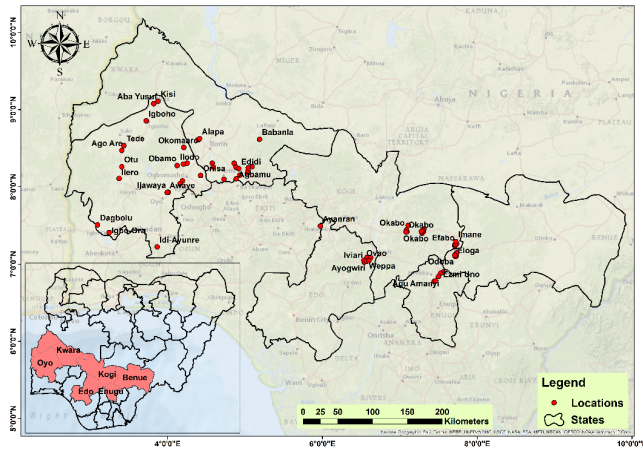
Powdery mildew disease was observed in all surveyed states, indicating widespread occurrence across cashew belt of Nigeria (
Figure 1).
Figure 1. Map of Nigeria showing Surveyed States.
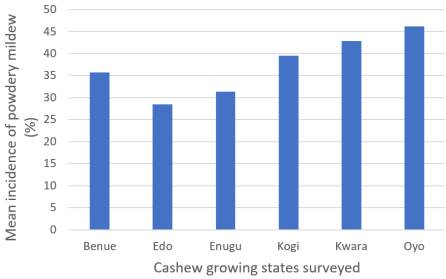
Disease incidence varied significantly among states, Oyo State recorded the highest mean incidence, followed by Kwara and Kogi, and the lowest incidence was recorded in Edo State (
Figure 2).
Figure 2. Mean incidence (%) of cashew powdery mildew across surveyed states.
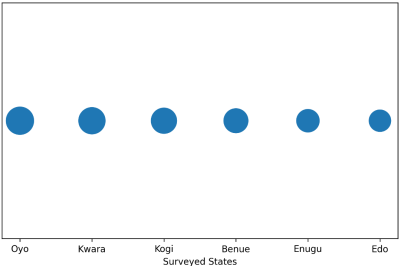
The state-level disease pressure was classified into three categories: low (<30%), moderate (30–45%), and relatively high (>45%) incidence. Oyo State was identified as a relatively high-incidence zone, while Kwara and Kogi States were classified as moderate-incidence hotspots. Edo and Enugu States consistently exhibited lower disease pressure.
3.2. Disease Severity on Cashew Parts
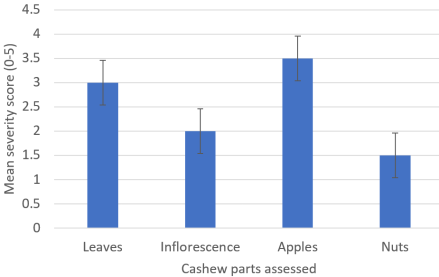
Figure 3. Severity of powdery mildew on cashew parts.
The severity of powdery mildew on cashew parts differed significantly (p < 0.05). Cashew apples recorded the highest mean severity scores (around 3.5), followed by leaves (3.0), while nuts showed comparatively lower severity (1.5) and the inflorescence had 2.0 severity (
Figure 3). The highest severity on cashew apple was observed in Oyo and Kwara States.
3.3. Patterns and Field Observations
Higher disease pressure was observed in plantations with dense canopy cover, poor air circulation, and limited phytosanitary practices. Plantations located in humid microclimates showed more severe infections, particularly during peak flowering.
Figure 4. State-level distribution of cashew powdery mildew incidence.
3.4. Signs of Powdery Mildew on Cashew Parts
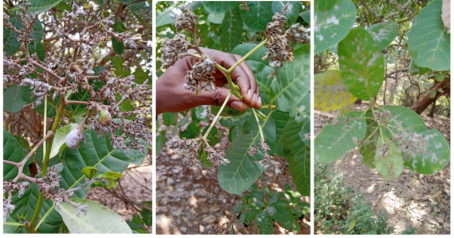
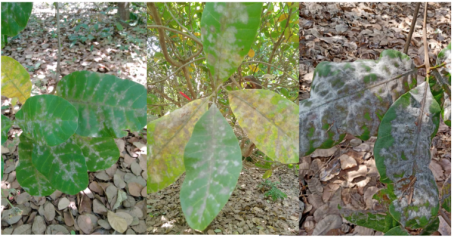
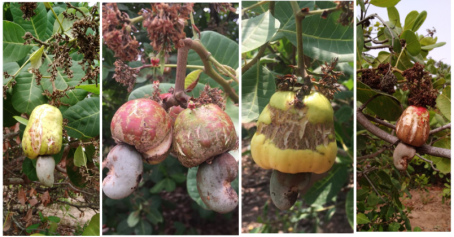
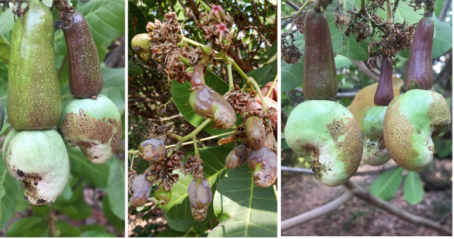
The signs of powdery mildew on cashew parts were shown in plate 1 to 4, with extensive growth of white, superficial mycelium on young shoots with tender leaves, inflorescences, young and mature nuts and apples.
Figure 5. Cashew Inflorescence with Powdery Mildew.
Unlike the regular physiological pinkish-yellow appearances of cashew flowers, powdery mildew infected inflorescences turn brownish with whitish wool-like mycelium on the flowers (
Figure 5). The spread of mycelium on the inflorescence is gradual from one flower panicles to another until the entire in infected.
Figure 6. Cashew Leaves with Powdery Mildew.
Cashew leaves were infected from stage of growth with whitish brown patches on the upper leaf surface concentrated at the midribs and margins from the apex to the base of the leaves. Severely infected leaves were turns brownish yellow and deformed in contrast to older leaves that were unaffected (
Figure 6).
Figure 7. Cashew Apples with Powdery Mildew.
Powdery mildew infects both young green developing apples as well as the yellow mature ones ready for consumption. The sign includes cracking of any part of the apples and a splitting of the affected areas at advance stage. The usually red or yellow apple gradually turns brown from the area of infect making the physiologically soft fleshy apple hardened (
Figure 7). The disease compromises the hygiene and quality of the cashew apple for consumption and reduced the market value of the product.
Figure 8. Cashew Nuts with Powdery Mildew.
The effect of powdery mildew on newly initiated and young green nuts showed a sign of brown patches on the nuts area with whitish-grey colouration in severe infection (
Figure 8). This affects the quality of raw nut and reduce the yield potential of the trees.
4. Discussion
This baseline disease audit demonstrates that cashew powdery mildew is widely distributed across major cashew-producing states of Nigeria, with overall moderate disease pressure. The spatial patterns observed—particularly the concentration of higher incidence in Oyo, Kwara, and Kogi States—are consistent with patterns reported in other West African cashew-growing regions where humid conditions during flowering favor powdery mildew development.
Powdery mildew disease infests all tender tissues of the cashew trees, mainly the tender leaf and inflorescence including the part not well unfolded. The disease seldom attacks old and mature leaves
| [11] | Sijaona, M. E. R., Reeder, R. H. and Waller, J. M. (2006), Cashew leaf and nut blight – a new disease of cashew in Tanzania caused by Cryptosporiopsis spp. Plant Pathology, 55: 576-576. |
[11]
. A white powdery growth is formed on the infested fruit bearing branches and inflorescence. The lesions of the infected parts turn to brown and after 2 – 3 weeks they shrink gradually and become dry and shed, leading to drying out and drop of numerous flowers and tender fruits
| [12] | Sijaona, M. E. R. and Shomari, S. H. (1987). "Incidence of cashew nut diseases in Tanzania." Proceedings of the 2nd Tanzania Cashew Nut Improvement Programme Workshop. |
[12]
. Infected apples turn dull and their skin becomes much coarser. The apples when heavily infected show deep cracks on the surface and gradually shrivel and dry up
| [13] | Sijaona, M. E. R., Shomari, S. H. and Msechu, O. (2005). "Control of cashew powdery mildew (Oidium anacardii Noak) in Tanzania." Tanzania Journal of Agricultural Sciences, 6(1), 17–24. |
[13]
. The tender nuts when infected are deformed on the shell. The lesions turn grey on infected tender apples and nuts. Infected nuts deteriorate in quality during storage, decays easily and produce poor quality kernels when processed
| [14] | Waller, J. M., Nathaniels, N., Sijoana, M. E. R., & Shomari, S. H. (1992). Cashew powdery mildew (oidium anacardii Noack) in Tanzania. Tropical Pest Management, 38(2), 160–163.
https://doi.org/10.1080/09670879209371675 |
[14]
. The report of earlier findings on the pattern of infection and damages caused to cashew parts are much similar to the observations made in this study.
Comparative studies from East Africa and South Asia report similar disease behavior, with inflorescences and young leaves identified as the most susceptible plant parts due to their high physiological activity and tender tissues. The severity ranges observed in this study align with those reported for cashew plantations in Tanzania and India, suggesting that Nigeria is experiencing disease pressure comparable to other major cashew-producing countries.
The moderate disease pressure recorded represents an early warning scenario rather than a full-scale epidemic. However, the absence of structured disease surveillance, limited canopy management, and low adoption of fungicide-based control measures observed during field assessments could accelerate disease intensification if left unaddressed. Climate variability, particularly increased humidity during flowering periods, may further exacerbate disease risk.
The conducive environment for PMD are cold nights which are followed by warm daytimes leading to mist and fog conditions in the early mornings. An optimum temperature ranges between 25-28°C with optimum at 26°C. Relative humidity that is conducive to the environment ranges between 80-100% with optimum at 95%
| [15] | Noak, F. (1898). "A molestia das mangueiras no Rio de Janeiro" [The disease of mango trees in Rio de Janeiro]. Boletim do Instituto Agronômico de Campinas, 9, 76–81. |
| [16] | Ohler, J. G. (1979). Cashew. Communication No. 71, Department of Agricultural Research, Royal Tropical Institute, Amsterdam, Netherlands. 260 pp. |
| [17] | Casulli, F. (1979). "Studio preliminare sull'antracnosi dell'anacardio (Anacardium occidentale L.) in Tanzania" [Preliminary study on cashew anthracnose (Anacardium occidentale L.) in Tanzania]. Rivista di Agricoltura Subtropicale e Tropicale, 73, 203–216. |
| [18] | Chacko, E. K., Singh, B. B., and Aneja, R. P. (1990). Cashew Production Technology and Constraints in India. In: Proceedings of the International Cashew Symposium. (Often cited in combination with Indian cashew research from that era). |
[15-18]
. The powdery mildew spores are mainly dispersed by wind as rainfall inhibits its development. However, perennation and survival of the pathogen from one season to another takes place in fallen infested leaves, water shoots and off-season flowers
| [11] | Sijaona, M. E. R., Reeder, R. H. and Waller, J. M. (2006), Cashew leaf and nut blight – a new disease of cashew in Tanzania caused by Cryptosporiopsis spp. Plant Pathology, 55: 576-576. |
[11]
. Powdery mildew disease is not dormant and can occur on the tree canopy all the year round by wind dispersal
| [19] | Shomari, S. H. (1996). "Epidemiology and control of cashew anthracnose in Tanzania." PhD Thesis, University of Reading. |
[19]
. Overlapping branches and twigs under the crown without penetration of sunlight and lack of rains are optimum condition for the powdery mildew fungus to survive
| [19] | Shomari, S. H. (1996). "Epidemiology and control of cashew anthracnose in Tanzania." PhD Thesis, University of Reading. |
| [20] | Zhongrun, Z and Masawe, P. A. L. (2014). Diseases and insect pests of Cashew in Tanzania, Tropical Crops Genetic Resources Institute, Colour Print Ltd, Dar es Salem, Tanzania. |
[19, 20]
.
By explicitly positioning this study as a baseline disease audit, the findings establish a critical reference point for future longitudinal assessments of cashew powdery mildew in Nigeria. The integration of field-based incidence data with spatial mapping provides a scalable framework for national cashew disease monitoring systems and supports evidence-based decision-making for extension services and agricultural policy development. Baseline audits are critical for tracking temporal changes in disease dynamics, evaluating the effectiveness of management interventions, and supporting evidence-based policy formulation. The findings therefore serve as a reference point for future longitudinal studies and integrated disease management programs.
The integration of spatial mapping with field incidence data, as demonstrated in this study, offers a scalable framework for national cashew disease monitoring systems. Such approaches are increasingly recommended for perennial crop disease management in the context of climate variability and expanding cultivation areas.
The results of this disease audit demonstrate that cashew powdery mildew is widely distributed across major cashew-producing states of Nigeria, with moderate overall disease pressure. The variation in disease incidence among states may be attributed to differences in agro-ecological conditions, farm management practices, and local microclimates. The higher severity observed on apples and young leaves is consistent with previous studies, which report that powdery mildew preferentially infects actively growing tissues.
The moderate disease pressure observed suggests that while powdery mildew is not yet catastrophic in most locations, it poses a significant threat if left unmanaged. Limited farmer awareness and lack of routine disease monitoring may exacerbate disease spread. These findings highlight the importance of integrating cultural practices, timely fungicide application, and resistant varieties into cashew disease management programs.
5. Conclusion
This study provides the first structured disease audit of cashew powdery mildew across selected cashew-growing states of Nigeria. The disease was present in all surveyed states, with moderate incidence and severity levels. Apples and leaves were the most affected plant parts. The findings provide essential baseline data for strengthening disease surveillance, guiding extension services, and informing policy decisions aimed at improving cashew productivity in Nigeria.
6. Recommendations
There is need to institutionalize baseline disease audits for cashew as part of national crop protection programs. Develop state-level disease risk maps to guide targeted extension and intervention efforts. Promote integrated disease management strategies, including canopy pruning, farm sanitation. Strengthen farmer training and extension services on early disease detection and reporting. Support long-term monitoring studies to track changes in cashew powdery mildew dynamics under climate variability. Establish routine cashew disease surveillance programs across major producing states and support research on resistant cashew varieties and pathogen ecology.
Abbreviations
ANOVA | Analysis of Variance |
PMD | Powdery Mildew Disease |
Author Contributions
Dele Omoyele Adeniyi: Conceptualization, Project administration, Writing – original draft
Fiyin Tijesunimi Laoye: Data curation, Investigation
Maria Olufunke Bobinihi: Data curation, Investigation
Alaba Olaitan Adeji: Resources, Visualization
Yetunde Ololade Oladigbolu: Data curation, Investigation
Samuel Abiodun Ayanwole: Data curation, Formal Analysis
Margaret Toluwalope Omoleye: Data curation, Investigation
Funding
The authors acknowledge the funding from USDA/CNFA PROCashew in Nigeria, and the cooperation of cashew farmers and extension officers in the surveyed states for their support during field data collection.
Conflicts of Interest
The authors declare no conflicts of interest.
References
| [1] |
Adeniyi, D. O., Mneney, E. E. and Majune, J. (2025). Report Of Powdery Mildew Disease Condition on Cashew in Nigeria. BIO Web of Conferences, Vol. 158, 03020, 2025.
|
| [2] |
Adeigbe, O. O., Olasupo, F. O., Adewale, B. D., and Muyiwa, A. A. (2015). A review on cashew research and production in Nigeria in the last four decades. Scientific Research and Essays, 10(5), 196–209.
|
| [3] |
Sambucci, G., Sumner, D. A. and Zivin, J. G. (2014). The value of powdery mildew resistance in grapes. Ecological Economics, 108, 11-19.
|
| [4] |
Chisengele, L. (2023). Prevalence, Etiology and Sources of Resistance against Cashew Powdery Mildew Disease in Western Zambia. A dissertation submitted to the University of Zambia in partial fulfilment of the requirements of the degree of Master of Science in Agronomy (Plant Science), University of Zambia. 59 pp.
|
| [5] |
Masawe, P. A. L. (2006). Tanzania cashew cultivars - Selected clones (1st edition). Dar es Salem: Colour Print Ltd, Tanzania.
|
| [6] |
Swart, W. J. (2004). First Report of Powdery Mildew of Cashew Caused by Oidium anacardii in South Africa. Plant Dis. 2004 Nov; 88(11): 1284.
https://doi.org/10.1094/PDIS.2004.88.11.1284A
|
| [7] |
Majune, D. J., Masawe, P. A., & Mbega, E. R. (2018). Status and Management of Cashew Disease in Tanzania. International Journal of Environment, Agriculture and Biotechnology, 3(5), 1590–1597.
https://doi.org/10.22161/ijeab/3.5.4
|
| [8] |
Madden, L. V., Hughes, G., and van den Bosch, F. (2017). The Study of Plant Disease Epidemics (2nd ed.). APS Press. (Though not strictly a "cashew" book, this is the definitive 2017 text on plant disease modeling by Madden, likely referenced for disease spread).
|
| [9] |
Cardoso JE, Martins MVV, Lima JS, Viana FMP & Silva LGC (2012) Controle químico do oídio do cajueiro. Fortaleza, Embrapa Agroindústria Tropical. 4 p. (Comunicado Técnico, 196).
|
| [10] |
Nathaniels, N. Q. R. and Kennedy, R. (1996). Variation in severity of cashew powdery mildew (Oidium anacardii Noack) disease in Tanzania: Implications for research and extension. International Journal of Pest Management.
https://doi.org/10.1080/09670879609371991
|
| [11] |
Sijaona, M. E. R., Reeder, R. H. and Waller, J. M. (2006), Cashew leaf and nut blight – a new disease of cashew in Tanzania caused by Cryptosporiopsis spp. Plant Pathology, 55: 576-576.
|
| [12] |
Sijaona, M. E. R. and Shomari, S. H. (1987). "Incidence of cashew nut diseases in Tanzania." Proceedings of the 2nd Tanzania Cashew Nut Improvement Programme Workshop.
|
| [13] |
Sijaona, M. E. R., Shomari, S. H. and Msechu, O. (2005). "Control of cashew powdery mildew (Oidium anacardii Noak) in Tanzania." Tanzania Journal of Agricultural Sciences, 6(1), 17–24.
|
| [14] |
Waller, J. M., Nathaniels, N., Sijoana, M. E. R., & Shomari, S. H. (1992). Cashew powdery mildew (oidium anacardii Noack) in Tanzania. Tropical Pest Management, 38(2), 160–163.
https://doi.org/10.1080/09670879209371675
|
| [15] |
Noak, F. (1898). "A molestia das mangueiras no Rio de Janeiro" [The disease of mango trees in Rio de Janeiro]. Boletim do Instituto Agronômico de Campinas, 9, 76–81.
|
| [16] |
Ohler, J. G. (1979). Cashew. Communication No. 71, Department of Agricultural Research, Royal Tropical Institute, Amsterdam, Netherlands. 260 pp.
|
| [17] |
Casulli, F. (1979). "Studio preliminare sull'antracnosi dell'anacardio (Anacardium occidentale L.) in Tanzania" [Preliminary study on cashew anthracnose (Anacardium occidentale L.) in Tanzania]. Rivista di Agricoltura Subtropicale e Tropicale, 73, 203–216.
|
| [18] |
Chacko, E. K., Singh, B. B., and Aneja, R. P. (1990). Cashew Production Technology and Constraints in India. In: Proceedings of the International Cashew Symposium. (Often cited in combination with Indian cashew research from that era).
|
| [19] |
Shomari, S. H. (1996). "Epidemiology and control of cashew anthracnose in Tanzania." PhD Thesis, University of Reading.
|
| [20] |
Zhongrun, Z and Masawe, P. A. L. (2014). Diseases and insect pests of Cashew in Tanzania, Tropical Crops Genetic Resources Institute, Colour Print Ltd, Dar es Salem, Tanzania.
|
Cite This Article
-
APA Style
Adeniyi, D. O., Laoye, F. T., Bobinihi, M. O., Adeji, A. O., Oladigbolu, Y. O., et al. (2026). Surveillance of Powdery Mildew Disease on Cashew in Selected Growing Ecologies of Nigeria. American Journal of BioScience, 14(3), 47-54. https://doi.org/10.11648/j.ajbio.20261403.11
 Copy
|
Copy
|
 Download
ACS Style
Adeniyi, D. O.; Laoye, F. T.; Bobinihi, M. O.; Adeji, A. O.; Oladigbolu, Y. O., et al. Surveillance of Powdery Mildew Disease on Cashew in Selected Growing Ecologies of Nigeria. Am. J. BioScience 2026, 14(3), 47-54. doi: 10.11648/j.ajbio.20261403.11
Copy
|
Download
AMA Style
Adeniyi DO, Laoye FT, Bobinihi MO, Adeji AO, Oladigbolu YO, et al. Surveillance of Powdery Mildew Disease on Cashew in Selected Growing Ecologies of Nigeria. Am J BioScience. 2026;14(3):47-54. doi: 10.11648/j.ajbio.20261403.11
Copy
|
Download
-
@article{10.11648/j.ajbio.20261403.11,
  author = {Dele Omoyele Adeniyi and Fiyin Tijesunimi Laoye and Maria Olufunke Bobinihi and Alaba Olaitan Adeji and Yetunde Ololade Oladigbolu and Samuel Abiodun Ayanwole and Margaret Toluwalope Omoleye},
  title = {Surveillance of Powdery Mildew Disease on Cashew in Selected Growing Ecologies of Nigeria},
  journal = {American Journal of BioScience},
  volume = {14},
  number = {3},
  pages = {47-54},
  doi = {10.11648/j.ajbio.20261403.11},
  url = {https://doi.org/10.11648/j.ajbio.20261403.11},
  eprint = {https://article.sciencepublishinggroup.com/pdf/10.11648.j.ajbio.20261403.11},
  abstract = {Cashew (Anacardium occidentale L.) is a major perennial cash crop in Nigeria, yet its productivity is increasingly constrained by many factors of which pests are major, notably powdery mildew, a fungal disease. This study presents a baseline disease audit assessing the occurrence, incidence, severity, and distribution of cashew powdery mildew in six major cashew producing states of Nigeria: Kwara, Kogi, Oyo, Benue, Enugu, and Edo. Field surveys were conducted during the flowering and fruiting period of the year 2024 production season, and a multistage sampling technique was employed. A total of 250 trees were assessed per state, targeted at young, actively growing tissue which are usually susceptible to mildew infection. A 1 sqm quadrants were placed on two opposite sides of the cashew canopies for assessment of affected parts. Powdery mildew incidence and severity were assessed on leaves, inflorescences, apples and nuts using standardized visual scoring methods and damages caused. Powdery mildew was detected in all surveyed states, with overall moderate disease pressure. Mean disease incidence ranged from 28.5% to 46.2% across surveyed states, while severity was highest on cashew apples, followed by leaves and least on the nuts. Disease severity also differed significantly among plant parts (p 45%) incidence, spatial analysis identified Oyo as high incidence zone, while Kwara, and Kogi States as moderate disease hotspots. The widespread presence of the disease underscores the need for regular disease surveillance and the adoption of integrated disease management strategies. The study provides the first multi-state baseline data on cashew powdery mildew in Nigeria and establishes a reference framework for long-term disease monitoring, extension services, future research and policy formulation.},
 year = {2026}
}
Copy
|
Download
-
TY  - JOUR
T1  - Surveillance of Powdery Mildew Disease on Cashew in Selected Growing Ecologies of Nigeria
AU  - Dele Omoyele Adeniyi
AU  - Fiyin Tijesunimi Laoye
AU  - Maria Olufunke Bobinihi
AU  - Alaba Olaitan Adeji
AU  - Yetunde Ololade Oladigbolu
AU  - Samuel Abiodun Ayanwole
AU  - Margaret Toluwalope Omoleye
Y1  - 2026/05/12
PY  - 2026
N1  - https://doi.org/10.11648/j.ajbio.20261403.11
DO  - 10.11648/j.ajbio.20261403.11
T2  - American Journal of BioScience
JF  - American Journal of BioScience
JO  - American Journal of BioScience
SP  - 47
EP  - 54
PB  - Science Publishing Group
SN  - 2330-0167
UR  - https://doi.org/10.11648/j.ajbio.20261403.11
AB  - Cashew (Anacardium occidentale L.) is a major perennial cash crop in Nigeria, yet its productivity is increasingly constrained by many factors of which pests are major, notably powdery mildew, a fungal disease. This study presents a baseline disease audit assessing the occurrence, incidence, severity, and distribution of cashew powdery mildew in six major cashew producing states of Nigeria: Kwara, Kogi, Oyo, Benue, Enugu, and Edo. Field surveys were conducted during the flowering and fruiting period of the year 2024 production season, and a multistage sampling technique was employed. A total of 250 trees were assessed per state, targeted at young, actively growing tissue which are usually susceptible to mildew infection. A 1 sqm quadrants were placed on two opposite sides of the cashew canopies for assessment of affected parts. Powdery mildew incidence and severity were assessed on leaves, inflorescences, apples and nuts using standardized visual scoring methods and damages caused. Powdery mildew was detected in all surveyed states, with overall moderate disease pressure. Mean disease incidence ranged from 28.5% to 46.2% across surveyed states, while severity was highest on cashew apples, followed by leaves and least on the nuts. Disease severity also differed significantly among plant parts (p 45%) incidence, spatial analysis identified Oyo as high incidence zone, while Kwara, and Kogi States as moderate disease hotspots. The widespread presence of the disease underscores the need for regular disease surveillance and the adoption of integrated disease management strategies. The study provides the first multi-state baseline data on cashew powdery mildew in Nigeria and establishes a reference framework for long-term disease monitoring, extension services, future research and policy formulation.
VL  - 14
IS  - 3
ER  -
Copy
|
Download





 Share This Article
 Twitter
 Linked In
 Facebook