
The exponential growth of industrial enterprise has highly increased the demand for effective and efficient optimization solutions. Which is resulting to the broad use of meta heuristic algorithms. This study explores eminent bio-inspired population based optimization techniques, including Particle Swarm Optimization (PSO), Spider Monkey Optimization (SMO), Grey Wolf Optimization (GWO), Cuckoo Search Optimization (CSO), Grasshopper Optimization Algorithm (GOA), and Ant Colony Optimization (ACO). These methods which are inspired by natural and biological phenomena, offer revolutionary problems solving abilities with rapid convergence rates and high fitness scores. The investigation examines each algorithm's unique features, optimization properties, and operational paradigms, conducting broad comparative analyses against conventional methods, such as search history, fitness functions and to express their superiority. The study also assesses their relevance, arithmetic andlogical efficiency, applications, innovation, robustness, andlimitations. The findings show the transformative potential of these algorithms and offering valuable wisdom for future research to enhance and broaden upon these methodologies. This finding assists as a guiding for researchers to enable inventive solutions based in natural algorithms and advancing the field of optimization.
| Published in | American Journal of Computer Science and Technology (Volume 7, Issue 4) |
| DOI | 10.11648/j.ajcst.20240704.17 |
| Page(s) | 195-217 |
| Creative Commons |
This is an Open Access article, distributed under the terms of the Creative Commons Attribution 4.0 International License (http://creativecommons.org/licenses/by/4.0/), which permits unrestricted use, distribution and reproduction in any medium or format, provided the original work is properly cited. |
| Copyright |
Copyright © The Author(s), 2024. Published by Science Publishing Group |
Meta Heuristic Algorithms, Particle Swarm Optimization, Spider Monkey Optimization, Grey Wolf Optimization, Cuckoo Search Optimization, Grasshopper Optimization Algorithm, Ant Colony Optimization
Application Area/Field | Proposed Method/Approach | Strengths/Contribution | Reference |
|---|---|---|---|
Smart Homes | Optimized energy management using PSO | Achieved reduced costs and efficient energy use in residential buildings. | [1] |
Traffic Management | PSO for urban traffic signal optimization | Reduced congestion and improved traffic flow. | [ 21] |
Power Grid Optimization | PSO forload flow optimization | Enhanced grid reliability and reducedlosses. | [3] |
Building Design | Heatingload prediction using PSO | Optimized energy consumption forlarge-scale buildings. | [25] |
Business Centerlocation | Location optimization using PSO | Improved accessibility and cost-effectiveness of business center placement. | [2] |
Cost Prediction in Engineering | Transmissionline cost optimization using hybrid PSO | Reduced costs with better estimation accuracy. | [22] |
Wireless Networks | Energy-efficient routing with PSO | Prolonged networklife and enhanced data delivery in ad hoc networks. | [25] |
Image Processing | Hybrid PSO for image restoration and clustering | Improved image quality and segmentation accuracy. | [23] |
Electrical Systems | PSO for power flow optimization | Improved system reliability and security under varyingload conditions. | [26] |
Robotics Path Planning | Trajectory optimization in autonomous robots | Achieved smooth, collision-free motion in complex environments. | [6] |
Renewable Energy Systems | Maximum power point tracking for solar systems using PSO | Increased energy efficiency under variable shading conditions. | [27] |
Healthcare Systems | Disease prediction and diagnostics using PSO | Improved diagnostic accuracy for cardiovascular and diabetic conditions. | [9] |
IoT Optimization | Resource allocation and energy optimization for IoT networks | Extended batterylife and improved throughput in IoT devices. | [24] |
Manufacturing Optimization | PSO for scheduling in productionlines | Reduced processing time and optimized resource utilization. | [28] |
Civil Infrastructure Optimization | Truss design optimization with PSO | Enhancedload distribution and minimized material usage. | [29] |
Application Area/Field | Proposed Method/Approach | Strengths/Contribution | Reference |
|---|---|---|---|
Android Malware Detection | SMO-based Bi-LSTM for malware classification | Achieved high accuracy in detecting Android malware for cybersecurity applications. | [31] |
Electric Vehicle Power Systems | Control for interleaved parallel bidirectional DC-DC converters | Enhanced grid integration and energy efficiency in electric vehicles. | [32] |
Load Flow Optimization | SMO combined with swarm intelligence forload flow in power grids | Improved efficiency and convergence inlarge-scale power networks. | [33] |
Wireless Networks | Smart SMO for energy-efficient wireless communication | Achieved reduced energy consumption and enhanced nodelifetime. | [34] |
Network Intrusion Detection | Hybrid SMO with hierarchical swarm intelligence for feature selection | Enhanced detection accuracy for intrusion prevention in network security systems. | [35] |
Chemical Engineering | SMO for optimization in chemical data processing | Improved hyperparameter tuning for chemical data models, increasing processing accuracy. | [12] |
Structural Engineering | SMO for bridgeload optimization | Improved structural safety and cost efficiency in bridge designs. | [36] |
Healthcare Applications | SMO for medical image feature extraction and segmentation | Enhanced accuracy in disease diagnosis through optimized image processing. | [37] |
Renewable Energy Systems | SMO for wind farm placement optimization | Achieved higher energy efficiency and reduced setup costs in renewable energy projects. | [38] |
Machinelearning Optimization | SMO for optimizing deeplearning hyperparameters | Increased model accuracy with efficient hyperparameter tuning. | [39] |
Robotics and Path Planning | SMO for robot trajectory optimization in dynamic environments | Improved obstacle avoidance and energy efficiency in robotic movements. | [40] |
IoT Network Management | SMO for bandwidth and energy optimization in IoT networks | Enhanced network utilization and extended devicelife in IoT applications. | [41] |
Bioinformatics | SMO for gene selection in protein structure analysis | Achieved higher predictive accuracy in bioinformatics applications. | [42] |
Civil Infrastructure Optimization | SMO for optimizing truss designs | Enhancedload distribution and material utilization inlarge-scale truss structures. | [36] |
Transportation Optimization | SMO for vehicle routing in urbanlogistics | Improved delivery efficiency and reduced transportation costs. | [43] |
Application Area/Field | Proposed Method/Approach | Strengths/Contribution | Reference |
|---|---|---|---|
Structural Engineering | Enhanced GWO for structural optimization | Achieved improved efficiency and stability in building designs. | [44] |
Renewable Energy Systems | GWO for optimizing hybrid renewable energy systems | Improved energy efficiency and power balancing in solar-wind hybrid systems. | [45] |
Control Systems | Adaptive GWO for PID controller design | Enhanced performance in industrial control systems with optimal parameter tuning. | [51] |
Electromagnetic Systems | GWO-based antenna array optimization | Achieved better directional performance with reduced design costs. | [46] |
Healthcare Applications | GWO for feature selection in disease diagnostics | Improved classification accuracy in cancer and diabetes detection. | [47] |
Machinelearning | Integration of GWO with deeplearning models | Optimized hyperparameter tuning for improved model performance. | [48] |
IoT and Network Systems | GWO for resource allocation in IoT networks | Enhanced bandwidth utilization and reducedlatency inlarge-scale IoT networks. | [50] |
Robotics and Path Planning | GWO for robot trajectory optimization | Improved obstacle avoidance and energy efficiency in dynamic environments. | [55] |
Power Systems | GWO forload frequency control in power grids | Achieved better frequency regulation and stability in smart grids. | [52] |
Environmental Monitoring | GWO for optimizing sensor deployment | Improved coverage and reduced costs in environmental monitoring systems. | [56] |
Bioinformatics | GWO for protein structure prediction | Enhanced accuracy in determining stable protein conformations. | [57] |
Transportation andlogistics | GWO for vehicle routing problem | Improved delivery efficiency and reduced transportation costs. | [58] |
Financial Applications | GWO for stock market prediction | Optimized trading strategies with higher predictive accuracy. | [53] |
Energy Optimization | GWO for maximum power point tracking in solar panels | Enhanced energy harvesting under partial shading conditions. | [49] |
Civil Engineering | GWO for optimizing truss structures | Improvedload-bearing efficiency and material usage in bridge designs. | [59] |
Application Area/Field | Proposed Method/Approach | Strengths/Contribution | Reference |
|---|---|---|---|
Power Systems Control | Standard GOA for controlling power systems | Efficient balancing of control parameters and optimization in complex systems. | [62] |
Routing in FANETs | Hybrid GOA with Invasive Weed Optimization | Enhanced routing efficiency and reduced computational overhead for network optimization. | [65] |
Structural Analysis | Finite Element Method (FEM) plugin in Grasshopper | Improved structural modeling and optimization using a parametric environment. | [66] |
Lung Cancer Classification | Binary GOA combined with Artificial Bee Colony | Effective feature selection and classification in medical applications using deeplearning. | [63] |
Pavement Crack Detection | GOA integrated with U-Net framework | Accurate crack detection and condition scoring for pavement maintenance. | [67] |
Machinelearning Optimization | GOA for optimizing machinelearning models | Achieved better refinement and performance of predictive models in healthcare applications. | [64] |
Wind Farm Power Systems | GOA forload Frequency Control (LFC) | Improved dynamic stability in power systems incorporating renewable energy. | [60] |
Tunnel Design | GOA for iterative and dynamic tunnel modeling | Enhanced geometric adjustments and airflow optimization in tunnel design. | [68] |
Interior Design | Parametric modeling with Grasshopper optimization | Improved customization and innovation in furniture and architectural design. | [69] |
Conceptual Design Process | Computational design methods based on Grasshopper | Facilitated brainstorming and creative solutions in the early stages of design. | [70] |
Concrete Dam Optimization | GOA for gravity dam design | Achieved better structural stability and resource efficiency. | [10] |
Photovoltaic Systems | Improved GOA for global maximum power tracking | Enhanced energy efficiency in solar panels under varying conditions. | [61] |
Fuzzy Neural Networks | GOA integrated with Recurrent Fuzzy Neural Networks | Accurate predictions of surface ozonelevels using hybrid optimization methods. | [71] |
Energy Management in Micro-Grids | Modified Chaos GOA for optimizing renewable energy output | Achieved higher efficiency in hybrid renewable energy systems. | [8] |
Heart Disease Prediction | GOA-optimized Convolutional Neural Network (CNN) | Improved prediction accuracy and computational performance for medical diagnostics. | [72] |
Application Area/Field | Proposed Method/Approach | Strengths/Contribution | Reference |
|---|---|---|---|
Power Systems Control | Reactive power compensation using CS for grid system optimization | Improved stability and efficiency in grid systems with FACTS devices. | [16] |
Network Telemetry | Structure-aware CS for real-time traffic monitoring | Enhanced data tracking in modern computer networks. | [78] |
Renewable Energy Systems | CS for photovoltaic power forecasting | Increased accuracy in solar irradiance and photovoltaic power predictions. | [79] |
Fault Diagnosis | Hybrid CS for gas turbine engine fault identification | Enhanced diagnostic accuracy for gas turbine systems with constrained nonlinear optimization. | [80] |
Data Mining Optimization | Dynamic CS combined with neutrosophic cognitive mapping | Improved feature selection and clustering efficiency inlarge datasets. | [74] |
Wind Power Prediction | CS for wind power installed capacity forecasting | Accurate predictions for energy capacity planning in renewable systems. | [75] |
Vehicular Networks | CS for resource allocation in vehicular networks | Efficient caching and offloading in resource-constrained vehicular systems. | [76] |
Groundwater Contamination | CS for identifying contamination sources | Improved environmental monitoring with kernel extremelearning machines. | [77] |
Structural Engineering | CS-based optimization for concrete dam design | Achieved better structural stability and resource utilization. | [81] |
Healthcare Systems | CS for disease classification and prediction | Enhanced diagnostic accuracy for medical imaging and classification tasks. | [82] |
Image Segmentation | Triple hybrid CS with Type II fuzzy sets | Improved multi-level image segmentation with adaptive mechanisms. | [83] |
Engineering Design Problems | Multi-algorithm CS with adaptive mutation mechanism | Enhanced constraint handling and optimization efficiency. | [84] |
Mechanical Design | Enhanced CS withlevy flight and GANs | Optimized mechanical manufacturing processes with generative models. | [85] |
Advanced Machining | CS for optimization of machining parameters | Improved accuracy in machining tasks with reduced waste. | [86] |
Bearing Fault Diagnosis | Adaptive CS for noise-resistant fault diagnosis | Achieved effective fault identification under strong noise conditions. | [87] |
Application Area/Field | Proposed Method/Approach | Strengths/Contribution | Reference |
|---|---|---|---|
Agriculture | Boosting agriculture and water efficiency with advanced ACO | Enhanced accuracy and efficiency in predictive modeling. | [89] |
Tourist Route Optimization | ACO-based recommendation system | Reduced travel times and optimized itineraries. | [90] |
Human Resource Management | ACO for job candidate optimization | Improved recruitment and resource management. | [91] |
Robotic Swarm Cleaning | Bee-inspired ACO for robotic cleaners | Improved navigation and task completion in industrial setups. | [92] |
Load Balancing in Computing | Dynamic ACO for serverload balancing | Reduced downtime and improved computation efficiency. | [93] |
Energy Monitoring | ACO with neural networks for harmonic distortion monitoring | Enhanced detection and prediction in energy systems. | [94] |
Microenterprise Vulnerability | ACO for fuzzy geodemographic clustering | Improved business vulnerability analysis. | [95] |
Logistics and Routing | Improved ACO for integratedlogistics optimization | Enhanced delivery efficiency and cost reduction. | [96] |
Network Optimization | Multi-ACO for vehicular routing problem | Optimized traffic flow and resource utilization. | [97] |
Humanitarian Aid Distribution | ACO forlocation routing problem | Improved speed and efficiency in critical resource distribution. | [98] |
Laser Drilling Optimization | ACO with gradient descent for precisionlaser drilling | Achieved higher accuracy and reduced waste. | [88] |
3D Containerloading | Hybrid ACO for multi-objective optimization | Improved packing efficiency and resource utilization. | [99] |
Carbon Emissions Modeling | ACO with Cobb-Douglas models for emission analysis | Enhanced understanding of emission patterns and impacts. | [100] |
Power and Transportation Networks | Collaborative ACO for urban transportation and power systems | Improved integration and efficiency. | [101] |
Edge-Cloud Resource Allocation | Bi-directionallSTM and ACO for adaptive resource scheduling | Enhanced cloud computing efficiency. | [102] |
Algorithm | Inspiration | Strength | Limitations | Scalability | Computational Complexity | Flexibility | Convergence Rate |
|---|---|---|---|---|---|---|---|
PSO | Swarm behavior of birds and fish | Simple implementation, effective in dynamic systems | Prone to premature convergence | Moderate Scalability in medium sized problems | Lower computational cost compared to others | High adaptability to dynamic environments | Fast convergence but risks local optima |
SMO | Social behavior of spider monkeys | Effective in multi objective optimizations tasks | Slower convergence in complex scenarios | Moderate Scalability with hybrid enhancements | Higher computational cost in large scale problems | Good adaptability in structured problems | Moderate convergence requires parameter tuning |
GWO | Social hierarchy and hunting behavior of grey wolves | Simplicity, low parameter dependency, | Balancing global and local search is challenging | High Scalability in large problem spaces | Moderate computational cost | Flexible for different optimizations problems | Efficient convergence in static environments |
GOA | Swarming behavior of grasshoppers | Strong exploration abilities | High sensitivity to parameter settings | Moderate scalability in medium complexity tasks | Higher computational complexity | Good flexibility in multimedia tasks | Fast convergence in structured environments |
CSO | Brood parasitism of cuckoos | Excellent global exploration capabilities | Poor local search requires hybridization | Limited scalability for very large data sets | Higher computations demands | Moderate flexibility in constrained problems | Effective in global optimization tasks |
ACO | Pheromone laying behavior of ants | Best for combinational problems | High computational cost for large problems | Moderate scalability with hybrid approaches | Significant computational complexity | Highly flexible for discrete problems | Slower convergence in dynamic scenarios |
PSO | Particle Swarm Optimization |
SMO | Spider Monkey Optimization |
GWO | Grey Wolf Optimization |
GOA | Grasshopper Optimization Algorithm |
CS | Cuckoo Search |
ACO | Ant Colony Optimization |
| [1] | A. Ahmad et al., “An Optimized Home Energy Management System with Integrated R enewable Energy and Storage Resources,” Energies, vol. 10, no. 4, p. 549, Apr. 2017, |
| [2] | J. U et al., “Particle Swarm Optimization based Spatiallocation Allocation of Urban Parks,” 2014 Third Int. Conf. Agro-Geoinformatics, no. March, pp. 1–6, 2014. |
| [3] | W. Al-Saedi, S. W. lachowicz, D. Habibi, and O. Bass, “Power flow control in grid-connected microgrid operation using Particle Swarm Optimization under variableload conditions,” Int. J. Electr. Power Energy Syst., vol. 49, pp. 76–85, Jul. 2013, |
| [4] | S. M. Haakonsen, S. H. Dyvik, M. luczkowski, and A. Rønnquist, “A Grasshopper Plugin for Finite Element Analysis with Solid Elements and Its Application on Gridshell Nodes,” Appl. Sci., vol. 12, no. 12, 2022, |
| [5] | S. R. Kamel and R. Yaghoubzadeh, “Feature selection using grasshopper optimization algorithm in diagnosis of diabetes disease,” Informatics Med. Unlocked, vol. 26, p. 100707, 2021, |
| [6] | J. J. Kim and J. J. lee, “Trajectory optimization with particle swarm optimization for manipulator motion planning,” IEEE Trans. Ind. Informatics, vol. 11, no. 3, pp. 620–631, 2015, |
| [7] | P. Hou, W. Hu, M. Soltani, and Z. Chen, “Optimized Placement of Wind Turbines inlarge-Scale Offshore Wind Farm Using Particle Swarm Optimization Algorithm,” IEEE Trans. Sustain. Energy, vol. 6, no. 4, pp. 1272–1282, Oct. 2015, |
| [8] | Z. Yan, Y. li, and M. Eslami, “Maximizing micro-grid energy output with modified chaos grasshopper algorithms,” Heliyon, vol. 10, no. 1, p. e23980, Jan. 2024, |
| [9] | H. H. Inbarani, A. T. Azar, and G. Jothi, “Supervised hybrid feature selection based on PSO and rough sets for medical diagnosis,” Comput. Methods Programs Biomed., vol. 113, no. 1, pp. 175–185, Jan. 2014, |
| [10] | S. Abbasi et al., “Design optimization of concrete gravity dams using grasshopper optimization algorithm,” Innov. Infrastruct. Solut., vol. 9, no. 12, p. 453, Dec. 2024, |
| [11] | M. Prabakaran, M. K. Bhole, V. Kalpana, S. Dixit, K. Divya, and D. A. Chauhan, “Enhancing Disease Prediction in Healthcare: A Comparative Analysis of PSO and Extremelearning Approach,” in 2023 3rd International Conference on Innovative Mechanisms for Industry Applications (ICIMIA), IEEE, Dec. 2023, pp. 1092–1097. |
| [12] | D. Kumari, A. Sinha, S. Dutta, and P. Pranav, “Optimizing neural networks using spider monkey optimization algorithm for intrusion detection system,” Sci. Rep., vol. 14, no. 1, p. 17196, Jul. 2024, |
| [13] | T. Hosseinalizadeh, S. M. Salamati, S. A. Salamati, and G. B. Gharehpetian, “Improvement of Identification Procedure Using Hybrid Cuckoo Search Algorithm for Turbine-Governor and Excitation System,” IEEE Trans. Energy Convers., vol. 34, no. 2, pp. 585–593, Jun. 2019, |
| [14] | A. Gálvez, I. Fister, S. Deb, I. Fister, and A. Iglesias, “Hybrid GA-PSO method withlocal search and image clustering for automatic IFS image reconstruction of fractal colored images,” Neural Comput. Appl., Nov. 2023, |
| [15] | S. Biswas, K. Mandal, D. Pramanik, N. Roy, R. Biswas, and A.. Kuar, “Prediction and optimization of Nd: YAGlaser transmission micro-channelling on PMMA employing an artificial neural network model,” Infrared Phys. Technol., vol. 137, p. 105121, Mar. 2024, |
| [16] | A. I. Omar, Z. M. Ali, S. H. E. Abdel Aleem, E. E. A. El-Zahab, and A. M. Sharaf, “A dynamic switched compensation scheme for grid-connected wind energy systems using cuckoo search algorithm,” Int. J. Energy Convers., vol. 7, no. 2, pp. 64–74, 2019, |
| [17] | R. Sridhar, C. Subramani, and S. Pathy, “A grasshopper optimization algorithm aided maximum power point tracking for partially shaded photovoltaic systems,” Comput. Electr. Eng., vol. 92, p. 107124, Jun. 2021, |
| [18] | S. R. Salkuti, “Optimal Reactive Power Scheduling Using Cuckoo Search Algorithm,” Int. J. Electr. Comput. Eng., vol. 7, no. 5, p. 2349, Oct. 2017, |
| [19] | A. A. Ghavifekr, A. Mohammadzadeh, and J. F. Ardashir, “Optimal Placement and Sizing of Energy-related Devices in Microgrids Using Grasshopper Optimization Algorithm,” in 2021 12th Power Electronics, Drive Systems, and Technologies Conference (PEDSTC), IEEE, Feb. 2021, pp. 1–4. |
| [20] | Li Yancang, Cheng Fangmeng, and J. Suo, “Improved ACO inspired bylogistics and distribution problem,” in 2010 2nd International Conference on Advanced Computer Control, IEEE, 2010, pp. 369–371. |
| [21] | R. DIAF, C. TOLBA, and A. Nait Sidi Moh, “Traffic Urban Control Using an Intelligent PSO Algorithm Based on Integrated Approach,” Alger. J. Signals Syst., vol. 5, no. 1, pp. 1–9, Mar. 2020, |
| [22] | C. H. Ram Jethmalani, S. P. Simon, K. Sundareswaran, P. S. R. Nayak, and N. P. Padhy, “Auxiliary Hybrid PSO-BPNN-Based Transmission Systemloss Estimation in Generation Scheduling,” IEEE Trans. Ind. Informatics, vol. 13, no. 4, pp. 1692–1703, Aug. 2017, |
| [23] | P. C. S. Rao, P. K. Jana, and H. Banka, “A particle swarm optimization based energy efficient cluster head selection algorithm for wireless sensor networks,” Wirel. Networks, vol. 23, no. 7, pp. 2005–2020, Oct. 2017, |
| [24] | A. K. Sangaiah, A. A. R. Hosseinabadi, M. B. Shareh, S. Y. B. Rad, A. Zolfagharian, and N. Chilamkurti, “IoT resource allocation and optimization based on heuristic algorithm,” Sensors (Switzerland), vol. 20, no. 2, 2020, |
| [25] | L. Xudong, l. Shuo, and F. Qingwu, “Prediction of Building Heating and Coolingload Based on IPSO-LSTM Neural Network,” in 2020 Chinese Automation Congress (CAC), IEEE, Nov. 2020, pp. 1085–1090. |
| [26] | H. E. Mostafa, M. A. El-Sharkawy, A. A. Emary, and K. Yassin, “Design and allocation of power system stabilizers using the particle swarm optimization technique for an interconnected power system,” Int. J. Electr. Power Energy Syst., vol. 34, no. 1, pp. 57–65, Jan. 2012, |
| [27] | M. H. Ibrahim, S. P. Ang, M. N. Dani, M. I. Rahman, R. Petra, and S. M. Sulthan, “Optimizing Step-Size of Perturb & Observe and Incremental Conductance MPPT Techniques Using PSO for Grid-Tied PV System,” IEEE Access, vol. 11, pp. 13079–13090, 2023, |
| [28] | Q. S. Khalid et al., “Hybrid Particle Swarm Algorithm for Products’ Scheduling Problem in Cellular Manufacturing System,” Symmetry (Basel)., vol. 11, no. 6, p. 729, May 2019, |
| [29] | G.-C. luh and C.-Y. lin, “Optimal design of truss-structures using particle swarm optimization,” Comput. Struct., vol. 89, no. 23–24, pp. 2221–2232, Dec. 2011, |
| [30] | A. Agrawal, D. Garg, D. Popli, A. Banerjee, A. Raj, and I. Dikshit, “A review of spider monkey optimization: modification and its biomedical application,” Int. J. Interact. Des. Manuf., Dec. 2023, |
| [31] | B. Isong and O. Kgote, “Insights into Modern Intrusion Detection Strategies for Internet of Things Ecosystems,” 2024. |
| [32] | Y. lan, Q. Chen, l. Zhang, and R. long, “Model Predictive Control Based On Spider monkey optimization Algorithm of Interleaved Parallel Bidirectional DC-DC Converter,” pp. 50–55, 2020. |
| [33] | D. Tripathy, B. K. Sahu, N. B. D. Choudhury, and S. Dawn, “Spider monkey optimization based cascade controller forlFC of a hybrid power system.,” pp. 747–753, 2018. |
| [34] | R. K. Sanapala, “An Optimized Energy Efficient Routing for Wireless Sensor Network using Improved Spider Monkey Optimization Algorithm,” vol. 15, no. 1, pp. 188–197, 2022, |
| [35] | R. Alkanhel, A. A. Abdelhamid, A. Ibrahim, M. A. Alohali, M. Abotaleb, and D. S. Khafaga, “Metaheuristic Optimization,” 2023, |
| [36] | X. Zhang, Y. M. Xie, and S. Zhou, “A nodal-based evolutionary optimization algorithm for frame structures,” Comput. Civ. Infrastruct. Eng., vol. 38, no. 3, pp. 288–306, 2023, |
| [37] | G. Nirmalapriya, V. Agalya, R. Regunathan, and M. Belsam Jeba Ananth, “Fractional Aquila spider monkey optimization based deeplearning network for classification of brain tumor,” Biomed. Signal Process. Control, vol. 79, p. 104017, Jan. 2023, |
| [38] | W. Sultana and S. D. S. Jebaseelan, “Optimal allocation of solar PV and wind energy power for radial distribution system using spider monkey optimization,” Sustain. Comput. Informatics Syst., vol. 42, p. 100986, Apr. 2024, |
| [39] | N. Khare et al., “SMO-DNN: Spider Monkey Optimization and Deep Neural Network Hybrid Classifier Model for Intrusion Detection,” Electronics, vol. 9, no. 4, p. 692, Apr. 2020, |
| [40] | A. Kumar Kashyap and D. R. Parhi, “Multi-objective trajectory planning of humanoid robot using hybrid controller for multi-target problem in complex terrain,” Expert Syst. Appl., vol. 179, p. 115110, Oct. 2021, |
| [41] | P. Vijayalakshmi and D. Karthika, “Hybrid dual-channel convolution neural network (DCCNN) with spider monkey optimization (SMO) for cyber security threats detection in internet of things,” Meas. Sensors, vol. 27, p. 100783, Jun. 2023, |
| [42] | B. Sahu, A. Panigrahi, B. Dash, P. K. Sharma, and A. Pati, “A hybrid wrapper spider monkey optimization-simulated annealing model for optimal feature selection,” Int. J. Reconfigurable Embed. Syst., vol. 12, no. 3, pp. 360–375, 2023, |
| [43] | M. Montalvo-Martel, A. Ochoa-Zezzatti, E. Carrum, and D. Barzaga, “Design of an Urban Transport Network for the Optimallocation of Bus Stops in a Smart City Based on a Big Data Model and Spider Monkey Optimization Algorithm,” 2021, pp. 167–201. |
| [44] | S. Mirjalili, S. M. Mirjalili, and A. lewis, “Grey Wolf Optimizer,” Adv. Eng. Softw., vol. 69, pp. 46–61, 2014, |
| [45] | A. Yahiaoui, F. Fodhil, K. Benmansour, M. Tadjine, and N. Cheggaga, “Grey wolf optimizer for optimal design of hybrid renewable energy system PV-Diesel Generator-Battery: Application to the case of Djanet city of Algeria,” Sol. Energy, vol. 158, pp. 941–951, Dec. 2017, |
| [46] | X. li and Y.-X. Guo, “The Grey Wolf Optimizer for Antenna Optimization Designs: Continuous, binary, single-objective, and multiobjective implementations,” IEEE Antennas Propag. Mag., vol. 64, no. 6, pp. 29–40, Dec. 2022, |
| [47] | Q. Al-Tashi et al., “Binary Multi-Objective Grey Wolf Optimizer for Feature Selection in Classification,” IEEE Access, vol. 8, pp. 106247–106263, 2020, |
| [48] | S. KILIÇARSLAN, “PSO + GWO: a hybrid particle swarm optimization and Grey Wolf optimization based Algorithm for fine-tuning hyper-parameters of convolutional neural networks for Cardiovascular Disease Detection,” J. Ambient Intell. Humaniz. Comput., vol. 14, no. 1, pp. 87–97, Jan. 2023, |
| [49] | R. Debbarma* and D. C. Nandi*, “Maximum Power Point Tracking using Grey Wolf Technique Under Fast-Changing Irradiance,” Int. J. Innov. Technol. Explor. Eng., vol. 9, no. 12, pp. 365–371, Sep. 2020, |
| [50] | Z. Wang, Z. Jin, Z. Yang, W. Zhao, and M. Trik, “Increasing efficiency for routing in internet of things using Binary Gray Wolf Optimization and fuzzylogic,” J. King Saud Univ. - Comput. Inf. Sci., vol. 35, no. 9, p. 101732, Oct. 2023, |
| [51] | S. Yadav, S. K. Nagar, and A. Mishra, “Tuning of parameters of PID controller using Grey Wolf Optimizer,” SSRN Electron. J., 2020, |
| [52] | I. I. Novendra, I. M. Wirawan, A. Kusumawardana, and A. K. latt, “Optimization ofload frequency control using grey wolf optimizer in micro hydro power plants,” J. Mechatronics, Electr. Power, Veh. Technol., vol. 14, no. 2, pp. 166–176, Dec. 2023, |
| [53] | S. Kumar Chandar, “RETRACTED ARTICLE: Grey Wolf optimization-Elman neural network model for stock price prediction,” Soft Comput., vol. 25, no. 1, pp. 649–658, Jan. 2021, |
| [54] | Y. Qiu, X. Yang, and S. Chen, “An improved gray wolf optimization algorithm solving to functional optimization and engineering design problems,” Sci. Rep., vol. 14, no. 1, p. 14190, Jun. 2024, |
| [55] | A. Pawlowski, S. Romaniuk, Z. Kulesza, and M. Petrovic, “Trajectory optimization usinglearning from demonstration with meta-heuristic grey wolf algorithm,” IAES Int. J. Robot. Autom., vol. 11, no. 4, p. 263, Dec. 2022, |
| [56] | K. Jaiswal and V. Anand, “A Grey-Wolf based Optimized Clustering approach to improve QoS in wireless sensor networks for IoT applications,” Peer-to-Peer Netw. Appl., vol. 14, no. 4, pp. 1943–1962, Jul. 2021, |
| [57] | J. Y. An, Z. H. You, Y. Zhou, and D. F. Wang, “Sequence-based Prediction of Protein-Protein Interactions Using Gray Wolf Optimizer–Based Relevance Vector Machine,” Evol. Bioinforma., vol. 15, 2019, |
| [58] | S. li and F. Wang, “Research on optimization of improved gray wolf optimization-extremelearning machine algorithm in vehicle route planning,” Discret. Dyn. Nat. Soc., vol. 2020, 2020, |
| [59] | H. Alkhraisat, l. M. Dalbah, M. A. Al-Betar, M. A. Awadallah, K. Assaleh, and M. Deriche, “Size Optimization of Truss Structures Using Improved Grey Wolf Optimizer,” IEEE Access, vol. 11, no. February, pp. 13383–13397, 2023, |
| [60] | A. S. Mohammed and A. Dodo, “Load Frequency Control of One and Two Areas Power System Using Grasshopper Optimization Based Fractional Order PID Controller,” Control Syst. Optim. lett., vol. 1, no. 1, pp. 32–40, Apr. 2023, |
| [61] | T. Tamilarasan and M. V. Suganyadevi, “An improvement of Global Maximum Power Point Tracking Using a Novel Grasshopper Optimisation Algorithm of Photovoltaic System,” Iran. J. Sci. Technol. Trans. Electr. Eng., vol. 48, no. 2, pp. 929–943, Jun. 2024, |
| [62] | A. Abdulrahman,.. Z. M., A. M. Zaki, F. H. H. Rizk, M. M. Eid, and E.-S. M. EL EL-Kenawy, “Exploring Optimization Algorithms: A Review of Methods and Applications,” J. Artif. Intell. Metaheuristics, vol. 7, no. 2, pp. 08–17, 2024, |
| [63] | S. Kolli and B. R. Parvathala, “A Novel Assessment oflung Cancer Classification System Using Binary Grasshopper with Artificial Bee Optimisation Algorithm with Double Deep Neural Network Classifier,” J. Inst. Eng. Ser. B, vol. 105, no. 5, pp. 1129–1143, Oct. 2024, |
| [64] | J. Xia et al., “Performance optimization of support vector machine with oppositional grasshopper optimization for acute appendicitis diagnosis,” Comput. Biol. Med., vol. 143, p. 105206, Apr. 2022, |
| [65] | X. Yue, H. Zhang, and H. Yu, “A Hybrid Grasshopper Optimization Algorithm With Invasive Weed for Global Optimization,” IEEE Access, vol. 8, pp. 5928–5960, 2020, |
| [66] | S. M. Haakonsen, S. H. Dyvik, M. luczkowski, and A. Rønnquist, “A Grasshopper Plugin for Finite Element Analysis with Solid Elements and Its Application on Gridshell Nodes,” Appl. Sci., vol. 12, no. 12, p. 6037, Jun. 2022, |
| [67] | M. Sabouri and A. Sepidbar, “U-Net-based integrated framework for pavement crack detection and zone-based scoring,” Int. J. Pavement Eng., vol. 25, no. 1, Dec. 2024, |
| [68] | C. Waibel, l. Bystricky, A. Kubilay, R. Evins, and J. Carmeliet, “Validation of Grasshopper-based Fast Fluid Dynamics for Air Flow around Buildings in Early Design Stage,” Aug. 2017. |
| [69] | T. Wortmann, “Model-based Optimization for Architectural Design: Optimizing Daylight and Glare in Grasshopper,” Technol. + Des., vol. 1, no. 2, pp. 176–185, Nov. 2017, |
| [70] | A. Maksoud, H. B. Al-Beer, A. A. Hussien, S. Dirar, E. Mushtaha, and M. W. Yahia, “Computational Design for Futuristic Environmentally Adaptive Building Forms and Structures,” Archit. Eng., vol. 8, no. 1, pp. 13–24, 2023, |
| [71] | M. Braik et al., “Predicting Surface Ozonelevels in Eastern Croatia: leveraging Recurrent Fuzzy Neural Networks with Grasshopper Optimization Algorithm,” Water, Air, Soil Pollut., vol. 235, no. 10, p. 655, Oct. 2024, |
| [72] | S. Polepaka et al., “Optimized convolutional neural network using grasshopper optimization technique for enhanced heart disease prediction,” Cogent Eng., vol. 11, no. 1, p., 2024, |
| [73] | S. Selvarajan, A comprehensive study on modern optimization techniques for engineering applications, vol. 57, no. 8. Springer Netherlands, 2024. |
| [74] | B. Chithra and R. Nedunchezhian, “Dynamic neutrosophic cognitive map with improved cuckoo search algorithm (DNCM-ICSA) and ensemble classifier for rheumatoid arthritis (RA) disease,” J. King Saud Univ. - Comput. Inf. Sci., vol. 34, no. 6, pp. 3236–3246, Jun. 2022, |
| [75] | S. Afanasyeva, J. Saari, O. Pyrhönen, and J. Partanen, “Cuckoo search for wind farm optimization with auxiliary infrastructure,” Wind Energy, vol. 21, no. 10, pp. 855–875, Oct. 2018, |
| [76] | R. Zhang, X. Jiang, and R. li, “Improved decomposition-based multi-objective cuckoo search algorithm for spectrum allocation in cognitive vehicular network,” Phys. Commun., vol. 34, pp. 301–309, Jun. 2019, |
| [77] | S. Haghdoost, M. H. Niksokhan, M. G. Zamani, and M. R. Nikoo, “Optimal wasteload allocation in river systems based on a new multi-objective cuckoo optimization algorithm,” Environ. Sci. Pollut. Res., vol. 30, no. 60, pp. 126116–126131, Nov. 2023, |
| [78] | H. Xue, “Adaptive Cultural Algorithm-Based Cuckoo Search for Time-Dependent Vehicle Routing Problem with Stochastic Customers Using Adaptive Fractional Kalman Speed Prediction,” Math. Probl. Eng., vol. 2020, 2020, |
| [79] | S. Sengar and X. liu, “Optimal electricalload forecasting for hybrid renewable resources through a hybrid memetic cuckoo search approach,” Soft Comput., vol. 24, no. 17, pp. 13099–13114, Sep. 2020, |
| [80] | A. Zadeh Shirazi, M. Hatami, M. Yaghoobi, and S. J. Seyyed Mahdavi Chabok, “An Intelligent Approach to Predict Vibration Rate in a Real Gas Turbine,” Intell. Ind. Syst., vol. 2, no. 3, pp. 253–267, 2016, |
| [81] | F. Ahmadkhanlou and H. Adeli, “Optimum cost design of reinforced concrete slabs using neural dynamics model,” Eng. Appl. Artif. Intell., vol. 18, no. 1, pp. 65–72, 2005, |
| [82] | A. Kumar, S. S. Satyanarayana Reddy, G. B. Mahommad, B. Khan, and R. Sharma, “Smart Healthcare: Disease Prediction Using the Cuckoo-Enabled Deep Classifier in IoT Framework,” Sci. Program., vol. 2022, pp. 1–11, May 2022, |
| [83] | R. Salgotra, N. Mittal, A. S. Almazyad, and A. W. Mohamed, “RGN: A Triple Hybrid Algorithm for Multi-level Image Segmentation with Type II Fuzzy Sets,” Ain Shams Eng. J., vol. 15, no. 11, p. 102997, Nov. 2024, |
| [84] | R. Salgotra and S. Mirjalili, “Multi-algorithm based evolutionary strategy with Adaptive Mutation Mechanism for Constraint Engineering Design Problems,” Expert Syst. Appl., vol. 258, p. 125055, Dec. 2024, |
| [85] | M. Guerrero, O. Castillo, and M. García, “Cuckoo Search vialévy Flights and a Comparison with Genetic Algorithms,” 2015, pp. 91–103. |
| [86] | A. R. Yildiz, “Cuckoo search algorithm for the selection of optimal machining parameters in milling operations,” Int. J. Adv. Manuf. Technol., vol. 64, no. 1–4, pp. 55–61, Jan. 2013, |
| [87] | R. Salgotra, U. Singh, S. Saha, and A. H. Gandomi, “Self adaptive cuckoo search: Analysis and experimentation,” Swarm Evol. Comput., vol. 60, p. 100751, Feb. 2021, |
| [88] | H. Tang, X. li, l. Meng, Z. Zhang, and S. Chen, “Process modeling and optimization inlaser drilling of bulk metallic glasses based on GABPNN and machine vision,” Opt.laser Technol., vol. 172, p. 110502, May 2024, |
| [89] | B. S. Anukeerthana, D. S. lavanya, V. Gurucharran, and R. Madhumathi, “Improving Agricultural Productivity and Water Usage Through Advanced ACO Technique,” in 2024 10th International Conference on Communication and Signal Processing (ICCSP), IEEE, Apr. 2024, pp. 93–97. |
| [90] | S. Ç. Öztürk and E. Ö. A. Aktan, “A Cultural Route Recommendation Based on Optimization Techniques in Urban Spaces,” Int. J. Sustain. Dev. Plan., vol. 19, no. 9, pp. 3417–3430, 2024, |
| [91] | S. Kashef and H. Nezamabadi-pour, “An advanced ACO algorithm for feature subset selection,” Neurocomputing, vol. 147, pp. 271–279, Jan. 2015 |
| [92] | T. Islam, M. E. Islam, and M. R. Ruhin, “An Analysis of Foraging and Echolocation Behavior of Swarm Intelligence Algorithms in Optimization: ACO, BCO and BA,” Int. J. Intell. Sci., vol. 08, no. 01, pp. 1–27, 2018, |
| [93] | K. Jairam Naik, “A Dynamic ACO-Based Elasticload Balancer for Cloud Computing (D-ACOELB),” 2020, pp. 11–20. |
| [94] | J. Wu and H. Zou, “Harmonic detection technology based on ant colony optimization BP neural network,” J. Phys. Conf. Ser., vol. 2221, no. 1, p. 012058, May 2022, |
| [95] | A. W. Wijayanto, S. Mariyah, and A. Purwarianti, “Enhancing clustering quality of fuzzy geographically weighted clustering using Ant Colony optimization,” Proc. 2017 Int. Conf. Data Softw. Eng. ICoDSE 2017, vol. 2018-January, pp. 1–6, 2017, |
| [96] | Z. Wan, Y. Guo, J. Yang, X. Wang, and J. li, “Logistics Routing Intelligence based on Improved Ant Colony Algorithm and Dijkstra Algorithm,” Front. Sci. Eng., vol. 4, no. 8, pp. 130–142, Aug. 2024, |
| [97] | Y. Gajpal and P. l. Abad, “Multi-ant colony system (MACS) for a vehicle routing problem with backhauls,” Eur. J. Oper. Res., vol. 196, no. 1, pp. 102–117, Jul. 2009, |
| [98] | B. Saeidian, M. S. Mesgari, B. Pradhan, and M. Ghodousi, “Optimizedlocation-Allocation of Earthquake Relief Centers Using PSO and ACO, Complemented by GIS, Clustering, and TOPSIS,” ISPRS Int. J. Geo-Information, vol. 7, no. 8, p. 292, Jul. 2018, |
| [99] | Y. Gao, J. Wang, and C. li, “Escape afterlove: Philoponella prominens optimizer and its application to 3D path planning,” Cluster Comput., vol. 28, no. 2, p. 81, Apr. 2025, |
| [100] | Sukono et al., “The effect of gross domestic product and population growth on CO2 emissions in Indonesia: An application of the ant colony optimisation algorithm and cobb-douglas model,” Int. J. Energy Econ. Policy, vol. 9, no. 4, pp. 313–319, 2019, |
| [101] | M. R. Jabbarpour, H. Malakooti, R. M. Noor, N. B. Anuar, and N. Khamis, “Ant colony optimisation for vehicle traffic systems: applications and challenges,” Int. J. Bio-Inspired Comput., vol. 6, no. 1, p. 32, 2014, |
| [102] | A. Tahir et al., “Hybrid HP-BOA: An Optimized Framework for Reliable Storage of Cloud Data Using Hybrid Meta-Heuristic Algorithm,” Appl. Sci., vol. 13, no. 9, p. 5346, Apr. 2023, |
APA Style
Poudel, Y. K., Phuyal, J., Kumar, R. (2024). Comprehensive Study of Population Based Algorithms. American Journal of Computer Science and Technology, 7(4), 195-217. https://doi.org/10.11648/j.ajcst.20240704.17
ACS Style
Poudel, Y. K.; Phuyal, J.; Kumar, R. Comprehensive Study of Population Based Algorithms. Am. J. Comput. Sci. Technol. 2024, 7(4), 195-217. doi: 10.11648/j.ajcst.20240704.17
AMA Style
Poudel YK, Phuyal J, Kumar R. Comprehensive Study of Population Based Algorithms. Am J Comput Sci Technol. 2024;7(4):195-217. doi: 10.11648/j.ajcst.20240704.17
@article{10.11648/j.ajcst.20240704.17,
  author = {Yam Krishna Poudel and Jeewan Phuyal and Rajiv Kumar},
  title = {Comprehensive Study of Population Based Algorithms
},
  journal = {American Journal of Computer Science and Technology},
  volume = {7},
  number = {4},
  pages = {195-217},
  doi = {10.11648/j.ajcst.20240704.17},
  url = {https://doi.org/10.11648/j.ajcst.20240704.17},
  eprint = {https://article.sciencepublishinggroup.com/pdf/10.11648.j.ajcst.20240704.17},
  abstract = {The exponential growth of industrial enterprise has highly increased the demand for effective and efficient optimization solutions. Which is resulting to the broad use of meta heuristic algorithms. This study explores eminent bio-inspired population based optimization techniques, including Particle Swarm Optimization (PSO), Spider Monkey Optimization (SMO), Grey Wolf Optimization (GWO), Cuckoo Search Optimization (CSO), Grasshopper Optimization Algorithm (GOA), and Ant Colony Optimization (ACO). These methods which are inspired by natural and biological phenomena, offer revolutionary problems solving abilities with rapid convergence rates and high fitness scores. The investigation examines each algorithm's unique features, optimization properties, and operational paradigms, conducting broad comparative analyses against conventional methods, such as search history, fitness functions and to express their superiority. The study also assesses their relevance, arithmetic andlogical efficiency, applications, innovation, robustness, andlimitations. The findings show the transformative potential of these algorithms and offering valuable wisdom for future research to enhance and broaden upon these methodologies. This finding assists as a guiding for researchers to enable inventive solutions based in natural algorithms and advancing the field of optimization.
},
 year = {2024}
}
TY  - JOUR
T1  - Comprehensive Study of Population Based Algorithms

AU  - Yam Krishna Poudel
AU  - Jeewan Phuyal
AU  - Rajiv Kumar
Y1  - 2024/12/23
PY  - 2024
N1  - https://doi.org/10.11648/j.ajcst.20240704.17
DO  - 10.11648/j.ajcst.20240704.17
T2  - American Journal of Computer Science and Technology
JF  - American Journal of Computer Science and Technology
JO  - American Journal of Computer Science and Technology
SP  - 195
EP  - 217
PB  - Science Publishing Group
SN  - 2640-012X
UR  - https://doi.org/10.11648/j.ajcst.20240704.17
AB  - The exponential growth of industrial enterprise has highly increased the demand for effective and efficient optimization solutions. Which is resulting to the broad use of meta heuristic algorithms. This study explores eminent bio-inspired population based optimization techniques, including Particle Swarm Optimization (PSO), Spider Monkey Optimization (SMO), Grey Wolf Optimization (GWO), Cuckoo Search Optimization (CSO), Grasshopper Optimization Algorithm (GOA), and Ant Colony Optimization (ACO). These methods which are inspired by natural and biological phenomena, offer revolutionary problems solving abilities with rapid convergence rates and high fitness scores. The investigation examines each algorithm's unique features, optimization properties, and operational paradigms, conducting broad comparative analyses against conventional methods, such as search history, fitness functions and to express their superiority. The study also assesses their relevance, arithmetic andlogical efficiency, applications, innovation, robustness, andlimitations. The findings show the transformative potential of these algorithms and offering valuable wisdom for future research to enhance and broaden upon these methodologies. This finding assists as a guiding for researchers to enable inventive solutions based in natural algorithms and advancing the field of optimization.

VL  - 7
IS  - 4
ER  -
Department of Computer Science Engineering, RIMT University, Punjab, India
Department of Electrical and Electronics, Nepal Engineering College, Pokhara University, Pokhara, Nepal
Department of Computer Science Engineering, RIMT University, Punjab, India
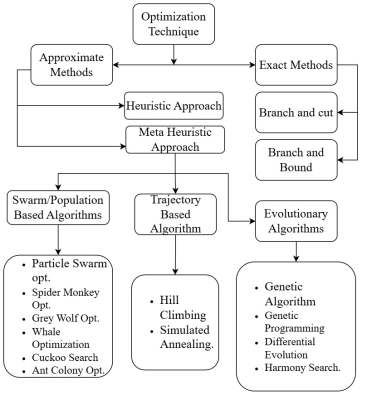
Figure 1. Classification of Optimization Technique.
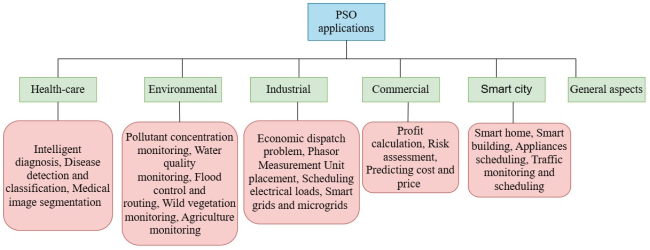
Figure 2. Applications of PSO.
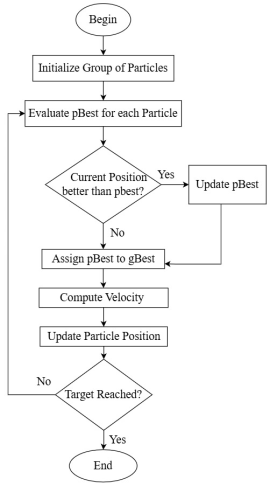
Figure 3. Flowchart of PSO.
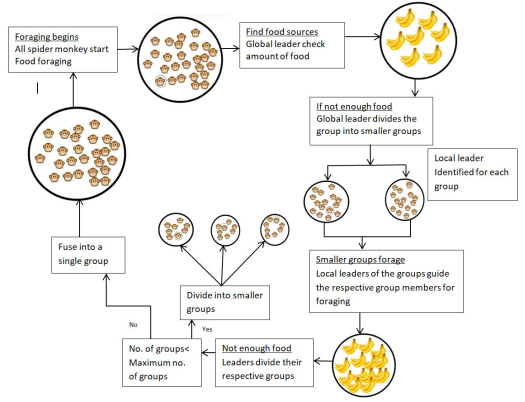
Figure 4. Spider Monkey foraging behavior analysis [30].
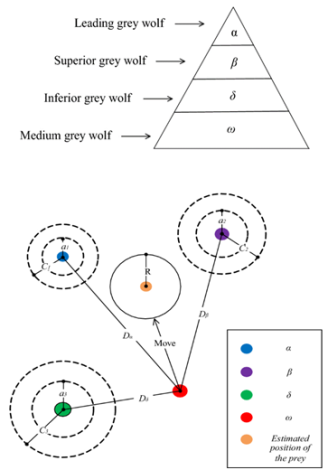
Figure 5. Schematic diagram of gray wolf population hierarchy and predation processes [54].
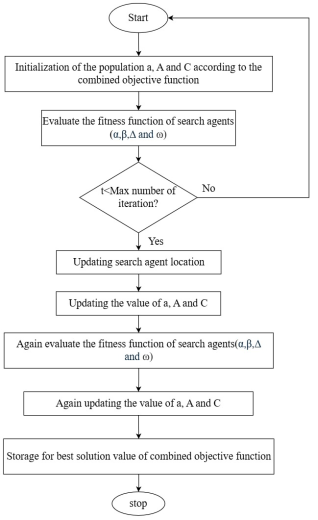
Figure 6. Flowchart of Grey Wolf Optimization.
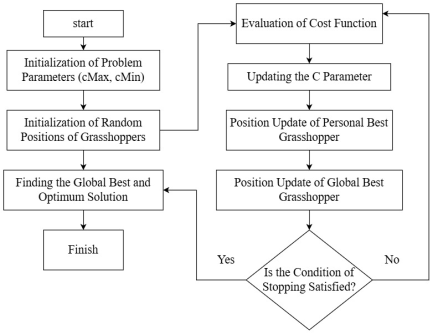
Figure 7. Flowchart of Grasshopper Optimization Algorithm (GOA).
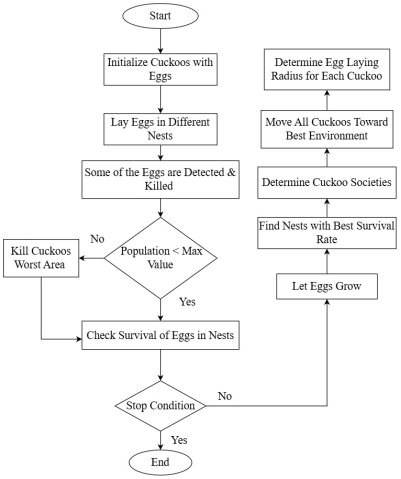
Figure 8. Flowchart of Cuckoo Search Optimization.
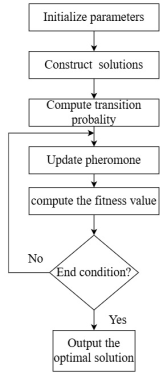
Figure 9. Flowchart of the Ant Colony Optimization.
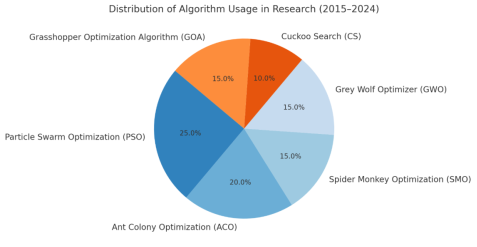
Figure 10. Pie Chart of Distribution of Algorithm Usage in Research.
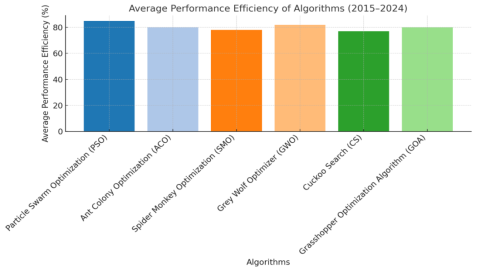
Figure 11. Bar graph of the Average Performance Efficiency of Algorithms.

Information



 Share This Article
 Twitter
 Linked In
 Facebook
 Copy
Copy Download