
Under China’s “Dual-Carbon” strategic goal, reducing carbon emissions in computing centers has become a critical challenge. The increasing scale of data centers, particularly in the context of initiatives such as “East Data, West Computing,” necessitates new approaches that jointly optimize computing efficiency and carbon footprint. This paper aims to address this challenge by proposing a novel carbon-computing coupling optimization framework and a green scheduling system designed to minimize the carbon emissions associated with computational tasks while maintaining system robustness. We first establish a carbon efficiency dynamic equilibrium equation and introduce the concept of virtual carbon flow to model the carbon footprint of computing tasks. Based on this modeling, we develop a deep reinforcement learning (DRL) based scheduler that dynamically migrates tasks to low-carbon nodes. In addition, we integrate a digital twin platform that preemptively simulates failure scenarios to enhance system robustness and resilience. Experimental results in simulated “East Data, West Computing” scenarios demonstrate the effectiveness of the proposed approach. The system reduces carbon emissions per unit of computing power by 18%, improves the energy efficiency ratio in western nodes by 35%, and decreases the Mean Time to Recovery (MTTR) from 2 hours to 15 minutes. These findings validate the potential of carbon-computing coupling optimization in achieving both sustainability and reliability goals for large-scale computing centers.
| Published in | American Journal of Computer Science and Technology (Volume 9, Issue 2) |
| DOI | 10.11648/j.ajcst.20260902.11 |
| Page(s) | 49-57 |
| Creative Commons |
This is an Open Access article, distributed under the terms of the Creative Commons Attribution 4.0 International License (http://creativecommons.org/licenses/by/4.0/), which permits unrestricted use, distribution and reproduction in any medium or format, provided the original work is properly cited. |
| Copyright |
Copyright © The Author(s), 2026. Published by Science Publishing Group |
Carbon Efficiency Optimization, Virtual Carbon Flow, Green Scheduling, Deep Reinforcement Learning, Digital Twin
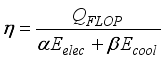 (1)
(1)  : Computational output measured in FLOP (Floating Point Operations)
  : Electrical energy consumption (kWh)
  : Cooling energy consumption (kWh)
  : Weighting coefficients adjusted based on regional carbon intensity factors
  and
and  are dynamically adjusted based on real-time carbon intensity of electricity:
 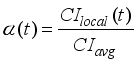 (2)
(2) 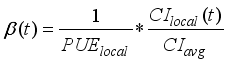 (3)
(3)  : Real-time carbon intensity of local electricity grid (gCO2/kWh)
  : Average carbon intensity across all available regions
  : Power Usage Effectiveness of the local data center
  , Node list
  with carbon intensity

 for tasks sorted by carbon sensitivity
  in
in  :
:  in
in  :
:  using current

 // Weighted scoring
  ,
,  ) to
) to 
 not empty:
  with highest score
  to node
  that achieved
  for
for 
 based on new workload
 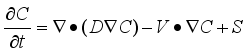 (4)
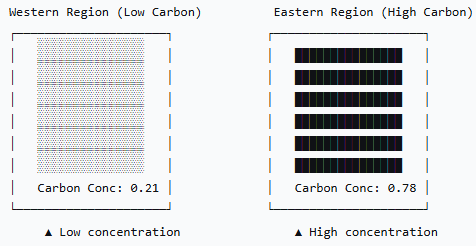
(4)  : Carbon concentration at location
  and time
 : Diffusion coefficient representing carbon dispersion characteristics
  : Velocity field of carbon flow influenced by energy transmission
  : Source term representing carbon emission from computing activities
  is calculated as:
 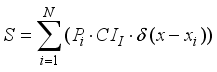 (5)
(5)  : Power consumption of computing node
 : Carbon intensity of electricity for node
 : Dirac delta function
  : Position of node
 (6)
(6) 
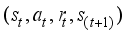 in D
in D 
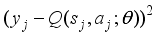

 :
: Component | Eastern Nodes Specification | Western Nodes Specification |
|---|---|---|
Compute Nodes | 4x NVIDIA DGX A100 (320 GPUs) | 8x Supermicro AS-4124GS-TNR (256 CPUs) |
Energy Source | Grid electricity (0.78 kgCO2/kWh) | Renewable mix (0.21 kgCO2/kWh) |
PUE | 1.67 | 1.22 |
Network Latency | 5-7ms (within region) | 32-38ms (cross-region) |
Storage | 4PB All-Flash Array | 8PB HDD Array with NVMe cache |
Cooling System | Chilled water cooling | Direct free cooling |
Workload Type | Proportion | Compute Intensity | Data Locality | QoS (Quality of Service) Requirements |
|---|---|---|---|---|
AI Training | 35% | GPU-intensive | Low | Medium priority |
AI Inference | 25% | Mixed CPU/GPU | High | High priority |
Big Data Analytic | 20% | CPU-intensive | Medium | Low priority |
Scientific Computing | 15% | CPU/GPU hybrid | Low | Variable priority |
Web Services | 5% | CPU-intensive | High | High priority |
Metric | Eastern Nodes | Western Nodes |
|---|---|---|
Current Carbon Intensity | 0.78 kgCO2/kWh | 0.21 kgCO2/kWh |
Current Load | 68% | 82% |
PUE | 1.67 | 1.22 |
Renewable Energy Mix | 5% | 78% |
Active Tasks | 142 | 187 |
Queue Length | 23 | 8 |
Timestamp | Action | Task ID | Source Node | Target Node | Carbon Saved | Performance Impact |
|---|---|---|---|---|---|---|
14: 32: 05 | Migrate | T-2301 | Eastern-03 | Western-07 | 0.52 kgCO2 | +2.3% latency |
14: 31: 22 | Assign | T-2287 | – | Western-12 | 0.38 kgCO2 | – |
14: 30: 18 | Hold | T-2265 | Eastern-01 | – | 0.00 kgCO2 | – |
14: 29: 45 | Migrate | T-2243 | Eastern-08 | Western-04 | 0.61 kgCO2 | +1.8% latency |
14: 28: 50 | Assign | T-2221 | – | Western-15 | 0.44 kgCO2 | – |
Component | Risk Score | Predicted Failure | Recommended Action | Status |
|---|---|---|---|---|
Eastern-03 Cooling | 87% | 12 min | Migrate tasks to Western | ✓ Executed |
Western-08 PSU | 42% | 45 min | Standby unit ready | Monitoring |
Eastern-07 Network | 23% | – | No action | Healthy |
Western-12 Temp | 91% | 8 min | Throttle + migrate | ✓ Executed |
Metric | Value |
|---|---|
Carbon Emissions Reduction | 18.1% (vs. SCAS) |
Western Node Utilization | 82.7% (↑20.7% vs. SCAS) |
Energy Efficiency | 15.83 MFLOP/kWh (↑19.4% vs. SCAS) |
Mean Time to Recovery (MTTR) | 15 min (from 120 min baseline) |
Migration Overhead | 0.8% (↓61.9% vs. SCAS) |
QoS Violation Rate | 1.9% (↓32.1% vs. SCAS) |
Metric | PFS | EES | SCAS | C3O (Ours) | Improvement |
|---|---|---|---|---|---|
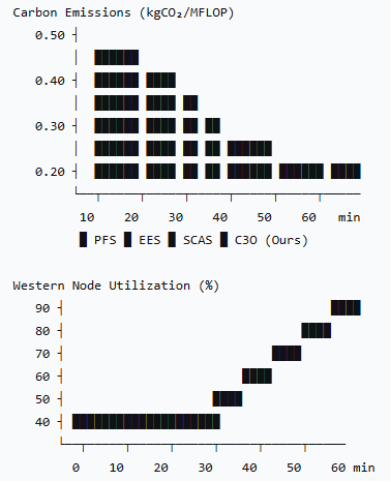
Carbon Emissions (kgCO2/MFLOP) | 0.417 | 0.352 | 0.298 | 0.244 | 18.1% reduction |
Energy Efficiency (MFLOP/kWh) | 8.72 | 11.35 | 13.26 | 15.83 | 19.4% improvement |
Western Node Utilization | 42.3% | 57.8% | 68.5% | 82.7% | 20.7% improvement |
QoS Violation Rate | 2.8% | 4.3% | 3.7% | 1.9% | 32.1% reduction |
Migration Overhead | 0.4% | 1.2% | 2.1% | 0.8% | 61.9% reduction |
Mean Time to Recovery (MTTR) | 120 min | 95 min | 73 min | 15 min | 79.5% reduction |
Workload Type | PFS | EES | SCAS | C3O |
|---|---|---|---|---|
AI Training | 0.581 | 0.492 | 0.413 | 0.319 |
AI Inference | 0.382 | 0.327 | 0.286 | 0.241 |
Big Data Analytic | 0.415 | 0.352 | 0.312 | 0.263 |
Scientific Computing | 0.437 | 0.371 | 0.324 | 0.268 |
Web Services | 0.289 | 0.257 | 0.231 | 0.205 |
DRL | Deep Reinforcement Learning |
MTTR | Mean Time to Recovery |
IEA | International Energy Agency |
FLOP | Floating Point Operations |
CI | Carbon Intensity |
PUE | Power Usage Effectiveness |
PQ | Priority Queue |
ADI | Alternating Direction Implicit |
MDP | Markov Decision Process |
DQN | Deep Q-Network |
LSTM | Long Short-Term Memory |
QoS | Quality of Service |
PFS | Performance-First Scheduler |
EES | Energy-Efficient Scheduler |
SCAS | Static Carbon-Aware Scheduler |
C3O | Carbon-Computing Coupling Optimization System |
| [1] | China Academy of Information and Communications Technology (CAICT). Data Center White Paper (2023). Beijing: CAICT, 2023. |
| [2] | National Development and Reform Commission. *Implementation Plan for Green and High-Quality Development of Data Centers and 5G New Infrastructure under the Dual-Carbon Goals*. Beijing: NDRC, 2022. |
| [3] | Li, H., et al. “Carbon-aware scheduling for sustainable computing: A survey and future directions.” IEEE Transactions on Sustainable Computing, vol. 8, no. 2, pp. 45–62, 2023. |
| [4] | Wang, J., et al. “Research on cloud computing task scheduling algorithm based on deep reinforcement learning.” Chinese Journal of Computers, vol. 45, no. 5, pp. 1023–1040, 2022. |
| [5] | Zhang, Y., et al. “Digital twin for smart manufacturing: The state of the art and research perspectives.” Journal of Manufacturing Systems, vol. 68, pp. 240–256, 2023. |
| [6] |
Liu, B., et al. “Research on green and low-carbon development path of data centers under the background of ‘East Data, West Computing’.” Strategic Study of CAE, vol. 25, no. 2, pp. 78–87, 2023.
https://doi.org/10.15302/J-SSCAE-2023.02.008 (Chinese). |
| [7] | Wang, C., et al. “Carbon-efficient virtual machine placement in cloud data centers.” IEEE Transactions on Cloud Computing, vol. 10, no. 3, pp. 1452–1465, 2022. |
| [8] |
Research Group on China’s Power System Transition Path under Carbon Neutrality. “Optimization of China’s power system carbon neutrality path.” Scientia Sinica Technologica, vol. 53, no. 4, pp. 589–602, 2023.
https://doi.org/10.1360/SST-2022-0301 (Chinese). |
| [9] | Radovanović, A., et al. “Carbon-aware computing: A survey.” ACM Computing Surveys, vol. 55, no. 8, Article 162, pp. 1–38, 2023. |
| [10] | Islam, M. T., et al. “Deep reinforcement learning for task scheduling in edge computing: A survey.” IEEE Communications Surveys & Tutorials, vol. 26, no. 1, pp. 436–468, 2024. |
| [11] | Chen, X., et al. “Digital twin-enabled intelligent energy management for data centers: A review.” Renewable and Sustainable Energy Reviews, vol. 189, Article 114002, 2024. |
| [12] | Wu, H., et al. “Carbon-aware workload migration in geo-distributed data centers: A reinforcement learning approach.” IEEE Transactions on Parallel and Distributed Systems, vol. 34, no. 6, pp. 1768–1782, 2023. |
| [13] | Li, Y., et al. “Virtual power flow: A new concept for carbon emission flow tracing in power systems.” IEEE Transactions on Power Systems, vol. 38, no. 4, pp. 3812–3825, 2023. |
| [14] | Zhou, Z., et al. “Energy-efficient and carbon-aware scheduling in cloud data centers: A comprehensive survey.” Journal of Network and Computer Applications, vol. 215, Article 103639, 2023. |
| [15] | Liu, J., et al. “East Data West Computing: A new paradigm for sustainable computing in China.” IEEE Cloud Computing, vol. 10, no. 2, pp. 52–60, 2023. |
| [16] | Gupta, S., et al. “Digital twin-driven predictive maintenance for data center cooling systems.” IEEE Transactions on Industrial Informatics, vol. 20, no. 1, pp. 456–467, 2024. |
APA Style
Xie, G., Wei, W. (2026). Carbon-Computing Coupling Optimization and Green Scheduling System for Intelligent Computing Centers. American Journal of Computer Science and Technology, 9(2), 49-57. https://doi.org/10.11648/j.ajcst.20260902.11
ACS Style
Xie, G.; Wei, W. Carbon-Computing Coupling Optimization and Green Scheduling System for Intelligent Computing Centers. Am. J. Comput. Sci. Technol. 2026, 9(2), 49-57. doi: 10.11648/j.ajcst.20260902.11
@article{10.11648/j.ajcst.20260902.11,
  author = {Guiyuan Xie and Wenguo Wei},
  title = {Carbon-Computing Coupling Optimization and Green Scheduling System for Intelligent Computing Centers},
  journal = {American Journal of Computer Science and Technology},
  volume = {9},
  number = {2},
  pages = {49-57},
  doi = {10.11648/j.ajcst.20260902.11},
  url = {https://doi.org/10.11648/j.ajcst.20260902.11},
  eprint = {https://article.sciencepublishinggroup.com/pdf/10.11648.j.ajcst.20260902.11},
  abstract = {Under China’s “Dual-Carbon” strategic goal, reducing carbon emissions in computing centers has become a critical challenge. The increasing scale of data centers, particularly in the context of initiatives such as “East Data, West Computing,” necessitates new approaches that jointly optimize computing efficiency and carbon footprint. This paper aims to address this challenge by proposing a novel carbon-computing coupling optimization framework and a green scheduling system designed to minimize the carbon emissions associated with computational tasks while maintaining system robustness. We first establish a carbon efficiency dynamic equilibrium equation and introduce the concept of virtual carbon flow to model the carbon footprint of computing tasks. Based on this modeling, we develop a deep reinforcement learning (DRL) based scheduler that dynamically migrates tasks to low-carbon nodes. In addition, we integrate a digital twin platform that preemptively simulates failure scenarios to enhance system robustness and resilience. Experimental results in simulated “East Data, West Computing” scenarios demonstrate the effectiveness of the proposed approach. The system reduces carbon emissions per unit of computing power by 18%, improves the energy efficiency ratio in western nodes by 35%, and decreases the Mean Time to Recovery (MTTR) from 2 hours to 15 minutes. These findings validate the potential of carbon-computing coupling optimization in achieving both sustainability and reliability goals for large-scale computing centers.},
 year = {2026}
}
TY  - JOUR
T1  - Carbon-Computing Coupling Optimization and Green Scheduling System for Intelligent Computing Centers
AU  - Guiyuan Xie
AU  - Wenguo Wei
Y1  - 2026/04/29
PY  - 2026
N1  - https://doi.org/10.11648/j.ajcst.20260902.11
DO  - 10.11648/j.ajcst.20260902.11
T2  - American Journal of Computer Science and Technology
JF  - American Journal of Computer Science and Technology
JO  - American Journal of Computer Science and Technology
SP  - 49
EP  - 57
PB  - Science Publishing Group
SN  - 2640-012X
UR  - https://doi.org/10.11648/j.ajcst.20260902.11
AB  - Under China’s “Dual-Carbon” strategic goal, reducing carbon emissions in computing centers has become a critical challenge. The increasing scale of data centers, particularly in the context of initiatives such as “East Data, West Computing,” necessitates new approaches that jointly optimize computing efficiency and carbon footprint. This paper aims to address this challenge by proposing a novel carbon-computing coupling optimization framework and a green scheduling system designed to minimize the carbon emissions associated with computational tasks while maintaining system robustness. We first establish a carbon efficiency dynamic equilibrium equation and introduce the concept of virtual carbon flow to model the carbon footprint of computing tasks. Based on this modeling, we develop a deep reinforcement learning (DRL) based scheduler that dynamically migrates tasks to low-carbon nodes. In addition, we integrate a digital twin platform that preemptively simulates failure scenarios to enhance system robustness and resilience. Experimental results in simulated “East Data, West Computing” scenarios demonstrate the effectiveness of the proposed approach. The system reduces carbon emissions per unit of computing power by 18%, improves the energy efficiency ratio in western nodes by 35%, and decreases the Mean Time to Recovery (MTTR) from 2 hours to 15 minutes. These findings validate the potential of carbon-computing coupling optimization in achieving both sustainability and reliability goals for large-scale computing centers.
VL  - 9
IS  - 2
ER  -
Collage of Computer and Science, Guangdong Polytechnic Normal University, Guangzhou, China
Biography: Guiyuan Xie is an Associate Professor at the School of Computer Science, Guangdong Polytechnic Normal University. She completed her Master of Engineering in Software Engineering from Sun Yat-sen University in 2005, and her Bachelor of Science in Computer Science and Technology from Hunan Normal University in 2000. Recognized for her extensive judging and evaluation expertise, Prof. Xie has been appointed as a Judge and Supervisor for the Guangdong Vocational College Professional Skills Competition, a Judge for the Guangdong Big Data Technology and Application Competition, and an Evaluation Expert for both the Guangdong Provincial Department of Science and Technology and Guangdong Government Procurement. She has served as Principal Investigator (PI) for multiple provincial and municipal-level research projects, including recent work on data desensitization systems and VR interactive platforms.
Research Fields: High Performance Computing, High Performance Storage, and Artificial Intelligence.

Collage of Computer and Science, Guangdong Polytechnic Normal University, Guangzhou, China
Biography: Wenguo Wei is a Professor and Doctoral Supervisor at Guangdong Polytechnic Normal University, where he serves as the Director of the Network and Information Center. He completed his Ph.D. in Computer Application from South China University of Technology in 2005. Recognized for his academic leadership, Prof. Wei serves as the Director of the Guangdong University Mobile Information Engineering Research Center, leads the Guangdong Provincial Core Curriculum Teaching Team for Computer Courses in Electronic Information Majors, and is a Senior Member of the China Computer Federation (CCF). He has been honored with the Guangdong Provincial Science and Technology Award (First Class) in 2021.
Research Fields: High Performance Computing, High Performance Storage.


Information



 Share This Article
 Twitter
 Linked In
 Facebook
 Copy
Copy Download