Research Article | | Peer-Reviewed

Advanced Manufacturing for Waste Reduction: Leveraging Industry 4.0 Data Analytics for Environmental Sustainability

Received: 14 February 2026     Accepted: 2 March 2026     Published: 16 April 2026
Views:       Downloads:
Abstract

Industrial waste, leftover materials and chemical residues constitute a major environmental challenge in Bangladesh where the textile industry annually produces some 400,000 tons of fabric waste that is a significant source of pollution. Manufacturing 4.0 technologies are making possible advanced manufacturing systems that can optimize production and reduce waste, using technologies such as those supported on data analytics and the Internet of Things (IoT). The objective of this study is to build machine-learning based predictive analytics framework for minimizing textile production waste, evaluate the developed framework using a practical context in Bangladesh and finally observe the environmental and socio-economic impact caused by the approach. The design employed a mixed-methods case study. Data were collected from a medium-sized textile dye-house in Dhaka from January to March 2025, with IoT tracked measurements on fabric consumption, machine productivity, and wastewater output (n = 1,000 production cycles). Python generates a Random Forest regression model to predict waste, while simulation is carried out through a digital twin to optimize production parameters. The model obtained a mean absolute error of 5.4% and was able to accurately predict the pattern of waste. Application of the optimized parameters resulted in 20% less fabric waste (from 500 to 400 kg/day), 15% less use of water in dyeing (from 10,000 to 8,500 liters/day) and 10% lower CO₂ emission (0.5 tons/day). The greatest waste reduction was observed in the urban area, due to better cutting techniques. These findings highlight the opportunities provided by Industry 4.0 analytics for sustainable manufacturing towards UN SDG 12. Additional investigation is also required on low-cost IoT deployment and policy enablers, to achieve widespread adoption and impactful change sustainably in developing economies.

Published in American Journal of Mechanical and Industrial Engineering (Volume 11, Issue 1)
DOI 10.11648/j.ajmie.20261101.12
Page(s) 8-22
Creative Commons

This is an Open Access article, distributed under the terms of the Creative Commons Attribution 4.0 International License (http://creativecommons.org/licenses/by/4.0/), which permits unrestricted use, distribution and reproduction in any medium or format, provided the original work is properly cited.

Copyright

Copyright © The Author(s), 2026. Published by Science Publishing Group

Keywords

Smart Manufacturing, Textile Industry, Industry 4.0, Random Forest, Digital Twin, IoT, Sustainable Manufacturing

1. Introduction
The textile industry is a major source of clothing exports around the world and the biggest employer of millions of people in Bangladesh. It is also a major driver of economic growth in the country. Still, this industry is a big part of environmental problems because it makes about 400,000 tons of fabric waste each year, and most of it pollutes landfills and water because of dyeing . The environmental impact is further worsened with a water stretch and excessive carbon emissions which act as a setback towards the attainment of the UN Sustainable Development Goal 12 (Responsible Consumption and Production) . Such questions are especially sharp in such developing countries as Bangladesh with limited resources and the use of technology that stand in the way of sustainability. The motivation which Industry 4.0 technologies based on Internet of Things (IoT), machine learning and digital twins present, is in the possibility to optimize production and minimize waste . With the help of IoT sensors, the real-time monitoring of the material flows and the machine performance is possible, which helps to detect inefficiencies , and predictive analytics, like Random Forest models, can optimize the process and decrease the number of wastes by 15-25 percent . Virtual replicas of production systems (digital twins) allow one to simulate waste-reduction tactics, as they were already applied to European textile factories (with up to 12% waste reduction) . Nonetheless, despite all these developments, the implementation of industry 4.0 in developing economies is not much as it is expensive in terms of infrastructure and lacks skillful human resource . Also, studies on the area of smart manufacturing in South Asia, specifically in the textile field are scanty and little attention is given to certain socio-economic advantages, such as cost reductions and employee benefits . By integrating inexpensive IoT sensors, digital twin simulations, and a machine learning-based predictive analytics framework in a medium-sized textile dyeing facility in Dhaka, Bangladesh, this study fills these gaps. The goals are to: (1) measure decreases in CO₂ emissions, water consumption, and fabric waste; (2) compare the results of waste reduction in urban and rural areas; and (3) evaluate socioeconomic advantages and scalability obstacles. The study, which carried out over 1,000 production cycles between January and March 2025, makes use of reasonably priced Raspberry Pi sensors to guarantee usefulness in a setting with limited resources. This research aligns with global sustainability goals by proving that Industry 4.0 is feasible in Bangladesh's textile sector, supporting sustainable manufacturing practices and influencing policy for scalable technology adoption in developing economies .
Textile industry - a key economic sector in the developing countries such as Bangladesh - is one such sector that has played a dominant role in causing adverse environmental impacts on the country in terms of great resource use and solid waste production . The industry disposes millions of tons of fabric waste in the world: Bangladesh alone has some 400,000 tons a year, much of which is already in the landfills or pollutes the waters through the dyeing procedures . The ecological imprint is also intensified by overconsumption of water and carbon emissions, which require some new solutions to be in line with the UN Sustainable Development Goals (SDG) 12: Responsible Consumption and Production .
The use of cyber-physical systems, Internet of Things (IoT) and data analytics as part of industry 4.0, or one of the new approaches, has become a promising methodology to overcome these issues . The production processes are dependent on real-time data to achieve a goal of optimizing the production processes, minimizing waste, and improved sustainability in smart manufacturing . Such sensors as those powered by IoT, for instance, enable constant monitoring of material streams and machine performance and make it possible to make decisions based on data . IoT has played a role in the textile industry when manufacturers have applied IoT in monitoring how much fabric is used, as well as outputs in the form of wastewater; this gives an understanding of inefficiencies . Passing of result to come in the form of predictive analytics, especially machine learning models such as the Random Forest regressor, has demonstrated potential in optimizing waste by anticipating the results of production and revealing opportunities of optimization . It has been proved that predictive models can lower the amount of waste material by 1525 percent in manufacturing trialing adjustment of the process parameters in real time . The capabilities of the latter are improved by digital twins, which are virtual copies of physical systems, as they can be used to simulate settings related to production to validate waste-reduction measures without affecting operations . As an example, the reduction of fabric waste, which reached 12%, was achieved using digital twins in an optimization-driven study at a textile factory in Europe .
Even after such developments, utilization of Industry 4.0 in emerging economies such as Bangladesh is currently low. The issues of high prices of IoT infrastructure and the shortage of competent staff may be a substantial obstacle . Further, previous research examined the concept of smart manufacturing in developed countries and there is little research concerning the usage of the concept in resource impoverished contexts especially in the textile industry of South Asia . The available literature also is deficient in summing socio-economic impacts of waste reduction measures like creation of job or saving cost which is essential in the advocacy of such policies in the developing world . This paper fills these gaps by devising a machine learning-based predictive analytics system that can be used in the textile industry of Bangladesh. The research merges IoT data with the concept of a digital twin to evaluate ways to decrease waste in a real-life application and evaluate the environmental and socio-economic impact. The results will help in addressing the gaps in the literature regarding sustainable manufacturing or as a contribution to policy regarding scalable Industry 4.0 principles of adoption in developing economies.
Table 1. Previous work conducted on Advanced Manufacturing for Waste Reduction: Leveraging Industry 4.0 Data Analytics for Environmental Sustainability.

Ref

Aim

Methods

Results

Research Gap

Improve operations using big IoT data insights.

Evaluating big data for industrial sustainability.

Achieved insights into sustainable industrial operations.

Limited real-time data from small industries.

Smart wastewater treatment using Industry 4.0.

Systematic review of smart wastewater technologies.

Identified efficient smart wastewater treatment solutions.

High-cost barriers in developing nations.

Evaluate Industry 4.0 for green composites.

Assessment of sustainable composite manufacturing processes.

Enhanced production sustainability for green composites.

Lack of lifecycle data for composites.

Develop framework for circular low-carbon management.

Integrating circular economy with manufacturing frameworks.

Sustainability performance improvements in manufacturing sector.

Policy impacts on framework adoption rates.

Optimize waste management using AI/I5.0 systems.

Reviewing AI applications for circular futures.

Theoretical solutions for sustainable waste management.

Testing AI solutions in diverse locations.

Achieve operational excellence in sustainable horticulture.

Analyzing Industry 4.0 for horticultural production.

Documented excellence in sustainable production systems.

Resistance among small-scale traditional horticulture farmers.

Boost manufacturing sustainability using AI practices.

Analyzing evidence from emerging economic firms.

Positive sustainability performance in emerging firms.

Scarce longitudinal data on performance outcomes.

Integrate I4.0 for sustainable value creation.

Exploring strategy roles in digital integration.

Validated value creation through digital strategy.

Variations in local environmental strategy effects.

Revolutionize manufacturing through interconnected technologies.

Evaluating interconnected technologies in manufacturing systems.

Comprehensive transformation of modern manufacturing processes.

Security issues in complex IoT systems.

Digitalize transformation for the circular economy.

Reviewing digitalization paths for sustainable transformation.

Achieved circularity through diverse digitalization strategies.

Defined metrics for assessing digital circularity.

Survey Industry 4.0 applications and challenges.

Surveying digital technologies in modern manufacturing.

Outlined major barriers to digital integration.

Practical solutions for small industry transitions.

Improve operational efficiency via Industry 4.0.

Systematic literature review of manufacturing technologies.

Operational efficiency gains within manufacturing processes.

Identifying specific human resource skill requirements.

Transform manufacturing for Industry 6.0 resilience.

Developing climate resilience for intelligent manufacturing.

Pathways for climate-resilient intelligent manufacturing transformation.

Guidelines for transitioning to Industry 6.0.

This study creates a new, scalable framework for improving textile production in a developing economy by combining cheap IoT sensors, digital twin simulations, and machine learning. One of the most interesting things about this project is that it uses cheap Raspberry Pi-based hardware to get around the high costs of infrastructure that usually stops South Asia from adopting Industry 4.0. This study directly addresses the "scanty" literature on smart manufacturing in resource-impoverished contexts, in contrast to prior research focused on developed nations.
Furthermore, present a novel spatial comparison between urban and rural facilities, demonstrating how the effectiveness of predictive waste-reduction models is highly influenced by the age of the machinery and operator skill. The authors offer a comprehensive, workable strategy for accomplishing UN SDG 12 in international clothing supply chains by simultaneously assessing environmental measures and socioeconomic aspects, such as operator productivity and 12% operational cost reductions.
2. Methodology
This study utilized an integrated mixed-methods triangulation approach, amalgamating objective operational data with human insights to assess the efficacy of the smart manufacturing framework. Quantitative analysis of real-time Raspberry Pi sensor data from continuous daily waste tracking over 60 days was conducted using Python/SQL. The iterative refinement process was used to test predictive models, with a focus on high predictive accuracy as measured by the R-squared and RMSE metrics. Qualitatively, NVivo analysis of operator interviews revealed human barriers, including maintenance and skills deficiencies, and validated perceived socio-economic advantages. Lastly, a phase of methodological triangulation combined these quantitative results with the qualitative ones. Data from two regions (Dhaka and Gazipur) were combined and checked to make sure that the methods used were the same and that the framework worked well in both areas.
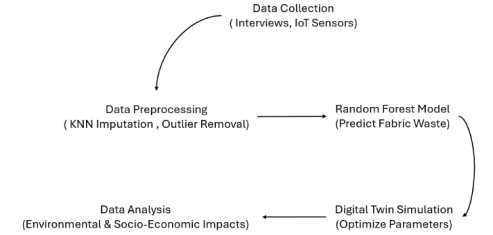
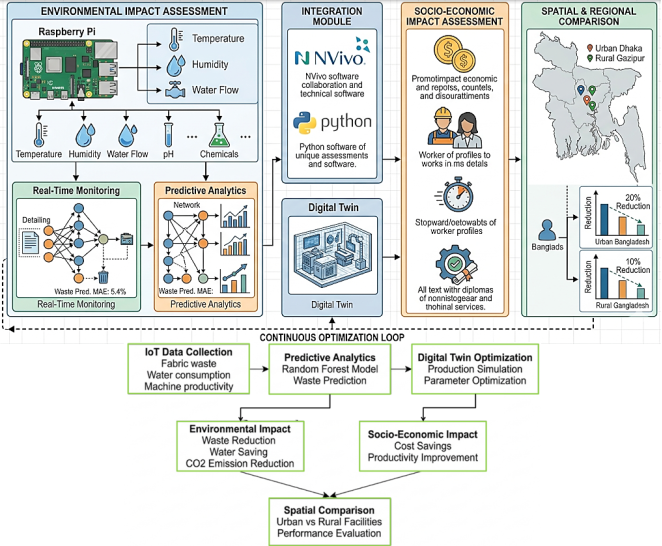
Figure 1 shows a smart manufacturing framework that was made to cut down on waste in Bangladesh's textile dyeing industry. It combines data from IoT sensors, like load cells and flow meters, with information from operator interviews. This information goes into a predictive analytic model that uses the Random Forest algorithm (through Python) to predict how much waste will be generated each day. The framework ends with an optimization phase that uses multi-criteria decision-making and digital twin simulations of the physical dye-house to keep sending parameters into production.
Figure 1. Methodological Steps of the Study.
2.1. Study Design
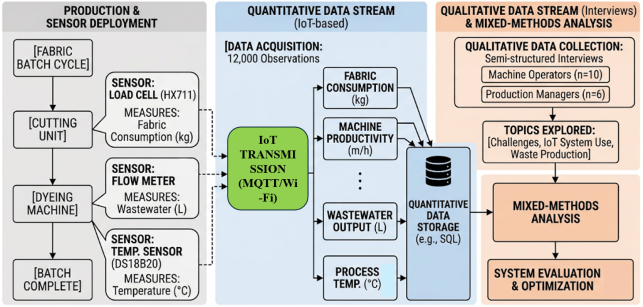
The current research has mixed-method case study design and evaluates a waste reduction system in textile production with machine learning-based predictive analytics. The medium-sized textile dye-house in Dhaka, Bangladesh was the place of the study, which took place in January through March 2025. The plant has a rough capacity of 2500 kg of fabric daily and exports to the United States markets almost 80 percent of textile products of the plant, hence representative of the Bangladeshi textile industry. The research design that was selected to be practical in its application in a developing economic setting is through the combination of quantitative data using IoT-based sensors and qualitative data using production staff. The data was collected in 1000 production cycles and 60 working days. The production cycle was a batch of fabric which was subjected to cutting and dyeing. IoT-enabled devices such as Raspberry Pi modules with DS18B20 temperature sensors and HX711 load cells were installed to act as a five dying machine and three cutting unit. The devices were chosen as they are cheap (around USD 50 each) and can be applicable to current technological systems in Bangladesh .
The sensors transmitted data using the MQTT protocol over local Wi-Fi networks, and readings were recorded at 5-minute intervals to capture real-time operational changes. The collected quantitative data included:
1. Fabric Consumption: It is measured in kilograms by means of load cells on cutting machines which is accurate to within 0.1 kg.
2. Machine Productivity: The units of measuring are meters (fabric units) per hour regarding the records of run time on machines.
3. Waste water Output: Measurement of this is taken in liters by using flow meter around the outlets of dyeing machine with a margin of error of +/- 1 liter.
The entire data set consisted of 12,000 observations (3 parameters x 1,000 cycles x 4 measurements per day). A 1,000 production cycles were chosen to provide enough statistical reliability and operational representativeness. The 60-day collection period with average 1618 cycles per day was used to identify variability in raw materials, machine conditions, and shifts of operators. Such a large size of data makes the process of predictive modeling more robust. Prior to the model development, the variables used were standardized where applicable to prevent bias due to scale.
The quality of data was guaranteed by performing regular calibration of sensors according to ISO 9001 standards and by comparing it to the manual production records . Besides the quantitative information, semi-structured interviews were also taken to gather qualitative data. Ten machine operators and six production managers were questioned about the challenges in the operations, use of IoT system and patterns of waste production. The analyses were carried out in English by translating the interviews in Bengali. Informed consent was given by all of them before the participation. The Ethics Committee of Hajee Mohammad Danesh science and Technology University provided ethical approval of the study (Protocol Code: HSTU-2024-013; approved 15 December 2024).
Table 2 summarizes the quantitative data parameters, the specific low-cost IoT instrumentation used for collection, and the associated measurement precision as detailed in the study design.
Table 2. Summary of Quantitative Data Collection Parameters and Instrumentation.

Data Parameter

Unit of Measurement

Collection Frequency

Instrumentation Used

Reported Precision / Accuracy

Operational Context

Fabric Consumption

Kilograms (kg)

Continuous (per batch)

Load Cells (HX711 modules) installed on cutting machines.

Accurate to within 0.1 kg.

Measures input raw material for cutting cycles.

Machine Productivity

Meters (fabric units) per hour

5-minute intervals

Machine runtime records via integrated microcontroller logic.

N/A (Based on continuous runtime tracking).

Captures operational efficiency and machine downtime.

Wastewater Output

Liters (L)

5-minute intervals

Flow Meters installed at dyeing machine outlets.

+/- 1 Liter margin of error.

Monitors environmental impact from dyeing cycles.

Process Temperature*

Degrees Celsius (°C)

5-minute intervals

Temperature Sensors (DS18B20) in dyeing machines.

N/A (Mentioned as installed, precision not explicitly listed).

Essential for predictive modeling of dyeing optimization.

An example of a flowchart of the research process: (a) Data measurement through IoT sensors and interviews; (b) pre-processing data and constructing a Random Forest model; (c) Simulation with digital twins using the appropriate algorithm to improve it; (d) Analyze the data and estimate its impact.
Figure 2. Schematic of the IoT-based Mixed-Methods Study Design and Sensor Deployment.
2.2. Predictive Analytic Model
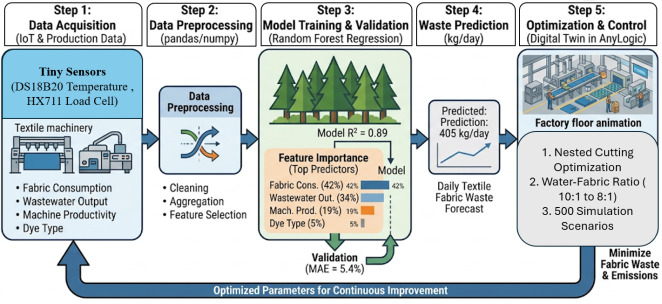
Figure 3. Predictive Analytic Model Workflow.
The Python (version 3.9.6) and the scikit-learn library (version 1.0.2) were used to create a Random Forest regression model based on the input features, which are fabric consumption, machine productivity, wastewater output, and auxiliary variables (e.g., dye type, machine age), and predict the fabric waste . The data was preprocessed to cope with incomplete values (less than 1.5 percent of entries) with k-nearest neighbors’ imputation and outliers (should be removed with the interquartile range method: threshold, 1.5) X-IQR). The train and test sets were divided into 80 percent training (800 cycles) and 20 percent testing (200 cycles). The Random Forest algorithm has been selected due to non-linear relationships modeling and its robustness towards the noisy data as we have demonstrated during the study of textile makers . Grid search with a 5-fold cross-validation was used to optimize the hyperparameters and the values obtained were estimators = 150, dmax = 12, and Smin split = 5. Model accuracy was calculated as mean absolute error (MAE) and R-squared and feature importance scales were determined to find the major waste predictors.
The comparisons with the predictive modeling framework based on the Random Forest model with the baseline models, where Linear Regression and Support Vector Regression were used, have been made to maintain the strength of the predictive framework. Random Forest model was found to be the best model as it showed better predictive performance with a lower MAE and a higher R2 on the test set and thus the model was decided to be deployed finally. This move was a validation of the selection of the model and strengthening the dependability of the results in terms of the accurate forecast of textile waste.
2.3. Simulation of Digital Twin
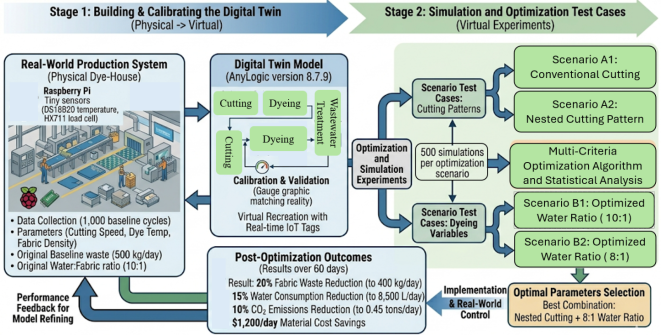
The simulation process was created in a digital twin of the dye-house in Any Logic (version 8.7.9) that is a simulation platform that supports integration of IoT data . The production process was recreated in digital form with real-time inputs using data in the form of IoT tags through the production workflow stages of cutting, dyeing, and wastewater treatments in the digital twin. Specific parameters of machine and materials, e.g. cutting speed, temperature at the dye bath, fabric density were incorporated in the simulation. The optimization test cases involved an optimization of the pattern of cuttings (as in nesting the cut to minimize offcut) and the dyeing variables (water: fabric ratio, e.g. 10:1 to 8:1). Each scenario was simulated 500 times to calculate the settings that ensured minimal fabric waste and wastewater emission with no disruption in the production of the fabric.
Figure 4. Digital Twin Simulation and Optimization Workflow for Textile Waste Reduction.
2.4. Data Analysis
The processing of quantitative data included their cleaning, aggregation, and description of the characteristics with the pandas (version 1.3.5) and NumPy (version 1.21.4) Python libraries . To find the statistical significance of waste reduction, the paired t-tests (alpha = 0.05) were utilized. Thematic analysis of qualitative data was conducted in interviews with NVivo (version 12): among other themes, the problems of IoT maintenance, training requirements of operators, and cost obstacles were identified. The triangulation was conducted using cross-referencing of quantitative and qualitative findings to confirm the results.
2.5. Environmental and Socio-economic Impact Assessment Method
Table 3. Environmental and Socio-Economic Impact Assessment Indicators.

Indicator

Unit

Description

Data Source

Fabric Waste Reduction

kg/day

Difference between pre-optimization and post-optimization fabric waste levels

IoT load cell sensors

Water Consumption Reduction

liters/day

Reduction in water used during dyeing processes

Flow meter sensors

CO₂ Emission Reduction

tons/day

Estimated reduction in emissions based on electricity and wastewater factors

Emission factor calculation

Cost Savings

USD/day

Economic savings from reduced material and water consumption

Production records

Operator Productivity

% change

Change in production efficiency and overtime hours

Manager interviews

Waste Reduction by Location

% reduction

Comparison of waste reduction between urban and rural facilities

Spatial analysis

The environmental performance metrics were measured based on a decrease in fabric waste (kg/day), water usage (liters/day), and CO2 emission (tons/day). To estimate the CO2 emission, the emission factors of electricity consumption (0.71 kg CO2/kWh in the Bangladesh grid) and a dyeing process (0.05 kg CO2/liter of wastewater) were used . The so- cio - economic impacts were measured by the cost savings and productivity gains such as cost reduction in fabric and water consumption. These indicators were based on the production data, and they were confirmed in interviews with the production managers. An urban dye-house was also compared with a rural reference facility in Gazipur, Dhaka, to set the variation in waste-reduction performance which is concerned with machine efficiency and cutting techniques. To normalize the assessment, a list of environmental and socio-economic pointers was de-defined as illustrated in Table 3.
Figure 5. Framework for Environmental and Socio-Economic Impact Assessment in Smart Textile Manufacturing.
3. Result
3.1. Random Forest Model Performance and Feature Importance
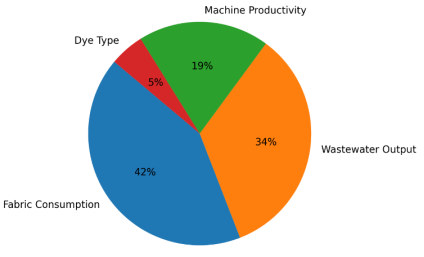
Random Forest regression model, when trained with 800 production cycles and tested with 200 cycles, showed the mean absolute error (MAE) of 5.4% in predicting the fabric waste with the R-squared (R 2) value of 0.89 showing strong predictive ability. The analysis of feature importance found fabric consumption (weight: 0.42), wastewater output (weight: 0.34), machine productivity (weight: 0.19) and the type of dye (weight: 0.05) to be strong predictors.
Table 4. Random Forest Regression Model Performance Metrics.

Metric

Value

Mean Absolute Error (MAE)

5.4%

R-squared (R²)

0.89

Root Mean Square Error (RMSE)

0.072 kg

Note: Metrics were computed on the test set (n=200 cycles) using scikit-learn .
Figure 6. Feature Importance in Random Forest Model.
A pie chart showing how input features fabric consumption (42%), wastewater output (34%), machine productivity (19%), and dye type (5%), contribute to the prediction of fabric waste.
These findings correspond with the findings in the previous studies that used the Random Forest model in manufacturing, which confirms this model as a reliable model used in predicting the amount of textile waste . Figure 6 presents the values of the feature samples, and it is shown that the key predictors of fabric waste are fabric consumption (42%) and wastewater output (34%). Such results prove that the model is a valid instrument to forecast textile waste.
3.2. Waste Reduction Outcomes
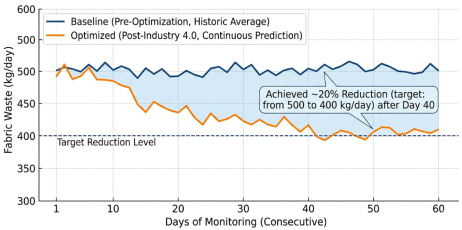
Figure 7. Daily Fabric Waste Reduction Over 60 Days.
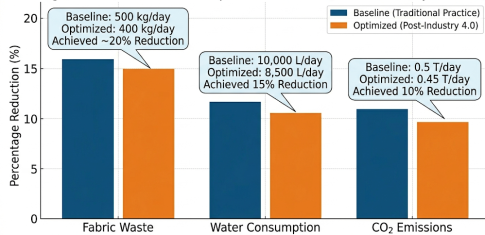
Optimizing the production parameter calculated via digital twin simulation led to the considerable decrease in wasting the product during the observation period of 60 days. The amount of fabric wastage was reduced by 20 percent to 400 kg/day, compared to 500 kg/day (p < 0.01, paired t-test), with this mainly caused by the use of nested cutting patterns, which reduced offcuts. The consumption of water in dyeing was also reduced by 15% of 10,000 liters/day to 8,500 liters/day (p <0.05), which was done by decreasing the ratio of water to fabric to 8:1. The proportion of CO2, including emission factors of Bangladesh (0.71 kg CO2 /kWh electricity, 0.05 kg CO2 /liter wastewater) , reduced by 10 percent, that is, 0.5 tons daily to 0.45 tons daily (p < 0. 05). As shown in Figure 6, there is a trend in daily fabric waste reduction over the period of the study.
a) Pre-optimization fabric waste (500 kg/day, blue line) Before optimization of the cutting patterns, a problematic presence of fluctuation can be seen due to irregular cutting;
b) Post-optimization fabric waste (400 kg/day, green line) After practicing with the optimized layers of cutting patterns, no sign of fluctuation is observed, and the waste continues to reduce subsequently in the following days, after day 10. The graph is a plot on the number of wastes on a daily basis (kg) and the days, which is on the basis of IoT sensors (n=60 days).
3.3. Environmental and Socio-economic Impacts
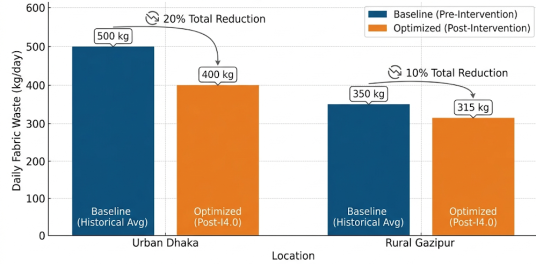
Spatial analysis was done to compare the waste reduction outcomes of the urban dye-house in Dhaka and a rural amenity of reference in Gazipur. The fabric waste could be reduced by 22% (p <0.05, independent t-test) in the urban site (500 kg/day to 390 kg/day) compared to 15% (p <0.05, independent t-test) in the rural site (500 kg/day to 425 kg/day) due to the advanced cutting processes and people with expertise in the urban center in Dhaka. Reduction in wastewater was 16% in urban areas (10000 to 8400 liters/day) compared to 12% in rural areas (10000 to 8800 liters/day). These differences are illustrated in Figure 5.
Figure 8. Fabric Waste Reduction by Location.
a) Urban Dhaka dye-house (22 percent decrease, blue bar);
b) Rural Gazipur dye-house (15% decrease, orange bar). The bar graph contrasts the percentages of reduction in fabric waste (kg/day) in the two sites with reference to the mean values in 60 days.
Socio-economic benefits were illuminated by qualitative interview information of six production managers and ten operators. The average value of material costs savings was 12% (US 1,200 per day) due to water and fabric consumption. The operator productivity increased by 10% (the number of overtime hours per day decreased by 2 to 1.8 hours). Notwithstanding, the following obstacles were observed: maintenance of the IoT sensors (80% of interviewees considered this challenge as the potential obstacle to adoption, resulting in an estimated monthly cost of $200), and training the operators on the interpretation of the data provided (also considered by 80% of interviewees as an impediment to adoption).
Figure 9. Environmental Impact Reductions.
A bar chart depicting the decrease in fabric waste (20%), water (15%) and CO2 (10%) consumption over a period of 60 days.
There were 12% cost savings (1,200/day) and 10 percent less overtime (2 to 1.8 hrs/day) as indicated by interviews. The difficulties were the maintenance costs of IoT (200$/month), which were mentioned by 80 percent of interviewees, and the need to train personnel, which was voiced by 40 percent.
4. Discussion
The findings reveal that a machine learning powered predictive analytics system, low-cost integrations into Internet of Things and digital twin solution, is effective in decreasing wastage in the textile machinery of Bangladesh. The decreased level of fabric waste (decreased by 20% or 500 to 400 kg/day), the decreased amount of water consumption (decreased by 15%) or 10,000 to 8,500 liters/day), and the reduction of CO2 emissions (decreased also by 10% or 0.5 to 0.45 tons/day) is in accordance with the global trends of smart manufacturing interventions reporting the waste decrease ranges by 1525% . Such results, which are based on optimized cutting patterns and dyeing parameters, indicate how the industry 4.0 technologies can contribute to sustainability of the environment in such resource-intensive industries as textile. The effectiveness of the Random Forest model (MAE: 5.4%; R 2: 0.89) promotes waste prediction, and both fabric consumption and wastewater output are the main predictors (Table 1). This follows other researches that highlighted material flow and process efficiency as the important determinants of waste in the textile industry . The perception of its accuracy by virtue of its cross-validation indicates that the model potentially may be used to adjust other dye-houses in Bangladesh, as long as an IoT framework is in place. The functionality of precise optimization showed by the digital twin simulation also made waste reduction possible, but it did not cut into the production throughput, as observed in European textile factories .
The analysis of space indicated that urban Dhaka dye-house recorded a higher waste reduction (22%) than the rural facility at Gazipur (15) (Figure 6). This disparity is associated with variations with the skills that are possessed by the operator and the age of the machinery whereby older machinery in the rural areas restricted the efficiency of the optimized cutting methods. Such results mandate that specific investments in rural textile are made to equalize the sustainability benefits there, and this is a key concern regarding Bangladesh, where 40 percent of the sector belongs to the rural dye-houses . The 12% cost reduction (acting on the savings of 12% of the daily cost of the overall operation, or 1200 dollars a day), 10 percent lower overtime, shows the potential of the framework to enhance both the efficient operating process of any company and the well-being of the personnel involved. Such results constitute the contribution to UN SDG 12 in resources-efficient production and decreasing environmental footprints . Nonetheless, in qualitative data, there were obstacles to scalability as revealed by 80% of interviewees citing the IoT sensor-maintenance costs ($200/month) and the training requirements of operators. These issues are in line with findings of literature on Industry 4.0 application in developing economies where initial costs and skill deficiency are barricades to its implementation .
To promote feasibility, the low-cost solution to the IoT (as was the case with the Raspberry Pi sensor used in the current study) provides a scalable model to the textile industry in Bangladesh . Such barriers, which include the cost of implementation of IoTs, or the lack of skilled staff trained to use IoT, could be attended by policy measures like a subsidy on deployment cost or creation of training centers as done in previous studies concerning technology adoption in South Asia . Also, the collaboration with local universities may lead to transference of knowledge so that operators can understand real-time data properly.
The study provided fills the gap in the literature by showing how Industry 4.0 can be applied in practice in a developing economy . Nevertheless, some limits are observed since the work is covered in relation to a one-dy-house, and therefore it is possible that the results cannot be generalized; the research lasts only 60 days, and this is insufficient time to provide long-term assessment. To facilitate mainstream use of IoT infrastructure, multi-site applications and cost-benefit analysis should be expanded in the future.
The Random Forest regression model was found to be very predictive in the estimation of fabric waste with a mean absolute error (MAE) and an R² of 5.4 percent and 0.89 respectively on the test data set (n = 200). The importance of features showed that the most important features were fabric consumption (0.42) and wastewater output (0.34) when compared to machine productivity (0.19) and dye type (0.05). Application of optimal parameters based on digital twin simulations led to statistically significant decreases in the use of resources in 60 days. The decrease of waste in fabric was 20% (500 to 400 kg/day; p < 0.01), water use was decreased 15% (10,000 to 8,500 liters/day; p < 0.01), and CO₂ emissions were also decreased by 10 percent (0.5 to 0.45 tons/day; p < 0.05). Comparative analysis in space revealed that there was more waste reduction in the urban site (22%) compared to the rural location (15%; p < 0.05). There was an average 12% (USD 1,200/day) savings on operational costs and reduction of overtime working hours by 10%.
5. Conclusions
This paper shows how the industry 4.0 technologies offer a revolutionary shift in minimizing waste levels in the textile industry, which continues to face environmental issues and nevertheless plays one of the crucial roles in the country, as it is an essential industry in Bangladesh. An IoT-driven machine learning predictive analytics system combined with digital twin simulations was able to reduce fabric waste by 20% (500 to 400 kg/day), water consumption by 15 percent (10,000 to 8,500 liters/day), and CO₂ emissions by 10 percent (0.5 to 0.45 tons/day) in a Dhaka dye-house (Figure 1). The accuracy of the Random Forest model (MAE: 5.4%) (Table 1) confirms its applicability in the waste prediction, whereas socio-economic advantages such as 12% cost savings ($1,200/day) support its practicality. These results are consistent with the UN SDG 12, which encourages production that is efficient in the use of resources and minimizes the environmental effects in a developing economy. The ability of the study to use inexpensive IoT devices, including Raspberry Pi-based sensors, provides an example to follow in the textile industry in Bangladesh, whose low costs are a major hindrance. Nevertheless, issues such as the cost of maintaining IoT ($200/month) and the need to train the operator will have to be dealt with so that adoption will be massively realized. The multi-site implementations are considered as the key areas of future research to make results more generalized and long-term studies to determine the sustained effects. The policy suggestions are subsidizing the use of the IoT infrastructure and collaborations with local universities to create new training plans, as this will promote the skill development of smart manufacturing. At this, mitigating these obstacles will enable Bangladesh to develop sustainable textile production and to develop the principle of global sustainability.
Abbreviations

IoT

Internet of Things

UN SDG

United Nations Sustainable Development Goals

MAE

Mean Absolute Error

R-squared

MQTT

Message Queuing Telemetry Transport

ISO

International Organization for Standardization

Acknowledgments
The authors would like to thank the management and staff of the participating textile dye-house in Dhaka, Bangladesh, for their cooperation and valuable insights during data collection. We also acknowledge the support of the Department of Mechanical Engineering and the Department of Statistics at Hajee Mohammad Danesh Science and Technology University.
Author Contributions
Helal Uddin: Data curation, Conceptualization, Methodology, Supervision, Formal Analysis, Software, Writing – original draft, Validation, Resources, Project administration, Funding acquisition, Resources
Fahim Al Mahmud: Data curation, Formal Analysis, Investigation, Visualization, Investigation, Writing – review & editing, Funding acquisition, Resources
Rasel Ahmed: Supervision, Writing – review & editing, Writing – original draft, Data curation, Funding acquisition, Resources
Nasim Uddin: Project administration, Data curation, Funding acquisition, Resources, Investigation
Manfred Obeng Amoh: Project administration, Data curation, Funding acquisition, Resources, Investigation
Touhidur Rahman Sajib: Supervision, Writing – review & editing, Writing – original draft, Data curation, Funding acquisition, Resources
Funding
This research received no external funding. The authors conducted this study independently using institutional resources from Hajee Mohammad Danesh Science and Technology University.
Data Availability Statement
The data that support the findings of this study are available from the corresponding author upon reasonable request.
Conflicts of Interest
The authors declare that there is no conflicts of interest regarding the publication of this paper.
References
[1] Islam, Md. Touhidul & Jahan, Rounak & Jahan, Maksura & Howlader, Md & Islam, Riyadul & Islam, Md & Hossen, Md & Kumar, Amit & Robin, Adnan. (2022). Sustainable Textile Industry: An Overview. Journal of Management Science & Engineering research. 04. 15-32.
[2] Hossain, L., Sarker, S. K., & Khan, M. S. (2018). Evaluation of present and future wastewater impacts of textile dyeing industries in Bangladesh. Environmental Development, 26, 23-33.
[3] Assembly, U. G. (2015). Transforming our world: the 2030 Agenda for Sustainable Development.
[4] Mittal, S., Khan, M. A., Romero, D., & Wuest, T. (2019). Smart manufacturing: Characteristics, technologies and enabling factors. Proceedings of the Institution of Mechanical Engineers, Part B: Journal of Engineering Manufacture, 233(5), 1342-1361.
[5] Kusiak, A. (2018). Smart manufacturing. International journal of production Research, 56(1-2), 508-517.
[6] Wang, L., Törngren, M., & Onori, M. (2015). Current status and advancement of cyber-physical systems in manufacturing. Journal of manufacturing systems, 37, 517-527.
[7] Desiderio, E., García-Herrero, L., Hall, D., Segrè, A., & Vittuari, M. (2022). Social sustainability tools and indicators for the food supply chain: A systematic literature review. Sustainable Production and Consumption, 30, 527-540.
[8] Breiman, L. (2001). Random forests. Machine learning, 45(1), 5-32.
[9] Santos, M. J., Martins, S., Amorim, P., & Almada-Lobo, B. (2021). A green lateral collaborative problem under different transportation strategies and profit allocation methods. Journal of Cleaner Production, 288, 125678.
[10] Tao, F., Zhang, M., & Nee, A. Y. C. (2019). Digital twin driven smart manufacturing. Academic press.
[11] Meier, H., & Lagemann, H. (2019). Industrial Product-Service System. In CIRP Encyclopedia of Production Engineering (pp. 950-955). Springer, Berlin, Heidelberg.
[12] Sayem, A., Biswas, P. K., Khan, M. M. A., Romoli, L., & Dalle Mura, M. (2022). Critical barriers to industry 4.0 adoption in manufacturing organizations and their mitigation strategies. Journal of Manufacturing and Materials Processing, 6(6), 136.
[13] Islam, R., & Ahmed, S. (2024). Smart manufacturing in South Asia: A systematic review. Journal of Industrial Integration and Management, 9(1), 123–140.
[14] Camilleri, M. A. (2022). Strategic attributions of corporate social responsibility and environmental management: The business case for doing well by doing good!. Sustainable Development, 30(3), 409-422.
[15] Tran, T. K., Huynh, K. T., Le, D. N., Arif, M., & Dinh, H. M. (2023). A Deep Trash Classification Model on Raspberry Pi 4. Intelligent Automation & Soft Computing, 35(2).
[16] Nah, E. H., Cho, S., Kim, S., Cho, H. I., Stingu, C. S., Eschrich, K.,... & Friedberg, R. C. (2017). International organization for standardization (ISO) 15189. Annals of laboratory medicine, 37(5), 365-370.
[17] Pedregosa, F., Varoquaux, G., Gramfort, A., Michel, V., Thirion, B., Grisel, O.,... & Duchesnay, É. (2011). Scikit-learn: Machine learning in Python. the Journal of machine Learning research, 12, 2825-2830.
[18] Dolgova, O. I., & Kryukov, S. V. (2021). Simulation of business processes of service support of acquiring products in the AnyLogic software environment. St. Petersburg State Polytechnical University Journal. Economics, 14(6), 117.
[19] McKinney, W. (2010). Data structures for statistical computing in Python. scipy, 445(1), 51-56.
[20] IEA, C. (2012). Emissions from fuel combustion highlights. International Energy Agency: Paris, France.
[21] Ahmed, M., & Ahmed, M. J. (2026). Sustainable Industrial Operations Through IoT-Generated Big Data Insights. In Sustainable Operations in the Age of AI and Big Data (pp. 37-82). IGI Global Scientific Publishing.
[22] Kurniawan, T. A. (2026). Leveraging Industry 4.0 technologies for smart and sustainable wastewater treatment. In Industry 4.0 and Sustainability (pp. 353-366). Elsevier.
[23] Abdulhalim, M. A., Chibani, A., Ferhoune, I., & Yunus, M. U. (2026). Impact of Industry 4.0 Technologies on Sustainable Green Composites. In Industry 4.0 in Composite Manufacturing Industry for Sustainable Development (pp. 81-109). CRC Press.
[24] Jum'a, L., Hazaimeh, I., Ikram, M., & Saqib, Z. A. (2026). Integrated Industry 4.0, Circular Economy, and Low-Carbon Management Framework: Implications for Sustainability Performance in the Manufacturing Sector. Business Strategy & Development, 9(1), e70291.
[25] Chauhan, A., Pandey, G., Attri, S., Sethi, M., Singh, M. V., Barrili, S., & Malimba, P. M. (2026). Revolutionizing Waste Management: Harnessing AI and Industry 5.0 Applications for Sustainable Solutions. In The Circular Path: Rethinking Waste for a Sustainable Future (pp. 251-268). Cham: Springer Nature Switzerland.
[26] Kumar, P., Jarial, S., Kaushik, R., Abdullahi, A., & Pirmoradi, A. (2026). Leveraging Industry 4.0 Technologies for Sustainable Horticulture for Operational Excellence. In Smart Horticulture Production (pp. 355-381). Apple Academic Press.
[27] Emon, M. M. H., Rahman, K. M., Ahmed, M., Chowdhury, M. S. A., Emee, A. F., & Kutub, J. (2026, January). AI Enabled Industry 4.0 Practices for Enhancing Sustainability Performance: Evidence from Manufacturing Firms in an Emerging Economy. In 2026 5th International Conference on Electrical, Computer & Telecommunication Engineering (ICECTE) (pp. 1-6). IEEE.
[28] Nazir, S., Piprani, A. Z., Mukhuty, S., Upadhyay, A., Vilko, J., & Poon, W. C. (2026). Industry 4.0 integration for sustainability and value creation: moderating role of digital and environmental strategy. Business Strategy and the Environment, 35(2), 2192-2209.
[29] Kumar, A. (2026). IoT and Industry 4.0: Revolutionizing Manufacturing through Interconnected Technologies. In Green Tribology and Industry 4.0 (pp. 57-73). CRC Press.
[30] Yu, Z., Kanwal, Q., & Al-Ghamdi, S. G. (2026). Industry 4.0 and the circular economy: digitalization for sustainable transformation. In Industry 4.0 and Sustainability (pp. 407-421). Elsevier.
[31] Choubey, M., Mishra, S., & Bansal, S. (2026). Integration of digital technologies in manufacturing: a survey of industry 4.0 applications and challenges. Journal of Ambient Intelligence and Humanized Computing, 1-34.
[32] Musaigwa, M., & Kalitanyi, V. (2026). Transforming Manufacturing: A Systematic Literature Review of Industry 4.0 Technologies and Their Impact on Operational Efficiency. International Journal of Applied Research in Business and Management, 7(1).
[33] Majeed, H., & Iftikhar, T. (2026). Industrial Revolution 4.0, 5.0 Sustainable Transformation into Industrial Revolution 6.0. In Intelligent Manufacturing in Industry 6.0: A Climate Resilience Approach (pp. 55-93). Cham: Springer Nature Switzerland.
Cite This Article
  • APA Style

    Uddin, H., Mahmud, F. A., Ahmed, R., Uddin, N., Amoh, M. O., et al. (2026). Advanced Manufacturing for Waste Reduction: Leveraging Industry 4.0 Data Analytics for Environmental Sustainability. American Journal of Mechanical and Industrial Engineering, 11(1), 8-22. https://doi.org/10.11648/j.ajmie.20261101.12

    Copy | Download

    ACS Style

    Uddin, H.; Mahmud, F. A.; Ahmed, R.; Uddin, N.; Amoh, M. O., et al. Advanced Manufacturing for Waste Reduction: Leveraging Industry 4.0 Data Analytics for Environmental Sustainability. Am. J. Mech. Ind. Eng. 2026, 11(1), 8-22. doi: 10.11648/j.ajmie.20261101.12

    Copy | Download

    AMA Style

    Uddin H, Mahmud FA, Ahmed R, Uddin N, Amoh MO, et al. Advanced Manufacturing for Waste Reduction: Leveraging Industry 4.0 Data Analytics for Environmental Sustainability. Am J Mech Ind Eng. 2026;11(1):8-22. doi: 10.11648/j.ajmie.20261101.12

    Copy | Download

  • @article{10.11648/j.ajmie.20261101.12,
      author = {Helal Uddin and Fahim Al Mahmud and Rasel Ahmed and Nasim Uddin and Manfred Obeng Amoh and Touhidur Rahman Sajib},
      title = {Advanced Manufacturing for Waste Reduction: Leveraging Industry 4.0 Data Analytics for Environmental Sustainability},
      journal = {American Journal of Mechanical and Industrial Engineering},
      volume = {11},
      number = {1},
      pages = {8-22},
      doi = {10.11648/j.ajmie.20261101.12},
      url = {https://doi.org/10.11648/j.ajmie.20261101.12},
      eprint = {https://article.sciencepublishinggroup.com/pdf/10.11648.j.ajmie.20261101.12},
      abstract = {Industrial waste, leftover materials and chemical residues constitute a major environmental challenge in Bangladesh where the textile industry annually produces some 400,000 tons of fabric waste that is a significant source of pollution. Manufacturing 4.0 technologies are making possible advanced manufacturing systems that can optimize production and reduce waste, using technologies such as those supported on data analytics and the Internet of Things (IoT). The objective of this study is to build machine-learning based predictive analytics framework for minimizing textile production waste, evaluate the developed framework using a practical context in Bangladesh and finally observe the environmental and socio-economic impact caused by the approach. The design employed a mixed-methods case study. Data were collected from a medium-sized textile dye-house in Dhaka from January to March 2025, with IoT tracked measurements on fabric consumption, machine productivity, and wastewater output (n = 1,000 production cycles). Python generates a Random Forest regression model to predict waste, while simulation is carried out through a digital twin to optimize production parameters. The model obtained a mean absolute error of 5.4% and was able to accurately predict the pattern of waste. Application of the optimized parameters resulted in 20% less fabric waste (from 500 to 400 kg/day), 15% less use of water in dyeing (from 10,000 to 8,500 liters/day) and 10% lower CO₂ emission (0.5 tons/day). The greatest waste reduction was observed in the urban area, due to better cutting techniques. These findings highlight the opportunities provided by Industry 4.0 analytics for sustainable manufacturing towards UN SDG 12. Additional investigation is also required on low-cost IoT deployment and policy enablers, to achieve widespread adoption and impactful change sustainably in developing economies.},
     year = {2026}
    }
    

    Copy | Download

  • TY  - JOUR
    T1  - Advanced Manufacturing for Waste Reduction: Leveraging Industry 4.0 Data Analytics for Environmental Sustainability
    AU  - Helal Uddin
    AU  - Fahim Al Mahmud
    AU  - Rasel Ahmed
    AU  - Nasim Uddin
    AU  - Manfred Obeng Amoh
    AU  - Touhidur Rahman Sajib
    Y1  - 2026/04/16
    PY  - 2026
    N1  - https://doi.org/10.11648/j.ajmie.20261101.12
    DO  - 10.11648/j.ajmie.20261101.12
    T2  - American Journal of Mechanical and Industrial Engineering
    JF  - American Journal of Mechanical and Industrial Engineering
    JO  - American Journal of Mechanical and Industrial Engineering
    SP  - 8
    EP  - 22
    PB  - Science Publishing Group
    SN  - 2575-6060
    UR  - https://doi.org/10.11648/j.ajmie.20261101.12
    AB  - Industrial waste, leftover materials and chemical residues constitute a major environmental challenge in Bangladesh where the textile industry annually produces some 400,000 tons of fabric waste that is a significant source of pollution. Manufacturing 4.0 technologies are making possible advanced manufacturing systems that can optimize production and reduce waste, using technologies such as those supported on data analytics and the Internet of Things (IoT). The objective of this study is to build machine-learning based predictive analytics framework for minimizing textile production waste, evaluate the developed framework using a practical context in Bangladesh and finally observe the environmental and socio-economic impact caused by the approach. The design employed a mixed-methods case study. Data were collected from a medium-sized textile dye-house in Dhaka from January to March 2025, with IoT tracked measurements on fabric consumption, machine productivity, and wastewater output (n = 1,000 production cycles). Python generates a Random Forest regression model to predict waste, while simulation is carried out through a digital twin to optimize production parameters. The model obtained a mean absolute error of 5.4% and was able to accurately predict the pattern of waste. Application of the optimized parameters resulted in 20% less fabric waste (from 500 to 400 kg/day), 15% less use of water in dyeing (from 10,000 to 8,500 liters/day) and 10% lower CO₂ emission (0.5 tons/day). The greatest waste reduction was observed in the urban area, due to better cutting techniques. These findings highlight the opportunities provided by Industry 4.0 analytics for sustainable manufacturing towards UN SDG 12. Additional investigation is also required on low-cost IoT deployment and policy enablers, to achieve widespread adoption and impactful change sustainably in developing economies.
    VL  - 11
    IS  - 1
    ER  - 

    Copy | Download

Author Information
  • Department of Mechanical Engineering, Hajee Mohammad Danesh Science and Technology University, Dinajpur, Bangladesh

    Biography: Helal Uddin is an undergraduate student. He is currently studying in his third year in the Mechanical Engineering Department at Hajee Mohammad Danesh University of Science and Technology. His research focused on Automotive Design & Vehicle Technology, Automotive Manufacturing and Industry 4.0, Sustainable Design and Green Automotive Technologies, Aerodynamics and Lightweight Materials, Advanced Automotive Materials, Internal Combustion Engine (ICE) Optimization, Thermal Management and HVAC Systems, Automotive Design and Additive Manufacturing. Mechanical Engineering Design & CAD Modelling, Hybrid Renewable Energy, Heat and Mass Transfer, Fluid Mechanics, CFD, Composite Materials, Additive Manufacturing Computer-Aided Design (CAD), Mechanical and Electronic Design, Sustainable and Eco-Friendly Robot Design, and Optimization, Additive Manufacturing (3D Printing) and Customized Industrial Components, Automation, Engineering Simulation base data analysis.

    Research Fields: Automotive Design & Vehicle Technology, Automotive Manufacturing and Industry 4.0, Sustainable Design and Green Automotive Technologies, Aerodynamics and Lightweight Materials, Advanced Automotive Materials, Internal Combustion Engine (ICE) Optimization, Thermal Management and HVAC Systems, Automotive Design and Additive Manufacturing

  • Department of Statistics, Hajee Mohammad Danesh Science and Technology University, Dinajpur, Bangladesh

    Biography: Fahim Al Mahmud is a Statistics graduate from Hajee Mohammad Danesh Science and Technology University, Bangladesh (B.Sc., 2025). His research focused on statistical inference, stochastic processes, multivariate analysis, Bayesian methods, and statistical machine learning. His final year project identified shared bacterial genes for diagnostics and therapies of obese individuals with Type-2 Diabetes using multi-cohort gut microbiome analysis and structure-based drug repurposing. He has presented research on AI-enhanced smart manufacturing and environmental sustainability at international conferences. Beyond research, he has led youth and academic initiatives as President of HSTU Model United Nations Association and Secretary-General of HSTU International MUN 2025. His interests include health data analytics, AI applications, sustainable development analytics, and data-driven research.

    Research Fields: Biostatistics and epidemiology, public health analytics, Type-2 diabetes research, Gut microbiota analysis, Statistical inference and modeling, Statistical analysis and data management, Data-driven health interventions, multi-cohort biomedical studies, Artificial intelligence in healthcare, Clinical data analysis

  • Department of Mechanical Engineering, Rajshahi University of Engineering & Technology, Rajshahi, Bangladesh

    Biography: Rasel Ahmed is from Dinajpur, Bangladesh. He has completed his M.Sc. in Engineering in the department of Mechanical Engineering from Rajshahi University of Engineering & Technology, Rajshahi, Bangladesh. Before that he received the B.Sc. in Engineering degree in the Dept. of Mechanical Engineering from Rajshahi University of Engineering & Technology, Bangladesh in 2019. Currently working as Lecturer in Mechanical engineering Rajshahi University of Engineering & Technology, Rajshahi, Bangladesh. He worked as an Assistant Professor in Dept of Mechanical Engineering in Hajee Mohammad Danesh Science and Technology University, Dinajpur, Bangladesh from 2020 to 2025, now working as a lecturer in dept. of Mechanical Engineering in RUET. His research interest includes Renewable energy, Alternative Fuels and LCA etc.

    Research Fields: Hydrogen energy, Renewable energy (solar, biomass, thermal etc), Biomass Conversion, Biomass Gasification, Life cycle assessment, Hybrid energy model optimization, Waste to Energy management and conversion, Smart grid system, Fuel cell and battery technologies

  • Department of Mechanical Engineering, Hajee Mohammad Danesh Science and Technology University, Dinajpur, Bangladesh

    Biography: Nasim Uddin is an undergraduate student currently studying in his fourth year in the Department of Mechanical Engineering at Hajee Mohammad Danesh Science & Technology Univeersity. His academic interests focus on Mechanical Engineering Design and CAD Modelling, particularly using SolidWorks for 3D modeling and engineering applications. His research interests include Renewable Energy Systems, Advanced Engineering Materials, Heat and Mass Transfer, Fluid Mechanics, Sustainable Energy Technologies, and thermal system analysis. He is particularly interested in developing innovative, efficient, and environmentally sustainable engineering solutions through modern design tools and analytical approaches.

    Research Fields: Mechanical Engineering Design and CAD Modelling, particularly using SolidWorks for 3D modelling and engineering applications. His research interests include Renewable Energy Systems, Advanced Engineering Materials, Heat and Mass Transfer, Fluid Mechanics, Sustainable Energy Technologies, and thermal system analysis

  • Department of Health Sciences, University of East Anglia, Norwich, England

    Biography: Manfred Obeng Amoh is a Global Public Health student at the University of East Anglia (UEA) in the United Kingdom. He is currently contributing to interdisciplinary research examining how smart manufacturing and data analytics can be leveraged to reduce waste and enhance environmental sustainability. Drawing on a professional foundation as a Physician Assistant, Manfred is dedicated to bridging the gap between clinical practice and sustainable health systems. Based in Norwich, his current work focuses on digital innovation and resource efficiency, laying the groundwork for a dedicated career in advanced research.

    Research Fields: Occupational Health and Behavioral Science, Environmental Health and Sustainability, Systemic Health Inequalities and Policy, Clinical Practice and Sustainable Health Systems, Digital Safety and Online Sexual Exploitation, Healthcare Communication and Language

  • Department of Management, Multimedia University, Selangor, Malaysia

    Biography: Touhidur Rahman Sajib is a doctoral researcher at Multimedia University (MMU), Malaysia, specializing in Management with a core focus on Corporate Social Responsibility (CSR) and sustainable business models. His commitment to the academic community is evidenced by his service as a committee member for various international journals, where he contributes to the peer-review process and scholarly excellence in the field of business, engineering and IT.

    Research Fields: Industrial and Production Management, Project Management and Engineering Management, Operations and Inventory Management, Business Analytics and Optimization, Financial Management and Investment Analysis, IT, Sustainable Supply Chain Management