
The existing structure might not have enough seismic resistance capacities due to construction errors, design by old building design codes (EBCS 1995), deterioration, and building function changes. To increase the seismic resistance capacity of Reinforced Concrete (RC) structures, many studies recommend different strengthening methods. Those strengthening methods have different costs, strengthening capacities, and availabilities. To identify the best, strengthening methods it needs further investigations. Most previous studies were conducted on the detailed application of individual strengthening applications. There are no previous studies that have done a comparative study on the seismic strengthening of reinforced concrete beam–structural wall joints using external stiffener plates, Basaltic Fiber Reinforced Polymer (BFRP), and Carbon Fiber Reinforced Polymer (CFRP). The main aim of this study is a comparative study on the seismic strengthening of reinforced concrete beam–structural wall joints using an external stiffener plate, BFRP and CFRP. The experimental work presented in the literature was used for validation of finite element analysis to ensure the accuracy of developed finite element models and further investigations. The numerical investigation of a comparative study on the seismic strengthening of reinforced concrete beam–structural wall joints using external stiffener plates, basaltic fiber, and CFRP has been done with the comparison of load resistance capacities. The numerical study will be done using ANSYS 22R1 mechanical APDL nonlinear software program. The finite element analysis result shows that, for both CFRP and BFRP from 0°, 45° & 90° layer orientations of CFRP strengthening methods, 90° CFRP layer orientation shows better improvement of ultimate load resistance capacity. The 90° layer orientation strengthening layout increased the load-carrying capacity of the beam-shear wall connection by 30% and 26.4% for CFRP and BFRP respectively. For both CFRP and BFRP strengthening mechanisms with 90° orientation, three number of layers and 90°, 90°& 90° configuration best fiber lay out for strengthening of beam – shear wall joint. From the three beam -shear wall strengthening mechanisms of stiffener plate, CFRP and BFRP, the stiffener plate shows better performance. The stiffener plate increases the lateral load resistance capacity of the existing beam- shear wall joint by 37% - 66%.
| Published in | American Journal of Mechanical and Materials Engineering (Volume 10, Issue 2) |
| DOI | 10.11648/j.ajmme.20261002.11 |
| Page(s) | 34-47 |
| Creative Commons |
This is an Open Access article, distributed under the terms of the Creative Commons Attribution 4.0 International License (http://creativecommons.org/licenses/by/4.0/), which permits unrestricted use, distribution and reproduction in any medium or format, provided the original work is properly cited. |
| Copyright |
Copyright © The Author(s), 2026. Published by Science Publishing Group |
ANSYS, Beam–Wall Joint, External Strengthening Steel Plate, BFRP, CFRP
APDL | Analysis Parametric Design Language |
FEM | Finite Element Method |
E | Modulus of Elasticity |
BFRP | Basaltic Fiber Reinforced Polymer |
CFRP | Carbon Fiber Reinforced Polymer |
GFRP | Glass Fiber Reinforced Polymer |
Ey | Modulus of Elasticity in y-direction |
Ez | Modulus of Elasticity in z-direction |
PRxy | Poison’s Ratio in xy Direction |
PRxz | Poison’s Ratio in xz Direction |
PRyz | Poison’s Ratio in yz Direction |
Gx | Shear Modulus in x- direction |
Gy | Shear Modulus in y- direction |
Gz | Shear Modulus in z- direction |
| [1] | C. S. &. S. M. M. Sumaya, STRENGTHENING OF PRECAST BEAM-COLUMN JOINT USING STEEL ENCASEMENT., 2022. |
| [2] | M. D. V. C. D. L. M. D. P. A. &. M. G. (. D. V. e. a. .. Ludovico, Analytical model and design approach for FRP strengthening of non-conforming RC corner beam-column joints Analytical model and design approach or FRP strengthening of non-conforming RC corner beam - column joints., 2016. |
| [3] | Q. &. Z. Y. Ma, Experimental research on the microstructure and compressive and tensile properties of nano-SiO2 concrete containing basalt fibers. Underground Space (China), 2(3), 175-181., 2017. |
| [4] | K. K. &. S. S. A. Ghosh, Seismic upgrade with carbon fiber-reinforced polymer of columns containing lap-spliced reinforcing bars. ACI Structural Journal, 104(2), 227-236., 2007. |
| [5] | D. A. A. &. E. A. Mostofinejad, Estimating the Seismic Performance of CFRP-Retrofitted RC Beam-Column Connections Using Fiber-Section Analysis. Journal of Earthquake Engineering, 22(6), 1092-1110., 2018. |
| [6] | S. K. S. L. N. &. K. C. Durgadevi, A review on retrofitting of reinforced concrete elements using FRP. Materials Today: Proceedings, 45(xxxx), 1050-1054., 2021. |
| [7] | D. L. M. K. J. L. C. &. L. C. Shen, Experimental studies on the seismic behavior of reinforced concrete beam-column joints strengthened with basalt fiber-reinforced polymer sheets. Construction and Building Materials, 287, 122901., 2021. |
| [8] | M. A. S. A. A. K. T. M. E.-s. G. &. S. M. A. Sakr, Studying Behavior of Exterior RC Beam - Column Joints Strengthened Using CFRP for Achieving “ Strong Column - Weak Beam ” In RC Frames. 4480(2), 53-68., 2019. |
| [9] | H. Sinaei., Numerical investigation on exterior reinforced concrete Beam-Column joint strengthened by composite fiber reinforced polymer (CFRP). International Journal of the Physical Sciences, 6(28), 6572-6579., 2011. |
| [10] | M. E. T. A. M. &. A. M. Z. Shoukry, Seismic retrofit of deficient exterior RC beam-column joints using steel plates and angles. Alexandria Engineering Journal, 61(4), 3147-3164., 2022. |
| [11] | S. A.-S. N. &. N. D. Abdullah, Experimental study of nonplanar wall-to-beam connections under cyclic loading. ACI Structural Journal, 113(4), 655-664. |
| [12] | Ethiopian building code of standared based on Europian norm three, (n.d.). Ethiopian building code of standared based on Europian norm three for steel structure design, ESEN 1993/2015., 1993/2015. |
APA Style
Mulugeta, Y., Worabo, U. (2026). A Comparative Study on Seismic Strengthening of Reinforced Concrete Beam–Structural Wall Joints Using External Stiffeners Plate, Basaltic Fiber and CFRP. American Journal of Mechanical and Materials Engineering, 10(2), 34-47. https://doi.org/10.11648/j.ajmme.20261002.11
ACS Style
Mulugeta, Y.; Worabo, U. A Comparative Study on Seismic Strengthening of Reinforced Concrete Beam–Structural Wall Joints Using External Stiffeners Plate, Basaltic Fiber and CFRP. Am. J. Mech. Mater. Eng. 2026, 10(2), 34-47. doi: 10.11648/j.ajmme.20261002.11
@article{10.11648/j.ajmme.20261002.11,
  author = {Yosef Mulugeta and Utino Worabo},
  title = {A Comparative Study on Seismic Strengthening of Reinforced Concrete Beam–Structural Wall Joints Using External Stiffeners Plate, Basaltic Fiber and CFRP},
  journal = {American Journal of Mechanical and Materials Engineering},
  volume = {10},
  number = {2},
  pages = {34-47},
  doi = {10.11648/j.ajmme.20261002.11},
  url = {https://doi.org/10.11648/j.ajmme.20261002.11},
  eprint = {https://article.sciencepublishinggroup.com/pdf/10.11648.j.ajmme.20261002.11},
  abstract = {The existing structure might not have enough seismic resistance capacities due to construction errors, design by old building design codes (EBCS 1995), deterioration, and building function changes. To increase the seismic resistance capacity of Reinforced Concrete (RC) structures, many studies recommend different strengthening methods. Those strengthening methods have different costs, strengthening capacities, and availabilities. To identify the best, strengthening methods it needs further investigations. Most previous studies were conducted on the detailed application of individual strengthening applications. There are no previous studies that have done a comparative study on the seismic strengthening of reinforced concrete beam–structural wall joints using external stiffener plates, Basaltic Fiber Reinforced Polymer (BFRP), and Carbon Fiber Reinforced Polymer (CFRP). The main aim of this study is a comparative study on the seismic strengthening of reinforced concrete beam–structural wall joints using an external stiffener plate, BFRP and CFRP. The experimental work presented in the literature was used for validation of finite element analysis to ensure the accuracy of developed finite element models and further investigations. The numerical investigation of a comparative study on the seismic strengthening of reinforced concrete beam–structural wall joints using external stiffener plates, basaltic fiber, and CFRP has been done with the comparison of load resistance capacities. The numerical study will be done using ANSYS 22R1 mechanical APDL nonlinear software program. The finite element analysis result shows that, for both CFRP and BFRP from 0°, 45° & 90° layer orientations of CFRP strengthening methods, 90° CFRP layer orientation shows better improvement of ultimate load resistance capacity. The 90° layer orientation strengthening layout increased the load-carrying capacity of the beam-shear wall connection by 30% and 26.4% for CFRP and BFRP respectively. For both CFRP and BFRP strengthening mechanisms with 90° orientation, three number of layers and 90°, 90°& 90° configuration best fiber lay out for strengthening of beam – shear wall joint. From the three beam -shear wall strengthening mechanisms of stiffener plate, CFRP and BFRP, the stiffener plate shows better performance. The stiffener plate increases the lateral load resistance capacity of the existing beam- shear wall joint by 37% - 66%.},
 year = {2026}
}
TY  - JOUR
T1  - A Comparative Study on Seismic Strengthening of Reinforced Concrete Beam–Structural Wall Joints Using External Stiffeners Plate, Basaltic Fiber and CFRP
AU  - Yosef Mulugeta
AU  - Utino Worabo
Y1  - 2026/04/10
PY  - 2026
N1  - https://doi.org/10.11648/j.ajmme.20261002.11
DO  - 10.11648/j.ajmme.20261002.11
T2  - American Journal of Mechanical and Materials Engineering
JF  - American Journal of Mechanical and Materials Engineering
JO  - American Journal of Mechanical and Materials Engineering
SP  - 34
EP  - 47
PB  - Science Publishing Group
SN  - 2639-9652
UR  - https://doi.org/10.11648/j.ajmme.20261002.11
AB  - The existing structure might not have enough seismic resistance capacities due to construction errors, design by old building design codes (EBCS 1995), deterioration, and building function changes. To increase the seismic resistance capacity of Reinforced Concrete (RC) structures, many studies recommend different strengthening methods. Those strengthening methods have different costs, strengthening capacities, and availabilities. To identify the best, strengthening methods it needs further investigations. Most previous studies were conducted on the detailed application of individual strengthening applications. There are no previous studies that have done a comparative study on the seismic strengthening of reinforced concrete beam–structural wall joints using external stiffener plates, Basaltic Fiber Reinforced Polymer (BFRP), and Carbon Fiber Reinforced Polymer (CFRP). The main aim of this study is a comparative study on the seismic strengthening of reinforced concrete beam–structural wall joints using an external stiffener plate, BFRP and CFRP. The experimental work presented in the literature was used for validation of finite element analysis to ensure the accuracy of developed finite element models and further investigations. The numerical investigation of a comparative study on the seismic strengthening of reinforced concrete beam–structural wall joints using external stiffener plates, basaltic fiber, and CFRP has been done with the comparison of load resistance capacities. The numerical study will be done using ANSYS 22R1 mechanical APDL nonlinear software program. The finite element analysis result shows that, for both CFRP and BFRP from 0°, 45° & 90° layer orientations of CFRP strengthening methods, 90° CFRP layer orientation shows better improvement of ultimate load resistance capacity. The 90° layer orientation strengthening layout increased the load-carrying capacity of the beam-shear wall connection by 30% and 26.4% for CFRP and BFRP respectively. For both CFRP and BFRP strengthening mechanisms with 90° orientation, three number of layers and 90°, 90°& 90° configuration best fiber lay out for strengthening of beam – shear wall joint. From the three beam -shear wall strengthening mechanisms of stiffener plate, CFRP and BFRP, the stiffener plate shows better performance. The stiffener plate increases the lateral load resistance capacity of the existing beam- shear wall joint by 37% - 66%.
VL  - 10
IS  - 2
ER  -
Department of Civil Engineering, Bahir Dar University, Bahir Dar, Ethiopia
Department of Civil Engineering, Bahir Dar University, Bahir Dar, Ethiopia
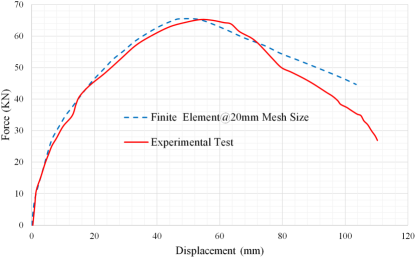
Figure 1. Experimental and finite element load-displacement responses.
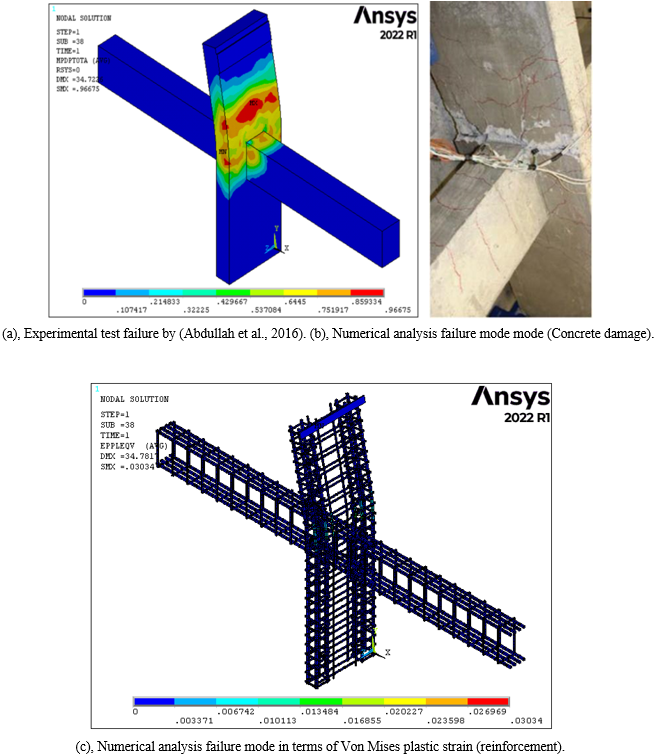
Figure 2. (a), (b) & (C); Experimental and numerical study failure modes.
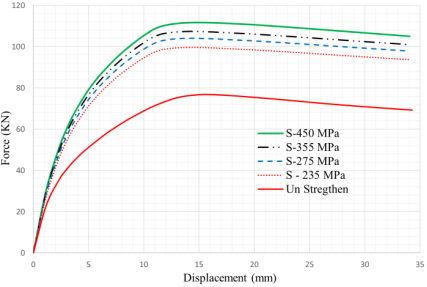
Figure 3. Force–displacement responses of bream–shear wall joint strengthened with the variation of stiffener steel plate material grade.
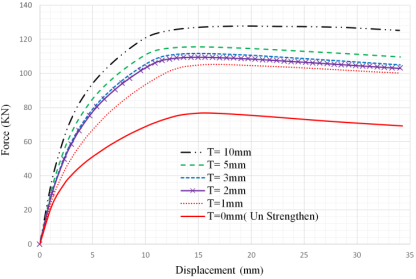
Figure 4. Force–displacement responses of bream–shear wall joint strengthened with variation stiffener steel plate thickness.
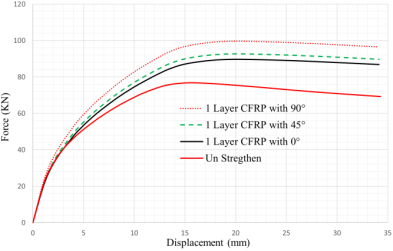
Figure 5. Beam-shear wall connection strengthened with different orientations of CFRP.
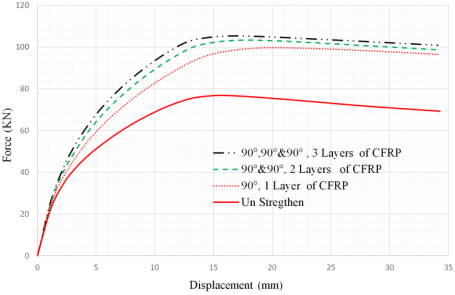
Figure 6. Beam-shear wall connection strengthened with different number of layers of CFRP.
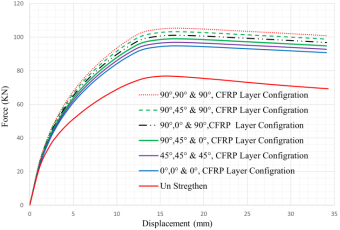
Figure 7. Beam-shear wall connection strengthened with different configurations of CFRP.
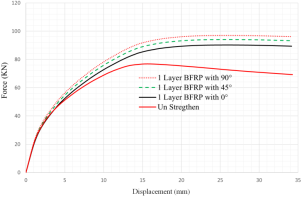
Figure 8. Beam-shear wall connection strengthened with different orientations of BFRP.
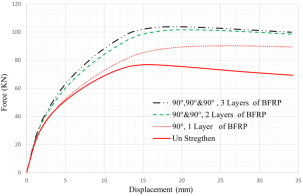
Figure 9. Beam-shear wall connection strengthened with different number of layers of BFRP.
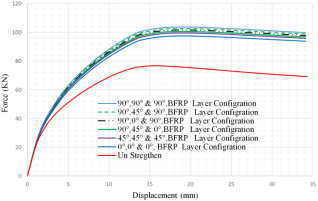
Figure 10. Beam-shear wall connection strengthened with different configurations of BFRP.
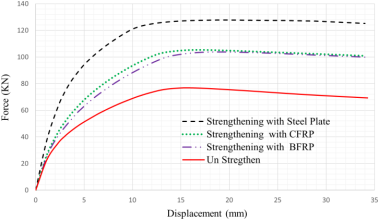
Figure 11. Comparison of beam–shear wall joint strengthen mechanisms.
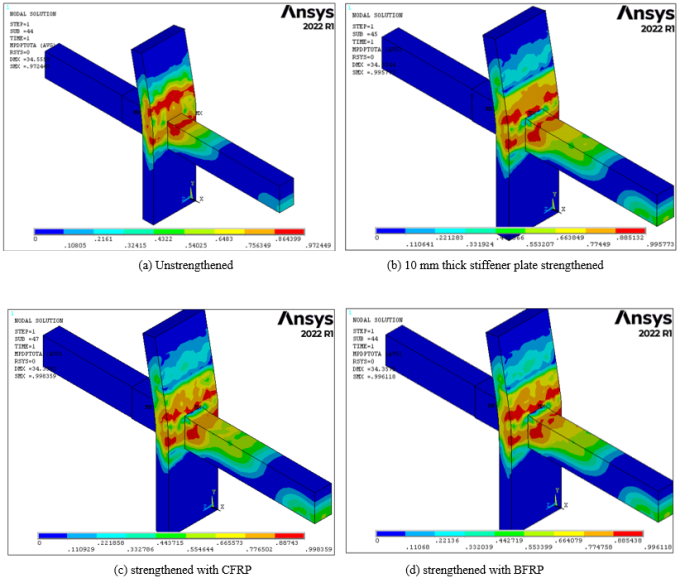
Figure 12. (a), (b), (c) & (d); Tensile and compressive concrete damage frailer mode of beam-shear wall joint strengthening mechanisms.
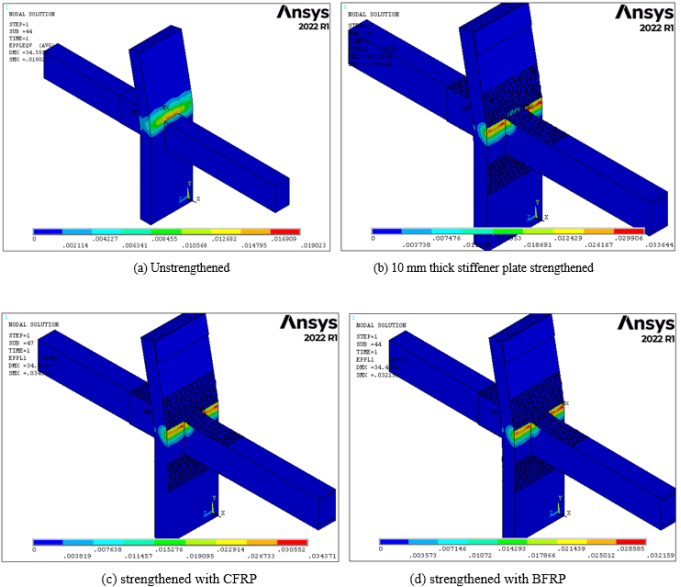
Figure 13. (a), (b), (c) & (d); First principal plastic strain concrete damage failer mode of beam-shear wall joint strengthen mechanisms.
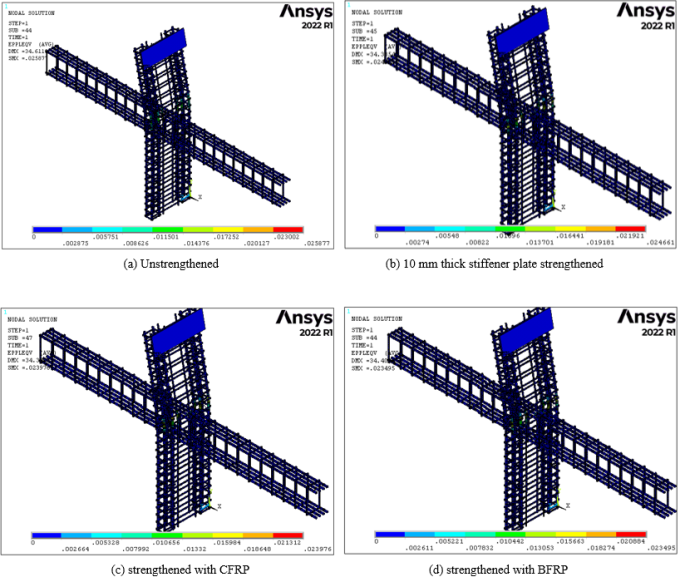
Figure 14. (a), (b), (c) & (d); Concrete damage failer mode of beam-shear wall joint strengthen mechanisms.
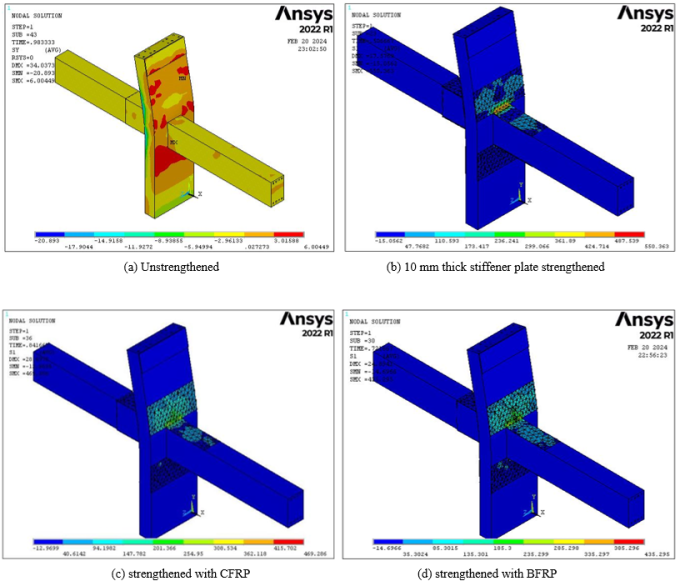
Figure 15. (a), (b), (c) & (d); Bending stress response of beam-shear wall joint strengthening mechanisms.
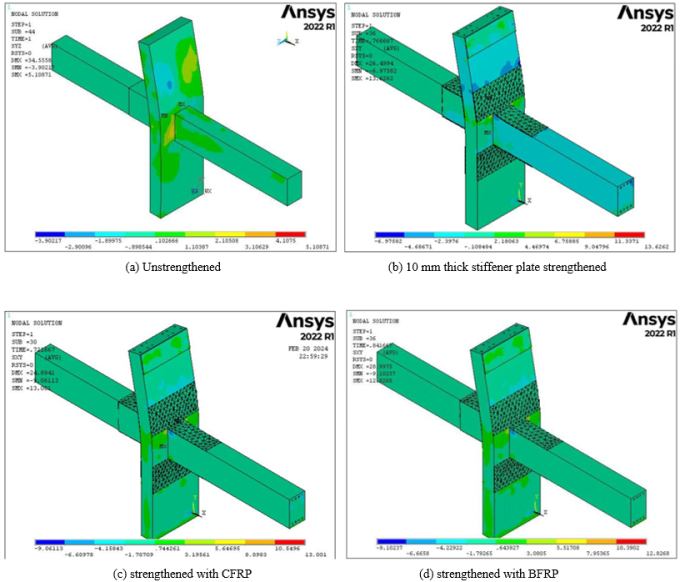
Figure 16. (a), (b), (c) & (d); Shear stress responses of beam-shear wall joint strengthening mechanisms.

Information



 Share This Article
 Twitter
 Linked In
 Facebook
 Copy
Copy Download