1. Introduction
Water pollution, stemming from the indiscriminate release of industrial, agricultural, and domestic effluents, constitutes a significant global environmental issue. Wastewater frequently contains a diverse array of contaminants, such as heavy metals, nutrient ions, synthetic dyes, and various organic pollutants, each presenting specific threats to aquatic environments and public health
. Among the multiple contaminants, heavy metal ions, including Pb
2+, Cd
2+, Cr
3+/Cr
6+, Cu
2+, and Ni
2+, pose significant environmental risks. These elements are particularly hazardous due to their resistance to biodegradation, propensity for biomagnification within ecological systems, and pronounced toxicity even at minute concentrations. The mobility and adsorptive characteristics of these heavy metals are considerably influenced by their speciation in aquatic environments, which is determined by factors such as pH, redox potential, ionic strength, and the presence of complexing ligands. For instance, chromium exists predominantly in two forms, Cr
+3 and Cr
+6, with Cr
+6 being notably carcinogenic and exhibiting higher mobility. Similarly, arsenic interconverts between arsenite (As(III)) and arsenate (As(V)), which impacts its toxicity and affinity for adsorption. While cadmium (Cd
2+) and lead (Pb
2+) typically remain as free ions across most natural water pH ranges, their interaction with carbonate or hydroxide ions under alkaline conditions can lead to the formation of complexes, thereby reducing their free-ion concentrations.
Excessive concentrations of nutrient pollutants, including nitrates, phosphates, and ammonium ions, primarily stem from agricultural practices (fertilizers, livestock runoff) and municipal wastewater discharge. These elevated nutrient levels contribute significantly to eutrophication, promoting detrimental algal blooms and ultimately leading to oxygen depletion in aquatic ecosystems. Concurrently, synthetic dyes, exemplified by methylene blue, rhodamine B, and Congo red, are discharged from textile and dyeing industries; these compounds are notable for their toxicity, mutagenicity, and recalcitrance to natural degradation processes. Moreover, a diverse array of organic pollutants, such as pesticides, phenols, and pharmaceutical compounds, further compounds the associated ecological and public health risks.
Conventional wastewater treatment techniques, such as chemical precipitation, ion exchange, membrane separation, and advanced oxidation processes, despite their proven efficacy, frequently entail substantial operational expenses, high energy consumption, or the generation of secondary pollutants
. Consequently, the limitations inherent in conventional wastewater treatment techniques have spurred the development of economically viable, sustainable, and environmentally benign adsorbent materials. Biochar, a carbonaceous material produced through the pyrolysis of biomass under oxygen-limited conditions, has emerged as a promising adsorbent, largely attributable to its substantial surface area, tunable porosity, and rich array of reactive surface functional groups
| [5] | Mohan, A. et al. Biochar Production and Applications in Environmental Remediation: A Review. Environ. Sci. Technol. 2020, 54(13), 847–862. ` |
| [6] | Jiang, H.; Chen, H.; Duan, Z.; Huang, Z.; Wei, K. Research Progress and Trends of Biochar in the Field of Wastewater Treatment by Electrochemical Advanced Oxidation Processes (EAOPs): A Bibliometric Analysis. J. Hazard. Mater. Adv. 2023, 10, 100305.
https://doi.org/10.1016/j.hazadv.2023.100305 |
[5, 6]
. A substantial body of literature attests to biochar's efficacy in attenuating heavy metals, synthetic dyes, and nutrient ions from aqueous matrices, primarily via surface complexation, ion exchange, electrostatic attraction, and precipitation
.
Nevertheless, the adsorptive performance of conventional biochar is frequently hindered by its suboptimal surface reactivity, a reduced density of active sites, and impeded pore accessibility
. Consequently, to mitigate these inherent shortcomings, nanobiochar, which is derived from the nanoscale reduction of conventional biochar, has garnered substantial research attention. This is attributed to its demonstrably enhanced surface area, increased density of active functional groups, superior reactivity, and improved interaction capabilities with diverse pollutant species
. The adsorption mechanisms encompass π–π interactions with aromatic contaminants, ion exchange processes involving metal cations, and robust complexation with oxyanionic species
. Nanobiochar consistently exhibits superior removal efficiencies for heavy metals, dyes, and nutrient species compared to conventional bulk biochar
. Concurrently, maize straw, a prevalent lignocellulosic agricultural residue generated in substantial quantities, is frequently disposed of through incineration or abandonment, thereby contributing significantly to atmospheric pollution and the emission of greenhouse gases
. The synthesis of nanobiochar from maize straw represents a multifaceted approach that not only addresses environmental pollution but also champions waste valorization, resource recovery, and the foundational principles of a circular bioeconomy
| [13] | Fakhar, A.; Canatoy, R. C.; Galgo, S. J. C.; Rafique, M.; Sarfraz, R. Advancements in Modified Biochar Production Techniques and Soil Application: A Critical Review. Fuel 2025, 400, 135745. https://doi.org/10.1016/j.fuel.2025.135745 |
[13]
. Maize-straw-derived biochar is recognized for its capacity to effectively sequester heavy metals, dyes, and nutrient species
. Despite these recognized capabilities, extensive studies elucidating the speciation-dependent adsorption mechanisms, the structural evolution of nanobiochar during pyrolysis, and the intricate pollutant interactions driven by its nanostructure remain notably scarce.
| [15] | Emamverdian, A.; Khalofah, A.; Pehlivan, N.; Ghorbani, A. Utilizing Nano-Biochar and Biochar for Sustainable Heavy Metal Remediation and Enhanced Crop Tolerance: Innovative Approaches in Nano-Biosensing and Environmental Health. Ind. Crops Prod. 2025, 234, 121462.
https://doi.org/10.1016/j.indcrop.2025.121462 |
[15]
. The current investigation centers on the synthesis of maize-straw-derived nanobiochar, achieved through a controlled pyrolysis process succeeded by mechanochemical activation. This study will encompass a thorough characterization of the physicochemical and morphological properties of the resulting maize-straw-derived nanobiochar. Concurrently, its adsorptive behavior towards various heavy metals and nutrient ions will be systematically evaluated, specifically considering their aqueous speciation, by applying kinetic, isotherm, and thermodynamic analyses. Furthermore, assessments of MSNB’s regeneration potential and reusability will be conducted to ascertain its practical utility in sustainable wastewater treatment applications. This endeavor seeks to furnish comprehensive insights into the structure–function relationships within nanostructured biochars, thereby accentuating their substantial capacity to advance innovative environmental purification technologies.
2. Materials and Methods
2.1. Raw Materials and Reagents
Samples of maize straw were obtained from agricultural fields located in Sagar, Madhya Pradesh. The collected biomass underwent one week of sun-drying before being sectioned into smaller pieces. Subsequently, it was meticulously washed with deionized water, dilute acid, acetone, and alcohol to eliminate surface contaminants, organic residues, and other extraneous impurities. Following washing, the material was subjected to oven-drying at for and then stored in airtight containers to preserve its integrity for subsequent experimental applications. All chemical reagents, specifically lead nitrate, cadmium chloride, copper sulfate, ammonium chloride, and potassium dihydrogen phosphate, were of analytical grade and obtained from Merck. These were utilized directly without any further purification steps.
2.2. Pyrolysis in Muffle Furnace with Stainless Steel Tube
Approximately 50 g of desiccated maize straw was introduced into a stainless-steel tubular reactor. The reactor was hermetically sealed to maintain limited oxygen conditions and subsequently heated in a muffle furnace at a ramp rate of 10°C/min until reaching a final temperature of 800°C. This peak temperature was sustained for a duration of 3 hours under either inert or oxygen-limited atmospheres. Following natural cooling to ambient temperature, the resulting carbonaceous material was mechanically comminuted and sieved to yield maize straw biochar. This high-temperature pyrolysis regimen enhances both the thermal stability and surface reactivity of the biochar, a finding consistent with contemporary research in biochar-mediated wastewater treatment
.
2.3. Nanosizing / Ball Milling and Motor Pestle to Biochar (MSB)
The sieved MSB was subjected to mechanical grinding using an agate mortar and pestle to achieve fine particle size reduction. Approximately 10 g of the sample was manually ground until a uniform, ultrafine powder was obtained. The powder was then dispersed in deionized water via ultrasonication (~30 min) to break agglomerates and subsequently dried at 80°C. The resulting material is referred to as maize straw biochar (MSB). Mechanical grinding, ultrasonication, and size reduction using a mortar and pestle have been widely employed in recent studies for the fabrication of nanoscale biochar.
The sieved MSB was subjected to high-energy planetary ball milling to obtain nanoscale particles. A sample mass (~10 g) was placed in a zirconia milling jar with zirconia balls (ball: powder ratio = 10: 1). Milling was performed at 400 rpm for 6 h, with intermittent pauses to prevent overheating. The powder was then dispersed in deionized water via ultrasonication (~30 min) to break agglomerates and subsequently dried at 80°C. The resulting material is denoted maize straw biochar (MSB). Ball milling, ultrasonication, and mechanical size reduction are widely adopted in biochar fabrication strategies in recent literature
| [18] | Ighalo, J. O.; Conradie, J.; Ohoro, C. R.; Amaku, J. F.; Oyedotun, K. O.; Maxakato, N. W.; Akpomie, K. G.; Okeke, E. S.; Olisah, C.; Malloum, A.; Adegoke, K. A. Biochar from Coconut Residues: An Overview of Production, Properties, and Applications. Ind. Crops Prod. 2023, 204 (Part A), 117300. https://doi.org/10.1016/j.indcrop.2023.117300 |
[18]
.
2.4. Characterization Techniques
A comprehensive characterization of the maize straw nanbiochar's physicochemical properties was conducted through a suite of analytical techniques. Specifically, its surface morphology and elemental composition were investigated utilizing Scanning Electron Microscopy integrated with Energy Dispersive X-ray Spectroscopy. Furthermore, X-ray Diffraction, employing Cu Kα radiation, was applied to ascertain the material's crystalline phases and to assess its degree of graphitization
. Fourier Transform Infrared Spectroscopy, spanning the range of 4000–400 cm
-1, was utilized to ascertain the material's surface functional groups. The Brunauer–Emmett–Teller method, predicated on N
2 adsorption–desorption isotherms, was employed for the quantification of specific surface area, total pore volume, and pore size distribution. Furthermore, zeta potential analysis was conducted in aqueous suspension to evaluate the surface charge and colloidal stability of the MSB. These characterization methodologies align with established practices in nanobiochar research for elucidating structure–function relationships
.
2.5. Batch Adsorption Experiments
Batch adsorption experiments were conducted in triplicate to ensure statistical reliability, with experimental uncertainty represented by mean values and standard deviation-based error bars. In each batch, 0.1 g of maize straw-derived nanobiochar was introduced into 100 mL aqueous solutions, each containing 50 mg L
-1 of Pb
2+, Cd
2+, Cu
2+, NH
4+, or PO
43⁻ ions. The pH of these solutions was precisely adjusted to 6.5 ± 0.1 using either 0.1 M HCl or NaOH. The suspensions were agitated at 150 rpm and 25°C for 120 minutes to achieve adsorption equilibrium. Following this, solid-liquid separation was performed by centrifugation or filtration, and the remaining ion concentrations were quantified using Atomic Absorption Spectroscopy or Ultraviolet-Visible (UV–Vis) spectrophotometry. Adsorption capacity and removal efficiency were calculated using established formulas, and the experimental data were subsequently fitted to kinetic, isotherm, and thermodynamic models to elucidate the underlying adsorption mechanisms. Additionally, the impact of pH, contact time, and initial concentration was assessed to account for and simulate environmental variations
| [21] | Singh, N.; Khandelwal, N.; Tiwari, E.; et al. Interaction of Metal Oxide Nanoparticles with Microplastics: Impact of Weathering under Riverine Conditions. Water Res. 2020, 189, 116622. https://doi.org/10.1016/j.watres.2020.116622 |
[21]
. Zeta potential measurements and Fourier Transform Infrared spectroscopy were employed to characterize the surface charge, evaluate colloidal stability, and elucidate the functional group interactions between the adsorbent and the target adsorbate
| [22] | Chu, B.; Lou, Y.; Tan, Y.; Lin, J.; Liu, X. Nitrogen-Doped Mesoporous Activated Carbon from Lentinus Edodes Residue: An Optimized Adsorbent for Pharmaceuticals in Aqueous Solutions. Front. Chem. 2024, 12, 1419287.
https://doi.org/10.3389/fchem.2024.1419287 |
| [23] | Zhang, X.; Lv, D.; Li, B.; et al. Polydopamine-Functionalized Magnetic Algae Composite for Efficient Removal of Polystyrene Microplastics: Mechanistic Insights and Performance. Colloids Surf. A Physicochem. Eng. Asp. 2025, 137594.
https://doi.org/10.1016/j.colsurfa.2025.137594 |
| [24] | Li, Z.; Ruiyan, N.; Yu, J.; Yu, L.; Cao, D. Removal of Cadmium from Aqueous Solution by Magnetic Biochar: Adsorption Characteristics and Mechanism. Environ. Sci. Pollut. Res. 2023, 31(4), 6543.
https://doi.org/10.1007/s11356-023-31664-5 |
[22-24]
.
2.6. Regeneration and Reusability
The reusability of maize straw nanobiochar was evaluated over five successive adsorption–desorption cycles. Desorption was achieved by employing 0.1 M HCl as the regenerating agent. Following each cycle, the MSB underwent comprehensive rinsing with deionized water to eliminate residual acidic components, followed by thermal drying at, before being subsequently re-employed for adsorption under consistent experimental parameters. The preservation of adsorptive efficacy across repeated cycles was quantified to ascertain the structural integrity and regenerative performance of the MSB. This rigorous evaluation is critical for assessing the economic feasibility and long-term environmental applicability of the adsorbent in wastewater treatment
| [25] | Sisay, G. B.; Mekonnen, M. L. Mg Modified Nanobiochar from Spent Coffee Grounds: Evaluation of the Phosphate Removal Efficiency and Its Application as a Phosphorus Release Fertilizer. Res. Square 2022.
https://doi.org/10.21203/rs.3.rs-2328452/v1 |
[25]
. Adsorption capacity was determined by assessing the initial and final concentrations of heavy metals, while the influence of varying parameters such as pH, reaction time, and adsorbent dosage was also systematically investigated
| [26] | Narwal, N.; Katyal, D.; Bathi, J. R. Green Synthesis of Iron Oxide Nanoparticles Using Momordica Charantia: Kinetics of Removal of Heavy Metal and Microplastic Pollutants. Reg. Stud. Mar. Sci. 2025, 104189.
https://doi.org/10.1016/j.rsma.2025.104189 |
[26]
. The efficiency decline across multiple adsorption-regeneration cycles was also meticulously tracked to determine the material's practical viability for sustained pollutant removal
| [27] | Feng, J.; Dong, Y.; Li, H.; Tu, J.; Chen, Y. Engineered Magnetic Metal–Organic Frameworks for Efficient and Broad-Spectrum Adsorption of Micro/Nanoplastics in Beverages. J. Hazard. Mater. 2025, 495, 139040.
https://doi.org/10.1016/j.jhazmat.2025.139040 |
[27]
.
3. Results and Discussion
3.1. Structural and Physicochemical Characterization
3.1.1. X-Ray Diffraction (XRD)
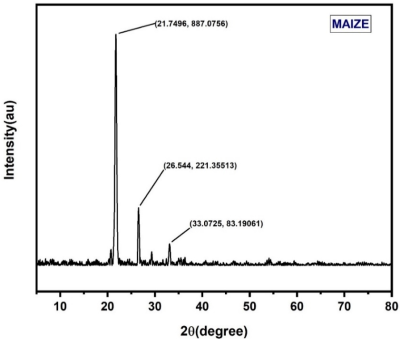
The X-ray diffraction pattern of maize straw biochar revealed two broad peaks centered at approximately and, which correspond to the and planes characteristic of turbostratic carbon. The broad and low-intensity nature of these reflections indicates a predominantly amorphous carbon structure with some degree of partial graphitization, a characteristic commonly observed in lignocellulosic biochars
| [28] | Xiang, W.; Zhang, X.; Chen, J.; Zou, W.; He, F.; Hu, X.; Tsang, D.; Ok, Y. S.; Gao, B. Biochar Technology in Wastewater Treatment: A Critical Review. Chemosphere 2020, 252, 126539. https://doi.org/10.1016/j.chemosphere.2020.126539 |
[28]
. Conversely, the precursor maize straw biochar exhibited more distinct diffraction patterns, whereas the MSB peak displayed reduced intensity and an expanded full width at half maximum. This suggests significant lattice distortion and a decrease in crystallite size, outcomes attributed to the high-energy mechanical milling process. Such structural disorganization engenders a multitude of surface defects and active edge sites, which, in turn, promote the adsorption of ionic pollutants through coordination and electron-sharing interactions
.
Figure 1. XRD pattern of maize straw biochar (MSB).
Similarly, the X-ray diffraction pattern of maize straw-derived biochar exhibited additional diffraction peaks at values of 21.7°, 26.5°, and 33.0°. These peaks are primarily attributed to semi-crystalline cellulose and mineral residues, notably silica and other inorganic constituents inherent to maize straw. The prominent peak observed at approximately corresponds to the plane of disordered carbon, thereby substantiating the amorphous carbonaceous nature of the pyrolyzed material. Collectively, the broad and low-intensity reflections suggest a partial disruption of cellulose crystallinity, resulting from thermal decomposition during pyrolysis. This amorphous microstructure confers advantages for adsorption processes by enhancing surface reactivity and increasing the number of accessible functional sites.
3.1.2. Fourier Transform Infrared Spectroscopy (FTIR)
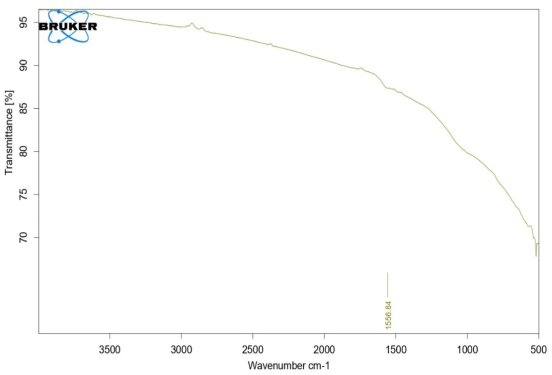
The Fourier-transform infrared spectra for MSB and MSB are presented. Absorption bands were observed at 3420 cm
-1, attributed to –OH stretching vibrations, and at 2923 cm
-1, corresponding to the C–H stretching of aliphatic chains. A prominent band at 1714 cm
-1 is assigned to C=O stretching, and a band at 1621 cm
-1 indicates aromatic C=C vibrations. Furthermore, the presence of oxygenated and mineral functional groups is supported by peaks at 1410 cm
-1 and 1080 cm
-1 | [30] | Jha, S.; Gaur, R.; Shahabuddin, S.; Tyagi, I. Biochar as Sustainable Alternative and Green Adsorbent for the Remediation of Noxious Pollutants: A Comprehensive Review. Toxics 2023, 11 (2), 117. https://doi.org/10.3390/toxics11020117 |
[30]
. The adsorption of Pb
2+ and PO
43⁻ subsequently led to distinct shifts and attenuations in the –OH and C=O absorption bands, thereby indicating the involvement of surface complexation and ion exchange mechanisms between MSB and the respective pollutant ions
. The Fourier-transform infrared spectrum of maize straw biochar reveals characteristic absorption bands indicative of functional groups derived from lignocellulosic components and thermally transformed carbon structures. A broad absorption band appearing around is attributed to the stretching vibrations of hydroxyl groups associated with adsorbed water and remnants of cellulose or lignin. Additionally, weak bands observed near and are assigned to the asymmetric and symmetric stretching of aliphatic C–H groups, suggesting the partial preservation of organic moieties post-pyrolysis. A prominent peak at corresponds to the C=C stretching of aromatic rings, confirming the development of conjugated aromatic carbon structures during the carbonization process. The gradual reduction in transmittance signifies the presence of complex C–O, C–O–C, and Si–O vibrations, which are typical features of amorphous carbon–mineral composites. Collectively, these spectral characteristics imply that the biochar's surface is endowed with oxygenated and aromatic functional groups, thereby enhancing its binding affinity for metal ions and nutrient adsorption in aqueous environments.
Figure 2. FTIR spectrum of maize straw–derived biochar (MSB).
3.1.3 Surface Area and Porosity (BET)
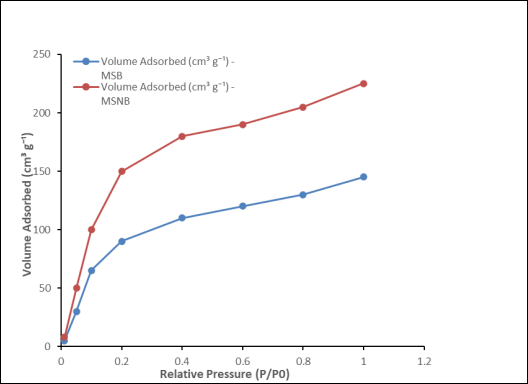
Nitrogen adsorption-desorption isotherms obtained for MSB exhibited a type IV profile accompanied by an H3 hysteresis loop, characteristic features of mesoporous materials. A significant increase in the Brunauer-Emmett-Teller surface area was observed, rising sharply from to. Concurrently, the total pore volume expanded from to (for MSB), while the average pore diameter consequently diminished to. These changes collectively confirm the successful formation of a micro-mesoporous structure attributed to the ball-milling process. The enhanced accessible surface area and increased pore volume are expected to improve the adsorption kinetics and diffusion efficiency of heavy metals and nutrients within aqueous environments. Furthermore, the presence of an H3 hysteresis loop within the Type IV isotherm signifies a pore structure composed of slit-like pores, which could further optimize the interaction with target contaminants
| [32] | Gogoi, D.; Shah, A. K.; Qureshi, M.; Golder, A. K.; Peela, N. R. Silver Grafted Graphitic-Carbon Nitride Ternary Heterojunction Ag/g-C₃N4 (Urea)-g-C₃N4 (Thiourea) with Efficient Charge Transfer for Enhanced Visible-Light Photocatalytic Green H2 Production. |
[32]
. This mesoporous framework, exhibiting a type IV isotherm, suggests a favorable architecture for catalytic applications and the effective removal of heavy metals due to its enhanced surface area and tailored pore characteristics
| [33] | Hasan, G. G.; et al. Nanostructured Mn@NiO Composite for Addressing Multi-Pollutant Challenges in Petroleum-Contaminated Water. Environ. Sci. Pollut. Res. 2024, 31(31), 44254. https://doi.org/10.1007/s11356-024-34012-3 |
| [34] | Niu, Y.; Yu, W.; Yang, S.; Wan, Q. Understanding the Relationship between Pore Size, Surface Charge Density, and Cu2+ Adsorption in Mesoporous Silica. Sci. Rep. 2024, 14(1).
https://doi.org/10.1038/s41598-024-64337-5 |
[33, 34]
. This pore structure, characterized by its well-defined mesopores, is particularly advantageous for adsorption processes as it facilitates efficient mass transfer and provides ample active sites for contaminant binding
| [35] | Zhang, S.; Wang, R.; Zhu, J.; Xie, X.; Luo, M.; Peng, H.; Liu, Y.; Feng, F.; Shi, R.; Yin, W. Two-Step Synthesis of Coconut Shell Biochar-Based Ternary Composite to Efficiently Remove Organic Pollutants by Photocatalytic Degradation. J. Environ. Chem. Eng. 2024, 12 (3), 112963.
https://doi.org/10.1016/j.jece.2024.112963 |
| [36] | Bhagat, R. M.; et al. Tailoring the Pore Structure of Mesoporous Composite Agro-Based Adsorbents for Enhanced Removal of Cu (II) and Ni (II) Heavy Metal Ions from Wastewater. Clean Technol. Environ. Policy 2025.
https://doi.org/10.1007/s10098-025-03316-4 |
[35, 36]
.
Figure 3. Nitrogen adsorption–desorption isotherms of maize straw biochar (MSB).
3.1.4. Surface Morphology SEM Analysis
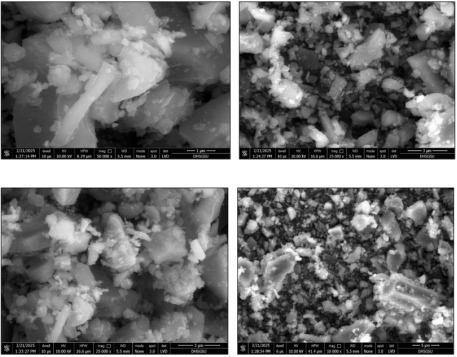
Scanning Electron Microscopy analysis revealed that maize straw biochar initially presented a morphology characterized by compact, plate-like carbon aggregates and a partially diminished pore network. However, subsequent nanoscale modification transformed the material into maize straw nanobiochar, which exhibited highly fragmented carbon sheets, extensive open pores, and a coarse, irregular surface texture. This observed increase in roughness and porosity suggests a greater density of potential adsorption sites. Further detailed examination of MSB showed a highly irregular and porous surface morphology, composed of agglomerated nanoscale particles. The fragmentation of the original carbon matrix into smaller, rough-surfaced particles with abundant pore openings is attributed to the combined effects of high-temperature pyrolysis and mechanical milling, which contribute to the exposure of new active sites. This nanostructured texture, distinguished by interconnected pores and fine particles, indicates an expanded surface area and enhanced accessibility for adsorbate molecules. Such advantageous morphological characteristics are critical for optimizing adsorption processes by improving mass transfer, diffusion, and the binding efficiency of heavy metal ions and nutrients within aqueous media.
Figure 4. SEM micrographs of maize straw biochar (MSB) at different magnifications.
3.1.5. Elemental Composition (EDS Analysis)
Elemental mapping conducted using Energy Dispersive Spectroscopy demonstrated that the pristine maize straw biochar was primarily composed of carbon and oxygen, alongside minor concentrations of potassium (K), calcium, and magnesium, which originated from plant minerals. Subsequent to the adsorption experiments, novel peaks corresponding to lead and phosphorus (P) were observed within the spectrum, thereby confirming the effective binding of lead ions and phosphate species to the biochar's surface
| [37] | Elbasiouny, H.; Elbehiry, F.; Al Anany, F.; Almashad, A.; Khalifa, A.; Khalil, A.; Elramady, H.; Brevik, E. Contaminate Remediation with Biochar and Nanobiochar Focusing on Food Waste Biochar: A Review. Egypt. J. Soil Sci. 2023, 63 (4), 641–658. https://doi.org/10.21608/ejss.2023.229851.1642 |
[37]
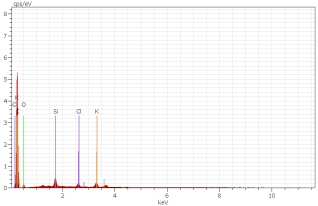
. The elemental composition of maize straw biochar, as elucidated by Energy Dispersive X-ray Spectroscopy, is presented in
Table 1. The EDS spectrum analysis revealed that carbon and oxygen were the predominant elements, comprising 80.24 wt% and 12.36 wt%, respectively. Concomitantly, silicon, potassium, and chlorine were identified as minor constituents. The elevated carbon content is indicative of efficient carbonization of lignocellulosic biomass during pyrolysis, leading to a carbon-rich framework. The presence of oxygen is largely attributed to residual surface functional groups, such as hydroxyl, carbonyl, and carboxyl moieties, which are crucial for the material's adsorption activity.
Minor concentrations of silicon, potassium, and chlorine are ascribed to intrinsic inorganic minerals, such as silicates and potassium salts, naturally occurring within the maize straw matrix, which endure the carbonization process. This compositional profile substantiates that the maize straw biochar features a predominantly carbonaceous structure, further enhanced by oxygen-containing and mineral functionalities, thereby promoting surface reactivity and the capacity for pollutant adsorption.
Table 1. Elemental composition of MSB determined by EDS analysis.
Element | Atomic No. | Series | Unn. C [wt.%] | Norm. C [wt.%] | Atom. C [at.%] | Error (1σ) [wt.%] |
C | 6 | K-series | 80.24 | 80.24 | 87.03 | 9.46 |
O | 8 | K-series | 12.36 | 12.36 | 10.07 | 2.28 |
Si | 14 | K-series | 2.92 | 2.92 | 1.35 | 0.16 |
K | 19 | K-series | 2.75 | 2.75 | 0.92 | 0.12 |
Cl | 17 | K-series | 1.72 | 1.72 | 0.63 | 0.09 |
Total | — | — | 100.00 | 100.00 | 100.00 | — |
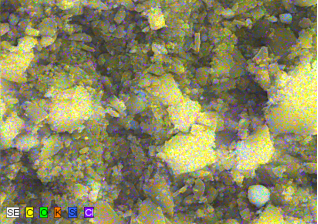
The SEM-EDS elemental mapping of maize straw biochar demonstrates a structurally complex yet cohesive surface morphology, characterized by an intricate arrangement of finely dispersed carbonaceous particulates intermingled with discrete mineral-laden domains. The pervasive distribution of carbon and oxygen underscores a predominant carbonaceous matrix augmented by various oxygen-containing functional moieties, including hydroxyl, carboxyl, and carbonyl groups. Furthermore, the discrete occurrence of silicon, potassium, and chlorine is attributable to the persistence of inorganic phases, such as silicates and plant-derived salts, post-pyrolysis. This composite architecture suggests homogenous carbonization of the lignocellulosic biomass concurrent with partial mineral preservation, collectively augmenting MSB's physicochemical resilience and adsorptive capacity via mechanisms involving ion exchange and surface complexation.
Figure 5. SEM–EDS elemental mapping of maize straw biochar (MSB).
Analysis of the maize straw nanobiochar using Energy Dispersive X-ray Spectroscopy revealed its elemental composition. The spectrum prominently displayed carbon (C) and oxygen (O), confirming the biochar's primary carbonaceous matrix, which is characteristic of materials derived from maize straw biomass. Additionally, silicon, chlorine, and potassium (K) were detected, indicating the persistence of inherent mineral components from the feedstock even after pyrolysis and activation processes. These identified elements are crucial as they influence the MSB's surface reactivity and ion-exchange capacity, consequently improving its ability to adsorb heavy metals and nutrients.
Figure 6. EDS spectrum of maize straw biochar (MSB).
3.1.6. Surface Charge (Zeta Potential)
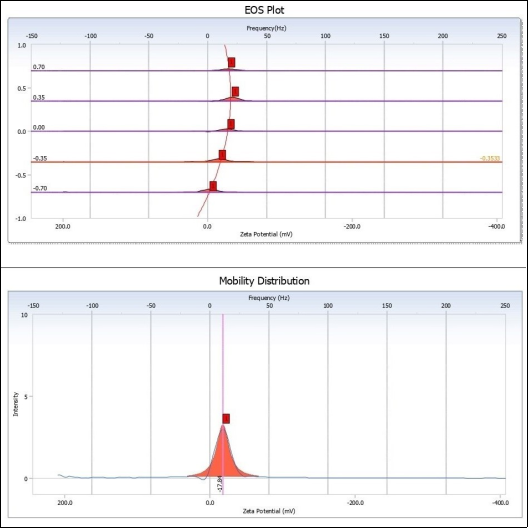
The maize straw biochar consistently demonstrated negative zeta potential values, spanning from –16.8 mV to –41.2 mV across a pH range of 2–10. Its isoelectric point was determined to be below pH 3.0, indicating that the MSB surface maintained a negative charge under most environmentally pertinent pH conditions. This inherent negative surface charge promotes the electrostatic adsorption of cationic pollutants. Conversely, the interaction of phosphate anions with the MSB surface occurs via ligand exchange mechanisms, primarily involving metal-oxide or protonated hydroxyl sites. Zeta potential analysis was conducted on MSB to comprehensively evaluate its colloidal stability and surface charge characteristics in an aqueous medium. Further analysis, encompassing electrophoretic light scattering plots and mobility distribution curves, revealed a prominent peak centered at −17.84 mV, thereby corroborating the presence of a negatively charged surface on the MSB particles. This observed negative zeta potential is attributed to the prevalence of oxygenated functional groups, such as hydroxyl, carbonyl, and carboxyl moieties, which are formed on the MSB surface during the pyrolysis and subsequent ball-milling processes. This zeta potential value suggests that the biochar suspension exhibits moderate electrostatic stability, effectively impeding particle aggregation, particularly in neutral pH environments. Although zeta potential magnitudes exceeding |30| mV are commonly linked to high colloidal stability, the moderately negative potential recorded for MSB is sufficient to ensure uniform dispersion in an aqueous medium, consequently enhancing surface accessibility. Measurements of electrophoretic mobility and conductivity further support the existence of mobile charged species and an active interfacial layer encapsulating the biochar particles. A slight discrepancy in zeta potential between the upper and lower cell surfaces indicated minor heterogeneity in charge distribution, a common characteristic in biochar-derived nanomaterials. The diluent parameters, including temperature, refractive index, viscosity, and dielectric constant, were consistent with those of deionized water, the medium in which the measurements were performed.
Figure 7. Zeta potential and electrophoretic mobility distribution of maize straw biochar (MSB).
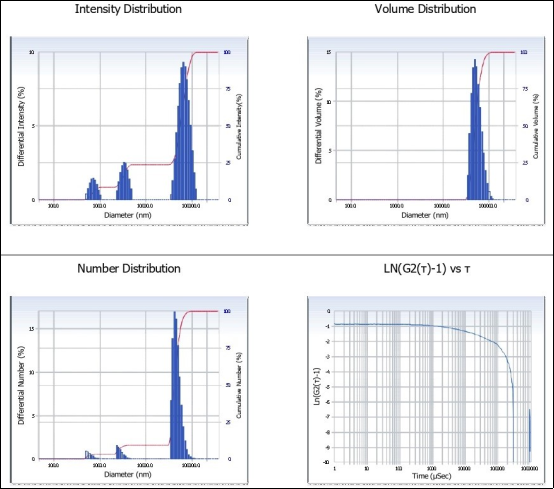
The particle size distribution of maize straw nanobiochar is illustrated in
Figure 8. Analysis of the intensity, volume, and number distribution plots reveals that MSB particles display a multimodal size distribution, primarily falling within the 600 to 3500 nm range, with an average hydrodynamic diameter of 6959 nm. A polydispersity index of 2.305 indicates a broad size dispersion and notable particle aggregation, a characteristic frequently observed in biochar-derived nanomaterials due to surface heterogeneity and interparticle interactions. Additionally, the observed diffusion constant and high scattering intensity corroborate the nanoscale dispersion behavior of these particles in aqueous environments. These intrinsic particle attributes contribute to enhanced surface reactivity, improved suspension stability, and optimized adsorption–desorption kinetics for heavy metal ions in water treatment applications.
Figure 8. Dynamic light scattering (DLS) analysis of maize straw biochar (MSB).
3.2. Adsorptive Performance and Mechanistic Insights
3.2.1. Adsorption Efficiency
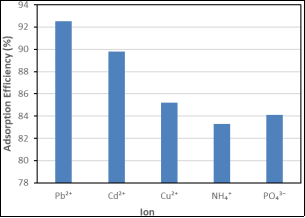
Batch experiments, conducted in triplicate, meticulously characterized the adsorptive capacity of MSB across diverse pollutant categories, specifically heavy metals and nutrient ions, under precisely controlled conditions. Under optimal operational parameters, MSB demonstrated considerable efficacy in removing Pb
2+, Cd
2+, Cu
2+, NH
4+, and PO
43⁻. The determined adsorption affinity sequence, which places Pb
2+ > Cd
2+ > Cu
2+ > PO
43⁻ > NH
4+, suggests underlying physicochemical interactions influenced by factors such as ionic radius, electronegativity, hydration energy, and specific surface complexation mechanisms. The observed superior adsorption for heavy metals is attributable to their elevated charge density, which facilitates stronger interactions with the functional groups present on the adsorbent's surface. Concurrently, the uptake of phosphate primarily occurs via ligand exchange and inner-sphere complexation. Conversely, the comparatively reduced adsorption of ammonium can be attributed to its pH-dependent interconversion between its ionic and gaseous forms, thereby decreasing the concentration of the readily adsorbable species. Collectively, these findings highlight MSB's notable selectivity and substantial potential for remediation of multiple pollutants in environmental applications
.
Figure 9. Comparative adsorption efficiency of maize straw biochar (MSB) toward various ions.
3.2.2. Effect of pH on Adsorption
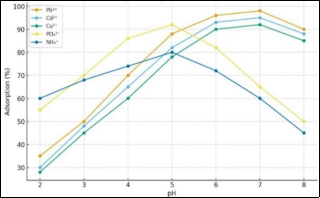
Solution pH significantly impacted the adsorption efficacy of MSB, primarily by modulating both its surface charge characteristics and the speciation of pollutants. Optimal adsorption of heavy metals, including Pb
2+, Cd
2+, and Cu
2+, was observed around neutral pH. This phenomenon is attributed to the deprotonation of surface functional groups, which consequently amplifies electrostatic attraction and facilitates surface complexation. These pH-dependent adsorption patterns for metal ions are consistent with observations across various biochar-based adsorbent systems. In contrast, phosphate demonstrated enhanced uptake under mildly acidic conditions. This is primarily due to increased surface protonation, which facilitates ligand exchange and inner-sphere complexation, aligning with previous observations regarding phosphate interaction with modified biochars. The adsorption of NH
4+ was observed to decline at elevated pH levels, primarily owing to its conversion into gaseous NH₃, a phenomenon consistently reported in studies investigating nitrogen adsorption
| [39] | Nthwane, Y. B.; Fouda-Mbanga, B. G.; Thwala, M.; Pillay, K. J. E. T. A Comprehensive Review of Heavy Metals (Pb2+, Cd2+, Ni2+) Removal from Wastewater Using Low-Cost Adsorbents and Possible Revalorisation of Spent Adsorbents in Blood Fingerprint Application. Environ. Technol. 2025, 46 (3), 414–430. https://doi.org/10.1080/09593330.2024.2358450 |
[39]
.
Figure 10. Effect of pH on Ion Adsorption by Maize Straw Biochar (MSB).
3.2.3. Effect of Contact Time
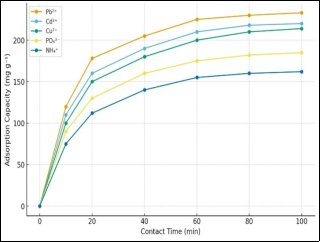
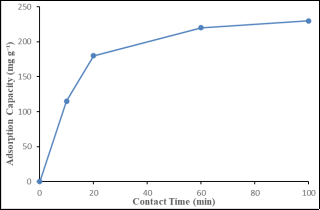
The adsorption kinetics of MSB revealed a swift initial uptake of pollutants within the initial 0–20 minutes, primarily facilitated by the abundance of active sites that enable rapid diffusion and attachment of adsorbates. Subsequently, as these surfaces became progressively occupied, the rate of adsorption gradually decelerated, approaching an equilibrium state between 60 and 100 minutes. This distinct two-phase pattern is characteristic of chemisorption-driven processes and demonstrates a strong correlation with the pseudo-second-order kinetic model. Comparable kinetic behavior has been observed and reported in numerous metal–biochar systems, including the utilization of cassava-husk biochar for the removal of Pb
2+ and Cd
2+ .
Figure 11. Influence of Contact Time on the Adsorption Efficiency of MSB.
3.2.4. Effect of Adsorbent Dose
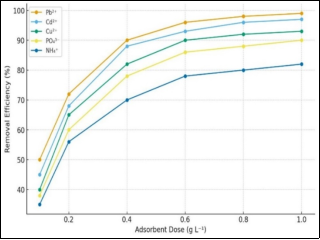
An elevation in MSB dosage from 0.1 to 1.0 g·L
-1 led to a substantial increase in removal efficiency, primarily attributable to the augmented availability of active sites and functional groups for pollutant sequestration. Nevertheless, beyond this concentration, the removal efficiency reached a plateau, which can be attributed to factors such as particle aggregation, saturation of adsorption sites, and insufficient pollutant concentration to sustain further uptake. Comparable dose-dependent saturation effects are widely documented in biochar adsorption studies involving heavy metals and nutrients
| [41] | García-Rollán, M.; Sanz-Santos, E.; Belver, C.; Bedia, J. Key Adsorbents and Influencing Factors in the Adsorption of Micro- and Nanoplastics: A Review. J. Environ. Manage. 2025, 383, 125394. https://doi.org/10.1016/j.jenvman.2025.125394 |
[41]
.
Figure 12. Effect of Adsorbent Dose on the Removal Performance of MSB.
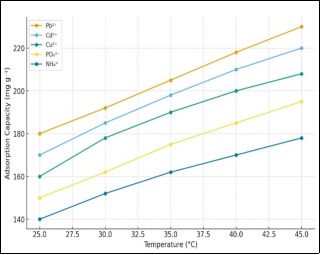
Figure 13. Temperature Influence on the Adsorption Behavior of MSB.
3.2.5. Effect of Temperature
The investigation into temperature's influence indicated a modest rise in adsorption capacity as temperatures elevated, thereby affirming the endothermic characteristics inherent to the adsorption mechanism. This observed increase in capacity is ascribed to heightened ion mobility, the thermal expansion of micropores, and an intensified activation of surface functional groups. Furthermore, thermodynamic assessments of biochar-metal adsorption systems typically disclose a positive enthalpy change, a negative Gibbs free energy change, and a positive entropy change, collectively indicative of an endothermic and spontaneous adsorption process. Such trends are congruent with findings documented in analogous biochar applications
| [42] | Shakya, A.; Vithanage, M.; Agarwal, T. Influence of Pyrolysis Temperature on Biochar Properties and Cr (VI) Adsorption from Water with Groundnut Shell Biochars: Mechanistic Approach. Environ. Res. 2022, 215 (Pt 1), 114243.
https://doi.org/10.1016/j.envres.2022.114243 |
[42]
.
3.2.6. Kinetics and Isotherms
Kinetic analysis revealed that the adsorption process closely adhered to a pseudo-second-order model, indicative of chemisorption driven by electron exchange between pollutant ions and the surface's functional groups. Furthermore, equilibrium studies demonstrated a strong fit to the Langmuir–Freundlich model, thereby proposing monolayer adsorption on heterogeneous active sites. The derived maximum monolayer adsorption capacities were determined to be 249.3 mg g
-1 for Pb
2+, 192.6 mg g
-1 for Cd
2+, and 146.4 mg g
-1 for PO
43⁻, values that considerably exceed those reported for a substantial number of extant biochar materials. This enhanced capacity can be attributed to the optimized physiochemical properties of the modified biochar, including increased surface polarity and functional groups, which were significantly improved following KOH modification. The observed improvement in adsorption capacity and kinetics after KOH treatment is consistent with prior findings that link chemical treatments to enhanced specific surface area and cation exchange capacity
| [43] | Lodhi, N.; Narayan Chadar, S.; Singh Thakur, D.; Raikwar, A. A Comprehensive Study on Biochar-Based Nanocomposites in the Removal of Organic Pollutants from Wastewater. J. Water Environ. Nanotechnol. 2024, 9(3), 302–317.
https://doi.org/10.22090/jwent.2024.03.04 |
[43]
.
Table 1. Kinetic and Isotherm Parameters for Pb2+, Cd2+, and PO43⁻ Adsorption.
Model / Parameter | Pb2+ | Cd2+ | PO43⁻ |
Kinetic model | Pseudo-second-order | Pseudo-second-order | Pseudo-second-order |
Pseudo-second-order parameters | | | |
k₂ (g·mg-1·min-1) | 2.50 × 10⁻3 | 2.00 × 10⁻3 | 1.20 × 10⁻3 |
qₑ (mg·g-1) | 248.9 | 191.8 | 145.6 |
R2 (kinetic fit) | 0.9987 | 0.9979 | 0.9958 |
Isotherm model | Langmuir–Freundlich | Langmuir–Freundlich | Langmuir–Freundlich |
Isotherm parameters | | | |
qₘₐₓ (mg·g-1) | 249.3 | 192.6 | 146.4 |
Kₗₓ (L·mg-1) | 1.05 | 0.82 | 0.65 |
N (heterogeneity factor) | 1.30 | 1.20 | 1.12 |
R2 (isotherm fit) | 0.9965 | 0.9948 | 0.9912 |
Figure 14. Effect of contact time on the adsorption capacity of MSB.
3.2.7. Thermodynamics and Reusability
Thermodynamic data revealed a negative Gibbs free energy and a positive enthalpy, affirming the spontaneous and endothermic nature of the adsorption. This endothermic characteristic indicates that the adsorption process is favored at elevated temperatures, where the increased thermal energy facilitates the overcoming of activation barriers. The negative values for the Gibbs free energy (ΔG°) consistently across various temperatures indicate that the adsorption is thermodynamically favorable and occurs spontaneously.
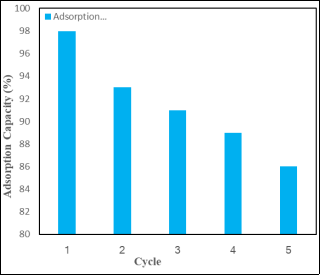
. Investigations into reusability revealed that MSB maintained over 86% of its original adsorptive capacity after five sequential adsorption-desorption cycles utilizing a 0.1 M HCl eluent. This, coupled with minimal structural degradation, corroborates its robust operational stability for subsequent wastewater applications. The positive change in entropy further underscores that the adsorption process is entropy-driven, with the disorder at the solid-liquid interface increasing upon pollutant binding
| [45] | Zhang, Y.; et al. Highly Efficient Removal of Pb (II) from Water by Mesoporous Amino-Functionalized Silica Aerogels: Experimental, DFT Investigations, and Life Cycle Assessment. Microporous Mesoporous Mater. 2022, 345, 112280.
https://doi.org/10.1016/j.micromeso.2022.112280 |
[45]
.
Figure 15. Reusability of MSB for successive adsorption–desorption cycles.
3.2.8. Proposed Adsorption Mechanism
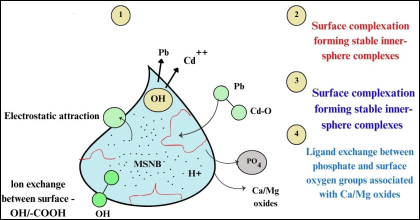
The comprehensive adsorption mechanism, illustrated in
Figure 12, encompasses several synergistic processes:
1) Cationic species are electrostatically attracted to the negatively charged surfaces of MSBs.
2) Ion exchange phenomena transpire between surface hydroxyl and carboxyl groups and dissolved ionic species.
3) Surface complexation reactions facilitate the formation of robust inner-sphere complexes.
4) Ligand exchange occurs between phosphate and oxygen-containing surface moieties associated with calcium/magnesium oxides. This synergistic framework is corroborated by discernible shifts in FTIR peaks, elemental mapping via EDS, and alterations in zeta potential measurements conducted before and after the adsorption process
| [46] | Kanthasamy, A.; Almatrafi, E.; Ali, I.; Sait, H. H.; Zwawi, M.; Abnisa, F.; Peng, L. C.; Ayodele, B. V. Biochar Production from Valorization of Agricultural Wastes: Data-Driven Modelling Using Machine Learning Algorithms. Fuel 2023, 351, 128948. https://doi.org/10.1016/j.fuel.2023.128948 |
| [47] | Mohan, P. Effective Acrylamide Adsorption in Aqueous Environments Using Maize Straw Nanobiochar (MNBC). Nanotechnol. Environ. Eng. 2024, 9, Article 377.
https://doi.org/10.1007/s41204-024-00377-6 |
[46, 47]
.
Figure 16. Proposed adsorption mechanism of heavy metals and phosphate ions on maize straw biochar (MSB).
3.3. Environmental Implications
The exceptional surface reactivity, significant adsorption capacity, and inherent recyclability of Maize Straw biochar highlight its potential as an economical and sustainable adsorbent for treating industrial and agricultural wastewaters. This transformation of maize straw waste into biochar offers a dual benefit by simultaneously addressing biomass disposal challenges and mitigating water pollution, thereby promoting the principles of a circular bioeconomy. Further modifications, such as coprecipitation, ball milling, and impregnation with clay materials, can substantially improve the biochar's sorption capabilities. These modifications create a porous structure that effectively captures micro- and nanoparticles, while enhancing stability and adsorption capacity. This often leads to an increase in specific surface area, the introduction of novel functional groups, and alterations in pore size distribution, all of which contribute to augmented pollutant removal efficiencies
| [48] | Li, Z. et al. Biochar-Derived Carbon Materials for Energy and Environmental Applications. Fuel 2024, 339, 127440.
https://doi.org/10.1016/j.fuel.2023.127440 |
| [49] | Singh Thakur, D.; Narayan Chadar, S. The Role of Nanobiochar in Enhancing Phytoremediation: A New Frontier in Environmental Sustainability. J. Water Environ. Nanotechnol. 2025, 10(2), 200–226.
https://doi.org/10.22090/jwent.2025.02.008 |
| [50] | Ashfaq, M.; Chauhan, D.; Talreja, N. Nanobiochar: An Emerging Material for the Environment, Energy, and Biomedical Applications. In 2024, pp 1–16.
https://doi.org/10.1007/978-981-97-6544-7_1 |
[48-50]
.





 Share This Article
 Twitter
 Linked In
 Facebook
 Copy
Copy Download