Research Article | | Peer-Reviewed

Groundwater Quality Assessment and Its Suitability for Drinking and Irrigation Purposes in the Eocene Aquifer of Diourbel-center Senegal

Received: 1 February 2026     Accepted: 20 February 2026     Published: 10 March 2026
Views:       Downloads:
Abstract

Water resource availability in quantity and quality is a primary factor which influences the development of various human activities worldwide. In most countries in Africa, due to the scarcity and poor quality of surface water, groundwater is the main natural resource used to relieve the increasing water demands of population. In Diourbel region (central Senegal), groundwater is an important resource used for economic activities. This study aims to evaluate groundwater quality and suitability for drinking and irrigation purposes. Thirty-seven (37) samples (boreholes and dug wells) were collected and major ions were analyzed. Classification of groundwater using TDS (Total Dissolved Solids) and TH (Total Hardness) showed respectively that 81.08% fall in the fresh water type, suggesting suitability for drinking water purpose. Moreover, most of groundwater samples fall in hard (21.62%) and very hard (75.68%) category of water. Furthermore, the computed values of WQI indicate majority of groundwater samples (76%) falls under good to excellent water, suggesting that the groundwater is suitable for drinking and other domestic uses. Data Wilcox and US Salinity Laboratory (USSL) plots show that the majority of groundwater samples are suitable for irrigation.% N, SAR, KR, PI, and RSC show that groundwater samples are suitable for irrigation except MR (Magnesium Ratio). This study shows a good quality of groundwater for consumption and irrigation purposes and thus contributes to the rural and urban development of the study area where the most productive aquifer is limited by the presence of brackish water.

Published in American Journal of Water Science and Engineering (Volume 12, Issue 1)
DOI 10.11648/j.ajwse.20261201.12
Page(s) 13-26
Creative Commons

This is an Open Access article, distributed under the terms of the Creative Commons Attribution 4.0 International License (http://creativecommons.org/licenses/by/4.0/), which permits unrestricted use, distribution and reproduction in any medium or format, provided the original work is properly cited.

Copyright

Copyright © The Author(s), 2026. Published by Science Publishing Group

Keywords

Drinking and Irrigation Suitability, Groundwater Quality, Water Quality Index, Diourbel, Senegal

1. Introduction
In most countries, particularly those in semi-arid and arid zones, groundwater is the main water resource available to meet the various needs of the population. According to , 65% of groundwater is used for drinking purposes, 20% for irrigation and livestock, and 15% for industry and mining. Groundwater is mainly used for drinking water supply in both urban and rural areas but also for agriculture, industry, and domestic uses. In agricultural areas, production is highly dependent on the quantity and especially on the quality of irrigation water, which is generally taken from groundwater. Thus, almost 40% of the world’s food is produced by irrigation that highly depends on groundwater . However strong demographic growth combined with various anthropic activities leads to an overexploitation of groundwater, generally leading to a gradual degradation of its quality. Thus, in urban areas with a high concentration of people and in areas with high agricultural activity, the availability of good quality water is a major concern for the population. Hence, since the last few decades many studies have been conducted to assess groundwater quality and identify the major hydrogeochemical processes that control surface water or groundwater quality. Furthermore, other previous studies have been carried out, using different approaches, to classify and determine the suitability of waters for drinking and irrigation purposes. The assessment of water quality is therefore an essential step in classifying and identifying areas with high drinking water potential, but also in implementing an effective policy of rational and sustainable management of water resources. The study area is a densely populated (3.3% growth rate) region with high agricultural activity where most of the water needs for drinking, industry and agriculture uses come from groundwater exploitation. Thus, in this region, groundwater is a very important resource because of the low rainfall and the scarcity of surface water. Also, the most productive aquifer (Maastrichtian) has brackish water and was located at depths outside of carrying populations. Therefore, it is important to understand the variation of chemical composition of groundwater to meet water demand. The objective of this study is to assess the chemical quality of groundwater and determine its suitability for drinking water purpose and agricultural use.
2. Study Area Description
2.1. Location and Climate
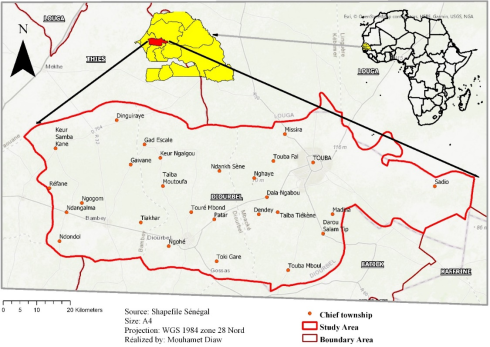
Located in central Senegal, the study area belongs to the groundnut basin. It covers an area of 4769 km² and lies between 14°30 and 15° North latitude and 15°40 and 16°40 West longitude . It is bounded to the east by the Kaffrine region, to the west by the Thiès region, to the north by the Louga region, and to the south and southwest by the Fatick region (Figure 1). According to forecasts by the National Agency of statistics and Demography (ANDS) the Diourbel region will be the third most populated region in Senegal behind Dakar and Thiès, with 2,179,594 inhabitants by 2025 . The Diourbel region is characterized by a strong agricultural activity which is largely dependent on rainfall. Majority of the study area is occupied by agricultural land with 446829 ha. The main crops in the study area are Groundnut, Millet and Sorghum. Groundnut production, which is highly dependent on rainfall, is highly variable from one year to another. The urban area covers 14684 ha and soils are mainly made up of sandy or sandy-clayey sediments of wind and alluvial origin. The climate of the study area is Sudano-Sahelian and is characterized by a long dry season and a short rainy season lasting only three to four months. The inter-annual evolution of rainfall shows a variability in rainfall with an average rainfall value of 516.4 mm over 30 years (1987 to 2017). The hydrographic network is almost non-existent except for a few rare temporary ponds that store rainwater for three to four months. The maximum monthly average temperature is between 33 and 40°C.
Figure 1. Location of the Study area with groundwater sampling sites.
2.2. Geology and Hydrogeology
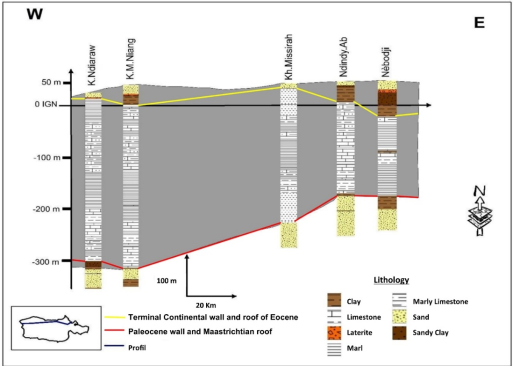
The geology of the study area is known through drilling and boreholes carried out in the context of water research or geological studies. The lithological description of the geological formations encountered shows that the study area is made up of clayey sands of the Continental Terminal, marls, limestones and marly-limestones of the Paleocene and the Eocene and quartz sands of the Maastrichtian. This study is mainly focused on the Eocene which constitutes an important aquifer. Throughout the study area, the Eocene is particularly formed of marly-limestone, limestone, marly limestone to nummulites . The W-E geological section (Figure 2) obtained from the drilling data confirms that the Paleocene and Eocene are mainly composed of limestone, marl and marl-limestone. The hydrogeology of the Diourbel region is characterized by the presence of several types of aquifers: the shallow aquifers, which include the terminal continental and quaternary aquifers, which are very little exploited in the study area, the intermediate aquifers, which include the Paleocene and Eocene aquifers, and the Maastrichtian, which constitutes the deep aquifer. The Eocene aquifer, focus of this study, is mainly exploited by traditional dug wells. It is submerged in the southwest and northwest and sinks towards the east. The thickness of the Eocene aquifer increases from East to West and varies between 80 and 225 m (Northwest) with an average value of 150 m . The transmissivity values of the Eocene aquifer vary from 2.10-5 to 1.10-3 m2/s.
Figure 2. Geological section of the study area.
3. Water Sampling and Analytical Method
A campaign of groundwater samples collection was carried out during October 2017 at the entire study area. Thirty-seven (37) samples were collected in polyethylene bottles of 250 ml on a sampling network, consisting of dug wells and boreholes. The samples were taken after pumping in borehole or in dug wells which are still used by the population in order to obtain a representative groundwater. However, before sampling, the bottles were rinsed respectively with distilled water and then two to three times with water to be collected and then the bottles were filled till the rim. At each dug well or borehole two groundwater’s samples were collected and stored in two polyethylene’s bottles. One of the bottles was acidified with HCl to pH≈2 for cations determination. The other bottle for anions analysis was kept unacidified. Electrical conductivity (EC), pH and Temperature were directly measured in the field using a multi-parameter portable devices WTW Multi 3630 IDS. After sampling, groundwater samples were immediately sealed and transported to the laboratory. In the laboratory, groundwater samples were filtered through 0.45µm cellulose membrane to retain suspended elements and colloids. Major ions ((Ca2+, Mg2+, Na+, K+, HCO3-, Cl-, SO42-, NO3-) and some minor ions (Fe2+ and F-) were determined at the hydrochemistry laboratory of the Department of Geology (Cheikh Anta Diop University of Dakar) using a Dionex DX 120 chromatography, equipped with an automatic sampler, an AS4 column for anions (except HCO3-, which was determined by titration) and a CS12 column for cations (measurement precision of 3%). The accuracy of chemical data analysis was checked using the charge balance equation Eq. (1). The ionic balance for all samples is within ±5% .
CBE (%)=cations- anionscations+ anions*100(1)
Assessment of water quality is an essential step in water management. It is essential to ensure protection and good supply of drinking water to the population. Several water quality parameters are generally used to assess the suitability of water for drinking purpose. To determine the water’s suitability for drinking, TDS (Total Dissolved Solids), TH (Total Hardness) and WQI (Water Quality Index) were used.
The TH represent the measure of dissolved Ca2+ and Mg2+ content expressed as CaCO3 which is also a reflection of soap-neutralizing power . It is generally used to evaluate groundwater usability for drinking or domestic purpose. High hardness is usually undesirable because it can cause lime buildup (scaling) in pipes and also in water heaters, which over the time will decrease water heater efficiency and decrease lathering of soap. Furthermore, water with TH greater than 80 mg/L cannot be used for domestic purposes, because it coagulates soap lather .
Total dissolved solids (TDS) is an important quality parameter that is widely used to assess the quality of water for human consumption but also for other uses . It reflects the overall amount of dissolved salts in water. High TDS values influence groundwater suitability for drinking and agricultural use. Furthermore, high concentration of TDS can cause gastrointestinal irritation in human and may also lead to laxative effects . The TDS is obtained using the formula from the Table 2.
WQI is an important parameter for assessing the overall quality of water and evaluating its suitability for human consumption based on the chemical parameters of the water. WQI is defined as a technique of rating that provides the composite influence of individual water quality parameters on the overall water quality . It is widely used, for the past few decades, by several studies worldwide to assess the suitability of waters for drinking purpose. The standards for drinking purposes as recommended by have been used for the calculation of WQI. The calculation of the Water quality index is generally done in three steps. In the first step, each of the 12 physico – chemical parameters like pH, TDS, TH, Ca2+, Mg2+, Na+, K+, HCO3-, SO42-, NO3-, F- and Cl-) has been assigned a weight (wi) ranging from 1 to 5 according to its relative importance in the overall quality of water for drinking purposes (Table 1). The maximum weight of 5 has been assigned to nitrate, fluoride and TDS due to their major significance in water quality assessment. For this study, the lowest weight of 1 was assigned to potassium because of its weak influence on the assessment of groundwater quality. The other parameters of quality such as pH, TH, Ca2+, Mg2+, Na+, K+, HCO3-, SO42- and Cl- were assigned a weight between 2 and 4 according to their importance on the water quality determination. In the second step, the relative weight (Wi) of the water quality parameter was computed from the Eq. (2).
Wi=wii=1nwi(2)
where Wi is the relative weight, wi is the weight of each parameter, n is the number of parameters. Calculated relative weight (Wi) values of each parameter are also given in Table 1.
Table 1. Relative of chemical parameters in the study area.

Chemical Parameters

Units

WHO standard 2006 and 2011

Weight (wi)

Relative weight (Wi) Wi=wii=1nwi

pH

-

6.5 -8.5

3

0.075

TDS

mg/L

500

5

0.125

TH

mg/L

200

3

0.075

Ca2+

mg/L

75

3

0.075

Mg2+

mg/L

30

3

0.075

Na+

mg/L

200

2

0.05

K+

mg/L

12

1

0.025

HCO3-

mg/L

350

3

0.075

SO42-

mg/L

250

3

0.075

NO3-

mg/L

50

5

0.125

F-

mg/L

1.5

5

0.125

Cl-

mg/L

250

4

0.1

wi=40

Wi=1

In the third step, a quality rating scale (qi) for each parameter is consigned by dividing its concentration in each water sample by its respective standard according to the guidelines laid down by and then the result was multiplied by 100 Eq. (3):
qi=CiSi*100Eq.(3)
where qi is the quality rating, Ci is the concentration of each chemical parameter in each water sample in milligrams per liter and Si is the WHO drinking water standard for each chemical parameter in milligrams per liter except for pH. Before computing the WQI, the SI is first calculated for each chemical parameter and then used to determine the WQI using the equations (4) and (5).
SIi=Wi*qi Eq.(4)
WQI=i=1nSIiEq.(5)
where SIi is the Sub-Index of ith parameter, qi is the rating based on concentration of ith parameter, n is the number of parameters.
The study area is an area of high agricultural activity since it is located in the heart of the Senegalese groundnut basin. Therefore, groundwater is used extensively for agriculture. An evaluation of their suitability for irrigation is necessary to increase agricultural production but also to ensure efficient management of water and soil resources. Numerous groundwater quality parameters such as EC (Electrical Conductivity), SAR (Sodium adsorption ratio), MR (Magnesium Ratio), KR (Kelley Ratio),% N (Sodium percent), PI (Permeability Index) are widely used in previous studies to assess the suitability of water for irrigation. In this study, quality parameters such as%N, SAR, MR, KR, PI, and RSC (Residual sodium carbonate) were used to assess the suitability of waters for irrigation purpose (Table 2). USSL diagram (SAR versus EC plot) and Wilcox diagram (Na% versus EC plot) were also applied to evaluate the irrigation suitability of groundwater. All ionic concentrations are expressed in meq/L.
Table 2. Common indices for drinking and irrigation water quality evaluation.

Sl N°

Water quality formula

references

1

TH (as CaCO3) mg/L = (Ca2+ + Mg2+) meq/L * 50

, 31]

2

TDS (mg/L) = 0.67 * Electrical conductivity (μS/cm)

3

WQI=i=1nSIi

4

% Na=[Na++ K+][Ca2++Mg2++Na++K+] 

5

SAR=Na+Ca2++Mg2+2

6

RSC = (HCO3- + CO32-) – (Ca2+ + Mg2+)

7

PI=(Na++HCO3-)Ca2++Mg2++Na++K+x 100

8

KR=Na+Ca2++Mg2+ 

9

MR=Mg2+Ca2++Mg2+x 100

4. Results and Discussion
4.1. Groundwater Chemistry
The chemical analysis results of groundwater samples of the study area are presented in Table 3. The pH of groundwater samples ranges from 6.73 to 8.3 with an average value of 7.6 suggesting mildly acidic to slightly alkaline nature of groundwater. Electrical conductivity is an important water parameter that gives an idea on the degree of water mineralization. It increases according to the content of dissolved ions and the nature of the dissolved salts . The electrical conductivity (EC) of groundwater samples varies between 390 and 4750 µS/cm with an average value of 1,291.6 µS/cm, indicating low to highly mineralized water. Calcium (Ca2+) constitutes the most abundant cation in the groundwater and ranges from 41.60 to 232.04 mg/L with an average value of 105.02 mg/L. Sodium (Na+) is the most abundant cation in water after Ca2+ and high Na+ contents in water are generally related to several factors such as weathering of rock, sea water intrusion and anthropogenic sources like domestic and animal waste . Na+ concentration ranged from 4.68 to 576.62 mg/L with an average value of 76.85 mg/L. Magnesium (Mg2+) and potassium (K+) are the least abundant cations in groundwater samples. Their concentrations vary respectively from 6.32 to 183.63 mg/L and from 1.34 to 30.17 mg/L with respective average values of 42.02 mg/L and 6.32 mg/L. The general dominance of cations in groundwater was in the order of Ca2+ > Na+ > Mg2+ > K+. For the anions, bicarbonate (HCO3-) is the most abundant anion in the groundwater samples with values that vary from 67.1 to 610 mg/L with an average value of 307.47 mg/L. It is followed by chloride with concentrations ranging from 21.6 to 1447.91 mg/L with an average value of 194.96 mg/L. Sulfate (SO42-) contents ranged from 0.92 to 485.8 mg/L with an average value of 78.80 mg/L. Nitrate (NO3-) is a chemical pollutant of water that generally derives from anthropic activities, degradation of organic matter, wastewater, fertilizers, human and animal waste, leakage of septic tanks . High NO3- concentration is a danger to human health, especially for children. According to , the consumption of water with high NO3- concentration causes blue babies or methemoglobinemia disease in infants, gastric carcinomas, abnormal pain, central nervous system birth defects, and diabetes. In the study area, nitrate concentrations are relatively low, except for a few points that have NO3- values above the WHO limit for drinking water supply. NO3- concentration ranged from 0.41 to 577.81 mg/L with an average value of 32.9 mg/L. In the study area majority of groundwater samples (83.8%) have NO3- concentration lower than the recommended desirable limit of 50 mg/L for drinking water indicating the usability of this water for drinking use. The abundance of anions is in the following order: HCO3- > Cl- > SO42- ˃ NO3-. Fluoride concentrations are very low in groundwater of the study area. Fluoride values ranged from 0.08 to 0.48 mg/L with an average value of 0.27 mg/L. All groundwater samples of the study area have fluoride content below the allowable limit of 1.5 mg/L suggested by the WHO for drinking purpose.
The Eocene formation was marked by major tectonic phenomena that affected the sedimentary basin. The density of accidents is very high, but their reject is generally modest . It will result in the general retreat of the sea but thus promote the trapping of seawater in certain parts of the upper horizons of the Eocene aquifer.
Table 3. Physico-chemical parameters of groundwater samples of the study area.

Libellé

Samples

Aquifer

pH

CE

HCO3-

Cl-

SO42-

NO3-

F-

Na+

K+

Mg2+

Ca2+

Fe2+

P33

Baity

eocene

7.9

1040

445.3

75.03

104.5

0.58

0.27

24.13

3.23

49.92

109.82

0.21

P12

Boundou

eocene

7.36

1375

366

161.77

178.56

1.24

0.2

75.95

7.28

66.74

96.14

0.06

P27

Bousrah

eocene

6.89

490

67.1

85.49

6.91

66.4

0.15

30.09

1.77

12.72

44.06

1.38

P2

Coky Ndiaguène

eocene

7.24

997

244

135.1

105.23

0.81

0.31

45.77

7.23

45.96

68.35

0.11

P18

Darou Ndiaye

eocene

7.88

1727

378.2

162.55

320.77

3.45

0.4

71.55

8.46

86.47

129.67

0.21

P22

Darou Salam Typ

eocene

7.72

950

195.2

133.9

0.92

119.8

0.24

39.14

6.26

19.99

103.09

0.46

P4

diokoul 2

eocene

6.91

1786

610

270.02

65.32

2.06

0.41

133.65

9.51

80.28

119.86

0.83

P28

Diorel

eocene

7.92

1015

475.8

75.1

47.96

3.68

0.23

28.97

2.44

53.76

91.5

0.07

P25

Fassel

eocene

7.7

760

152.5

94.5

98.7

0.72

0.18

46.53

4.53

9.27

88.74

0.14

P21

Gallé

eocene

7.33

818

335.5

71.78

38.77

0.61

0.2

26.93

4.08

18.01

102.35

0.18

P3

Keur Awa Loumene

eocene

7.21

900

253.15

80.83

57.7

62.56

0.35

41.65

6.82

33.93

68.14

0.14

P8

Keur Mousseu

eocene

7.41

1070

366

136.2

92.08

0.63

0.3

73.82

6.21

44.75

76.34

0.07

F3

Kewré

eocene

7.68

700

262.3

75.26

13.84

3.09

0.17

41.43

3.65

7.43

91.77

0.16

P31

Khandiar

eocene

7.88

745

311.1

53.83

26.44

8.55

0.24

32.27

2.68

8.51

96

0.12

P23

Koba Diop

eocene

8.09

754

268.4

72.06

23.86

17.16

0.19

30.83

3.87

17.10

79.86

0.31

F1

Lappe

eocene

7.41

530

237.9

54.03

3.1

1.17

0.24

18.5

3.14

7.14

78.25

0.14

P36

Lougoul

eocene

6.73

3680

128.1

1263.37

131.6

5.73

0.39

300.4

16.96

183.63

177.73

0.12

P16

Magagne

eocene

7.83

1376

384.3

180.18

120.22

2.78

0.37

82.89

8.33

42.22

110.5

0.15

P6

Mbarane Thiam

eocene

7.55

737

305

71.85

22.03

2.151

0.28

21.8

5.6

24.23

84.12

0.07

P34

Mbary 2

eocene

7.95

1190

427

126

79.56

1.91

0.25

64.47

3.78

37.33

118.55

0.18

P13

Medina Touré

eocene

7.15

2740

109.8

541.29

11.9

577.81

0.48

229.4

14.82

55.81

212.13

0.08

P11

Merina Dieng

eocene

7.33

780

292.8

82.8

43.72

3.15

0.27

32.17

5.3

32.47

72.55

0.17

P26

Ndary Diop

eocene

7.8

915

341.6

107.84

17.26

2.59

0.25

57.55

6.61

9.91

107.69

0.46

F5

Ndiégué

eocene

7.79

681

305

57.59

5.42

0.65

0.23

20.32

3.02

9.72

96

0.05

P7

Ndjiss

eocene

7.46

700

366

21.73

28.85

0.42

0.3

10.78

3.12

36.98

70.6

0.18

P20

Ngaraf Mbayène

eocene

7.54

1480

274.5

135.7

285.24

3.7

0.3

141.35

8.1

13.72

125.29

0.12

P1

Ngascop

eocene

7.29

4750

381.25

1447.91

165.12

1.78

0.41

576.62

30.17

135.96

224.2

0.07

P29

Ngogom

eocene

8.1

700

384.3

28.8

3.47

5.12

0.14

6.92

1.89

26.94

87.65

0.49

P17

Peulh Ndiaye

eocene

8.25

2370

427

287.74

485.8

2.59

0.45

233.17

11.42

65.71

163.84

0.28

P24

Sakal

eocene

7.77

901

427

54.15

43.92

0.49

0.21

27.6

2.19

33.51

103.91

0.03

P19

Sandatou

eocene

7.37

898

335.5

45

95.9

4.45

0.23

24.24

3.23

41.22

80.15

0.28

P35

Sandiara

eocene

8

790

396.5

32.44

29.01

3.76

0.18

31.05

1.89

30.22

81.34

0.1

P30

Satte

eocene

7.27

390

128.1

64.76

3.32

0.41

0.08

29.45

2.03

6.32

41.6

0.37

P5

Siguidiadji

eocene

7.2

400

183

21.6

12.78

2.19

0.22

4.68

1.34

17.19

43.7

0.03

P9

Thialle

eocene

8.26

946

298.9

126.34

79.81

1.36

0.29

69.14

6.69

38.63

70.41

0.21

P14

Touba Guédé

eocene

7.33

2710

314.15

628.69

39.4

181.02

0.33

92.6

13.16

125.22

232.04

0.25

P32

Touba Mboul

eocene

7.28

1110

198.25

150.21

26.6

120.09

0.33

25.55

2.92

25.70

137.7

0.07

4.2. Groundwater Suitability for Drinking
In the study area, all groundwater samples have TH values higher than 80 mg/L indicating a limit of use for domestic purpose without treatment. The total hardness values of groundwater samples in the study area ranged from 129.8 to 1198.9 mg/L with an average value of 434.9 mg/L. High TH values can be related to the high content of calcium which constitute the most abundant cation in groundwater samples. Based on the total hardness values, the classification of groundwater of the study area, according to the method proposed by , shows that the majority (75,68%) of groundwater samples belongs to the very hard water category, 21,62% and 2.7% of groundwater samples belongs respectively to the hard and moderate hard category (Table 4). The hardness of these waters is closely linked to the geological nature of the aquifer formation with the presence of calcite and dolomite.
The computed values of TDS were compared to the recommended values of . TDS value in groundwater samples ranged from 276 to 2,964 mg/L with an average value of 844.81 mg/L. Based on , the maximum acceptable concentration of TDS in groundwater for a domestic purpose is 500 mg/l and excessive permissible limit is 1,000 mg/L. According to these values, only 7 samples out of 37 (19%) has TDS values below the maximum acceptable concentration which can be used for drinking purpose without any risk and 5 samples (13.5%) has TDS values above the excessive permissible limit. classify water into fresh (TDS ˂ 1,000 mg/L), brackish (1,000 – 10,000 mg/L), saline (10,000 – 100,000 mg/L) and brine (˃ 100,000 mg/L) categories on the basis of TDS concentration. According to this classification, 81.1% of groundwater of the study area belongs to freshwater and thus can be used for drinking purpose and the remaining 18.9% to brackish water category (Table 4).
Table 4. Classification of groundwater based on TH and TDS.

Parameters

Range

Water type

Number of samples

% of samples

TH

˂ 75

Soft

0

0

75 - 150

Moderately hard

1

2.7

150 - 300

Hard

8

21.62

˃ 300

Very hard

28

75.68

TDS

˂ 1000

Fresh

30

81.08

1000 – 10 000

Brackish

7

18.92

10000 – 100 000

Saline

0

0

˃ 100 000

Brine

0

0

The WQI of groundwater samples in the study area ranged from 20.2 to 231.3 mg/L with an average value of 58.3 mg/L. According to water can be classify as excellent water type if the WQI is less than 50, good water type if the WQI ranged from 50 to 100; poor Water if the WQI ranged from 100 to 200; very poor water if the WQI ranged from 200 to 300 and unsuitable for drinking purpose if the WQI higher than 300 (Table 5). Based on this classification, 8% and 67.5% of groundwater samples fall respectively under excellent and good category indicating that majority of groundwater samples are suitable for drinking purpose. However, 13.5% and 11% of groundwater samples belong respectively to poor and very poor water quality category.
Table 5. Classification of groundwater based on WQI.

WQI values

Water quality status

Number of samples

% of samples

˂50

Excellent water

3

8

50 – 100

Good water

25

67.5

100 – 200

Poor water

5

13.5

200 – 300

Very poor water

4

11

˃300

Unsuitable water for drinking

-

-

4.3. Groundwater Suitability for Irrigation
The percent sodium (% Na) is one of the most substantial and widely used to estimate the suitability of groundwater for irrigation purpose. Sodium combines with inorganic carbon (HCO3- and CO32-) to form alkaline soils and combines with Cl- to form saline soils. Both these soils are not favorable for plant growth . High concentration of sodium may cause the changes in soil permeability .
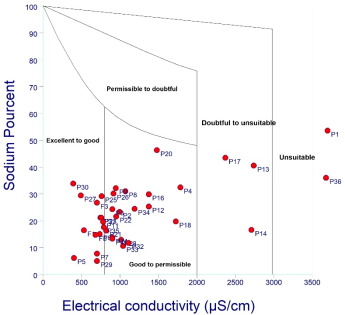
The sodium percent (% N) in the groundwater of the study area ranged from 5.03 to 53.61% with an average value of 23.59%. The classification of groundwater samples based on% N values is shown in Table 6. According to this classification, 43.24% of groundwater samples fall in the field of excellent water for irrigation use, 45.95% and 10.81% of groundwater sample were respectively good and permissible category. proposed a diagram for evaluating the suitability of water for irrigation. In this diagram% Na is plotted against EC. The plot of analytical data in this diagram reveal that most of the groundwater samples fall in excellent to good and good to permissible categories of water indicating that the majority of groundwater samples were suitable for irrigation purpose. However, three groundwater samples (8.11%) fall in the field of doubtful to unsuitable and two samples (5.40%) belong to unsuitable category of water (Figure 3).
Figure 3. Wilcox diagram of groundwater samples of the study area.
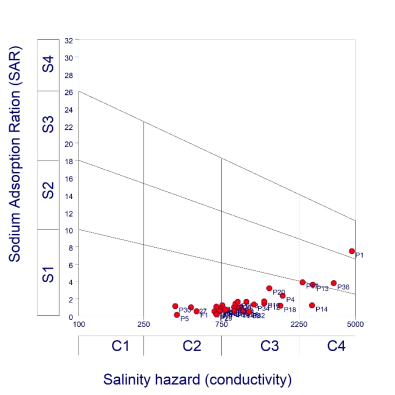
Sodium adsorption ratio (SAR) is considered as a better measure of sodium (alkali) hazard in irrigation area as SAR of water is directly related to the adsorption of sodium by soil . It is an important parameter widely used to evaluate the suitability of water for irrigation purposes because it influences the permeability of soils. Indeed, excessive sodium content, compared to calcium and magnesium contents, lead to a reduction of soil permeability and thus inhibits the supply of water needed for the crops . Sodium replacing adsorbed calcium and magnesium is a hazard as it causes damage to the soil structure resulting in compact and impervious soil . According to , groundwater samples having SAR values less than 10 are considered to be excellent quality for irrigation, 10 to 18 as good, 18 to 26 as fair, and above 26 are unsuitable for irrigation use (Table 6). The SAR values, in the study area, ranged from 0.15 to 7.99 with an average value of 1.41 (Table 6). Based on the classification of , 100% of groundwater samples, in the study area, fall in excellent category of (S1) which can be used for irrigation on almost all soils. The US salinity diagram is widely used for representing sodium alkalinity hazards. The plot of analytical data on the US salinity diagram (Figure 4) show that most of the groundwater samples fall under C3S1 (59.46%) indicating high salinity and low sodium water, which can be used for irrigation for almost all types of soil with little danger of exchangeable sodium . However, this kind of water requires good drainage because the high salinity may affect crop growth and can cause osmotic effects and nutritional disorders. Ten groundwater samples (27.03%) falls in the field of C2S1 indicating medium salinity and low sodium hazard water which can be used for irrigation if a moderate amount of leaching occurs. It was also found that three groundwater samples (8.1%) fall in the C4S1 field indicating water with very high salinity but low alkalinity hazard which can be used to irrigate crops having good salt tolerance. Only one groundwater sample fall respectively in the C4S2 and C4S3 field indicating respectively very high salinity and medium alkalinity hazard and high alkalinity hazard. These kinds of water are not suitable for irrigation except if special management of soil for salinity control is taken into account and crops with good salt tolerance are selected .
Figure 4. US salinity diagram of groundwater of the study area.
The residual sodium carbonate (RSC) is an irrigation quality parameter widely used to assess the hazardous effects of carbonate and bicarbonate on the irrigation water quality. The suitability of groundwater for irrigation is influenced by excess content of HCO3- and CO32- over Ca2+ and Mg2+. When the excess carbonate concentration in groundwater becomes very high, the carbonate combines with Ca2+ and Mg2+ to form scale which settles out of the water . The classification of irrigation water according to the RSC values is presented in Table 6. If the RSC of water is greater than 2.5 meq/L, water is unsuitable for irrigation purpose. Groundwater having RSC between 1.25 to 2.5 meq/L is doubtful for irrigation purpose whereas values of RSC lower than 1.25 indicates that water is good thereby suitable for irrigation purpose . The RSC values of groundwater samples in the study area ranged from -21.88 to -0.05 with an average value of -3.66. All groundwater samples have negative values of RSC indicating the occurrence of high concentrations of calcium and magnesium in groundwater due to nature of geological formation. Based on the computed values of RSC, all groundwater samples (100%) fall in good water type indicating the suitability of groundwater for irrigation purpose (Table 6).
The permeability index (PI) is also an important water quality parameter which is widely used to assess the suitability of groundwater for irrigation, as the soil permeability is affected by long-term use of irrigation water, influenced by the Na+, Ca2+, Mg2+, and HCO3- contents of the soil. The PI is computed using the formula in Table 2. Based on the permeability index, classified water into three classes. Groundwater with PI value greater than 75% belongs to Class I which indicates excellent quality of water for irrigation. If the PI value of water is between 25 and 75%, they belongs to Class II and indicate good quality of water for irrigation and Class III includes water that have a PI less than 25% indicating unsuitable water for irrigation. The PI values of the study area ranged from 24 to 69.42% with an average value of 46%. According to Doneen’s classification, 97% of groundwater samples are classified into Class II indicating good quality of water for irrigation and only 3% fall in Class III showing unsuitable water for irrigation and characterize sample P14 (Touba Guede).
Sodium content measured against calcium and magnesium is known as Kelley’s ratio (KR). It is an important water parameter used to determine the suitability of water for irrigation. Water with a KR value greater than 1 is considered unsuitable for irrigation due to excessive Na+ concentrations and the risk of dispersive soils, whereas water with a KR value less than 1 is suitable for irrigation . The KR of groundwater samples ranged from 0.05 to 1.12 with an average value of 0.32. According to Kelley’s Ratio (KR) values, 97.3% of groundwater in the study area are less than one (1) indicating good quality of water for irrigation purpose while only one (1) groundwater sample representing 2.7% has a KR greater than 1 indicating unsuitable water for irrigation purpose (Table 6).
Magnesium content in water is one of the most important water quality parameters used to determine the quality of water for irrigation. In most waters, magnesium and calcium maintain generally a state of equilibrium . When the magnesium content in waters becomes very high, the quality of soil is affected adversely rendering it alkaline and thereby decrease the yield of crops . Based on the Magnesium Ratio, water with a MR greater than 50% is considered as suitable for irrigation purposes. The computed MR, in the study area, ranged from 11.77 to 63.01% with an average value of 35.24% and show that 13.51% of water are suitable for irrigation purposes and the reminding (86.49%) are unsuitable for irrigation.
Table 6. Classification of groundwater for irrigation purpose based on several parameters.

Parameters

Range

Water type

Number of samples

% of samples

SAR

˂ 10

Excellent

37

100

10 - 18

Good

-

-

18 - 26

Fair

-

-

˃ 26

Unsuitable

-

-

% N

˂ 20

Excellent

16

43.24

20 - 40

Good

17

45.95

40 - 60

Permissible

4

10.81

60 - 80

Doubtful

-

-

˃ 80

Unsuitable

-

-

PI

˃ 75%

Class I

-

-

75 - 25%

Class II

36

97

˃ 25%

Class III

1

3

RSC

˂ 1.25

Good

37

100

1.25 – 2.50

Doubtful

-

-

˃ 2.50

Unsuitable

-

-

KR

˂ 1

suitable

36

97.3

˃ 1

unsuitable

1

2.7

MR

˂ 50%

Unsuitable

32

86.49

˃ 50%

Suitable

5

13.51

5. Conclusion
Groundwater is the main water resource in the study area that is available for human consumption, agriculture, livestock, and industry. In this study, the results of chemical analyses of groundwater samples were used to determine the quality of groundwater and to assess its suitability for human drinking water and agricultural use. The hydrogeochemical analysis reveals that the majority of the groundwater samples (83.8%) have a nitrate content below the recommended desirable limit of 50 mg/l for drinking suggested by the WHO. Furthermore, all water samples have a fluoride concentration lower than the allowable limit of 1.5 mg/L suggested by the WHO for drinking purpose. More than 75.68% of the samples show groundwater with high hardness. The water quality assessment shows that groundwater is suitable for drinking, with 81.1% of samples classified as freshwater according to TDS and 67% classified as good quality by WQI. The plot of chemical data on the US salinity Laboratory and Wilcox diagrams shows that most of groundwater samples fall respectively under C3S1 (59.46%) indicating high salinity and low sodium water, which can be used for irrigation for almost all types of soil and in excellent to good and good to permissible categories of water indicating the suitability of the majority of groundwater samples (89.2%) for irrigation purpose. Furthermore, others irrigation quality parameters such us KR, PI, SAR,%N and RSC reveal that majority of groundwater are excellent or good quality, except for the MR where more than 80% of the samples are unsuitable for agriculture. This aspect is very indicative of a probable limit of this approach in carbonate formations. The results of this study show groundwater suitable for human consumption and agricultural use. However, due to the high agricultural activity in the area, an assessment of the spatial and temporal evolution of groundwater quality is necessary to ensure effective and sustainable management of water resources, but also implement water transfer or treatment approaches in the area.
Abbreviations

% N

Sodium Percent

ANSD

National Agency of Statistics and Demography

EC

Electrical Conductivity

KR

Kelly Ratio

MR

Magnesium Ratio

PI

Permeability Index

RSC

Residual Sodium Carbonate

SAR

Sodium Absorption Ratio

TDS

Total Dissolved Solids

TH

Total Hardness

WHO

World Health Organisation

WQI

Water Quality Index

Acknowledgments
The authors express their gratitude to all those who contributed to this manuscript. The authors would like to thank Mr. Moussa Sow, research engineer at the UCAD water chemistry laboratory, who carried out the major element analysis. We would also like to thank M. Mouhamadou Doudou Fall (former director) of the DGPRE Hydrogeology Division for their support and guidance and the SFTeam research group.
Author Contributions
Mouhamet Moustapha Diaw: Conceptualization, Writing – review & editing, Writing – original draft, Data curation, Investigation, Formal analysis, Validation
Mathias Diedhiou: Conceptualization, Data curation, Formal analysis, Writing – original draft, Writing – review & editing
Ousmane Coly Diouf: Writing – review & editing, validation
Moctar Diaw: Conceptualization, Writing – review & editing
Serigne Faye: Supervision, Conceptualization, Writing – review & editing, validation
Funding
This research was partially funded by Government of Senegal through the DGPRE of the Ministry of Water and Sanitation as part of the Groundnut Basin Project (BA).
Data Availability Statement
Data will be made available on request.
Conflicts of Interest
The authors declare that they have no conflicts of interest.
References
[1] S. Salehi, M. Chizari, H. Sadighi, et M. Bijani, «Assessment of agricultural groundwater users in Iran: a cultural environmental bias», Hydrogeol J, vol. 26, no 1, p. 285-295, févr. 2018,
[2] G. Yasmin, D. Islam, M. Islam, M. ShariotUllah, et A. Adham, «Evaluation of groundwater quality for irrigation and drinking purposes in Barishal district of Bangladesh», Fundam Appl Agric, vol. 4, no 1, p. 632, 2019,
[3] N. Kura, M. Ramli, W. Sulaiman, S. Ibrahim, A. Aris, et A. Mustapha, «Evaluation of Factors Influencing the Groundwater Chemistry in a Small Tropical Island of Malaysia», IJERPH, vol. 10, no 5, p. 1861-1881, mai 2013,
[4] P. J. Sajil Kumar, L. Elango, et E. J. James, «Assessment of hydrochemistry and groundwater quality in the coastal area of South Chennai, India», Arab J Geosci, vol. 7, no 7, p. 2641-2653, juill. 2014,
[5] N. Subba Rao, «Seasonal variation of groundwater quality in a part of Guntur District, Andhra Pradesh, India», Environ Geol, vol. 49, no 3, p. 413-429, janv. 2006,
[6] S. Varol et A. Davraz, «Assessment of geochemistry and hydrogeochemical processes in groundwater of the Tefenni plain (Burdur/Turkey)», Environ Earth Sci, vol. 71, no 11, p. 4657-4673, juin 2014,
[7] V. Amiri, N. Sohrabi, et M. A. Dadgar, «Evaluation of groundwater chemistry and its suitability for drinking and agricultural uses in the Lenjanat plain, central Iran», Environ Earth Sci, vol. 74, no 7, p. 6163-6176, oct. 2015,
[8] T. Kaur, R. Bhardwaj, et S. Arora, «Assessment of groundwater quality for drinking and irrigation purposes using hydrochemical studies in Malwa region, southwestern part of Punjab, India», Appl Water Sci, vol. 7, no 6, p. 3301-3316, oct. 2017,
[9] M. Kumar, K. Kumari, Al. Ramanathan, et R. Saxena, «A comparative evaluation of groundwater suitability for irrigation and drinking purposes in two intensively cultivated districts of Punjab, India», Environ Geol, vol. 53, no 3, p. 553-574, oct. 2007,
[10] P. Li, J. Wu, et H. Qian, «Assessment of groundwater quality for irrigation purposes and identification of hydrogeochemical evolution mechanisms in Pengyang County, China», Environ Earth Sci, vol. 69, no 7, p. 2211-2225, août 2013,
[11] D. A. Sharma, M. S. Rishi, et T. Keesari, «Evaluation of groundwater quality and suitability for irrigation and drinking purposes in southwest Punjab, India using hydrochemical approach», Appl Water Sci, vol. 7, no 6, p. 3137-3150, oct. 2017,
[12] ANDS, «Economic and social situation of the region of Diourbel », Ntional Agency for Statistics and Demography, Diourbel, Economic and social situation of the region, 2023. Available on:
[13] ANSD, «Economic and social situation of the region of Diourbel», National Agency for Statistics and Demography, Diourbel, Rapport définitif, 2013. Available on:
[14] ANSD, «Economic and social situation of the region of Diourbel», National Agency for Statistics and Demography, Diourbel, Economic and social situation of the region, 2014.. Available on:
[15] B. Sarr, «Contribution to the hydrogeological study of aquifers in the western Senegal basin», 'These of the 3rd cycle in geology (Mention Hydrogeology), UCAD, Department of Geology, 2000.
[16] M. M. Diaw, Evaluation of the potentialities of superficial and intermediate aquifers in the region of Diourbel with a view to dilution and/or transfer into the groundnut basin», Department of Geology/UCAD, 2018.
[17] A. W. Hounslow, Water Quality Data: Analysis and Interpretation, 1re éd. CRC Press, 2018.
[18] S. Selvam, «Irrigational Feasibility of Groundwater and Evaluation of Hydrochemistry Facies in the SIPCOT Industrial Area, South Tamilnadu, India: A GIS Approach», Water Qual Expo Health, vol. 7, no 3, p. 265-284, sept. 2015,
[19] D. Marghade, D. B. Malpe, et A. B. Zade, «Geochemical characterization of groundwater from northeastern part of Nagpur urban, Central India», Environ Earth Sci, vol. 62, no 7, p. 1419-1430, avr. 2011,
[20] Md. M. Islam et al., «Environmental Study on a Coastal River of Bangladesh with Reference to Irrigation Water Quality Assessment: A Case Study on Shailmari River, Khulna», GEP, vol. 04, no 10, p. 41-64, 2016,
[21] M. Youssef, M. Ahmed, et S. Mohamed, «Application of DrinkingWwater Quality Index for Assessing Groundwater Quality of The Quaternary Aquifer in El-Marashda Area, Qena, Egypt», Journal of Environmental Studies and Researches, vol. 11, no 2, p. 315-322, juin 2021,
[22] N. Adimalla, R. Dhakate, A. Kasarla, et A. K. Taloor, «Appraisal of groundwater quality for drinking and irrigation purposes in Central Telangana, India», Groundwater for Sustainable Development, vol. 10, p. 100334, avr. 2020,
[23] S. Deepa et S. Venkateswaran, «Appraisal of groundwater quality in upper Manimuktha sub basin, Vellar river, Tamil Nadu, India by using Water Quality Index (WQI) and multivariate statistical techniques», Model. Earth Syst. Environ., vol. 4, no 3, p. 1165-1180, sept. 2018,
[24] S. Gopinath, K. Srinivasamoorthy, K. Saravanan, R. Prakash, et D. Karunanidhi, «Characterizing groundwater quality and seawater intrusion in coastal aquifers of Nagapattinam and Karaikal, South India using hydrogeochemistry and modeling techniques», Human and Ecological Risk Assessment: An International Journal, vol. 25, no 1-2, p. 314-334, févr. 2019,
[25] C. R. Ramakrishnaiah, C. Sadashivaiah, et G. Ranganna, «Assessment of Water Quality Index for the Groundwater in Tumkur Taluk, Karnataka State, India», Journal of Chemistry, vol. 6, no 2, p. 523-530, janv. 2009,
[26] M. A. Talib, Z. Tang, A. Shahab, J. Siddique, M. Faheem, et M. Fatima, «Hydrogeochemical Characterization and Suitability Assessment of Groundwater: A Case Study in Central Sindh, Pakistan», IJERPH, vol. 16, no 5, p. 886, mars 2019,
[27] M. Vasanthavigar et al., «Application of water quality index for groundwater quality assessment: Thirumanimuttar sub-basin, Tamilnadu, India», Environ Monit Assess, vol. 171, no 1-4, p. 595-609, déc. 2010,
[28] World Health Organization, Éd., Guidelines for drinking-water quality, 4th ed. Geneva: World Health Organization, 2011.
[29] M. Diedhiou, S. Ndoye, H. Celle, S. Faye, S. Wohnlich, et P. Le Coustumer, «Hydrogeochemical Appraisal of Groundwater Quality and Its Suitability for Drinking and Irrigation Purposes in the West Central Senegal», Water, vol. 15, no 9, p. 1772, mai 2023,
[30] E. Y. T. Benam-Beltoungou, I. Bassene, H. C. Emvoutou, K. V. Akpataku, D. M. L. Diongue, et S. Faye, «Groundwater quality assessed using water quality indices and geostatistical methods in the Thiaroye aquifer, Senegal», Water Science, vol. 39, no 1, p. 151-170, déc. 2025,
[31] K. Arumugam et K. Elangovan, «Hydrochemical characteristics and groundwater quality assessment in Tirupur Region, Coimbatore District, Tamil Nadu, India», Environ Geol, vol. 58, no 7, p. 1509, oct. 2009,
[32] L. V. Wilcox, Classification and Use of Irrigation Waters, U.S. Department of Agriculture, 1955. Universite de l’Illinois à Urbana-Champaign: United States. Department of Agriculture, 1955. [En ligne]. Disponible sur:
[33] L. A. Richards, « Diagnosis and Improvement of Saline and Alkali Soils »:, Soil Science, vol. 78, no 2, p. 154, août 1954,
[34] L. D. Doneen, «Water Quality for Irrigated Agriculture», in Plants in Saline Environments, vol. 15, A. Poljakoff-Mayber et J. Gale, Éd., in Ecological Studies, vol. 15., Berlin, Heidelberg: Springer Berlin Heidelberg, 1975, p. 56-76.
[35] W. P. Kelley, «USE OF SALINE IRRIGATION WATER»:, Soil Science, vol. 95, no 6, p. 385-391, juin 1963,
[36] K. V. Palliwal, «Irrigation with saline water», in Monograph, New Delhi, 1972, p. 198.
[37] G. Castany, Principles and methods of hydrogeology, DUNOD. PARIS. Paris, 1982.
[38] R. Aravena, M. Auge, N. Bucich, et M. Nagy, «Evaluation of the origin of groundwater nitrate in the city of La Plata—Argentina, using isotope techniques», in In Proceeding XXIX IAH Congress, Bratislava, September 6–10, 2002.
[39] J. Chippaux, S. Houssier, P. Gross, C. Bouvier, et F. Brissaud, «Study of groundwater pollution in the city of Niamey, Niger» Bulletin de la Société de Pathologie Exotique, p. 119-123, 2002. Available on:
[40] J. Groen, J. B. Schuchmann, et W. Geirnaert, «The occurence of high nitrate concentration in groundwater in villages in Northwestern Burkina Faso», Journal of African Earth Sciences (and the Middle East), vol. 7, no 7-8, p. 999-1009, janv. 1988,
[41] C. N. Rivers, M. H. Barrett, K. M. Hiscock, P. F. Dennis, N. A. Feast, et D. N. Lerner, «Use Of Nitrogen Isotopes To Identify Nitrogen Contamination Of The Sherwood Sandstone Aquifer Beneath The City Of Nottingham, United Kingdom», HYJO, vol. 4, no 1, p. 90-102, janv. 1996,
[42] K. Voudouris, A. Panagopoulos, et I. Koumantakis, «Nitrate pollution in the coastal aquifer system of the korinthos prefecture (greece)», Global Nest: the Int. J., p. 31-38, 2004. [En ligne]. Disponible sur:
[43] Y. J. C. Bellion, «Post-paleozoic geodynamic history of West Africa according to the study of some sedimentary basins (Senegal, Taoudenni, Iullemmeden, Chad)», Thesis, University of Avignon and Vaucluse countries, France, 1987.
[44] C. Sawyer, Chemistry for Sanitary Engineers, 2e éd. Universite du Michigan: McGraw-Hill, 1967, 1967. [En ligne]. Disponible sur:
[45] WHO, «Guidelines for drinking-water quality. 1: Recommendations», 3. ed., Geneva: World Health Organization, 2009.
[46] R. A. Freeze et J. A. Cherry, Groundwater. Englewood Cliffs, N. J: Prentice-Hall, 1979.
[47] P. Sahu et P. K. Sikdar, «Hydrochemical framework of the aquifer in and around East Kolkata Wetlands, West Bengal, India», Environ Geol, vol. 55, no 4, p. 823-835, août 2008,
[48] S. Krishna Kumar, A. Logeshkumaran, N. S. Magesh, P. S. Godson, et N. Chandrasekar, «Hydro-geochemistry and application of water quality index (WQI) for groundwater quality assessment, Anna Nagar, part of Chennai City, Tamil Nadu, India», Appl Water Sci, vol. 5, no 4, p. 335-343, 2015,
[49] A. Nagaraju, A. Thejaswi, et Z. Sharifi, «Assessment of groundwater quality and its suitability for agricultural usage in and around Rangampeta area, Andhra Pradesh, south India», J. Water Chem. Technol., vol. 38, no 6, p. 358-365, nov. 2016,
Cite This Article
  • APA Style

    Diaw, M. M., Diedhiou, M., Diouf, O. C., Diaw, M., Faye, S. (2026). Groundwater Quality Assessment and Its Suitability for Drinking and Irrigation Purposes in the Eocene Aquifer of Diourbel-center Senegal. American Journal of Water Science and Engineering, 12(1), 13-26. https://doi.org/10.11648/j.ajwse.20261201.12

    Copy | Download

    ACS Style

    Diaw, M. M.; Diedhiou, M.; Diouf, O. C.; Diaw, M.; Faye, S. Groundwater Quality Assessment and Its Suitability for Drinking and Irrigation Purposes in the Eocene Aquifer of Diourbel-center Senegal. Am. J. Water Sci. Eng. 2026, 12(1), 13-26. doi: 10.11648/j.ajwse.20261201.12

    Copy | Download

    AMA Style

    Diaw MM, Diedhiou M, Diouf OC, Diaw M, Faye S. Groundwater Quality Assessment and Its Suitability for Drinking and Irrigation Purposes in the Eocene Aquifer of Diourbel-center Senegal. Am J Water Sci Eng. 2026;12(1):13-26. doi: 10.11648/j.ajwse.20261201.12

    Copy | Download

  • @article{10.11648/j.ajwse.20261201.12,
      author = {Mouhamet Moustapha Diaw and Mathias Diedhiou and Ousmane Coly Diouf and Moctar Diaw and Serigne Faye},
      title = {Groundwater Quality Assessment and Its Suitability for Drinking and Irrigation Purposes in the Eocene Aquifer of Diourbel-center Senegal},
      journal = {American Journal of Water Science and Engineering},
      volume = {12},
      number = {1},
      pages = {13-26},
      doi = {10.11648/j.ajwse.20261201.12},
      url = {https://doi.org/10.11648/j.ajwse.20261201.12},
      eprint = {https://article.sciencepublishinggroup.com/pdf/10.11648.j.ajwse.20261201.12},
      abstract = {Water resource availability in quantity and quality is a primary factor which influences the development of various human activities worldwide. In most countries in Africa, due to the scarcity and poor quality of surface water, groundwater is the main natural resource used to relieve the increasing water demands of population. In Diourbel region (central Senegal), groundwater is an important resource used for economic activities. This study aims to evaluate groundwater quality and suitability for drinking and irrigation purposes. Thirty-seven (37) samples (boreholes and dug wells) were collected and major ions were analyzed. Classification of groundwater using TDS (Total Dissolved Solids) and TH (Total Hardness) showed respectively that 81.08% fall in the fresh water type, suggesting suitability for drinking water purpose. Moreover, most of groundwater samples fall in hard (21.62%) and very hard (75.68%) category of water. Furthermore, the computed values of WQI indicate majority of groundwater samples (76%) falls under good to excellent water, suggesting that the groundwater is suitable for drinking and other domestic uses. Data Wilcox and US Salinity Laboratory (USSL) plots show that the majority of groundwater samples are suitable for irrigation.% N, SAR, KR, PI, and RSC show that groundwater samples are suitable for irrigation except MR (Magnesium Ratio). This study shows a good quality of groundwater for consumption and irrigation purposes and thus contributes to the rural and urban development of the study area where the most productive aquifer is limited by the presence of brackish water.},
     year = {2026}
    }
    

    Copy | Download

  • TY  - JOUR
    T1  - Groundwater Quality Assessment and Its Suitability for Drinking and Irrigation Purposes in the Eocene Aquifer of Diourbel-center Senegal
    AU  - Mouhamet Moustapha Diaw
    AU  - Mathias Diedhiou
    AU  - Ousmane Coly Diouf
    AU  - Moctar Diaw
    AU  - Serigne Faye
    Y1  - 2026/03/10
    PY  - 2026
    N1  - https://doi.org/10.11648/j.ajwse.20261201.12
    DO  - 10.11648/j.ajwse.20261201.12
    T2  - American Journal of Water Science and Engineering
    JF  - American Journal of Water Science and Engineering
    JO  - American Journal of Water Science and Engineering
    SP  - 13
    EP  - 26
    PB  - Science Publishing Group
    SN  - 2575-1875
    UR  - https://doi.org/10.11648/j.ajwse.20261201.12
    AB  - Water resource availability in quantity and quality is a primary factor which influences the development of various human activities worldwide. In most countries in Africa, due to the scarcity and poor quality of surface water, groundwater is the main natural resource used to relieve the increasing water demands of population. In Diourbel region (central Senegal), groundwater is an important resource used for economic activities. This study aims to evaluate groundwater quality and suitability for drinking and irrigation purposes. Thirty-seven (37) samples (boreholes and dug wells) were collected and major ions were analyzed. Classification of groundwater using TDS (Total Dissolved Solids) and TH (Total Hardness) showed respectively that 81.08% fall in the fresh water type, suggesting suitability for drinking water purpose. Moreover, most of groundwater samples fall in hard (21.62%) and very hard (75.68%) category of water. Furthermore, the computed values of WQI indicate majority of groundwater samples (76%) falls under good to excellent water, suggesting that the groundwater is suitable for drinking and other domestic uses. Data Wilcox and US Salinity Laboratory (USSL) plots show that the majority of groundwater samples are suitable for irrigation.% N, SAR, KR, PI, and RSC show that groundwater samples are suitable for irrigation except MR (Magnesium Ratio). This study shows a good quality of groundwater for consumption and irrigation purposes and thus contributes to the rural and urban development of the study area where the most productive aquifer is limited by the presence of brackish water.
    VL  - 12
    IS  - 1
    ER  - 

    Copy | Download

Author Information