
This study presents an analysis of coupled thermal and concentration gradients in nanofluid boundary-layer flow over a stretching surface under the influence of magnetic, thermal, and mass transport effects. The governing nonlinear partial differential equations describing momentum, energy, and nanoparticle concentration are formulated for an electrically conducting nanofluid and solved numerically using the finite element method. Emphasis is placed on the roles of key dimensionless parameters including the magnetic field parameter, thermal and solutal Grashof numbers, Prandtl number, Brownian motion, thermophoresis, heat source, heat absorption, Lewis number, and chemical reaction rate on velocity, temperature, and concentration distributions within the boundary layer. The results indicate that the applied magnetic field retards the flow due to the Lorentz force, while buoyancy forces arising from thermal and concentration differences enhance fluid motion along the stretching surface. Thermal profiles are strongly influenced by internal heat generation, heat absorption, thermophoresis, and fluid thermal diffusivity, whereas nanoparticle concentration is governed by the combined effects of Brownian diffusion, thermophoretic transport, chemical reaction, and mass diffusivity. The analysis highlights the strong coupling between heat and mass transfer mechanisms in nanofluid boundary layers and demonstrates that controlling these parameters can effectively regulate transport processes in applications such as polymer extrusion, cooling of stretching sheets, coating processes, and advanced energy systems.
| Published in | International Journal of Applied Mathematics and Theoretical Physics (Volume 12, Issue 1) |
| DOI | 10.11648/j.ijamtp.20261201.16 |
| Page(s) | 55-64 |
| Creative Commons |
This is an Open Access article, distributed under the terms of the Creative Commons Attribution 4.0 International License (http://creativecommons.org/licenses/by/4.0/), which permits unrestricted use, distribution and reproduction in any medium or format, provided the original work is properly cited. |
| Copyright |
Copyright © The Author(s), 2026. Published by Science Publishing Group |
Nanofluid, FEM, Thermal, Concentration Gradients, Heat and Mass Transfers, Heat Absorption
FEM | Finite Element Method |
MHD | Magnetohydrodynamics |
| [1] | Weli, A., Amadi, C. P., & Nwaigwe, C. (2019). Numerical investigation of transport in a Couette flow with unsteady suction. IOSR Journal of Mathematics, 15(6), 74-83. |
| [2] | Sandeep, N., & Kumar, J. (2016). Heat and mass transfer in nanofluid flow over an inclined stretching sheet with volume fraction of dust and nanoparticles. Journal of Applied Fluid Mechanics, 9(5), 2205-2215. |
| [3] | Nandeppanavar, M. M., Abel, M. S., & Kemparaju, M. C. (2017). Stagnation Point flow, heat and mass transfer of MHD nanofluid due to porous stretching sheet through porous media with effect of thermal radiation. Journal of Nanofluids, 6(1), 38-47. |
| [4] | Pal, D., & Mandal, G. (2019). Magnetohydrodynamic heat and mass transfer of Sisko nanofluid past a stretching sheet with nonlinear thermal radiation and convective boundary condition. Journal of Nanofluids, 8(4), 852-860. |
| [5] | Amos, E., & Uka, U. A. (2022). Hydromagnetic nanofluid flow over an exponentially stretching sheet in the presence of radiation and nonuniform heat generation. IOSR Journal of Mathematics, 18(1), 31-43. |
| [6] | Ali, N., Bahman, A. M., Aljuwayhel, N. F., Ebrahim, S. A., Mukherjee, S., & Alsayegh, A. (2021). Carbon-based nanofluids and their advances towards heat transfer applications—a review. Nanomaterials, 11(6), 1628. |
| [7] | Tlili, I. (2024). Impact of thermal conductivity on the thermophysical properties and rheological behavior of nanofluid and hybrid nanofluid. Mathematical Sciences, 18(4), 493-501. |
| [8] | Shafique, A., Ramzan, M., Amir, M., Abbas, S., Nazar, M., Ali, E.,... & Garalleh, H. A. (2025). Heat and mass transfer effects on an unsteady MHD boundary layer flow of fractionalized fluid. Radiation Effects and Defects in Solids, 180(5-6), 708-720. |
| [9] | Amos, E., Amadi. C. P., & Nwaigwe, C. (2019). Free Convection Boundary Layer Flow of a Rotating MHD Fluid past a Vertical Porous Medium with Thermal Radiation. International Journal of Applied Science and Mathematical Theory, 5(2). |
| [10] | Kumar, K., Sarkar, J., & Mondal, S. S. (2024). Analysis of ternary hybrid nanofluid in microchannel-cooled cylindrical Li-ion battery pack using multi-scale multi-domain framework. Applied Energy, 355, 122241. |
| [11] | Kumar, S., Murthy, S. K., Kumar, B. R., & Parmar, D. (2024). Multi-physics study on double-diffusion convective flow in an inverted T-shaped porous enclosure: ANN-based parametric estimation. Physics Letters A, 518, 129681. |
| [12] | Walelign, T., Haile, E., Kebede, T., & Awgichew, G. (2021). Heat and mass transfer in stagnation point flow of Maxwell nanofluid towards a vertical stretching sheet with effect of induced magnetic field. Mathematical Problems in Engineering, 2021(1), 6610099. |
| [13] | Gireesha, B. J., Kumar, K. G., Ramesh, G. K., & Prasannakumara, B. C. (2018). Nonlinear convective heat and mass transfer of Oldroyd-B nanofluid over a stretching sheet in the presence of uniform heat source/sink. Results in Physics, 9, 1555-1563. |
| [14] | Sadighi, S., Afshar, H., Jabbari, M., & Ashtiani, H. A. D. (2023). Heat and mass transfer for MHD nanofluid flow on a porous stretching sheet with prescribed boundary conditions. Case Studies in Thermal Engineering, 49, 103345. |
| [15] | Akbar, N. S., Akhtar, S., Shaiq, S., Hussain, M. F., Muhammad, T., Farooq, M., & Habib, M. B. (2025). Mixed convective heat transfer enhancement in hybrid nanofluid flow through complex-finned tube cavities. Dynamics of Atmospheres and Oceans, 101612. |
| [16] | Akhtar, S., Akbar, N. S., Akram, J., Hussain, M. F., & Muhammad, T. (2025). Heat transfer analysis on blood flow dynamics of hybrid nanoparticles in an asymmetric domain under electroosmotic and microbial effects: A Johnson-Segalman model approach. International Journal of Heat and Fluid Flow, 115, 109879. |
| [17] | Akbar, N. S., Butt, A. W., Akhtar, S., & Tripathi, D. (2024). Hall effect on mixed convection MHD flow of nanofluid with clean, copper and Ag water through a vertical rotating channel. ZAMM‐Journal of Applied Mathematics and Mechanics/Zeitschrift für Angewandte Mathematik und Mechanik, 104(12), e202200387. |
| [18] | Baig, M. N. J., Salamat, N., Duraihem, F. Z., Akhtar, S., Nadeem, S., Alzabut, J., & Saleem, S. (2023). Exact analytical solutions of stagnation point flow over a heated stretching cylinder: A phase flow nanofluid model. Chinese Journal of Physics, 86, 1-11. |
| [19] | Alghamdi, M., Akbar, N. S., Hussain, M. F., Akhtar, S., & Muhammad, T. (2023). Thermodynamic study of hybrid nanofluid to explore synergistic effects of multiple ferromagnetic nanoparticles in co-axial disks for magnetized fluid. Tribology International, 188, 108867. |
| [20] | Nadeem, S., Akhtar, S., & Abbas, N. (2020). Heat transfer of Maxwell base fluid flow of nanomaterial with MHD over a vertical moving surface. Alexandria Engineering Journal, 59(3), 1847-1856. |
| [21] | Khan, M. S., Wahiduzzaman, M., Sazad, M. A. K., & Uddin, M. S. (2012). Finite difference solution of MHD free convection heat and mass transfer flow of a nanofluid along a Stretching sheet with Heat generation effects. Indian J. Theor. Physics, 60(4), 285-306. |
APA Style
Amadi, C. P., Amos, E., Iyai, D. (2026). Analysis of Coupled Thermal and Concentration Gradients in Nanofluid Boundary-Layer Flow over a Stretching Surface. International Journal of Applied Mathematics and Theoretical Physics, 12(1), 55-64. https://doi.org/10.11648/j.ijamtp.20261201.16
ACS Style
Amadi, C. P.; Amos, E.; Iyai, D. Analysis of Coupled Thermal and Concentration Gradients in Nanofluid Boundary-Layer Flow over a Stretching Surface. Int. J. Appl. Math. Theor. Phys. 2026, 12(1), 55-64. doi: 10.11648/j.ijamtp.20261201.16
@article{10.11648/j.ijamtp.20261201.16,
  author = {Chukwuemeka Paul Amadi and Emeka Amos and Davies Iyai},
  title = {Analysis of Coupled Thermal and Concentration Gradients in Nanofluid Boundary-Layer Flow over a Stretching Surface},
  journal = {International Journal of Applied Mathematics and Theoretical Physics},
  volume = {12},
  number = {1},
  pages = {55-64},
  doi = {10.11648/j.ijamtp.20261201.16},
  url = {https://doi.org/10.11648/j.ijamtp.20261201.16},
  eprint = {https://article.sciencepublishinggroup.com/pdf/10.11648.j.ijamtp.20261201.16},
  abstract = {This study presents an analysis of coupled thermal and concentration gradients in nanofluid boundary-layer flow over a stretching surface under the influence of magnetic, thermal, and mass transport effects. The governing nonlinear partial differential equations describing momentum, energy, and nanoparticle concentration are formulated for an electrically conducting nanofluid and solved numerically using the finite element method. Emphasis is placed on the roles of key dimensionless parameters including the magnetic field parameter, thermal and solutal Grashof numbers, Prandtl number, Brownian motion, thermophoresis, heat source, heat absorption, Lewis number, and chemical reaction rate on velocity, temperature, and concentration distributions within the boundary layer. The results indicate that the applied magnetic field retards the flow due to the Lorentz force, while buoyancy forces arising from thermal and concentration differences enhance fluid motion along the stretching surface. Thermal profiles are strongly influenced by internal heat generation, heat absorption, thermophoresis, and fluid thermal diffusivity, whereas nanoparticle concentration is governed by the combined effects of Brownian diffusion, thermophoretic transport, chemical reaction, and mass diffusivity. The analysis highlights the strong coupling between heat and mass transfer mechanisms in nanofluid boundary layers and demonstrates that controlling these parameters can effectively regulate transport processes in applications such as polymer extrusion, cooling of stretching sheets, coating processes, and advanced energy systems.},
 year = {2026}
}
TY  - JOUR
T1  - Analysis of Coupled Thermal and Concentration Gradients in Nanofluid Boundary-Layer Flow over a Stretching Surface
AU  - Chukwuemeka Paul Amadi
AU  - Emeka Amos
AU  - Davies Iyai
Y1  - 2026/03/17
PY  - 2026
N1  - https://doi.org/10.11648/j.ijamtp.20261201.16
DO  - 10.11648/j.ijamtp.20261201.16
T2  - International Journal of Applied Mathematics and Theoretical Physics
JF  - International Journal of Applied Mathematics and Theoretical Physics
JO  - International Journal of Applied Mathematics and Theoretical Physics
SP  - 55
EP  - 64
PB  - Science Publishing Group
SN  - 2575-5927
UR  - https://doi.org/10.11648/j.ijamtp.20261201.16
AB  - This study presents an analysis of coupled thermal and concentration gradients in nanofluid boundary-layer flow over a stretching surface under the influence of magnetic, thermal, and mass transport effects. The governing nonlinear partial differential equations describing momentum, energy, and nanoparticle concentration are formulated for an electrically conducting nanofluid and solved numerically using the finite element method. Emphasis is placed on the roles of key dimensionless parameters including the magnetic field parameter, thermal and solutal Grashof numbers, Prandtl number, Brownian motion, thermophoresis, heat source, heat absorption, Lewis number, and chemical reaction rate on velocity, temperature, and concentration distributions within the boundary layer. The results indicate that the applied magnetic field retards the flow due to the Lorentz force, while buoyancy forces arising from thermal and concentration differences enhance fluid motion along the stretching surface. Thermal profiles are strongly influenced by internal heat generation, heat absorption, thermophoresis, and fluid thermal diffusivity, whereas nanoparticle concentration is governed by the combined effects of Brownian diffusion, thermophoretic transport, chemical reaction, and mass diffusivity. The analysis highlights the strong coupling between heat and mass transfer mechanisms in nanofluid boundary layers and demonstrates that controlling these parameters can effectively regulate transport processes in applications such as polymer extrusion, cooling of stretching sheets, coating processes, and advanced energy systems.
VL  - 12
IS  - 1
ER  -
Department of Mathematics, Rivers State University, Port Harcourt, Nigeria
Biography: Chukwuemeka Paul Amadi received his B.Sc. degree in Mathematics and Computer Science from Rivers State University of Science and Technology, Nigeria, and his M.Sc. degree in Applied Mathematics from Rivers State University, Port Harcourt, Nigeria. He is currently a Lecturer I in the Department of Mathematics at Rivers State University. His research interests include fluid dynamics, magnetohydrodynamics, nanofluid modeling, and numerical simulations. He is a registered member of the Mathematical Association of Nigeria (MAN) and the Nigerian Mathematical Society (NMS). He has published several research articles in reputable local and international journals, contributing to the advancement of applied mathematics research.
Department of Mathematics, Rivers State University, Port Harcourt, Nigeria
Biography: Emeka Amos earned a B.Sc. in Pure and Applied Mathematics, an M.Sc. in Radiation Physics, and a Ph.D. in Applied Mathematics from Rivers State University of Science and Technology, Port Harcourt, and a second M.Sc. in Applied and Industrial Mathematics from the Federal University of Technology, Owerri. A Professor of Mathematics at Rivers State University, he is a former Head of Department and currently Associate Dean of the Faculty of Science. His research focuses on fluid dynamics, blood-flow and magnetohydrodynamic modeling, nanofluids, and numerical simulation. A member of the Mathematical Association of Nigeria and the Nigerian Mathematical Society, he has published widely in local and international journals, supervised numerous M.Sc. and Ph.D. students, and serves as an external examiner for universities in Nigeria and abroad.
Department of Mathematics, Rivers State University, Port Harcourt, Nigeria
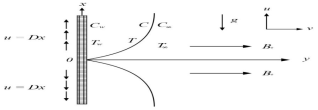
Figure 1. Schematic diagram of the flow.
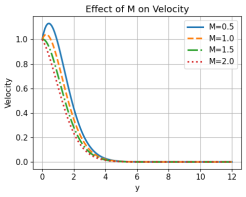
Figure 2. Effect of Magnetic field on velocity of some parameter values =1.5, =1.0, =0.72, Q=0.2, = 0.1, =0.1, =0.2, =2.0, =0.3.
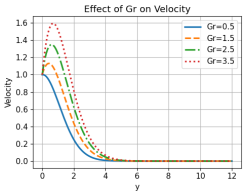
Figure 3. Effect on velocity of some parameter values, =1.0, =0.5, =0.72, Q=0.2, = 0.1, =0.1, =0.2, =2.0, =0.3.
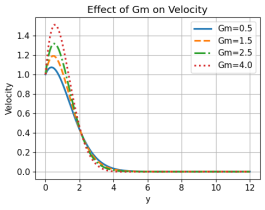
Figure 4. Effect of Mass grashof number on velocity of some parameter values =0.5 =1.5, =0.72, Q=0.2, = 0.1, =0.1, =0.2, =2.0, =0.3.
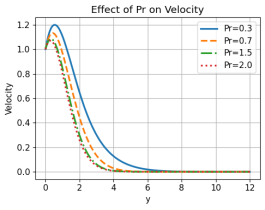
Figure 5. Effect of Prantl number on velocity of some parameter values =0.5 =1.5, =1.0, Q=0.2, = 0.1, =0.1, =0.2, =2.0, =0.3.
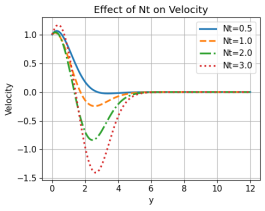
Figure 6. Effect of thermophoresis on velocity of some parameter values =0.5 =1.5, =1.0, =0.72, Q=0.2, = 0.1, =0.1, =0.2, =2.0, =0.3.
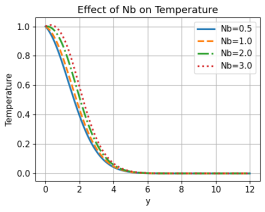
Figure 7. Effect of brownian motion on velocity of some parameter values =0.5 =1.5, =1.0, =0.72, Q=0.2, =0.1, =0.2, =2.0, =0.3.
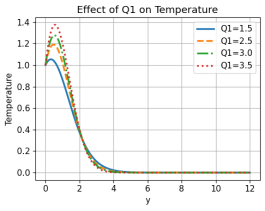
Figure 8. Effect of heat absorption on the temperature of some parameter values =0.5 =1.5, =1.0, =0.72, Q=0.2, = 0.1, =0.1, =2.0, =0.3.
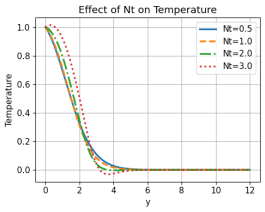
Figure 9. Effect of thermophoresis on the temperature of some parameter values =0.5 =1.5, =1.0, =0.72, Q=0.2, = 0.1, =0.2, =2.0, =0.
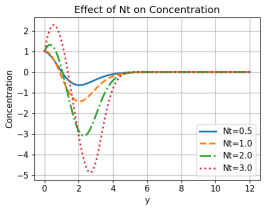
Figure 10. Effect of Thermophoresis on the concentration of some parameter values =0.5 =1.5, =1.0, =0.72, Q=0.2, = 0.1, =0.2, =2.0, =0.3.
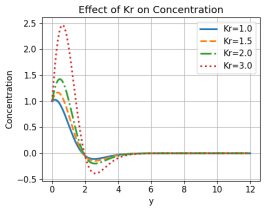
Figure 11. Effect of chemical reaction on the concentration of some parameter values =0.5 =1.5, =1.0, =0.72, Q=0.2, = 0.1, =0.1, =0.2, =2.0.
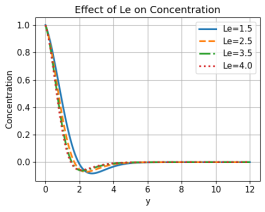
Figure 12. Effect of Magnetic field on the concentration of some parameter values =0.5 =1.5, =1.0, =0.72, Q=0.2, = 0.1, =0.1, =0.2, =0.
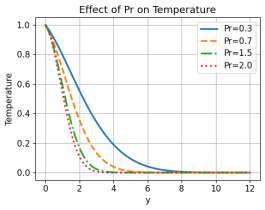
Figure 13. Effect of Prantl number on temperature of some parameter values =0.5 =1.5, =1.0, Q=0.2, = 0.1, =0.1, =0.2, =2.0, =0.3.
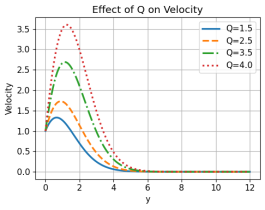
Figure 14. Effect of heat source on velocity of some parameter values =0.5 =1.5, =1.0, =0.72, = 0.1, =0.1, =0.2, =2.0, =0.3.
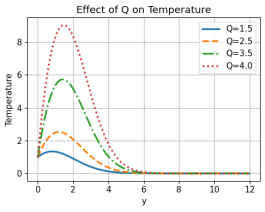
Figure 15. Effect of heat source on the temperature of some parameter values =0.5 =1.5, =1.0, =0.72, = 0.1, =0.1, =0.2, =2.0, =0.3.
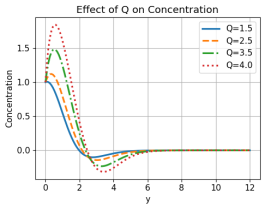
Figure 16. Effect of heat source on the concentration of some parameter values =0.5 =1.5, =1.0, =0.72, = 0.1, =0.1, =0.2, =2.0, =0.3.

Information



 Share This Article
 Twitter
 Linked In
 Facebook
 Copy
Copy Download