The diurnal anisotropy of galactic cosmic ray intensity provides an important diagnostic of solar modulation processes operating in the heliosphere. In the present work, a comprehensive long-term investigation of the diurnal anisotropy has been carried out using pressure-corrected hourly neutron monitor data from two high-latitude stations, Moscow and Kiel, covering a period of 52 years (1965–2016) corresponding to solar cycles 20 to 24. Daily values of the first harmonic diurnal amplitude and phase were obtained through harmonic analysis, from which annual mean values were derived. The long-term relationship between the diurnal amplitude and phase has been examined on annual, solar-cycle, and solar magnetic polarity bases. While day-to-day variations of amplitude and phase are found to be statistically independent, their annual averages exhibit clear solar-cycle-dependent behavior. A weak positive correlation between the diurnal amplitude and phase is observed when all years are considered together. However, a pronounced odd–even solar cycle asymmetry emerges when the data are segregated into odd and even cycles. Strong and statistically significant positive correlations characterize the odd solar cycles, whereas even solar cycles display weak and insignificant correlations. Furthermore, a clear dependence on solar magnetic polarity is observed, with large positive correlations during positive polarity epochs (A > 0) and reduced or reversed correlations during negative polarity epochs (A < 0). These results provide strong observational evidence that long-term variations of cosmic ray diurnal anisotropy are governed not only by solar activity but also by heliospheric magnetic polarity and particle drift effects.
This is an Open Access article, distributed under the terms of the Creative Commons Attribution 4.0 International License (http://creativecommons.org/licenses/by/4.0/), which permits unrestricted use, distribution and reproduction in any medium or format, provided the original work is properly cited.
Galactic Cosmic Rays, Diurnal Anisotropy, Solar Cycle, Solar Magnetic Polarity, Neutron Monitor Observations
1. Introduction
Galactic cosmic rays (GCRs) entering the heliosphere are significantly modulated by their interaction with the solar wind, the interplanetary magnetic field (IMF), and large-scale heliospheric structures. One of the most persistent and well-observed manifestations of this modulation is the solar diurnal anisotropy of cosmic ray intensity, which appears as a systematic daily variation in ground-based neutron monitor observations
[1]
Agrawal, S. P. Bercovitch, M., “Study of 11, 22-year periodic variation of cosmic ray diurnal anisotropy”, Proc. 18th Int. Cosmic Ray Conf., 3, 316-319 (1983).
[2]
Ananth, A. G., Venkatesan, D. and Pillai, S.; “Long-term changes in the cosmic ray diurnal anisotropy”, Solar Physics, 143, 187-196 (1993).
[7]
Hall, D. L., Duldig, M. L. and Humble, J. E.; “Analysis of sidereal and solar anisotropies in cosmic rays”, Space Sc. Rev., 78, 401-442 (1996).
[8]
Mori, S.; “Annual modulation of solar diurnal variation of the cosmic ray nucleonic component in three-dimensional space”, J. Geomag. Geoelectr., 27, 1-23(1975).
[9]
Munakata, K. and Nagashima, K.; “A theory of cosmic ray anisotropies of solar origin”, Plant. Space Sci., 34, 99 (1986).
[10]
Nagashima, K., Duggal, S. P. and Pomerantz, M. A.; “Cosmic ray anisotropy in three-dimensional space”, Planet. Space Sci., 16, 29-46 (1968).
[15]
Venkatesan, D. and Badruddin; “Cosmic ray intensity variations in the 3-dimentional heliosphere”, Space Sci. Rev., 52, 121-194 (1990).
[1, 2, 7-10, 15]
. The average diurnal anisotropy has traditionally been interpreted within the framework of the convection–diffusion model. In this model, an equilibrium is established between the outward convection of cosmic ray particles by the solar wind and their inward diffusion along the IMF. This balance produces an apparent co-rotation of cosmic rays with the heliospheric magnetic field, leading to the observed diurnal variation
[4]
Axford, W. I.; “The modulation of galactic cosmic rays in the interplanetary medium”, Planet. Space Sci., 13, 115 (1965).
[5]
Forman, M. A. and Gleeson, L. J.; “Cosmic ray streaming and anisotropies” Astrophys. Space Sci., 32, 77-94 (1975).
[6]
Parker, E. N.; “Theory of streaming of cosmic rays and the diurnal variation”, Planet. Space Sci., 12, 735-749 (1964).
[4-6]
. Although the convection–diffusion model successfully explains the general features of the diurnal anisotropy, numerous long-term observational studies have revealed systematic deviations that cannot be fully accounted for by this simplified approach. In particular, significant temporal shifts in the phase of the diurnal anisotropy and variations in its amplitude suggest the influence of additional physical mechanisms, such as gradient, curvature, and current-sheet drifts associated with the large-scale heliospheric magnetic field.
Earlier investigations have demonstrated that the amplitude of the diurnal anisotropy exhibits a dominant 11-year periodicity associated with the solar activity cycle, whereas the phase shows a 22-year periodicity corresponding to the solar magnetic cycle. Systematic shifts of the diurnal phase toward earlier or later local times have been shown to be closely linked to changes in the polarity of the solar magnetic field
[3]
Ahluwalia, H. S. and Riker, J. F.; “Diurnal anisotropy during solar activity cycle twenty and diffusion-convection model”, Proc. 19th Int. Cosmic Ray Conf., San Diego (USA), 5, 116-119 (1985).
[16]
Yadav, R. S. and Badruddin ; “Solar longitudinal distribution of solar flares in association with Forbush decreases”, Ind. J. Radio Space phys., 12, 10 (1983).
[3, 16]
.
Subsequent studies have emphasized the role of particle drift effects in explaining these polarity-dependent behaviors, indicating that the configuration of the heliospheric magnetic field plays a crucial role in shaping the long-term characteristics of cosmic ray anisotropy
[11]
Singh, Ambika, Tiwari, A. K. and Agrawal, S. P.; “Study of High and Low Amplitude Wave Trains of Cosmic Ray Diurnal Variation during Solar Cycle 23’’, J. Astrophys. Astr. 31, 89-96 (2010).
[12]
Singh, Ambika, Dubey, Divya, Singh, R. P. Tiwari, A. K.; ‘Variation of Upper Cut-off Rigidity of Cosmic Ray Diurnal Anisotropy”, IJIRSET, 2, 4648-4654 (2013).
[13]
Singh, Munendra, Badruddin; “Study of the cosmic ray diurnal anisotropy during different solar magnetic conditions”, Solar Physics, 233, 291-317 (2006).
[14]
Tiwari, A. K., Singh, Ambika and Agrawal, S. P.; “Study of the Diurnal Variation of Cosmic Rays during Different Phases of Solar Activity”, Solar Phys, 279, 253-267 (2012).
[11-14]
.
Despite extensive investigations of the amplitude and phase of the diurnal anisotropy, relatively little attention has been paid to the mutual relationship between these two parameters over extended time scales, particularly with respect to odd–even solar cycle asymmetry and solar magnetic polarity dependence. The present study addresses this gap by examining the long-term correlation between the diurnal amplitude and phase using 52 years of neutron monitor data from two high-latitude stations.
2. Data Analysis
Hourly pressure-corrected neutron monitor data from the Moscow and Kiel neutron monitor stations were obtained from the NOAA National Geophysical Data Center database. These two stations were selected due to their high geomagnetic latitudes and long, continuous data records, making them particularly suitable for studies of cosmic ray anisotropy. The hourly data were subjected to harmonic analysis to extract the first harmonic components of the solar diurnal variation. For each day, the diurnal amplitude (expressed as a percentage) and the diurnal phase (expressed in local solar time hours) were calculated. Days associated with large transient cosmic ray intensity variations, such as Forbush decreases and major solar energetic particle events, were excluded from the analysis to ensure the reliability of long-term averages.
Annual mean values of the diurnal amplitude and phase were then computed for each station. The one-sigma standard error of the annual mean diurnal vector is approximately 6% of the amplitude value, indicating that the observed long-term variations are statistically significant. To investigate the relationship between the diurnal amplitude and phase, correlation analyses were performed on both daily and annual average bases. The data were further classified according to solar activity cycles (odd and even cycles) and solar magnetic polarity states (A > 0 and A < 0).
3. Discussion and Results
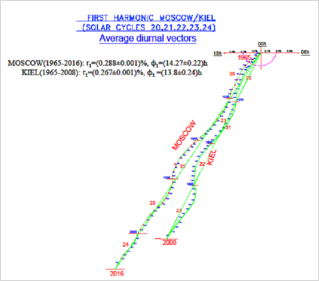
Figure 1 show the annual average diurnal vectors for the Moscow and Kiel neutron monitor stations over the period 1965–2016 are presented in vector addition diagrams. Both stations exhibit remarkably similar long-term behavior, confirming the reliability and consistency of high-latitude neutron monitor observations.
Figure 1. Shows the vector addition diagram of the annual average vectors of the first harmonic of the observed daily variation of cosmic rays of Moscow N M stations for the years 1996-2016 and Kiel N M station for the years 1996-2008. The overall average values are also marked.
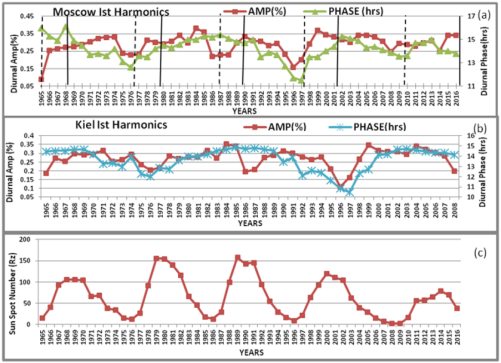
The diurnal amplitude shows a clear 11-year modulation associated with the solar activity cycle. The amplitude generally attains minimum values near solar minima and reaches maximum values during the declining phase of solar activity. In contrast, the diurnal phase exhibits a 22-year periodicity, with systematic shifts linked to the reversal of the solar magnetic field polarity. The overall average diurnal vector for the complete solar cycle 23 for Moscow and Kiel neutron monitor stations have also been deduced and these are found to be:
Figure 2 shows the yearly average vectors for Moscow neutron monitor from 1965 to 2016. The figure reveals the 22-year recurrence of the phase and the 11-year recurrence of the amplitude with the lowest values occurring at solar minima and the highest values occurring at declining phase of solar activity.
Figure 2. Shows the yearly average of cosmic ray diurnal amplitude (in %) and diurnal time of maximum (in hrs.) obtained using two neutron monitor data for Moscow during the years 1965 to 2016 and Kiel during the years 1965-2008. Shows the yearly average of Sunspot number (Rz).
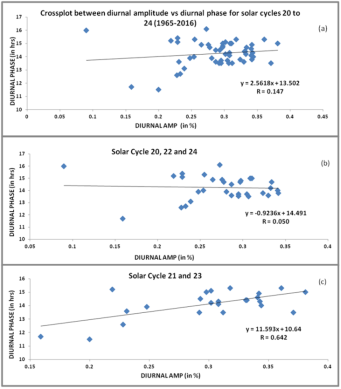
Figure 3. Shows the relationships between the annual average diurnal amplitudes and diurnal phase for Moscow neutron monitor station (a) for the solar cycles 20 to 24, (b) for the even solar cycles 20, 22 and 24, and (c) for the odd solar cycles 21 and 23. In each case, the regression lines are also shown. The correlation coefficients (r) are also marked.
In earlier studies, any significant correlation between the observed amplitude and phase of the diurnal variation has not been reported. However, it is necessary to study such a relationship for the entire period of 52 years of data of Moscow station. The study has been performed both on the annual average basis as well as on a day-to-day basis, for the entire period (1965-2016).
When we derive the correlation coefficients on a day-to-day basis on each year basis, starting from the year 1965 up to 2016, we surprisingly find that in none of the years the value of “r” is > ± 0.15, which is highly insignificant. As such, we can state very confidently that on each day basis, the amplitude and phase of the observed diurnal variation vary independently and have no correlation.
We have further analyzed the relationship on the yearly average basis using the Moscow data for the five solar cycles. First of all, we have drawn in Figure 3(a) the scatter-plot of the observed diurnal amplitude and diurnal phase for all the 52 years from 1965-2016 positive correlation (r=0.15± 0.07) is evident from Figure 3(a). The positive correlation means that when the annual average diurnal amplitude is larger, the diurnal phase is also larger (i.e. the diurnal phase is in the later hours). When we divide the complete period of four solar cycles into two sets: odd and even cycles, we still get the positive correlation, but the value of “r” is very significantly different in the two sets. The scatter-plots are shown in Figure 3(b) for even cycles and in Figure 3(c) for the two odd solar cycles 21 and 23 taken together. The correlation coefficient for the even cycle is - 0.05±0.12, and for the odd solar cycles the value of “r” is 0.64±0.06. The striking difference in the value of “r” once again points out the asymmetry in the odd and even cycles. Moreover, the regression lines are also significantly different between odd and even cycles. The slope in the case of even cycles is very small as compared to the slope observed for the odd solar cycles. It means that the annual average diurnal phase increases much faster with the increase of the diurnal amplitude in the odd solar cycles.
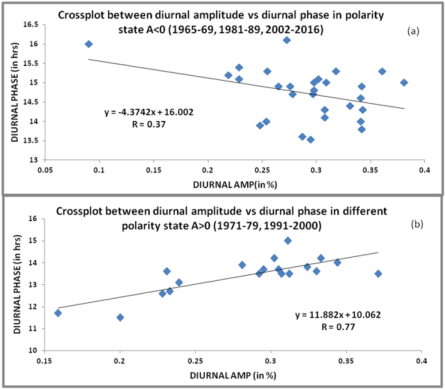
We have further investigated, the relationship between the observed diurnal amplitude and the diurnal phase on annual average basis, for the said values of the Moscow data, on the basis of the state of the solar magnetic field polarity (i.e. for A<0 and for A>0, separately). The cross-plots shown in Figure 4 (a & b) are for the two states. The upper panel (a) is for the polarity state A<0, whereas the lower panel (b) is for A>0. The difference observed in the correlation are very striking, with very high and significant value of the correlation coefficient (r=0.77 ±0.091) for the polarity state A>0, whereas absolutely no correlation (r= - 0.3±0.223) for the case of A<0. Such a result of differential variability, once again reveals that various effects in the diurnal anisotropy are quite different on solar field polarity basis.
Figure 4. Shows the relationship between the annual average diurnal amplitude and the annual average diurnal phase for Moscow neutron monitor station (a) for the negative polarity state A<0 (b) for the positive polarity state A>0. In each case, the regression lines are also shown. The correlation coefficients (r) are also marked.
The relationship between the diurnal amplitude and phase was further examined on the basis of the solar magnetic field polarity. During positive polarity epochs (A > 0), a strong and statistically significant positive correlation is observed. In contrast, during negative polarity epochs (A < 0), the correlation is weak or negative.
This pronounced polarity dependence strongly suggests the influence of particle drift effects associated with the large-scale heliospheric magnetic field on the long-term behavior of cosmic ray diurnal anisotropy.
4. Conclusions
From the present long-term study of cosmic ray diurnal anisotropy, the following conclusions are drawn:
1) The diurnal amplitude exhibits an 11-year periodicity associated with the solar activity cycle, while the diurnal phase follows a 22-year solar magnetic cycle.
2) On daily time scales, the diurnal amplitude and phase vary independently and show no significant correlation.
3) On annual time scales, a weak positive correlation exists between the diurnal amplitude and phase.
4) Strong and statistically significant positive correlations are observed during odd solar cycles, whereas even solar cycles show weak or insignificant correlations.
5) The amplitude–phase relationship is strongly dependent on solar magnetic polarity, with large positive correlations during A > 0 epochs and reduced or reversed correlations during A < 0 epochs.
These findings highlight the crucial role of heliospheric magnetic field configuration and particle drift effects in governing the long-term behavior of cosmic ray diurnal anisotropy.
Abbreviations
GCR
Galactic Cosmic Ray
IMF
Interplanetary Magnetic Field
NM
Neutron Monitor
NOAA
National Oceanic and Atmospheric Administration
AMP
Amplitude
Acknowledgments
The author gratefully acknowledges the use of neutron monitor data from the Moscow and Kiel stations. Sincere thanks are also due to the Principal, S.B.S. Government P.G. College, Pipariya (M.P.), for providing the necessary research facilities.
Author Contributions
Ambika Singh is the sole author. The author read and approved the final manuscript.
Conflicts of Interest
The author declares no conflicts of interest.
References
[1]
Agrawal, S. P. Bercovitch, M., “Study of 11, 22-year periodic variation of cosmic ray diurnal anisotropy”, Proc. 18th Int. Cosmic Ray Conf., 3, 316-319 (1983).
[2]
Ananth, A. G., Venkatesan, D. and Pillai, S.; “Long-term changes in the cosmic ray diurnal anisotropy”, Solar Physics, 143, 187-196 (1993).
[3]
Ahluwalia, H. S. and Riker, J. F.; “Diurnal anisotropy during solar activity cycle twenty and diffusion-convection model”, Proc. 19th Int. Cosmic Ray Conf., San Diego (USA), 5, 116-119 (1985).
[4]
Axford, W. I.; “The modulation of galactic cosmic rays in the interplanetary medium”, Planet. Space Sci., 13, 115 (1965).
[5]
Forman, M. A. and Gleeson, L. J.; “Cosmic ray streaming and anisotropies” Astrophys. Space Sci., 32, 77-94 (1975).
[6]
Parker, E. N.; “Theory of streaming of cosmic rays and the diurnal variation”, Planet. Space Sci., 12, 735-749 (1964).
[7]
Hall, D. L., Duldig, M. L. and Humble, J. E.; “Analysis of sidereal and solar anisotropies in cosmic rays”, Space Sc. Rev., 78, 401-442 (1996).
[8]
Mori, S.; “Annual modulation of solar diurnal variation of the cosmic ray nucleonic component in three-dimensional space”, J. Geomag. Geoelectr., 27, 1-23(1975).
[9]
Munakata, K. and Nagashima, K.; “A theory of cosmic ray anisotropies of solar origin”, Plant. Space Sci., 34, 99 (1986).
[10]
Nagashima, K., Duggal, S. P. and Pomerantz, M. A.; “Cosmic ray anisotropy in three-dimensional space”, Planet. Space Sci., 16, 29-46 (1968).
[11]
Singh, Ambika, Tiwari, A. K. and Agrawal, S. P.; “Study of High and Low Amplitude Wave Trains of Cosmic Ray Diurnal Variation during Solar Cycle 23’’, J. Astrophys. Astr. 31, 89-96 (2010).
[12]
Singh, Ambika, Dubey, Divya, Singh, R. P. Tiwari, A. K.; ‘Variation of Upper Cut-off Rigidity of Cosmic Ray Diurnal Anisotropy”, IJIRSET, 2, 4648-4654 (2013).
[13]
Singh, Munendra, Badruddin; “Study of the cosmic ray diurnal anisotropy during different solar magnetic conditions”, Solar Physics, 233, 291-317 (2006).
[14]
Tiwari, A. K., Singh, Ambika and Agrawal, S. P.; “Study of the Diurnal Variation of Cosmic Rays during Different Phases of Solar Activity”, Solar Phys, 279, 253-267 (2012).
[15]
Venkatesan, D. and Badruddin; “Cosmic ray intensity variations in the 3-dimentional heliosphere”, Space Sci. Rev., 52, 121-194 (1990).
[16]
Yadav, R. S. and Badruddin ; “Solar longitudinal distribution of solar flares in association with Forbush decreases”, Ind. J. Radio Space phys., 12, 10 (1983).
Singh, A. (2026). Polarity Dependence of the Diurnal Anisotropy of Cosmic Rays Intensity. International Journal of Astrophysics and Space Science, 14(1), 14-19. https://doi.org/10.11648/j.ijass.20261401.12
Singh, A. Polarity Dependence of the Diurnal Anisotropy of Cosmic Rays Intensity. Int. J. Astrophys. Space Sci.2026, 14(1), 14-19. doi: 10.11648/j.ijass.20261401.12
Singh A. Polarity Dependence of the Diurnal Anisotropy of Cosmic Rays Intensity. Int J Astrophys Space Sci. 2026;14(1):14-19. doi: 10.11648/j.ijass.20261401.12
@article{10.11648/j.ijass.20261401.12,
  author = {Ambika Singh},
  title = {Polarity Dependence of the Diurnal Anisotropy of Cosmic Rays Intensity},
  journal = {International Journal of Astrophysics and Space Science},
  volume = {14},
  number = {1},
  pages = {14-19},
  doi = {10.11648/j.ijass.20261401.12},
  url = {https://doi.org/10.11648/j.ijass.20261401.12},
  eprint = {https://article.sciencepublishinggroup.com/pdf/10.11648.j.ijass.20261401.12},
  abstract = {The diurnal anisotropy of galactic cosmic ray intensity provides an important diagnostic of solar modulation processes operating in the heliosphere. In the present work, a comprehensive long-term investigation of the diurnal anisotropy has been carried out using pressure-corrected hourly neutron monitor data from two high-latitude stations, Moscow and Kiel, covering a period of 52 years (1965–2016) corresponding to solar cycles 20 to 24. Daily values of the first harmonic diurnal amplitude and phase were obtained through harmonic analysis, from which annual mean values were derived. The long-term relationship between the diurnal amplitude and phase has been examined on annual, solar-cycle, and solar magnetic polarity bases. While day-to-day variations of amplitude and phase are found to be statistically independent, their annual averages exhibit clear solar-cycle-dependent behavior. A weak positive correlation between the diurnal amplitude and phase is observed when all years are considered together. However, a pronounced odd–even solar cycle asymmetry emerges when the data are segregated into odd and even cycles. Strong and statistically significant positive correlations characterize the odd solar cycles, whereas even solar cycles display weak and insignificant correlations. Furthermore, a clear dependence on solar magnetic polarity is observed, with large positive correlations during positive polarity epochs (A > 0) and reduced or reversed correlations during negative polarity epochs (A < 0). These results provide strong observational evidence that long-term variations of cosmic ray diurnal anisotropy are governed not only by solar activity but also by heliospheric magnetic polarity and particle drift effects.},
 year = {2026}
}
TY  - JOUR
T1  - Polarity Dependence of the Diurnal Anisotropy of Cosmic Rays Intensity
AU  - Ambika Singh
Y1  - 2026/01/30
PY  - 2026
N1  - https://doi.org/10.11648/j.ijass.20261401.12
DO  - 10.11648/j.ijass.20261401.12
T2  - International Journal of Astrophysics and Space Science
JF  - International Journal of Astrophysics and Space Science
JO  - International Journal of Astrophysics and Space Science
SP  - 14
EP  - 19
PB  - Science Publishing Group
SN  - 2376-7022
UR  - https://doi.org/10.11648/j.ijass.20261401.12
AB  - The diurnal anisotropy of galactic cosmic ray intensity provides an important diagnostic of solar modulation processes operating in the heliosphere. In the present work, a comprehensive long-term investigation of the diurnal anisotropy has been carried out using pressure-corrected hourly neutron monitor data from two high-latitude stations, Moscow and Kiel, covering a period of 52 years (1965–2016) corresponding to solar cycles 20 to 24. Daily values of the first harmonic diurnal amplitude and phase were obtained through harmonic analysis, from which annual mean values were derived. The long-term relationship between the diurnal amplitude and phase has been examined on annual, solar-cycle, and solar magnetic polarity bases. While day-to-day variations of amplitude and phase are found to be statistically independent, their annual averages exhibit clear solar-cycle-dependent behavior. A weak positive correlation between the diurnal amplitude and phase is observed when all years are considered together. However, a pronounced odd–even solar cycle asymmetry emerges when the data are segregated into odd and even cycles. Strong and statistically significant positive correlations characterize the odd solar cycles, whereas even solar cycles display weak and insignificant correlations. Furthermore, a clear dependence on solar magnetic polarity is observed, with large positive correlations during positive polarity epochs (A > 0) and reduced or reversed correlations during negative polarity epochs (A < 0). These results provide strong observational evidence that long-term variations of cosmic ray diurnal anisotropy are governed not only by solar activity but also by heliospheric magnetic polarity and particle drift effects.
VL  - 14
IS  - 1
ER  -
Singh, A. (2026). Polarity Dependence of the Diurnal Anisotropy of Cosmic Rays Intensity. International Journal of Astrophysics and Space Science, 14(1), 14-19. https://doi.org/10.11648/j.ijass.20261401.12
Singh, A. Polarity Dependence of the Diurnal Anisotropy of Cosmic Rays Intensity. Int. J. Astrophys. Space Sci.2026, 14(1), 14-19. doi: 10.11648/j.ijass.20261401.12
Singh A. Polarity Dependence of the Diurnal Anisotropy of Cosmic Rays Intensity. Int J Astrophys Space Sci. 2026;14(1):14-19. doi: 10.11648/j.ijass.20261401.12
@article{10.11648/j.ijass.20261401.12,
  author = {Ambika Singh},
  title = {Polarity Dependence of the Diurnal Anisotropy of Cosmic Rays Intensity},
  journal = {International Journal of Astrophysics and Space Science},
  volume = {14},
  number = {1},
  pages = {14-19},
  doi = {10.11648/j.ijass.20261401.12},
  url = {https://doi.org/10.11648/j.ijass.20261401.12},
  eprint = {https://article.sciencepublishinggroup.com/pdf/10.11648.j.ijass.20261401.12},
  abstract = {The diurnal anisotropy of galactic cosmic ray intensity provides an important diagnostic of solar modulation processes operating in the heliosphere. In the present work, a comprehensive long-term investigation of the diurnal anisotropy has been carried out using pressure-corrected hourly neutron monitor data from two high-latitude stations, Moscow and Kiel, covering a period of 52 years (1965–2016) corresponding to solar cycles 20 to 24. Daily values of the first harmonic diurnal amplitude and phase were obtained through harmonic analysis, from which annual mean values were derived. The long-term relationship between the diurnal amplitude and phase has been examined on annual, solar-cycle, and solar magnetic polarity bases. While day-to-day variations of amplitude and phase are found to be statistically independent, their annual averages exhibit clear solar-cycle-dependent behavior. A weak positive correlation between the diurnal amplitude and phase is observed when all years are considered together. However, a pronounced odd–even solar cycle asymmetry emerges when the data are segregated into odd and even cycles. Strong and statistically significant positive correlations characterize the odd solar cycles, whereas even solar cycles display weak and insignificant correlations. Furthermore, a clear dependence on solar magnetic polarity is observed, with large positive correlations during positive polarity epochs (A > 0) and reduced or reversed correlations during negative polarity epochs (A < 0). These results provide strong observational evidence that long-term variations of cosmic ray diurnal anisotropy are governed not only by solar activity but also by heliospheric magnetic polarity and particle drift effects.},
 year = {2026}
}
TY  - JOUR
T1  - Polarity Dependence of the Diurnal Anisotropy of Cosmic Rays Intensity
AU  - Ambika Singh
Y1  - 2026/01/30
PY  - 2026
N1  - https://doi.org/10.11648/j.ijass.20261401.12
DO  - 10.11648/j.ijass.20261401.12
T2  - International Journal of Astrophysics and Space Science
JF  - International Journal of Astrophysics and Space Science
JO  - International Journal of Astrophysics and Space Science
SP  - 14
EP  - 19
PB  - Science Publishing Group
SN  - 2376-7022
UR  - https://doi.org/10.11648/j.ijass.20261401.12
AB  - The diurnal anisotropy of galactic cosmic ray intensity provides an important diagnostic of solar modulation processes operating in the heliosphere. In the present work, a comprehensive long-term investigation of the diurnal anisotropy has been carried out using pressure-corrected hourly neutron monitor data from two high-latitude stations, Moscow and Kiel, covering a period of 52 years (1965–2016) corresponding to solar cycles 20 to 24. Daily values of the first harmonic diurnal amplitude and phase were obtained through harmonic analysis, from which annual mean values were derived. The long-term relationship between the diurnal amplitude and phase has been examined on annual, solar-cycle, and solar magnetic polarity bases. While day-to-day variations of amplitude and phase are found to be statistically independent, their annual averages exhibit clear solar-cycle-dependent behavior. A weak positive correlation between the diurnal amplitude and phase is observed when all years are considered together. However, a pronounced odd–even solar cycle asymmetry emerges when the data are segregated into odd and even cycles. Strong and statistically significant positive correlations characterize the odd solar cycles, whereas even solar cycles display weak and insignificant correlations. Furthermore, a clear dependence on solar magnetic polarity is observed, with large positive correlations during positive polarity epochs (A > 0) and reduced or reversed correlations during negative polarity epochs (A < 0). These results provide strong observational evidence that long-term variations of cosmic ray diurnal anisotropy are governed not only by solar activity but also by heliospheric magnetic polarity and particle drift effects.
VL  - 14
IS  - 1
ER  -





 Share This Article
 Twitter
 Linked In
 Facebook
 Copy
Copy Download