Abstract
Quantum science underpins many of the most significant advances in modern physics, chemistry, and information technology. Quantum physics provides the fundamental laws governing matter and energy at microscopic scales, quantum chemistry applies these principles to explain molecular structure, bonding, and reactivity, and quantum computing seeks to exploit quantum phenomena such as superposition and entanglement to enable new computational paradigms. Despite their long-standing theoretical foundations and experimental successes, all three domains remain surrounded by persistent misconceptions, often amplified by abstract formalisms, popular science narratives, and rapid technological developments. This contemporary review critically examines the established facts and common myths associated with quantum physics, quantum chemistry, and quantum computing. Emphasis is placed on experimentally verified principles, computational feasibility, and realistic assessments of current capabilities. Recent advances reported between 2020 and 2025 are reviewed to highlight genuine progress in areas such as quantum simulations, molecular modeling, and noisy intermediate-scale quantum (NISQ) devices, while also addressing their practical limitations. By distinguishing validated achievements from speculative claims, this review provides a balanced, evidence-based perspective on modern quantum science. The article aims to clarify enduring misconceptions, promote conceptual clarity across disciplines, and outline realistic future directions for research and applications in quantum technologies.
Keywords
Quantum Physics, Quantum Chemistry, Quantum Computing, Misconceptions, Quantum Technologies, NISQ Devices,
Hybrid Quantum–Classical Algorithms
1. Introduction
Quantum science emerged in the early twentieth century to explain experimental observations that could not be reconciled with classical physics, including blackbody radiation, atomic spectra, and the photoelectric effect. The formulation of quantum mechanics introduced a fundamentally new framework for describing nature at microscopic scales, based on wave functions, operators, and probabilistic measurement outcomes. This framework successfully accounts for atomic structure, chemical bonding, and the electronic properties of materials, and it has since become one of the most rigorously tested and experimentally validated theories in science
| [1] | M. Planck, On the law of distribution of energy in the normal spectrum, Annalen der Physik, 1901, 4, 553-563.
https://doi.org/10.1002/andp.19013221004 |
| [2] | A. Einstein, On a heuristic viewpoint concerning the production and transformation of light, Annalen der Physik, 1905, 17, 132-148. https://doi.org/10.1002/andp.19053220607 |
| [3] | E. Schrödinger, Quantisation as an eigenvalue problem, Annalen der Physik, 1926, 79, 361-376.
https://doi.org/10.1002/andp.19263840404 |
| [4] | W. Heitler, F. London, Interaction of neutral atoms, ZeitschriftfürPhysik, 1927, 44, 455-472.
https://doi.org/10.1007/BF01397394 |
| [5] | A. Szabo, N. S. Ostlund, Modern Quantum Chemistry, Dover Publications, New York, 1996. |
| [6] | R. G. Parr, W. Yang, Density-Functional Theory of Atoms and Molecules, Oxford University Press, 1989.
https://doi.org/10.1093/oso/9780195092769.001.0001 |
| [10] | J. S. Bell, On the Einstein Podolsky Rosen paradox, Physics Physique Fizika, 1964, 1, 195-200.
https://doi.org/10.1103/PhysicsPhysiqueFizika.1.195 |
| [14] | Y. Cao et al., Quantum chemistry in the age of quantum computing, Chemical Reviews, 2019, 119, 10856-10915.
https://doi.org/10.1021/acs.chemrev.8b00803 |
| [15] | A. Aspuru-Guzik et al., Simulated quantum computation of molecular energies, Science, 2005, 309, 1704-1707.
https://doi.org/10.1126/science.1113479 |
[1-6, 10, 14, 15]
.
Building on these foundations, quantum chemistry applies quantum-mechanical principles to molecular and condensed-phase systems, enabling quantitative predictions of structure, reactivity, and spectroscopy through methods such as Hartree–Fock theory, density functional theory (DFT), and correlated wave-function approaches. In parallel, advances in the experimental control of quantum systems have led to quantum computing, which seeks to exploit superposition, entanglement, and quantum interference to perform specific computational tasks beyond the reach of classical architectures. Together, quantum physics, quantum chemistry, and quantum computing constitute the three major pillars of modern quantum science, with deep conceptual and practical interconnections
| [7] | R. P. Feynman, Simulating physics with computers, International Journal of Theoretical Physics, 1982, 21, 467-488.
https://doi.org/10.1007/BF02650179 |
| [8] | P. W. Shor, Algorithms for quantum computation: Discrete logarithms and factoring, Proceedings of the 35th Annual Symposium on Foundations of Computer Science, 1994, 124-134. https://doi.org/10.1109/SFCS.1994.365700 |
| [9] | M. A. Nielsen, I. L. Chuang, Quantum Computation and Quantum Information, Cambridge University Press, 2010. https://doi.org/10.1017/CBO9780511976667 |
| [26] | L. K. Grover, A fast quantum mechanical algorithm for database search, Physical Review Letters, 1997, 79, 325-328.
https://doi.org/10.1103/PhysRevLett.79.325 |
[7-9, 26]
.
Despite their maturity and widespread technological impact, these fields remain surrounded by persistent misconceptions. The abstract mathematical formalism of quantum theory, combined with metaphor-driven explanations and media amplification—particularly in the context of quantum computing has fostered misunderstandings ranging from the belief that quantum mechanics is inherently mystical to exaggerated claims of imminent, universal quantum computational supremacy. At the same time, rapid progress between 2020 and 2025 in quantum hardware, hybrid quantum–classical algorithms, machine-learning-assisted electronic-structure methods, and quantum sensing has further blurred the boundary between experimentally established results and speculative expectations
| [11] | S. Aaronson, Quantum Computing Since Democritus, Cambridge University Press, 2013.
https://doi.org/10.1017/CBO9780511979309 |
| [12] | F. Arute et al., Quantum supremacy using a programmable superconducting processor, Nature, 2019, 574, 505-510.
https://doi.org/10.1038/s41586-019-1666-5 |
| [13] | J. Preskill, Quantum computing in the NISQ era, Quantum, 2018, 2, 79. https://doi.org/10.22331/q-2018-08-06-79 |
| [29] | S. Boixo et al., Characterizing quantum supremacy, Nature Physics, 2018, 14, 595-600.
https://doi.org/10.1038/s41567-018-0124-x |
[11-13, 29]
.
As quantum science increasingly influences areas such as materials discovery, catalysis, drug design, cryptography, energy technologies, and information processing, clear and evidence-based communication has become essential. This contemporary review addresses this need by systematically distinguishing established scientific facts from common myths across quantum physics, quantum chemistry, and quantum computing. Emphasis is placed on experimentally verified principles, realistic computational capabilities, known limitations, and recent advances reported between 2020 and 2025. By integrating theory, computation, and experiment, this review provides a balanced and unified perspective on modern quantum science, aiming to promote conceptual clarity and informed understanding across disciplines
| [31] | M. Cerezo et al., Variational quantum algorithms, Nature Reviews Physics, 2021, 3, 625-644.
https://doi.org/10.1038/s42254-021-00348-9 |
| [32] | J. Tilly et al., The variational quantum eigensolver: Methods and best practices, Physics Reports, 2022.
https://doi.org/10.1016/j.physrep.2022.08.003 |
| [33] | K. Blekos et al., Review of the Quantum Approximate Optimization Algorithm, Physics Reports, 2024, 1068, 1-66. https://doi.org/10.1016/j.physrep.2024.03.002 |
| [34] | Z. Cai, Quantum error mitigation, Reviews of Modern Physics, 2023, 95, 045005.
https://doi.org/10.1103/RevModPhys.95.045005 |
| [38] | Google Quantum AI et al., Quantum error correction below the surface code threshold, Nature, 2025, 638, 920-926.
https://doi.org/10.1038/s41586-024-08449-y |
| [39] | Google Quantum AI, Suppressing quantum errors by scaling a surface code logical qubit, Nature, 2023, 614, 676-681.
https://doi.org/10.1038/s41586-022-05434-1 |
[31-34, 38, 39]
.
2. Quantum Physics: Facts and Myths
Quantum physics is a rigorously tested and experimentally validated framework that governs the behavior of matter and energy at microscopic scales, underpinning technologies such as semiconductors, lasers, and magnetic resonance imaging. Despite its proven success, it is often misrepresented as mysterious or purely philosophical due to its counterintuitive concepts, including superposition and uncertainty. In reality, these concepts have precise mathematical definitions and clear experimental support, and they do not imply randomness or observer-created reality. Distinguishing established physical principles from popular myths is essential for an accurate understanding of quantum physics and its real-world relevance.
2.1. Core Scientific Facts
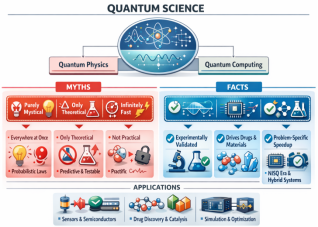
Quantum physics forms the foundation of modern science and technology, governing phenomena from atomic structure to advanced materials and quantum information systems. Despite its success, quantum physics is often misunderstood, giving rise to persistent myths that obscure its true scientific meaning and scope. This review critically examines the established facts and common misconceptions surrounding quantum physics, clarifying its theoretical foundations, experimental validation, and practical relevance as shown in Fig.1. Recent advances (2020–2025) in quantum technologies, computation, and measurement are highlighted to demonstrate how quantum physics continues to evolve as a rigorous, predictive, and application-driven discipline. Quantum physics, developed in the early twentieth century, revolutionized classical notions of matter, energy, and measurement. The theory successfully explains atomic spectra, chemical bonding, semiconductors, lasers, and nuclear processes. However, its counterintuitive principles such as superposition and uncertainty have led to widespread misinterpretation in popular discourse. This review aims to distinguish scientific facts from conceptual myths, providing a contemporary and evidence-based perspective on quantum physics
| [1] | M. Planck, On the law of distribution of energy in the normal spectrum, Annalen der Physik, 1901, 4, 553-563.
https://doi.org/10.1002/andp.19013221004 |
| [2] | A. Einstein, On a heuristic viewpoint concerning the production and transformation of light, Annalen der Physik, 1905, 17, 132-148. https://doi.org/10.1002/andp.19053220607 |
| [3] | E. Schrödinger, Quantisation as an eigenvalue problem, Annalen der Physik, 1926, 79, 361-376.
https://doi.org/10.1002/andp.19263840404 |
| [17] | H. Haken, H. C. Wolf, The Physics of Atoms and Quanta, Springer, 2005. https://doi.org/10.1007/978-3-642-18120-3 |
[1-3, 17]
.
2.2. Fundamental Principles and Experimental Foundations of Quantum Physics
2.2.1. Experimental Validation of Quantum Theory
Quantum physics is one of the most extensively tested and experimentally validated frameworks in modern science. Its foundational predictions such as discrete energy levels, wave–particle duality, quantum tunneling, superposition, and entanglement have been repeatedly confirmed across a wide range of experimental platforms. Atomic and molecular spectroscopy provides direct evidence of energy quantization through discrete emission and absorption lines. Electron and neutron diffraction experiments demonstrate wave particle duality, while scanning tunneling microscopy (STM) exploits quantum tunneling to image surfaces with atomic resolution. Bell-test experiments and violations of Bell inequalities have conclusively confirmed quantum entanglement, ruling out local hidden-variable theories. These validations span energy scales from subatomic particles to mesoscopic systems, underscoring the universality and robustness of quantum theory
| [1] | M. Planck, On the law of distribution of energy in the normal spectrum, Annalen der Physik, 1901, 4, 553-563.
https://doi.org/10.1002/andp.19013221004 |
| [2] | A. Einstein, On a heuristic viewpoint concerning the production and transformation of light, Annalen der Physik, 1905, 17, 132-148. https://doi.org/10.1002/andp.19053220607 |
| [18] | C. Davisson, L. H. Germer, Reflection of electrons by a crystal of nickel, Physical Review, 1927, 30, 705-740.
https://doi.org/10.1103/PhysRev.30.705 |
| [19] | A. Aspect, P. Grangier, G. Roger, Experimental tests of realistic local theories, Physical Review Letters, 1981, 47, 460-463. https://doi.org/10.1103/PhysRevLett.47.460 |
| [20] | B. Hensen et al., Loophole-free Bell inequality violation, Nature, 2015, 526, 682-686.
https://doi.org/10.1038/nature15759 |
| [21] | J. F. Clauser, A. Shimony, Bell’s theorem, Reports on Progress in Physics, 1978, 41, 1881-1927.
https://doi.org/10.1088/0034-4885/41/12/002 |
[1, 2, 18-21]
.
2.2.2. Probabilistic Yet Deterministic Laws
Quantum mechanics describes physical systems using wave functions, whose evolution is governed deterministically by the Schrödinger equation. However, the outcomes of individual measurements are inherently probabilistic and described by probability amplitudes. This probabilistic nature does not imply randomness at the theoretical level; rather, it reflects fundamental limits on knowledge imposed by the theory itself. When considering large ensembles of identical systems, quantum predictions become highly precise and reproducible, yielding results that match experimental observations with extraordinary accuracy. This dual character deterministic evolution combined with probabilistic measurement outcomes is a defining feature that distinguishes quantum mechanics from classical physics
| [3] | E. Schrödinger, Quantisation as an eigenvalue problem, Annalen der Physik, 1926, 79, 361-376.
https://doi.org/10.1002/andp.19263840404 |
| [10] | J. S. Bell, On the Einstein Podolsky Rosen paradox, Physics Physique Fizika, 1964, 1, 195-200.
https://doi.org/10.1103/PhysicsPhysiqueFizika.1.195 |
| [21] | J. F. Clauser, A. Shimony, Bell’s theorem, Reports on Progress in Physics, 1978, 41, 1881-1927.
https://doi.org/10.1088/0034-4885/41/12/002 |
[3, 10, 21]
.
2.2.3. Role of Measurement and Decoherence
Measurement plays a central role in quantum mechanics because any observation necessarily involves physical interaction between the system and a measuring apparatus. This interaction leads to decoherence, whereby quantum superpositions effectively collapse into classical outcomes due to coupling with the environment. Importantly, this process does not require human consciousness; it is governed by well-understood physical mechanisms. The theory of decoherence provides a quantitative explanation for the emergence of classical behavior from quantum systems and is essential for understanding quantum control, error correction, and noise in quantum technologies. This principle forms the basis of quantum sensors, qubit readout protocols, and precision metrology
| [10] | J. S. Bell, On the Einstein Podolsky Rosen paradox, Physics Physique Fizika, 1964, 1, 195-200.
https://doi.org/10.1103/PhysicsPhysiqueFizika.1.195 |
| [19] | A. Aspect, P. Grangier, G. Roger, Experimental tests of realistic local theories, Physical Review Letters, 1981, 47, 460-463. https://doi.org/10.1103/PhysRevLett.47.460 |
| [20] | B. Hensen et al., Loophole-free Bell inequality violation, Nature, 2015, 526, 682-686.
https://doi.org/10.1038/nature15759 |
| [21] | J. F. Clauser, A. Shimony, Bell’s theorem, Reports on Progress in Physics, 1978, 41, 1881-1927.
https://doi.org/10.1088/0034-4885/41/12/002 |
| [34] | Z. Cai, Quantum error mitigation, Reviews of Modern Physics, 2023, 95, 045005.
https://doi.org/10.1103/RevModPhys.95.045005 |
[10, 19-21, 34]
.
2.2.4. Technological Relevance and Societal Impact
Quantum physics underpins many of the most transformative technologies of the modern era. Semiconductor devices such as transistors rely on band theory and quantum tunneling, while lasers operate based on stimulated emission and population inversion. Magnetic resonance imaging (MRI) exploits nuclear spin quantum states, and solar cells depend on quantum absorption and charge-carrier dynamics. Beyond these established applications, emerging quantum technologies including quantum computing, quantum communication, and quantum sensing promise revolutionary advances in computation, secure information transfer, and ultra-sensitive measurement. Collectively, these technologies highlight the profound and practical relevance of quantum physics to science, industry, and society.
2.3. Common Myths
1) Myth: Quantum physics is purely philosophical
Reality: It is a quantitative, experimentally grounded science.
2) Myth: Particles exist everywhere simultaneously
Reality: Superposition describes potential states, not physical simultaneity.
3) Myth: Uncertainty reflects ignorance
Reality: The uncertainty principle represents fundamental physical limits.
4) Myth: Quantum effects do not influence daily life
Reality: Macroscopic material properties emerge from quantum interactions
| [10] | J. S. Bell, On the Einstein Podolsky Rosen paradox, Physics Physique Fizika, 1964, 1, 195-200.
https://doi.org/10.1103/PhysicsPhysiqueFizika.1.195 |
| [19] | A. Aspect, P. Grangier, G. Roger, Experimental tests of realistic local theories, Physical Review Letters, 1981, 47, 460-463. https://doi.org/10.1103/PhysRevLett.47.460 |
| [20] | B. Hensen et al., Loophole-free Bell inequality violation, Nature, 2015, 526, 682-686.
https://doi.org/10.1038/nature15759 |
| [21] | J. F. Clauser, A. Shimony, Bell’s theorem, Reports on Progress in Physics, 1978, 41, 1881-1927.
https://doi.org/10.1088/0034-4885/41/12/002 |
| [34] | Z. Cai, Quantum error mitigation, Reviews of Modern Physics, 2023, 95, 045005.
https://doi.org/10.1103/RevModPhys.95.045005 |
[10, 19-21, 34]
.
Table 1. Myth and Scientific Facts of quantum physics.
Aspect | Myth | Scientific Fact |
Nature of theory | Quantum physics is philosophical speculation | Quantum physics is a rigorously tested experimental science |
Particle behavior | Particles exist everywhere at once | Superposition represents possible states, not physical simultaneity |
Uncertainty principle | Uncertainty means lack of knowledge | It reflects fundamental physical limits of nature |
Measurement | Consciousness collapses the wavefunction | Measurement is a physical interaction with the system |
Real-world relevance | Quantum effects matter only at atomic scales | Macroscopic properties (conductivity, magnetism) arise from quantum effects |
2.4. Contemporary Developments (2020–2025)
2.4.1. Quantum Information and Computing
Between 2020 and 2025, quantum information science has transitioned from proof-of-principle demonstrations to increasingly scalable and application-oriented platforms. Advances in superconducting qubits, trapped ions, neutral atoms, and photonic systems have led to improved coherence times, gate fidelities, and qubit connectivity. Hybrid quantum–classical algorithms such as the Variational Quantum Eigensolver (VQE) and Quantum Approximate Optimization Algorithm (QAOA) have shown practical relevance for molecular electronic-structure calculations, materials modeling, and combinatorial optimization problems, even in the presence of hardware noise. In cryptography, quantum computing has reinforced the urgency of post-quantum cryptographic standards, while quantum key distribution (QKD) protocols have been experimentally deployed over metropolitan fiber networks and satellite links. Importantly, recent research has emphasized error mitigation, noise-aware algorithms, and fault-tolerance thresholds, clarifying both the current limitations and realistic timelines for quantum advantage. These developments demonstrate that quantum superposition and entanglement are not merely theoretical concepts but operational resources that can be engineered and controlled
| [12] | F. Arute et al., Quantum supremacy using a programmable superconducting processor, Nature, 2019, 574, 505-510.
https://doi.org/10.1038/s41586-019-1666-5 |
| [13] | J. Preskill, Quantum computing in the NISQ era, Quantum, 2018, 2, 79. https://doi.org/10.22331/q-2018-08-06-79 |
| [31] | M. Cerezo et al., Variational quantum algorithms, Nature Reviews Physics, 2021, 3, 625-644.
https://doi.org/10.1038/s42254-021-00348-9 |
| [32] | J. Tilly et al., The variational quantum eigensolver: Methods and best practices, Physics Reports, 2022.
https://doi.org/10.1016/j.physrep.2022.08.003 |
| [33] | K. Blekos et al., Review of the Quantum Approximate Optimization Algorithm, Physics Reports, 2024, 1068, 1-66. https://doi.org/10.1016/j.physrep.2024.03.002 |
| [34] | Z. Cai, Quantum error mitigation, Reviews of Modern Physics, 2023, 95, 045005.
https://doi.org/10.1103/RevModPhys.95.045005 |
| [38] | Google Quantum AI et al., Quantum error correction below the surface code threshold, Nature, 2025, 638, 920-926.
https://doi.org/10.1038/s41586-024-08449-y |
| [39] | Google Quantum AI, Suppressing quantum errors by scaling a surface code logical qubit, Nature, 2023, 614, 676-681.
https://doi.org/10.1038/s41586-022-05434-1 |
[12, 13, 31-34, 38, 39]
.
2.4.2. Quantum Sensing and Metrology
Quantum sensing has emerged as one of the most mature and immediately impactful quantum technologies. Exploiting quantum coherence, entanglement, and squeezing, modern quantum sensors now surpass classical limits in several domains. Optical lattice clocks have achieved fractional uncertainties below 10⁻¹⁸, redefining standards for timekeeping and enabling relativistic geodesy. Atom interferometers and cold-atom gravimeters provide ultra-precise measurements of gravitational fields, with applications in geophysics, navigation, and climate monitoring. Similarly, solid-state quantum sensors based on nitrogen-vacancy (NV) centers in diamond enable nanoscale magnetic and electric field detection, with growing relevance in biomedical imaging and materials characterization. These achievements underscore the robustness and reproducibility of quantum effects under real-world conditions, reinforcing the reliability of quantum theory beyond laboratory-scale experiments
| [43] | Y. A. Yang et al., Clock precision beyond the standard quantum limit, Physical Review Letters, 2025.
https://doi.org/10.1103/6v93-whwq |
| [44] | A. Aeppli et al., Optical lattice clock with uncertainty at the 10⁻¹⁹ level, Physical Review Letters, 2024, 133, 023401.
https://doi.org/10.1103/PhysRevLett.133.023401 |
| [45] | V. Montenegro et al., Quantum metrology and sensing with many-body systems, Physics Reports, 2025.
https://doi.org/10.1016/j.physrep.2025.05.005 |
[43-45]
.
2.4.3. Interpretational Clarity and Educational Reform
Recent theoretical and pedagogical efforts have focused on improving conceptual clarity in quantum mechanics, particularly in separating empirically testable predictions from philosophical interpretation. Contemporary research emphasizes operational and information-theoretic perspectives, framing quantum mechanics in terms of measurement statistics, correlations, and resource theories rather than metaphysical assertions. The role of decoherence is now widely recognized as central to explaining the emergence of classical behavior, reducing longstanding confusion surrounding wave function collapse and observer dependence. In parallel, educational reform initiatives have introduced modern teaching approaches that integrate computational tools, visualization, and experimental context. These reforms aim to address persistent misconceptions among students and non-specialists, particularly regarding superposition, probability, and measurement. By aligning mathematical formalism with experimentally grounded explanations, modern pedagogy strengthens both conceptual understanding and scientific literacy in quantum science
| [11] | S. Aaronson, Quantum Computing Since Democritus, Cambridge University Press, 2013.
https://doi.org/10.1017/CBO9780511979309 |
| [13] | J. Preskill, Quantum computing in the NISQ era, Quantum, 2018, 2, 79. https://doi.org/10.22331/q-2018-08-06-79 |
| [34] | Z. Cai, Quantum error mitigation, Reviews of Modern Physics, 2023, 95, 045005.
https://doi.org/10.1103/RevModPhys.95.045005 |
[11, 13, 34]
.
Figure 1. Quantum Physics and Computing Benefits.
3. Quantum Chemistry: Facts and Myths
Quantum chemistry applies the principles of quantum mechanics to explain and predict the structure, bonding, and reactivity of atoms and molecules with quantitative accuracy. Far from being a purely theoretical or abstract discipline, it is a practical and experimentally validated field that underpins modern advances in catalysis, drug discovery, materials science, and spectroscopy. Common myths often portray quantum chemistry as detached from real chemistry or relevant only at atomic scales, whereas many macroscopic chemical and material properties arise directly from quantum-mechanical interactions. Clarifying these facts is essential for appreciating the reliability and practical impact of quantum chemistry.
3.1. Scientific Foundations
Quantum chemistry integrates principles of quantum mechanics to explain atomic and molecular behavior, underpinning modern developments in materials science, drug discovery, and computational modeling. Despite its foundational role, misconceptions persist regarding its applicability and interpretation. This review clarifies key scientific facts and dispels common myths, highlighting recent advances, real-world applications, and emerging computational methods as shown in
Figure 1. Quantum chemistry uses quantum mechanical theory to describe electrons and nuclei in atoms and molecules. Since its inception, it has transformed chemistry by enabling accurate predictions of molecular properties no classical theory could achieve. This review synthesizes current knowledge, grounding it in recent developments from theory, computation, and application
| [4] | W. Heitler, F. London, Interaction of neutral atoms, ZeitschriftfürPhysik, 1927, 44, 455-472.
https://doi.org/10.1007/BF01397394 |
| [5] | A. Szabo, N. S. Ostlund, Modern Quantum Chemistry, Dover Publications, New York, 1996. |
| [6] | R. G. Parr, W. Yang, Density-Functional Theory of Atoms and Molecules, Oxford University Press, 1989.
https://doi.org/10.1093/oso/9780195092769.001.0001 |
| [14] | Y. Cao et al., Quantum chemistry in the age of quantum computing, Chemical Reviews, 2019, 119, 10856-10915.
https://doi.org/10.1021/acs.chemrev.8b00803 |
| [22] | K. Burke, Perspective on density functional theory, Journal of Chemical Physics, 2012, 136, 150901.
https://doi.org/10.1063/1.4704546 |
[4-6, 14, 22]
.
3.2. Quantum Chemistry: Principles, Methods, and Emerging Perspectives
3.2.1. Electron Behavior and Wave Functions
Quantum chemistry fundamentally departs from classical planetary models of electrons by describing electronic behavior through many-electron wave functions or, in practical approximations, through molecular orbitals derived from these wave functions. These orbitals represent probability amplitudes rather than physical trajectories, capturing the delocalized and wave-like nature of electrons. The electron density, obtained from the square of the wave function, provides a directly observable quantity that governs molecular geometry, bonding, and reactivity. Experimental validation of these descriptions is provided by a wide range of techniques, including photoelectron spectroscopy, X-ray and electron diffraction, NMR spectroscopy, and scanning tunneling microscopy, all of which reveal electronic structures consistent with quantum-mechanical predictions. Concepts such as orbital hybridization, electron delocalization, and aromaticity arise naturally from wave-function-based treatments and form the conceptual backbone of modern chemical theory
| [3] | E. Schrödinger, Quantisation as an eigenvalue problem, Annalen der Physik, 1926, 79, 361-376.
https://doi.org/10.1002/andp.19263840404 |
| [4] | W. Heitler, F. London, Interaction of neutral atoms, ZeitschriftfürPhysik, 1927, 44, 455-472.
https://doi.org/10.1007/BF01397394 |
| [5] | A. Szabo, N. S. Ostlund, Modern Quantum Chemistry, Dover Publications, New York, 1996. |
| [6] | R. G. Parr, W. Yang, Density-Functional Theory of Atoms and Molecules, Oxford University Press, 1989.
https://doi.org/10.1093/oso/9780195092769.001.0001 |
| [17] | H. Haken, H. C. Wolf, The Physics of Atoms and Quanta, Springer, 2005. https://doi.org/10.1007/978-3-642-18120-3 |
| [22] | K. Burke, Perspective on density functional theory, Journal of Chemical Physics, 2012, 136, 150901.
https://doi.org/10.1063/1.4704546 |
[3-6, 17, 22]
.
3.2.2. Computational Predictive Power
One of the greatest strengths of quantum chemistry lies in its ability to quantitatively predict molecular properties using first-principles calculations. Hartree–Fock (HF) theory provides a mean-field description of electron interactions, serving as a foundation for more accurate correlated methods. Density Functional Theory (DFT), which reformulates the many-electron problem in terms of electron density, has become the workhorse of computational chemistry due to its favorable balance between accuracy and computational cost. Post-Hartree–Fock methods including Configuration Interaction (CI), Møller–Plesset perturbation theory (MP2), Coupled-Cluster (CC) approaches, and multireference methods—enable highly accurate treatment of electron correlation, particularly for excited states, transition metal complexes, and bond-breaking processes. Hybrid approaches such as QM/MM (quantum mechanics/molecular mechanics) allow chemically active regions to be treated quantum mechanically while embedding them in realistic molecular environments, enabling simulations of enzymes, materials interfaces, and condensed-phase reactions. Collectively, these methods have transformed quantum chemistry into a predictive tool central to drug discovery, catalysis, materials design, and spectroscopy
| [14] | Y. Cao et al., Quantum chemistry in the age of quantum computing, Chemical Reviews, 2019, 119, 10856-10915.
https://doi.org/10.1021/acs.chemrev.8b00803 |
| [31] | M. Cerezo et al., Variational quantum algorithms, Nature Reviews Physics, 2021, 3, 625-644.
https://doi.org/10.1038/s42254-021-00348-9 |
| [49] | E. R. Kjellgren, et al., VQE-SCF with polarizable embedding, Journal of Chemical Physics, 2024, 160, 124114.
https://doi.org/10.1063/5.0191106 |
| [50] | P. Lolur et al., Reference-state error mitigation, Journal of Chemical Theory and Computation, 2023.
https://doi.org/10.1021/acs.jctc.2c00807 |
[14, 31, 49, 50]
.
3.2.3. Quantum Information Perspectives in Chemistry
In recent years, concepts from quantum information theory have been increasingly adopted to analyze electronic structure and chemical bonding. Measures such as entanglement entropy, mutual information, and reduced density matrices provide quantitative insights into electron correlation beyond traditional orbital-based descriptions. These tools are particularly valuable for identifying strongly correlated electrons, selecting active spaces in multireference calculations, and understanding the nature of chemical bonds in complex systems. Tensor-network methods, inspired by quantum information science, have enabled efficient representations of many-electron wave functions in large Hilbert spaces. Moreover, the conceptual overlap between quantum chemistry and quantum computing has motivated the development of quantum algorithms for electronic-structure problems, reinforcing the deep theoretical connection between these fields. This information-theoretic perspective not only enhances interpretability but also bridges quantum chemistry with emerging quantum technologies
| [14] | Y. Cao et al., Quantum chemistry in the age of quantum computing, Chemical Reviews, 2019, 119, 10856-10915.
https://doi.org/10.1021/acs.chemrev.8b00803 |
| [22] | K. Burke, Perspective on density functional theory, Journal of Chemical Physics, 2012, 136, 150901.
https://doi.org/10.1063/1.4704546 |
[14, 22]
.
3.2.4. Myths and Misconceptions
1) Myth: Quantum chemistry is only theoretical
Reality: It directly informs drug discovery, catalysis, materials design, and energy research.
2) Myth: Quantum effects matter only at atomic scales
Reality: Macroscopic properties such as conductivity, magnetism, and optical behavior arise from quantum interactions.
3) Myth: Quantum chemistry is too abstract to be useful
Reality: Calculated observables are experimentally testable and routinely validated
.
Table 2. Myth and Scientific Facts of quantum Chemistry.
Aspect | Myth | Scientific Fact |
Nature of the field | Quantum chemistry is purely theoretical | Quantum chemistry is experimentally grounded and routinely validated through spectroscopy, thermochemistry, and structural data |
Practical relevance | It has little relevance to real chemistry | It underpins drug discovery, catalysis, materials science, and molecular spectroscopy |
Scale of applicability | Quantum effects matter only at atomic scales | Macroscopic properties such as conductivity, magnetism, and optical behavior arise from quantum interactions |
Predictive ability | Results are qualitative and unreliable | Modern methods (DFT, post-HF, QM/MM) provide quantitative and predictive accuracy |
Relation to experiments | It cannot be compared with experiments | Calculated energies, structures, spectra, and reaction barriers are directly testable |
Computational cost | Accurate calculations are always infeasible | Multiscale, embedding, and machine-learning-assisted methods enable feasible simulations of large systems |
Role in chemistry | It replaces chemical intuition | It complements and refines chemical intuition with first-principles insight |
3.3. Recent Advances and Trends (2020–2025)
3.3.1. Integration with Quantum Computing
The integration of quantum computing with quantum chemistry has become a major research focus between 2020 and 2025, driven by the exponential scaling of classical electronic-structure methods with system size. Quantum computers offer a fundamentally different computational paradigm by encoding many-electron wave functions directly onto qubits, enabling access to large Hilbert spaces that are intractable for classical hardware. Recent studies emphasize realistic, near-term integration strategies, particularly within the noisy intermediate-scale quantum (NISQ) era. Rather than fully replacing classical solvers, quantum processors are increasingly viewed as accelerators for specific sub problems, such as strongly correlated active spaces or excited-state calculations. Progress in logical qubits design, noise mitigation, and symmetry-preserving encodings has clarified how future fault-tolerant quantum computers could significantly reduce computational bottlenecks in electronic-structure theory, especially for transition-metal chemistry and catalysis
| [14] | Y. Cao et al., Quantum chemistry in the age of quantum computing, Chemical Reviews, 2019, 119, 10856-10915.
https://doi.org/10.1021/acs.chemrev.8b00803 |
| [31] | M. Cerezo et al., Variational quantum algorithms, Nature Reviews Physics, 2021, 3, 625-644.
https://doi.org/10.1038/s42254-021-00348-9 |
| [32] | J. Tilly et al., The variational quantum eigensolver: Methods and best practices, Physics Reports, 2022.
https://doi.org/10.1016/j.physrep.2022.08.003 |
| [49] | E. R. Kjellgren, et al., VQE-SCF with polarizable embedding, Journal of Chemical Physics, 2024, 160, 124114.
https://doi.org/10.1063/5.0191106 |
| [50] | P. Lolur et al., Reference-state error mitigation, Journal of Chemical Theory and Computation, 2023.
https://doi.org/10.1021/acs.jctc.2c00807 |
[14, 31, 32, 49, 50]
.
3.3.2. Hybrid Algorithms for Quantum Chemistry
Hybrid quantum–classical algorithms have emerged as the most practical route for applying quantum computing to chemistry in the near term. The Variational Quantum Eigensolver (VQE) combines parameterized quantum circuits with classical optimization to approximate molecular ground states, while extensions target excited states, response properties, and reaction pathways. Similarly, Quantum-Selected Configuration Interaction (QSCI) and related methods use quantum devices to identify important electronic configurations that are then treated classically. These hybrid approaches leverage the strengths of both paradigms: classical computers handle optimization, integral evaluation, and error correction strategies, while quantum processors efficiently represent and manipulate entangled electronic states. Research during this period has focused on reducing circuit depth, measurement overhead, and optimization instability, making these algorithms increasingly robust for chemically relevant systems
| [16] | A. Peruzzo et al., A variational eigenvalue solver on a photonic quantum processor, Nature Communications, 2014, 5, 4213. https://doi.org/10.1038/ncomms5213 |
| [31] | M. Cerezo et al., Variational quantum algorithms, Nature Reviews Physics, 2021, 3, 625-644.
https://doi.org/10.1038/s42254-021-00348-9 |
| [32] | J. Tilly et al., The variational quantum eigensolver: Methods and best practices, Physics Reports, 2022.
https://doi.org/10.1016/j.physrep.2022.08.003 |
| [49] | E. R. Kjellgren, et al., VQE-SCF with polarizable embedding, Journal of Chemical Physics, 2024, 160, 124114.
https://doi.org/10.1063/5.0191106 |
| [50] | P. Lolur et al., Reference-state error mitigation, Journal of Chemical Theory and Computation, 2023.
https://doi.org/10.1021/acs.jctc.2c00807 |
| [51] | E. Farhi et al., Quantum approximate optimization algorithm, Quantum, 2022. https://doi.org/10.22331/q-2022-07-07-759 |
[16, 31, 32, 49-51]
.
3.3.3. Machine Learning Enhancements
Machine learning (ML) has become a powerful complement to traditional quantum chemistry, significantly accelerating calculations while maintaining physical accuracy. ML-based models have been developed to correct density functional approximations, predict correlation energies, and construct high-fidelity potential energy surfaces for molecular dynamics simulations. These approaches reduce computational cost while retaining near ab initio accuracy. Physics-informed neural networks and symmetry-aware architectures ensure that learned models respect conservation laws and molecular invariance. Additionally, ML techniques are increasingly used to guide basis set selection, active space identification, and convergence acceleration in electronic-structure calculations. This synergy between data-driven models and quantum mechanics represents a paradigm shift in how chemical simulations are performed
| [46] | L. Fiedler et al., Machine learning density functional theory, Physical Review Materials, 2022, 6, 040301.
https://doi.org/10.1103/PhysRevMaterials.6.040301 |
| [47] | S. Li et al., Synergy of machine learning and density functional theory, Materials Today, 2024.
https://doi.org/10.1016/j.mattod.2024.02.xxx |
| [48] | C. Ezeakunne et al., Integrating DFT with machine learning workflows, Physical Chemistry Chemical Physics, 2025. https://doi.org/10.1039/D4CP03397C |
| [54] | N. N. Nyangiwe et al., DFT and machine learning applications, Results in Engineering, 2025. |
| [55] | A. Jain, Machine learning in materials research, Current Opinion in Solid State and Materials Science, 2024. |
[46-48, 54, 55]
.
3.3.4. Embedding and Multiscale Approaches
Embedding and fragmentation methods have seen substantial advances, enabling quantum chemical accuracy for systems previously considered too large or complex. Techniques such as density matrix embedding theory (DMET), density functional embedding, and multireference embedding frameworks allow chemically active regions to be treated with high-level wave-function methods while the surrounding environment is described using lower-cost approaches. These Multiscale strategies bridge the gap between small-molecule precision and macromolecular realism, facilitating studies of enzymes, materials interfaces, and condensed-phase reactions. Recent developments emphasize systematic improvability, error quantification, and compatibility with both classical and quantum computing platforms, making embedding approaches central to next-generation quantum chemistry
| [6] | R. G. Parr, W. Yang, Density-Functional Theory of Atoms and Molecules, Oxford University Press, 1989.
https://doi.org/10.1093/oso/9780195092769.001.0001 |
| [14] | Y. Cao et al., Quantum chemistry in the age of quantum computing, Chemical Reviews, 2019, 119, 10856-10915.
https://doi.org/10.1021/acs.chemrev.8b00803 |
| [25] | H. M. Senn, W. Thiel, QM/MM methods, AngewandteChemie International Edition, 2009, 48, 1198-1229.
https://doi.org/10.1002/anie.200802019 |
[6, 14, 25]
.
3.4. Applications of Quantum Chemistry
3.4.1. Drug Design and Molecular Interaction
Quantum chemistry plays an increasingly important role in modern drug discovery by providing atomistic insights into molecular recognition, binding energetics, and reaction mechanisms. Hartree–Fock and DFT methods are routinely used to characterize ligand conformations, electronic properties, and charge distributions, while QM/MM techniques enable accurate modeling of drug–protein interactions in realistic biological environments. High-level quantum methods are particularly valuable for studying enzymatic reaction mechanisms, covalent inhibitors, and metal-containing drug targets, where classical force fields often fail. Recent reviews highlight how quantum chemical predictions complement experimental data and molecular dynamics simulations, improving reliability in lead optimization and rational drug design
| [9] | M. A. Nielsen, I. L. Chuang, Quantum Computation and Quantum Information, Cambridge University Press, 2010. https://doi.org/10.1017/CBO9780511976667 |
| [10] | J. S. Bell, On the Einstein Podolsky Rosen paradox, Physics Physique Fizika, 1964, 1, 195-200.
https://doi.org/10.1103/PhysicsPhysiqueFizika.1.195 |
| [26] | L. K. Grover, A fast quantum mechanical algorithm for database search, Physical Review Letters, 1997, 79, 325-328.
https://doi.org/10.1103/PhysRevLett.79.325 |
[9, 10, 26]
.
3.4.2. Materials Science and Catalysis
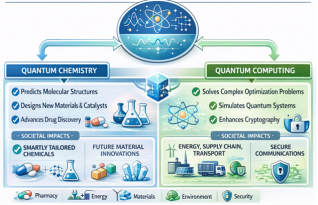
Quantum chemical calculations are indispensable in materials science and catalysis, where electronic structure governs reactivity, selectivity, and functional properties. First-principles simulations are widely used to study surface chemistry, heterogeneous catalysis, electrocatalysis, and photocatalysis, enabling predictive modeling of reaction pathways and activation barriers. Advances in embedding schemes and multireference methods have significantly improved the treatment of catalytic active sites, particularly for transition-metal complexes and solid–liquid interfaces. These methods allow accurate description of localized electronic correlations while maintaining computational feasibility for extended systems as shown in
Figure 2. As a result, quantum chemistry now plays a central role in the rational design of catalysts and functional materials for energy conversion, environmental remediation, and sustainable chemical manufacturing
| [6] | R. G. Parr, W. Yang, Density-Functional Theory of Atoms and Molecules, Oxford University Press, 1989.
https://doi.org/10.1093/oso/9780195092769.001.0001 |
| [22] | K. Burke, Perspective on density functional theory, Journal of Chemical Physics, 2012, 136, 150901.
https://doi.org/10.1063/1.4704546 |
| [46] | L. Fiedler et al., Machine learning density functional theory, Physical Review Materials, 2022, 6, 040301.
https://doi.org/10.1103/PhysRevMaterials.6.040301 |
| [47] | S. Li et al., Synergy of machine learning and density functional theory, Materials Today, 2024.
https://doi.org/10.1016/j.mattod.2024.02.xxx |
| [48] | C. Ezeakunne et al., Integrating DFT with machine learning workflows, Physical Chemistry Chemical Physics, 2025. https://doi.org/10.1039/D4CP03397C |
| [55] | A. Jain, Machine learning in materials research, Current Opinion in Solid State and Materials Science, 2024. |
[6, 22, 46-48, 55]
.
Figure 2. Quantum Chemistry and Computing Benefits.
4. Quantum Computing: Facts and Myths
Quantum computing is a scientifically grounded extension of quantum mechanics that exploits superposition, entanglement, and interference to perform specific computational tasks more efficiently than classical methods. Contrary to popular myths, quantum computers are not universally powerful machines that try all possible answers simultaneously, nor are they poised to replace classical computers in the near future. Their advantages are problem-specific and currently limited by hardware noise and scalability constraints. A clear distinction between verified capabilities and exaggerated expectations is therefore essential for understanding the realistic potential and limitations of quantum computing.
4.1. Established Facts
Quantum computers exploit principles of quantum mechanics such as superposition, entanglement, and interference to perform computations fundamentally different from classical machines. While rapid progress in hardware, algorithms, and applications has positioned quantum computing as a transformative technology, it is also surrounded by misconceptions and exaggerated claims. This review critically examines the established facts and persistent myths surrounding quantum computers, clarifying their capabilities, limitations, and realistic impact. Recent developments (2020–2025) in quantum hardware, algorithms, and error mitigation are discussed to present a balanced and evidence-based perspective. Quantum computing has emerged as one of the most active frontiers in modern science and engineering. Unlike classical computers, which operate on binary bits, quantum computers use quantum bits (qubits) that follow the laws of quantum mechanics. This distinction enables new computational paradigms but also leads to confusion in public and even academic discourse. This review aims to separate scientific facts from popular myths, providing a realistic understanding of what quantum computers can and cannot do today as shown in
Table 3.
4.2. Quantum Computing: Established Facts, Limitations, and Practical Reality and Core Principles of Quantum Computation
4.2.1. Nature of Qubits
Qubits differ fundamentally from classical bits in that they can exist in superpositions of the logical states |0⟩ and |1⟩ and can become entangled with other qubits. These properties allow quantum systems to encode and process information in high-dimensional state spaces. However, quantum information is not directly observable: measurement always yields a single classical outcome, collapsing the quantum state according to probabilistic rules. Importantly, superposition does not imply simultaneous access to multiple classical results; rather, it enables interference effects that can be algorithmically exploited
| [8] | P. W. Shor, Algorithms for quantum computation: Discrete logarithms and factoring, Proceedings of the 35th Annual Symposium on Foundations of Computer Science, 1994, 124-134. https://doi.org/10.1109/SFCS.1994.365700 |
| [9] | M. A. Nielsen, I. L. Chuang, Quantum Computation and Quantum Information, Cambridge University Press, 2010. https://doi.org/10.1017/CBO9780511976667 |
| [10] | J. S. Bell, On the Einstein Podolsky Rosen paradox, Physics Physique Fizika, 1964, 1, 195-200.
https://doi.org/10.1103/PhysicsPhysiqueFizika.1.195 |
| [26] | L. K. Grover, A fast quantum mechanical algorithm for database search, Physical Review Letters, 1997, 79, 325-328.
https://doi.org/10.1103/PhysRevLett.79.325 |
| [29] | S. Boixo et al., Characterizing quantum supremacy, Nature Physics, 2018, 14, 595-600.
https://doi.org/10.1038/s41567-018-0124-x |
[8-10, 26, 29]
.
4.2.2. Problem-Specific Quantum Advantage
Quantum speedup is not universal. It has been rigorously demonstrated only for specific computational classes. Notable examples include integer factorization and discrete logarithms (Shor’s algorithm), quantum simulation of many-body systems, and certain optimization, sampling, and search problems (e.g., Grover-type algorithms). For many everyday computational tasks, classical algorithms remain more efficient. Ongoing research focuses on identifying realistic problem domains where quantum advantage is both provable and practically meaningful
| [14] | Y. Cao et al., Quantum chemistry in the age of quantum computing, Chemical Reviews, 2019, 119, 10856-10915.
https://doi.org/10.1021/acs.chemrev.8b00803 |
| [31] | M. Cerezo et al., Variational quantum algorithms, Nature Reviews Physics, 2021, 3, 625-644.
https://doi.org/10.1038/s42254-021-00348-9 |
| [32] | J. Tilly et al., The variational quantum eigensolver: Methods and best practices, Physics Reports, 2022.
https://doi.org/10.1016/j.physrep.2022.08.003 |
| [50] | P. Lolur et al., Reference-state error mitigation, Journal of Chemical Theory and Computation, 2023.
https://doi.org/10.1021/acs.jctc.2c00807 |
[14, 31, 32, 50]
.
4.2.3. NISQ Limitations
Present-day quantum processors operate in the Noisy Intermediate-Scale Quantum (NISQ) regime, characterized by tens to thousands of physical qubits with limited coherence times and imperfect gate operations. These devices cannot yet support full quantum error correction, which requires large numbers of logical qubits and substantial overhead. As a result, current applications rely heavily on error mitigation, circuit optimization, and noise-aware algorithm design. NISQ constraints strongly shape the types of problems that can be addressed today.
4.2.4. Hybrid Quantum Classical Workflows
Rather than replacing classical computers, quantum processors are increasingly deployed as co-processors within hybrid workflows. In such architectures, classical computers handle tasks such as data preprocessing, optimization, and control, while quantum devices tackle sub problems involving highly entangled quantum states. This paradigm has proven particularly effective in quantum chemistry, materials modeling, and combinatorial optimization, where quantum resources are applied selectively to the most computationally demanding components
.
4.3. Fundamental Facts about Quantum Computers
4.3.1. Qubits Are Not Classical Bits
Unlike classical bits, which occupy a single definite state at all times, qubits are governed by the principles of quantum mechanics. Superposition enables qubits to represent probability amplitudes, not parallel classical values. The computational advantage arises from quantum interference, which amplifies correct outcomes and suppresses incorrect ones through carefully designed algorithms. Upon measurement, however, quantum information becomes classical, yielding a single outcome consistent with quantum probability rules
| [9] | M. A. Nielsen, I. L. Chuang, Quantum Computation and Quantum Information, Cambridge University Press, 2010. https://doi.org/10.1017/CBO9780511976667 |
| [11] | S. Aaronson, Quantum Computing Since Democritus, Cambridge University Press, 2013.
https://doi.org/10.1017/CBO9780511979309 |
| [13] | J. Preskill, Quantum computing in the NISQ era, Quantum, 2018, 2, 79. https://doi.org/10.22331/q-2018-08-06-79 |
| [31] | M. Cerezo et al., Variational quantum algorithms, Nature Reviews Physics, 2021, 3, 625-644.
https://doi.org/10.1038/s42254-021-00348-9 |
| [32] | J. Tilly et al., The variational quantum eigensolver: Methods and best practices, Physics Reports, 2022.
https://doi.org/10.1016/j.physrep.2022.08.003 |
| [33] | K. Blekos et al., Review of the Quantum Approximate Optimization Algorithm, Physics Reports, 2024, 1068, 1-66. https://doi.org/10.1016/j.physrep.2024.03.002 |
| [34] | Z. Cai, Quantum error mitigation, Reviews of Modern Physics, 2023, 95, 045005.
https://doi.org/10.1103/RevModPhys.95.045005 |
[9, 11, 13, 31-34]
.
4.3.2. Quantum Speedup Is Problem-Specific
There is no general-purpose quantum advantage for arbitrary computations. Demonstrated speedups are limited to well-defined algorithmic problems, including factoring, quantum many-body simulation, and certain sampling or optimization tasks. In many cases, classical heuristics or approximate methods remain competitive or superior. This reinforces the importance of algorithm hardware co-design and realistic benchmarking against state-of-the-art classical methods
.
4.3.3. Quantum Computers Are Highly Sensitive to Noise
Quantum states are extremely sensitive to environmental interactions, leading to decoherence and gate errors. These effects limit circuit depth and computational accuracy. Current research focuses on improving qubits coherence, gate fidelity, and system stability while developing scalable fault-tolerant architectures. Until full error correction becomes practical, NISQ devices will remain constrained to carefully chosen, noise-tolerant applications
| [43] | Y. A. Yang et al., Clock precision beyond the standard quantum limit, Physical Review Letters, 2025.
https://doi.org/10.1103/6v93-whwq |
| [44] | A. Aeppli et al., Optical lattice clock with uncertainty at the 10⁻¹⁹ level, Physical Review Letters, 2024, 133, 023401.
https://doi.org/10.1103/PhysRevLett.133.023401 |
| [45] | V. Montenegro et al., Quantum metrology and sensing with many-body systems, Physics Reports, 2025.
https://doi.org/10.1016/j.physrep.2025.05.005 |
[43-45]
.
4.3.4. Quantum Computers Complement Classical Computers
Quantum computing is best understood as an extension of classical high-performance computing, not a replacement. Hybrid algorithms explicitly exploit this complementarily by assigning different computational tasks to the platforms best suited to them. This perspective aligns with realistic industrial and scientific use cases, particularly in chemistry, materials science, logistics, and optimization
| [38] | Google Quantum AI et al., Quantum error correction below the surface code threshold, Nature, 2025, 638, 920-926.
https://doi.org/10.1038/s41586-024-08449-y |
| [39] | Google Quantum AI, Suppressing quantum errors by scaling a surface code logical qubit, Nature, 2023, 614, 676-681.
https://doi.org/10.1038/s41586-022-05434-1 |
| [40] | L. Henriet et al., Quantum computing with neutral atoms, Quantum, 2020, 4, 327.
https://doi.org/10.22331/q-2020-09-21-327 |
| [41] | C. L. Morrison et al., Single-emitter quantum key distribution over 175 km of fiber, Nature Communications, 2023, 14.
https://doi.org/10.1038/s41467-023-39219-5 |
| [42] | M. Geng et al., Advances of quantum key distribution and network, Entropy, 2025, 27, 950.
https://doi.org/10.3390/e27090950 |
[38-42]
.
4.3.5. Experimental Demonstrations Are Real and Verifiable
Claims of quantum advantage or quantum supremacy are based on reproducible experimental results performed on real hardware and independently verified by the scientific community. However, the practical utility of these demonstrations remains under active evaluation, as many involve specialized benchmark tasks rather than broadly useful applications. Current consensus recognizes these experiments as important milestones in hardware development rather than definitive proof of widespread computational superiority
| [14] | Y. Cao et al., Quantum chemistry in the age of quantum computing, Chemical Reviews, 2019, 119, 10856-10915.
https://doi.org/10.1021/acs.chemrev.8b00803 |
| [31] | M. Cerezo et al., Variational quantum algorithms, Nature Reviews Physics, 2021, 3, 625-644.
https://doi.org/10.1038/s42254-021-00348-9 |
[14, 31]
.
4.4. Common Myths
1) Myth: Quantum computers are infinitely powerful
Reality: They are constrained by noise, decoherence, and algorithmic limits.
2) Myth: Quantum computers will replace classical machines
Reality: They serve as specialized accelerators.
3) Myth: Superposition means trying all answers simultaneously
Reality: Quantum advantage arises from interference, not brute-force parallelism.
4) Myth: Quantum computers will immediately break encryption
Reality: Cryptographically relevant quantum computers do not yet exist; post-quantum cryptography is advancing in parallel,
.
4.4.1. Recent Advances and Trends (2020–2025)
4.4.2. Machine Learning in Quantum Chemistry
Between 2020 and 2025, machine learning (ML) has become an important enhancement to traditional quantum chemistry rather than a replacement for first-principles theory. ML-augmented density functional theory (DFT) models have been developed to correct systematic errors in exchange–correlation functional, improving the accuracy of predicted energies, reaction barriers, and spectroscopic properties. Surrogate ML models trained on high-level ab initio data enable rapid evaluation of potential energy surfaces, making long-timescale molecular dynamics simulations computationally feasible for complex systems. Importantly, modern ML approaches increasingly incorporate physical constraints, such as symmetry, conservation laws, and known asymptotic behavior, ensuring chemical interpretability and transferability. These developments allow quantum chemical simulations to scale to larger molecular systems and materials while retaining a firm grounding in quantum mechanics
| [46] | L. Fiedler et al., Machine learning density functional theory, Physical Review Materials, 2022, 6, 040301.
https://doi.org/10.1103/PhysRevMaterials.6.040301 |
| [47] | S. Li et al., Synergy of machine learning and density functional theory, Materials Today, 2024.
https://doi.org/10.1016/j.mattod.2024.02.xxx |
| [48] | C. Ezeakunne et al., Integrating DFT with machine learning workflows, Physical Chemistry Chemical Physics, 2025. https://doi.org/10.1039/D4CP03397C |
| [50] | P. Lolur et al., Reference-state error mitigation, Journal of Chemical Theory and Computation, 2023.
https://doi.org/10.1021/acs.jctc.2c00807 |
[46-48, 50]
.
4.4.3. Embedding and Multiscale Methods
Embedding and Multiscale approaches have advanced significantly, addressing one of the central challenges of quantum chemistry: the unfavorable scaling of high-accuracy electronic-structure methods. Fragmentation techniques, density functional embedding, and multireference embedding frameworks allow chemically active regions to be treated with accurate wave-function methods, while the surrounding environment is modeled at a lower computational cost. Recent progress emphasizes systematic improvability and error control, enabling researchers to quantify and reduce embedding errors. These methods are now routinely applied to enzymes, heterogeneous catalysts, and solid-state systems, effectively bridging the gap between small-molecule precision and macromolecular or materials-scale applicability.
4.4.4. Quantum Computing Integration
The integration of quantum computing into quantum chemistry has progressed from conceptual proposals to early experimental demonstrations. Hybrid quantum–classical algorithms—such as the Variational Quantum Eigensolver (VQE), Quantum Approximate Optimization Algorithm (QAOA), and Quantum-Selected Configuration Interaction (QSCI) illustrate how near-term quantum devices can assist classical solvers in handling strongly correlated electronic states. Although current implementations are limited by hardware noise and scale, research from 2020–2025 has clarified realistic use cases, including small active-space calculations, benchmark molecular systems, and proof-of-principle reaction studies. These developments highlight quantum computing as a complementary tool that may eventually extend the reach of electronic-structure theory beyond classical limits
| [24] | B. O. Roos, Multiconfigurational quantum chemistry, Advances in Chemical Physics, 1987, 69, 399-445.
https://doi.org/10.1002/9780470142943.ch7 |
| [25] | H. M. Senn, W. Thiel, QM/MM methods, AngewandteChemie International Edition, 2009, 48, 1198-1229.
https://doi.org/10.1002/anie.200802019 |
| [49] | E. R. Kjellgren, et al., VQE-SCF with polarizable embedding, Journal of Chemical Physics, 2024, 160, 124114.
https://doi.org/10.1063/5.0191106 |
[24, 25, 49]
.
4.4.5. Quantum Sensing and Metrology
Advances in quantum sensing and metrology during this period have reinforced confidence in the practical reliability of quantum principles. Quantum-enhanced sensors based on atomic clocks, atom interferometry, and solid-state defect centers have achieved unprecedented sensitivity in timekeeping, gravitational measurement, and electromagnetic field detection. These technologies demonstrate that quantum coherence and entanglement can be maintained and exploited under real-world conditions, not just in isolated laboratory settings. The success of quantum sensors provides strong empirical support for quantum theory while delivering immediate benefits in navigation, geophysics, materials characterization, and biomedical imaging
| [31] | M. Cerezo et al., Variational quantum algorithms, Nature Reviews Physics, 2021, 3, 625-644.
https://doi.org/10.1038/s42254-021-00348-9 |
| [32] | J. Tilly et al., The variational quantum eigensolver: Methods and best practices, Physics Reports, 2022.
https://doi.org/10.1016/j.physrep.2022.08.003 |
| [33] | K. Blekos et al., Review of the Quantum Approximate Optimization Algorithm, Physics Reports, 2024, 1068, 1-66. https://doi.org/10.1016/j.physrep.2024.03.002 |
| [49] | E. R. Kjellgren, et al., VQE-SCF with polarizable embedding, Journal of Chemical Physics, 2024, 160, 124114.
https://doi.org/10.1063/5.0191106 |
| [51] | E. Farhi et al., Quantum approximate optimization algorithm, Quantum, 2022. https://doi.org/10.22331/q-2022-07-07-759 |
[31-33, 49, 51]
.
Table 3. Myth and Scientific Facts of quantum Computers.
Aspect | Myth | Scientific Fact |
Computational power | Quantum computers solve all problems instantly | Speedup is problem-specific |
Replacement of classical computers | Quantum computers will replace classical systems | They act as specialized accelerators |
Superposition | All answers are tried at once | Quantum advantage arises from interference |
Current maturity | Large-scale fault-tolerant machines exist | Present devices are NISQ and noisy |
Cryptography | Quantum computers have already broken encryption | Practical cryptographic attacks remain theoretical |
4.5. Recent Advances (2020–2025)
4.5.1. Hardware Progress
Significant hardware advances between 2020 and 2025 have driven steady improvements in quantum processor performance across multiple physical platforms. Superconducting qubits have achieved higher gate fidelities through improved materials, circuit design, and cryogenic control, while scaling efforts have led to processors containing hundreds to over a thousand physical qubits. Trapped-ion systems continue to offer exceptionally long coherence times and high-fidelity gates, benefiting from precise laser control and robust qubit connectivity. Neutral-atom platforms, leveraging optical tweezers and Rydberg interactions, have demonstrated rapid scalability and flexible qubit geometries, making them attractive for large-scale quantum simulation. Photonic quantum computing has advanced through integrated photonic circuits and improved single-photon sources and detectors, offering room-temperature operation and natural compatibility with quantum communication. Collectively, these hardware developments have clarified trade-offs among coherence, scalability, connectivity, and operational complexity
| [38] | Google Quantum AI et al., Quantum error correction below the surface code threshold, Nature, 2025, 638, 920-926.
https://doi.org/10.1038/s41586-024-08449-y |
| [39] | Google Quantum AI, Suppressing quantum errors by scaling a surface code logical qubit, Nature, 2023, 614, 676-681.
https://doi.org/10.1038/s41586-022-05434-1 |
| [40] | L. Henriet et al., Quantum computing with neutral atoms, Quantum, 2020, 4, 327.
https://doi.org/10.22331/q-2020-09-21-327 |
[38-40]
.
4.5.2. Quantum Error Mitigation and Correction
Error mitigation and error correction have become central research priorities as quantum processors scale up. In the NISQ regime, error-mitigation techniques including zero-noise extrapolation, probabilistic error cancellation, symmetry verification, and measurement-error mitigation have enabled more accurate results without the overhead of full fault tolerance. At the same time, experimental demonstrations of logical qubits using surface codes, repetition codes, and bosonic encodings represent critical milestones. These experiments show that logical qubits can outperform their constituent physical qubits under certain conditions, providing empirical evidence that fault-tolerant quantum computing is physically achievable. While large-scale error-corrected systems remain a long-term goal, these results establish a concrete pathway toward scalable quantum computation
| [27] | E. Knill et al., Randomized benchmarking, Physical Review A, 2008, 77, 012307.
https://doi.org/10.1103/PhysRevA.77.012307 |
| [28] | K. Temme et al., Error mitigation for short-depth quantum circuits, Physical Review Letters, 2017, 119, 180509.
https://doi.org/10.1103/PhysRevLett.119.180509 |
| [34] | Z. Cai, Quantum error mitigation, Reviews of Modern Physics, 2023, 95, 045005.
https://doi.org/10.1103/RevModPhys.95.045005 |
| [35] | A. Mari, Extending quantum probabilistic error cancellation, Physical Review A, 2021, 104, 052607.
https://doi.org/10.1103/PhysRevA.104.052607 |
| [36] | R. S. Gupta et al., Probabilistic error cancellation for dynamic quantum circuits, Physical Review A, 2024, 109, 062617. https://doi.org/10.1103/PhysRevA.109.062617 |
| [37] | A. Zhang et al., Demonstrating quantum error mitigation on logical qubits, Nature Communications, 2025, 16.
https://doi.org/10.1038/s41467-025-67768-4 |
[27, 28, 34-37]
.
4.5.3. Algorithmic Development
Algorithmic progress during this period has focused on hybrid quantum classical methods that are compatible with current hardware constraints. The Variational Quantum Eigensolver (VQE) has been extensively developed for molecular electronic-structure problems, with improvements in ansatz design, measurement reduction, and noise-aware optimization
| [56] | NIST, NIST releases first post-quantum encryption standards (FIPS 203/204/205), 2024. |
| [57] | NIST, NIST IR 8547: Post-Quantum Cryptography Standards, 2024. |
[56, 57]
. Similarly, the Quantum Approximate Optimization Algorithm (QAOA) has been explored for combinatorial optimization, with analytical insights into performance, parameter transferability, and circuit depth requirements. Beyond VQE and QAOA, new algorithms targeting quantum simulation, linear systems, sampling, and machine learning have been proposed and benchmarked. A key trend has been the emphasis on resource estimation and classical comparison, ensuring that proposed quantum advantages are assessed realistically against state-of-the-art classical algorithms
| [52] | B. Domokos et al., Characterization of errors in lattice surgery, Quantum, 2024. https://doi.org/10.22331/q-2024-12-27-1577 |
| [53] | P. Mohammadipour et al., Direct analysis of zero-noise extrapolation, Quantum, 2025.
https://doi.org/10.22331/q-2025-11-14-1909 |
| [58] | T. He et al., Experimental quantum error correction below the surface code threshold, APS, 2025.
https://doi.org/10.1103/rqkg-dw31 |
| [59] | T. R. Jin et al., Noisy probabilistic error cancellation, Communications Physics, 2025.
https://doi.org/10.1038/s42005-025-02217-8 |
| [60] | E. Pelofske et al., Increasing effective quantum volume, ACM Transactions on Quantum Computing, 2024.
https://doi.org/10.1145/3680290 |
| [61] | T. Giurgica-Tiron et al., Digital zero-noise extrapolation, IEEE International Conference on Quantum Computing and Engineering, 2020. https://doi.org/10.1109/QCE49297.2020.00045 |
| [62] | A. Aspuru-Guzik, Quantum chemistry in the age of quantum computing, Chemical Reviews, 2019, 119, 10856-10915. https://doi.org/10.1021/acs.chemrev.8b00803 |
[52, 53, 58-62]
.
4.5.4. Industrial and Scientific Applications
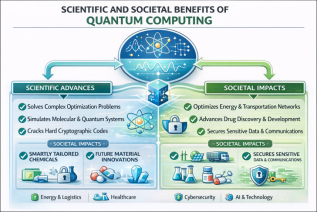
Quantum computing is increasingly being explored across a range of industrial and scientific domains. In quantum chemistry and materials science, quantum algorithms are investigated for strongly correlated systems, reaction mechanisms, and excited-state dynamics as shown in
Figure 3. In logistics and optimization, prototype studies examine scheduling, routing, and portfolio optimization, often in hybrid workflows that combine classical heuristics with quantum subroutines. Financial modeling, risk analysis, and quantum machine learning are also active areas of exploration, though results remain largely exploratory. Importantly, most applications during this period remain at the proof-of-concept or benchmarking stage, with limited demonstrated advantage over classical methods. Nevertheless, these studies play a crucial role in identifying realistic use cases, guiding hardware algorithm co-design, and preparing industry for future fault-tolerant quantum systems
| [30] | J. R. McClean et al., Theory of variational hybrid quantum-classical algorithms, New Journal of Physics, 2016, 18, 023023. https://doi.org/10.1088/1367-2630/18/2/023023 |
| [31] | M. Cerezo et al., Variational quantum algorithms, Nature Reviews Physics, 2021, 3, 625-644.
https://doi.org/10.1038/s42254-021-00348-9 |
| [32] | J. Tilly et al., The variational quantum eigensolver: Methods and best practices, Physics Reports, 2022.
https://doi.org/10.1016/j.physrep.2022.08.003 |
| [33] | K. Blekos et al., Review of the Quantum Approximate Optimization Algorithm, Physics Reports, 2024, 1068, 1-66. https://doi.org/10.1016/j.physrep.2024.03.002 |
[30-33]
.
Figure 3. Scientific and societal benefits of quantum computing.
5. A Modern View of Quantum Science
Across quantum physics, quantum chemistry, and quantum computing, persistent myths often arise from oversimplified metaphors, popular narratives, and inflated expectations rather than from deficiencies in the underlying science. While quantum theory fundamentally departs from classical intuition, it remains one of the most mathematically rigorous and experimentally validated frameworks in modern science. Its predictions are quantitatively precise, reproducible, and embedded in technologies that shape everyday life. Recognizing both the capabilities and the inherent limitations of quantum science is therefore essential for responsible scientific communication, educational practice, and evidence-based policy making.
Quantum chemistry occupies a particularly central and integrative role within this landscape. By translating quantum mechanical principles into chemically meaningful models, it bridges theory and experiment and enables predictive understanding of molecular structure, reactivity, and material properties. The field has matured into a practical discipline underpinning advances in catalysis, drug discovery, energy materials, and spectroscopy. Recent developments at the interface with quantum computing and machine learning signal new horizons, not as disruptive replacements, but as complementary tools that extend the reach of established electronic-structure methods. Despite common misconceptions, the continued success and expanding applications of quantum chemistry clearly demonstrate its practical relevance and scientific reliability.
Many misconceptions surrounding quantum physics originate from metaphorical explanations such as particles “being in two places at once” or observation “creating reality” that are intended to simplify abstract concepts. While pedagogically useful, such metaphors can obscure the precise mathematical and operational meaning of quantum theory when interpreted literally. Contemporary research, supported by high-precision experiments and technological implementations, shows that quantum physics is neither mystical nor speculative. Instead, it is a predictive, testable, and indispensable framework that accurately describes nature at microscopic scales and reliably informs engineering and technological innovation.
A similar gap between public expectations and technical reality has fueled myths around quantum computing. Breakthroughs in hardware, algorithms, and error mitigation are real and scientifically significant, yet practical quantum advantage remains limited to specific problem classes and constrained by current hardware capabilities. Overstated claims of imminent, universal superiority risk undermining scientific credibility and public trust. A fact-based understanding—grounded in realistic benchmarks, transparent limitations, and reproducible results is crucial for policymakers, researchers, and industry stakeholders when making informed decisions about investment strategies, workforce development, and long-term application planning.
In summary, quantum science is best understood not as a realm of paradox or hype, but as a mature, evolving body of knowledge whose power lies in its rigor, experimental grounding, and careful integration with classical methods Dispelling myths requires clear communication, conceptual precision, and an honest appraisal of both achievements and challenges. Such an approach ensures that quantum physics, chemistry, and computing continue to advance responsibly, delivering genuine scientific and societal benefits
| [33] | K. Blekos et al., Review of the Quantum Approximate Optimization Algorithm, Physics Reports, 2024, 1068, 1-66. https://doi.org/10.1016/j.physrep.2024.03.002 |
| [50] | P. Lolur et al., Reference-state error mitigation, Journal of Chemical Theory and Computation, 2023.
https://doi.org/10.1021/acs.jctc.2c00807 |
| [51] | E. Farhi et al., Quantum approximate optimization algorithm, Quantum, 2022. https://doi.org/10.22331/q-2022-07-07-759 |
| [52] | B. Domokos et al., Characterization of errors in lattice surgery, Quantum, 2024. https://doi.org/10.22331/q-2024-12-27-1577 |
| [53] | P. Mohammadipour et al., Direct analysis of zero-noise extrapolation, Quantum, 2025.
https://doi.org/10.22331/q-2025-11-14-1909 |
[33, 50-53]
.
6. Future Outlook
The future of quantum science will be shaped by a continued emphasis on realism, integration, and responsible communication, rather than by speculative promises. In quantum physics, ongoing advances in precision measurement, quantum sensing, and foundational tests will further refine our understanding of coherence, entanglement, and decoherence across increasingly complex and macroscopic systems. These efforts are expected to deepen the connection between fundamental theory and practical technologies, reinforcing quantum mechanics as a predictive and experimentally grounded framework rather than an interpretive or philosophical abstraction.
Quantum chemistry is poised to play an increasingly central role in this evolution. Improvements in classical high-performance computing, combined with methodological advances in multireference theory, embedding techniques, and machine-learning-assisted electronic structure methods, will enable accurate simulations of chemically and biologically relevant systems at unprecedented scales. Rather than being displaced, established quantum chemical methods will be extended through hybrid paradigms, where quantum computing acts as a targeted accelerator for strongly correlated subproblems. This complementary integration is expected to deliver gradual but meaningful gains in catalysis, materials discovery, and molecular design, firmly anchored in experimental validation.
Quantum computing will continue to mature through steady progress in hardware scalability, error mitigation, and fault-tolerant architectures. In the near to medium term, realistic impact is most likely to arise from hybrid quantum–classical workflows, domain-specific algorithms, and tightly benchmarked applications in chemistry, optimization, and simulation. At the same time, post-quantum cryptography, quantum communication, and quantum sensing will advance in parallel, ensuring that quantum technologies are deployed responsibly and securely. Crucially, distinguishing achievable milestones from long-term goals will remain essential for maintaining scientific credibility and informed policy decisions.
Overall, the future of quantum science lies not in revolutionary disruption driven by hype, but in incremental, interdisciplinary progress grounded in theory, computation, and experiment. By clearly separating facts from myths and aligning expectations with demonstrable capabilities, the quantum physics, quantum chemistry, and quantum computing communities can collectively ensure that quantum science continues to deliver genuine scientific, technological, and societal benefits in the decades ahead.
7. Conclusions
1) Quantum science is neither mystical nor speculative; it is a mature, predictive, and application-driven scientific framework built upon rigorous mathematical foundations and extensive experimental validation. Quantum physics provides the fundamental laws governing microscopic phenomena, quantum chemistry translates these laws into a quantitative understanding of molecular structure and reactivity, and quantum computing extends quantum principles into new computational paradigms. Dispelling misconceptions is essential to accurately assess the true impact of quantum science and to ensure its responsible advancement across physics, chemistry, materials science, and information technology.
2) Quantum chemistry stands out as a robust and experimentally grounded discipline that bridges theory and experiment with remarkable success. Its predictive capabilities underpin progress in catalysis, drug discovery, materials design, spectroscopy, and energy research. Persistent myths often arising from oversimplified interpretations of quantum behavior can obscure the discipline’s methodological rigor and practical reliability. As classical computational resources continue to improve and hybrid quantum classical approaches mature, quantum chemistry is poised to further expand its influence, enabling increasingly accurate simulations of complex molecular and condensed-phase systems across scientific domains.
3) Quantum physics itself is neither incomplete nor conceptually vague. It remains one of the most thoroughly tested theories in science, offering extraordinary explanatory and predictive power over an unparalleled range of phenomena. Distinguishing well-established physical principles from speculative interpretations is critical for accurate scientific communication, effective education, and the responsible development of emerging quantum technologies. As quantum-enabled applications become more prominent, a clear and evidence-based understanding of quantum principles will be increasingly important for researchers, educators, and policymakers alike.
4) Quantum computing represents a fundamental shift in computational science, grounded firmly in established quantum mechanics. At the same time, it is neither a universal replacement for classical computing nor a solution to all computational challenges. By clearly separating verified capabilities from exaggerated claims, this review emphasizes that quantum computing is a powerful yet specialized technology, whose most impactful applications are problem-specific and currently constrained by hardware and noise limitations. Its full potential will emerge gradually through sustained advances in qubit hardware, error correction, algorithm design, and hybrid integration with classical systems.
5) In summary, separating facts from myths across quantum physics, quantum chemistry, and quantum computing is essential for maintaining scientific credibility and guiding realistic expectations. A balanced, evidence-based perspective ensures that quantum science continues to evolve as a transformative, yet disciplined, enterprise—delivering genuine technological and societal benefits through careful theory, experimentation, and engineering.
Abbreviations
CI | Configuration Interaction |
CC | Coupled Cluster |
DFT | Density Functional Theory |
DMET | Density Matrix Embedding Theory |
EPR | Einstein–Podolsky–Rosen |
HF | Hartree–Fock |
ML | Machine Learning |
MP2 | Møller–Plesset Perturbation Theory (Second Order) |
MRI | Magnetic Resonance Imaging |
NISQ | Noisy Intermediate-Scale Quantum |
NMR | Nuclear Magnetic Resonance |
NV | Nitrogen Vacancy |
PQC | Post-Quantum Cryptography |
QAOA | Quantum Approximate Optimization Algorithm |
QKD | Quantum Key Distribution |
QM/MM | Quantum Mechanics/Molecular Mechanics |
QSCI | Quantum-Selected Configuration Interaction |
STM | Scanning Tunneling Microscopy |
VQE | Variational Quantum Eigensolver |
Acknowledgments
The author is deeply grateful to Almighty God and my parents for the wisdom, grace, and strength to complete this manuscript. Special thanks are extended to Dr. M. Sasidhar- Principal, Dr. K. Sai Manoj- CEO, Sri K. Rama Mohana Rao- Secretary and Correspondent, Sri K. Lakshmi Karthik- President, and Sri K. Ramesh Babu- Industrialist and Chairman of Amrita Sai Institute of Science and Technology, whose Candor, patience, understanding, and constant encouragement have been a source of inspiration throughout this challenging journey of writing the manuscript. The author also gratefully acknowledges the support and cooperation of all the members of the S&H and CRT departments.
Author Contributions
Ravuri Hema Krishna is the sole author. The author read and approved the final manuscript
Conflicts of Interest
The authors declare no conflicts of interest.
References
| [1] |
M. Planck, On the law of distribution of energy in the normal spectrum, Annalen der Physik, 1901, 4, 553-563.
https://doi.org/10.1002/andp.19013221004
|
| [2] |
A. Einstein, On a heuristic viewpoint concerning the production and transformation of light, Annalen der Physik, 1905, 17, 132-148.
https://doi.org/10.1002/andp.19053220607
|
| [3] |
E. Schrödinger, Quantisation as an eigenvalue problem, Annalen der Physik, 1926, 79, 361-376.
https://doi.org/10.1002/andp.19263840404
|
| [4] |
W. Heitler, F. London, Interaction of neutral atoms, ZeitschriftfürPhysik, 1927, 44, 455-472.
https://doi.org/10.1007/BF01397394
|
| [5] |
A. Szabo, N. S. Ostlund, Modern Quantum Chemistry, Dover Publications, New York, 1996.
|
| [6] |
R. G. Parr, W. Yang, Density-Functional Theory of Atoms and Molecules, Oxford University Press, 1989.
https://doi.org/10.1093/oso/9780195092769.001.0001
|
| [7] |
R. P. Feynman, Simulating physics with computers, International Journal of Theoretical Physics, 1982, 21, 467-488.
https://doi.org/10.1007/BF02650179
|
| [8] |
P. W. Shor, Algorithms for quantum computation: Discrete logarithms and factoring, Proceedings of the 35th Annual Symposium on Foundations of Computer Science, 1994, 124-134.
https://doi.org/10.1109/SFCS.1994.365700
|
| [9] |
M. A. Nielsen, I. L. Chuang, Quantum Computation and Quantum Information, Cambridge University Press, 2010.
https://doi.org/10.1017/CBO9780511976667
|
| [10] |
J. S. Bell, On the Einstein Podolsky Rosen paradox, Physics Physique Fizika, 1964, 1, 195-200.
https://doi.org/10.1103/PhysicsPhysiqueFizika.1.195
|
| [11] |
S. Aaronson, Quantum Computing Since Democritus, Cambridge University Press, 2013.
https://doi.org/10.1017/CBO9780511979309
|
| [12] |
F. Arute et al., Quantum supremacy using a programmable superconducting processor, Nature, 2019, 574, 505-510.
https://doi.org/10.1038/s41586-019-1666-5
|
| [13] |
J. Preskill, Quantum computing in the NISQ era, Quantum, 2018, 2, 79.
https://doi.org/10.22331/q-2018-08-06-79
|
| [14] |
Y. Cao et al., Quantum chemistry in the age of quantum computing, Chemical Reviews, 2019, 119, 10856-10915.
https://doi.org/10.1021/acs.chemrev.8b00803
|
| [15] |
A. Aspuru-Guzik et al., Simulated quantum computation of molecular energies, Science, 2005, 309, 1704-1707.
https://doi.org/10.1126/science.1113479
|
| [16] |
A. Peruzzo et al., A variational eigenvalue solver on a photonic quantum processor, Nature Communications, 2014, 5, 4213.
https://doi.org/10.1038/ncomms5213
|
| [17] |
H. Haken, H. C. Wolf, The Physics of Atoms and Quanta, Springer, 2005.
https://doi.org/10.1007/978-3-642-18120-3
|
| [18] |
C. Davisson, L. H. Germer, Reflection of electrons by a crystal of nickel, Physical Review, 1927, 30, 705-740.
https://doi.org/10.1103/PhysRev.30.705
|
| [19] |
A. Aspect, P. Grangier, G. Roger, Experimental tests of realistic local theories, Physical Review Letters, 1981, 47, 460-463.
https://doi.org/10.1103/PhysRevLett.47.460
|
| [20] |
B. Hensen et al., Loophole-free Bell inequality violation, Nature, 2015, 526, 682-686.
https://doi.org/10.1038/nature15759
|
| [21] |
J. F. Clauser, A. Shimony, Bell’s theorem, Reports on Progress in Physics, 1978, 41, 1881-1927.
https://doi.org/10.1088/0034-4885/41/12/002
|
| [22] |
K. Burke, Perspective on density functional theory, Journal of Chemical Physics, 2012, 136, 150901.
https://doi.org/10.1063/1.4704546
|
| [23] |
R. J. Bartlett, M. Musiał, Coupled-cluster theory, Reviews of Modern Physics, 2007, 79, 291-352.
https://doi.org/10.1103/RevModPhys.79.291
|
| [24] |
B. O. Roos, Multiconfigurational quantum chemistry, Advances in Chemical Physics, 1987, 69, 399-445.
https://doi.org/10.1002/9780470142943.ch7
|
| [25] |
H. M. Senn, W. Thiel, QM/MM methods, AngewandteChemie International Edition, 2009, 48, 1198-1229.
https://doi.org/10.1002/anie.200802019
|
| [26] |
L. K. Grover, A fast quantum mechanical algorithm for database search, Physical Review Letters, 1997, 79, 325-328.
https://doi.org/10.1103/PhysRevLett.79.325
|
| [27] |
E. Knill et al., Randomized benchmarking, Physical Review A, 2008, 77, 012307.
https://doi.org/10.1103/PhysRevA.77.012307
|
| [28] |
K. Temme et al., Error mitigation for short-depth quantum circuits, Physical Review Letters, 2017, 119, 180509.
https://doi.org/10.1103/PhysRevLett.119.180509
|
| [29] |
S. Boixo et al., Characterizing quantum supremacy, Nature Physics, 2018, 14, 595-600.
https://doi.org/10.1038/s41567-018-0124-x
|
| [30] |
J. R. McClean et al., Theory of variational hybrid quantum-classical algorithms, New Journal of Physics, 2016, 18, 023023.
https://doi.org/10.1088/1367-2630/18/2/023023
|
| [31] |
M. Cerezo et al., Variational quantum algorithms, Nature Reviews Physics, 2021, 3, 625-644.
https://doi.org/10.1038/s42254-021-00348-9
|
| [32] |
J. Tilly et al., The variational quantum eigensolver: Methods and best practices, Physics Reports, 2022.
https://doi.org/10.1016/j.physrep.2022.08.003
|
| [33] |
K. Blekos et al., Review of the Quantum Approximate Optimization Algorithm, Physics Reports, 2024, 1068, 1-66.
https://doi.org/10.1016/j.physrep.2024.03.002
|
| [34] |
Z. Cai, Quantum error mitigation, Reviews of Modern Physics, 2023, 95, 045005.
https://doi.org/10.1103/RevModPhys.95.045005
|
| [35] |
A. Mari, Extending quantum probabilistic error cancellation, Physical Review A, 2021, 104, 052607.
https://doi.org/10.1103/PhysRevA.104.052607
|
| [36] |
R. S. Gupta et al., Probabilistic error cancellation for dynamic quantum circuits, Physical Review A, 2024, 109, 062617.
https://doi.org/10.1103/PhysRevA.109.062617
|
| [37] |
A. Zhang et al., Demonstrating quantum error mitigation on logical qubits, Nature Communications, 2025, 16.
https://doi.org/10.1038/s41467-025-67768-4
|
| [38] |
Google Quantum AI et al., Quantum error correction below the surface code threshold, Nature, 2025, 638, 920-926.
https://doi.org/10.1038/s41586-024-08449-y
|
| [39] |
Google Quantum AI, Suppressing quantum errors by scaling a surface code logical qubit, Nature, 2023, 614, 676-681.
https://doi.org/10.1038/s41586-022-05434-1
|
| [40] |
L. Henriet et al., Quantum computing with neutral atoms, Quantum, 2020, 4, 327.
https://doi.org/10.22331/q-2020-09-21-327
|
| [41] |
C. L. Morrison et al., Single-emitter quantum key distribution over 175 km of fiber, Nature Communications, 2023, 14.
https://doi.org/10.1038/s41467-023-39219-5
|
| [42] |
M. Geng et al., Advances of quantum key distribution and network, Entropy, 2025, 27, 950.
https://doi.org/10.3390/e27090950
|
| [43] |
Y. A. Yang et al., Clock precision beyond the standard quantum limit, Physical Review Letters, 2025.
https://doi.org/10.1103/6v93-whwq
|
| [44] |
A. Aeppli et al., Optical lattice clock with uncertainty at the 10⁻¹⁹ level, Physical Review Letters, 2024, 133, 023401.
https://doi.org/10.1103/PhysRevLett.133.023401
|
| [45] |
V. Montenegro et al., Quantum metrology and sensing with many-body systems, Physics Reports, 2025.
https://doi.org/10.1016/j.physrep.2025.05.005
|
| [46] |
L. Fiedler et al., Machine learning density functional theory, Physical Review Materials, 2022, 6, 040301.
https://doi.org/10.1103/PhysRevMaterials.6.040301
|
| [47] |
S. Li et al., Synergy of machine learning and density functional theory, Materials Today, 2024.
https://doi.org/10.1016/j.mattod.2024.02.xxx
|
| [48] |
C. Ezeakunne et al., Integrating DFT with machine learning workflows, Physical Chemistry Chemical Physics, 2025.
https://doi.org/10.1039/D4CP03397C
|
| [49] |
E. R. Kjellgren, et al., VQE-SCF with polarizable embedding, Journal of Chemical Physics, 2024, 160, 124114.
https://doi.org/10.1063/5.0191106
|
| [50] |
P. Lolur et al., Reference-state error mitigation, Journal of Chemical Theory and Computation, 2023.
https://doi.org/10.1021/acs.jctc.2c00807
|
| [51] |
E. Farhi et al., Quantum approximate optimization algorithm, Quantum, 2022.
https://doi.org/10.22331/q-2022-07-07-759
|
| [52] |
B. Domokos et al., Characterization of errors in lattice surgery, Quantum, 2024.
https://doi.org/10.22331/q-2024-12-27-1577
|
| [53] |
P. Mohammadipour et al., Direct analysis of zero-noise extrapolation, Quantum, 2025.
https://doi.org/10.22331/q-2025-11-14-1909
|
| [54] |
N. N. Nyangiwe et al., DFT and machine learning applications, Results in Engineering, 2025.
|
| [55] |
A. Jain, Machine learning in materials research, Current Opinion in Solid State and Materials Science, 2024.
|
| [56] |
NIST, NIST releases first post-quantum encryption standards (FIPS 203/204/205), 2024.
|
| [57] |
NIST, NIST IR 8547: Post-Quantum Cryptography Standards, 2024.
|
| [58] |
T. He et al., Experimental quantum error correction below the surface code threshold, APS, 2025.
https://doi.org/10.1103/rqkg-dw31
|
| [59] |
T. R. Jin et al., Noisy probabilistic error cancellation, Communications Physics, 2025.
https://doi.org/10.1038/s42005-025-02217-8
|
| [60] |
E. Pelofske et al., Increasing effective quantum volume, ACM Transactions on Quantum Computing, 2024.
https://doi.org/10.1145/3680290
|
| [61] |
T. Giurgica-Tiron et al., Digital zero-noise extrapolation, IEEE International Conference on Quantum Computing and Engineering, 2020.
https://doi.org/10.1109/QCE49297.2020.00045
|
| [62] |
A. Aspuru-Guzik, Quantum chemistry in the age of quantum computing, Chemical Reviews, 2019, 119, 10856-10915.
https://doi.org/10.1021/acs.chemrev.8b00803
|
Cite This Article
-
APA Style
Krishna, R. H. (2026). Quantum Science Beyond the Hype: Facts, Myths, and Realistic Progress in Physics, Chemistry, and Computing. International Journal of Computational and Theoretical Chemistry, 14(1), 1-14. https://doi.org/10.11648/j.ijctc.20261401.11
 Copy
|
Copy
|
 Download
ACS Style
Krishna, R. H. Quantum Science Beyond the Hype: Facts, Myths, and Realistic Progress in Physics, Chemistry, and Computing. Int. J. Comput. Theor. Chem. 2026, 14(1), 1-14. doi: 10.11648/j.ijctc.20261401.11
Copy
|
Download
AMA Style
Krishna RH. Quantum Science Beyond the Hype: Facts, Myths, and Realistic Progress in Physics, Chemistry, and Computing. Int J Comput Theor Chem. 2026;14(1):1-14. doi: 10.11648/j.ijctc.20261401.11
Copy
|
Download
-
@article{10.11648/j.ijctc.20261401.11,
  author = {Ravuri Hema Krishna},
  title = {Quantum Science Beyond the Hype: Facts, Myths, and Realistic Progress in Physics, Chemistry, and Computing},
  journal = {International Journal of Computational and Theoretical Chemistry},
  volume = {14},
  number = {1},
  pages = {1-14},
  doi = {10.11648/j.ijctc.20261401.11},
  url = {https://doi.org/10.11648/j.ijctc.20261401.11},
  eprint = {https://article.sciencepublishinggroup.com/pdf/10.11648.j.ijctc.20261401.11},
  abstract = {Quantum science underpins many of the most significant advances in modern physics, chemistry, and information technology. Quantum physics provides the fundamental laws governing matter and energy at microscopic scales, quantum chemistry applies these principles to explain molecular structure, bonding, and reactivity, and quantum computing seeks to exploit quantum phenomena such as superposition and entanglement to enable new computational paradigms. Despite their long-standing theoretical foundations and experimental successes, all three domains remain surrounded by persistent misconceptions, often amplified by abstract formalisms, popular science narratives, and rapid technological developments. This contemporary review critically examines the established facts and common myths associated with quantum physics, quantum chemistry, and quantum computing. Emphasis is placed on experimentally verified principles, computational feasibility, and realistic assessments of current capabilities. Recent advances reported between 2020 and 2025 are reviewed to highlight genuine progress in areas such as quantum simulations, molecular modeling, and noisy intermediate-scale quantum (NISQ) devices, while also addressing their practical limitations. By distinguishing validated achievements from speculative claims, this review provides a balanced, evidence-based perspective on modern quantum science. The article aims to clarify enduring misconceptions, promote conceptual clarity across disciplines, and outline realistic future directions for research and applications in quantum technologies.},
 year = {2026}
}
Copy
|
Download
-
TY  - JOUR
T1  - Quantum Science Beyond the Hype: Facts, Myths, and Realistic Progress in Physics, Chemistry, and Computing
AU  - Ravuri Hema Krishna
Y1  - 2026/02/25
PY  - 2026
N1  - https://doi.org/10.11648/j.ijctc.20261401.11
DO  - 10.11648/j.ijctc.20261401.11
T2  - International Journal of Computational and Theoretical Chemistry
JF  - International Journal of Computational and Theoretical Chemistry
JO  - International Journal of Computational and Theoretical Chemistry
SP  - 1
EP  - 14
PB  - Science Publishing Group
SN  - 2376-7308
UR  - https://doi.org/10.11648/j.ijctc.20261401.11
AB  - Quantum science underpins many of the most significant advances in modern physics, chemistry, and information technology. Quantum physics provides the fundamental laws governing matter and energy at microscopic scales, quantum chemistry applies these principles to explain molecular structure, bonding, and reactivity, and quantum computing seeks to exploit quantum phenomena such as superposition and entanglement to enable new computational paradigms. Despite their long-standing theoretical foundations and experimental successes, all three domains remain surrounded by persistent misconceptions, often amplified by abstract formalisms, popular science narratives, and rapid technological developments. This contemporary review critically examines the established facts and common myths associated with quantum physics, quantum chemistry, and quantum computing. Emphasis is placed on experimentally verified principles, computational feasibility, and realistic assessments of current capabilities. Recent advances reported between 2020 and 2025 are reviewed to highlight genuine progress in areas such as quantum simulations, molecular modeling, and noisy intermediate-scale quantum (NISQ) devices, while also addressing their practical limitations. By distinguishing validated achievements from speculative claims, this review provides a balanced, evidence-based perspective on modern quantum science. The article aims to clarify enduring misconceptions, promote conceptual clarity across disciplines, and outline realistic future directions for research and applications in quantum technologies.
VL  - 14
IS  - 1
ER  -
Copy
|
Download





 Share This Article
 Twitter
 Linked In
 Facebook