Abstract
Women’s entrepreneurship represents a significant driver of economic, social, and technological development. However, female entrepreneurs often face structural, social, and contextual barriers that limit their access to resources, professional networks, and entrepreneurial opportunities. To address these challenges, this study adopts an integrative literature review and conceptual synthesis to examine how digital support mechanisms can be designed to better meet the specific needs of women entrepreneurs. Based on the analysis of prior research, the study develops an integrative conceptual framework linking women entrepreneurs’ individual and contextual characteristics with four key digital support mechanisms: modular digital training, personalized mentoring, specialized digital platforms, and inclusive virtual communities. The framework highlights the role of moderating factors such as personalization, accessibility, continuous support, and participatory feedback in shaping the effectiveness of these mechanisms. By emphasizing a user-centered socioconstructivist perspective, the model explains how digital mechanisms can foster skill development, entrepreneurial empowerment, and the expansion of digital social capital. The study provides a theoretical contribution by integrating fragmented research streams on women’s entrepreneurship and digital support mechanisms, while also offering practical implications for policymakers and entrepreneurial support organizations seeking to design more inclusive and effective digital support programs.
Keywords
Women Entrepreneurship, Digital Support, Mentoring, Virtual Communities, Empowerment
1. Introduction
Women’s entrepreneurship plays a decisive role in the economic, social, and technological development of contemporary societies. Beyond job creation and the stimulation of economic growth, it contributes to the diversification of business models and to digital inclusion by facilitating women’s access to tools, knowledge, and professional networks that were previously less accessible
| [1] | Ahl, H. (2006). Why research on women entrepreneurs needs new directions. Entrepreneurship Theory and Practice, 30(5), 595–621.
https://doi.org/10.1111/j.1540-6520.2006.00138.x |
| [4] | Brush, C. G., Carter, N., Gatewood, E., Greene, P., & Hart, M. (2009). Gatekeepers of venture growth: A Diana project report on the role and participation of women in the venture capital industry. Babson College. |
[1, 4]
. In this context, digital support mechanisms emerge as a strategic response to overcome some of the structural limitations associated with women’s entrepreneurship. These mechanisms enable women entrepreneurs to benefit from flexible and modular training, centralized access to resources, and remote mentoring opportunities. However, their effectiveness cannot be fully understood without considering the specific constraints that shape women’s entrepreneurial trajectories. Among these, the double burden of professional and family responsibilities constitutes a major factor, reducing the time available for training and business development. In addition, gender stereotypes and sociocultural biases may limit access to funding, networks, and professional recognition, thereby directly affecting women’s ability to benefit from conventional digital support mechanisms
| [17] | Hilbert, M. (2011). Digital gender divide or technologically empowered women in developing countries? World Development, 39(6), 999–1006.
https://doi.org/10.1016/j.wsif.2011.07.001 |
| [28] | Ghezzi, A., & Cavallo, A. (2020). Agile business model innovation in digital entrepreneurship: Lean startup approaches. Journal of business research, 110, 519-537.
https://doi.org/10.1016/j.jbusres.2018.06.013 |
| [31] | UN Women. (2022). Women’s economic empowerment: Global trends and policy directions. New York, NY: United Nations Entity for Gender Equality and the Empowerment of Women. |
[17, 28, 31]
. These challenges highlight the importance of designing support mechanisms that account for both the personal and professional realities of women entrepreneurs.
The existing literature extensively documents the potential of digital mechanisms to enhance entrepreneurial competencies and foster innovation. Online training programs, specialized platforms, and virtual communities have demonstrated their capacity to offer flexible learning pathways, develop digital skills, and create essential support networks for women entrepreneurs
| [12] | De Vita, L., Mari, M., & Poggesi, S. (2014). Women entrepreneurs in and from developing countries: Evidences from the literature. European Management Journal, 32(3), 451–460.
https://doi.org/10.1016/j.emj.2013.07.009 |
| [26] | Minniti, M., & Naudé, W. (2010). What do we know about the patterns and determinants of female entrepreneurship across countries? European Journal of Development Research, 22(3), 277–293. https://doi.org/10.1057/ejdr.2010.17 |
| [30] | Svahn, S., Mathiassen, L., & Lindgren, R. (2017). Embracing digital innovation in incumbent firms: How Volvo Cars managed competing concerns. MIS Quarterly, 41(1), 239–253.
https://doi.org/10.25300/MISQ/2017/41.1.12 |
[12, 26, 30]
. At the same time, research has identified specific constraints affecting women, such as lower levels of entrepreneurial experience, limited managerial training, and the influence of sociocultural norms on their perceived legitimacy in certain economic sectors
| [1] | Ahl, H. (2006). Why research on women entrepreneurs needs new directions. Entrepreneurship Theory and Practice, 30(5), 595–621.
https://doi.org/10.1111/j.1540-6520.2006.00138.x |
| [4] | Brush, C. G., Carter, N., Gatewood, E., Greene, P., & Hart, M. (2009). Gatekeepers of venture growth: A Diana project report on the role and participation of women in the venture capital industry. Babson College. |
[1, 4]
. These studies emphasize that the effectiveness of digital mechanisms lies not only in their existence but also in their alignment with the needs, contexts, and individual characteristics of participants. Recent empirical studies, for instance, show that modular training structures, personalized mentoring, and the creation of inclusive spaces are essential to foster the appropriation of digital tools and entrepreneurial empowerment
| [9] | Cherie Blair Foundation. (2024). Annual report: Empowering women entrepreneurs worldwide. London, UK: Cherie Blair Foundation for Women. |
| [21] | Sharma, N., Sinha, E., & Shalender, K. (2024). Espoused model of women entrepreneurship: antecedents to women entrepreneurial intention and moderating role of entrepreneurial self-efficacy. Journal of Enterprising Communities: People and Places in the Global Economy, 18(5), 881-901.
https://doi.org/10.1108/JEC-01-2023-0011 |
[9, 21]
. Thus, while the literature identifies key drivers of effectiveness, it remains partially fragmented when it comes to systematically linking the individual and contextual profiles of women entrepreneurs to the design of digital mechanisms.
Despite these contributions, several gaps remain. Existing research tends to treat digital mechanisms and their beneficiaries as homogeneous, thereby underestimating the diversity of profiles and needs among women entrepreneurs. Such an approach risks overlooking critical factors, including time flexibility adapted to family constraints, the personalization of content for specific sectors or levels of experience, and the secure and inclusive design of digital platforms to overcome sociocultural biases. By neglecting these dimensions, digital mechanisms are likely to generate only limited impact on skills appropriation, innovation, and the sustainable structuring of enterprises. Furthermore, few studies adopt an integrated perspective to examine how the individual and contextual characteristics of women entrepreneurs interact with digital mechanisms to influence the actual effectiveness of support. This gap calls for a more comprehensive reflection on the relationship between beneficiaries’ profiles, specific needs, and the design of digital support mechanisms.
To address these issues, this study raises the following central research question:
“How do the characteristics and specific needs of women entrepreneurs influence the design and effectiveness of digital support mechanisms?”
The proposed response is grounded in an integrative conceptual framework that connects four main dimensions: digital training, mentoring, specialized platforms, and virtual communities. The underlying mechanism relies on a user-centered socioconstructivist approach, which considers flexibility, personalization, digital inclusion, and continuous support as key levers for transforming digital mechanisms into effective tools for entrepreneurial development. Concretely, this approach enables women entrepreneurs to mobilize both technical and strategic competencies, structure their business models, expand their digital social capital, and enhance their autonomy and resilience. By integrating individual and contextual characteristics into the design of support mechanisms, the proposed model illustrates how digitalization extends beyond a mere technical tool to become a structuring context capable of reshaping women’s entrepreneurial trajectories. Methodologically, the study adopts an integrative literature review and conceptual synthesis of prior research on women’s entrepreneurship and digital support mechanisms in order to develop and articulate the proposed conceptual framework.
2. Characteristics and Specific Needs of Women Entrepreneurs
The characteristics and specific needs of women entrepreneurs constitute essential determinants for the design and effectiveness of digital support mechanisms. Individual profiles, shaped by varying levels of education, experience, and personal responsibilities, interact with contextual and sociocultural factors such as gender norms, stereotypes, and family constraints to generate distinct learning and support needs. Understanding these dimensions provides guidance for the selection of formats, content, and support modalities, ensuring that digital mechanisms deliver tailored and effective responses capable of enhancing women’s autonomy, confidence, and entrepreneurial resilience.
Although prior studies have examined various aspects of women’s entrepreneurship and digital support, the existing literature remains fragmented, often addressing training, mentoring, digital platforms, or networks separately. This fragmentation reveals a synthesis gap regarding how these mechanisms interact and collectively respond to the specific needs of women entrepreneurs. The present study seeks to address this gap by integrating these dimensions into a coherent analytical framework linking entrepreneurs’ characteristics, contextual constraints, and digital support mechanisms.
2.1. Individual Factors
The individual characteristics of women entrepreneurs directly shape their needs in terms of digital support. Many of them are relatively young and possess a high level of education; however, as observed by Itani et al.
| [19] | Itani, H., Sidani, Y., & Baalbaki, I. (2011). The impact of network ties and entrepreneurial orientation on Lebanese women entrepreneurs’ success. Equality, Diversity and Inclusion, 30(5), 409–424.
https://doi.org/10.1108/02610151111150654 |
[19]
and Carrington
| [2] | Agrawal, S., & Agrawal, R. (2023). Female entrepreneurship motivational factors: Analysing effect through the conceptual competency-based framework. International Journal of Entrepreneurship and Small Business, 49(3), 350–373.
https://doi.org/10.1504/IJESB.2023.132525 |
[2]
their managerial training often remains limited and their entrepreneurial experience comparatively lower. This situation requires digital support mechanisms to move beyond the mere transmission of technical knowledge and to incorporate modular and flexible learning pathways, accessible via mobile devices and in asynchronous formats, thereby enabling progressive learning compatible with their professional and family commitments
| [34] | World Bank Group. (2022). Women, business and the law 2022: Unlocking economic opportunities for women. Washington, DC: World Bank. |
[34]
.
The double burden of professional and family responsibilities represents another determining factor. As highlighted by Brush et al.
| [4] | Brush, C. G., Carter, N., Gatewood, E., Greene, P., & Hart, M. (2009). Gatekeepers of venture growth: A Diana project report on the role and participation of women in the venture capital industry. Babson College. |
[4]
, domestic and parental responsibilities reduce the time and energy that women entrepreneurs can devote to training and business development. In this context, targeted digital mentoring, combining both emotional and strategic support, proves crucial in strengthening entrepreneurs’ confidence and facilitating the appropriation of digital competencies, as emphasized by Lall et al.
| [21] | Sharma, N., Sinha, E., & Shalender, K. (2024). Espoused model of women entrepreneurship: antecedents to women entrepreneurial intention and moderating role of entrepreneurial self-efficacy. Journal of Enterprising Communities: People and Places in the Global Economy, 18(5), 881-901.
https://doi.org/10.1108/JEC-01-2023-0011 |
[21]
. Such mechanisms foster entrepreneurial empowerment by enabling women to experiment with new practices and make informed decisions despite personal constraints.
The concentration of women in traditional sectors, such as services, healthcare, and trade, along with the relatively small size of their businesses, also influences the nature of the required support. Brush et al.
| [4] | Brush, C. G., Carter, N., Gatewood, E., Greene, P., & Hart, M. (2009). Gatekeepers of venture growth: A Diana project report on the role and participation of women in the venture capital industry. Babson College. |
[4]
and Fairlie and Robb
| [16] | Fairlie, R. W., & Robb, A. M. (2009). Gender differences in business performance: Evidence from the Characteristics of Business Owners survey. Small Business Administration.
https://doi.org/10.1007/s11187-009-9207-5 |
[16]
demonstrate that, although these sectors are strategically important for the economy, they often operate with limited resources and therefore require structured support. Centralized digital platforms offer the possibility of integrating tools, resources, and professional networks, enabling women entrepreneurs to organize their activities, optimize management practices, and develop new opportunities, while taking into account sector-specific characteristics and the small scale of their enterprises.
2.2. Contextual and Sociocultural Factors
Contextual and sociocultural factors further amplify these specific needs. Gender norms and stereotypes, as documented by Ahl
and De Bruin et al.
, limit women’s access to financial resources, professional networks, and market opportunities, sometimes reducing their perceived legitimacy in certain sectors. To overcome these barriers, digital support mechanisms must create inclusive and secure spaces that foster participation, collaboration, and access to specialized mentors. Svahn et al.
| [30] | Svahn, S., Mathiassen, L., & Lindgren, R. (2017). Embracing digital innovation in incumbent firms: How Volvo Cars managed competing concerns. MIS Quarterly, 41(1), 239–253.
https://doi.org/10.25300/MISQ/2017/41.1.12 |
[30]
and the Cherie Blair Foundation
| [9] | Cherie Blair Foundation. (2024). Annual report: Empowering women entrepreneurs worldwide. London, UK: Cherie Blair Foundation for Women. |
[9]
highlight that centralized digital platforms are particularly effective in developing digital social capital and enabling women entrepreneurs to co-construct professional networks.
Moreover, restrictive social expectations, which assign women the majority of domestic and parental responsibilities, influence their entrepreneurial engagement and their ability to participate in training programs. Brush et al.
| [4] | Brush, C. G., Carter, N., Gatewood, E., Greene, P., & Hart, M. (2009). Gatekeepers of venture growth: A Diana project report on the role and participation of women in the venture capital industry. Babson College. |
[4]
show that these constraints reduce women’s availability for entrepreneurial development activities. Digital mechanisms must therefore combine flexibility, modularity, and strategic mentoring to support progressive learning adapted to time constraints. Inclusive virtual communities facilitate the sharing of experiences and the co-creation of opportunities, while providing a safe environment to address gender-related biases and discrimination, as emphasized by Dutta and Mishra
| [13] | Dutta, A., & Mishra, D. (2021). Women entrepreneurs and digital business transformation: Evidence from India. Journal of Small Business Management, 59(S1), 123–144.
https://doi.org/10.17705/1thci.00156 |
[13]
and Boubrik et al.
| [36] | Boubrik, S., Elmaymouni, Y., & Benabdeljalil, R. (2024). Female social entrepreneurship in Moroccan SMEs: A path toward empowerment. International Journal of Social Entrepreneurship and Innovation, 12(2), 45–63. |
[36]
. These digital spaces strengthen resilience, confidence, and the capacity to take calculated risks, while supporting the gradual appropriation of digital tools and the sustainable transformation of business models.
Overall, individual and contextual factors define precise digital support needs. Effective mechanisms must combine flexible and modular training, personalized mentoring that integrates both emotional and strategic support, centralized platforms that aggregate tools and resources, and secure virtual communities that foster exchange, co-creation, and empowerment. This integrative perspective demonstrates that adapting digital mechanisms to personal and sociocultural constraints constitutes a strategic lever for enhancing the autonomy, competitiveness, and resilience of women entrepreneurs.
The analysis of the characteristics and specific needs of women entrepreneurs highlights distinct requirements in terms of support mechanisms. Constraints related to the double burden, levels of experience, and sociocultural contexts directly influence the most appropriate formats and modalities of support. This understanding of participants’ profiles and environments provides the foundation for identifying and designing digital support mechanisms capable of addressing these needs in a targeted manner. It underscores that the effectiveness of support does not lie solely in the availability of digital tools, but in their alignment with the daily realities, professional objectives, and aspirations of women entrepreneurs. From this perspective, the following section examines the typologies of digital mechanisms, exploring how each format can mobilize the resources, competencies, and networks necessary to support the development of women entrepreneurs.
3. Typologies of Digital Support Mechanisms and Their Linkages with Women’s Needs
The typologies of digital support mechanisms constitute the operational infrastructure through which the needs and characteristics of women entrepreneurs can be effectively addressed. These mechanisms include digital training, mentoring programs, specialized platforms, and virtual communities, each playing a complementary role in supporting skill acquisition, the expansion of social capital, and entrepreneurial autonomy. Understanding how each type of mechanism responds to the individual, sectoral, and sociocultural constraints faced by women enables the design of tailored and inclusive digital solutions capable of maximizing the effectiveness of support and fostering entrepreneurial empowerment across diverse contexts.
3.1. Digital Training
Digital training represents a fundamental lever for strengthening the technical and strategic competencies of women entrepreneurs. Minniti and Naudé
| [26] | Minniti, M., & Naudé, W. (2010). What do we know about the patterns and determinants of female entrepreneurship across countries? European Journal of Development Research, 22(3), 277–293. https://doi.org/10.1057/ejdr.2010.17 |
[26]
show that such programs not only facilitate the acquisition of traditional entrepreneurial knowledge but also support the development of skills adapted to digital environments, such as data analysis and the management of digital tools. This approach is particularly relevant for entrepreneurs who possess a high level of education but have limited managerial experience, as observed by Itani et al.
| [19] | Itani, H., Sidani, Y., & Baalbaki, I. (2011). The impact of network ties and entrepreneurial orientation on Lebanese women entrepreneurs’ success. Equality, Diversity and Inclusion, 30(5), 409–424.
https://doi.org/10.1108/02610151111150654 |
[19]
and Carrington
| [2] | Agrawal, S., & Agrawal, R. (2023). Female entrepreneurship motivational factors: Analysing effect through the conceptual competency-based framework. International Journal of Entrepreneurship and Small Business, 49(3), 350–373.
https://doi.org/10.1504/IJESB.2023.132525 |
[2]
. In this context, digital training provides a structured learning framework that compensates for the absence of formal management education.
The flexibility and modularity of training programs are essential to address the time constraints associated with the double burden often faced by women entrepreneurs
| [4] | Brush, C. G., Carter, N., Gatewood, E., Greene, P., & Hart, M. (2009). Gatekeepers of venture growth: A Diana project report on the role and participation of women in the venture capital industry. Babson College. |
[4]
. Wilson et al.
| [35] | Zahara, Z., Ikhsan, Santi, I. N., & Farid. (2023). Entrepreneurial marketing and marketing performance through digital marketing capabilities of SMEs in post-pandemic recovery. Cogent Business & Management, 10(2), 2204592.
https://doi.org/10.1080/23311975.2023.2204592 |
[35]
emphasize that mobile access and asynchronous content allow participants to progress at their own pace, balancing professional commitments with domestic responsibilities. This flexibility also supports the gradual appropriation of digital tools and reduces the risk of disengagement, particularly for those operating in geographical areas with limited access to traditional infrastructures.
Beyond technical skill acquisition, digital training plays a strategic role in fostering autonomy and confidence among women entrepreneurs. By offering contextualized learning pathways adapted to local socio-economic realities and sector-specific characteristics, these programs contribute to transforming entrepreneurial practices, stimulating creativity, and strengthening innovation capacity
| [3] | Brändle, T., Weller, R., & Elfring, T. (2018). I am what I am: How nascent entrepreneurs’ social identity affects their entrepreneurial self-efficacy. Journal of Business Venturing Insights, 9, 17–23. https://doi.org/10.1016/j.jbvi.2017.12.001 |
| [12] | De Vita, L., Mari, M., & Poggesi, S. (2014). Women entrepreneurs in and from developing countries: Evidences from the literature. European Management Journal, 32(3), 451–460.
https://doi.org/10.1016/j.emj.2013.07.009 |
[3, 12]
. This process promotes a more proactive entrepreneurial mindset and prepares women to manage resilient digital business models.
Finally, digital training facilitates the progressive integration of women entrepreneurs into broader digital ecosystems. By combining technical content, practical case studies, and interactions with peers and mentors, these programs create a supportive environment where women can exchange experiences and best practices. This dynamic fosters not only technical learning but also the development of digital social capital, which is crucial for overcoming barriers related to male-dominated traditional networks and gender stereotypes
| [9] | Cherie Blair Foundation. (2024). Annual report: Empowering women entrepreneurs worldwide. London, UK: Cherie Blair Foundation for Women. |
| [34] | World Bank Group. (2022). Women, business and the law 2022: Unlocking economic opportunities for women. Washington, DC: World Bank. |
[9, 34]
.
3.2. Digital Mentoring
Digital mentoring constitutes a complementary tool that is essential for translating acquired knowledge into concrete actions within the business. Brush and Cooper
demonstrate that mentoring enables women to benefit from moral support, which is critical for overcoming psychological barriers and strengthening self-confidence in entrepreneurial environments often dominated by men. Marlow and McAdam
| [24] | Marlow, S., & McAdam, M. (2015). Incubation or induction? Gendered identity work in the context of technology business incubation. Entrepreneurship theory and practice, 39(4), 791-816. https://doi.org/10.1111/etap.1206 |
[24]
highlight that mentoring also facilitates the transfer of practical and strategic skills, ranging from operational management to the integration of digital technologies, while taking into account the specific contexts and constraints of each beneficiary.
At the same time, digital mentoring facilitates the expansion of social capital and reduces entrepreneurial isolation. Mentors act as guides in accessing professional networks and financial resources, which are often difficult for women to reach due to institutional biases and sociocultural norms
| [5] | Brush, C. G., Carter, N. M., Greene, P. G., Hart, M., & Gatewood, E. J. (2019). A gendered look at entrepreneurship ecosystems. Small Business Economics, 53(2), 393–408.
https://doi.org/10.1007/s11187-018-9992-9 |
| [8] | Chag, L., & Bourkha, B. (2025). Vulnerable women entrepreneurs confront structural challenges: An integrated theoretical model for mentorship, networks, and entrepreneurial empowerment. Journal of Economics, Business and Management (SSRJEBM), 2(8). https://doi.org/10.5281/zenodo.17573623 |
| [29] | Pouka Pouka, M. R., & Biwolé, V. O. (2024). Does causal analysis improve the understanding of entrepreneurial support for SME performance?. Journal of Global Entrepreneurship Research, 14(1), 19.
https://doi.org/10.1007/s40497-024-00387-3 |
[5, 8, 29]
. The personalized support provided through mentoring strengthens entrepreneurs’ decision-making autonomy, consolidates their digital strategies, and supports the continuous adaptation of their business models in an ever-evolving digital environment
| [15] | Eesley, C. E., Eberhart, R. N., Skousen, B. R., & Cheng, J. L. C. (2018). Institutions and entrepreneurial activity: The interactive influence of misaligned formal and informal institutions. Strategy Science, 3(2), 393–407.
https://doi.org/10.1287/stsc.2018.0060 |
| [21] | Sharma, N., Sinha, E., & Shalender, K. (2024). Espoused model of women entrepreneurship: antecedents to women entrepreneurial intention and moderating role of entrepreneurial self-efficacy. Journal of Enterprising Communities: People and Places in the Global Economy, 18(5), 881-901.
https://doi.org/10.1108/JEC-01-2023-0011 |
| [23] | Malainine, H., Chag, L., & Bourkha, B. (2025). Contraintes des femmes entrepreneures en situation de vulnérabilité: Analyse des obstacles sociaux, institutionnels et économiques [Challenges facing women entrepreneurs in vulnerable contexts: a critical analysis of social, institutional, and economic barriers]. Journal of Integrated Studies in Economics, Law, Technical Sciences & Communication, 1(1). |
[15, 21, 23]
.
3.3. Specialized Platforms
Specialized digital platforms centralize several key functions—training, management tools, and networking—thereby constituting an integrated ecosystem that responds to the diverse needs of women entrepreneurs. As indicated by Elmaymouni et al.
| [14] | Elmaymouni, Y., Boubrik, S., & Benabdeljalil, R. (2024). Female social entrepreneurship in Morocco: Challenges and pathways. Journal of Entrepreneurship in Emerging Economies, 16(1), 101–120. |
[14]
and UN Women
| [32] | UN Women. (2023). Gender equality in digital entrepreneurship: Progress report. New York, NY: UN Women. |
[32]
, these platforms enable the combination of technical learning, access to adapted tools, and connections with experts and investors, thus compensating for the marginalization that women often experience in traditional male-dominated professional networks.
In addition to centralizing access to resources, these platforms promote digital inclusion by adapting their interfaces to different skill levels and offering multilingual content. Women entrepreneurs can thus navigate more easily between learning, management, and business development, while benefiting from a secure environment to exchange and experiment with new strategies
| [9] | Cherie Blair Foundation. (2024). Annual report: Empowering women entrepreneurs worldwide. London, UK: Cherie Blair Foundation for Women. |
[9]
.
These digital spaces also support the structuring and formalization of business models. By integrating analytical tools, training modules, and expert networks, platforms enable women to plan their operations, measure performance, and adapt their business models to market constraints and digital opportunities
| [7] | Burgess, R., Brixiová, Z., & Cros, M. (2020). Training, human capital, and gender gaps in entrepreneurial performance. Economic Modelling, 85, 367–380.
https://doi.org/10.1016/j.econmod.2019.11.006 |
| [8] | Chag, L., & Bourkha, B. (2025). Vulnerable women entrepreneurs confront structural challenges: An integrated theoretical model for mentorship, networks, and entrepreneurial empowerment. Journal of Economics, Business and Management (SSRJEBM), 2(8). https://doi.org/10.5281/zenodo.17573623 |
[7, 8]
. This systemic integration of resources contributes to reducing gender gaps and strengthening entrepreneurial resilience.
Finally, specialized platforms encourage co-creation and the emergence of new economic opportunities. Interactive functionalities and integrated communities enable women entrepreneurs to collaborate with peers, share best practices, and access diverse expertise, thereby fostering continuous innovation and the sustainable development of their activities
| [14] | Elmaymouni, Y., Boubrik, S., & Benabdeljalil, R. (2024). Female social entrepreneurship in Morocco: Challenges and pathways. Journal of Entrepreneurship in Emerging Economies, 16(1), 101–120. |
| [30] | Svahn, S., Mathiassen, L., & Lindgren, R. (2017). Embracing digital innovation in incumbent firms: How Volvo Cars managed competing concerns. MIS Quarterly, 41(1), 239–253.
https://doi.org/10.25300/MISQ/2017/41.1.12 |
[14, 30]
.
3.4. Virtual Communities and Networks
Virtual communities and networks play a central role in the construction of social capital and the empowerment of women entrepreneurs. Agrawal and Agrawal
| [2] | Agrawal, S., & Agrawal, R. (2023). Female entrepreneurship motivational factors: Analysing effect through the conceptual competency-based framework. International Journal of Entrepreneurship and Small Business, 49(3), 350–373.
https://doi.org/10.1504/IJESB.2023.132525 |
[2]
show that these spaces facilitate experience sharing, co-creation of solutions, and professional visibility, enabling women to overcome institutional and sociocultural constraints. These platforms also provide a secure environment, which is essential for those facing restrictive gender norms or discrimination within traditional networks.
Beyond networking, these communities foster collaborative learning and the development of innovative strategies. Svahn et al.
| [30] | Svahn, S., Mathiassen, L., & Lindgren, R. (2017). Embracing digital innovation in incumbent firms: How Volvo Cars managed competing concerns. MIS Quarterly, 41(1), 239–253.
https://doi.org/10.25300/MISQ/2017/41.1.12 |
[30]
emphasize that participation in digital forums and discussion groups allows women entrepreneurs to exchange views on operational practices, strategic decisions, and the use of digital tools, thereby strengthening their autonomy and adaptability. Interactions within these networks also contribute to professional recognition and legitimacy in sectors where women are often underrepresented.
Virtual networks also offer opportunities for identity experimentation and visibility. Women entrepreneurs can construct hybrid professional identities that highlight both their technical competencies and their social initiatives
| [25] | Marlow, S., & Patton, D. (2005). All credit to men? Entrepreneurship, finance, and gender. Entrepreneurship Theory and Practice, 29(6), 717–735.
https://doi.org/10.1111/j.1540-6520.2005.00105.x |
| [36] | Boubrik, S., Elmaymouni, Y., & Benabdeljalil, R. (2024). Female social entrepreneurship in Moroccan SMEs: A path toward empowerment. International Journal of Social Entrepreneurship and Innovation, 12(2), 45–63. |
[25, 36]
. This identity recomposition contributes to empowerment, self-confidence, and the social acceptance of their activities.
Finally, digital communities play a strategic role in the resilience and sustainability of business models. They provide rapid access to advice, resources, and collaborations, strengthening women’s capacity to pivot, innovate, and maintain competitiveness in changing environments
| [18] | Hughes, K. D., & Jennings, J. E. (2020). A legacy of attention to embeddedness in gendered institutions: Reflections on a key contribution of women’s entrepreneurship research. International Journal of Gender and Entrepreneurship, 12(1), 53-76. https://doi.org/10.1108/IJGE-04-2019-0085 |
| [22] | Baral, R., Dey, C., Manavazhagan, S., & Kamalini, S. (2023). Women entrepreneurs in India: a systematic literature review. International Journal of Gender and Entrepreneurship, 15(1), 94-121. https://doi.org/10.1108/IJGE-05-2021-0079 |
| [23] | Malainine, H., Chag, L., & Bourkha, B. (2025). Contraintes des femmes entrepreneures en situation de vulnérabilité: Analyse des obstacles sociaux, institutionnels et économiques [Challenges facing women entrepreneurs in vulnerable contexts: a critical analysis of social, institutional, and economic barriers]. Journal of Integrated Studies in Economics, Law, Technical Sciences & Communication, 1(1). |
[18, 22, 23]
.
Moreover, moderation and continuous support within these networks are essential to ensure an inclusive and secure environment. The Cherie Blair Foundation
| [9] | Cherie Blair Foundation. (2024). Annual report: Empowering women entrepreneurs worldwide. London, UK: Cherie Blair Foundation for Women. |
[9]
and Svahn et al.
| [30] | Svahn, S., Mathiassen, L., & Lindgren, R. (2017). Embracing digital innovation in incumbent firms: How Volvo Cars managed competing concerns. MIS Quarterly, 41(1), 239–253.
https://doi.org/10.25300/MISQ/2017/41.1.12 |
[30]
emphasize that well-managed spaces foster active participation, peer-to-peer mentoring, and the reduction of psychological and social barriers, thereby consolidating the impact of digital mechanisms on empowerment and the sustainable structuring of women’s entrepreneurial activities.
While the typologies of digital mechanisms reveal the range of solutions available to train, support, and connect women entrepreneurs, their mere existence does not guarantee optimal impact. The effectiveness of these mechanisms depends on how well they are adapted to participants’ profiles, constraints, and contexts of use. Moderating factors such as personalization, accessibility, continuous support, and participatory feedback play a decisive role in transforming digital offerings into effective levers for entrepreneurial development. The following section therefore examines these elements, analyzing how they influence engagement, appropriation, and the overall effectiveness of digital mechanisms, with the aim of proposing digital support strategies that are truly aligned with the specific needs of women entrepreneurs.
To synthesize prior research and clarify the relationships between these mechanisms, the literature highlights four recurring dimensions of digital support for women entrepreneurs: digital training, digital mentoring, specialized platforms, and virtual communities. While existing frameworks often examine these elements independently, the present study proposes an integrated perspective that connects them within a single conceptual architecture aligned with the specific needs and contexts of women entrepreneurs.
Table 1 provides a synthesized overview of key studies and the mechanisms they emphasize, offering a conceptual mapping of the literature.
Table 1. Conceptual Mapping of Digital Support Mechanisms for Women Entrepreneurs.
Study | Digital Mechanism Examined | Objectives Addressed | Observations |
Brush et al. | [4] | Brush, C. G., Carter, N., Gatewood, E., Greene, P., & Hart, M. (2009). Gatekeepers of venture growth: A Diana project report on the role and participation of women in the venture capital industry. Babson College. |
[4] | Digital training | Skill acquisition, flexibility | Modular programs are essential for women with dual professional and domestic responsibilities |
Minniti & Naudé | [26] | Minniti, M., & Naudé, W. (2010). What do we know about the patterns and determinants of female entrepreneurship across countries? European Journal of Development Research, 22(3), 277–293. https://doi.org/10.1057/ejdr.2010.17 |
[26] | Digital training | Development of digital and entrepreneurial skills | Mobile access and asynchronous content support gradual appropriation |
Brush & Cooper | Digital mentoring | Emotional and strategic support | Mentoring enhances confidence and decision-making autonomy |
Marlow & McAdam | [24] | Marlow, S., & McAdam, M. (2015). Incubation or induction? Gendered identity work in the context of technology business incubation. Entrepreneurship theory and practice, 39(4), 791-816. https://doi.org/10.1111/etap.1206 |
[24] | Digital mentoring | Transfer of practical skills | Must be adapted to each entrepreneur’s specific context |
Elmaymouni et al. | [14] | Elmaymouni, Y., Boubrik, S., & Benabdeljalil, R. (2024). Female social entrepreneurship in Morocco: Challenges and pathways. Journal of Entrepreneurship in Emerging Economies, 16(1), 101–120. |
[14] | Specialized platforms | Centralization of resources, tools, and networks | Promotes inclusion and structuring of business models |
Svahn et al. | [30] | Svahn, S., Mathiassen, L., & Lindgren, R. (2017). Embracing digital innovation in incumbent firms: How Volvo Cars managed competing concerns. MIS Quarterly, 41(1), 239–253.
https://doi.org/10.25300/MISQ/2017/41.1.12 |
[30] | Virtual communities | Experience sharing, co-creation | Supports professional networking, legitimacy, and visibility |
4. Moderating Factors Influencing the Effectiveness of Digital Support Mechanisms
The effectiveness of digital support mechanisms does not depend solely on their existence or content, but also on the factors that modulate their impact on beneficiaries. These factors relate to the ability of programs to adapt to individual profiles, usage contexts, and the specific constraints faced by women entrepreneurs. Personalization, accessibility, continuous support, and participatory feedback constitute key levers that shape appropriation, engagement, and the actual transformation of entrepreneurial competencies and practices. Understanding and integrating these dimensions makes it possible to design truly effective digital mechanisms capable of strengthening the autonomy, confidence, and resilience of women entrepreneurs in the face of personal, sociocultural, and professional challenges.
4.1. Personalization According to Profile and Context
The personalization of digital mechanisms constitutes a critical lever for their effectiveness. Kraus et al.
| [20] | Kraus, S., Clauss, T., Breier, M., Gast, J., Zardini, A., & Tiberius, V. (2019). Digital entrepreneurship: A research agenda on new business models for the twenty-first century. International Journal of Entrepreneurial Behavior & Research, 29(5), 1014–1039. https://doi.org/10.1108/IJEBR-06-2018-0425 |
[20]
emphasize that an appropriate matching between mentor and mentee, based on sector of activity, level of experience, and specific competencies, fosters deeper engagement and more rapid appropriation of the proposed tools and knowledge. For women entrepreneurs with limited entrepreneurial experience and operating in traditional sectors, such adaptation is particularly crucial, as it enables the construction of a learning pathway aligned with their concrete needs.
Modular pathways and adaptive content allow participants to progress at their own pace while taking into account their professional and family constraints. This flexibility reduces the risk of disengagement and enhances intrinsic motivation, as anticipated by Brush and Cooper
in their work on women’s engagement in training and mentoring programs. Mechanisms offering short, targeted, and adjustable modules aligned with entrepreneurs’ immediate priorities facilitate the acquisition of operational skills while simultaneously developing strategic capabilities over the medium and long term.
Beyond technical aspects, personalization also contributes to the legitimization of participants within their professional environments. By aligning content and support with the sociocultural and institutional context of each entrepreneur, digital mechanisms enhance confidence and decision-making autonomy, while helping to mitigate the effects of gender stereotypes that may constrain participation or initiative
| [1] | Ahl, H. (2006). Why research on women entrepreneurs needs new directions. Entrepreneurship Theory and Practice, 30(5), 595–621.
https://doi.org/10.1111/j.1540-6520.2006.00138.x |
| [8] | Chag, L., & Bourkha, B. (2025). Vulnerable women entrepreneurs confront structural challenges: An integrated theoretical model for mentorship, networks, and entrepreneurial empowerment. Journal of Economics, Business and Management (SSRJEBM), 2(8). https://doi.org/10.5281/zenodo.17573623 |
| [11] | De Bruin, A., Brush, C. G., & Welter, F. (2007). Advancing a framework for coherent research on women’s entrepreneurship. Entrepreneurship Theory and Practice, 31(3), 323–339.
https://doi.org/10.1111/j.1540-6520.2007.00176.x |
[1, 8, 11]
.
Finally, personalization extends beyond pedagogical aspects to include the monitoring of interactions and performance, enabling the identification of emerging needs and the provision of tailored recommendations. This integrated approach ensures that each entrepreneur benefits from targeted support, thereby optimizing the effectiveness of digital mechanisms and maximizing their impact on professional development and organizational resilience
| [20] | Kraus, S., Clauss, T., Breier, M., Gast, J., Zardini, A., & Tiberius, V. (2019). Digital entrepreneurship: A research agenda on new business models for the twenty-first century. International Journal of Entrepreneurial Behavior & Research, 29(5), 1014–1039. https://doi.org/10.1108/IJEBR-06-2018-0425 |
| [21] | Sharma, N., Sinha, E., & Shalender, K. (2024). Espoused model of women entrepreneurship: antecedents to women entrepreneurial intention and moderating role of entrepreneurial self-efficacy. Journal of Enterprising Communities: People and Places in the Global Economy, 18(5), 881-901.
https://doi.org/10.1108/JEC-01-2023-0011 |
[20, 21]
.
4.2. Accessibility and Inclusion
Accessibility constitutes a fundamental factor in the effectiveness of digital mechanisms designed for women entrepreneurs. Hilbert
notes that technological barriers, such as limited access to the Internet or digital devices, can restrict participation and reinforce inequalities. Choudhury and Easwarn
| [10] | Choudhury, P., & Easwarn, V. (2019). Digital technologies and female entrepreneurship: Insights from emerging economies. Technological Forecasting and Social Change, 146, 860–872.
https://doi.org/10.1016/j.ssci.2018.07.009 |
[10]
emphasize that these challenges are often exacerbated by geographical and socio-economic constraints, particularly for entrepreneurs operating in rural areas or in less digitized sectors.
Multilingual content and intuitive, inclusive interfaces help overcome these barriers by enabling participants to navigate easily across modules and access resources without requiring advanced technical skills. The adoption of platforms accessible to all levels of competence fosters autonomy while ensuring active and sustained participation among women entrepreneurs
| [32] | UN Women. (2023). Gender equality in digital entrepreneurship: Progress report. New York, NY: UN Women. |
[32]
.
Beyond technical considerations, digital inclusion also encompasses cultural and social dimensions. Mechanisms that take into account local norms and expectations—by offering, for example, secure spaces for interaction and structured moderation—enable women entrepreneurs to participate without fear of discrimination or judgment. These conditions strengthen self-confidence and encourage initiative in entrepreneurial activities, particularly for those facing gender stereotypes or operating within male-dominated networks
| [1] | Ahl, H. (2006). Why research on women entrepreneurs needs new directions. Entrepreneurship Theory and Practice, 30(5), 595–621.
https://doi.org/10.1111/j.1540-6520.2006.00138.x |
| [8] | Chag, L., & Bourkha, B. (2025). Vulnerable women entrepreneurs confront structural challenges: An integrated theoretical model for mentorship, networks, and entrepreneurial empowerment. Journal of Economics, Business and Management (SSRJEBM), 2(8). https://doi.org/10.5281/zenodo.17573623 |
| [11] | De Bruin, A., Brush, C. G., & Welter, F. (2007). Advancing a framework for coherent research on women’s entrepreneurship. Entrepreneurship Theory and Practice, 31(3), 323–339.
https://doi.org/10.1111/j.1540-6520.2007.00176.x |
[1, 8, 11]
.
Accessibility and inclusion also promote the expansion of digital social capital. By enabling participation in broader and more diverse networks, these mechanisms create opportunities for collaboration, co-creation, and connections with experts, investors, and peers, thereby reducing isolation and stimulating innovation within enterprises
| [9] | Cherie Blair Foundation. (2024). Annual report: Empowering women entrepreneurs worldwide. London, UK: Cherie Blair Foundation for Women. |
| [30] | Svahn, S., Mathiassen, L., & Lindgren, R. (2017). Embracing digital innovation in incumbent firms: How Volvo Cars managed competing concerns. MIS Quarterly, 41(1), 239–253.
https://doi.org/10.25300/MISQ/2017/41.1.12 |
[9, 30]
. This inclusive approach maximizes the impact of digital mechanisms on the development and sustainability of women’s entrepreneurial activities.
4.3. Continuous Monitoring and Support
Regular monitoring and continuous support represent essential elements for enhancing the effectiveness of digital mechanisms. Lall et al.
| [21] | Sharma, N., Sinha, E., & Shalender, K. (2024). Espoused model of women entrepreneurship: antecedents to women entrepreneurial intention and moderating role of entrepreneurial self-efficacy. Journal of Enterprising Communities: People and Places in the Global Economy, 18(5), 881-901.
https://doi.org/10.1108/JEC-01-2023-0011 |
[21]
and the OECD
| [27] | OECD. (2021). Women’s entrepreneurship and digitalisation. Paris: OECD Publishing. |
[27]
highlight that competencies acquired through training or mentoring sessions are consolidated only when participants are able to apply them in their daily practices. Mechanisms that integrate progressive and structured follow-up enable women entrepreneurs to transform theoretical learning into concrete operational skills.
Continuous mentoring plays a central role in this process. Mentors provide regular feedback, adjust recommendations, and support entrepreneurs in implementing digital strategies adapted to their specific contexts. For women operating in sectors where traditional networks are limited or male-dominated, this ongoing presence constitutes a strategic resource for the effective adoption of digital tools and the management of daily challenges
| [6] | Brush, C., & Cooper, S. (2012). Female entrepreneurship and economic development: An international perspective. Entrepreneurship & Regional Development, 24(1–2), 1–6.
https://doi.org/10.1080/08985626.2012.637340 |
| [24] | Marlow, S., & McAdam, M. (2015). Incubation or induction? Gendered identity work in the context of technology business incubation. Entrepreneurship theory and practice, 39(4), 791-816. https://doi.org/10.1111/etap.1206 |
[6, 24]
.
Progressive follow-up also extends to digital training through complementary modules, practical exercises, and contextualized case studies. This approach enhances knowledge retention, skill integration, and the appropriation of tools over time. It also enables the rapid identification of obstacles specific to each entrepreneur—whether technical, organizational, or related to personal constraints—and the provision of targeted solutions
| [21] | Sharma, N., Sinha, E., & Shalender, K. (2024). Espoused model of women entrepreneurship: antecedents to women entrepreneurial intention and moderating role of entrepreneurial self-efficacy. Journal of Enterprising Communities: People and Places in the Global Economy, 18(5), 881-901.
https://doi.org/10.1108/JEC-01-2023-0011 |
| [27] | OECD. (2021). Women’s entrepreneurship and digitalisation. Paris: OECD Publishing. |
[21, 27]
.
Moreover, continuous support fosters motivation and persistence. Women entrepreneurs, who often face dual responsibilities and social constraints, benefit from regular support that strengthens their engagement and sense of progress. Digital mechanisms that incorporate this dimension therefore provide a response aligned with participants’ daily realities and significantly enhance program effectiveness and impact
| [9] | Cherie Blair Foundation. (2024). Annual report: Empowering women entrepreneurs worldwide. London, UK: Cherie Blair Foundation for Women. |
| [30] | Svahn, S., Mathiassen, L., & Lindgren, R. (2017). Embracing digital innovation in incumbent firms: How Volvo Cars managed competing concerns. MIS Quarterly, 41(1), 239–253.
https://doi.org/10.25300/MISQ/2017/41.1.12 |
[9, 30]
.
Finally, continuous monitoring allows for the adjustment of content and learning pathways based on observed outcomes and emerging needs. This responsiveness contributes to sustaining engagement and maximizing the practical relevance of digital mechanisms, while strengthening trust and the credibility of programs among women entrepreneurs
| [18] | Hughes, K. D., & Jennings, J. E. (2020). A legacy of attention to embeddedness in gendered institutions: Reflections on a key contribution of women’s entrepreneurship research. International Journal of Gender and Entrepreneurship, 12(1), 53-76. https://doi.org/10.1108/IJGE-04-2019-0085 |
| [22] | Baral, R., Dey, C., Manavazhagan, S., & Kamalini, S. (2023). Women entrepreneurs in India: a systematic literature review. International Journal of Gender and Entrepreneurship, 15(1), 94-121. https://doi.org/10.1108/IJGE-05-2021-0079 |
[18, 22]
.
4.4. Feedback and Adjustment
Participatory feedback constitutes a key factor in ensuring the relevance and effectiveness of digital mechanisms. UN Women
| [31] | UN Women. (2022). Women’s economic empowerment: Global trends and policy directions. New York, NY: United Nations Entity for Gender Equality and the Empowerment of Women. |
[31]
and Harima et al.
| [37] | Harima, A., Müller, R., & Schilling, J. (2022). Women in digital entrepreneurship: Evidence from European start-ups. Technological Forecasting and Social Change, 176, 121412. |
[37]
emphasize that the regular evaluation of participants’ experiences enables the adaptation of content, pathways, and pedagogical approaches to real needs and local contexts. This user-centered approach strengthens appropriation and ensures that mechanisms remain relevant in the face of evolving social, economic, and technological constraints.
Feedback mechanisms also promote alignment between program objectives and entrepreneurs’ expectations. Mechanisms that systematically collect participants’ feedback can identify points of friction, unmet needs, and opportunities for improvement, enabling continuous and targeted adjustments
| [31] | UN Women. (2022). Women’s economic empowerment: Global trends and policy directions. New York, NY: United Nations Entity for Gender Equality and the Empowerment of Women. |
[31]
. This dynamic enhances not only participant satisfaction but also the operational and strategic impact of the mechanisms.
Furthermore, feedback and adjustment reinforce autonomy and active participation. Women entrepreneurs are encouraged to share their experiences, successes, and challenges, thereby contributing to the creation of a collaborative learning environment and positive emulation. This participatory dimension supports the development of context-appropriate and sustainable solutions, while strengthening digital social capital and participants’ confidence in the mechanism
| [30] | Svahn, S., Mathiassen, L., & Lindgren, R. (2017). Embracing digital innovation in incumbent firms: How Volvo Cars managed competing concerns. MIS Quarterly, 41(1), 239–253.
https://doi.org/10.25300/MISQ/2017/41.1.12 |
| [37] | Harima, A., Müller, R., & Schilling, J. (2022). Women in digital entrepreneurship: Evidence from European start-ups. Technological Forecasting and Social Change, 176, 121412. |
[30, 37]
.
Introduction to the Conceptual Framework
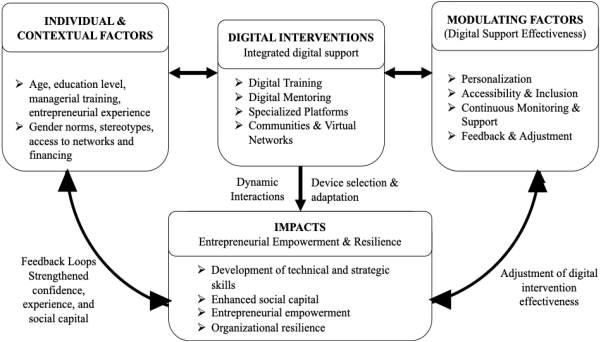
To synthesize insights from the literature and empirical analyses, the conceptual model (see
Figure 1) proposes an integrative perspective on digital support mechanisms specifically adapted to women entrepreneurs. It is based on the assumption that the effectiveness of digital mechanisms simultaneously depends on the individual characteristics and contextual needs of beneficiaries. The model highlights four complementary dimensions: modular digital training, personalized mentoring, centralized specialized platforms, and inclusive virtual communities. Each of these dimensions represents a lever to address the identified constraints and challenges, including time limitations due to the double burden, heterogeneous levels of entrepreneurial experience, sociocultural barriers and gender stereotypes, and sector-specific needs.
Unlike existing frameworks that often analyze these mechanisms in isolation, the present model proposes an integrated structure that explicitly connects women entrepreneurs’ characteristics and contextual constraints with the design and effectiveness of digital support mechanisms. In doing so, it contributes a novel conceptual perspective by highlighting the moderating role of personalization, accessibility, continuous monitoring, and participatory feedback in shaping the impact of digital support on entrepreneurial development.
The approach adopted within this conceptual framework is user-centered and draws on socioconstructivist principles, emphasizing that the appropriation of digital competencies, the development of decision-making autonomy, and the expansion of digital social capital are conditioned by flexibility, personalization, and continuous support. By articulating these dimensions with the identified moderating factors—personalization, accessibility, monitoring, and feedback—the model illustrates how the thoughtful design of digital mechanisms can not only enhance women entrepreneurs’ technical and strategic competencies but also foster their empowerment, the sustainable structuring of their activities, and the resilience of their enterprises.
Figure 1 therefore illustrates the conceptual relationships between three main components: (1) the individual and contextual characteristics of women entrepreneurs, (2) the four types of digital support mechanisms, and (3) the moderating factors that influence their effectiveness. These relationships are primarily causal and enabling, suggesting that appropriately designed digital mechanisms—when moderated by personalization, accessibility, monitoring, and feedback—can strengthen entrepreneurial competencies, social capital, and ultimately women entrepreneurs’ autonomy and resilience.
This conceptual framework goes beyond presenting available tools by offering an integrated mapping of the interactions between beneficiaries’ profiles, specific needs, and digital mechanisms, thereby providing a solid theoretical foundation to guide the design and evaluation of high-value digital support programs for women entrepreneurs.
Figure 1. Integrative conceptual framework for the digital support of women entrepreneurs.
To further clarify the analytical structure of the framework, the model can be interpreted through a set of conceptual propositions:
Proposition 1: Digital training positively influences the development of technical and managerial competencies among women entrepreneurs.
Proposition 2: Personalized digital mentoring strengthens entrepreneurial confidence, strategic decision-making, and access to professional networks.
Proposition 3: Specialized digital platforms facilitate resource integration, business structuring, and market access.
Proposition 4: Virtual communities enhance digital social capital, peer learning, and professional visibility.
Proposition 5: The effectiveness of these mechanisms is moderated by personalization, accessibility, continuous support, and participatory feedback.
The analysis of the individual and contextual characteristics of women entrepreneurs reveals that their needs with regard to digital mechanisms can only be understood by simultaneously considering personal constraints, professional experiences, and sociocultural contexts. Age, level of education, limited entrepreneurial experience, and the double burden of professional and family responsibilities determine the need for flexible and modular formats adapted to variable learning rhythms and often constrained working environments. These elements confirm that the effectiveness of digital mechanisms relies on precise alignment with participants’ profiles.
Within this framework, digital mentoring emerges as a central lever, not only for transferring technical and strategic competencies but also for providing moral support and strengthening entrepreneurs’ confidence. Centralized platforms and virtual communities complement this mechanism by offering integrated access to resources, tools, and professional networks, thereby reducing isolation and overcoming structural barriers that limit access to economic opportunities.
The alignment between mechanisms and individual profiles proves to be critical in ensuring participants’ appropriation and engagement. Modular learning pathways and adaptive content enable women to progress at their own pace while responding to time and geographical constraints imposed by family or professional responsibilities. Personalization, beyond mere flexibility, ensures that each entrepreneur can mobilize these mechanisms according to her objectives, sector of activity, and level of digital competence.
Finally, the combination of these mechanisms contributes to a cumulative effect on entrepreneurial empowerment. The synergy between digital training, mentoring, specialized platforms, and virtual communities fosters the progressive transformation of entrepreneurial practices, the consolidation of digital competencies, and the enhancement of resilience and competitiveness among women-led enterprises. This confirms that digitalization does not constitute merely a technical tool, but rather a structuring context capable of reshaping entrepreneurial trajectories.
5. Research Methodology
This study adopts an integrative literature review methodology to develop a conceptual framework explaining how the characteristics and specific needs of women entrepreneurs influence the design and effectiveness of digital support mechanisms. Integrative reviews are particularly appropriate for research domains characterized by fragmented theoretical contributions and heterogeneous empirical findings, as they enable the synthesis and reconceptualization of knowledge across diverse research streams
| [38] | Swartz, E. M., Scheepers, C. B., & Toefy, T. (2022). Women entrepreneurs’ opportunity identification of digital platform start-ups: emerging evidence from South Africa. International Journal of Gender and Entrepreneurship, 14(3), 352-374.
https://doi.org/10.1108/IJGE-06-2021-0096 |
| [39] | Torraco, R. J. (2005). Writing integrative literature reviews: Guidelines and examples. Human resource development review, 4(3), 356-367.
https://doi.org/10.1177/1534484305278283 |
[38, 39]
. In the context of women’s digital entrepreneurship, the literature spans several disciplines including entrepreneurship, gender studies, digital innovation, and entrepreneurial support mechanisms. Consequently, an integrative approach provides a suitable methodological framework for identifying patterns, connecting theoretical insights, and developing a comprehensive conceptual model.
5.1. Review Design
The integrative review followed a structured process consisting of four main stages: literature identification, screening and selection, thematic analysis, and conceptual model development. This approach allows the systematic consolidation of prior research while maintaining the flexibility necessary to integrate theoretical and empirical contributions from different fields. Unlike purely systematic reviews that prioritize strict protocol-driven synthesis, integrative reviews enable broader theoretical interpretation and conceptual development, which is particularly relevant for building explanatory frameworks in emerging research areas.
The purpose of this methodological approach is therefore twofold. First, it seeks to synthesize existing knowledge on the challenges faced by women entrepreneurs and the potential of digital mechanisms to support their entrepreneurial development. Second, it aims to identify the relationships between individual characteristics, contextual constraints, digital support mechanisms, and moderating factors in order to propose an integrative conceptual model.
5.2. Literature Search and Selection Criteria
The literature review was conducted using major academic databases commonly used in management and entrepreneurship research, including Scopus, Web of Science, and Google Scholar. These databases were selected because they provide comprehensive coverage of peer-reviewed journal articles and high-impact publications in entrepreneurship, digital innovation, and gender studies.
The search strategy relied on combinations of keywords related to the core dimensions of the study, including women entrepreneurship, digital support, digital training, digital mentoring, entrepreneurial platforms, virtual communities, and digital inclusion. Additional terms such as gender barriers, entrepreneurial empowerment, and digital entrepreneurship ecosystems were also incorporated to capture relevant interdisciplinary contributions.
The selection of articles followed three main criteria:
First, the review focused primarily on peer-reviewed academic publications, ensuring the scientific rigor and credibility of the sources. Seminal theoretical works and influential reports from international organizations (such as the World Bank, OECD, and UN Women) were also included when they provided significant empirical insights or conceptual contributions to the understanding of digital mechanisms supporting women entrepreneurs.
Second, the review prioritized studies addressing women’s entrepreneurship, digital entrepreneurial support, and digital capacity building mechanisms. Articles examining mentoring programs, digital learning environments, entrepreneurial networks, or digital platforms were retained when they provided insights into how these mechanisms influence entrepreneurial competencies, networks, or business development.
Third, the review considered publications from multiple geographical contexts, allowing the identification of common structural challenges affecting women entrepreneurs across different institutional environments. This approach ensures a broader analytical perspective and reduces the risk of context-specific bias.
Following the screening process, the selected literature was analyzed in depth to identify recurring themes, theoretical explanations, and empirical findings related to digital support mechanisms and women entrepreneurs’ needs.
5.3. Analytical Approach
The analysis of the selected literature followed a thematic synthesis approach, which allowed the identification of key conceptual dimensions emerging from previous studies. The analysis revealed four major categories of digital support mechanisms frequently discussed in the literature: digital training, mentoring programs, specialized digital platforms, and virtual communities.
In addition to these mechanisms, the literature highlighted several moderating factors influencing their effectiveness, including personalization of support, accessibility and digital inclusion, continuous monitoring and mentoring, and participatory feedback mechanisms. These dimensions repeatedly appeared across studies examining digital learning, entrepreneurial ecosystems, and gender-related barriers in entrepreneurship.
The thematic synthesis enabled the structuring of the literature around three complementary analytical levels. The first level concerns the characteristics and constraints of women entrepreneurs, encompassing both individual factors such as education, entrepreneurial experience, and time availability, and contextual factors including sociocultural norms, gender stereotypes, and access to professional networks. The second level relates to the digital support mechanisms designed to address these constraints, particularly digital training programs, mentoring initiatives, specialized digital platforms, and virtual communities that facilitate learning, networking, and access to resources. The third level focuses on the moderating factors that influence the effectiveness of these mechanisms, notably personalization of support, accessibility and digital inclusion, continuous monitoring and mentoring, and participatory feedback processes. Taken together, these three analytical dimensions provide a structured perspective that explains how digital mechanisms interact with the specific profiles and contexts of women entrepreneurs. This analytical framework therefore served as the foundation for the development of the conceptual model proposed in this study.
5.4. Conceptual Model Development
The conceptual model presented in
Figure 1 was developed through an iterative theory-building process grounded in the synthesis of prior literature. Rather than deriving the model from a single theoretical perspective, the framework integrates insights from several complementary approaches, including research on women’s entrepreneurship, digital learning environments, entrepreneurial ecosystems, and socioconstructivist perspectives on knowledge acquisition.
The model construction followed three steps.
First, the literature review enabled the identification of key challenges and needs faced by women entrepreneurs, particularly those related to time constraints, limited entrepreneurial experience, restricted access to professional networks, and sociocultural barriers.
Second, the analysis highlighted four categories of digital support mechanisms that repeatedly appear in the literature as effective tools for addressing these challenges: modular digital training, personalized mentoring, centralized specialized platforms, and inclusive virtual communities.
Third, the review revealed that the effectiveness of these mechanisms depends on several moderating conditions, such as personalization, accessibility, continuous support, and participatory feedback. These factors influence the degree to which digital mechanisms are adopted, appropriated, and translated into tangible entrepreneurial outcomes.
By articulating these three dimensions, the proposed framework provides an integrated perspective explaining how digital mechanisms can support women entrepreneurs’ skill development, empowerment, and entrepreneurial resilience. The resulting conceptual model therefore synthesizes existing theoretical contributions while offering a structured foundation for future empirical research examining the impact of digital support mechanisms on women’s entrepreneurial development.
6. Discussion
The findings of this study are situated within a critical analytical perspective aimed at confronting empirical insights with existing theoretical frameworks on women’s entrepreneurship and digital support. This positioning makes it possible to highlight the contributions of the proposed model, both theoretically and practically, while also identifying the limitations of the analysis and outlining avenues for future research. It underscores the structuring role of digital mechanisms in the development of competencies, the strengthening of autonomy, and the enhancement of resilience among women entrepreneurs, in interaction with their individual characteristics and contextual environments.
6.1. Linking Back to the Literature
The findings of this study align with prior research highlighting the importance of flexibility and mentoring in supporting women entrepreneurs’ adoption of digital mechanisms
| [4] | Brush, C. G., Carter, N., Gatewood, E., Greene, P., & Hart, M. (2009). Gatekeepers of venture growth: A Diana project report on the role and participation of women in the venture capital industry. Babson College. |
| [5] | Brush, C. G., Carter, N. M., Greene, P. G., Hart, M., & Gatewood, E. J. (2019). A gendered look at entrepreneurship ecosystems. Small Business Economics, 53(2), 393–408.
https://doi.org/10.1007/s11187-018-9992-9 |
| [9] | Cherie Blair Foundation. (2024). Annual report: Empowering women entrepreneurs worldwide. London, UK: Cherie Blair Foundation for Women. |
| [21] | Sharma, N., Sinha, E., & Shalender, K. (2024). Espoused model of women entrepreneurship: antecedents to women entrepreneurial intention and moderating role of entrepreneurial self-efficacy. Journal of Enterprising Communities: People and Places in the Global Economy, 18(5), 881-901.
https://doi.org/10.1108/JEC-01-2023-0011 |
[4, 5, 9, 21]
. Modular programs accessible via mobile devices and asynchronous formats address temporal and geographical constraints, thereby fostering sustained engagement and the gradual appropriation of digital tools
| [3] | Brändle, T., Weller, R., & Elfring, T. (2018). I am what I am: How nascent entrepreneurs’ social identity affects their entrepreneurial self-efficacy. Journal of Business Venturing Insights, 9, 17–23. https://doi.org/10.1016/j.jbvi.2017.12.001 |
| [12] | De Vita, L., Mari, M., & Poggesi, S. (2014). Women entrepreneurs in and from developing countries: Evidences from the literature. European Management Journal, 32(3), 451–460.
https://doi.org/10.1016/j.emj.2013.07.009 |
| [26] | Minniti, M., & Naudé, W. (2010). What do we know about the patterns and determinants of female entrepreneurship across countries? European Journal of Development Research, 22(3), 277–293. https://doi.org/10.1057/ejdr.2010.17 |
| [35] | Zahara, Z., Ikhsan, Santi, I. N., & Farid. (2023). Entrepreneurial marketing and marketing performance through digital marketing capabilities of SMEs in post-pandemic recovery. Cogent Business & Management, 10(2), 2204592.
https://doi.org/10.1080/23311975.2023.2204592 |
[3, 12, 26, 35]
.
Furthermore, this study confirms that digital inequalities, including the digital divide and deficits in digital competencies, remain major barriers for women entrepreneurs
| [14] | Elmaymouni, Y., Boubrik, S., & Benabdeljalil, R. (2024). Female social entrepreneurship in Morocco: Challenges and pathways. Journal of Entrepreneurship in Emerging Economies, 16(1), 101–120. |
| [17] | Hilbert, M. (2011). Digital gender divide or technologically empowered women in developing countries? World Development, 39(6), 999–1006.
https://doi.org/10.1016/j.wsif.2011.07.001 |
| [28] | Ghezzi, A., & Cavallo, A. (2020). Agile business model innovation in digital entrepreneurship: Lean startup approaches. Journal of business research, 110, 519-537.
https://doi.org/10.1016/j.jbusres.2018.06.013 |
| [32] | UN Women. (2023). Gender equality in digital entrepreneurship: Progress report. New York, NY: UN Women. |
[14, 17, 28, 32]
. The development of inclusive platforms and content adapted to varying skill levels appears essential to reduce these disparities and enable women to integrate digital technologies into their business models, thereby contributing to the reduction of gender gaps in digital entrepreneurship
| [7] | Burgess, R., Brixiová, Z., & Cros, M. (2020). Training, human capital, and gender gaps in entrepreneurial performance. Economic Modelling, 85, 367–380.
https://doi.org/10.1016/j.econmod.2019.11.006 |
| [30] | Svahn, S., Mathiassen, L., & Lindgren, R. (2017). Embracing digital innovation in incumbent firms: How Volvo Cars managed competing concerns. MIS Quarterly, 41(1), 239–253.
https://doi.org/10.25300/MISQ/2017/41.1.12 |
[7, 30]
.
Finally, these findings enrich socioconstructivist perspectives that conceptualize gender as a dynamic construct shaped by contextual influences
| [1] | Ahl, H. (2006). Why research on women entrepreneurs needs new directions. Entrepreneurship Theory and Practice, 30(5), 595–621.
https://doi.org/10.1111/j.1540-6520.2006.00138.x |
| [8] | Chag, L., & Bourkha, B. (2025). Vulnerable women entrepreneurs confront structural challenges: An integrated theoretical model for mentorship, networks, and entrepreneurial empowerment. Journal of Economics, Business and Management (SSRJEBM), 2(8). https://doi.org/10.5281/zenodo.17573623 |
| [11] | De Bruin, A., Brush, C. G., & Welter, F. (2007). Advancing a framework for coherent research on women’s entrepreneurship. Entrepreneurship Theory and Practice, 31(3), 323–339.
https://doi.org/10.1111/j.1540-6520.2007.00176.x |
| [33] | Welter, F. (2011). Contextualizing entrepreneurship—conceptual challenges and ways forward. Entrepreneurship Theory and Practice, 35(1), 165–184.
https://doi.org/10.1111/j.1540-6520.2010.00427 |
[1, 8, 11, 33]
. The integration of digitalization as a structuring context demonstrates that digital technologies are not neutral but actively shape interactions, networks, and entrepreneurial opportunities
| [9] | Cherie Blair Foundation. (2024). Annual report: Empowering women entrepreneurs worldwide. London, UK: Cherie Blair Foundation for Women. |
| [18] | Hughes, K. D., & Jennings, J. E. (2020). A legacy of attention to embeddedness in gendered institutions: Reflections on a key contribution of women’s entrepreneurship research. International Journal of Gender and Entrepreneurship, 12(1), 53-76. https://doi.org/10.1108/IJGE-04-2019-0085 |
[9, 18]
. This multi-level perspective provides a deeper understanding of how digital mechanisms can simultaneously transform competencies, visibility, and resilience among women entrepreneurs.
6.2. Theoretical Implications
From a theoretical standpoint, this study makes three main contributions to the literature on women’s entrepreneurship and digital support mechanisms.
First, it proposes an integrative conceptual framework that bridges previously fragmented research streams by linking the characteristics and constraints of women entrepreneurs with specific digital support mechanisms. While prior studies have examined digital training, mentoring, or entrepreneurial networks separately, this study integrates these dimensions into a unified analytical framework that explains how they interact to support entrepreneurial development.
Second, the study introduces a multi-level perspective that connects individual factors (such as entrepreneurial experience, education, and time constraints) with contextual and sociocultural influences, including gender norms and institutional barriers. By highlighting these interactions, the framework extends existing research on entrepreneurial support by demonstrating that the effectiveness of digital mechanisms depends not only on their design but also on their alignment with the profiles and contexts of beneficiaries.
Third, the study conceptualizes digitalization as a structuring context for entrepreneurial empowerment rather than merely a technological tool. This perspective contributes to socioconstructivist and gender-based approaches in entrepreneurship research by showing how digital environments reshape learning processes, network formation, and opportunity recognition for women entrepreneurs.
Together, these contributions advance existing theoretical debates by offering a more comprehensive understanding of how digital support mechanisms can foster skill development, entrepreneurial autonomy, and resilience among women entrepreneurs.
6.3. Practical Implications
For practitioners, these findings suggest that the co-design of digital support mechanisms with beneficiaries constitutes a key condition for maximizing inclusion and effectiveness. By involving women entrepreneurs in the design of learning pathways, it becomes possible to adapt content, formats, and delivery modalities to their specific constraints and diverse contexts, thereby enhancing engagement and the appropriation of digital tools. For example, policymakers and support organizations could organize participatory workshops or pilot programs with women entrepreneurs in order to identify priority training needs and test digital learning modules before their large-scale implementation.
Moreover, digital mechanisms should be modular and accessible through mobile devices, incorporating personalized mentoring that combines strategic and emotional support, centralized platforms that integrate tools, resources, and professional networks, as well as virtual communities that foster exchange, co-creation, and visibility. In practice, platform designers could develop mobile-based training modules that allow entrepreneurs to access short learning sessions adapted to their limited time availability. Similarly, digital mentoring programs could include structured mentor–mentee matching systems based on sector, experience, and specific business challenges in order to provide more targeted and relevant support.
In addition, policymakers and entrepreneurial support organizations can strengthen the effectiveness of digital ecosystems by investing in inclusive digital infrastructures and partnerships with private and non-profit actors. For instance, national entrepreneurship programs could integrate centralized digital platforms that combine training resources, funding opportunities, and networking tools, enabling women entrepreneurs to access multiple forms of support within a single digital environment.
Finally, continuous monitoring is essential to ensure the sustainable transformation of business models and the consolidation of digital competencies. Digital mechanisms should incorporate phases of practical application, progressive support, and regular mentoring, enabling women entrepreneurs to gradually integrate digital tools into their daily activities and assess their tangible impact on performance, resilience, and competitiveness. From an operational perspective, this could involve the implementation of feedback systems, performance dashboards, and periodic evaluation sessions that allow program designers to continuously adapt digital support mechanisms to the evolving needs of participants.
6.4. Limitations and Future Research
First, a major limitation of this analysis lies in the conceptual nature of the proposed model. The theoretical propositions are grounded in existing literature and documented mechanisms, without direct empirical validation among the targeted population of women entrepreneurs. This lack of primary data may limit the ability to assess the actual relevance of the recommendations across different profiles and entrepreneurial contexts, as well as their effective adoption in practice.
Second, the scope of this study is deliberately focused on the intersection between women’s entrepreneurship and digital support mechanisms. As a result, the analysis prioritizes research addressing digital training, mentoring, platforms, and virtual communities, which may exclude other potentially relevant forms of entrepreneurial support such as traditional incubators, financial instruments, or offline mentoring initiatives. This scope delimitation was necessary to maintain conceptual coherence but may limit the breadth of perspectives considered in the analysis.
Third, the literature selection process may also introduce potential biases. Although the review prioritizes peer-reviewed academic publications and influential institutional reports, the selection of sources may reflect the availability of studies in major academic databases and the predominance of research conducted in certain geographical or institutional contexts. Consequently, some regional perspectives or emerging practices may remain underrepresented in the analysis.
Fourth, the specific context of the studies mobilized—often concentrated in particular countries, sectors, or types of enterprises (such as the limited liability companies examined in the Moroccan context)—restricts the generalizability of the findings. Institutional, cultural, and economic dynamics may vary significantly across contexts, potentially influencing the needs, barriers, and relevant forms of digital support for women entrepreneurs.
A further limitation concerns the rapid evolution of digital technologies. The mechanisms and tools analyzed may quickly become outdated with the emergence of new platforms, applications, or pedagogical formats, such as artificial intelligence, microlearning, or augmented and virtual reality. The effectiveness and relevance of digital mechanisms therefore require continuous monitoring and ongoing adaptation to technological innovations and emerging practices in digital entrepreneurship.
Finally, certain social and cultural dimensions, such as gender stereotypes, the double burden of professional and family responsibilities, and unequal access to networks, remain difficult to measure and may influence the effectiveness of mechanisms differently depending on the context. These aspects highlight the need for in-depth empirical research that examines not only the adoption of digital tools but also their actual impact on performance, resilience, and the empowerment of women entrepreneurs, in order to complement and validate the proposed theoretical model.
7. Conclusion
The analysis of the individual and contextual characteristics of women entrepreneurs demonstrates that the effectiveness of digital support mechanisms relies on a nuanced understanding of their profiles and the sociocultural environments in which they operate. Constraints related to dual domestic and professional responsibilities, limited managerial training, restricted entrepreneurial experience, and gender stereotypes directly influence how women can engage with and benefit from digital tools. In this context, the mere availability of digital interventions is insufficient to guarantee a positive impact; it is their alignment with personal, professional, and contextual realities that constitutes the determining factor.
The findings underscore the importance of an integrated design of support mechanisms, combining modular digital training, personalized mentoring, centralized platforms, and inclusive virtual communities. This combination not only facilitates the development of technical and strategic competencies but also strengthens digital social capital, decision-making autonomy, and entrepreneurial resilience. The socio-constructivist approach adopted in this study highlights that entrepreneurial empowerment emerges from a dynamic interaction between digital mechanisms and the specific needs of women, confirming that digitalization can serve as a structuring lever for transforming both practices and business models.
From a theoretical perspective, this research contributes to the development of an integrative conceptual framework linking individual characteristics, contextual needs, and typologies of digital interventions. It emphasizes the necessity of a multi-level approach, where content adaptation, flexible formats, continuous monitoring, and social inclusion act synergistically to maximize adoption and impact. The study further enriches the literature on women’s entrepreneurship by highlighting the interaction between sociocultural factors, organizational constraints, and the effectiveness of digital technologies, thereby offering a comprehensive analytical lens for examining gender dynamics in entrepreneurship.
From a practical standpoint, the findings provide concrete recommendations for designers of digital support mechanisms: co-design with beneficiaries, personalization of learning paths according to profile and context, modularity and mobile accessibility of training, mentoring that combines strategic and emotional support, integration of centralized platforms and inclusive virtual communities, as well as continuous monitoring and participatory feedback. These elements constitute essential levers for enhancing engagement, sustainability, and program impact, ultimately fostering the durable transformation of women’s business models.
Finally, this study opens avenues for future empirical research aimed at testing and validating the proposed conceptual framework, evaluating the effectiveness of digital interventions across different geographic and sectoral contexts, and exploring the tangible impact on economic performance, organizational resilience, and social empowerment of women. The rapid evolution of digital technologies and the changing nature of entrepreneurial environments necessitate continuous adaptation, underscoring the importance of flexible, inclusive, and user-centered mechanisms to sustainably support women’s entrepreneurship.
Moreover, the study highlights the potential of digitalization to bridge structural and social gaps, enabling women entrepreneurs to access networks, knowledge, and resources that were previously limited by gendered constraints. By strategically integrating technological tools with tailored mentoring and community engagement, digital interventions can serve as a catalyst for long-term business growth, resilience, and empowerment. This perspective reinforces the view that digital support mechanisms, when thoughtfully designed and contextually grounded, transcend their functional role and become instruments of systemic change in women’s entrepreneurial trajectories.
Abbreviations
UN Women | United Nations Entity for Gender Equality and the Empowerment of Women |
OCDE | Organisation for Economic Co-operation and Development |
Author Contributions
Rachid Samkane: Conceptualization, Methodology, Writing – original draft
Loubna Chag: Formal Analysis, Supervision, Writing – review & editing
Conflicts of Interest
The authors declare no conflicts of interest.
References
| [1] |
Ahl, H. (2006). Why research on women entrepreneurs needs new directions. Entrepreneurship Theory and Practice, 30(5), 595–621.
https://doi.org/10.1111/j.1540-6520.2006.00138.x
|
| [2] |
Agrawal, S., & Agrawal, R. (2023). Female entrepreneurship motivational factors: Analysing effect through the conceptual competency-based framework. International Journal of Entrepreneurship and Small Business, 49(3), 350–373.
https://doi.org/10.1504/IJESB.2023.132525
|
| [3] |
Brändle, T., Weller, R., & Elfring, T. (2018). I am what I am: How nascent entrepreneurs’ social identity affects their entrepreneurial self-efficacy. Journal of Business Venturing Insights, 9, 17–23.
https://doi.org/10.1016/j.jbvi.2017.12.001
|
| [4] |
Brush, C. G., Carter, N., Gatewood, E., Greene, P., & Hart, M. (2009). Gatekeepers of venture growth: A Diana project report on the role and participation of women in the venture capital industry. Babson College.
|
| [5] |
Brush, C. G., Carter, N. M., Greene, P. G., Hart, M., & Gatewood, E. J. (2019). A gendered look at entrepreneurship ecosystems. Small Business Economics, 53(2), 393–408.
https://doi.org/10.1007/s11187-018-9992-9
|
| [6] |
Brush, C., & Cooper, S. (2012). Female entrepreneurship and economic development: An international perspective. Entrepreneurship & Regional Development, 24(1–2), 1–6.
https://doi.org/10.1080/08985626.2012.637340
|
| [7] |
Burgess, R., Brixiová, Z., & Cros, M. (2020). Training, human capital, and gender gaps in entrepreneurial performance. Economic Modelling, 85, 367–380.
https://doi.org/10.1016/j.econmod.2019.11.006
|
| [8] |
Chag, L., & Bourkha, B. (2025). Vulnerable women entrepreneurs confront structural challenges: An integrated theoretical model for mentorship, networks, and entrepreneurial empowerment. Journal of Economics, Business and Management (SSRJEBM), 2(8).
https://doi.org/10.5281/zenodo.17573623
|
| [9] |
Cherie Blair Foundation. (2024). Annual report: Empowering women entrepreneurs worldwide. London, UK: Cherie Blair Foundation for Women.
|
| [10] |
Choudhury, P., & Easwarn, V. (2019). Digital technologies and female entrepreneurship: Insights from emerging economies. Technological Forecasting and Social Change, 146, 860–872.
https://doi.org/10.1016/j.ssci.2018.07.009
|
| [11] |
De Bruin, A., Brush, C. G., & Welter, F. (2007). Advancing a framework for coherent research on women’s entrepreneurship. Entrepreneurship Theory and Practice, 31(3), 323–339.
https://doi.org/10.1111/j.1540-6520.2007.00176.x
|
| [12] |
De Vita, L., Mari, M., & Poggesi, S. (2014). Women entrepreneurs in and from developing countries: Evidences from the literature. European Management Journal, 32(3), 451–460.
https://doi.org/10.1016/j.emj.2013.07.009
|
| [13] |
Dutta, A., & Mishra, D. (2021). Women entrepreneurs and digital business transformation: Evidence from India. Journal of Small Business Management, 59(S1), 123–144.
https://doi.org/10.17705/1thci.00156
|
| [14] |
Elmaymouni, Y., Boubrik, S., & Benabdeljalil, R. (2024). Female social entrepreneurship in Morocco: Challenges and pathways. Journal of Entrepreneurship in Emerging Economies, 16(1), 101–120.
|
| [15] |
Eesley, C. E., Eberhart, R. N., Skousen, B. R., & Cheng, J. L. C. (2018). Institutions and entrepreneurial activity: The interactive influence of misaligned formal and informal institutions. Strategy Science, 3(2), 393–407.
https://doi.org/10.1287/stsc.2018.0060
|
| [16] |
Fairlie, R. W., & Robb, A. M. (2009). Gender differences in business performance: Evidence from the Characteristics of Business Owners survey. Small Business Administration.
https://doi.org/10.1007/s11187-009-9207-5
|
| [17] |
Hilbert, M. (2011). Digital gender divide or technologically empowered women in developing countries? World Development, 39(6), 999–1006.
https://doi.org/10.1016/j.wsif.2011.07.001
|
| [18] |
Hughes, K. D., & Jennings, J. E. (2020). A legacy of attention to embeddedness in gendered institutions: Reflections on a key contribution of women’s entrepreneurship research. International Journal of Gender and Entrepreneurship, 12(1), 53-76.
https://doi.org/10.1108/IJGE-04-2019-0085
|
| [19] |
Itani, H., Sidani, Y., & Baalbaki, I. (2011). The impact of network ties and entrepreneurial orientation on Lebanese women entrepreneurs’ success. Equality, Diversity and Inclusion, 30(5), 409–424.
https://doi.org/10.1108/02610151111150654
|
| [20] |
Kraus, S., Clauss, T., Breier, M., Gast, J., Zardini, A., & Tiberius, V. (2019). Digital entrepreneurship: A research agenda on new business models for the twenty-first century. International Journal of Entrepreneurial Behavior & Research, 29(5), 1014–1039.
https://doi.org/10.1108/IJEBR-06-2018-0425
|
| [21] |
Sharma, N., Sinha, E., & Shalender, K. (2024). Espoused model of women entrepreneurship: antecedents to women entrepreneurial intention and moderating role of entrepreneurial self-efficacy. Journal of Enterprising Communities: People and Places in the Global Economy, 18(5), 881-901.
https://doi.org/10.1108/JEC-01-2023-0011
|
| [22] |
Baral, R., Dey, C., Manavazhagan, S., & Kamalini, S. (2023). Women entrepreneurs in India: a systematic literature review. International Journal of Gender and Entrepreneurship, 15(1), 94-121.
https://doi.org/10.1108/IJGE-05-2021-0079
|
| [23] |
Malainine, H., Chag, L., & Bourkha, B. (2025). Contraintes des femmes entrepreneures en situation de vulnérabilité: Analyse des obstacles sociaux, institutionnels et économiques [Challenges facing women entrepreneurs in vulnerable contexts: a critical analysis of social, institutional, and economic barriers]. Journal of Integrated Studies in Economics, Law, Technical Sciences & Communication, 1(1).
|
| [24] |
Marlow, S., & McAdam, M. (2015). Incubation or induction? Gendered identity work in the context of technology business incubation. Entrepreneurship theory and practice, 39(4), 791-816.
https://doi.org/10.1111/etap.1206
|
| [25] |
Marlow, S., & Patton, D. (2005). All credit to men? Entrepreneurship, finance, and gender. Entrepreneurship Theory and Practice, 29(6), 717–735.
https://doi.org/10.1111/j.1540-6520.2005.00105.x
|
| [26] |
Minniti, M., & Naudé, W. (2010). What do we know about the patterns and determinants of female entrepreneurship across countries? European Journal of Development Research, 22(3), 277–293.
https://doi.org/10.1057/ejdr.2010.17
|
| [27] |
OECD. (2021). Women’s entrepreneurship and digitalisation. Paris: OECD Publishing.
|
| [28] |
Ghezzi, A., & Cavallo, A. (2020). Agile business model innovation in digital entrepreneurship: Lean startup approaches. Journal of business research, 110, 519-537.
https://doi.org/10.1016/j.jbusres.2018.06.013
|
| [29] |
Pouka Pouka, M. R., & Biwolé, V. O. (2024). Does causal analysis improve the understanding of entrepreneurial support for SME performance?. Journal of Global Entrepreneurship Research, 14(1), 19.
https://doi.org/10.1007/s40497-024-00387-3
|
| [30] |
Svahn, S., Mathiassen, L., & Lindgren, R. (2017). Embracing digital innovation in incumbent firms: How Volvo Cars managed competing concerns. MIS Quarterly, 41(1), 239–253.
https://doi.org/10.25300/MISQ/2017/41.1.12
|
| [31] |
UN Women. (2022). Women’s economic empowerment: Global trends and policy directions. New York, NY: United Nations Entity for Gender Equality and the Empowerment of Women.
|
| [32] |
UN Women. (2023). Gender equality in digital entrepreneurship: Progress report. New York, NY: UN Women.
|
| [33] |
Welter, F. (2011). Contextualizing entrepreneurship—conceptual challenges and ways forward. Entrepreneurship Theory and Practice, 35(1), 165–184.
https://doi.org/10.1111/j.1540-6520.2010.00427
|
| [34] |
World Bank Group. (2022). Women, business and the law 2022: Unlocking economic opportunities for women. Washington, DC: World Bank.
|
| [35] |
Zahara, Z., Ikhsan, Santi, I. N., & Farid. (2023). Entrepreneurial marketing and marketing performance through digital marketing capabilities of SMEs in post-pandemic recovery. Cogent Business & Management, 10(2), 2204592.
https://doi.org/10.1080/23311975.2023.2204592
|
| [36] |
Boubrik, S., Elmaymouni, Y., & Benabdeljalil, R. (2024). Female social entrepreneurship in Moroccan SMEs: A path toward empowerment. International Journal of Social Entrepreneurship and Innovation, 12(2), 45–63.
|
| [37] |
Harima, A., Müller, R., & Schilling, J. (2022). Women in digital entrepreneurship: Evidence from European start-ups. Technological Forecasting and Social Change, 176, 121412.
|
| [38] |
Swartz, E. M., Scheepers, C. B., & Toefy, T. (2022). Women entrepreneurs’ opportunity identification of digital platform start-ups: emerging evidence from South Africa. International Journal of Gender and Entrepreneurship, 14(3), 352-374.
https://doi.org/10.1108/IJGE-06-2021-0096
|
| [39] |
Torraco, R. J. (2005). Writing integrative literature reviews: Guidelines and examples. Human resource development review, 4(3), 356-367.
https://doi.org/10.1177/1534484305278283
|
Cite This Article
-
APA Style
Samkane, R., Chag, L. (2026). Bridging Gender Gaps in Entrepreneurship: A Conceptual Model for Tailored Digital Support Mechanisms. International Journal of Economic Behavior and Organization, 14(2), 22-35. https://doi.org/10.11648/j.ijebo.20261402.11
 Copy
|
Copy
|
 Download
ACS Style
Samkane, R.; Chag, L. Bridging Gender Gaps in Entrepreneurship: A Conceptual Model for Tailored Digital Support Mechanisms. Int. J. Econ. Behav. Organ. 2026, 14(2), 22-35. doi: 10.11648/j.ijebo.20261402.11
Copy
|
Download
AMA Style
Samkane R, Chag L. Bridging Gender Gaps in Entrepreneurship: A Conceptual Model for Tailored Digital Support Mechanisms. Int J Econ Behav Organ. 2026;14(2):22-35. doi: 10.11648/j.ijebo.20261402.11
Copy
|
Download
-
@article{10.11648/j.ijebo.20261402.11,
  author = {Rachid Samkane and Loubna Chag},
  title = {Bridging Gender Gaps in Entrepreneurship: A Conceptual Model for Tailored Digital Support Mechanisms},
  journal = {International Journal of Economic Behavior and Organization},
  volume = {14},
  number = {2},
  pages = {22-35},
  doi = {10.11648/j.ijebo.20261402.11},
  url = {https://doi.org/10.11648/j.ijebo.20261402.11},
  eprint = {https://article.sciencepublishinggroup.com/pdf/10.11648.j.ijebo.20261402.11},
  abstract = {Women’s entrepreneurship represents a significant driver of economic, social, and technological development. However, female entrepreneurs often face structural, social, and contextual barriers that limit their access to resources, professional networks, and entrepreneurial opportunities. To address these challenges, this study adopts an integrative literature review and conceptual synthesis to examine how digital support mechanisms can be designed to better meet the specific needs of women entrepreneurs. Based on the analysis of prior research, the study develops an integrative conceptual framework linking women entrepreneurs’ individual and contextual characteristics with four key digital support mechanisms: modular digital training, personalized mentoring, specialized digital platforms, and inclusive virtual communities. The framework highlights the role of moderating factors such as personalization, accessibility, continuous support, and participatory feedback in shaping the effectiveness of these mechanisms. By emphasizing a user-centered socioconstructivist perspective, the model explains how digital mechanisms can foster skill development, entrepreneurial empowerment, and the expansion of digital social capital. The study provides a theoretical contribution by integrating fragmented research streams on women’s entrepreneurship and digital support mechanisms, while also offering practical implications for policymakers and entrepreneurial support organizations seeking to design more inclusive and effective digital support programs.},
 year = {2026}
}
Copy
|
Download
-
TY  - JOUR
T1  - Bridging Gender Gaps in Entrepreneurship: A Conceptual Model for Tailored Digital Support Mechanisms
AU  - Rachid Samkane
AU  - Loubna Chag
Y1  - 2026/04/16
PY  - 2026
N1  - https://doi.org/10.11648/j.ijebo.20261402.11
DO  - 10.11648/j.ijebo.20261402.11
T2  - International Journal of Economic Behavior and Organization
JF  - International Journal of Economic Behavior and Organization
JO  - International Journal of Economic Behavior and Organization
SP  - 22
EP  - 35
PB  - Science Publishing Group
SN  - 2328-7616
UR  - https://doi.org/10.11648/j.ijebo.20261402.11
AB  - Women’s entrepreneurship represents a significant driver of economic, social, and technological development. However, female entrepreneurs often face structural, social, and contextual barriers that limit their access to resources, professional networks, and entrepreneurial opportunities. To address these challenges, this study adopts an integrative literature review and conceptual synthesis to examine how digital support mechanisms can be designed to better meet the specific needs of women entrepreneurs. Based on the analysis of prior research, the study develops an integrative conceptual framework linking women entrepreneurs’ individual and contextual characteristics with four key digital support mechanisms: modular digital training, personalized mentoring, specialized digital platforms, and inclusive virtual communities. The framework highlights the role of moderating factors such as personalization, accessibility, continuous support, and participatory feedback in shaping the effectiveness of these mechanisms. By emphasizing a user-centered socioconstructivist perspective, the model explains how digital mechanisms can foster skill development, entrepreneurial empowerment, and the expansion of digital social capital. The study provides a theoretical contribution by integrating fragmented research streams on women’s entrepreneurship and digital support mechanisms, while also offering practical implications for policymakers and entrepreneurial support organizations seeking to design more inclusive and effective digital support programs.
VL  - 14
IS  - 2
ER  -
Copy
|
Download




 Share This Article
 Twitter
 Linked In
 Facebook