Research Article | | Peer-Reviewed

Cracks in the Border: The Shadow Economy, Trade Openness, and Institutional Effectiveness in Sub-sahara Africa

Received: 2 January 2026     Accepted: 14 January 2026     Published: 4 February 2026
Views:       Downloads:
Abstract

Sub-Saharan Africa (SSA) continues to have the world’s largest shadow economy, even as countries work to liberalize trade and reform their institutions. This raises the question of whether opening trade always reduces informality or if it can sometimes make it worse. Our study examines how trade openness affects the size of the shadow economy in SSA. We look at exports, imports, and total trade openness separately, and also consider the influence of institutions and the wider economy. Using data from 31 SSA countries from 2000 to 2020, we apply the Dynamic System Generalized Method of Moments (System-GMM) to address endogeneity and differences between countries. We measure the shadow economy with an improved MIMIC-based index and break down trade into exports-to-GDP, imports-to-GDP, and total trade openness. Our findings show that trade affects informality in different ways. Exports and overall trade openness help reduce the shadow economy, likely because joining global markets encourages countries to follow international standards. In contrast, imports tend to increase informality, possibly because they create more competition for local businesses and make it harder for some firms and workers to stay formal. We also find that stronger institutions, higher literacy, and better tax systems are linked to less informality, while inflation makes it worse. These results suggest that trade openness alone is not enough to reduce informality. It should be combined with strong institutions, export-oriented policies, support for small businesses, and social safety nets. This study can help guide inclusive trade and formalization policies, especially for regional projects like the African Continental Free Trade Area (AfCFTA).

Published in International Journal of Economics, Finance and Management Sciences (Volume 14, Issue 1)
DOI 10.11648/j.ijefm.20261401.17
Page(s) 79-93
Creative Commons

This is an Open Access article, distributed under the terms of the Creative Commons Attribution 4.0 International License (http://creativecommons.org/licenses/by/4.0/), which permits unrestricted use, distribution and reproduction in any medium or format, provided the original work is properly cited.

Copyright

Copyright © The Author(s), 2026. Published by Science Publishing Group

Keywords

Shadow Economy, Trade Openness, Institutional Quality, Sub-saharan Africa, Dynamic System-GMM

1. Introduction
Sub-Saharan Africa (SSA) remains one of the regions most impacted by the shadow economy. Despite growing trade openness and institutional reforms, the informal economy persists. The paper explores how trade openness and the quality of institutions interact to influence the size and development of the shadow economy in SSA. The interaction between the shadow economy, trade openness and institutional efficiency creates a complex network that significantly impacts the economic landscape in Sub-Saharan Africa (SSA). The shadow economy, characterized by informal and unregulated activities, has increasingly been recognized as a crucial determinant of economic outcomes . Simultaneously, trade openness facilitates the movement of goods, services and capital across borders, which can either bolster formal economic growth or exacerbate informality, depending on the robustness of institutional frameworks. This literature review explores how these interconnected factors reveal structural vulnerabilities at borders, thus having far-reaching implications for economic stability and governance in the region.
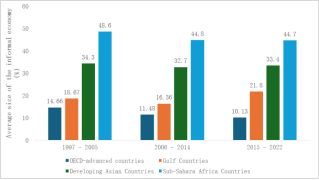
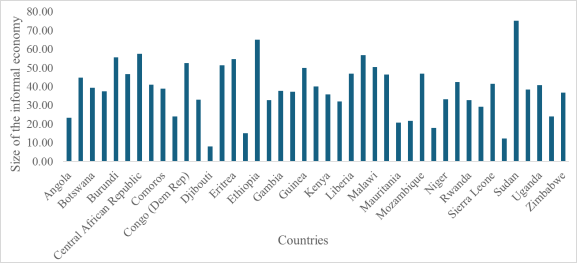
As shown in Figure 1, the shadow economy in sub-Saharan Africa remains substantial, with estimates suggesting that it accounts for a substantial share of GDP when compared to the other regions . Figure 2 shows significant differences in the size of informality across African countries, ranging from about 10% to about 70%. Factors such as high levels of poverty, high unemployment rates, and limited access to formal job opportunities have pushed people to informal economic activities . Additionally, informal cross-border trade and smuggling play pivotal roles in the economies of many nations in the region. While these activities support income generation, they also operate beyond government regulation, leading to a decline in national tax revenues .
In theory, trade liberalization should stimulate economic growth by facilitating access to international markets, allowing countries to take advantage of their comparative advantages. However, practical reality often diverges from this prior expectation. In context, where institutions are weak, increased trade openness can unintentionally proliferate informal activities, as regulatory systems fail to keep pace with rapidly evolving economic dynamics. SHAW et al. (2014) highlight that in the context of the region, trade liberalization has significantly influenced traffic patterns, revealing how porous borders and ineffective institutions create an environment where both legal and illegal trade can thrive .
Although trade liberalization is typically associated with economic growth, its relationship with weak institutions can worsen informality and weaken governance. The paper seeks to understand these dynamics within the distinct economic and political context of SSA. Moreover, the effectiveness of institutions plays an impactful role in shaping the outcomes of trade liberalization. In regions plagued with corruption and poor governance, the benefits of open trade often end up in the hands of a select few, while the wider population scrapes through informal economic activities . Institutional efficiency not only includes the presence of formal regulations but also encompasses the country’s ability to implement these regulations equitably. As asserted by Meagher (2024), structural adjustment programs and globalization have facilitated trade in West Africa, stressing that this trade often occurs outside formal purviews, thus perpetuating a cycle of informal economy participation . The study aims to investigate the impact of trade openness and institutional quality on the size of the shadow economy in Sub-Saharan Africa.
Prior studies have carried out extensive research on the interplay between the shadow economy, macroeconomic indicators, and structural and institutional variables such as trade openness, tax revenue, GDP per capita, inflation, regulatory quality, and literacy rates . These variables have served as proxies for macroeconomic performance and institutional robustness in understanding the size and behavior of the shadow economy in emerging and developing economies.
However, our paper makes a novel contribution to literature by disentangling the distinct effects of exports, imports, and overall trade openness on the size and dynamics of the informal economy in Sub-Saharan Africa. While much of the existing research treats trade openness as a broad aggregate, few studies explore how its individual components may exert differential impacts on informality, particularly in the context of Sub-Saharan economies with unique structural and institutional characteristics. By focusing on this nuanced relationship, the paper offers fresh insights into trade policy’s role in shaping informality across the region. This approach allows for a comprehensive analysis of the relationship between trade composition, public sector performance, informality, and economic development in these regions.
Source: Authors’ computation

Download: Download full-size image

Figure 1. Size of informal economies across regions around the world.
Thus, the novelty of our paper lies in the specific focus and detail of our analysis. By capturing the empirical approach to fit the contextual dynamics of the selected developing countries in the SSA, we present a more nuanced understanding of the institutional and structural factors that drive the shadow economy. In doing so, we extend the frontiers of current literature on informality and economic governance. Thus, the findings from the study will help shape policies aimed at balancing openness and institutional reforms, ultimately working to reduce informality and boost participation in the formal economy. The remainder of our paper is organized as follows: in Section 2, we dive into the literature review. Section 3 focuses on the methodological approach, data description, the estimation methods, and the results obtained. Section 4 captures the empirical results, and finally, we present the conclusions and possible policy implications in Section 5.
2. Literature Review
The shadow economy in Sub-Saharan Africa significantly affects trade openness and the effectiveness of institutions, which, in turn, shape economic development and governance. It covers unregulated and often illegal activities, making its relationship with formal trade systems complex. Nkemgha (2023) notes that informal trade makes it more difficult to carry out traditional trade liberalization and facilitation reforms . As a result, a large shadow economy can undermine the positive effects of formal trade policies. So, attempts to boost trade openness may fall short if the informal sector continues to operate without regulation alongside formal markets.
Previous research on the shadow economy and trade openness shows that their relationship is complex, especially in Sub-Saharan Africa. Esaku (2021) argues that both short- and long-term links between the shadow economy and trade policy have a big impact on economic activity in the region . Informal sectors can play two roles: they can help people cope with economic shocks and provide jobs when formal markets fail, but they can also make problems worse by allowing tax evasion and avoiding regulations. This means that while informal economies can help during tough times, they can also weaken formal institutions, especially when those institutions try to improve trade openness.
Golub (2015) highlights how informal cross-border trade, including smuggling networks, affects legal trade flows . These networks raise important concerns about how well regulations work. When much of the trade happens outside official channels, it is harder for governments to enforce rules, collect taxes, and protect consumers. Ongoing informal trade can cause governments to lose revenue, making it more difficult to fund public goods and services, and can deepen poverty and economic informality.
Understanding how institutional quality and economic activity interact is key to seeing the wider effects of the shadow economy on governance. Gallien (2020) and Nwosu et al. (2025) find that while informal economic activities can sometimes support growth, they also point to weaknesses in governance . When institutions struggle to enforce laws and provide public goods, more people turn to the shadow economy. Informal work can offer flexibility and quick jobs, but it also means less involvement in the formal economy, which is important for accountability, transparency, and long-term development.
Source: Authors’ computation

Download: Download full-size image

Figure 2. Size of informal economy in selected Sub-Saharan African countries (1997-2022).
Thus, the dual economy model focuses on the coexistence of a modern, industrialized sector alongside an informal, subsistence-based sector in developing economies, and it carries significant implications for economic development. One of the main concerns tied to this model is its contribution to increasing income inequality . In many emerging and developing economies, there is a visible gap in wealth distribution, as the modern sector often offers higher wages and profits, leaving the informal sector at a disadvantage . Thus, this structural divide deepens systemic inequality, where rapid economic growth in urban areas intensifies income disparities, while rural regions struggle to keep up, perpetuating a cycle of poverty in the least developed parts of the economy .
The Dual Economy model, first formalized by Arthur Lewis in his seminal paper in 1957, outlines an economy that is divided into two distinct sectors . Lewis (1957) argued that there is an abundance of labor in the informal sector, which can be transferred to the modern sector without affecting overall output . Thus, this process theoretically fuels economic growth and structural transformation. The model is built on key assumptions, including surplus labor in rural areas, a wage gap between the two sectors, and capital accumulation in the modern sector, which creates more job opportunities.
As capital increases over time, labor transitions from the low-productivity informal sector to the high-productivity modern sector, leading to development. This framework has been pivotal in shaping later thoughts in structuralist and development economics . In the context of Sub-Saharan Africa (SSA), the dual economy remains highly applicable. Many countries in the region exhibit persistent economic dualism, with the informal sector absorbing a significant portion of the labor force, Chukwu et al (2024), despite growth in services and extractive industries . This gap contributes to underemployment, income inequality, and low productivity growth .
Blanton (2018) results from a panel of 145 countries from 1971 to 2012 argue that economic openness reduces the size of the shadow economy, while participation in multinational programs is significantly related to a larger shadow economy . Similarly, using data from 24 Sub-Saharan African countries, Nkemgha (2023) asserts that trade openness significantly reduces the size of the SSA’s in formal economy across various parameters . In addition, the results demonstrate that governance is a mechanism by which trade openness reduces the size of the informal economy. Fields (2004) explores the relationship between the shadow economy and trade openness in Uganda using autoregressive distributed lag bounds . The results showed that both short-run and long-run relationships exist between the shadow economy and trade openness. The study further reveals that trade openness is an important determinant of the shadow economy. At the policy level, any framework that strengthens integration into the global economy will be an effective tool for reducing the activities of the shadow economy in both the short and long run.
Gillanders et al. (2018) argue that corruption plays a significant role in the growth of the shadow economy by hindering access to formal economic participation and encouraging informal activities . This situation leads to a dual economy, where a large chunk of activity occurs outside of formal oversight, driven by both necessity and opportunism. The extent to which trade openness exacerbates this relationship largely depends on the strength of institutional integrity. When institutions become more transparent and effective, the informal sector tends to shrink, allowing formal businesses to flourish and contribute meaningfully to national revenue.
The effects of trade openness are not uniformly beneficial, as porous, unregulated borders can become hubs for illicit trade, potentially destabilizing the regions. For instance, the study by Carmody et al. (2020) argues that the increase in trade relations, especially with China, has led to structural transformations of African economies, which often neglect local needs and contribute to informal corruption and economic activities . These transformations underline how the interaction of foreign economic interests and local institutional weakness can further expose border vulnerabilities, leading to increased insecurity and instability. Structural vulnerabilities at the borders are exacerbated by the fragility of political institutions in many sub-Saharan African countries.
For example, Chalfin (2021) notes that corruption can stimulate insecurity and undermine the state’s capacity to manage borders effectively, while informal cross-border trade, essential for livelihoods, can over time erode the legitimacy of the state . Informal commercial activities, although they are essential for immediate livelihoods, create long-term challenges when they dispute the legitimacy of the state authority and complicate the application of commercial regulations . The establishment of more robust institutional frameworks is essential to alleviate these vulnerabilities while promoting economic growth through formal channels. Trade policies that do not take into account the pre-existing complexities of the shaded economy at the risk of strengthening the vulnerabilities they aim to address. Adekunle et al (2024) comment on the need for political interventions which integrate considerations of the informal and formal sectors to improve the opening of trade while ensuring that the associated risks of a prosperous ghost economy are attenuated . This approach requires an in-depth understanding of informal networks that permeate economies through sub-Saharan Africa, emphasizing the need for adaptable policies that can promote growth without sacrificing state integrity.
Moreover, the interplay between the shadow economy and institutional effectiveness can create a cyclical relationship. Weak governance may lead to more pronounced shadow economic activities, which, in turn, further undermine the institutional landscape, making reform and improvement more challenging. Thus, in examining the economic development landscape in Sub-Saharan Africa, it becomes evident that addressing the shadow economy is not merely an issue of economic policy; it is fundamentally intertwined with governance quality, institutional reform, and the quest for sustainable development. The complexity of these interactions necessitates robust research and policy engagement to delineate pathways for balancing the informal and formal economies, bolstering overall economic resilience and governance effectiveness.
The shadow economy also affects global economic integration and local governance. Carmody et al. (2020) note that globalization and informal economic activities can bring both benefits and risks to African countries pursuing sustainable development . Azam (2007) explains that trade, smuggling, and exchange rates can interact in ways that disrupt economic growth . These disruptions make economic modelling more difficult and pose challenges for policymakers, especially as global economic pressures grow . The complex links between informal transactions and government policies are often missed in standard economic studies.
The informal economy is often seen as entrepreneurial, but it also highlights governance problems. Webb et al. (2009) found that informal businesses can provide important jobs and income when formal options are lacking, but they can also reveal and exacerbate governance weaknesses . These ongoing informal activities often result from failed regulations and formal institutions that do not meet people's needs. Rogerson (2016) adds that if the root causes of informality and the details of informal entrepreneurship are not addressed, attempts to formalize these activities may not fit local conditions .
The shadow economy also affects a country's openness to trade, which is closely linked to the effectiveness of its institutions. When transparency is low and regulations are weak, it becomes harder for the state to support trade. This allows the informal sector to grow in places where people do not trust institutions. As trust declines, it becomes even harder to improve trade and economic growth. Research shows that a large shadow economy can make foreign investors uncertain and less willing to invest. Schneider et al (2000) note that countries with bigger informal sectors often have trouble attracting foreign direct investment, which is important for bringing in new technology and supporting economic growth . These issues show the need for more research on how the shadow economy and institutional systems affect trade and regulation.
In conclusion, the interaction between the shaded economy, the opening of trade and institutional efficiency is essential to the understanding of the economic dynamics of sub-Saharan Africa. As the literature shows, while trade openness has the potential to stimulate economic growth, its effectiveness is often undermined by weak institutions and corruption, which promotes the shadow economy. Vulnerabilities associated with borders in this context reveal critical information on the interaction of legal and illegal economic activities, stressing the importance of adopting robust economic frameworks that can effectively integrate the two sectors. A nuanced understanding of these relationships is crucial to clarifying research and future practice aimed at promoting sustainable economic development in sub-Saharan Africa. This review of the literature highlights the need for new interdisciplinary studies to explore global themes in this area, in particular, how the promotion of institutional efficiency can mitigate the impact of the shadow economy and improve economic conditions.
3. Data and Empirical Strategy
3.1. Data Description
Source: Authors’ computation using data from World Bank Development Index and .

Download: Download full-size image

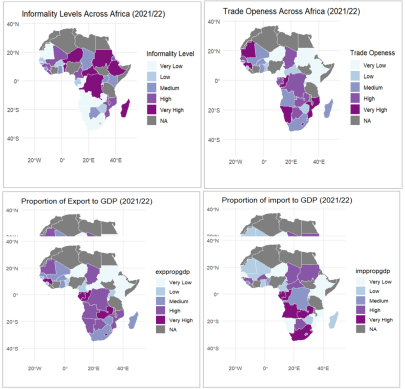
Figure 3. Informality, trade openness, exports to GDP ratio and imports to GDP ratio in Sub-Saharan Africa.
The study draws on data from 31 countries, primarily based on the availability of data for the variables of interest. These countries include Angola, Benin, Botswana, Burkina Faso, Burundi, Cameroon, Central African Republic, Chad, Democratic Republic Congo, Congo Republic, Cote d’Ivoire, Ethiopia, The Gambia, Ghana, Guinea, Kenya, Lesotho, Madagascar, Mali, Mauritania, Mauritius, Mozambique, Namibia, Niger, Rwanda, Senegal, South Africa, Sudan, Togo, Uganda, and Zambia. The panel spans the years 2000 to 2020. Although the time range spans 21 years, the number of time series observations in the panel is limited to eight, as constrained by the published data on the informality index by .
The data on informality, as published by Asllani et al. (2024) is presented in terms of 3-year non-overlapping ranges from 2000 to 2020, with the last range spanning 2021-2022 . The data for the other variables are obtained from the World Bank Development Index. The summary statistics indicate that the informality index ranges from 8.65 to 80.72, a vast range reflected in a standard deviation of 14.75 and an average of 39.1. Meanwhile, trade openness averages 46.1 billion USD across the sampled countries and the period covered. This is nowhere near the median, given the minimum of 1.04 billion USD and the maximum of 664 billion USD, hence demonstrating a higher level of inequality in the sample with a high standard deviation.
The summary statistics for all other control variables are shown in Table 1. The pairwise correlation in Table 2 indicates that the correlation between the independent variables and the dependent variable is moderate, mainly, which is higher than expected when compared to the pairwise correlations among the independent variables. All pairwise correlations are less than 0.6, indicating that there is no strong relationship between the independent variables; therefore, the fear of multicollinearity is reduced. This is confirmed by the Variance Inflation Factor (VIF) tested on the pooled regression, which shows that the individual variables and the combined average are all less than 5.
3.2. Empirical Strategy
We rely on the dynamic system GMM model proposed by Arellano et al. (1995) and Blundell et al (1998) to investigate the effects of trade openness on the size of the shadow economy in Sub-Saharan African countries. Thus, we specify the following dynamic panel regression model:
INTit=α+γINFit-1+βTOPit+j=1kδXj,it+μit, j=1,,n;;t=1, ,T(1)
where, INFit denotes the size of informal economy for country i over period t; INFit-1 represents the one-period lag value of the size of informality for country i over period t - 1; TOPit is the level of trade openness for country i over period t; Xj,it is the set of control variables for country i over period t while j is the number of included control variables. The set of control variables includes the ratio of exports of goods and services to GDP; the ratio of imports of goods and services to GDP; tax revenue; inflation, literacy rate, regulatory quality, GDP per capita and government effectiveness. Indeed, the first two control variables enable us to account for the size of external exposure through trade in goods and services and how this impacts the size of the informal sector, while tax revenue captures the size of the formal economy through the lens of fiscal compliance. The other two control variables relate to the effects of literacy/awareness of fiscal obligations and the quality of regulatory institutions, while the last two account for the size of the economy scaled by the population and the effectiveness of government. We assume a country-specific fixed effect for the error term specified as:
μit=εi+νit(2)
where μit is the disturbance error term. It also includes εi, which denotes time invariant country specific fixed effects while νit is assumed to be independent and normally distributed with zero 0 mean and constant variance σν2 both over time and across countries. Hence, σν2 approximates to n0,σν2. Given our objective, which is to examine the impact of trade openness on informality, we use a dynamic panel estimation technique within the system-GMM framework. As such, the use of a lagged dependent variable in the list of independent variables negates the orthogonality assumption because the lagged dependent variable INFit-1 depends on μit-1, which is derived from μit. Hence, given that μit=μi+νit, it follows that EINFit-1μit0. To control for country-specific effects, Eq. (1) may be restated as:
InINFit=α+γΔInINFit-1+ βΔInTOPit+j=1kδΔInXj,it+Δνit(3)
4. Results and Discussions
The primary objective of this study is to examine the impact of trade openness on the size of the shadow economy in Sub-Saharan Africa. The results for the three models are presented in Table 3 below. For Model 1, the key independent variable is the proportion of export of goods and services to GDP; for Model 2, it is the proportion of export of goods and services to GDP, and trade openness is used as the key independent variable in Model 3. All three models are estimated using the dynamic system GMM as specified in the previous section.
The diagnostic tests of all three models confirm that the serial correlation in the error terms is not second order, given that the p-values of the AR (2) tests are all greater than 0.05, hence not significant at a 5%significance level. The number of instruments for all three models is less than the number of cross-sectional units (countries) employed for the analysis. The results of the Sargan Over-identification test validate the instruments used, as the p-values are all greater than 0.05, indicating significance at the 5% level. The Wald test results, with significance at the 1% level for all three models, suggest that the explanatory variables collectively explain a significant portion of the variation in the dependent variable across the three models. Finally, the Pesaran Cross-sectional Dependence test, with insignificant p-values across the three models, also confirms that there is no cross-sectional dependence that could bias the estimators. We, therefore, perceive the estimators as robust and reliable enough for policy inferences.
The results show that the effect of trade openness on informality is heterogeneous. While imports increase informality positively and significantly, exports and trade openness reduce it significantly. This appears to be a sharp contrast between these ideal proxies of trade openness. However, this paradox can be explained in terms of structural, institutional, and sectoral dynamics, particularly in developing economies such as those found in many parts of Africa. On one hand, imports can increase informality due to the competition with cheap foreign goods. The influx of cheap imports (mainly from low-cost producers like China or India) may undercut local formal producers, such that small firms that are unable to compete may move into the informal sector to survive (e.g., avoid taxes, regulation, labour standards).
The Competitive Displacement and Coexistence Principles validate this assertion, and Dix-Carneiro et al. (2021) provide empirical support for it . Dix-Carneiro et al. (2021) present a structural model for Brazil, demonstrating that import competition prompts low-productivity formal firms to transition into informality . In addition, weak trade adjustment policies, such as weak social safety nets and re-skilling programs, in many developing countries could lead to continuous imports by firms that 7 fall short and cannot easily transition into new formal settings.
On the other hand, exports in particular and trade openness in general will reduce informality because export sectors are usually more regulated, and exporters are more likely to formalize operations to meet international standards and comply with labor and tax laws to access global markets. Moreover, export sectors tend to have higher productivity and more capital investment, which can lead to higher wages, attract formal contracts, and disseminate formal business practices throughout supply chains. Dix-Carneiro et al. (2021) empirically shows that trade openness significantly reduces informal employment in the tradable sector but may increase it modestly overall due to expansion in non-tradable sectors . Other empirical studies had mixed findings. These include the IMF working paper, which shows that some countries experienced declines in informal work after liberalization (e.g., Brazil, Vietnam), while others saw increases in informality or self-employment (e.g., Botswana), where formal jobs weren’t readily available . Additionally, the World Bank provides micro-level evidence on trade reform, showing that trade liberalization in India and Latin America yielded productivity gains in surviving firms but also led to market exit among the least productive, many of which slipped into informality.
The heterogeneous effects of import, export, and trade openness on the size of informality in African countries imply the need for countries to position themselves strategically to optimize the outcomes. The findings support export-linked productivity gains, beyond their contribution to foreign exchange accounts, the creation of jobs domestically, and an increase in national income, among other benefits. Hence, the need to improve export-oriented formalization, strengthen institutional quality, and promote inclusive sectoral development. It also means that adequate social safety nets must be put in place to facilitate seamless adjustments for firms that no longer qualify for informality so that they can be fully reintegrated. The findings also generally indicate that trade volumes should not be assumed to reduce informality, especially in Africa; policy recommendations must be derived from empirical findings that show which aspects of trade liberalization reduce the informal sector and how to minimize it.
The results of the control variables are similar across the three models, further indicating the robustness of the model and results. Tax revenue as a percentage of GDP, inflation, literacy rate and regulation quality are significant determinants of the informal economy at least at a 10% significance level. While tax revenue, literacy rate and regulation quality reduce informality as expected, inflation increases it. Stronger fiscal capacity implies better government services, such as infrastructure, education, and healthcare, which reduce the incentives to remain informal. Also, governments with higher tax-to-GDP ratios often have more resources to monitor economic activity, enforce compliance and simplify tax administration (e.g., e-filing, tax identification numbers).
Joshi (2014) posit that greater tax effort strengthens state–citizen accountability and encourages formal participation . The International Monetary Fund (2015) states that higher tax revenue is linked to lower informality across many developing countries . Meanwhile, the literacy rate is more likely to decrease informality because literate individuals are more likely to understand business regulations, formal registration procedures, and the long-term benefits of formalization. Education also correlates with higher productivity and innovation, which makes firms more viable in the formal sector. La Porta et al. (2014) opined that educational attainment directly influences the formalization of firms and formal labor market participation, especially among small businesses and self-employed individuals .
Similarly, regulatory institutional quality decreases informality because strong institutions provide efficient legal frameworks, characterized by predictable and fair enforcement of regulations, as well as lower bureaucratic costs associated with formalization. According to Friedman et al. (2000), bureaucratic inefficiencies and corruption at the local level correlate with larger informal sectors . Finally, inflation causes economic uncertainty and erodes real incomes, so firms may opt for informality to avoid rising costs, especially labor and compliance costs indexed to inflation. Inflation also erodes trust in formal financial systems and contracts, prompting firms and workers to shift toward more flexible, cash-based, and informal arrangements.
Figure 3 presents a descriptive overview of the distribution of average informality and trade indicators during the study period. The study’s findings are supported to a reasonable extent. Djibouti is the country with the smallest informal economy and has the highest export proportion to GDP, as well as the highest trade openness. The following five countries, which have the lowest levels of informality, such as Namibia, Mauritania, the Democratic Republic of Congo, Angola, and Zambia, are also among the seven countries with the highest levels of trade openness and exports. Conversely, three of the five countries with the highest levels of informality– Sudan, Ethiopia, and Burundi- have the least trade openness across Africa. Although South Africa is the highest importer and the country with the second-lowest informality, it has an average export proportion and trade openness when compared to the other countries sampled.
Table 1. Summary Statistics of the Variables.

Variables

Obs.

Mean

Std. Dev.

Min

Max

Informality Index

248

39.1

14.75

8.65

80.72

Trade Openness (Billion USD)

248

46.1

95.9

1.04

664

Tax Revenue (% GDP)

160

15.12

7.32

2.59

37.16

Exports of goods and services (% of GDP)

243

28.19

14.89

1.91

79.7

Imports of goods and services (% of GDP)

242

36.82

16.11

10.55

110

GDP per Capita

248

1606

2002.4

116.77

10685.9

Inflation (CPI)

245

10.31

28.4

-4.743

301.78

Government Effectiveness

248

-0.70

0.597

-1.82

1.04

Regulation Quality

248

-0.57

0.573

-1.77

1.163

Literacy Rate

201

58.95

20.13

14

95

Source: Authors’ computation of data from World Bank Development Index and .
Table 2. Pairwise Correlation of Variables.

Variables

(1)

(2)

(3)

(4)

(5)

(6)

(7)

(8)

(9)

(10)

Informality Index

1

Trade Openness

-0.29

1

Tax Revenue (% GDP)

-0.51

0.19

1

Exports of goods and services (% of GDP)

-0.50

0.04

0.37

1

Imports of goods and services (% of GDP)

-0.26

-0.19

0.49

0.54

1

GDP per Capita

-0.48

0.46

0.43

0.48

0.15

1

Inflation (CPI)

0.19

-0.01

-0.08

-0.07

-0.05

-0.08

1

Government Effectiveness

-0.49

0.24

0.57

0.22

0.18

0.68

-0.18

1

Regulation Quality

-0.51

0.22

-0.55

0.21

0.13

0.67

-0.24

0.93

1

Literacy Rate

-0.35

0.34

0.46

0.34

0.11

0.55

0.05

0.41

0.42

1

Source: Authors’ computation of data from World Bank Development Index and .
Table 3. Effect of International Trade on Informality in Sub-Saharan Africa.

Description

Independent Variable – International Trade Proxies

Model 1

Model 2

Model 3

Export

Import

Trade Openness

Informality Index (-1)

1.045**

(0.4237)

2.233***

(0.709)

2.327***

(0.8788)

Informality Index (-2)

0.8763***

(0.318)

1.175***

(0.416)

1.567***

(0.5037)

Exports of goods and services (% of GDP)

0.365***

(0.117)

Imports of goods and services (% of GDP)

0.143**

(0.064)

Trade Openness

5.790*

(3.0237)

Tax Revenue (% GDP)

0.405

(0.281)

1.139***

(0.352)

1.166***

(0.399)

Inflation (CPI)

0.373*

(0.201)

0.249

(0.191)

0.4606**

(0.214)

Literacy Rate

0.237**

(0.107)

0.520***

(0.148)

0.3555**

(0.141)

Regulation Quality

16.56**

(6.985)

15.05*

(8.728)

21.59***

(8.1844)

Government Effectiveness

6.231

(5.668)

1.2

(0.064)

12.446

(7.8181)

GDP per capita growth rate

0.0201

(8.660)

Constant

67.74***

(14.758)

112.526

(25.766)

238.52**

(98.034)

Test for AR(1) errors – z

-2.074

[0.038]

-1.197

[0.231]

-2.5829

[0.0098]

Test for AR(2) errors – z

-1.194

[0.232]

-0.1155

[0.908]

-0.0807

[0.9357]

Sargan Over-Identification Test

7.4736

[0.1877]

6.686

[0.245]

9.6885

[0.0846]

Pesaran CD test for CSD

1.1469

[0.2514]

-1.879

[0.0602]

1.8575

[0.0632]

Wald Joint Test

42.515

[0.0000]

31.399

[0.0003]

49.0234

[0.0000]

Number of Observations

105

103

106

Number of Instruments

14

15

14

Source: Authors’ computation of data from World Bank Development Index and .
Notes: Standard errors are in parentheses, ().
Probability Values in brackets, []
*** p<0.01, ** p<0.05, * p<0.1.
5. Conclusion and Policy Recommendations
The shadow economy poses a major challenge to governance, trade openness, and the effectiveness of institutions in Sub-Saharan Africa. Since many economic activities happen outside formal regulations, it is important to understand what this means for border management and regional integration. Tackling the shadow economy can help open up trade, strengthen institutions, and support sustainable economic growth in the region. Sub-Saharan Africa has significant informal cross-border trade. While this helps people earn a living, it also weakens formal economic systems. These informal activities often involve smuggling and tax evasion, resulting in governments losing potential revenue . To address this, it is important to both formalize these activities where possible and create policies that reduce their negative effects while making trade more open. For example, simpler and cheaper customs procedures could encourage informal traders to use official channels .
Another important issue is the link between illegal activities and insecurity, especially terrorism, which has been increasingly affecting trade routes in Sub-Saharan Africa . Managing borders and security requires a broad policy approach that goes beyond just enforcement and takes social and economic factors into account. If governments improve border security and institutional responses without addressing the root causes of the shadow economy, this could make things worse for local communities . The rationale for investigating the relationship between international trade and the size of the informal economy could hinge on four key cardinal points: employing trade as a channel for regulation and standards, improving revenue mobilization and tax base, addressing inequality and vulnerability, and its impact on the labor markets. Participation in international trade typically requires compliance with formal standards, documentation, and regulatory procedures, which may incentivize informal firms to formalize. However, trade liberalization could increase competition without adequate support for small firms, potentially leading to an increase in informality.
In addition, trade policies may impact tax structures; therefore, it is necessary to understand whether openness contributes to the expansion or contraction of the informal sector and its implications for fiscal sustainability. Furthermore, if trade disproportionately benefits capital-intensive or urban formal sectors, it may exacerbate inequality unless accompanied by policies that support informal workers and firms. Finally, an export-driven expansion in formal sectors may absorb informal workers, while import competition can lead to job losses and push workers into the informal economy. Exploring these dynamics is therefore crucial for designing inclusive trade policies and triggering structural transformation and formalization. The study therefore employed the system General Method of Moments to assess the impact of international trade, proxied by export, import and trade openness, on the size of the informal economy.
The results show that, while the proportion of imports to GDP significantly increases the size of the informal economy, the proportion of exports to GDP and trade openness both significantly reduce the size of the informal economy. This finding, in a sense, further supports export promotion policies, as it encourages the formalization of the economy and potentially reduces inequality. The findings further show that, while tax revenue, literacy rate and regulation quality reduce informality, inflation increases it. Again, underscoring why African countries should improve their literacy rates, regulatory quality, and tax revenue mobilization, while guarding against inflation. This finding is equally relevant in the context of the AfCFTA, given the significant size of informality in most African countries and the opportunities that informal firms may not utilize if they are not regularized. The study therefore recommends the following key policies derived from its findings.
Thus, when countries open up trade, they need to consider how informal trade networks work, especially in places where bureaucracy and corruption are problems. Working with informal traders helps policymakers understand their needs and find ways to strengthen institutions. By recognizing the role of the informal sector, trade policies can support sustainable growth and include important economic contributors . It is also important to look at how global events like the COVID-19 pandemic have affected the informal economy, Koti (2022) and Price (2020) found that pandemic rules were especially hard on small-scale and informal traders in Zimbabwe . This suggests that during crises, governments need flexible policies to address the challenges informal workers face. Policymakers can help these sectors become more resilient by offering social protection and better access to resources, so they are better prepared for future shocks.
The role of women in the informal economy is important. Rets’epile (2024) highlight the need for policies that support women involved in informal trade . Including gender perspectives in economic policies can help governments leverage the informal sector and improve trade and economic resilience in border areas. A broad approach that includes formalization, security, and inclusion can improve border management in Sub-Saharan Africa. For example, involving local stakeholders in decision-making can make policies to integrate the informal sector more effective . When local communities participate in policy discussions, it becomes easier to identify their challenges and develop solutions that meet their specific needs. These issues are closely connected. The informal economy is not just a result of weak institutions; it can also be a way for people to overcome broader barriers in Sub-Saharan Africa. Inclusive policies can address these challenges holistically, making trade more open and improving how institutions operate .
Addressing the complexities of the shadow economy, promoting open trade, and improving institutions are all important for better border management in Sub-Saharan Africa. Moving toward formal economic systems, improving security, involving local people, and supporting women are key parts of a strong policy plan. Ongoing research should keep exploring these links to create effective strategies for lasting economic growth in the regions, civil society, and the private sector to ensure that the lessons learned from informal trade practices can inform a more integrated and equitable approach to economic management. This collaborative framework can potentially lead to a significant decrease in the shadow economy, ultimately facilitating enhanced trade relations and improved institutional effectiveness across national borders . Through such endeavours, Sub-Saharan Africa can embark on a path toward greater economic integration and resilience in the face of ongoing global challenges.
In conclusion, since imports increase informality, it is crucial to provide phased tariff reductions to allow domestic firms time to adapt and implement temporary safeguard policies for sectors with a high risk of informality. Moreover, African governments can provide support for displaced firms and workers by implementing social protection measures such as unemployment benefits and health coverage. Finally, there is a need to strengthen institutional quality by streamlining business registration and licensing to make formalization low-cost and accessible.
Abbreviations

AfCFTA

African Continental Free Trade Area

DSG-MM

Dynamic System Generalized Method of Moments

MIMIC

Multiple Indicators Multiple Causes Model

SSA

Sub- Saharan Africa

GDP

Gross Domestic Product

Conflicts of Interest
The authors declare that they have no conflicts of interest related to the authorship or publication of this article. There were no financial, professional, or personal relationships that swayed the research, analysis, or findings shared in this study. They have followed all ethical guidelines and academic integrity standards closely, which helps maintain the objectivity and credibility of their work.
Appendix
Table 4. Summary of Empirical Studies on the Shadow Economy, Trade Openness, and Institutional Effectiveness in Developing Regions.

Author(s)

Region

Variable used

Methodology

Key Findings

Idris et al. (2024)

Sub Saharan Africa

Informality (shadow economy), Trade Openness, Tax Revenue

Pooled OLS panel (1991–2017)

Shadow economy negatively affects tax revenue; trade openness positive effect on tax revenue.

Akande et al. (2025)

West Africa (SSA)

Informality, Regulatory Efficiency, Trade Openness, Tax Revenue

Panel FE/RE regression (2011–2022)

Informality reduces tax revenue; regulatory quality mitigates this effect; trade openness boosts revenue

Hassan (2024)

Southern Africa

Shadow economy, Regulatory Quality, (Financial inclusion proxy), GDP per Capita

DCCE / DSUR dynamic panel (1993–2022)

Mobile financial services and better regulatory quality reduce shadow economy scale

Medina et al. (2017) – IMF Working Paper

Sub Saharan Africa

Informality (percent of GDP), GDP per capita, Literacy proxy (human capital), Governance indicators

MIMIC & predictive mean matching (1993–2016)

SSA has high informality levels; higher literacy/human capital associated with lower informal economy

Ghura (1998) – IMF Working Paper

Sub Saharan Africa

Trade Openness, Inflation, GDP per Capita, Human Capital (literacy proxy), Tax Revenue

Cross country regression (1985–96)

Tax/GDP increases with income, openness, human capital, and lower inflation; weak institutions undermine revenue

Bettencourt & Marchio (2023)

Sub Saharan Africa

Informality (informal settlements proxy), Literacy/human development indicators

Geospatial block level analysis

Higher informality correlates with lower literacy / development indicators.

Chu Khanh (2019)

Global sample including Asia, SSA, Latin America

Institutional quality, informality (informal borrowing), education/literacy proxy

Cross country micro survey of 131 countries

Better institutions reduce underground informal borrowing, especially in low income countries.

Elgin & Oztunali (2014)

Mixed (Asia, Latin America)

Shadow economy, Trade Openness, Institutional Quality, GDP per Capita, Corruption/Inflation proxies

Panel econometrics

Strong institutions and trade openness reduce informal sector; inflation and weak governance increase it

Ajide & Ojeyinka (2023)

Sub Saharan Africa

Shadow economy, Trade Openness, Tax Revenue, Regulation Quality, GDP per Capita

Panel regression (fixed effects) on African countries

Trade openness slightly reduces shadow economy; poor regulatory quality and low tax revenue linked to larger informality (reviewed in broader study context)

Esaku (2021)

Uganda (SSA)

Shadow economy, Trade Openness, Tax Revenue, Inflation

ARDL & GMM time series analysis (1990–2018)

Trade openness has ambiguous short run effect; overall higher openness reduces informality in the long run; shadow economy erodes tax revenue and fiscal capacity

Medina, Jonelis & Cangul (2017)

Sub Saharan Africa

Informality (latent), GDP per Capita, Literacy (human capital), Governance, Trade openness proxies

MIMIC modeling using country panel (1993–2016)

Higher human capital (literacy), GDP and stronger governance correlate with smaller informal economy

Loayza & Rigolini (2006)

Cross region incl. Latin America, Africa, Asia

Informality (shadow), Regulation Quality, GDP per Capita, Trade Openness, Tax Burden

World Bank PRWP econometric models

Stricter regulation and excessive tax burden increase informality; openness and higher income reduce it

Owolabi et al. (2025)

Sub Saharan Africa

Tax Revenue, Trade Openness, Governance Quality, FDI, GDP per Capita

Panel econometric models

Trade openness and GDP growth boost tax revenue; governance quality non significant but essential in reforms

Canh et al. (2020)

Mixed developing nations (including Asia, SSA, Latin America)

Shadow economy, Institutional Quality (regulation/governance), Trade Openness, GDP per Capita

Panel econometrics, instrumental variables on global sample

Better regulation strongly reduces shadow economy; trade openness has weaker negative effect; lower GDP per capita associated with larger informality

Source: Authors’ Computation.
References
[1] ABDYCHEV, A., ALONSO, C., ALPER, M. E., DESRUELLE, M. D., KOTHARI, S., LIU, Y., PERINET, M., REHMAN, S., SCHIMMELPFENNIG, M. A. & SHARMA, P. 2018. The future of work in sub-Saharan Africa, International Monetary Fund.
[2] ADEGBOYEGA, S. B., OGEDE, J. S., ODUSANYA, I. A., AJAYI, F. O. & ATOYEBI, O. E. 2022. DISAGGREGATED TRADE OPENNESS ON SHADOW ECONOMY IN NIGERIA: DOES INSTITUTIONAL QUALITY MATTER? Jurnal Ekonomi dan Bisnis Airlangga, 32.
[3] ADEKUNLE, B. & FILSON, G. 2024. Trade Facilitation: Understanding the Political Economy of Non-Tariff Barriers in Sub-Saharan Africa. Africa’s Trade, 257.
[4] AJIDE, F. M. & DADA, J. T. 2024. Globalization and shadow economy: a panel analysis for Africa. Review of Economics and Political Science, 9, 166-189.
[5] AKANDE, R. S., HAMMED, O. A., SHITU, A. M. & YUSUF, Y. T. 2025. Regulatory Efficiency and Informal Economy: Impact on Tax Revenue in West Africa. African Journal of Management and Business Research, 18, 199-217.
[6] ARELLANO, M. & BOVER, O. 1995. Another look at the instrumental variable estimation of error-components models. Journal of econometrics, 68, 29-51.
[7] ASLLANI, A., DELL'ANNO, R. & SCHNEIDER, F. 2024. Mapping the Informal Economy Around the World with an Enhanced MIMIC Approach: New Estimates for 110 Countries from 1997-2022. CESifo Working Paper.
[8] AZAM, J. P. 2007. Trade, Exchange Rate, and Growth in Sub-Saharan Africa, Cambridge University Press.
[9] BETTENCOURT, L. & MARCHIO, N. 2023. Street access, informality and development: A block level analysis across all of sub-Saharan Africa.
[10] BLANTON, R. G., EARLY, B. & PEKSEN, D. 2018. Out of the shadows or into the dark? Economic openness, IMF programs, and the growth of shadow economies. The Review of International Organizations, 13, 309-333.
[11] BLUNDELL, R. & BOND, S. 1998. Initial conditions and moment restrictions in dynamic panel data models. Journal of econometrics, 87, 115-143.
[12] CANH, P. N., SCHINCKUS, C. & DINH THANH, S. 2021. What are the drivers of shadow economy? A further evidence of economic integration and institutional quality. The Journal of International Trade & Economic Development, 30, 47-67.
[13] CARMODY, P., KRAGELUND, P. & REBOREDO, R. 2020. Africa's shadow rise: China and the mirage of African economic development, Bloomsbury Publishing.
[14] CHALFIN, B. 2001. Border zone trade and the economic boundaries of the state in north-east Ghana. Africa, 71, 202-224.
[15] CHUKWU, C. 2025. The Dual Impact of the Informal Economy on Formal Growth in Nigeria: Evidence from ARDL Bounds Testing. Journal of Economics, Business, and Commerce, 2, 101-111.
[16] CHUKWU, C., VASILEV, A. & SAHA, S. 2024. Measuring Business Cycle Stylized Facts in Selected Oil-Producing Economies: A Comparative Study. Journal of Business Cycle Research, 20, 89-121.
[17] DIAO, X. & MCMILLAN, M. 2014. Towards Understanding Economic Growth in Africa.
[18] DIX-CARNEIRO, R., GOLDBERG, P., MEGHIR, C. & ULYSSEA, G. 2021. Trade and informality in the presence of labor market frictions and regulations. Economic Research Initiatives at Duke (ERID) Working Paper.
[19] ELGIN, C. & OZTUNALI, O. 2014. Institutions, informal economy, and economic development. Emerging Markets Finance and Trade, 50, 145-162.
[20] ERNST, C. & LEUNG, V. 2023. Trade and informality: transition to formality and decent work. Integrating trade and decent work. ILO.
[21] ESAKU, S. 2021. The long-and short-run relationship between the shadow economy and trade openness in Uganda. Cogent Economics & Finance, 9, 1930886.
[22] FIELDS, G. S. 2004. Dualism in the labor market: A perspective on the Lewis model after half a century. The Manchester School, 72, 724-735.
[23] FRIEDMAN, E., JOHNSON, S., KAUFMANN, D. & ZOIDO-LOBATON, P. 2000. Dodging the grabbing hand: the determinants of unofficial activity in 69 countries. Journal of public economics, 76, 459-493.
[24] GALLIEN, M. 2020. Informal institutions and the regulation of smuggling in North Africa. Perspectives on Politics, 18, 492-508.
[25] GHURA, M. D. 1998. Tax revenue in Sub-Saharan Africa: Effects of economic policies and corruption, International Monetary Fund.
[26] GILLANDERS, R. & PARVIAINEN, S. 2018. Corruption and the shadow economy at the regional level. Review of Development Economics, 22, 1729-1743.
[27] GNANGNON, S. K. 2023. Effect of the shadow economy on tax reform in developing countries. Economies, 11, 96.
[28] GOLUB, S. 2015. Informal cross-border trade and smuggling in Africa. Handbook on trade and development. Edward Elgar Publishing.
[29] HARTMANN, V. & WACKER, K. M. 2023. Poverty decompositions with counterfactual income and inequality dynamics. Review of Development Economics, 27, 1746-1768.
[30] HARVIE, C. & LEE, H. H. 2003. Export‐led industrialization and growth: Korea's economic miracle, 1962–1989. Australian Economic History Review, 43, 256-286.
[31] HASSAN, A. 2024. Mobile Financial Services and the Shadow Economy in Southern African Countries: Does Regulatory Quality Matter? International Journal of Financial Studies, 12.
[32] IDRIS, A. A., YUSUF, I., EKUNDAYO, O. O. & ABDULATEEF, Y. 2024. Impact of Shadow Economy on Tax Revenue in Sub-Saharan Africa. FUDMA Journal of Accounting and Finance Research [FUJAFR], 2, 1-10.
[33] JOSHI, A., PRICHARD, W. & HEADY, C. 2014. Taxing the informal economy: The current state of knowledge and agendas for future research. The Journal of Development Studies, 50, 1325-1347.
[34] KHANH, L. C. 2019. The effects of institutional quality on formal and informal borrowing across high-, middle-, and low-income countries.
[35] KOTI, F. T. 2022. Resilience amid uncertainty: COVID-19 pandemic, the urban informal sector, and livelihoods in sub-Saharan Africa. The Geographies of COVID-19: Geospatial Stories of a Global Pandemic. Springer.
[36] LA PORTA, R. & SHLEIFER, A. 2014. Informality and development. Journal of Economic Perspectives, 28, 109-126.
[37] LEWIS, W. A. 1954. Economic development with unlimited supplies of labour.
[38] LIN, J. Y. 2011. New structural economics: A framework for rethinking development. The World Bank Research Observer, 26, 193-221.
[39] LOAYZA, N. & RIGOLINI, J. 2006. Informality trends and cycles, World Bank Publications.
[40] MCMILLAN, M., RODRIK, D. & VERDUZCO-GALLO, Í. 2014. Globalization, structural change, and productivity growth, with an update on Africa. World development, 63, 11-32.
[41] MEAGHER, K. 2003. A back door to globalization? Structural adjustment, globalization & transborder trade in West Africa. Review of African Political Economy, 30, 57-75.
[42] MEAGHER, K. 2024. A back door to globalization? Structural adjustment, globalization & transborder trade in West Africa (2003). Capitalism and Economic Crime in Africa. Routledge.
[43] MEDINA, L., JONELIS, M. A. W. & CANGUL, M. 2017. The informal economy in Sub-Saharan Africa: Size and determinants, International Monetary Fund.
[44] NEUWIRTH, R. 2012. Stealth of nations: The global rise of the informal economy, Anchor.
[45] NKEMGHA, G. Z. 2023. In the dark or out of the shadows? Trade liberalization and underground economies in Sub-Saharan Africa. Journal of Economic Integration, 38, 147-170.
[46] NWOSU, J. & FOLARIN, O. 2025. Bridging the formality divide: A cross-national analysis of economic informality determinants. Journal of Business and Economic Options, 8, 1-9.
[47] OWOLABI, S. A., ADEGBIE, F. F., BARTHOLOMEW, J. M., OGUNDAJO, G. O. & KWARBAI, J. D. 2025. Foreign Investment and Tax Revenue in Sub-Sahara African Countries. European Journal of Business and Management Research, 10, 13-19.
[48] PRICE, R. 2020. Impacts of COVID-19 regulatory measures on small-scale and informal trade in Zimbabwe.
[49] RETS’EPILE, C. K. & MATAMANDA, A. R. 2024. Women in the urban informal economy and pathways towards inclusive cities. Pandemic Recovery?: Edward Elgar Publishing.
[50] ROGERSON, C. M. 2016. South Africa’s informal economy: Reframing debates in national policy. Local Economy, 31, 172-186.
[51] SCHNEIDER, F. & ENSTE, D. H. 2000. Shadow economies: Size, causes, and consequences. Journal of economic literature, 38, 77-114.
[52] SHAW, M., REITANO, T. & EXCHANGE, S. K. 2014. The political economy of trafficking and trade in the Sahara: Instability and opportunities.
[53] TEMPLE, J. 2005. Dual economy models: A primer for growth economists. The Manchester School, 73, 435-478.
[54] The International Monetary Fund, 2015. Current Challenges in Revenue Mobilization: Improving Tax Compliance.
[55] TODARO, M. P. & SMITH, S. C. 2009. Economic development, Pearson education.
[56] UBBA KODERO, C. 2020. Development without borders? Informal cross-border trade in Africa. The Palgrave handbook of African political economy. Springer.
[57] UDO, O. & AGBAI, E. 2024. Terrorism in Sub-Saharan Africa and the illegal financial inflows: The nexus. Journal of Political Science and Leadership Research, 10, 18-36.
[58] VOLLRATH, D. 2009. The dual economy in long-run development. Journal of Economic Growth, 14, 287-312.
[59] VOTO, T. P. & NGEPAH, N. 2025. Persistent Income Inequality in Sub-Saharan Africa: The Role of Institution Index and Effective VAT. Economies, 13, 81.
[60] WEBB, J. W., TIHANYI, L., IRELAND, R. D. & SIRMON, D. G. 2009. You say illegal, I say legitimate: Entrepreneurship in the informal economy. Academy of management review, 34, 492-510.
[61] YAYBOKE, E. K. & GALLEGO, C. G. 2019. Out of the shadows: shining a light on irregular migration, Bloomsbury Publishing PLC.
Cite This Article
  • APA Style

    Chukwu, C., Yuni, D. N., Urom, C. (2026). Cracks in the Border: The Shadow Economy, Trade Openness, and Institutional Effectiveness in Sub-sahara Africa. International Journal of Economics, Finance and Management Sciences, 14(1), 79-93. https://doi.org/10.11648/j.ijefm.20261401.17

    Copy | Download

    ACS Style

    Chukwu, C.; Yuni, D. N.; Urom, C. Cracks in the Border: The Shadow Economy, Trade Openness, and Institutional Effectiveness in Sub-sahara Africa. Int. J. Econ. Finance Manag. Sci. 2026, 14(1), 79-93. doi: 10.11648/j.ijefm.20261401.17

    Copy | Download

    AMA Style

    Chukwu C, Yuni DN, Urom C. Cracks in the Border: The Shadow Economy, Trade Openness, and Institutional Effectiveness in Sub-sahara Africa. Int J Econ Finance Manag Sci. 2026;14(1):79-93. doi: 10.11648/j.ijefm.20261401.17

    Copy | Download

  • @article{10.11648/j.ijefm.20261401.17,
      author = {Chigozie Chukwu and Denis Nfor Yuni and Christian Urom},
      title = {Cracks in the Border: The Shadow Economy, Trade Openness, and Institutional Effectiveness in Sub-sahara Africa},
      journal = {International Journal of Economics, Finance and Management Sciences},
      volume = {14},
      number = {1},
      pages = {79-93},
      doi = {10.11648/j.ijefm.20261401.17},
      url = {https://doi.org/10.11648/j.ijefm.20261401.17},
      eprint = {https://article.sciencepublishinggroup.com/pdf/10.11648.j.ijefm.20261401.17},
      abstract = {Sub-Saharan Africa (SSA) continues to have the world’s largest shadow economy, even as countries work to liberalize trade and reform their institutions. This raises the question of whether opening trade always reduces informality or if it can sometimes make it worse. Our study examines how trade openness affects the size of the shadow economy in SSA. We look at exports, imports, and total trade openness separately, and also consider the influence of institutions and the wider economy. Using data from 31 SSA countries from 2000 to 2020, we apply the Dynamic System Generalized Method of Moments (System-GMM) to address endogeneity and differences between countries. We measure the shadow economy with an improved MIMIC-based index and break down trade into exports-to-GDP, imports-to-GDP, and total trade openness. Our findings show that trade affects informality in different ways. Exports and overall trade openness help reduce the shadow economy, likely because joining global markets encourages countries to follow international standards. In contrast, imports tend to increase informality, possibly because they create more competition for local businesses and make it harder for some firms and workers to stay formal. We also find that stronger institutions, higher literacy, and better tax systems are linked to less informality, while inflation makes it worse. These results suggest that trade openness alone is not enough to reduce informality. It should be combined with strong institutions, export-oriented policies, support for small businesses, and social safety nets. This study can help guide inclusive trade and formalization policies, especially for regional projects like the African Continental Free Trade Area (AfCFTA).},
     year = {2026}
    }
    

    Copy | Download

  • TY  - JOUR
    T1  - Cracks in the Border: The Shadow Economy, Trade Openness, and Institutional Effectiveness in Sub-sahara Africa
    AU  - Chigozie Chukwu
    AU  - Denis Nfor Yuni
    AU  - Christian Urom
    Y1  - 2026/02/04
    PY  - 2026
    N1  - https://doi.org/10.11648/j.ijefm.20261401.17
    DO  - 10.11648/j.ijefm.20261401.17
    T2  - International Journal of Economics, Finance and Management Sciences
    JF  - International Journal of Economics, Finance and Management Sciences
    JO  - International Journal of Economics, Finance and Management Sciences
    SP  - 79
    EP  - 93
    PB  - Science Publishing Group
    SN  - 2326-9561
    UR  - https://doi.org/10.11648/j.ijefm.20261401.17
    AB  - Sub-Saharan Africa (SSA) continues to have the world’s largest shadow economy, even as countries work to liberalize trade and reform their institutions. This raises the question of whether opening trade always reduces informality or if it can sometimes make it worse. Our study examines how trade openness affects the size of the shadow economy in SSA. We look at exports, imports, and total trade openness separately, and also consider the influence of institutions and the wider economy. Using data from 31 SSA countries from 2000 to 2020, we apply the Dynamic System Generalized Method of Moments (System-GMM) to address endogeneity and differences between countries. We measure the shadow economy with an improved MIMIC-based index and break down trade into exports-to-GDP, imports-to-GDP, and total trade openness. Our findings show that trade affects informality in different ways. Exports and overall trade openness help reduce the shadow economy, likely because joining global markets encourages countries to follow international standards. In contrast, imports tend to increase informality, possibly because they create more competition for local businesses and make it harder for some firms and workers to stay formal. We also find that stronger institutions, higher literacy, and better tax systems are linked to less informality, while inflation makes it worse. These results suggest that trade openness alone is not enough to reduce informality. It should be combined with strong institutions, export-oriented policies, support for small businesses, and social safety nets. This study can help guide inclusive trade and formalization policies, especially for regional projects like the African Continental Free Trade Area (AfCFTA).
    VL  - 14
    IS  - 1
    ER  - 

    Copy | Download

Author Information