
 ,
Gore Bi Boh Nestor,
Adjahossou Videdji Naesse,
Dago Lydia Karmelle Ornella,
Yao Kouakou Abessika Georges,
Coulibaly Belechonni François,
Akaffou Doffou Selastique
,
Gore Bi Boh Nestor,
Adjahossou Videdji Naesse,
Dago Lydia Karmelle Ornella,
Yao Kouakou Abessika Georges,
Coulibaly Belechonni François,
Akaffou Doffou Selastique
In Côte d'Ivoire, the cultivation of edible nutgrass (Cyperus esculentus L.) is mainly carried out by Senufo, Djimini, and Lobi women using traditional techniques. Given its importance in terms of food, medicine, and economics, promoting this sector is a major asset in reducing nutritional insecurity. However, the diversity of this crop remains poorly researched. This study aimed to characterize the agromorphological diversity of 27 tigernut accessions from four major production areas (Korhogo, Sinématiali, Dabakala, and Doropo) in a randomized experimental design with three replicates, set up in Bouaflé. Twenty-one morphological and agronomic traits related to growth, flowering, production, and yield were measured. High coefficients of variation (CV > 30%) revealed significant variability between accessions. Hierarchical classification analysis (HCA) structured the accessions into two distinct genetic groups. Group I was characterized by vegetative parameters and formed from accessions from the four study locations. Group II consisted of accessions from Korhogo and Doropo and was characterized by production parameters. Discriminant factor analysis (DFA) identified the number of mature tubers (NMT) and the total number of leaves (TNL) as the most discriminating traits. The results of this study will contribute to the implementation of a genetic improvement program for edible tiger nuts in Côte d'Ivoire.
| Published in | International Journal of Genetics and Genomics (Volume 14, Issue 1) |
| DOI | 10.11648/j.ijgg.20261401.13 |
| Page(s) | 25-38 |
| Creative Commons |
This is an Open Access article, distributed under the terms of the Creative Commons Attribution 4.0 International License (http://creativecommons.org/licenses/by/4.0/), which permits unrestricted use, distribution and reproduction in any medium or format, provided the original work is properly cited. |
| Copyright |
Copyright © The Author(s), 2026. Published by Science Publishing Group |
Cyperus esculentus, Diversity, Morphology, Tiger Nut, Production
Accessions | Origin | Locality | Varieties | Codes |
|---|---|---|---|---|
Accession 1 | Sinementiali | Fononkaha | Large tuber | AC1 |
Accession 2 | Sinementiali | Nabegnikaha | Large tuber | AC2 |
Accession 3 | Sinementiali | Fononkaha | Large tuber | AC3 |
Accession 4 | Sinementiali | Meguekaha | Large tuber | AC4 |
Accession 5 | Sinementiali | Zimekaha | Large tuber | AC5 |
Accession 6 | Sinementiali | Nahouokaha | Large tuber | AC6 |
Accession 7 | Sinementiali | Nogotienekaha | Large tuber | AC7 |
Accession 8 | Korhogo | Toulekaha | Large tuber | AC8 |
Accession 9 | Korhogo | Oleokaha | Large tuber | AC9 |
Accession 10 | Korhogo | Toulekaha | Large tuber | AC10 |
Accession 11 | Korhogo | Toulekaha | Large tuber | AC11 |
Accession 12 | Korhogo | Latiene | Large tuber | AC12 |
Accession 13 | Korhogo | Kafonnonkaha | Large tuber | AC13 |
Accession 14 | Korhogo | Pederikaha | Small tuber | AC14 |
Accession 15 | Korhogo | Toulekaha | Small tuber | AC15 |
Accession 16 | Dabakala | Kongo-Banadougou | Large tuber | AC16 |
Accession 17 | Dabakala | Sokala-Sobara | Large tuber | AC17 |
Accession 18 | Dabakala | Kafoudougou | Large tuber | AC18 |
Accession 19 | Dabakala | Dienagana | Large tuber | AC19 |
Accession 20 | Dabakala | Tagbonon | Large tuber | AC20 |
Accession 21 | Dabakala | Kafoudougou | Large tuber | AC21 |
Accession 22 | Dabakala | Kafoudougou | Small tuber | AC22 |
Accession 23 | Dabakala | Kafoudougou | Large tuber | AC23 |
Accession 24 | Doropo | Nougbara | Large tuber | AC24 |
Accession 25 | Doropo | Olara 1 | Large tuber | AC25 |
Accession 26 | Doropo | Youtedouo | Large tuber | AC26 |
Accession 27 | Doropo | Olara 1 | Large tuber s | AC27 |
Parameters | Average | Median | Minimum | Maximum | SD | CV (%) |
|---|---|---|---|---|---|---|
NFS | 76,23 | 70,50 | 20,00 | 218,00 | 29,45 | 38,63 |
NFJ | 42,34 | 39,00 | 8,00 | 110,00 | 17,62 | 41,61 |
NFPJ | 41,45 | 40,00 | 4,00 | 96,00 | 16,27 | 39,25 |
NTF | 159,58 | 153,00 | 11,00 | 371,00 | 52,59 | 32,96 |
NTAL | 18,10 | 16,00 | 3,00 | 60,00 | 8,57 | 47,35 |
NFPM | 16,69 | 16,00 | 9,00 | 32,00 | 2,75 | 16,49 |
RAFLO | 1,71 | 0,00 | 0,00 | 20,00 | 3,94 | 81,42 |
NEPI | 32,27 | 0,00 | 0,00 | 398,00 | 73,42 | 77,51 |
NDF | 4,44 | 4,00 | 4,00 | 12,00 | 1,17 | 26,42 |
LPLT | 85,68 | 85,00 | 40,00 | 131,00 | 13,30 | 15,53 |
DIACO | 1,17 | 1,00 | 0,40 | 14,00 | 0,75 | 64,56 |
DISP | 9,72 | 10,00 | 4,00 | 82,00 | 3,59 | 36,92 |
LORA | 61,03 | 62,00 | 11,00 | 93,00 | 8,74 | 14,32 |
NTM | 74,33 | 67,00 | 28,00 | 265,00 | 33,00 | 44,40 |
LOT | 2,36 | 2,38 | 1,10 | 4,38 | 0,50 | 21,08 |
LAT | 1,40 | 1,41 | 0,81 | 11,31 | 0,39 | 27,69 |
MTP | 51,79 | 44,25 | 10,06 | 176,27 | 29,67 | 57,28 |
BIOFO | 29,32 | 26,13 | 8,63 | 97,76 | 13,14 | 44,79 |
BIORA | 10,75 | 9,88 | 2,50 | 69,23 | 4,75 | 44,22 |
RED | 18,29 | 15,64 | 3,56 | 62,37 | 10,47 | 57,22 |
M100 | 68,90 | 67,35 | 20,38 | 151,54 | 22,46 | 32,60 |
Characters | NFS | NFJ | NFPJ | NTF | NTAL | NFPM | RAFLO | NEPI | NDF | LPLT |
|---|---|---|---|---|---|---|---|---|---|---|
NFS | 1 | |||||||||
NFJ | 0,26 | 1 | ||||||||
NFPJ | -0,14 | 0,05 | 1 | |||||||
NTF | 0,75 | 0,67 | 0,37 | 1 | ||||||
NTAL | 0,77 | 0,62 | 0,27 | 0,9 | 1 | |||||
NFPM | 0,35 | -0,05 | -0,21 | 0,1 | 0,11 | 1 | ||||
RAFLO | -0,39 | -0,41 | 0,04 | -0,4 | -0,44 | -0,28 | 1 | |||
NEPI | -0,39 | -0,44 | 0,05 | -0,5 | -0,46 | -0,24 | 0,99 | 1 | ||
NDF | -0,31 | -0,48 | -0,08 | -0,5 | -0,47 | -0,22 | 0,97 | 0,98 | 1 | |
LPLT | 0,23 | 0,06 | 0,38 | 0,4 | 0,48 | 0,27 | -0,12 | -0,13 | -0,2 | 1 |
DIACO | 0,42 | 0,51 | 0,18 | 0,6 | 0,7 | 0,24 | -0,37 | -0,4 | -0,4 | 0,59 |
DISP | 0,17 | -0,27 | -0,06 | -0 | 0,04 | 0,03 | 0,16 | 0,15 | 0,16 | 0,26 |
LORA | -0,38 | -0,57 | 0,49 | -0,3 | -0,28 | 0,1 | 0,16 | 0,19 | 0,13 | 0,42 |
NTM | 0,37 | 0,26 | 0,51 | 0,6 | 0,64 | 0,22 | -0,24 | -0,25 | -0,3 | 0,71 |
LOT | -0,35 | -0,56 | 0,44 | -0,3 | -0,37 | -0,08 | 0,52 | 0,54 | 0,5 | 0,17 |
LAT | -0,24 | -0,43 | 0,58 | -0,1 | -0,08 | -0,12 | 0,07 | 0,09 | 0,03 | 0,48 |
MTP | 0,04 | -0,1 | 0,76 | 0,3 | 0,28 | 0,07 | 0,05 | 0,06 | -0 | 0,65 |
BIOFO | 0,52 | 0,32 | 0,39 | 0,7 | 0,76 | 0,31 | -0,24 | -0,25 | -0,3 | 0,83 |
BIORA | 0,54 | 0,42 | 0,37 | 0,7 | 0,75 | 0,34 | -0,3 | -0,3 | -0,3 | 0,52 |
RED | 0,05 | -0,1 | 0,76 | 0,3 | 0,28 | 0,07 | 0,05 | 0,05 | -0 | 0,65 |
M100 | -0,29 | -0,38 | 0,68 | -0,1 | -0,16 | -0,19 | 0,35 | 0,37 | 0,29 | 0,35 |
Characters | DIACO | DISP | LORA | NTM | LOT | LAT | MTP | BIOFO | BIORA | RED | M100 |
|---|---|---|---|---|---|---|---|---|---|---|---|
NFS | |||||||||||
NFJ | |||||||||||
NFPJ | |||||||||||
NTF | |||||||||||
NTAL | |||||||||||
NFPM | |||||||||||
RAFLO | |||||||||||
NEPI | |||||||||||
NDF | |||||||||||
LPLT | |||||||||||
DIACO | 1 | ||||||||||
DISP | 0,17 | 1 | |||||||||
LORA | -0,04 | 0,21 | 1 | ||||||||
NTM | 0,48 | 0,27 | 0,14 | 1 | |||||||
LOT | -0,17 | -0,06 | 0,63 | -0,14 | 1 | ||||||
LAT | 0,13 | 0,23 | 0,7 | 0,41 | 0,48 | 1 | |||||
MTP | 0,29 | 0,15 | 0,45 | 0,74 | 0,42 | 0,76 | 1 | 1 | |||
BIOFO | 0,7 | 0,24 | 0,15 | 0,78 | -0,09 | 0,2 | 0,57 | 1 | |||
BIORA | 0,57 | 0,19 | 0 | 0,66 | -0,22 | -0,02 | 0,33 | 0,79 | 1 | ||
RED | 0,29 | 0,15 | 0,46 | 0,74 | 0,42 | 0,77 | 1 | 0,57 | 0,33 | 1 | |
M100 | 0,01 | 0,09 | 0,59 | 0,21 | 0,76 | 0,8 | 0,78 | 0,12 | -0,13 | 0,78 | 1 |
Principal Component | Axis 1 | Axis 2 |
|---|---|---|
Eigenvalue | 7.33 | 5.94 |
Total variance (%) | 34.90 | 28.29 |
Cumulative variance | 7.33 | 13.27 |
Cumulative total variance (%) | 34.90 | 63.19 |
NTF | -0.85* | -0.23 |
NFS | -0.61 | -0.38 |
NFJ | 0.50 | 0.55 |
NFPJ | -0.45 | 0.65 |
RAFLO | 0.54 | -0.51 |
NEPI | 0.55 | 0.53 |
NDF | 0.60 | -0.44 |
NPFM | -0.30 | -0.13 |
NTAL | -0.88* | -0.25 |
LPLT | -0.70* | 0.43 |
DIACO | -0.76* | -0.08 |
DISP | -0.13 | 0.22 |
NTM | -0.83* | 0.28 |
BIOFO | -0.88* | 0.16 |
BIORA | -0.81 | -0.07 |
LORA | -0.006 | -0.76* |
LOT | 0.24 | 0.79 |
LAT | -0.22 | -0.82* |
MTP | -0.57 | -0.76* |
RED | -0.57 | 0.76* |
M100 | -0.07 | 0.91* |
Group-CAH | NFS | NFPJ | NTF | NTAL | LPLT |
|---|---|---|---|---|---|
GroupI (N=21) | 71,07±17,24 | 38,58±9,46 | 144,18±16,55 | 14,81±2,34 | 83,61±9,76 |
GoupII (N=6) | 94,29±13,38 | 51,52±8,08 | 185,77±19,04 | 23,71±3,24 | 92,93±8,66 |
t | -3,03 | -3,04 | -4,86 | -4,86 | -2,11 |
p | 0,006 | 0,005 | ˂ 0,001 | ˂ 0,001 | ˂ 0,045 |
Group-CAH | NTM | MTP | BIOFO | BIORA | RED |
|---|---|---|---|---|---|
GroupI (N=21) | 67,60±12,27 | 44,95±14,99 | 26,50±6,74 | 10,01±1,97 | 15,86±5,53 |
GoupII (N=6) | 97,86±12,26 | 75,72±18,91 | 39,22±6,52 | 13,32±1,63 | 26,78±1,53 |
t | -5,18 | -4,20 | -4,10 | -3,74 | -4,21 |
p | ˂ 0,001 | ˂ 0,001 | ˂ 0,001 | ˂ 0,001 | ˂ 0,001 |
Group-CAH | NFJ | NFPM | RAFLO | NEPI | NDF |
|---|---|---|---|---|---|
GroupI (N=21) | 40,77±12,00 | 16,69±0,77 | 1,87±2,44 | 35,21±42,68 | 4,49±0,61 |
GoupII (N=6) | 47,86±12,21 | 16,69±0,72 | 1,76±1,53 | 21,97±26,86 | 4,25±0,35 |
t | -1,27 | 0,02 | 0,67 | 0,71 | 0,93 |
p | 0,22 | 0,99 | 0,51 | 0,48 | 0,36 |
Group-CAH | D1ACO | DISP | LORA | LOT | LAT | M100 |
|---|---|---|---|---|---|---|
GroupI (N=21) | 1,13±0,22 | 9,60±0,97 | 61,30±6,72 | 2,38±0,34 | 1,38±5,53 | 66,31±18,06 |
GoupII (N=6) | 1,29±0,1 | 10,16±1,1 | 60,10±6,57 | 2,28±0,50 | 1,50±1,12 | 77,98±19,93 |
t | -1,73 | -1,22 | 0,39 | 0,55 | -1,31 | -1,37 |
p | 0,1 | 0,23 | 0,7 | 0,58 | 0,20 | 0,18 |
Axis | 2 |
|---|---|
Eigenvalue | 1.71 |
Prop-Cum | 1 |
R | 0.79 |
Wilks’ Lambda | 0.37 |
Chi2 | 23.88 |
dl | 2 |
p-value | ˂ 0.001 |
Variance explained (%) | 100 |
Cumulative variance (%) | 100 |
NTM | -0.70* |
NTF | -0.62* |
AC | Accessions |
NFS | Number of Dry Leaves |
NFJ | Number of Yellow Leaves |
NFPJ | Number of Partially Yellow Leaves |
NTF | Total Number of Leaves |
NTAL | Number of Tillers |
NFPM | Number of Leaves of the Mother Plant |
RAFLO | Number of Flowering Branches |
NEPI | Number of Spikelets |
NDF | Number of Last Leaves |
LPLT | Plant Height |
DIACO | Collar Diameter |
DISP | Distance Between Mother Plant and Tillers |
LORA | Root Length |
NTM | Number of Mature Tubers |
LOT | Tuber Length |
LAT | Tuber Width |
MTP | Tuber Mass per Planting Hole |
BIOFO | Leaf Biomass |
BIORA | Root Biomass |
RED | Yield per Hectare |
M100 | Mass of 100 Tubers |
SD | Standard Deviation |
CV | Coefficient of Variation |
| [1] | Koffi B. L., Nemlin G. J., Lefevre S. &Kamenan A Physicochemical characterization and therapeutic potential of sweet tiger nut (Cyperus esculentus L. Cyperaceae). African Agronomy, (2005) 17(1): 63-71. |
| [2] | Koné M., Kaboré S., Bamba S. Role of rural women in tiger nut marketing in Côte d’Ivoire. African Journal of Agricultural Development (2015) 7(3), 51-50. |
| [3] | Kouamé E. P. G., Yapi H. Y. D. P., Ekissi E. S. G., Konan K. H. (2022). Physical parameters of tiger nut (Cyperus esculentus L.) yellow and black varieties harvested in Bondoukou (North-Est, Côte d’Ivoire) (2022) p 9. |
| [4] | Niamketchi G. L. Physicochemical and nutritional values of tiger nut (Cyperus esculentus) oil from three regions of Côte d’Ivoire. Centre National de Recherche Agronomique, (2025) 671-677. |
| [5] | Goré B. B. N., Ehui K. J. B., N’dri K. E., Dago L. K. O., Coulibaly B. F., Gbayoro S. F., Akaffou D. S. (2025). Identification of producers and cultivation areas of African edible tiger nut (Cyperus esculentus L.) in Côte d’Ivoire. 10 pp. (PDF). |
| [6] | Belewu M. A. &Belewu K. Y. Comparative physicochemicalevaluation of tigernut, soybean and coconutmilk. International Journal of Agriculture and Biology, (2007) 9: 785-787. |
| [7] | Zapata S. E., Lôpez F. J. & Alvarez P. A. J. «Tiger Nut (Cyperus esculentus) Commercialization: Health Aspects, Composition, Properties, and Food Applications». The ComprehensiveReviews in Food Science and Food Safety, (2012) 11: 366-377. |
| [8] | Arafat S. M., Gaafar A. M., Basuny A. M. &Nassef S. L. ChufaTubers (Cyperus esculentus L.): As à New Source of Food. World Applied Sciences Journal, (2009) 7(2): 151-156. |
| [9] | Etejeré E. O., Akinboye K. G., Owole A. O. (2018). Processing and utilization of tiger nut (Cyperus esculentus) for human consumption. Journal of food Science and Nutrition, 3(1), 22-29. |
| [10] | Aka B., Koanan N. Y., Aurèle A., Guessan K. N. Nutritional and Sensory Analysis of Milk Processed from Seeds of Sweet Pea (Cyperus esculentus L.) Consumed in Côte d'Ivoire. Journal of Applied Life Sciences International, (2016) 8(2): 1-12. |
| [11] | CIAT. Characterization of early-maturing accessions of edible tiger nut (Cyperus esculentus L.) cultivated in Côte d’Ivoire, presented at the International Confeence on Tropical Agroforestery (2023) p 196. |
| [12] | Hamlmer K., Gladis T., Diederichsen A. Genetic ressources of medecinal and aromatic plants-A worldwide inventory Fedral Centre of Breeding Research on Cultivated plants (2001). |
| [13] | Govindaraj M., Vetriventhan M., Srinivasan M. Importance of genetic diversity for crop improvement. Journal of plant Breeding and genetics, (2015) 3(1), 1-22. |
| [14] | Amanabo M. A., Alikwe P. C., Olatunji L. A. Agromorphological characterization of Cyperus esculentus accessions for crop improvement. Journal of Genetic Plant Improvenant (2017) 5(3), 78-89. |
| [15] | De Vicente M. C. & Fulton T. Genetic diversity analysis using molecular markers. Biodiersity International Technical Manual Series (2020) p 194. |
| [16] | Dagnelie P. (Belgique): Theoretical and Applied Statistics. Volume 1. Descriptive Statistics and Foundations of Statistcal Inference. Third Edition of Bussels Boeck, (2013) 516 p. |
| [17] | Oladeji O. S., Tijani K. O., Adegboyeaga T. T. Morphological variation and nutritional quality of Cyperus esculentus varieties in Nigeria. Journal of Applied Agricural Science, (2019) 14(3), 121-132. |
| [18] | Kowalski R., Krol K., Nowak A. Tiger nut (Cyperus esculentus): Worldwide cultivation, use and potentiel. Industrial Crops & products, (2021) 164, 113435. |
| [19] | BNETD/CCT. National Bureau of Technical Studies and Development and the Center for Cartography and Remote Sensing (2025). |
| [20] | Douka A. M. Food crops from subsistence farming to the market economy in the Gouro area (Central-Western Côte d’Ivoire. (2012). pp. 25–26. |
| [21] | N’da D. H., N’guessan K. E., Wadja E. M. Contribution of remote sensing to the monitoring of deforestation in Marahoue National Park (Côte d’Ivoire), (2008) 34 p. (PDF). |
| [22] | Assoko A. V. S. Design of forecasting tools for hydrological extremes in the West African tropical region: The case of the Marahoue watershed in Côte d’Ivoire, (2022) 240 pp (PDF). |
| [23] | N’guessan B. V.H., Saley M., Oga Y., Yapi A. & Biémi J. Characteristics of hydrological drought in the Marahoue region (Central-Western Côte d’Ivoire). (2017) 74 p. |
| [24] |
StatSoft. STATISTICA, data analysis software. Version 7.1.
www.statsoft.fr (2005). |
| [25] | Hamissou Z., Ibraham A., Seiny B., Hamissou M. A. Agromorphological characterization of sesame accessions (Sesamum indicum L.). Collected in Niger. International Journal of Innovation and Applied Studies (2020) 2028-9324 Vol 902-914. |
| [26] | Dede, E. L., N’da, A. H., Akanvou, L., & Sié, R. S. Agromorphological and botanical diversity of 357 sorghum [Sorghum bicolor (L.) Moench] accessions collected in Côte d’Ivoire. African Agronomy, 32(3) (2020): 297–308. |
| [27] | Kombeleme A. N., Koussao S., Djakaridja T., Tonde H. W., Yamwemba S., Kando B. P. Genetic diversity of genotypes of tiger nuts (Cyperus esculentus L.) using morphological descriptors in Burkina Faso. Int. J. Biosci. Research paper. International Journal of Biosciences | IJB |, (2024) (Print) 2222-5234 Vol. 25, No. 3, p. 21-31. |
| [28] | Sane S., Ngom M., NdoyeF., Niang E., Deme A., Ndiaye C., Diallo B., Cissoko M., Sy O. M. Agromorphological characterization of West African provenances of tiger nut (Cyperus esculentus, L.) for sustainable food and nutritional security in Senegal. Journal of Experimental Biology and Agricultural Sciences Journal of Experimental Biology and Agricultural Sciences, (2025) Volume –13(6) page 829–845. |
| [29] | Asare P. A, Kpankpari R, Adu M. O, Afutu E, Adewumi A. S. Phenotypic characterization of Tiger Nuts (Cyperus esculentus L.) from major growing areas in Ghana. The Scientific World Journal (2020), 1-11. |
| [30] | Twumasi P., Asare A. P., Afutu E., Amenorpe G., Addy T. T. N. S., Premph R., Donkor F. E. Genetic Diversity of Tiger Nuts (Cyperus esculentus L.) Grown in Ghana Based on Morpho-Descriptors and SSR Markers. The Journal of Agricultural Sciences- Sri Lanka, (2024). Vol. 19, No 2, May 2024. Pp 316-335 |
| [31] | Gbemavo, J. C., Gandji, K., Gnangle, P. C., Assogbadjo, E. A., & Kalaï, G. L. R. (2015). Morphological variability and conservation of Jatropha curcas Linn. (Euphorbiaceae) morphotypes in Benin. Journal of Agriculture and Environment for International Development, 109(1): 55–69. |
| [32] | Coskuner Y., Ercan R., Karababa E. &Nazlcan A. N. (2002). "Physical and chemical properties of chu fa (Cyperus esculentus L.) tubersgrown in the Cukurovaregion of Turkey," Journal of the Science of Food and Agriculture, 82(6): 625-631 |
APA Style
Jean-Baptiste, E. K., Nestor, G. B. B., Naesse, A. V., Ornella, D. L. K., Georges, Y. K. A., et al. (2026). Morphological and Agronomic Variability of Edible Tiger Nut (Cyperus esculentus L.) Accessions Cultivated in Côte d’Ivoire. International Journal of Genetics and Genomics, 14(1), 25-38. https://doi.org/10.11648/j.ijgg.20261401.13
ACS Style
Jean-Baptiste, E. K.; Nestor, G. B. B.; Naesse, A. V.; Ornella, D. L. K.; Georges, Y. K. A., et al. Morphological and Agronomic Variability of Edible Tiger Nut (Cyperus esculentus L.) Accessions Cultivated in Côte d’Ivoire. Int. J. Genet. Genomics 2026, 14(1), 25-38. doi: 10.11648/j.ijgg.20261401.13
AMA Style
Jean-Baptiste EK, Nestor GBB, Naesse AV, Ornella DLK, Georges YKA, et al. Morphological and Agronomic Variability of Edible Tiger Nut (Cyperus esculentus L.) Accessions Cultivated in Côte d’Ivoire. Int J Genet Genomics. 2026;14(1):25-38. doi: 10.11648/j.ijgg.20261401.13
@article{10.11648/j.ijgg.20261401.13,
  author = {Ehui Kirioua Jean-Baptiste and Gore Bi Boh Nestor and Adjahossou Videdji Naesse and Dago Lydia Karmelle Ornella and Yao Kouakou Abessika Georges and Coulibaly Belechonni François and Akaffou Doffou Selastique},
  title = {Morphological and Agronomic Variability of Edible Tiger Nut (Cyperus esculentus L.) Accessions Cultivated in Côte d’Ivoire},
  journal = {International Journal of Genetics and Genomics},
  volume = {14},
  number = {1},
  pages = {25-38},
  doi = {10.11648/j.ijgg.20261401.13},
  url = {https://doi.org/10.11648/j.ijgg.20261401.13},
  eprint = {https://article.sciencepublishinggroup.com/pdf/10.11648.j.ijgg.20261401.13},
  abstract = {In Côte d'Ivoire, the cultivation of edible nutgrass (Cyperus esculentus L.) is mainly carried out by Senufo, Djimini, and Lobi women using traditional techniques. Given its importance in terms of food, medicine, and economics, promoting this sector is a major asset in reducing nutritional insecurity. However, the diversity of this crop remains poorly researched. This study aimed to characterize the agromorphological diversity of 27 tigernut accessions from four major production areas (Korhogo, Sinématiali, Dabakala, and Doropo) in a randomized experimental design with three replicates, set up in Bouaflé. Twenty-one morphological and agronomic traits related to growth, flowering, production, and yield were measured. High coefficients of variation (CV > 30%) revealed significant variability between accessions. Hierarchical classification analysis (HCA) structured the accessions into two distinct genetic groups. Group I was characterized by vegetative parameters and formed from accessions from the four study locations. Group II consisted of accessions from Korhogo and Doropo and was characterized by production parameters. Discriminant factor analysis (DFA) identified the number of mature tubers (NMT) and the total number of leaves (TNL) as the most discriminating traits. The results of this study will contribute to the implementation of a genetic improvement program for edible tiger nuts in Côte d'Ivoire.},
 year = {2026}
}
TY  - JOUR
T1  - Morphological and Agronomic Variability of Edible Tiger Nut (Cyperus esculentus L.) Accessions Cultivated in Côte d’Ivoire
AU  - Ehui Kirioua Jean-Baptiste
AU  - Gore Bi Boh Nestor
AU  - Adjahossou Videdji Naesse
AU  - Dago Lydia Karmelle Ornella
AU  - Yao Kouakou Abessika Georges
AU  - Coulibaly Belechonni François
AU  - Akaffou Doffou Selastique
Y1  - 2026/03/04
PY  - 2026
N1  - https://doi.org/10.11648/j.ijgg.20261401.13
DO  - 10.11648/j.ijgg.20261401.13
T2  - International Journal of Genetics and Genomics
JF  - International Journal of Genetics and Genomics
JO  - International Journal of Genetics and Genomics
SP  - 25
EP  - 38
PB  - Science Publishing Group
SN  - 2376-7359
UR  - https://doi.org/10.11648/j.ijgg.20261401.13
AB  - In Côte d'Ivoire, the cultivation of edible nutgrass (Cyperus esculentus L.) is mainly carried out by Senufo, Djimini, and Lobi women using traditional techniques. Given its importance in terms of food, medicine, and economics, promoting this sector is a major asset in reducing nutritional insecurity. However, the diversity of this crop remains poorly researched. This study aimed to characterize the agromorphological diversity of 27 tigernut accessions from four major production areas (Korhogo, Sinématiali, Dabakala, and Doropo) in a randomized experimental design with three replicates, set up in Bouaflé. Twenty-one morphological and agronomic traits related to growth, flowering, production, and yield were measured. High coefficients of variation (CV > 30%) revealed significant variability between accessions. Hierarchical classification analysis (HCA) structured the accessions into two distinct genetic groups. Group I was characterized by vegetative parameters and formed from accessions from the four study locations. Group II consisted of accessions from Korhogo and Doropo and was characterized by production parameters. Discriminant factor analysis (DFA) identified the number of mature tubers (NMT) and the total number of leaves (TNL) as the most discriminating traits. The results of this study will contribute to the implementation of a genetic improvement program for edible tiger nuts in Côte d'Ivoire.
VL  - 14
IS  - 1
ER  -
Plant Production and Improvement, Jean Lorougnon Guede University of Daloa, Daloa, Ivory Coast
Plant Production and Improvement, Jean Lorougnon Guede University of Daloa, Daloa, Ivory Coast
Plant Production and Improvement, University of Dassa Zoume, Dassa Zoume, Benin
Plant Production and Improvement, Jean Lorougnon Guede University of Daloa, Daloa, Ivory Coast
Plant Production and Improvement, Jean Lorougnon Guede University of Daloa, Daloa, Ivory Coast
Plant Production and Improvement, Jean Lorougnon Guede University of Daloa, Daloa, Ivory Coast
Plant Production and Improvement, Jean Lorougnon Guede University of Daloa, Daloa, Ivory Coast
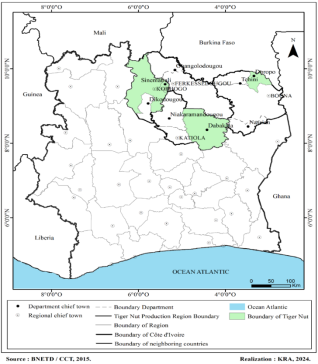
Figure 1. Geographic location of collection areas (Korhogo, Sinementiali, Dabakala, and Doropo) for edible tiger nut samples on a map of Côte d'Ivoire [19].
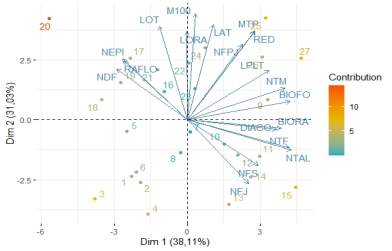
Figure 2. Distribution of the collected accessions based on the measured variables.
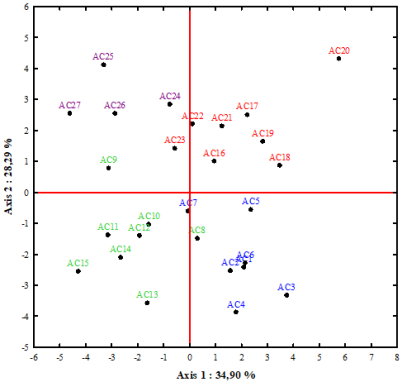
Figure 3. Distribution of the 27 edible tiger nut accessions along the PCA axes.
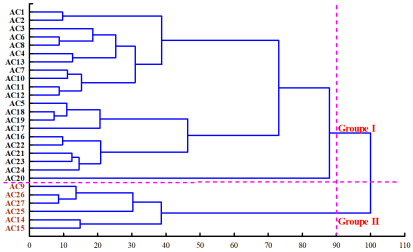
Figure 4. Dendrogram of the 27 tiger nut accessions based on Euclidean distances.

Information


 Share This Article
 Twitter
 Linked In
 Facebook
 Copy
Copy Download