Research Article | | Peer-Reviewed

Antimicrobial Use Practices and Resistance Risk in Cattle Farming in Korhogo, Ivory Coast

Received: 27 November 2025     Accepted: 3 February 2026     Published: 25 February 2026
Views:       Downloads:
Abstract

Cattle farming is a key sector for food and economic security in Côte d'Ivoire. However, inappropriate practices regarding the use of antimicrobials to treat cattle are prevalent among some farmers in several regions of the country. A survey assessing antimicrobial use practices in cattle farming was conducted in the Korhogo department using the Kobocollect digital questionnaire tool. This cross-sectional study of 215 cattle farmers in Korhogo, Côte d'Ivoire, reveals the widespread and unregulated use of antimicrobials in livestock farming. The most frequently used antibiotics were tetracyclines (39.91%) and sulfonamides (23.95%), while the most common antiparasitic agents were diminazene (33.26%) and albendazole (29.3%). These molecules are primarily used to treat conditions such as mastitis, skin infections, digestive disorders, respiratory diseases, foot rot, fluke and trypanosomiasis. Additionally, almost one-third of farmers purchase supplies from markets or street vendors. Of these farmers, 65.9% do not follow dosage instructions, 25% interrupt treatment prematurely, and only 30.8% consult a veterinarian. Around 56.1% of livestock farmers self-medicate to treat parasitic diseases, a practice encouraged by low levels of education, empirical experience and limited access to veterinary services. These practices, combined with a heavy reliance on informal distribution channels, significantly increase the risk of antimicrobial and antiparasitic resistance emerging and spreading in the region. The study therefore highlights the urgent need to strengthen veterinary services, regulate the drug market, and educate livestock farmers in the responsible use of antimicrobials.

Published in International Journal of Microbiology and Biotechnology (Volume 11, Issue 1)
DOI 10.11648/j.ijmb.20261101.13
Page(s) 20-29
Creative Commons

This is an Open Access article, distributed under the terms of the Creative Commons Attribution 4.0 International License (http://creativecommons.org/licenses/by/4.0/), which permits unrestricted use, distribution and reproduction in any medium or format, provided the original work is properly cited.

Copyright

Copyright © The Author(s), 2026. Published by Science Publishing Group

Keywords

Antimicrobial Misuse, Cattle Farming, Self-Medication, Informal Markets, Korhogo

1. Introduction
The use of antimicrobials in livestock farming is crucial for managing herd health, especially in developing countries where agriculture and livestock farming form the backbone of the economy. In cattle production systems, these substances are used to treat infections, prevent disease and boost productivity, helping to meet the growing demand for animal protein . This practice is crucial in regions where environmental and health issues, such as parasite infestations or epidemics, jeopardise the viability of livestock farming. In sub-Saharan Africa, extensive livestock farming predominates, with an increased reliance on medicines to preserve animal health and ensure food security for rural populations . Therefore, studying antimicrobial use practices in these systems is essential for optimising resources and promoting sustainable herd management.
In Africa, livestock farming makes a significant contribution to the rural economy and food security, but it faces challenges relating to the limited availability of skilled veterinary services. Surveys in different African countries reveal that farmers often use antimicrobials to treat common cattle diseases, such as respiratory or digestive infections, without consulting a vet first . In Kenya and Ethiopia, where livestock farming is more extensive, farmers administer these drugs independently, based on informal advice or past experience . The most commonly used classes of antimicrobial include tetracyclines and penicillins, which are administered either orally or by injection. Prophylactic treatments are predominant during transhumance or periods of environmental stress . While these practices are effective in the short term, they emphasise the importance of increased monitoring to prevent overuse and encourage the adoption of alternatives, such as vaccination and improved hygiene conditions .
In Côte d'Ivoire, cattle farming is crucial for the agricultural economy, providing significant contributions to rural livelihoods and food security . The country has an estimated cattle population of over 1.5 million, primarily found in the northern savannah zone where extensive and transhumant systems are predominant . Korhogo, in the Savanes region, is a key location for cattle production and is home to local trypanotolerant breeds such as the N'Dama and the Baoulé . Livestock farmers in this region practise family-based or semi-intensive farming, which is characterised by seasonal transhumance and integration with crop production. This exposes their herds to multiple health risks . Local studies indicate that self-medication is common for treating parasitic and bacterial infections, which are often administered by the farmers themselves due to the scarcity of veterinary services . Despite awareness-raising initiatives supported by national and international organisations, self-medication and the unregulated procurement of medicines remain widespread . These practices highlight the need for targeted studies to identify the factors that influence the use of antimicrobials, such as market access, farmers' knowledge and logistical constraints. The present study aims to analyse antimicrobial use practices in cattle farming in the Korhogo department of Côte d'Ivoire. The specific objectives are to determine the types of molecules used, the pathologies targeted, the modes of administration and the factors influencing these practices.
2. Materials and Methods
2.1. Materials
Our study used questionnaires developed with the Kobocollect tool and installed on a tablet. These survey forms were used to collect information on cattle farming in the Korhogo department.
2.2. Methods
2.2.1. Study Area
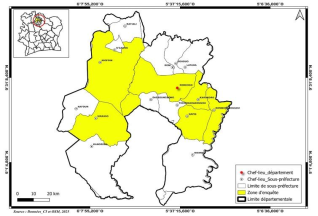
The study was conducted in the Korhogo region of northern Côte d'Ivoire. Spanning 12,500 km², it is located in the Sudanese savanna zone (with rainfall ranging from 1,000 to 1,400 mm, and a dry season from November to April). This important cattle-raising area is located 635 km north of Abidjan and is home to both sedentary and transhumant herds. It is characterised by high cattle density, limited veterinary coverage and large informal drug markets. Seven sub-prefectures were surveyed, including Korhogo, Karakoro, Komborodougou, Napiéolédougou, Sirasso, Kombolokoura and Niofoin (Figure 1).
Figure 1. Study sites in the Korhogo department.
2.2.2. Study Methodology
The study examined the use of antimicrobials by cattle farmers, looking at the types of antimicrobials used, the infections encountered in cattle and how these antimicrobials were acquired and used. The survey was conducted through direct interviews with farmers, and the responses were digitised using the Kobocollect tool. Farmers were unable to identify the families of antimicrobials. The antimicrobials used for treatment were identified by referring to the instructions for use on the bottles or packaging.
2.2.3. Selection Criteria
The criteria took both inclusion and exclusion into account.
The inclusion criteria were as follows: Any person aged 18 or over who resides in Korhogo, has raised livestock for at least five years and has given their consent to participate in the study.
Exclusion criteria: Individuals under the age of 18; individuals who had been raising cattle for less than five years; individuals who lived outside the Korhogo department; and individuals who did not consent to participate in the study.
2.2.4. Calculating the Sample Size
The sample size for cattle farmers in the Korhogo department was calculated using standard statistical formulas, in particular the one developed by Lemeshow .
n=N.Z2.p(1-p)e2N-1+Z2.p(1-p)
n: The calculated sample size.
N: The total population of livestock farmers in Korhogo (1,000).
Z: The Z-score corresponding to the confidence level. For a standard confidence level of 95%, the Z-score is 1.96.
p: The expected proportion. In a survey covering a variety of practices, p = 0.5 (50%) is often used to obtain the largest, most representative sample size possible.
e: The desired margin of error is 5%, or 0.05.
The calculated sample size is approximately 278. Of these, 215 farmers in the Korhogo department agreed to participate in the survey.
2.2.5. Statistical Analysis
A statistical analysis of the data was performed using R software (version 3.2.2). Means and standard deviations were calculated for quantitative variables and proportions for qualitative variables. Graphs were created using Excel. Associations between sociodemographic variables among cattle farmers in the Korhogo department were analysed using the chi-squared test (p-value and interpretation measure).
3. Results
3.1. Socio-Demographic Characteristics of Livestock Farmers in the Korhogo Department
Analysis of the survey results revealed that there were 225 livestock managers, comprising 215 farmers and 10 animal health workers. These individuals were spread across seven sub-prefectures in the Korhogo department: Korhogo, Karakoro, Komborodougou, Napieledougou, Sirasso, Kombolokoura and Niofoin. The surveyed livestock farmers were aged between 31 and 81. The 45–60 age group was the most represented (43.26%), while only 4.19% of respondents were over 75. The majority of respondents were foreign nationals (55.35%). The survey revealed that more than half of those interviewed (57.21%) worked in livestock farming. Salespeople came second with 30.7% of respondents, followed by farmers with 12.09% (Table 1).
Table 1. Sociodemographic characteristics of livestock farmers.

Variables

Farmers Number (N=215)

Percentage (%)

Age

[30 - 45]

40

18,60

[45 - 60]

93

43,26

[60 - 75]

73

33,95

[75 et plus]

9

4,19

Nationalité

Ivorian

96

44,65

Non-Ivorian

119

55,35

Level of education

Schooled

62

28,84

Not schooled

153

71,16

Main activity

Farmer

26

12,09

Livestock breeder

123 66

57,21 30,70

3.2. Determination of the Families of Antimicrobials Used in Cattle Farming in the Korhogo Department
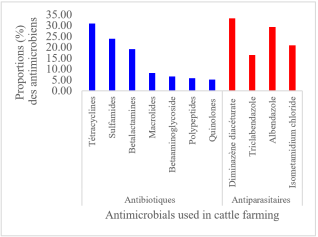
Analysis of the survey results revealed the proportions of two commonly used families of antimicrobials in cattle farming: antibiotics and antiparasitics. Regarding antibiotics, health workers in the Korhogo department primarily favoured tetracyclines (39.91%), followed by sulfonamides (23.95%) and beta-lactams (19.16%). In contrast, macrolide use was lower (8.27%), as were beta-aminoglycoside (6.68%), polypeptide (5.81%) and quinoline (5.22%) use. As for antiparasitics, diminazene and albendazole dominated this class with respective proportions of 33.26% and 29.30%. Isometamidium (20.91%) and triclabendazole (16.51%) were the least used (Figure 2).
Figure 2. Families of antimicrobials used in cattle farms in the Korhogo department.
3.3. Determination of the Types of Infection Observed in Cattle Farms in the Korhogo Department
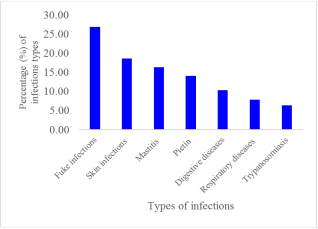
Analysis of the results revealed two distinct groups of infections on cattle farms in the Korhogo department. The highest rates were for fluke infestations (26.82%), followed by skin infections (18.55%) and mastitis (16.29%). Foot rot accounted for 14.04% of cases, while digestive diseases accounted for 10.28%. By contrast, respiratory diseases were less prevalent (7.77%), as was trypanosomiasis (6.27%) (Figure 3).
Figure 3. Prevalence of bovine diseases in Korhogo.
3.4. Use of Antimicrobials According to the Type of Infection in Cattle Farms in the Korhogo Department
The results reveal clear trends in the use of different antibiotic and antiparasitic families. Tetracyclines are primarily used for treating bacterial infections, including mastitis (53.85%) and skin infections (66.22%). They dominate the treatment of respiratory diseases, accounting for 45.16% and 41.16% of foot rot cases, respectively. Beta-lactams are primarily used to treat digestive disorders (63.41%), though they are rarely used to treat respiratory infections (22.28%). Macrolides occupy a secondary position, accounting for 20% of treatments for mastitis and skin infections, and 4.51% of treatments for foot rot. Regarding parasitic diseases, the main treatments for flukes are albendazole (55.14%) and triclabendazole (44.86%). Albendazole and triclabendazole are the main treatments for flukes, accounting for 55.14% and 44.86% respectively. For trypanosomiasis, diminazene acetate was the preferred choice of 76.3% of farmers, followed by isometamidium chloride at 24% (Table 2).
Table 2. Antimicrobial use by type of infection in Korhogo.

Types of infection

Antimicrobial families

Number (N)

Proportions (%)

Antibiotics

Mastitis

Tétracyclines

35

53,85

Bêtalactamines

17

26,15

Macrolides

13

20

65

skin infections

Tétracyclines

49

66,22

Bêtalactamines

16

21,62

Macrolides

9

12,16

74

Respiratory infections

Tétracyclines

14

45,16

Sulfamides

10

32,26

Bêtalactamines

7

22,28

31

Piétins

Tétracyclines

23

41 073

Bêtalactamines

14

25

Sulfamides

12

21,43

Macrolides

7

12,5

56

digestive diseases

Sulfamides

15

36,59

Bêtalactamines

26

63,41

41

Pesticides

Gills

Albendazole (Albex 10%)

59

55,14

Triclabendazole

48

44,86

107

trypanosomiasis

Diminazènes diacéturates

19

76

chlorure d'isométamidium

6

24

25

3.5. Determination of Antibiotic Use Practices in Cattle Farming in the Department of Korhogo
In the Korhogo department, the use of antibiotics in cattle farming is characterised by an uncontrolled supply and a lack of veterinary supervision: only 24.06% of farmers consult a professional. Many do not comply with prescription instructions, particularly regarding dosages (68.48%), and prematurely interrupt treatment (23.93%). Analysis of the survey results showed that 37.83% of antibiotics are supplied outside the official channel, with 33.33% originating from markets and 4.5% from street vendors (Table 3).
Table 3. Antibiotic use practices in cattle farms in the Korhogo department.

Practices when using antibiotics

Numbre (N)

Percentage (%)

Supply locations

Veterinarian pharmacies

69

62,16

Markets

37

33,33

Street vendors

15

4,5

111

Adherence to dosage

Never

63

68,48

One day

18

19,57

always

11

11,96

92

Criteria for discontinuing treatment

Duration of treatment

69

58,87

Improvement

28

23,93

Recovery

20

17,09

117

Attitudes toward a sick animal

Treat the animal

46

56,1

Call the veterinarian

32

24,06

Sell the animal

4

4,88

82

3.6. Determination of Practices for the Use of Antiparasitic Drugs in Cattle Farming in the Department of Korhogo
Analysis of practices reveals several cases of the misuse of antiparasitic drugs. A significant proportion of farmers obtain their supplies from unregulated sources, such as markets (28.85%) and street vendors (1.92%), thereby exposing their animals to potentially dangerous products. Nearly 65.86% of farmers report that they never follow the recommended dosage, indicating a widespread failure to comply with dosage instructions. Similarly, treatment is often discontinued based on apparent improvement or recovery in the animal without waiting for the full duration of the prescribed treatment. Furthermore, over half of farmers (65.41%) self-medicate without consulting a vet (Table 4).
Table 4. Practices for using antiparasitic drugs in cattle farms in the Korhogo department.

Pesticide use practices

Number (N)

Proportions (%)

Where purchased

Veterinarian pharmacies

72

69,23

Markets

30

28,85

Street vendors

2

1,92

104

Adherence to dosage

Never

81

65,86

One day

26

21,14

always

16

13,56

123

Decision to discontinue treatment

Compliance with treatment duration

67

68,48

Improved animal health

24

24,49

Recovery

7

7,14

98

Attitude toward a sick animal

Treat the animal

87

65,41

Consult a veterinarian

41

30,83

Sell the animal

5

3,76

133

3.7. Characteristics of Livestock Farmers According to Antimicrobial Use Practices in the Department of Korhogo
The geographical area of study was found to be the predominant factor influencing almost all of the observed animal health practices. It significantly impacted compliance with prescriptions (p = 0.001), the frequency of treatment administration (p = 0.001), dosage adjustment (p = 0.004), where antimicrobials were purchased (p = 0.012) and the criteria for stopping treatment (p = 0.001). Furthermore, changes in dosage correlated with the education level of livestock farmers (p = 0.036). Finally, nationality was found to mainly influence the duration of prescriptions (p = 0.041) and dose adjustments (p = 0.008) (see Table 5).
Table 5. Characteristics of farmers and abusive practices of cattle breeders in the Korhogo department.

Explanatory variables

Pratiques d’usage des antimicrobiens

Respect prescription

Modified duration

Frequency Modified

Dosage Modified

Place of purchase

Stop criterion

χ²

p-value

χ²

p-value

χ²

p-value

χ²

p-value

χ²

p-value

χ²

p-value

Study site

47,08

0,001*

6,01

0,422

46,06

0,001*

19,19

0,004*

25,71

0,012*

51,50

< 0,001*

Level of education

1,73

0,421

1,57

0,457

0,64

0,727

6,63

0,036*

5,25

0,263

4,05

0,399

Nationality

2,37

0,53

4,18

0,041*

1,24

0,13

7,09

0,008*

5,23

0,073

0,76

0,684

*: significatif, x2 = chi carré
4. Discussion
The results of this study show that the use of antimicrobials on cattle farms in Korhogo is influenced by low levels of education (28.84%). This could be due to some farmers not attending school due to financial constraints, as well as the predominantly rural nature of livestock farming areas, where access to schools is limited. In this area, livestock farming is a traditional activity, with young people learning the trade by working with the herd rather than attending school. This often comes at the expense of modern schooling, which has only been introduced more recently. This figure is lower than that reported by Orounladji et al. , who found that 34.5% of livestock farmers had received some form of education. Furthermore, our results showed that around 24% of farmers seek professional advice. This could be due to the high cost of care and the remote location of farms. This leads farmers to favour self-medication in order to preserve their income. Our results are lower than those reported by Yao , who found that 39.5% of farmers in a survey on the use of antibiotics in cattle farming in the Abidjan district (Ivory Coast) sought professional advice. In Abidjan, farmers benefit from a high concentration of veterinary practices and technicians nearby.
On the other hand, farms in Korhogo are often isolated in rural areas, making access to professionals much more difficult and costly due to travel expenses.
Regarding antimicrobials, the survey of cattle farmers revealed a reliance on tetracyclines, accounting for 39.91% of cases. This high level of dependence could be linked to the affordability and availability of tetracycline molecules in the Korhogo region. Our results are higher than those reported by Zeru et al. in Ethiopia, who found a proportion of 30% in a survey of the sale and use of antimicrobials in cattle farming. The development of the informal sales channel and the widespread availability of medicines on local markets in Korhogo facilitate unlimited access to tetracyclines without a prescription, unlike in other areas where the pharmaceutical channel is better controlled. In addition, our work has revealed a non-compliance rate of 68.48% among farmers. This can be attributed to the fact that most farmers do not know how to read the instructions and prefer to treat their livestock themselves. Consequently, they administer insufficient quantities of antibiotics, which could hinder full recovery and encourage the survival of resistant bacteria. These results are higher than those reported by Soma et al. on antibiotic use practices in livestock farming in sub-Saharan Africa, where a proportion of 40% was observed, and higher than those reported by Tufa et al. , who observed a rate of 55%. These figures suggest a high risk of resistant bacteria emerging and spreading, particularly due to the uncontrolled sale of drugs and their use without a veterinary prescription. Regarding pest control, the survey revealed that 76% of respondents used diminazene to treat trypanosomiasis. The high usage rate of diminazene can be attributed to the significant presence of tsetse flies in the Korhogo department, which is situated in a savannah region. Trypanosomiasis is one of the most common diseases affecting livestock. The results reported here are higher than those of Okello et al. , who found diminazene was used at a rate of around 54% to combat trypanosomiasis. Similarly, the study showed that albendazole was used at a rate of 55.14% on cattle farms in Korhogo. This high usage rate can be attributed to the prevalent presence of intestinal parasites among Korhogo's livestock, a condition exacerbated by outdoor grazing. These results are consistent with those reported by Tufa et al. , who observed an albendazole usage rate of 58%. These differences reflect the severity of parasitic diseases in the study area and the extent to which livestock farmers rely on empirical treatments. The survey revealed that 37.83% of people had access to informal markets and street vendors. The latter travel directly to isolated villages and camps, thereby facilitating the unregulated supply of medicines. These results are higher than those reported by Azabo et al. , in a study on the use of antimicrobials in cattle production in Tanzania, where rates ranged from 25 to 30%.
With regard to chi-squared tests, the study revealed a correlation between the study site and compliance with prescriptions and frequency of administration (p = 0.001). Depending on whether a farmer is located near an urban centre or in a remote rural area, their access to veterinary advice can differ significantly. The further away they are, the less likely they are to comply with official prescriptions. These observations corroborate those of Tufa et al. , who examined the knowledge, attitudes and behaviours (KAB) of Ethiopian livestock farmers with regard to the use of antimicrobials. Furthermore, the study showed that nationality influences treatment duration (p = 0.041). Indeed, livestock farmers from countries or regions with a long pastoral tradition have acquired different empirical knowledge to that of local livestock farmers. This knowledge influences how they administer medication and how long they treat the animal for. These observations are consistent with those of Yao et al. , who analysed cattle farming practices on rural farms in northern Côte d'Ivoire.
5. Conclusion
The Korhogo department is characterised by a strong dependence on informal channels, frequent self-medication and low use of veterinary services. The predominant use of tetracyclines and antiparasitics, combined with non-compliance regarding dosage, frequency and duration of treatment, poses a significant risk of antimicrobial resistance emerging and spreading. These practices are negatively influenced by the geographical context, the level of education, and the mobility of livestock farmers. These results highlight the urgent need to strengthen local veterinary supervision, regulate access to veterinary medicines and encourage the more responsible use of antimicrobials, in order to protect animal and consumer health sustainably. The study also revealed that livestock farmers have a relatively low level of education and consult with veterinary professionals infrequently. Tetracyclines and diminazene were the most commonly used antimicrobial molecules, with high levels of use in terms of dosage, frequency of administration and duration of treatment, particularly in cattle. This situation, exacerbated by cultural and mobility constraints related to the background of livestock farmers, could lead to antimicrobial resistance emerging. Therefore, it is urgent to strengthen local veterinary supervision and regulate the drug market in northern Côte d'Ivoire to ensure public and animal health. The following concrete actions are strongly recommended to effectively reduce the risk of antimicrobial and antiparasitic resistance: strengthening local veterinary supervision; promoting simplified education and awareness among livestock farmers; regulating and securing the drug supply chain; and adapting care protocols to mobility constraints.
Abreviations

PIB

Gross Domestic Product

LANADA

National Laboratory for Agriculture Development Support

Author Contributions
Modeste N'dri Koffi: Conceptualization, Methodology, Investigation, Writing – original draft
Elise Amoin N'guessan: Supervision, Formal Analys$is, Validation, Writing – review & editing
Séraphin Affou Wognin: Data curation, Methodology, Project administration, Resources, Validation
Conflicts of Interest
The authors declare that they have no conflicts of interest regarding the publication of this article.
References
[1] FAO, (2021). FAO Action Plan on Antimicrobial Resistance 2021-2025: Supporting innovation and resilience in food and agriculture, Rome.
[2] Kimera, ZI, Mshana, SE, Rweyemamu, MM, Mboera, LEG et Matee, MIN (2020). Antimicrobial use and resistance in foodproducing animals and the environment: an African perspective. Antimicrobial Resistance & Infection Control, 9(1), 37.
[3] Caudell, MA, Dorado-Garcia, A., Eckford, S., Creese, C., Byarugaba, DK, Afakye, K., Chansa-Kabali, T., Fasina, FO, Kabali, E., Kiambi, S., Kimani, T., Mainda, G., Manges, AR, Mukoba, A., Nakakande, BJ, Nyambe, S., Price, C., Subbiah, M., et Graham, JP (2020). Towards a bottom-up understanding of antimicrobial use and resistance in agriculture: a survey of knowledge, attitudes, and practices in livestock systems in five African countries. PLOS One, 15(1), e0220274.
[4] Odey T. O. J., Tanimowo W. O., Afolabi K. O., Jahid I. K., & Reuben R. C. (2023). Antimicrobial use and resistance in food animal production: food safety and associated concerns in Sub-Saharan Africa. International Microbiology, 27(1), 1‑23.
[5] Ducrot C., Hobeika A., Lienhardt C., Wieland B., Dehays C., Delabouglise A., Bordier M., Goutard F., Patel E., Figuié M., Peyre M., Moodley A., & Roger F. (2021). Antimicrobial Resistance in Africa—How to Relieve the Burden on Family Farmers. Emerging Infectious Diseases, 27(9), 2315-2323.
[6] Van Boeckel, TP, Brower, C., Gilbert, M., Grenfell, BT, Levin, SA, Robinson, TP, Teillant, A., & Laxminarayan, R. (2015). Global trends in the use of antimicrobials in food-producing animals. Proceedings of the National Academy of Sciences, 112(18), 5649-5654.
[7] World Bank. (2019). Republic of Côte d'Ivoire: Agricultural Sector Update.
[8] Ministère des Ressources Animales et Halieutiques (MIRAH), Côte d'Ivoire. Rapport annuel sur l'élevage en Côte d'Ivoire. Abidjan, 2021.
[9] Ekra J.-Y., N’Goran E. K., Mboera L. E. G., Gragnon B. G., Assovié K. R. N., & Mafie E. M. (2021). Molecular epidemiological survey of pathogenic trypanosomes in naturally infected cattle in northern Côte d’ivoire. Parasites, Hosts and Diseases, 61(2), 127‑137.
[10] Kouamé, A. C. (2022). Socio-demographic and technical characteristics of ruminant farming systems... in Côte d'Ivoire. (Revue Marocaine des Sciences Agronomiques et Vétérinaires).
[11] Beudjé F., Gbonon V. C. M., Konan F., Tiekoura B., N’Gbesso J. P. N., Afran S. A., & Guessennd K. N. (2025). Phenotypic Characterization of Antibiotic Resistance in Escherichia coli Strains Isolated from Bovine Faeces in the District of Abidjan. Open Journal of Medical Microbiology, 15(03), 167‑179.
[12] Dankar I., Hassan H., & Serhan M. (2022). Knowledge, attitudes, and perceptions of dairy farmers regarding antibiotic use: Lessons from a developing country. Journal of Dairy Science, 105(2), 1519‑1532.
[13] Lemeshow, S., Hosmer, DW, Jr., Klar, J., & Lwanga, SK (1990). Adéquation de la taille de l'échantillon dans les études de santé. Chichester (Royaume-Uni): John Wiley & Sons.
[14] Orounladji B. M., Oke F. O., Tozo K., & Chrysostome C. A. A. M. (2022). Socioeconomic correlates, typology and characterization of indigenous guinea fowl (Numida meleagris, Linnaeus) farming in Benin, West Africa. Heliyon, 8(4), e09226.
[15] Yao K. R. (2019). Caracterisation phenotypique et moleculaire de salmonella sp et escherichia coli isolees chez les bovins dans le district d’abidjan (côte d’ivoire): impact biologique de l’utilisation des antibiotiques (phd thesis). université félix houphouêt-boigny (abidjan, côte d’ivoire). p241.
[16] Zeru, H., Gemechu, A., Andualem, T., Seid, H. et Mengesha, F. (2019). Awareness of Veterinary Drug Retail Outlets on Antimicrobial Resistance and its Containment Strategy in Ethiopia, 19(29), 52.
[17] Soma D., Bonkoungou I. J. O., Garba Z., Diarra F. B. J., Somda N. S., Nikiema M. E. M., Bako E., Sore S., Sawadogo N., Barro N., & Haukka K. (2024). Extended-Spectrum Beta-Lactamase-Producing and Multidrug-Resistant Escherichia coli and Klebsiella spp. from the Human-Animal-Environment Interface on Cattle Farms in Burkina Faso. Microbiology Research, 15(4), 2286‑2297.
[18] Tufa, TB, Regassa, F., Amenu, K., Stegeman, JA et Hogeveen, H. (2023). Connaissances, attitudes et comportements (KAB) des éleveurs de bétail concernant l'utilisation des antimicrobiens en Éthiopie. Frontières de la science vétérinaire, 10, 1167847.
[19] Okello, I., Mafie, E., Eastwood, G., Nzalawahe, J., Mboera, LEG, et Onyoyo, S. (2022). Prévalence et facteurs de risque associés à la trypanosomiase animale africaine chez les bovins à Lambwe, au Kenya. Journal of Parasitology Research, 2022, Article ID 5984376.
[20] Azabo, R., Mshana, S., Matee, M., & Kimera, SI (2022). Utilisation des antimicrobiens dans la production bovine et avicole à Dar es Salaam, Tanzanie: modèle et quantité. BMC Veterinary Research, 18(1), 1-12.
[21] Yao, F. A. D., N’Goran, K. E., Ekra, J.-Y., Kanh, K. H. M., Tre, U. B., Konaté, A., Sonan, H., Diloreto, E., & Mafie, E. M. (2025). Characterization and Typology Analysis of Cattle Breeding Practices on Rural Farms in Northern Côte d’Ivoire. Tropical Animal Science Journal, 48(5), 471-480.
Cite This Article
  • APA Style

    Koffi, M. N., N'guessan, E. A., Wognin, S. A. (2026). Antimicrobial Use Practices and Resistance Risk in Cattle Farming in Korhogo, Ivory Coast. International Journal of Microbiology and Biotechnology, 11(1), 20-29. https://doi.org/10.11648/j.ijmb.20261101.13

    Copy | Download

    ACS Style

    Koffi, M. N.; N'guessan, E. A.; Wognin, S. A. Antimicrobial Use Practices and Resistance Risk in Cattle Farming in Korhogo, Ivory Coast. Int. J. Microbiol. Biotechnol. 2026, 11(1), 20-29. doi: 10.11648/j.ijmb.20261101.13

    Copy | Download

    AMA Style

    Koffi MN, N'guessan EA, Wognin SA. Antimicrobial Use Practices and Resistance Risk in Cattle Farming in Korhogo, Ivory Coast. Int J Microbiol Biotechnol. 2026;11(1):20-29. doi: 10.11648/j.ijmb.20261101.13

    Copy | Download

  • @article{10.11648/j.ijmb.20261101.13,
      author = {Modeste N'dri Koffi and Elise Amoin N'guessan and Séraphin Affou Wognin},
      title = {Antimicrobial Use Practices and Resistance Risk in Cattle Farming in Korhogo, Ivory Coast},
      journal = {International Journal of Microbiology and Biotechnology},
      volume = {11},
      number = {1},
      pages = {20-29},
      doi = {10.11648/j.ijmb.20261101.13},
      url = {https://doi.org/10.11648/j.ijmb.20261101.13},
      eprint = {https://article.sciencepublishinggroup.com/pdf/10.11648.j.ijmb.20261101.13},
      abstract = {Cattle farming is a key sector for food and economic security in Côte d'Ivoire. However, inappropriate practices regarding the use of antimicrobials to treat cattle are prevalent among some farmers in several regions of the country. A survey assessing antimicrobial use practices in cattle farming was conducted in the Korhogo department using the Kobocollect digital questionnaire tool. This cross-sectional study of 215 cattle farmers in Korhogo, Côte d'Ivoire, reveals the widespread and unregulated use of antimicrobials in livestock farming. The most frequently used antibiotics were tetracyclines (39.91%) and sulfonamides (23.95%), while the most common antiparasitic agents were diminazene (33.26%) and albendazole (29.3%). These molecules are primarily used to treat conditions such as mastitis, skin infections, digestive disorders, respiratory diseases, foot rot, fluke and trypanosomiasis. Additionally, almost one-third of farmers purchase supplies from markets or street vendors. Of these farmers, 65.9% do not follow dosage instructions, 25% interrupt treatment prematurely, and only 30.8% consult a veterinarian. Around 56.1% of livestock farmers self-medicate to treat parasitic diseases, a practice encouraged by low levels of education, empirical experience and limited access to veterinary services. These practices, combined with a heavy reliance on informal distribution channels, significantly increase the risk of antimicrobial and antiparasitic resistance emerging and spreading in the region. The study therefore highlights the urgent need to strengthen veterinary services, regulate the drug market, and educate livestock farmers in the responsible use of antimicrobials.},
     year = {2026}
    }
    

    Copy | Download

  • TY  - JOUR
    T1  - Antimicrobial Use Practices and Resistance Risk in Cattle Farming in Korhogo, Ivory Coast
    AU  - Modeste N'dri Koffi
    AU  - Elise Amoin N'guessan
    AU  - Séraphin Affou Wognin
    Y1  - 2026/02/25
    PY  - 2026
    N1  - https://doi.org/10.11648/j.ijmb.20261101.13
    DO  - 10.11648/j.ijmb.20261101.13
    T2  - International Journal of Microbiology and Biotechnology
    JF  - International Journal of Microbiology and Biotechnology
    JO  - International Journal of Microbiology and Biotechnology
    SP  - 20
    EP  - 29
    PB  - Science Publishing Group
    SN  - 2578-9686
    UR  - https://doi.org/10.11648/j.ijmb.20261101.13
    AB  - Cattle farming is a key sector for food and economic security in Côte d'Ivoire. However, inappropriate practices regarding the use of antimicrobials to treat cattle are prevalent among some farmers in several regions of the country. A survey assessing antimicrobial use practices in cattle farming was conducted in the Korhogo department using the Kobocollect digital questionnaire tool. This cross-sectional study of 215 cattle farmers in Korhogo, Côte d'Ivoire, reveals the widespread and unregulated use of antimicrobials in livestock farming. The most frequently used antibiotics were tetracyclines (39.91%) and sulfonamides (23.95%), while the most common antiparasitic agents were diminazene (33.26%) and albendazole (29.3%). These molecules are primarily used to treat conditions such as mastitis, skin infections, digestive disorders, respiratory diseases, foot rot, fluke and trypanosomiasis. Additionally, almost one-third of farmers purchase supplies from markets or street vendors. Of these farmers, 65.9% do not follow dosage instructions, 25% interrupt treatment prematurely, and only 30.8% consult a veterinarian. Around 56.1% of livestock farmers self-medicate to treat parasitic diseases, a practice encouraged by low levels of education, empirical experience and limited access to veterinary services. These practices, combined with a heavy reliance on informal distribution channels, significantly increase the risk of antimicrobial and antiparasitic resistance emerging and spreading in the region. The study therefore highlights the urgent need to strengthen veterinary services, regulate the drug market, and educate livestock farmers in the responsible use of antimicrobials.
    VL  - 11
    IS  - 1
    ER  - 

    Copy | Download

Author Information
  • Department of Biochemistry and Genetics, Université Peleforo Gon Coulibaly, Korhogo, Côte d'Ivoire

  • Department of Biochemistry and Genetics, Université Peleforo Gon Coulibaly, Korhogo, Côte d'Ivoire

  • Department of Biochemistry and Genetics, Université Peleforo Gon Coulibaly, Korhogo, Côte d'Ivoire;Ivorian Anti-Pollution Center (CIAPOL), Abidjan, Côte d'Ivoire

  • Abstract
  • Keywords
  • Document Sections

    1. 1. Introduction
    2. 2. Materials and Methods
    3. 3. Results
    4. 4. Discussion
    5. 5. Conclusion
    Show Full Outline
  • Abreviations
  • Author Contributions
  • Conflicts of Interest
  • References
  • Cite This Article
  • Author Information