
This study presents an integrated geotechnical, mineralogical and geochemical characterization of clayey Vertisols developed under Sudano-Sahelian climatic conditions in northern Cameroon, with the aim to provide a scientific basis for future stabilization and engineering applications. Representative Vertisol samples were collected from the North and Far North regions and investigated using standard geotechnical tests, chemical analyses, and mineralogical identification by X-ray diffraction. The results reveal clay-rich materials dominated by fine fractions, with textures ranging from sandy clay to sandy heavy clay, and displaying low to high plasticity indices, reflecting strong smectitic influence. Geochemically, the Vertisols are characterized by high SiO₂ and Al₂O₃ contents, moderate to high Fe₂O₃ levels, elevated CIA values (57–83%), and significant cation exchange capacities, indicating advanced chemical weathering under seasonally contrasted tropical conditions. Mineralogical assemblages are composed by smectite, kaolinite, illite, quartz and K-feldspars, confirming both pedogenetic clay formation and inheritance from parent materials. These combined characteristics explain the pronounced shrink–swell behavior and vertic features observed in the field. Overall, the studied Vertisols exhibit physicochemical properties that make them promising raw materials for sustainable construction applications and environmental uses, if appropriate stabilization strategies are implemented to mitigate their expansive behavior.
| Published in | International Journal of Materials Science and Applications (Volume 15, Issue 2) |
| DOI | 10.11648/j.ijmsa.20261502.13 |
| Page(s) | 62-72 |
| Creative Commons |
This is an Open Access article, distributed under the terms of the Creative Commons Attribution 4.0 International License (http://creativecommons.org/licenses/by/4.0/), which permits unrestricted use, distribution and reproduction in any medium or format, provided the original work is properly cited. |
| Copyright |
Copyright © The Author(s), 2026. Published by Science Publishing Group |
Cameroon, Clay Material, Mineralogy, Geotechnical Properties
Soil provenance | Sample code | Color (dry) | Textural Class/ Structure | Boundary | Special feature |
|---|---|---|---|---|---|
Gaschiga | J1 | Dark gray (2.5Y 6/1) | Sandy heavy clay/Massive | Progressive Limit | Presence of quartz fragments |
Adoumri | JII | Dark gray (2.5Y 6/1) | Sandy heavy clay/Massive | Progressive Limit | Presence of quartz fragments |
Guidiguis | JIII | Dark gray (2.5Y 6/1) | Sandy clay/Massive | Progressive Limit | Presence of quartz fragments Some desiccations cracks |
Garey | JVI | Black (10YR 2/1) | Sandy heavy clay/Massive | Progressive Limit | Presence of quartz fragments |
Mouda | JV | Dark gray to black (5 YR 2.5/1) | Sandy heavy clay/Massive | Progressive Limit | Presence of quartz fragments |
Congola | JVI | Dark gray (2.5Y 6/1) | Sandy heavy clay/Massive | Progressive Limit | Presence of quartz fragments Some desiccations cracks |
Maga | JVII | Dark gray (2.5Y 6/1) | Sandy heavy clay/Massive | Gradual | Some desiccations cracks |
Waza | JVIII | Dark gray (2.5Y 6/1) | Sandy heavy clay/Massive | Progressive Limit | Some desiccations cracks |
Samples | ||||||||
|---|---|---|---|---|---|---|---|---|
JI | JII | JIII | JIV | JV | JVI | JVII | JVIII | |
Particle size distribution (%) | ||||||||
Clay: (<0.002 mm) | 44.2 | 30.8 | 47.2 | 52.4 | 45.9 | 63.9 | 62.1 | 37.7 |
Silt: (0.002-0.02 mm) | 21.2 | 15.3 | 12.0 | 13.3 | 24.9 | 16.2 | 15.8 | 11.7 |
Sand: (0.02- 2 mm) | 30.4 | 53.3 | 38.9 | 29.7 | 28.5 | 19.9 | 21.4 | 50.6 |
Gravel: (>2mm) | 3.2 | 0.6 | 1.9 | 3.3 | 0.7 | 0.0 | 0.7 | 0.0 |
Atterberg Limits and CBR | ||||||||
Liquid limit (%) | 38.7 | 38.1 | 26.5 | 38.7 | 27.6 | 34.2 | 52.0 | 26.4 |
Plastic limit (%) | 19.1 | 17.9 | 13.3 | 22.9 | 14.9 | 18.4 | 20.8 | 12.4 |
Plastic index | 19.6 | 20.1 | 13.2 | 15.9 | 12.7 | 15.8 | 31.1 | 14.0 |
CBR | 3.50 | 8.00 | 4.00 | 6.00 | 6.00 | 6.00 | 2.50 | 6.00 |
pH and Organic Matter | ||||||||
M.O (%) | 3.3 | 1.2 | 2.9 | 5.5 | 9.5 | 4.1 | 5.5 | 2.7 |
pH | 6.60 | 7.03 | 6.64 | 7.31 | 7.83 | 7.61 | 7.85 | 7.84 |
Samples | ||||||||
|---|---|---|---|---|---|---|---|---|
JI | JII | JIII | JVI | JV | JVI | JVII | JVIII | |
SiO2 | 64.60 | 61.35 | 59.41 | 45.77 | 64.53 | 60.93 | 58.40 | 63.35 |
Al2O3 | 12.05 | 14.69 | 14.85 | 15.34 | 13.64 | 13.68 | 13.12 | 11.94 |
Fe2O3 | 7.50 | 6.90 | 5.15 | 10.74 | 6.94 | 4.92 | 7.62 | 8.92 |
K2O | 0.98 | 2.23 | 1.24 | 1.10 | 1.86 | 2.62 | 2.14 | 1.39 |
MgO | 0.39 | 0.83 | 0.33 | 1.45 | 0.60 | 0.56 | 0.86 | 0.71 |
TiO2 | 0.43 | 0.51 | 0.56 | 0.77 | 0.55 | 0.23 | 0.55 | 0.26 |
P2O5 | 0.08 | 0.10 | 0.00 | 0.28 | 0.08 | 0.00 | 0.00 | 0.10 |
CaO | 1.05 | 1.59 | 9.75 | 8.13 | 0.39 | 0.96 | 2.47 | 1.87 |
NaO | 0.40 | 0.92 | 0.08 | 2.44 | 0.79 | 1.57 | 0.60 | 0.37 |
MnO | 0.16 | 1.10 | 0.05 | 0.39 | 0.31 | 0.27 | 1.27 | 0.38 |
LOI | 9.31 | 9.78 | 8.59 | 13.51 | 10.08 | 15.42 | 12.99 | 10.71 |
SiO2/Al2O3 | 5.36 | 4.18 | 4.00 | 2.98 | 4.73 | 4.45 | 4.45 | 5.31 |
CIA | 83.22 | 75.61 | 57.30 | 56.79 | 81.78 | 72.65 | 71.60 | 76.71 |
CEC | 28.22 | 19.04 | 14.79 | 34.79 | 31.79 | 19.14 | 30.69 | 23.66 |
CaCO3 (%) | 5.88 | 5.60 | 5.85 | 7.48 | 8.80 | 7.00 | 6.95 | 4.88 |
WL | Liquid Limit |
WP | Plastic Limit |
PI | Plasticity Index |
Ph | Weight of the Wet Sample |
Ps | Weight of the Dry Sample |
pH CBR | Hydrogen Potential California Bearing Ratio |
CEC | Cation Exchange Capacity |
CIA | Chemical Alteration Index |
XRF | X-ray Fluorescence |
LOI | Loss on Ignition |
LABOGENIE | National Laboratory for Civil Engineering of Cameroon |
| [1] | Dengiz, O., Saglam, M., Sarioglu, F., Saygin, F. and Atasoy, C. Morphological and Physico-Chemical Characteristics and Classification of Vertisol Developed on Deltaic Plain. Open Journal of Soil Science. 2012 2, 20-27. |
| [2] | Murray, H. H. Applied Clay Mineralogy: Occurrences, Processing and Applications of Kao-lins, Bentonites, Palygorskite-Sepiolite, and Common Clays. Developments in Clay Science, Amsterdam: Elsevier, 2, 180 (2007) USDA. Soil Taxonomy, Soils classification and valorization. 2023. |
| [3] | Nguetnkam, J. P., Villiéras, F., Kamga, R., Ekodeck, G. E., Yvon, J. "Mineralogy and geo-chemical behaviour during weathering of greenstone belt under tropical dry conditions in the extreme North Cameroon (Central Africa) ", Elsevier, Chemie der Erde, 2014 74 185-193. |
| [4] | Dudal, R. “Dark Clay Soils of Tropical and Subtropical Regions,” Agriculture Development Paper, No. 83, 1965 161. |
| [5] | Basga, S. D., Temga, J. P. Tsozué, D., Danbé, N. Nguetnkam J. P. Morphological, mineralogical and geochemical features of topomorphic vertisols used for sorghum production in North Cameroon, Eurasian J Soil Sci. 2018, 7(4) 346–354. |
| [6] | Temga, J. P., Azinwi, P. T., Basga, D. S., Zo'o, P. Z., Gouban, H. Abossolo, M., Nguetnkam, J. P. Bitom, L. D., Characteristics, classification and genesis of vertisols under seasonally con-trasted climate in the Lake Chad Basin, Central Africa. Journal of African Earth Sciences. 2019 150, 176–193. |
| [7] | Kagonbé, B. P., Ngarena, K. M., Cengiz, Ö., Djallo, D., Fadil-Djenabouf, S., Bakaïné, V D., Yanné, E., Pagoré, D. F., Bandeya D. Suitability of clays from Maroua (Far North Cameroon) and physical properties of their adobe bricks reinforced with sta waste powder for eco-friendly construction, Journal of Ceramic Processing Research. 2025 26, 547-558. |
| [8] | Bal, D. V., “Some Aspects of the Black Cotton Soils of the Central Provinces,” Transactions of the 3rd International Congress of Soil Science, 1935, 3154-158. |
| [9] | Hosking, J. S. “A Comparative Study of the Black Earths of Australia and the Regur of In-dia,” Transactions of the Royal Society of South Australia, 1935 59, 168-200. |
| [10] | Basga, D. S. Tsozué, D., Temga, J. P., Balna, J.,.Nguetnkam, J. P. Land Use Impact on Clay Dispersion/Flocculation in Irrigated and Flooded Vertisols from Northern Cameroon! In-ternational Soil and Water Conservation Research. 2018 6, 237-244. |
| [11] | Bakaïné, V. D., Dawoua, M. K., Kagonbé, B. P., Babé, C., Kola, B. N. Djongyang, Proper-ties of Adobe Bricks Manufactured from Vertisol Reinforced with Brewer's Spent Grains: Case Study in Sudano Sahelian Region of Cameroon International Journal of Sustainable and Green Energy. 2025 14, 153-65. |
| [12] | Kagonbé B. P., Tsozué D., Nzeukou A. N., Ngos III S. Mineralogical, physico-chemical and ceramic properties of clay materials from Sekande and Gashiga (North, Cameroon) and their suitability in earthenware production Heliyon. 2021 7, e07608. |
| [13] | Kagonbé, B. P., Tsozué, D, Nzeukou, A. N., Ngos III, S. Mineralogical, geochemical and physico-chemical characterization of clay Raw materials from three clay deposits in Northern Cameroon. J Geoscience Environ Prot. 2021 9(6), 86–99. |
| [14] | Tagnitsap, T., Tchouata, J. H. K., Ngon Ngon, G. F., Mahamat, H., Taypondou S. D. J. Mineralogical and physicochemical assessment of Benue Cameroon Valley clays for trace metal adsorption potential, Discover Soil. 2025 2: 116. |
| [15] | Temga, J. P., Nguetnkam, J. P., Balo, M. A., Basga, S. D., Bitom, D. L., Morphological, physi-co chemical, mineralogical and geochemical properties of vertisols used in bricks production in the Logone Valley (Cameroon, Central Africa). International Research Journal of Geology and Mining. 2015 5(2) 20-30. |
| [16] | Nguetnkam, J. P., Kamga, R., Villiéras, F., Ekodeck, G. E., Yvon, J., Assessing the bleach-ing capacity of some Cameroonian clays on vegetable oils. Appl. Clay Sci. 2008 39, 113–121. |
| [17] | Iyammi, B. M., Tchedélé, L. Y., Alarba, S. T. A., Mache, J. R. and Mominou, N. Physico-Chemical, Mineralogical Characterization, and Ceramic Properties of Clay Materials from South Mindif (Far North, Cameroon). JMST Advances Journal. 2023 5, 13-26. |
| [18] | Buol, S. W., Southard, R. J., Graham, R. C. McDaniel, P. A. Soil Genesis and Classification. 6th Edition, John Wiley & Sons, Inc., West Sussex. 2011. |
| [19] | Rahim, I. S., Wahba, M. M., Amal, M. A. Micromorphological characteristics of vertisols in Egypt. International Journal of Research in Management 5(6) 2015 1-7. |
| [20] | Kamgang K., B. V., Boubakar, L., Ndome, P. E. Effoudou, G. E. Ekodeck, Mineralogy and geochemistry of Vertisols at Ferngo, Lake Chad basin: their potential as raw materials for fired bricks. Ann. Fac. Scie. Univ. Yaoundé I., Série Sc. de la Nat. et de la Vie 2011 38, 30–44. |
| [21] | Kovda, I. V., Wilding L. P. Vertisols: problems of classification, evolution and spatial self-organization. Eurasian Soil Science. 2004 37(12) 1341-1351. |
| [22] | Azinwi, P. T. Bitom, D. L., Njopwouo, D."Pretrological, Physic-chemical and mechanical-characterization of topomorphic Vertisols from soudano-sahélian region of Nord Cameroun" Open Geologie journal, 2011 5 33-35. |
| [23] | Brabant, P., Gavaud, M., Soils and land resources of North Cameroon (North and Far North Provinces). Paris, ORSTOM-MESRES-IRA. 1985. |
| [24] | Raunet, M. Quelques clés morpho-pédologiques pour le Nord Cameroun à l’usage des agro-nomes. CIRAD, Montpellier, 2003 24. |
| [25] | Azinwi, P. T. "petrological, physic-chemical and mechanical study of the Benue Wathershed vertisols (Nord Cameroon): spacial analysis and agricultural potential evaluation". Th. Mém. PhD. fac. Sc. Univ. Yaoundé I, 2012 183. |
| [26] | Azinwi, T.P. Djoufac, E. Woumfo, F.O. Tabi, B.A. Mvondo, Ze A.D. Bitom, D. Kamgang Kabeyene, V.B. Morphology, physico-chemical characteristics, nutritional status and fertility capability classification of the Benuefloodplain vertisols in North Cameroon. J., Geo., Environ., Earth Sci., Int., 2016 6, 1-15. |
| [27] | Yaboki, E., Temga, J. P., Balo, M. A., Basga, D. S., Atougour, B., Nguetnkam J. P. Character-ization of lithomorphic vertisols from Kaélé (Northern Cameroon) and their valorization in bricks production, J., Mater. Environ. Sci., 2021. 12(2), 353-372. |
| [28] | Ambassa-Kiki, R., Aboubakar, Y., Boulama, T., Zero-tillage for rice production on Cameroonian vertisols. Soil and Tillage Research. 1996 39(1-2) 75-84. |
| [29] | Ahmad, N. and Marmut, A. “Vertisols and Technologies for Their Management,” Elsevier, Amsterdam, 1996. |
| [30] | Hubble, D. G. “The Cracking Clay Soils, Definition, Dis- tribution, Nature, Genesis and Use,” In: J. W. McGarity, E. H. Hoult and H. B. So, Eds., The Properties and Utiliza- tion of Cracking Clay Soils, Review in Rural Science, University of New England Armidale, New South Wales, 1984, 3-13. |
| [31] | Suchel, J. B. The Distribution of Rainfall and Rainfall Patterns in Cameroon, Contribution to the Study of the Climates of Tropical Africa. CEGET/CNRS, Bordeaux. 1972 287. |
| [32] | Letouzey, R. Phytogeographic Map of Cameron. Paris: Les Atlas Jeune Afrique, 1980. |
| [33] | Hervieu, J. Quaternary of North Cameroon. Diagram of Geomorphological Evolution and Relations with Pedogenesis. ORSTOM Notebook, Soil Science Serial, 1970 8, 295-317. |
| [34] | Tsozué, D., Nzeukou, N. A., Maché, J. R., Loweh, S. and Fagel, N. Mineralogical, Physico-chemical and Technological Characterization of Clays from Maroua (Far-North, Cameroon) for Use in Ceramic Bricks Production. Journal of Building Engineering, 2017 11, 17-24. |
| [35] | Gountié, D. M., Tsozué, D., Kpoumié, A. and Nzeukou, N. A. Identification of Major Sources Controlling Groundwater Geochemistry in Mount Makabaï in the Far-North of Came-roon (The Northern Most Part of the Pan-African Belt. Acta Geochemical, 2022 42, 1-24. |
| [36] | Munsell Soil Color Chart (2014) |
| [37] | ASTM D-422 (2002) Standard Test Method for Particle-Size Analysis of Soils. American Society for Testing and Materials International, West Conshohocken, 8. |
| [38] | ASTM D-4318-00 (2000) Standard Test Method for Liquid Limit, Plastic Limit and Plastic-ity Index of Soils. Annual Book of ASTM Standards, 4, 1-14. |
| [39] | ASTM C40, Standard Test Method for Organic Impurities in Fine Aggregates for Concrete. American Society for Testing and Materials, West Conshohocken, PA, USA. 2004 2. |
| [40] | Nesbitt, H. W., Young, G. M. Early Proterozoic climates and plate motions inferred from major element chemistry of lutites. Nature, 1982 299 715-717. |
| [41] | Ozaytekin, H. H., & Uzum, C. Comparison of Weathering Rates of the Soils Classiefied in Alfisol and Entisol Order developed on Limestone in the Taurus Mountains at East Mediter-ranean Region. Carpathian Journal of Earth and Environmental Sciences, 2012 7, 109-120. |
| [42] | Moore D. M., and Reynolds, R. C. X-ray diffraction, identification and analysis of clay min-erals. 2nd Edition, Oxford University Press, New York, 1997. |
| [43] | Dudal, R., Eswaran, H., Distribution, properties and classification of vertisols. In: Vertisols: their distribution, properties, classification and management. Wilding, L. P., Puentes, R. (Eds.). Texas A&M University, Printing Centre, College Station, Texas, USA. 1988 1-22. |
| [44] | Nguetnkam, J. P., Les argiles des vertisols et des sols fersiallitiques de l’Extrême Nord du Cameroun: genèse, propriétés cristallochimiques et texturales, typologie et application à la dé-coloration des huiles végétales. Thèse Doct., Univ. Yaoundé I, Cameroon. 2004, 216. |
| [45] | Appel, C., Ma, L. Q. Rhue, R. D., Kennelley, E.Point of zero charge determination in soils and minerals via traditional methods and detection of electroacoustic mobility. Geoderma. 2003 113(1-2), 77-93. |
| [46] | Basga, S. D., Temga J. P., Tsozué, D., Gove A., Sali, B., Nguetnkam J. P. Erodibility of Ver-tisols about agricultural practices along a toposequence in the Logone floodplain. Soil Science Society of Pakistan, Soil Environ. 2020 39(1), 12. |
| [47] | Adjia, H. Z., Villiéras, F., Kamga, R. Thomas, F., Mineralogy and physic-chemical properties of alluvial clays from far-north Cameroon: A tool for an environmental problem. International Journal of Water Resources and Environmental Engineering. 2013 5(1) 54-66. |
| [48] | Özsoy G., Aksoy, E. “Characterization, Classification and Agricultural Usage of Vertisols Developed on Neo- gen Aged Calcareous Marl Parent Materials,” Journal of Biological & Environmental Sciences. 2007 1(1), 5-10. |
| [49] | Nafissatou M., Kagonbé, B. P., Mouthe A. G. A., Nafissa B., Bakaïné D. V., Yanné E., Likiby B., · Kagou D. A. Potential use of the Maroua (Far North, Cameroon) river sand as construction materials and degreasing agent for earthenware ceramics. Discover Applied Sciences. (2025) 7:92. |
APA Style
Pagouo, J., Kagonbe, B. P., Yanne, E., Danwe, R. (2026). Mineralogical and Geotechnical Properties of Clayey Vertisols from Northern Cameroon: To Provide a Scientific Basis for Future Stabilization and Engineering Applications. International Journal of Materials Science and Applications, 15(2), 62-72. https://doi.org/10.11648/j.ijmsa.20261502.13
ACS Style
Pagouo, J.; Kagonbe, B. P.; Yanne, E.; Danwe, R. Mineralogical and Geotechnical Properties of Clayey Vertisols from Northern Cameroon: To Provide a Scientific Basis for Future Stabilization and Engineering Applications. Int. J. Mater. Sci. Appl. 2026, 15(2), 62-72. doi: 10.11648/j.ijmsa.20261502.13
AMA Style
Pagouo J, Kagonbe BP, Yanne E, Danwe R. Mineralogical and Geotechnical Properties of Clayey Vertisols from Northern Cameroon: To Provide a Scientific Basis for Future Stabilization and Engineering Applications. Int J Mater Sci Appl. 2026;15(2):62-72. doi: 10.11648/j.ijmsa.20261502.13
@article{10.11648/j.ijmsa.20261502.13,
  author = {Jabin Pagouo and Bertin Pagna Kagonbe and Etienne Yanne and Raïdandi Danwe},
  title = {Mineralogical and Geotechnical Properties of Clayey Vertisols from Northern Cameroon: To Provide a Scientific Basis for Future Stabilization and Engineering Applications},
  journal = {International Journal of Materials Science and Applications},
  volume = {15},
  number = {2},
  pages = {62-72},
  doi = {10.11648/j.ijmsa.20261502.13},
  url = {https://doi.org/10.11648/j.ijmsa.20261502.13},
  eprint = {https://article.sciencepublishinggroup.com/pdf/10.11648.j.ijmsa.20261502.13},
  abstract = {This study presents an integrated geotechnical, mineralogical and geochemical characterization of clayey Vertisols developed under Sudano-Sahelian climatic conditions in northern Cameroon, with the aim to provide a scientific basis for future stabilization and engineering applications. Representative Vertisol samples were collected from the North and Far North regions and investigated using standard geotechnical tests, chemical analyses, and mineralogical identification by X-ray diffraction. The results reveal clay-rich materials dominated by fine fractions, with textures ranging from sandy clay to sandy heavy clay, and displaying low to high plasticity indices, reflecting strong smectitic influence. Geochemically, the Vertisols are characterized by high SiO₂ and Al₂O₃ contents, moderate to high Fe₂O₃ levels, elevated CIA values (57–83%), and significant cation exchange capacities, indicating advanced chemical weathering under seasonally contrasted tropical conditions. Mineralogical assemblages are composed by smectite, kaolinite, illite, quartz and K-feldspars, confirming both pedogenetic clay formation and inheritance from parent materials. These combined characteristics explain the pronounced shrink–swell behavior and vertic features observed in the field. Overall, the studied Vertisols exhibit physicochemical properties that make them promising raw materials for sustainable construction applications and environmental uses, if appropriate stabilization strategies are implemented to mitigate their expansive behavior.},
 year = {2026}
}
TY  - JOUR
T1  - Mineralogical and Geotechnical Properties of Clayey Vertisols from Northern Cameroon: To Provide a Scientific Basis for Future Stabilization and Engineering Applications
AU  - Jabin Pagouo
AU  - Bertin Pagna Kagonbe
AU  - Etienne Yanne
AU  - Raïdandi Danwe
Y1  - 2026/03/17
PY  - 2026
N1  - https://doi.org/10.11648/j.ijmsa.20261502.13
DO  - 10.11648/j.ijmsa.20261502.13
T2  - International Journal of Materials Science and Applications
JF  - International Journal of Materials Science and Applications
JO  - International Journal of Materials Science and Applications
SP  - 62
EP  - 72
PB  - Science Publishing Group
SN  - 2327-2643
UR  - https://doi.org/10.11648/j.ijmsa.20261502.13
AB  - This study presents an integrated geotechnical, mineralogical and geochemical characterization of clayey Vertisols developed under Sudano-Sahelian climatic conditions in northern Cameroon, with the aim to provide a scientific basis for future stabilization and engineering applications. Representative Vertisol samples were collected from the North and Far North regions and investigated using standard geotechnical tests, chemical analyses, and mineralogical identification by X-ray diffraction. The results reveal clay-rich materials dominated by fine fractions, with textures ranging from sandy clay to sandy heavy clay, and displaying low to high plasticity indices, reflecting strong smectitic influence. Geochemically, the Vertisols are characterized by high SiO₂ and Al₂O₃ contents, moderate to high Fe₂O₃ levels, elevated CIA values (57–83%), and significant cation exchange capacities, indicating advanced chemical weathering under seasonally contrasted tropical conditions. Mineralogical assemblages are composed by smectite, kaolinite, illite, quartz and K-feldspars, confirming both pedogenetic clay formation and inheritance from parent materials. These combined characteristics explain the pronounced shrink–swell behavior and vertic features observed in the field. Overall, the studied Vertisols exhibit physicochemical properties that make them promising raw materials for sustainable construction applications and environmental uses, if appropriate stabilization strategies are implemented to mitigate their expansive behavior.
VL  - 15
IS  - 2
ER  -
Department of Civil Engineering and Architecture, National Advanced School of Engineering, University of Maroua, Cameroon
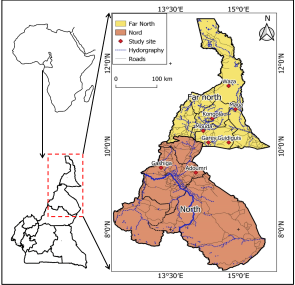
Figure 1.
Location of the study sites.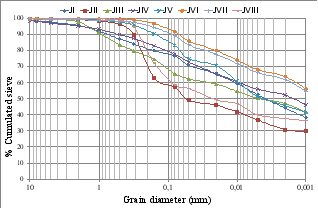
Figure 2. Grains size distribution of the clay samples.
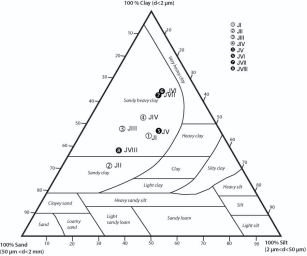
Figure 3.
Ternary diagram from the Belgian classification of the clay samples.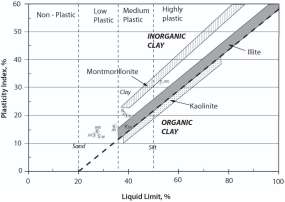
Figure 4.
Casagrande’s plasticity chart of the clay samples.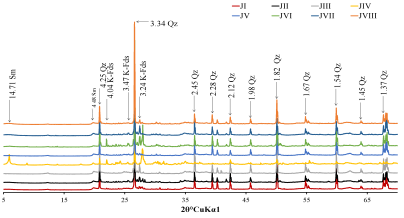
Figure 5. X-Ray Diffractograms of Studied Soil: Sm: Smectite, Ka: Kaolinite, Il: Illite, Go: Goethite Qz: Quartz, K-Felds: K-Feldspar.

Information


 Share This Article
 Twitter
 Linked In
 Facebook
 Copy
Copy Download