
The utilization of dyeing sludge in conjunction with soft waste in the manufacturing of brick is a contemporary way of disposing of trash that is both economically and practically viable. Bricks made of conventional and regular clay are used extensively in the construction industry. These bricks cause significant environmental damage, including air pollution caused by toxic fumes, deforestation for the purpose of providing fuel for kilns, soil degradation caused by the removal of topsoil, which can cause damage to agricultural land and can also lead to an increase in flooding, and an increase in carbon emissions. At the same time, the textile sector is responsible for the generation of a significant amount of trash, which includes effluent treatment sludge (ETS) sludge and spinning fiber remnants, both of which are classified as soft waste. This results in significant complications for the environment. We explore the development of eco-friendly bricks by utilizing a novel combination of ETS and spinning waste fibers as substitutes for clay. The goal of this review is to develop bricks that are both cost-effective and environmentally friendly. These bricks serve as an alternative solution for the management of solid waste, the conservation of natural resources, and the earning of carbon credits. A dual-waste, non-fired, clay-free solution that offers an expandable and sustainable approach that is associated with the concepts of a circular economy is offered as an alternative to conventional bricks and other green alternatives that are already in existence.
| Published in | International Journal of Sustainable Development Research (Volume 12, Issue 1) |
| DOI | 10.11648/j.ijsdr.20261201.15 |
| Page(s) | 64-73 |
| Creative Commons |
This is an Open Access article, distributed under the terms of the Creative Commons Attribution 4.0 International License (http://creativecommons.org/licenses/by/4.0/), which permits unrestricted use, distribution and reproduction in any medium or format, provided the original work is properly cited. |
| Copyright |
Copyright © The Author(s), 2026. Published by Science Publishing Group |
Eco-friendly, Bricks, Effluent, Sludge, Fibres, Sustainable
Constituents | Active Percent Present |
|---|---|
SiO2 | 6.90 |
Al2O3 | 0.93 |
Fe2O3 | 0.21 |
CaO | 0.30 |
MgO | 0.68 |
Na2O | - |
K2O | 0.14 |
TiO2 | 0.54 |
ETS | Effluent Treatment Sludge |
WTS | Water Treatment Sludge |
SDG | Sustainable Development Goal |
| [1] | L. Zhang, Production of bricks from waste materials - A review, Construction and Building Materials 47 (2013) 643-655. |
| [2] | Z. Zhang, Y. Wong, A. Arulrajah, S. Horpibulsukab, A review of studies on bricks using alternative materials and approaches, Construction and Building Materials 188 (2018) 1101-1118. |
| [3] | G. Abed, J. Manii, J. Hussain, J. Manii, J. Al-Zubaydi, Some Engineering Properties of Ancient Fire Clay Bricks Discovered at the Dilbat Archaeological Site, South of Hilla City, Iraqi Geological Journal 55 (2022) 121-130. |
| [4] | B. Ghiassi, P. Lourenco, Long-term Performance and Durability of Masonry Structures., 2019. |
| [5] | Types of waste, properties, and durability of pore-forming waste-based fired masonry bricks, in: Eco-Efficient Masonry Bricks and Blocks, Woodhead Publishing, 2015: pp. 103-127. |
| [6] | G. Schiller, J. Roscher, Impact of urbanization on construction material consumption: A global analysis, Journal of Industrial Ecology 27 (2023) 1021-1036. |
| [7] | T. Suhariyanto, H. M. Asih, F. S. Ramadhan, A. R. Nasution, Environmental Impact Assessment of Brick Production in Indonesia, Engineering Science Letter 1 (2022) 20-23. |
| [8] | B. Begum, S. Biswas, A. Markwitz, P. Hopke, Identification of Sources of Fine and Coarse Particulate Matter in Dhaka, Bangladesh, Aerosol and Air Quality Research 10 (2010) 345-353. |
| [9] | W. Fei, A. Opoku, K. Agyekum, J. A. Oppon, V. Ahmed, C. Chen, K. L. Lok, The Critical Role of the Construction Industry in Achieving the Sustainable Development Goals (SDGs): Delivering Projects for the Common Good, Sustainability 13 (2021) 9112. |
| [10] | S. Sasi, P. Joseph, R. Haigh, M. Sandanayake, Z. Vrcelj, E. Yaghoubi, A Review on the Effects of Waste Textile Polymer Fiber on Concrete Strength: Exploring the Key Parameters, Buildings 14 (2024) 1486. |
| [11] | B. Cohen, Urbanization in developing countries: Current trends, future projections, and key challenges for sustainability, Technology in Society 28 (2006) 63-80. |
| [12] | A. L. Murmu, A. Patel, Towards sustainable bricks production: An overview, Construction and Building Materials 165 (2018) 112-125. |
| [13] | A. Raza, Z. Ali, Impact of Air Pollution Generated by Brick Kilns on the Pulmonary Health of Workers, J Health Pollut 11 (2021) 210906. |
| [14] | T. E. Aniyikaiye, J. N. Edokpayi, J. O. Odiyo, S. J. Piketh, Traditional Brick Making, Environmental and Socio-Economic Impacts: A Case Study of Vhembe District, South Africa, Sustainability 13 (2021) 10659. |
| [15] | A. Shakir, A. Mohammed, Manufacturing of Bricks in the Past, in the Present and in the Future: A state of the Art Review, International Journal of Advances in Applied Sciences 2 (2013). |
| [16] | A. Hepautwa, Y. Jande, Mechanical, chemical performance, and microstructural behavior of montmorillonite-burnt red soil bricks incorporating coffee ash biochar, Frontiers in Built Environment 11 (2025). |
| [17] | D. Chong, The sustainable development goals and climate change, Social Alternatives 37 (2018) 43-48. |
| [18] | N. Dalkılıç, A. Nabikoğlu, Traditional manufacturing of clay brick used in the historical buildings of Diyarbakir (Turkey), Frontiers of Architectural Research 6 (2017) 346-359. |
| [19] | V. Kathuria, R. Balasubramanian, Environmental Cost of Using Top-soil for Brick-Making: A Case Study from Tamil Nadu, India, Review of Market Integration 5 (2013) 171-201. |
| [20] | S. Ahmed, I. Hossain, Applicability of Air pollution Modeling in a Cluster of Brickfields in Bangladesh, Chemical Engineering Research Bulletin 12 (2008) 28-34. |
| [21] | A. A. Duker, E. J. M. Carranza, M. Hale, Arsenic geochemistry and health, Environ Int 31 (2005) 631-641. |
| [22] | M. Ishtiaq, I. Hussain, K. H. Bhatti, M. Maqbool, K. Shafique Ahmed, M. Ajaib, A. ullah Shah, W. Mushtaq, T. Hussain, A. Ghani, H. Khanum, M. Waqas Mazhar, M. Mazhar, T. Sardar, O. Nasif, M. Javed Ansari, P. Ondrisik, Study of impacts of brickkiln emanations on soil quality of agriculture lands in selected areas of District Bhimber, Azad Jammu and Kashmir, Pakistan, PLoS One 17 (2022) e0258438. |
| [23] | M. Hossain, K. Mahmud, Bangladesh’s Ready-made Garment Industry in the Era of Sustainable Development: A Triple Bottom Line Appraisal, Studia Ecologiae et Bioethicae 23 (2025) 49-69. |
| [24] | I. Yalcin-Enis, M. Kucukali-Ozturk, H. Sezgin, Risks and Management of Textile Waste, in: K. M. Gothandam, S. Ranjan, N. Dasgupta, E. Lichtfouse (Eds.), Nanoscience and Biotechnology for Environmental Applications, Springer International Publishing, Cham, 2019: pp. 29-53. |
| [25] | M. Shamsuzzaman, M. Islam, Md. A. Al. Mamun, R. Rayyaan, K. Sowrov, S. Islam, A. S. M. Sayem, Fashion and textile waste management in the circular economy: A systematic review, Cleaner Waste Systems 11 (2025) 100268. |
| [26] | M. S. Hasan, M. B. Mia, M. R. Ahammed, M. J. Alam, M. Biswas, M. M. H. Moon, Evaluation of Textile Wastewater Treatment via ETP in Bangladesh, IJRSI XI (2024) 356-368. |
| [27] | M. Hossain, S. Das, J. M. M. Islam, M. Mamun, M. Khan, Reuse of Textile Mill ETP Sludge in Environmental Friendly Bricks - Effect of Gamma Radiation, Radiation Physics and Chemistry 151 (2018) 77-83. |
| [28] | S. Singh, A. Kumar, Soft Waste Management in Spinning Industry, in: Lecture Notes in Civil Engineering, 2019: pp. 213-217. |
| [29] | P. Sadrolodabaee, G. D. Rienzo, I. Farina, C. Salzano, N. Singh, F. Colangelo, Characterization of Eco-Friendly Lightweight Aggregate Concretes Incorporating Industrial Wastes, Key Engineering Materials 944 (2023) 209-217. |
| [30] | A. Bartl, A. Hackl, B. Mihalyi, M. Wistuba, I. Marini, Recycling of Fibre Materials, Process Safety and Environmental Protection 83 (2005) 351-358. |
| [31] | A. Alhuthali, I. M. Low, C. Dong, Characterisation of the water absorption, mechanical and thermal properties of recycled cellulose fibre reinforced vinyl-ester eco-nanocomposites, Composites Part B: Engineering 43 (2012) 2772-2781. |
| [32] | I. S. ELDeeb, A. Bakry, A. M. Nasr, E. A. Showaib, Sustainable Clay Brick Manufacturing: A Review of Mechanical Properties, Firing Technologies, Emissions, and Control Strategies, Journal of Engineering Research 8 (2025). |
| [33] | H. Jamshaid, A. Shah, M. Shoaib, R. K. Mishra, Recycled-Textile-Waste-Based Sustainable Bricks: A Mechanical, Thermal, and Qualitative Life Cycle Overview, Sustainability 16 (2024) 4036. |
| [34] | M. Ahmadi, B. Hakimi, A. Mazaheri, M. Kioumarsi, Potential Use of Water Treatment Sludge as Partial Replacement for Clay in Eco-Friendly Fired Clay Bricks, Sustainability 15 (2023) 9389. |
| [35] | U. Patil, S. P. Raut, R. V. Ralegaonkar, M. V. Madurwar, Sustainable building materials using textile effluent treatment plant sludge: a review, Green Materials 10 (2021) 154-168. |
| [36] | H. A. Aziz, M. F. Ghazali, A. Omran, M. Umar, Solidification and stabilization of the incinerated wastewater sludge from textile industry, AIP Conf. Proc. 1892 (2017) 040029. |
| [37] | M. Arisiketty, D. Cruze, Sustainable clay bricks incorporating textile sludge, quarry dust, lime, and GGBS: an investigation of strength parameters, Matéria (Rio de Janeiro) 29 (2024). |
| [38] | D. A. Beshah, G. A. Tiruye, Y. S. Mekonnen, Characterization and recycling of textile sludge for energy-efficient brick production in Ethiopia, Environ Sci Pollut Res Int 28 (2021) 16272-16281. |
| [39] | K. Fatema, M. A. Nayem, M. S. Sanzid, Characterization of textile effluent treatment plant sludge and its industrial application in fired clay bricks with health risk assessment, J Environ Manage 351 (2024) 119965. |
| [40] | S. Sharma, G. D. Kumar, G. D. R. N., P. Kumar, Micro fiber reinforced cement paste and mortar overlays - A review, International Journal of Pavement Research and Technology 6 (2013) 765-772. |
| [41] | V. H. Martinez-Landeros, S. Y. Vargas-Islas, C. Cruz-González, S. Barrera, K. Mourtazov, R. Ramírez-Bon, Studies on the influence of surface treatment type, in the effectiveness of structural adhesive bonding, for carbon fiber reinforced composites, Journal of Manufacturing Processes 39 (2019) 160-166. |
| [42] | N. Gupta, B. K. Mahur, A. M. D. Izrayeel, A. Ahuja, V. K. Rastogi, Biomass conversion of agricultural waste residues for different applications: a comprehensive review, Environ Sci Pollut Res 29 (2022) 73622-73647. |
| [43] | P. Yadav, A. Petrella, F. Todaro, S. De Gisi, C. Vitone, R. Petti, M. Notarnicola, Ex Situ Stabilization/Solidification Approaches of Marine Sediments Using Green Cement Admixtures, Materials 17 (2024) 3597. |
| [44] | S. S. Rahman, S. Siddiqua, C. Cherian, Sustainable applications of textile waste fiber in the construction and geotechnical industries: A retrospect, Cleaner Engineering and Technology 6 (2022) 100420. |
| [45] | M. Seifali Abbas-Abadi, B. Tomme, B. Goshayeshi, O. Mynko, Y. Wang, S. Roy, R. Kumar, B. Baruah, K. De Clerck, S. De Meester, D. R. D’hooge, K. M. Van Geem, Advancing Textile Waste Recycling: Challenges and Opportunities Across Polymer and Non-Polymer Fiber Types, Polymers (Basel) 17 (2025) 628. |
| [46] | J. Saravanan, P. V. Rao, Past investigations on development of sustainable bricks - A comprehensive review, Sustainable Chemistry for the Environment 3 (2023) 100030. |
| [47] | M. M. Abedin, I. Siddique, A Research on Reducing Waste and Better Managing Resources in the Spinning Industry using Efficient Methods, 9 (2024) 40-49. |
| [48] | R. Sarkar, R. Kurar, A. K. Gupta, A. Mudgal, V. Gupta, Use of paper mill waste for brick making, Cogent Engineering 4 (2017) 1405768. |
| [49] | Utkarsh, P. K. Jain, Enhancing the properties of swelling soils with lime, fly ash, and expanded polystyrene -A review, Heliyon 10 (2024) e32908. |
| [50] | M. Teklehaimanot, H. Hailay, T. Tesfaye, Manufacturing of Ecofriendly Bricks Using Microdust Cotton Waste, Journal of Engineering 2021 (2021) 8815965. |
| [51] | C. George, S. Senthil Selvan, V. Sathish Kumar, G. Murali, J. Giri, E. Makki, T. Sathish, Enhancing the fire-resistant performance of concrete-filled steel tube columns with steel fiber-reinforced concrete, Case Studies in Construction Materials 20 (2024) e02741. |
| [52] | P. Kumar, R. Upadhyay, K. K. Sharma, S. Madhuri, A. Gogineni, P. K. Vagestan, Mechanical performance of fiber reinforced concrete incorporating rice husk ash and brick aggregate, Innov. Infrastruct. Solut. 10 (2025) 362. |
| [53] | K. Sonar, S. Sathe, Exploring fiber reinforcements in concrete and its challenges: a comprehensive review, Multiscale and Multidiscip. Model. Exp. and Des. 7 (2024) 3099-3131. |
| [54] | L. Wang, M. Cao, X. Li, W. Du, X. Wang, A novel approach for improving the water resistance of gypsum plaster by internal mixing hypromellose and external coating waterproofing agent, Construction and Building Materials 401 (2023) 132940. |
APA Style
Alam, M. M., Chowdhury, M. R. (2026). A Review on Eco-friendly Bricks Using Effluent Treatment Sludge (ETS) and Spinning Waste Fibers as a Sustainable Alternative to Traditional Clay Bricks. International Journal of Sustainable Development Research, 12(1), 64-73. https://doi.org/10.11648/j.ijsdr.20261201.15
ACS Style
Alam, M. M.; Chowdhury, M. R. A Review on Eco-friendly Bricks Using Effluent Treatment Sludge (ETS) and Spinning Waste Fibers as a Sustainable Alternative to Traditional Clay Bricks. Int. J. Sustain. Dev. Res. 2026, 12(1), 64-73. doi: 10.11648/j.ijsdr.20261201.15
@article{10.11648/j.ijsdr.20261201.15,
  author = {Mohammad Mahbubul Alam and Md. Rahim-ul-Islam Chowdhury},
  title = {A Review on Eco-friendly Bricks Using Effluent Treatment Sludge (ETS) and Spinning Waste Fibers as a Sustainable Alternative to Traditional Clay Bricks},
  journal = {International Journal of Sustainable Development Research},
  volume = {12},
  number = {1},
  pages = {64-73},
  doi = {10.11648/j.ijsdr.20261201.15},
  url = {https://doi.org/10.11648/j.ijsdr.20261201.15},
  eprint = {https://article.sciencepublishinggroup.com/pdf/10.11648.j.ijsdr.20261201.15},
  abstract = {The utilization of dyeing sludge in conjunction with soft waste in the manufacturing of brick is a contemporary way of disposing of trash that is both economically and practically viable. Bricks made of conventional and regular clay are used extensively in the construction industry. These bricks cause significant environmental damage, including air pollution caused by toxic fumes, deforestation for the purpose of providing fuel for kilns, soil degradation caused by the removal of topsoil, which can cause damage to agricultural land and can also lead to an increase in flooding, and an increase in carbon emissions. At the same time, the textile sector is responsible for the generation of a significant amount of trash, which includes effluent treatment sludge (ETS) sludge and spinning fiber remnants, both of which are classified as soft waste. This results in significant complications for the environment. We explore the development of eco-friendly bricks by utilizing a novel combination of ETS and spinning waste fibers as substitutes for clay. The goal of this review is to develop bricks that are both cost-effective and environmentally friendly. These bricks serve as an alternative solution for the management of solid waste, the conservation of natural resources, and the earning of carbon credits. A dual-waste, non-fired, clay-free solution that offers an expandable and sustainable approach that is associated with the concepts of a circular economy is offered as an alternative to conventional bricks and other green alternatives that are already in existence.},
 year = {2026}
}
TY  - JOUR
T1  - A Review on Eco-friendly Bricks Using Effluent Treatment Sludge (ETS) and Spinning Waste Fibers as a Sustainable Alternative to Traditional Clay Bricks
AU  - Mohammad Mahbubul Alam
AU  - Md. Rahim-ul-Islam Chowdhury
Y1  - 2026/03/27
PY  - 2026
N1  - https://doi.org/10.11648/j.ijsdr.20261201.15
DO  - 10.11648/j.ijsdr.20261201.15
T2  - International Journal of Sustainable Development Research
JF  - International Journal of Sustainable Development Research
JO  - International Journal of Sustainable Development Research
SP  - 64
EP  - 73
PB  - Science Publishing Group
SN  - 2575-1832
UR  - https://doi.org/10.11648/j.ijsdr.20261201.15
AB  - The utilization of dyeing sludge in conjunction with soft waste in the manufacturing of brick is a contemporary way of disposing of trash that is both economically and practically viable. Bricks made of conventional and regular clay are used extensively in the construction industry. These bricks cause significant environmental damage, including air pollution caused by toxic fumes, deforestation for the purpose of providing fuel for kilns, soil degradation caused by the removal of topsoil, which can cause damage to agricultural land and can also lead to an increase in flooding, and an increase in carbon emissions. At the same time, the textile sector is responsible for the generation of a significant amount of trash, which includes effluent treatment sludge (ETS) sludge and spinning fiber remnants, both of which are classified as soft waste. This results in significant complications for the environment. We explore the development of eco-friendly bricks by utilizing a novel combination of ETS and spinning waste fibers as substitutes for clay. The goal of this review is to develop bricks that are both cost-effective and environmentally friendly. These bricks serve as an alternative solution for the management of solid waste, the conservation of natural resources, and the earning of carbon credits. A dual-waste, non-fired, clay-free solution that offers an expandable and sustainable approach that is associated with the concepts of a circular economy is offered as an alternative to conventional bricks and other green alternatives that are already in existence.
VL  - 12
IS  - 1
ER  -
Department of Textile Engineering, Ahsanullah University of Science and Technology, Dhaka, Bangladesh
Biography: Mohammad Mahbubul Alam is an Associate Professor at Ahsanullah University of Science and Technology, Textile Engineering Department. He completed his PhD in Material, Structure and Nanotechnology Engineering from University of Salento, Lecce, Italy, and his Master of textile Engineering from the Polytechnic University of Turin, Italy. Recognized for his exceptional results in Bachelor of Science in Technology, Dr. Alam honored with Dean’s List from his University. In addition, he worked in national and multinational company for three years. Currently Dr. Alam serves on the Editorial Boards of numerous publications.
Research Fields: Dyeing, Printing and Finishing, Materials Science, Chemical Engineering, Nanotechnology, Sustainability, Coating, Fiber Science

Department of Textile Engineering, Ahsanullah University of Science and Technology, Dhaka, Bangladesh
Research Fields: Textile, Dyeing, printing, Fiber science, Coating, Sustainability

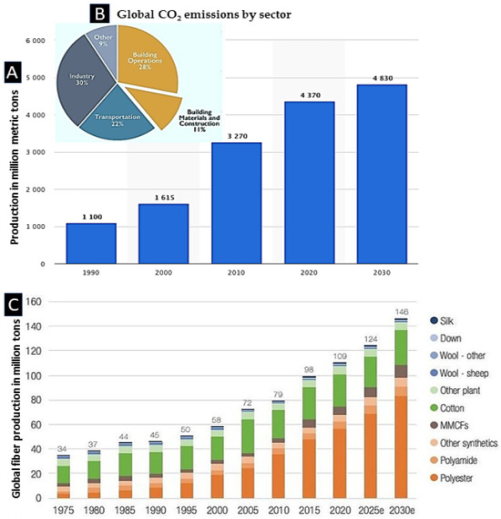
Figure 1. (A) Graph showing the cement production 1990–2030 (B) Graph showing the global CO2 emission by sector (C) graph showing the textile fiber production 1975–2030; Adopted from Buildings, MDPI, [10].
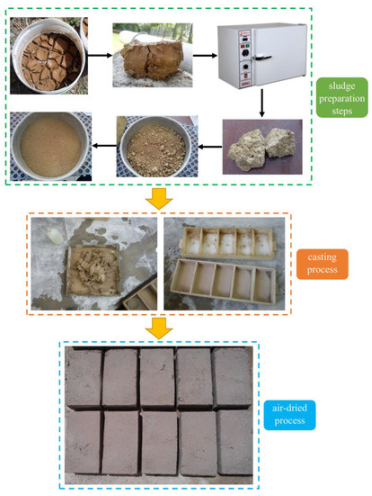
Figure 2. The brick preparation steps, adopted from Sustainability, MDPI [34].
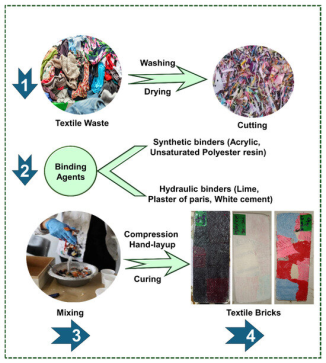
Figure 3. Scheme for the fabrication of textile waste based bricks. Adopted from Sustainability, MDPI [33].
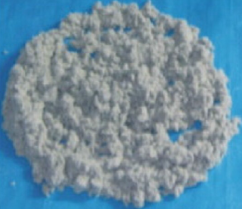
Figure 4. The cotton dust, adopted from Hindawi, Journal of Engineering [50].

Information



 Share This Article
 Twitter
 Linked In
 Facebook
 Copy
Copy Download