Research Article | | Peer-Reviewed

Analysis of the Correlation Between Intellectual Property Trade and Indigenous Innovation in China

Received: 12 December 2025     Accepted: 30 December 2025     Published: 20 January 2026
Views:       Downloads:
Abstract

Developing intellectual property (IP) trade helps enhance the level of opening-up, promotes synergy between international supply chains and industrial chains, facilitates integration into global innovation and industrial chains, and fosters open innovation. As an important growth driver for international trade and the world economy, leveraging IP trade to better propel Chinese enterprises to occupy the commanding heights of the global innovation chain holds significant importance for accelerating China's process of building an innovative nation. To explore the correlation and dynamic equilibrium between IP imports, IP exports, and indigenous innovation, this study employs data on China's intellectual property imports, exports, and indigenous innovation from 1995 to 2021 as its sample, selecting annual IP royalties imports, IP exports, and patent application volumes as proxy indicators for endogenous variables. A vector autoregressive (VAR) model is constructed for impulse response and variance decomposition analysis. The results show a stable, long-term relationship between China's IP trade and indigenous innovation. IP imports are a significant factor influencing China’s indigenous innovation, and this impact is growing. Meanwhile, indigenous innovation in China also promotes IP imports and exports to a certain extent, with a stronger effect on exports. IP imports and exports influence each other, especially with imports impacting exports. These findings provide insights for China to formulate differentiated innovation strategies and trade measures for different periods.

Published in International Journal of Science, Technology and Society (Volume 14, Issue 1)
DOI 10.11648/j.ijsts.20261401.11
Page(s) 1-11
Creative Commons

This is an Open Access article, distributed under the terms of the Creative Commons Attribution 4.0 International License (http://creativecommons.org/licenses/by/4.0/), which permits unrestricted use, distribution and reproduction in any medium or format, provided the original work is properly cited.

Copyright

Copyright © The Author(s), 2026. Published by Science Publishing Group

Keywords

Intellectual Property Trade, Innovation, Vector Autoregressive Model, Impulse Response, Variance Decomposition

1. Introduction
Intellectual property (IP) trade serves as an effective channel linking technology research and development with the technology market, enabling the deep integration of the innovation supply chain with industrial demand. This not only promotes socioeconomic development but also reflects a region or country’s technological innovation capability and international competitiveness It demonstrates the effectiveness of implementing an innovation-driven strategy . Generally, for a country or region to enhance its technological innovation capabilities, there are two primary approaches: first, to continuously strengthen technological reserves through independent research and development; second, to leverage foreign technology through IP trade, thereby boosting innovation through the effects of technology spillover. For developing countries, acquiring advanced technology via IP trade offers a critical pathway to realize their latecomer advantage . Developing IP trade contributes to high-level openness, facilitating collaboration across global supply and industrial chains, and fostering integration into the global innovation and industrial ecosystems, thus promoting open innovation . As a significant growth area in international trade and the global economy, leveraging IP trade to enable Chinese enterprises to secure leading positions in global innovation chains is of vital importance for advancing China’s construction as an innovative nation. Therefore, it is crucial to clarify the relationship between IP trade and independent innovation, assess the degree of IP import and export contributions to innovation, determine the duration of their effects, and investigate potential interactions between IP imports and exports. These are the primary issues that this study seeks to address.
2. Literature Review
On the relationship between IP trade and innovation, scholars mainly focus on two aspects of research: The first is whether IP trade promotes innovation and its pathway mechanisms, while the second examines whether innovation drives IP trade.
2.1. Research on the Promotion of Innovation and Pathway Mechanisms of IP Trade
The technology diffusion effect of international trade has long been a focus of domestic and international scholars. Grossman and Helpman , using a general equilibrium model, examined the relationship between trade, growth, and technological progress, finding that trade can effectively optimize the allocation of resources between physical product production and technological innovation units. Trade not only enhances economic growth but also promotes innovation. Through empirical research, Coe et al. found that the technology spillover effect in North-South trade is significant. Building on previous research, Chuang proposed a model suggesting that trade facilitates technological learning. Funk and Falvey et al. further confirmed that exports are an important channel for technological spillover. Worz classified traded goods by levels of technological intensity (high, medium, and low) and suggested that high-tech-intensive trade items yield the most significant technology spillover effects and thus can better promote technological innovation. Lu and Ng argued that imports enhance competition among domestic firms, which drives companies to innovate and improve product quality to boost market competitiveness. Dong and Sun pointed out that technology diffusion through trade is the primary means of obtaining technology when a country's industrial technology level is relatively low. Using data from 2000 to 2006, Kang analyzed the relationship between R&D intensity and import trade in Chinese manufacturing firms, finding that capital goods imports significantly enhance domestic firms’ R&D intensity, especially when these goods come from developed countries. Damijan and Kostevc asserted that domestic firms gain access to high-tech foreign technology through imports, with technology spillover and learning effects providing ideas and methods for R&D, reducing costs, shortening development time, and improving innovation efficiency in domestic firms.
However, some scholars argue that a negative relationship exists between import trade and innovation. For instance, Xu and Gao concluded that import trade suppresses innovation in China’s central and western regions, primarily due to the regions' lagging human capital levels, economic development, and trade structure. Liu and Rosell empirically demonstrated that import trade narrows product lines for enterprises and increases innovation risk, thus restraining R&D. Dauth et al. found that rising trade volumes led to widespread unemployment in Germany's manufacturing regions. Yang et al. noted that intensified import competition reduced Canadian firms' innovation capabilities. As Chinese enterprises gain ground in international competition, scholars have increasingly focused on the impact of Chinese import competition on domestic productivity and innovation. Bloom et al. found that while import competition from other developed countries had no significant impact on European firms' innovation, Chinese import competition indirectly promoted local firms' innovation. Conversely, Autor et al. observed a negative impact of Chinese import competition on R&D expenditures in U.S. companies.
As an advanced production factor, IP trade increasingly influences global trade patterns and reshapes comparative and competitive advantages for countries and regions . Many countries seek to gain a competitive edge in international IP trade by boosting R&D investment to generate more innovative results . IP trade has become a critical means for regions or countries to leverage knowledge resources to strengthen regional competitive advantages while efficiently utilizing external resources . A country or region's development level in IP trade can largely reflect its independent innovation capabilities . Innovation and IP trade are mutually dependent; innovation fosters IP trade development, while IP trade drives economic innovation and growth . Gu and Liu empirically found that IP trade positively impacts technological innovation in China’s high-tech industries, with a 1% increase in IP trade volume driving a 0.125% increase in patent applications.
Regarding pathway mechanisms, the pathways through which general trade promotes innovation-led economic development similarly apply to IP trade's promotion of an innovative economy. Furthermore, IP trade has unique pathways that promote innovative economic growth, such as introducing new products to cultivate new consumption, introducing new knowledge to create diffusion effects, and altering the levels and systems of knowledge protection . Some scholars have explored the facilitating and restraining mechanisms of IP import and export trade on innovation. IP import trade, through imitation innovation effects, collaborative innovation effects, and market competition effects, can shift from labor-intensive product exports to IP-intensive product exports, moving from low-end price competition to high-end patent technology and brand competition. This enables firms to secure high-end positions in the industry chain, gain higher profits, and support further innovation . However, innovation’s drive from imports is constrained by IP protection strength, firms' technological absorption capacities, and knowledge stickiness . IP export trade fosters innovation through the generation of excess market profits, forcing technology reinvention and sharing of R&D costs . Empirical testing supports this perspective, with multinational companies promoting technology flow through foreign direct investment (FDI) and increasing local patent licensing . Nonetheless, innovation driven by exports is constrained by IP barriers, the foundation of IP trade, and discriminatory government procurement policies . Shi and Zhang pointed out that China’s high-tech product trade structure remains suboptimal, as processing trade remains the dominant mode, and IP trade's driving force for high-tech industry development is relatively weak. While IP exports positively impact China’s independent innovation capabilities, the effect remains limited.
2.2. Research on Whether Innovation Promotes Intellectual Property Trade
Domestic and international scholars have primarily studied the impact of a country's or region's innovation resources on its exports, with most research focused at the firm level. Innovation resources represent an effective combination of innovation capabilities and other social resources. Gustavsson et al. demonstrated that the degree of impact of R&D varies across industries with different levels of technological intensity. For high-tech industries, R&D investment is particularly critical to international competitiveness. Greenhalgh et al. used intellectual property variables to analyze the role of technological innovation on the export of British manufacturing, paying particular attention to the mechanisms in different sub-sectors. Wei and Li found that the level of technological innovation, represented by the number of patent applications per capita, has a significant impact on high-tech product exports. Song , however, reached a different conclusion, suggesting that technological innovation has not effectively promoted high-tech product exports.
Additionally, scholars believe that innovation can drive improvements in the quality of export products. Geng and Chang argued that technological innovation significantly enhances the quality of exported products. Shen and Yuan examined the mediating mechanism of technological innovation on export quality improvement, introducing the role of digital capabilities. They argued that innovation protection improves the quality of intermediate inputs, which in turn enhances export quality. Sheng and Wang substituted financial openness as a mediating variable, studying how innovation influences financial openness to promote export quality. In contrast, as trade costs decline and expected industry productivity rises, the quality of exported products improves. From the R&D perspective, Cheng and Wang argued that R&D investment reduces marginal production costs and expands output, thereby significantly enhancing firms’ trade positions. Correspondingly, Shang et al. found that a firm's central position in the international trade network significantly improves its innovation quantity and quality, suggesting a bidirectional relationship between technological innovation and trade costs.
Existing domestic and international research on the relationship between IP trade and innovation is primarily theoretical, with limited empirical research. Analysis of the interaction between IP imports, exports, and innovation remains insufficient, and there is no consensus on whether IP trade promotes innovation. This study will use time series data from China from 1995 to 2021 to conduct an empirical analysis of IP imports, exports, and independent innovation. It will examine the interaction of these variables and employ methods such as impulse response and variance decomposition analysis to quantify variable influences, addressing gaps in current research regarding variable analysis and research methodology. The study aims to explore how IP trade influences innovation, investigate the long-term dynamic equilibrium relationship between IP trade and innovation, and provide theoretical evidence and practical references to inform China's innovation-driven development policies.
3. Research Design
3.1. VAR Model Design
The Vector Autoregressive Model (VAR model) was proposed by Christopher A. Sims in 1980 . This model can analyze the possible mutual influence mechanisms between different economic variables during a certain period of time based on statistical data. The VAR model has been widely used by scholars at home and abroad in the field of macroeconomic research, and its mathematical expression can be expressed as:
yt=φ1yt-1+φ2yt-2++φpyt-p+Hxt+εt, t=1, , T
Whereyt is a k-dimensional column vector of endogenous variables; xt is a d-dimensional column vector of exogenous variables; p is the lag order; and T is the sample size. The k×k matrices φ1 ,…,φp and the k×d matrix H are coefficient matrices to be estimated. εt is a k-dimensional column vector of random disturbances.
3.2. Variable Selection and Data Sources
This study uses a VAR model to analyze the interaction mechanism between intellectual property trade and independent innovation capacity in China. Among them, innovation capability is measured by the number of patent applications . IP trade is measured by the import and export amounts of intellectual property usage fees between China and other countries.
With the entry into force of TRIPS in 1995, IP trade entered a stage of rapid development. Considering the availability of data, this study selected time series data from 1995 to 2021. The patent application volume (PAT) comes from the World Bank, while the intellectual property royalty import value (IMP) and export value (EXP) come from the OECD database. To eliminate heteroscedasticity and obtain stationary data, without changing the properties of the time series, natural logarithms were taken as sample data for the three indicators, which were transformed into LNPAT, LNIMP, and LNEXP, respectively. The econometric software used is EViews13.
4. Estimation and Test of the Model
On the basis of establishing a VAR model and data standardization, EViews13 software was used for stationary test, cointegration test, impulse response analysis, and variance decomposition analysis to empirically study the relationship between intellectual property trade and China's independent innovation, and to discuss the results of data analysis calculations.
4.1. Stability Test of Time Series
Due to the fact that the three indicator data determined by the model in this study are all time series data with significant changes over time, it is necessary to test the stationarity of the time series variables before the model operation, i.e. unit root test, to avoid spurious regression problems. The ADF (augmented Dickey Fuller) test method was used to test the unit roots of three indicator data, as shown in Table 1. At a significance level of 5%, the original sequences of the three time variable data did not meet the stationarity requirement, but all met the stationarity requirement when following first-order difference. Therefore, it was preliminarily determined that first-order difference can be used to construct the VAR model.
Table 1. Results of Variable Stability Test.

Variables

ADF value

1%

critical value

5%

critical value

10%

critical value

P value

Test results

LNPAT

0.6713

-4.3561

-3.5950

-3.2335

0.9992

Unstable

LNIMP

-0.7050

-4.3561

-3.5950

-3.2335

0.9620

Unstable

LNEXP

-3.0467

-4.3561

-3.5950

-3.2335

0.1394

Unstable

DLNPAT

-3.9113

-4.3743

-3.6032

-3.2381

0.0268

stable

DLNIMP

-5.7690

-4.37431

-3.6032

-3.2381

0.0004

stable

DLNEXP

-6.3985

-4.3743

-3.6032

-3.2381

0.0001

stable

4.2. Cointegration Test
The unit root test mentioned earlier shows that the LNPAT, LNIMP, and LNEXP data are first-order differenced stationary. Using these non-stationary data to establish a regression model may result in spurious regression. Therefore, cointegration testing is needed to determine whether the linear combination of these non-stationary variables can be stationary. If the linear combination is a stationary sequence, there is a long-term equilibrium relationship between the variables. This article uses the EG two-step method for cointegration testing, and performs unit root tests on the residuals of LNPAT, LNIMP, and LNEXP variables to examine whether their residuals e are stationary. The results are shown in Table 2.
Table 2. Unit root test for residuals of three variables.

Variable

ADF value

1% critical value

5% critical value

10% critical value

P value

Test results

e

-3.6348

-2.6743

-1.9572

-1.6082

0.0009

stable

In Table 2, the ADF test statistical value of residual e is -3.6348, which is less than the critical value at the 1% to 10% significance level. Therefore, the null hypothesis is rejected, that is, the residual sequence e is stationary, i.e. I (0). The variables LNPAT, LNIMP, and LNEXP are cointegration, and they have a long-term equilibrium relationship. The results of residual e indicate that there is a long-term equilibrium relationship between independent innovation capability and intellectual property trade imports and exports.
4.3. Determine the Optimal Order
The vector autoregressive model has strict requirements for the optimal lag order, and the conclusions obtained from model testing will vary greatly depending on the choice of the optimal lag order. The AIC criterion and SC criterion are commonly used to determine the optimal lag order. The smaller the values calculated using these two criteria, the better the model performance (see Table 3).
Table 3. Results of lag order selection test.

lag

LogL

LR

FPE

AIC

SC

HQ

0

10.2673

NA

0.0001

-0.6056

-0.4584

-0.5665

1

106.3365

160.1153*

7.81e-08*

-7.861374*

-7.272347*

-7.705105*

2

111.8508

7.8120

0.0000

-7.5709

-6.5401

-7.2974

3

121.7899

11.5956

0.0000

-7.6492

-6.1766

-7.2585

Note: * represents the available lag order for selection.
Comparing the test results in Table 3, when the lag period is 1, it is the optimal lag order for the VAR model, that is, lag period Lag=1, and a VAR (1) model should be established.
4.4. Build a Model
After passing the cointegration test, the optimal lag time of the model has been determined to be 1, and the VAR model can be established. The VAR (1) model constructed using EViews 13 operation is shown in equation (1). The coefficients of each variable are shown in Table 4, indicating that the biggest factor affecting the current period's independent innovation capability comes from the previous period's independent innovation situation.
LNPAT=0.8700*LNPAT(-1)+0.2462*LNIMP(-1)-0.1252*LNEXP(-1)+0.1620(1)
The goodness of fit of the model equation is 0.9967, indicating a high degree of goodness of fit and explanatory power of the model. The relationship between variables can be analyzed using the impulse response function and variance decomposition of the VAR model.
Table 4. VAR model coefficients.

Variable

LNPAT

LNIMP

LNEXP

LNPAT (-1)

0.8700

-0.0374

0.3296

LNIMP (-1)

0.2462

0.9912

-0.0978

LNEXP (-1)

-0.1252

0.0384

0.6637

c

0.1620

0.1928

-0.3620

R2

0.9967

0.9900

0.9676

Adj. R2

0.9962

0.9886

0.9632

4.5. Stability Testing
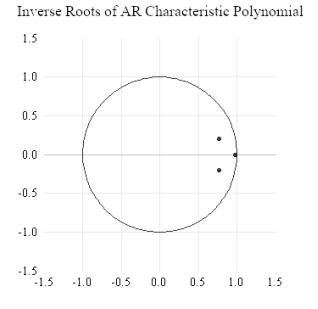
The stability test of model parameters is generally conducted through AR eigenvalues. Choosing to use AR root plot to analyze and test the stability of the VAR model with a lag of 1 period, as shown in Figure 1, all unit root points are within the circle, indicating that the stability of the model is very good and further analysis can be carried out.
Figure 1. Stability test results of VAR model.
4.6. Impulse Response Analysis
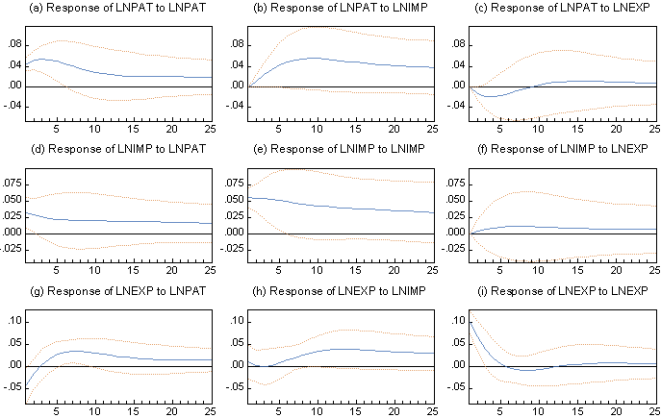
To further understand the dynamic impact relationship between variables in the constructed VAR model, impulse response analysis is continued in order. By assigning an impact to intellectual property import, export, or independent innovation variables, the sensitivity and degree of impact of this variable on other variables are obtained, thereby mining the impact of an endogenous variable (impact variable) on other endogenous variables (impacted variable). Using Eviews software, the impulse response relationship between intellectual property imports and exports and independent innovation capability was calculated (see Figure 2). The specific explanation is as follows: 1) Under the impact of LNIMP, the impulse response of LNPAT shows a trend of first increasing and then gradually stabilizing. During this process, the impulse response function is always positive and reaches its maximum value in the 9th year after being impacted (Figure 2-b). Under the impact of LNEXP, the impulse response of LNPAT shows a trend of first decreasing and then increasing, gradually stabilizing, and the impulse response function achieves a transition from negative to positive in the 9th year and remains positive thereafter (Figure 2-c). The impulse response of LNPAT indicates that intellectual property trade has a positive promoting effect on independent innovation as a whole, especially on intellectual property imports; 2) Under the impact of LNPAT and LNEXP, the impulse response of LNIMP is both positive. Among them, under the impact of LNPAT, it showed a slow decline and gradually stabilized trend (Figure 2-d), and under the impact of LNEXP, it showed a slow rise and gradually stabilized trend (Figure 2-f). The impulse response of LNIMP indicates that independent innovation and intellectual property exports have a positive overall promoting effect on intellectual property imports; 3) Under the impact of LNPAT and LNIMP, the pulse response of LNEXP is different. Among them, under the impact of LNPAT, it showed an upward trend and gradually stabilized, achieving a transition from negative to positive in the third year and remaining positive thereafter (Figure 2-g). Under the impact of LNIMP, it shows a trend of first decreasing and then increasing, gradually stabilizing, and the pulse response remains positive (Figure 2-h). The impulse response of LNEXP indicates that independent innovation and intellectual property imports have a positive overall promoting effect on intellectual property exports, and the promoting effect of independent innovation is more stable.
Figure 2. Impulse response diagram of China's IP trade import and export and indigenous innovation from 1995 to 2021.
Note: The centered solid line represents the impulse response function, while the upper and lower dashed lines indicate a deviation band of plus and minus two standard deviations.
The above results indicate that, overall, intellectual property imports, exports, and independent innovation are mutually reinforcing. Especially the promotion effect of imports on innovation and innovation on exports is more obvious and lasting. Export to innovation and import to export rebounded after a brief suppression. The promoting effect of innovation on imports is stable with a slight decrease.
4.7. Variance Decomposition Analysis
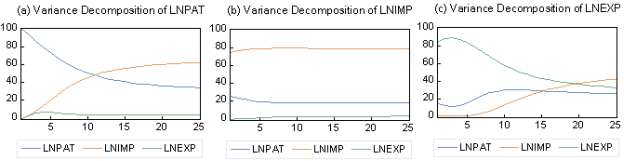
Further variance decomposition analysis was conducted to evaluate the relative importance of each variable's dynamic changes by analyzing the contribution of each variable indicator to the total variation of the target variable. Using EViews software, the variance decomposition results are shown in Figure 3. To clearly present each variable's specific variance decomposition results, the influence of each variable on itself has been excluded, as shown in Table 5. It can be observed that, aside from independent innovation, the dynamic contribution of intellectual property imports and exports to their own changes remains the largest. After excluding self-influence, the impacts among variables are as follows: (1) The contribution of imports to innovation exceeds that of exports starting from the second period, and this contribution increases annually. The contribution of exports to innovation, however, stabilizes after the eighth period, with an average contribution significantly lower than that of imports. (2) The contribution of innovation to imports is far greater than the contribution of exports to imports, and it remains relatively stable. (3) The average contributions of innovation and imports to exports are roughly equivalent. Before the 11th period, the contribution of innovation is more than double that of exports, but after the 15th period, the contribution of innovation consistently falls below that of exports. Overall, imports have a notable impact on innovation, with an impulse effect reaching over 60%, while exports contribute only minimally to innovation. Innovation contributes to both imports and exports, with its contribution to exports surpassing that of imports from the sixth period onward. Imports and exports are mutually reinforcing, but the contribution of imports to exports is significantly greater than that of exports to imports.
Figure 3. Variance decomposition analysis of China's IP trade imports and exports and indigenous innovation from 1995 to 2021.
Table 5. Contribution Analysis between China's IP Trade Import and Export and indigenous Innovation Indicators from 1995 to 2021.

Period

The contribution of LNIMP and LNEXP to LNPAT

The contribution of LNPAT and LNEXP to LNIMP

The contribution of LNPAT and LNIMP to LNEXP

LNIMP

LNEXP

LNPAT

LNEXP

LNPAT

LNIMP

1

0.0000

0.0000

25.5598

0.0000

14.5000

0.8155

2

2.9695

3.0669

23.5092

0.1864

11.8997

0.5927

3

8.1244

5.4352

21.9049

0.5311

10.9485

0.5426

4

14.2460

6.3865

20.6771

0.9473

12.2927

0.5495

5

20.6520

6.3416

19.7585

1.3709

15.5841

0.8270

6

26.8846

5.7839

19.0894

1.7611

19.6977

1.7342

7

32.6316

5.0674

18.6180

2.0966

23.5271

3.4857

8

37.7096

4.4044

18.3011

2.3703

26.4749

6.0457

9

42.0491

3.8937

18.1023

2.5843

28.4208

9.2046

10

45.6676

3.5571

17.9917

2.7458

29.5007

12.6928

11

48.6367

3.3736

17.9448

2.8638

29.9320

16.2596

12

51.0532

3.3042

17.9417

2.9476

29.9247

19.7111

13

53.0173

3.3088

17.9671

3.0055

29.6490

22.9197

14

54.6210

3.3538

18.0092

3.0446

29.2293

25.8187

15

55.9416

3.4146

18.0594

3.0704

28.7503

28.3879

16

57.0417

3.4760

18.1119

3.0872

28.2656

30.6388

17

57.9703

3.5292

18.1629

3.0981

27.8065

32.6007

18

58.7648

3.5709

18.2100

3.1054

27.3888

34.3101

19

59.4538

3.6005

18.2522

3.1107

27.0186

35.8049

20

60.0593

3.6193

18.2892

3.1149

26.6961

37.1197

21

60.5975

3.6294

18.3212

3.1187

26.4177

38.2850

22

61.0812

3.6327

18.3488

3.1224

26.1784

39.3263

23

61.5199

3.6312

18.3724

3.1261

25.9725

40.2644

24

61.9207

3.6266

18.3927

3.1300

25.7942

41.1163

25

62.2892

3.6202

18.4104

3.1340

25.6384

41.8954

average value

45.6209

4.0262

19.0522

2.4269

24.3003

20.8380

5. Conclusion and Implications
This study uses data on China’s intellectual property imports, exports, and independent innovation from 1995 to 2021 as a sample. The import and export values of intellectual property usage fees and the number of patent applications are selected as endogenous variables to represent the indicators. A VAR model is constructed for in-depth analysis, with impulse response analysis and variance decomposition used for empirical study. The main conclusions are as follows:
(1) There is a long-term stable correlation between China's intellectual property trade and independent innovation, affirming the technological diffusion effect of international trade and the driving role of intellectual property trade in innovation.
(2) Intellectual property imports are the primary factor influencing independent innovation in China, with an increasing impact over time. This indicates that China still relies on learning and absorbing advanced foreign technology to drive independent innovation improvement over an extended period. In contrast, intellectual property exports currently play a minimal role in promoting innovation, suggesting that China's intellectual property commercialization process is not yet fully developed and has not generated excess profits in the international market to reinvest in innovation.
(3) Independent innovation in China contributes to both intellectual property imports and exports, with a more significant impact on exports. This underscores the importance of self-reliance: China’s national strategy of prioritizing intellectual property development can stimulate domestic companies to enhance their competitiveness and capture a larger share of the international market.
(4) Intellectual property imports and exports in China are interrelated, especially with imports influencing exports. This shows that China’s capacity for technological absorption is gradually improving, allowing imported advanced technologies to be effectively transformed into export capabilities.
The findings provide valuable insights into the relationship between intellectual property imports, exports, and innovation, supporting relevant policy formulation. China should adopt differentiated innovation strategies and trade measures tailored to various timeframes. In the short term, China should continue to emphasize intellectual property trade, particularly by increasing intellectual property imports, formulating trade facilitation policies, and improving the quality of intellectual property imports to stimulate enterprises' capacity for absorption and innovation of practical new technologies. For a medium-term strategy, China should closely monitor global technological frontiers, especially in critical innovation fields and bottleneck technologies, maintain a steady scale of technology product imports, and increase independent R&D investment to improve intellectual property export levels. In the long term, China should strengthen fundamental research, raise product technology standards, enhance its influence on international standards, and shift from traditional international comparative advantages to intellectual property advantages, thereby comprehensively enhancing its independent innovation capacity and national competitiveness.
Abbreviations

ADF

Augmented Dickey Fuller

AIC

Akaike Information Criterion

AR

Autoregressive

EXP

Export Patent

FDI

Foreign Direct Investment

IMP

Import Patent

IP

Intellectual Property

LNEXP

the Natural Logarithms of Export Patent

LNIMP

the Natural Logarithms of Import Patent

LNPAT

the Natural Logarithms of Patent

OECD

Organisation for Economic Co-operation and Development

PAT

Patent

R&D

Research and Development

SC

Schwarz Criterion

VAR

Vector Autoregressive

Acknowledgments
We acknowledge the financial support from Beijing Social Science Planning Project of “Innovation Models and Strategic Choices of Beijing Enterprises under the China-US Trade Friction”(25BJ03206).
Author Contributions
Hou Xiaoli: Conceptualization, Data curation, Funding acquisition, Writing – original draft
Wang Qi: Data curation, Methodology, Software
Wang Xiao Fang: Conceptualization, Writing – review & editing
Conflicts of Interest
The authors declare no conflicts of interest.
References
[1] Gu, X. Y. & Zhu, W. W. The Impact of Intellectual Property Trade on High-quality Economic Development under the New Development Pattern [J]. On Economic Problems, 2022, (10): 19-26.
[2] Gu, X. Y. & Tian, J. L. The Impact Mechanism of Intellectual Property Trade on the Implementation of Innovation Driven Strategies [J]. Modern Economic Research, 2014, (10): 23-26.
[3] Liu, L. & Gu, X. Y. Intellectual Property Trade and Improving Independent Innovation in China [J]. On Economic Problems, 2014, (07): 27-30.
[4] Gu, X. Y. & Zhu, W. W. Research on the Influence of Intellectual Property Domestic Trade on the Effective Linkage of the ‘Dual Cycle’. [J]. On Economic Problems, 2024(03): 8-15.
[5] Grossman G M, Helpman E. Quality ladders in the theory of growth [J]. The review of economic studies, 1991, 58(1): 43-61.
[6] Coe D T, Helpman E, Hoffmaister A W. North-south R & D spillovers [J]. The economic journal, 1997, 107(440): 134-149.
[7] Chuang Y C. Learning by doing, the technology gap, and growth [J]. International economic review, 1998: 697-721.
[8] Funk M. Trade and international R&D spillovers among OECD countries [J]. Southern Economic Journal, 2001, 67(3): 725-736.
[9] Falvey R, Foster N, Greenaway D. Imports, exports, knowledge spillovers and growth [J]. Economics Letters, 2004, 85(2): 209-213.
[10] Wörz J. Skill intensity in foreign trade and economic growth [J]. Empirica, 2005, 32: 117-144.
[11] Lu Y, Ng T. Do imports spur incremental innovation in the South?[J]. China Economic Review, 2012, 23(4): 819-832.
[12] Dong, Y. & Sun, H. Quantitative Analysis of Effect of Intellectual Property Protection on Industrial Innovation: Take the High Technology Industry for Example [J]. World Economy Studies, 2012,(04): 11-15+87.
[13] Kang, Z. Y. Export and Independent Innovation: Empirical Study Based on China’s Manufacturing Enterprises [J]. Journal of International Trade, 2011,(02): 35-45.
[14] Damijan J P, Kostevc Č. Learning from trade through innovation [J]. Oxford bulletin of economics and statistics, 2015, 77(3): 408-436.
[15] Xu, P. Y.& Gao, W. S. The Spillover Effect of International Trade on China’s Innovation Capacity [J]. Journal of Finance and Economics, 2009, 35(09): 70-79.
[16] Liu R, Rosell C. Import competition, multi-product firms, and basic innovation [J]. Journal of International Economics, 2013, 91(2): 220-234.
[17] Dauth W, Findeisen S, Suedekum J. The rise of the East and the Far East: German labor markets and trade integration [J]. Journal of the European Economic Association, 2014, 12(6): 1643-1675.
[18] Yang M J, Li N, Lorenz K. The impact of emerging market competition on innovation and business strategy: Evidence from Canada [J]. Journal of Economic Behavior & Organization, 2021, 181: 117-134.
[19] Bloom N, Draca M, Van Reenen J. Trade induced technical change? The impact of Chinese imports on innovation, IT and productivity [J]. The review of economic studies, 2016, 83(1): 87-117.
[20] Autor D H, Dorn D, Hanson G H. The China shock: Learning from labor-market adjustment to large changes in trade [J]. Annual review of economics, 2016, 8: 205-240.
[21] Li, H. On Our Country’s Intellectual Property Rights Trade: Problems and Countermeasures [J]. Journal of International Trade, 2005,(11): 118-122.
[22] Ye, L. J. & Zhao, G. Y. The Role of International Intellectual Property Trade in World Economic Development [J]. HLJ Foreign Economic Relations & Trade, 2008,(04): 53-55.
[23] Wang, Y. & Zhang, Z. Y. Mechanism and Approaches Research of Knowledge Resources Use in Regional Independent Innovation [J]. Finance and Trade Research, 2010, 21(03): 39-44.
[24] Xu, X. L. & Li, Y. L. Analysis of the International Competitiveness of China's Intellectual Property Trade [J]. Price: Theory & Practice, 2011,(05): 83-84.
[25] Xu, C. Research on the Path of Promoting Innovative Economic Development through Intellectual Property Trad [D]. Nanjing Normal University, 2012.
[26] Gu, X. Y. & Liu, L. The impact of intellectual property trade on technological innovation in China's high-tech industries [J]. Inquiry into Economic Issues, 2014, (12): 50-54.
[27] Blomström M, Persson H. Foreign investment and spillover efficiency in an underdeveloped economy: Evidence from the Mexican manufacturing industry [J]. World development, 1983, 11(6): 493-501.
[28] Shi, H. & Zhang, D. Main characteristics, current situation, and prospects of China's high-tech product trade [J]. Intertrade, 2013,(07): 23-28.
[29] Gustavsson P, Hansson P, Lundberg L. Technology, resource endowments and international competitiveness [J]. European economic review, 1999, 43(8): 1501-1530.
[30] Greenhalgh C, Mavrotas G, Wilson R. Intellectual property, technological advantage and trade performance of UK manufacturing industries [J]. Applied Economics, 1996, 28(5): 509-519.
[31] Wei, L. & Li, L. J. Empirical Research on the Effect of Technological Innovation on the Exportation of High-tech Products Made in China [J]. Journal of International Trade, 2005,(12): 32-34+40.
[32] Song, D. J. Research on the Coupling Effect of Technological Innovation and Export of High tech Products in China [J]. Statistics & Decision, 2014, (04): 134-139.
[33] Geng, H. Q. & Chang, D. H. Enterprise Innovation and Quality Improvement of Export Products: An Empirical Study Based on China’s Manufacturing Enterprises [J]. Journal of Yunnan University of Finance and Economics, 2020, 36(01): 89-101.
[34] Shen, G. B. & Yuan, Z. Y. Internetization, Innovation Protection and the Promotion of Chinese Enterprises’ Export Quality [J]. The Journal of World Economy, 2020, 43(11): 127-151.
[35] Sheng, B. & Wang, H. Financial Openness, Independent Innovation, and Firms’ Export Products Quality: Analysis on Experience of Foreign Banks Entering China [J]. Finance and Trade Research, 2021, 32(11): 1-15.
[36] Cheng, D. Z. & Wang, N. Trade Network and Firm Innovation: Theory and Evidence from China-Listed Companies [J]. Journal of Quantitative & Technological Economics, 2023, 40(05): 158-179.
[37] Shang, H., Chen, Y., & Lu, A. B. International Trade Networks and Corporate Innovation [J]. Journal of International Trade, 2022,(11): 18-34.
[38] Sims C A. Macroeconomics and reality [J]. Econometrica: journal of the Econometric Society, 1980: 1-48.
[39] Crosby M. Patents, innovation and growth [J]. Economic Record, 2000, 76(234): 255-262.
Cite This Article
  • APA Style

    Xiaoli, H., Qi, W., Fang, W. X. (2026). Analysis of the Correlation Between Intellectual Property Trade and Indigenous Innovation in China. International Journal of Science, Technology and Society, 14(1), 1-11. https://doi.org/10.11648/j.ijsts.20261401.11

    Copy | Download

    ACS Style

    Xiaoli, H.; Qi, W.; Fang, W. X. Analysis of the Correlation Between Intellectual Property Trade and Indigenous Innovation in China. Int. J. Sci. Technol. Soc. 2026, 14(1), 1-11. doi: 10.11648/j.ijsts.20261401.11

    Copy | Download

    AMA Style

    Xiaoli H, Qi W, Fang WX. Analysis of the Correlation Between Intellectual Property Trade and Indigenous Innovation in China. Int J Sci Technol Soc. 2026;14(1):1-11. doi: 10.11648/j.ijsts.20261401.11

    Copy | Download

  • @article{10.11648/j.ijsts.20261401.11,
      author = {Hou Xiaoli and Wang Qi and Wang Xiao Fang},
      title = {Analysis of the Correlation Between Intellectual Property Trade and Indigenous Innovation in China},
      journal = {International Journal of Science, Technology and Society},
      volume = {14},
      number = {1},
      pages = {1-11},
      doi = {10.11648/j.ijsts.20261401.11},
      url = {https://doi.org/10.11648/j.ijsts.20261401.11},
      eprint = {https://article.sciencepublishinggroup.com/pdf/10.11648.j.ijsts.20261401.11},
      abstract = {Developing intellectual property (IP) trade helps enhance the level of opening-up, promotes synergy between international supply chains and industrial chains, facilitates integration into global innovation and industrial chains, and fosters open innovation. As an important growth driver for international trade and the world economy, leveraging IP trade to better propel Chinese enterprises to occupy the commanding heights of the global innovation chain holds significant importance for accelerating China's process of building an innovative nation. To explore the correlation and dynamic equilibrium between IP imports, IP exports, and indigenous innovation, this study employs data on China's intellectual property imports, exports, and indigenous innovation from 1995 to 2021 as its sample, selecting annual IP royalties imports, IP exports, and patent application volumes as proxy indicators for endogenous variables. A vector autoregressive (VAR) model is constructed for impulse response and variance decomposition analysis. The results show a stable, long-term relationship between China's IP trade and indigenous innovation. IP imports are a significant factor influencing China’s indigenous innovation, and this impact is growing. Meanwhile, indigenous innovation in China also promotes IP imports and exports to a certain extent, with a stronger effect on exports. IP imports and exports influence each other, especially with imports impacting exports. These findings provide insights for China to formulate differentiated innovation strategies and trade measures for different periods.},
     year = {2026}
    }
    

    Copy | Download

  • TY  - JOUR
    T1  - Analysis of the Correlation Between Intellectual Property Trade and Indigenous Innovation in China
    AU  - Hou Xiaoli
    AU  - Wang Qi
    AU  - Wang Xiao Fang
    Y1  - 2026/01/20
    PY  - 2026
    N1  - https://doi.org/10.11648/j.ijsts.20261401.11
    DO  - 10.11648/j.ijsts.20261401.11
    T2  - International Journal of Science, Technology and Society
    JF  - International Journal of Science, Technology and Society
    JO  - International Journal of Science, Technology and Society
    SP  - 1
    EP  - 11
    PB  - Science Publishing Group
    SN  - 2330-7420
    UR  - https://doi.org/10.11648/j.ijsts.20261401.11
    AB  - Developing intellectual property (IP) trade helps enhance the level of opening-up, promotes synergy between international supply chains and industrial chains, facilitates integration into global innovation and industrial chains, and fosters open innovation. As an important growth driver for international trade and the world economy, leveraging IP trade to better propel Chinese enterprises to occupy the commanding heights of the global innovation chain holds significant importance for accelerating China's process of building an innovative nation. To explore the correlation and dynamic equilibrium between IP imports, IP exports, and indigenous innovation, this study employs data on China's intellectual property imports, exports, and indigenous innovation from 1995 to 2021 as its sample, selecting annual IP royalties imports, IP exports, and patent application volumes as proxy indicators for endogenous variables. A vector autoregressive (VAR) model is constructed for impulse response and variance decomposition analysis. The results show a stable, long-term relationship between China's IP trade and indigenous innovation. IP imports are a significant factor influencing China’s indigenous innovation, and this impact is growing. Meanwhile, indigenous innovation in China also promotes IP imports and exports to a certain extent, with a stronger effect on exports. IP imports and exports influence each other, especially with imports impacting exports. These findings provide insights for China to formulate differentiated innovation strategies and trade measures for different periods.
    VL  - 14
    IS  - 1
    ER  - 

    Copy | Download

Author Information
  • Management College, Beijing Union University, Beijing, China

  • Management College, Beijing Union University, Beijing, China

  • Management College, Beijing Union University, Beijing, China

  • Abstract
  • Keywords
  • Document Sections

    1. 1. Introduction
    2. 2. Literature Review
    3. 3. Research Design
    4. 4. Estimation and Test of the Model
    5. 5. Conclusion and Implications
    Show Full Outline
  • Abbreviations
  • Acknowledgments
  • Author Contributions
  • Conflicts of Interest
  • References
  • Cite This Article
  • Author Information