Research Article | | Peer-Reviewed

Librarian Strategies to Improve Library Service Quality at NU University of South Kalimantan

Received: 22 May 2025     Accepted: 11 July 2025     Published: 26 February 2026
Views:       Downloads:
Abstract

This research is a field research with a qualitative descriptive approach, the subjects in this study are librarians and users in the NU University of South Kalimantan. And the object in this study is the librarian's strategy in improving services at UNU South Kalimantan. Problem formulation in this study The problem formulation used is what strategies are used by librarians at the NU University of South Kalimantan in improving the quality of library services. And the obstacles faced in implementing the strategy. Data were collected through in-depth interviews, observation, and documentation. The results of the study indicate that several strategies implemented at the Nahdatul Ulama University of South Kalimantan are Digitalization of Library Services, Improving Librarian Competence, Utilization of Information Technology and Library Automation Systems, Measuring Service Quality with the SERVQUAL Model, Information Literacy Program, Improving User-Based Services, Collaboration with Faculties and Development of Special Services, Cooperation with other libraries. The obstacles in implementing the strategy are that the awareness of users is still lacking, so they do not return library materials on time, Borrowers do not help maintain the collection, so most of the book covers are damaged. The computer sometimes has errors so it cannot be processed, network disruptions, sometimes stable sometimes low, plus when the rainy season arrives, the rainfall level is high, network disruptions occur more often, not to mention power outages which result in total blackouts.

Published in Innovation Management (Volume 1, Issue 1)
DOI 10.11648/j.im.20260101.18
Page(s) 68-73
Creative Commons

This is an Open Access article, distributed under the terms of the Creative Commons Attribution 4.0 International License (http://creativecommons.org/licenses/by/4.0/), which permits unrestricted use, distribution and reproduction in any medium or format, provided the original work is properly cited.

Copyright

Copyright © The Author(s), 2026. Published by Science Publishing Group

Keywords

Librarian Strategy, Service Quality, Servqual Model

1. Introduction
A library is an institution or place where the public can engage in various knowledge-enriching activities, such as borrowing books, reading, or searching for various types of information they wish to know.
Many methods have been implemented to improve library services, including the provision of suggestion and complaint boxes. However, there are still many shortcomings in service delivery. Common issues encountered by visitors include unfriendly staff, incomplete information such as limited book titles and quantities, and books placed on the wrong shelves—for example, a book that should be on shelf A is found on another. These problems lead to user dissatisfaction with the service .
Reflecting on this, it is assumed that a library will function well if strategies are implemented that can attract users to visit the library. Fundamentally, user interest in visiting can be stimulated and awakened when there is a sense of attraction. This attraction may refer to the library’s physical environment, atmosphere, collection, services, and other elements.
When users feel attracted and their needs are met, this sense of attraction will turn into satisfaction and enjoyment. As a result, they are more likely to return to the library.
Therefore, strategy plays a vital role in libraries whether in improving facilities and infrastructure, enhancing service quality, or increasing user visitation and engagement. . Dalam In this case, the researcher focuses on the strategies employed by librarians to improve services at the Nahdlatul Ulama (NU) University Library in South Kalimantan.
Library services are the frontline of the institution as a center of academic information, especially in supporting educational, research, and community service activities. This is the part of the library that first interacts with the public, and library services will only be truly beneficial if the information provided aligns with the needs of the users. . This is also closely related to the performance of librarians, which plays a key role in shaping the library’s image whether positive or negative. The overall performance of the library depends on the proactive attitude of librarians in demonstrating their capabilities and contributions to the parent institution. .
2. Research Methodology
This research is a field study using a descriptive qualitative method . The data collection techniques used in this study include interviews, observations, and documentation. The data required are related to the strategies employed by librarians to improve services at Nahdlatul Ulama University of South Kalimantan. The subjects of the study are students of Nahdlatul Ulama University of South Kalimantan.
The research questions formulated are: What strategies are used by librarians at NU University of South Kalimantan to improve the quality of library services? And what obstacles are encountered in implementing these strategies?
Research Methodology
This study employs a field research design using a descriptive qualitative approach . The qualitative method was chosen to obtain an in-depth understanding of the strategies implemented by librarians to improve library services at Nahdlatul Ulama University of South Kalimantan. A distinctive characteristic of this research is that the researcher acts as the key instrument, since the researcher determines what is to be studied and establishes the boundaries of the research. .
The data collection techniques used in this study include interviews, observations, and documentation. Interviews were conducted to obtain detailed information regarding the strategies implemented as well as the obstacles encountered by librarians. Observations were carried out to examine the actual conditions and service practices in the library. Documentation was used to support the research findings through institutional archives and related documents.
The subjects of this study were students of Nahdlatul Ulama University of South Kalimantan as the primary users of library services.
The research questions formulated in this study are:
1) What strategies are used by librarians at Nahdlatul Ulama University of South Kalimantan to improve the quality of library services?
2) What obstacles are encountered in implementing these strategies?
3. Previous Research
1) The first study, titled "Service Quality Analysis Using the SERVQUAL Method: A Case Study at Unesa Library" by Gloriano in 2022, obtained average customer satisfaction results by applying the SERVQUAL model to the attributes or indicators within its five dimensions. Consequently, the management of the State University of Surabaya Library can use this as a basis for evaluating their performance and considering suggestions for improvement and evaluation of service quality attributes within each SERVQUAL dimension Tangible, Responsiveness, Assurance, Empathy, and Reliability in order to enhance user satisfaction .
2) The second study, titled "Library Head’s Strategy in Improving Service Quality Through the Development of a Digital Library Information System" by Moh. Harun Al Rosid and Riza Alvina in 2022, presented findings highlighting that service quality is the form of service delivered to users in accordance with established service standards that serve as guidelines. The better the quality of service provided by the library or librarians, the more users will be attracted to visit the library . The service quality at A-Syafa’ah Library includes four key aspects: 1. Facilities, 2. Collections, 3. Librarians, 4. Users.
3) The third study, titled "Librarian Management at the Library and Archives Office of Central Aceh Regency" by Bensu Elianita, Niswanto, and Sakdiah Ibrahim (2018), presented findings that led the authors to conclude several key aspects of librarian management at the institution. These include: A system for planning and acquiring collections, A classification and cataloging system following the Dewey Decimal Classification (DDC) guidelines, A service system that applies an open-access approach, and Supervision and evaluation of library programs based on predetermined indicators agreed upon in advance .
4. Research Benefits
1) Improved Service Quality: This study will help the library identify the most effective librarian management strategies to enhance service quality. This, in turn, will increase the satisfaction of library users, including students, lecturers, and staff at NU University of South Kalimantan.
2) Managerial Guidance: The findings of this research can serve as a guide for library managers in designing policies and strategic steps to improve services, such as librarian training, technology implementation, or enhancement of the library collection.
3) Competency Development: This study can provide insights for librarians on how to manage and develop their skills to serve users more effectively.
4) Increased Motivation and Productivity: By understanding the challenges and opportunities in their work, librarians may be more motivated to innovate and improve service quality.
5) Enhanced Satisfaction and Accessibility: With improved library services, users will have faster, easier, and more relevant access to the information resources they need.
5. Results and Discussion
This is a more detailed explanation of the importance of libraries and the critical need to improve service quality: A library strategy is a formulation of the main lines of decisions and actions determined by decision-makers to be implemented in order to achieve predetermined objectives . Another perspective defines strategy as a planning process for developing methods to compete in the market. It includes the tactics used to carry out planned activities and objectives, while also considering the need for the organization to adapt to competitive conditions. . Strategies to increase student visits have also been widely applied in Indonesian libraries .
The service improvement strategies employed by the library at NU University of South Kalimantan reflect the growing attention given to academic library services, especially in efforts to support academic and research needs.
The library at NU University of South Kalimantan functions as an information hub for students, lecturers, and researchers. Therefore, service enhancement strategies must be adopted in a dynamic manner, aligned with current developments and technological progress.
The following are several approaches related to service improvement strategies commonly used in academic libraries, as implemented at NU University of South Kalimantan.
1) Digitalization of Library Services
Libraries generally provide two types of services: technical services and reader services. . Salah satu strategi utama yang banyak diterapkan di perpustakaan modern, termasuk perpustakaan perguruan tinggi, adalah digitalisasi layanan. One of the main strategies widely adopted in modern libraries, including university libraries, is the digitalization of services. This process involves converting physical collections into digital formats, implementing e-libraries, and providing access to electronic journals, e-books, and academic databases.
According to Tella and Mutula (2008), digitalizing the library allows for faster and more flexible access for users. Students and lecturers at NU University of South Kalimantan can access information resources anytime and from anywhere, without being limited by the library's operating hours. Digitalization also reduces the physical load on book collections and library space, while simplifying the search process through digital catalogs . In addition, the library at NU University is fully equipped with Wi-Fi, freely accessible to all users, including both lecturers and students.
2) Improving Librarian Competence
Literature indicates that the development of librarian competencies is a key factor in enhancing the quality of library services. Librarians who possess skills in management, information literacy, and information technology can provide better and more efficient services to users. In Indonesia, the minimum requirement for librarians is to have at least an associate degree (DII) in the field of library science, documentation, and information. . A librarian must develop their professionalism, which can be achieved by participating in seminars, workshops, and training programs. .
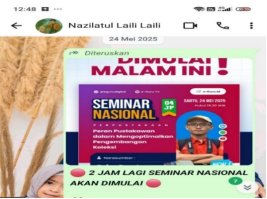
As part of its human resource development strategy, the library at NU University of South Kalimantan adopts this approach by conducting regular training sessions for librarians. These training programs may include digital information management skills, the use of library software, and technology-based customer service. Cooper (2009) states that skilled librarians are more responsive to user needs and are better able to adapt to the rapid changes occurring in the academic world. At NU University, librarians can also attend seminars online, such as the one recently held on May 24, 2025, with the theme "The Role of Librarians in Optimizing Collection Development," which was conducted live via Zoom and YouTube.
Figure 1. Online National Seminar on “The Role of Librarians in Optimizing Collection Development” held on May 24, 2025 via Zoom and YouTube.
3) Utilization of Information Technology and Library Automation Systems
Modern libraries rely heavily on information technology and automation systems to enhance service efficiency. The implementation of an Integrated Library System (ILS) enables more effective library management, covering cataloging, lending, and returning of books. This system also supports self-service, allowing users to borrow and return books independently.
The Online Public Access Catalog (OPAC) further facilitates users in searching for books or other resources online. The use of this technology not only speeds up service delivery but also reduces human error in collection management and library transactions. According to Ghosh (2010), library automation systems can improve accuracy, operational efficiency, and user satisfaction.
4) Measuring Service Quality Using the SERVQUAL Model
The SERVQUAL model, developed by Parasuraman, Zeithaml, and Berry (1988), is a widely used approach for evaluating library service quality. This model assesses service quality based on five key dimensions:
a) Tangibles (physical facilities and equipment),
b) Reliability (the ability to deliver promised services accurately),
c) Responsiveness (willingness to help and provide prompt service),
d) Assurance (knowledge and courtesy of staff, and their ability to inspire trust), and
e) Empathy (caring and personalized attention to users).
At NU University of South Kalimantan, the SERVQUAL model is applied to help the library understand user expectations, assess satisfaction levels, and develop strategies to bridge the gap between expectations and actual services provided. This measurement plays an important role in ongoing improvements, enabling the library to offer services that are more aligned with the academic needs of students and faculty.
5) Information Literacy Program
Another key strategy applied by the library at NU University of South Kalimantan is the implementation of an information literacy program. This initiative is designed to enhance the ability of students and lecturers to locate, evaluate, and use information effectively and ethically. In an era where digital information is abundant and often unfiltered, equipping users with the skills to critically assess the validity, reliability, and relevance of information is essential to prevent misinformation and disinformation.
The program is not only aimed at supporting academic achievement but also at fostering independent learning and critical thinking. It is integrated into academic support services and tailored to meet the varying levels of information needs among users from first-year students to postgraduate researchers.
At NU University of South Kalimantan, the library actively conducts this program through multiple formats. These include in-person workshops, online learning modules, training sessions embedded into course curricula, as well as one-on-one consultations. Topics covered may range from how to use academic databases, citation tools, and plagiarism detection software, to advanced research strategies and academic writing techniques.
Librarians act not just as resource managers but as educators and partners in learning. They guide users in identifying credible sources, structuring research strategies, and understanding the ethical use of information. By equipping users with strong information literacy competencies, the library empowers the academic community to be more self-sufficient, research-oriented, and globally competitive.
6) User-Based Service Improvement
Modern libraries are increasingly focused on user-centered service approaches, where strategies are tailored to meet the specific needs and preferences of users. Conducting regular user satisfaction surveys is one of the key methods used to gather feedback and implement improvements based on the results.
According to Rowley (2005), user-oriented libraries can foster more positive interactions between librarians and users, ultimately creating a better experience for both students and lecturers. At NU University of South Kalimantan, user surveys are actively utilized as a foundation for shaping library policies and strategic service improvements. Similar findings were also reported in studies on increasing visiting interest through strategic service improvements .
To strengthen this approach, the NU University Library has developed and distributed structured questionnaires targeting both students and faculty. These surveys cover various service aspects such as staff responsiveness, availability of resources, digital access, and the comfort of the reading environment. The collected data is carefully analyzed and presented in regular evaluation meetings to inform decision-making.
By consistently involving users in the assessment process, the library not only enhances transparency and accountability but also ensures that its development is aligned with the evolving academic needs of the university community.
7) Collaboration with Faculties and Development of Specialized Services
Strategi Another important service improvement strategy is establishing strong collaboration between the library and academic faculties. This partnership allows the library to offer specialized services tailored to the specific academic needs of each faculty. For example, the library can provide curated collections of literature relevant to a particular discipline or offer academic reference services for postgraduate students and researchers.
In addition, the library can support faculties by offering research guidance sessions, citation management assistance, and publication support services, which are particularly valuable for faculty members and students conducting research projects. These services not only enhance academic productivity but also strengthen the library's role as a research partner within the university ecosystem.
By aligning its services closely with faculty needs, the NU University of South Kalimantan Library ensures that its resources and expertise are directly contributing to academic excellence and the development of high-quality scholarly output.
8) Collaboration with Other Libraries
Libraries can more effectively improve both the quality of their services and the number of user visits by establishing partnerships with other, more advanced libraries.
By collaborating with well established institutions, libraries gain access to shared resources, best practices, and innovative service models. These partnerships can include interlibrary loan services, joint training programs for librarians, knowledge exchange sessions, and access to broader collections and databases. At NU University of South Kalimantan, forming strategic collaborations with leading libraries enables the library to learn, grow, and innovate ultimately delivering better and more diverse services to its users. .
1. CHALLENGES IN IMPLEMENTING THE STRATEGIES
The challenges faced by librarians in delivering services at the NU University Library in South Kalimantan, based on observation and reporting, are as follows:
1) Low User Awareness: Many users lack awareness of their responsibilities, often resulting in late returns of borrowed books.
2) Poor Care of Library Materials: Borrowers tend not to maintain the library’s collection properly, leading to damaged book covers and worn-out materials.
3) Technical Issues with Computers: Library computers occasionally experience system errors, making it impossible to process transactions smoothly. Similar technical and circulation problems were also identified in other regional library service studies .
4) Network Disruptions: The internet connection is sometimes stable and sometimes weak, which causes delays in book borrowing and return services.
To minimize the number of borrowers who fail to return books on time, it is essential to regularly socialize library rules and policies. This can be reinforced through the display of banners or brochures outlining the regulations in visible areas throughout the library. Implementing fines for late returns is also an important measure. However, the most crucial factor is building user awareness. Users must understand that the library is not a private facility, but a shared resource that benefits the entire academic community.
To address the issue of borrowers who fail to care for library materials leading to damaged book covers librarians should provide users with an understanding of the value and importance of books, and encourage them to treat library materials with respect. Raising awareness about the need to preserve the integrity of library resources and enforcing penalties for those who damage them are both necessary steps. In addition, for technical issues such as malfunctioning computers, library staff should regularly monitor and maintain the equipment to ensure service continuity and minimize disruptions.
6. Conclusion
This research has demonstrated that the library at Nahdatul Ulama University of South Kalimantan has implemented a series of well-planned strategies aimed at improving the quality and relevance of its services to meet the evolving needs of its academic community. These strategies include the Digitalization of Library Services, which has enabled greater flexibility and remote access; the Improvement of Librarian Competence, ensuring that staff are equipped with the latest knowledge and skills; the Utilization of Information Technology and Library Automation Systems for streamlined operations; and the application of the SERVQUAL Model to measure and respond to user expectations.
Additionally, the library has actively promoted Information Literacy Programs to support students and lecturers in their academic endeavors, adopted a User-Centered Service Approach to enhance engagement and satisfaction, fostered Collaboration with Faculties to tailor services to academic disciplines, and established Partnerships with Other Libraries to expand resource availability and exchange expertise.
While these efforts have led to notable improvements, the implementation process has not been without challenges. A primary concern is the lack of user awareness regarding responsibilities, which often results in overdue book returns and poor care for library materials evidenced by damaged book covers. Technical difficulties, such as intermittent computer errors, further disrupt daily operations. Unstable internet connectivity, which varies in reliability especially during the rainy season adds to the difficulty of providing consistent digital services. Moreover, frequent power outages in certain periods can completely halt library functions, affecting both on-site users and those accessing services remotely.
Despite these limitations, the library remains committed to continuous improvement. Strategic responses, such as enhanced user education, infrastructure upgrades, and more robust internal policies, are key steps being taken to address these issues. The findings from this study reinforce the importance of aligning library development with institutional goals, technological trends, and user expectations. It is hoped that these insights will serve as a reference and inspiration for similar institutions seeking to elevate the role of academic libraries in higher education.
Conflicts of Interest
The authors declare no conflict of interest.
References
[1] Al Rosid, M. H., & Alvina, R. (2022). “The Strategy of the Head Librarian in Improving Service Quality through the Development of a Digital Library Information System.” Jurnal Tarbiyatuna: Jurnal Kajian Pendidikan, Pemikiran Dan Pengembangan Pendidikan Islam, 3(1), 82–96.
[2] Elianita, B., Niswanto, & Ibrahim, S. (2018). “Librarian Management at the Central Aceh Regency Library and Archives Office.” Jurnal Magister Administrasi Pendidikan Pascasarjana Universitas Syiah Kuala, 6(4), 215–222.
[3] Gloriano. (2022). “Service Quality Analysis Using the SERVQUAL Method: A Case Study at the Unesa Library.”Jurnal Pendidikan Administrasi Perkantoran (JPAP), 10(3).
[4] Iwin Ardyawin, Rohana, Nurwahida. 2018. “Librarian Strategies in Improving Patrons’ Reading Interest at the Library and Archives Office of Central Lombok Regency.”Nusantara Journal of Information and Library Studies N-JILS, Vol. 1 No. 2,
[5] Suprihatin. 2022. “Librarian Strategies in Optimizing the Improvement of Students’ Reading Interest in School Libraries.”
[6] Nurul Wahdaniah. 2016. “Librarian Strategies in Increasing Student Visits at SMA Negeri 13 Makassar”: Makasar.
[7] Utari Surya Kartika. 2021. “Librarian Strategies in Increasing Visiting Interest at the Deli Serdang Regency Public Library.”Deli.
[8] Idzhari Rahman. 2023. “Library Strategies in Realizing Excellent Services for Users in University Libraries.” Jurnal Pustaka Ilmiah, Vol. 9, No. 1.
[9] Sri utami dkk. 2022“Strategies to Improve Library Services at the Agricultural Mechanization Development Center (BBP MEKTAN).” Business and Entrepreneurship Journal (BEJ)
[10] Hervinda Raana Oktaviani dkk. 2019. “Service Quality as a Strategy to Improve Visitor Satisfaction in Libraries.” PUSTABIBLIA: Journal of Library and Information Science. Volume 3, Number 2,
[11] Adelina Mutu Moruk. 2018“Strategies for Improving Circulation Services at the Malang City Library and Archives Office.”Jurnal JISIP : Jurnal Ilmu Sosial dan Ilmu Politik.
[12] Vera Devani. 2012. “Strategies to Improve the Service Quality of UIN Suska Riau Library Using the Kano Method.”
[13] Wahid Wahid Nashihuddin dan Dwi Ridho Aulianto. 2015. “Strategies for Enhancing Competence and Professionalism of Librarians in Special Libraries: A Case Study of the Scientific Documentation and Information Center – Indonesian Institute of Sciences (LIPI).”
[14] Fitria Widiyanti Roosinda dkk. 2021. “Qualitative Research Methods” Yogyakarta: zahir Publishing. H5
[15] Yusniah, Ahmad Fauzi. dkk. 2023. “Strategies for Developing Library Cooperation between UINSU and UMSU Libraries to Improve Library Services.”
Cite This Article
  • APA Style

    Sa’adah, N. L., Yulidawati, R. (2026). Librarian Strategies to Improve Library Service Quality at NU University of South Kalimantan. Innovation Management, 1(1), 68-73. https://doi.org/10.11648/j.im.20260101.18

    Copy | Download

    ACS Style

    Sa’adah, N. L.; Yulidawati, R. Librarian Strategies to Improve Library Service Quality at NU University of South Kalimantan. Innov. Manag. 2026, 1(1), 68-73. doi: 10.11648/j.im.20260101.18

    Copy | Download

    AMA Style

    Sa’adah NL, Yulidawati R. Librarian Strategies to Improve Library Service Quality at NU University of South Kalimantan. Innov Manag. 2026;1(1):68-73. doi: 10.11648/j.im.20260101.18

    Copy | Download

  • @article{10.11648/j.im.20260101.18,
      author = {Nazilatul Laili Sa’adah and Rusma Yulidawati},
      title = {Librarian Strategies to Improve Library Service Quality at NU University of South Kalimantan},
      journal = {Innovation Management},
      volume = {1},
      number = {1},
      pages = {68-73},
      doi = {10.11648/j.im.20260101.18},
      url = {https://doi.org/10.11648/j.im.20260101.18},
      eprint = {https://article.sciencepublishinggroup.com/pdf/10.11648.j.im.20260101.18},
      abstract = {This research is a field research with a qualitative descriptive approach, the subjects in this study are librarians and users in the NU University of South Kalimantan. And the object in this study is the librarian's strategy in improving services at UNU South Kalimantan. Problem formulation in this study The problem formulation used is what strategies are used by librarians at the NU University of South Kalimantan in improving the quality of library services. And the obstacles faced in implementing the strategy. Data were collected through in-depth interviews, observation, and documentation. The results of the study indicate that several strategies implemented at the Nahdatul Ulama University of South Kalimantan are Digitalization of Library Services, Improving Librarian Competence, Utilization of Information Technology and Library Automation Systems, Measuring Service Quality with the SERVQUAL Model, Information Literacy Program, Improving User-Based Services, Collaboration with Faculties and Development of Special Services, Cooperation with other libraries. The obstacles in implementing the strategy are that the awareness of users is still lacking, so they do not return library materials on time, Borrowers do not help maintain the collection, so most of the book covers are damaged. The computer sometimes has errors so it cannot be processed, network disruptions, sometimes stable sometimes low, plus when the rainy season arrives, the rainfall level is high, network disruptions occur more often, not to mention power outages which result in total blackouts.},
     year = {2026}
    }
    

    Copy | Download

  • TY  - JOUR
    T1  - Librarian Strategies to Improve Library Service Quality at NU University of South Kalimantan
    AU  - Nazilatul Laili Sa’adah
    AU  - Rusma Yulidawati
    Y1  - 2026/02/26
    PY  - 2026
    N1  - https://doi.org/10.11648/j.im.20260101.18
    DO  - 10.11648/j.im.20260101.18
    T2  - Innovation Management
    JF  - Innovation Management
    JO  - Innovation Management
    SP  - 68
    EP  - 73
    PB  - Science Publishing Group
    UR  - https://doi.org/10.11648/j.im.20260101.18
    AB  - This research is a field research with a qualitative descriptive approach, the subjects in this study are librarians and users in the NU University of South Kalimantan. And the object in this study is the librarian's strategy in improving services at UNU South Kalimantan. Problem formulation in this study The problem formulation used is what strategies are used by librarians at the NU University of South Kalimantan in improving the quality of library services. And the obstacles faced in implementing the strategy. Data were collected through in-depth interviews, observation, and documentation. The results of the study indicate that several strategies implemented at the Nahdatul Ulama University of South Kalimantan are Digitalization of Library Services, Improving Librarian Competence, Utilization of Information Technology and Library Automation Systems, Measuring Service Quality with the SERVQUAL Model, Information Literacy Program, Improving User-Based Services, Collaboration with Faculties and Development of Special Services, Cooperation with other libraries. The obstacles in implementing the strategy are that the awareness of users is still lacking, so they do not return library materials on time, Borrowers do not help maintain the collection, so most of the book covers are damaged. The computer sometimes has errors so it cannot be processed, network disruptions, sometimes stable sometimes low, plus when the rainy season arrives, the rainfall level is high, network disruptions occur more often, not to mention power outages which result in total blackouts.
    VL  - 1
    IS  - 1
    ER  - 

    Copy | Download

Author Information
  • Department of Library and Information Science, UIN Antasari, Banjarmasin, Indonesia

  • Department of Educational Management, STIT Darul Hijrah, Martapura, Indonesia