
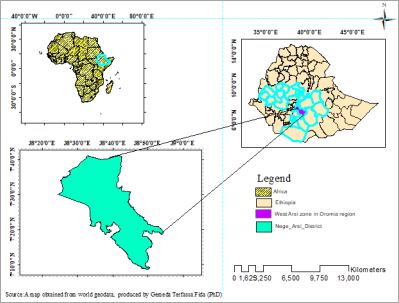
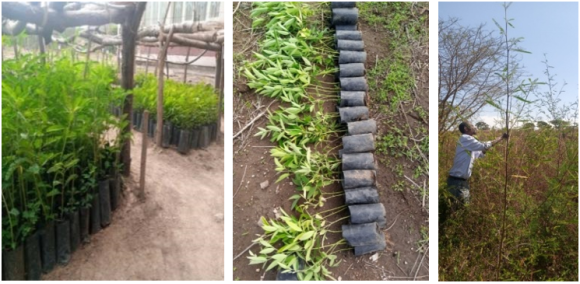
This study explored how community-based protected areas in the West Arsi Zone of Oromia, specifically Negele Arsi sub-district, can be strengthened environmentally and economically through the integration of protein bank trees and improved management practices. The main purpose was to assess the ecological and economic advantages of incorporating protein-rich leguminous trees within community-managed conservation lands. The experiment was conducted using a randomized complete block design (RCBD) with four treatments, including a control, each replicated three times. Individual plots measured 5 m × 5 m, with spacing of 1.5 m between blocks and 1 m between plots. Seedlings of tree legumes were raised in nurseries at ATARC and transplanted for field establishment. Agronomic data were collected, integrated tree plantings were carried out, and fresh biomass was measured to evaluate dry matter yield, nutrient content, and the contribution of protein bank trees. Subsamples of fresh biomass were taken for laboratory analysis. Samples were oven-dried at 60°C for 48 hours, ground, sieved (1 mm mesh), and analyzed for dry matter (DM), ash, and crude protein (CP) following standard procedures. Ash content was determined at 550°C for 3 hours using a carbolite furnace, while CP was analyzed using the Kjeldahl method. Fiber fractions including NDF, ADF, and ADL were also determined. Data were organized in Microsoft Excel and statistically analyzed using SAS version 9.2, with mean separation carried out using the Fisher’s LSD test at a 5% significance level. Results showed that integrating leguminous fodder trees into natural protected areas significantly affected ash content, organic matter, crude protein, neutral detergent fiber, and acid detergent fiber. These findings indicate that multipurpose tree legumes enhance both the quality and quantity of available forage resources in protected areas. Consequently, incorporating such trees can help address feed shortages by improving crude protein and organic matter levels. Further research is needed on optimal harvesting intervals and biomass yield of integrated tree legumes.
| Published in | Science Discovery Agriculture (Volume 1, Issue 2) |
| DOI | 10.11648/j.sda.20260102.16 |
| Page(s) | 111-116 |
| Creative Commons |
This is an Open Access article, distributed under the terms of the Creative Commons Attribution 4.0 International License (http://creativecommons.org/licenses/by/4.0/), which permits unrestricted use, distribution and reproduction in any medium or format, provided the original work is properly cited. |
| Copyright |
Copyright © The Author(s), 2026. Published by Science Publishing Group |
Tree Legumes, Protected Area, Sesbania, Animal Feeds, West Arsi
No | Treatments | Physical parameter of integrated multipurpose tree legumes | |||||
|---|---|---|---|---|---|---|---|
Survival rate | Plant height | DBH | Branch No | Canopy | |||
L1 | L2 | ||||||
1 | Cajunus cajun | 12.67±0.33b | 1.85±0.31b | 0.89±0.15ab | 11.33±5.93b | 98.89±16.02b | 65.56±22.31b |
2 | Lucinia leucocephala | 17.00±3.22b | 1.69±0.48b | 0.98±0.26ab | 12.44±5.61b | 72.78±15.88b | 45.56±10.94b |
3 | Control | 0.00±0.00c | 0.00±0.00c | 0.00±0.00b | 0.00±0.00b | 0.00±0.00c | 0.00±0.00c |
4 | Sesbania sesban | 23.33±0.88a | 3.64±0.37a | 2.11±0.80a | 38.56±3.58a | 142.22±9.69a | 108.89±6.94a |
Overall mean | 13.25±2.67 | 1.79±0.42 | 1.00±0.29 | 15.58±4.67 | 78.47±16.43 | 55.00±12.97 | |
CV | 21.90 | 13.07 | 14.18 | 19.52 | 17.09 | 19.63 | |
P<0.05 | <0.0001 | 0.0005 | 0.0486 | 0.0017 | 0.0003 | 0.0020 | |
No | Treatments | Chemical compositions parameters | ||||||
|---|---|---|---|---|---|---|---|---|
DM% | Ash% | OM% | CP | NDF | ADL | ADF | ||
1 | Cajunus cajun | 92.30±0.15ab | 4.99±0.46c | 92.80±0.70a | 18.90±0.33a | 16.87±2.49b | 3.06±0.95 | 9.38±0.99b |
2 | Lucinia leucocephala | 92.93±0.18ab | 4.38±0.41c | 95.62±0.41a | 18.46±0.26a | 25.60±3.00b | 5.91±0.91 | 16.58±3.09ab |
3 | Control | 91.83±0.59b | 10.36±0.42a | 87.97±2.00b | 5.71±0.42b | 38.64±2.00a | 6.02±2.04 | 23.87±0.35a |
4 | Sesbania sesban | 93.00±0.12a | 7.20±0.70b | 93.68±1.58a | 20.40±2.27a | 18.82±4.46b | 4.44±1.44 | 12.21±3.61b |
Overall mean | 92.27±0.20 | 6.73±0.74 | 92.52±1.02 | 15.87±1.85 | 24.98±2.90 | 4.86±0.70 | 15.51±1.94 | |
CV | 0.61 | 13.20 | 2.51 | 12.81 | 21.67 | 6.07 | 27.16 | |
P<0.05 | 0.0189 | 0.0001 | 0.0200 | <0.0001 | 0.0045 | 0.4486 | 0.0140 | |
ADF | Acid Detergent Fiber |
ADL | Acid Detergent Lignin |
CBPAs | Community-Based Protected Areas |
CP | Crude Protein |
CV | Coeffient of Variation |
°C | Degree Centigrade |
DBH | Diameter at Breast Height |
DM | Dry Matter |
NDF | Neutral Detergent Fiber |
OM | Organic Matter |
SNNPR | Southern Nations, Nationalities and Peoples’ Region |
| [1] | Achieng, A. O., Arhonditsis, G. B., Mandrack, N. E., Febria, C. M., Opaa, B., Odongo, V. O., & Barasa, J. E. (2023). Monitoring biodiversity loss in rapidly changing Afrotropical ecosystems: An emerging imperative for governance and research. Ecological Informatics, 76, 102266. |
| [2] | Aerts, R., Nyssen, J., & Haile, M. (2009). On the difference between “exclosures” and “enclosures” in ecology and the environment. Journal of Arid Environments, 73(8), 762-763. |
| [3] | Allendorf, T. D. (2007). Residents’ attitudes toward three protected areas in southwestern Nepal. Biodiversity and Conservation, 16(7), 2087-2102. |
| [4] | Allendorf, T. D., Swe, K. K., Oo, T., Htut, Y., Aung, M., Aung, M., & Wemmer, C. (2006). Community attitudes toward three protected areas in Upper Myanmar (Burma). Environmental Conservation, 33(4), 344-352. |
| [5] | Derero, A., & Kitaw, G. (2018). Nutritive values of seven high priority indigenous fodder tree species in pastoral and agro-pastoral areas in Eastern Ethiopia. Agriculture & Food Security, 7(1), 68. |
| [6] | Feeding the Future Innovation Laboratory for Livestock Systems. (2020). Improved forage and feed technologies for livestock production. University of Florida, Gainesville. |
| [7] | Gayo, L. (2025). Community-based conserved areas in advancing biodiversity and livelihoods in Sub-Saharan Africa: A political-ecology review. Conservation & Society, 23(1), 45-57. |
| [8] | Gulte, Y., Tesfaye, B., & Tadesse, Y. (2023). Governance challenges and community participation in protected area management in Ethiopia: A review. African Journal of Ecology, 61(2), 141-153. |
| [9] | Heuzé, V., Tran, G., & Lebas, F. (2016). Pigeon pea (Cajanus cajan). Feedipedia, a programme by INRA, CIRAD, AFZ and FAO. Retrieved from |
| [10] | Koricha, H. G., & Adem, M. J. (2024). The role of community-based conservation approaches for biodiversity conservation and socio-economic development in Bale Mountains National Park, Southeast Ethiopia. Scientific Reports, 14, 12241. |
| [11] | Mengist, W. (2020). Challenges of protected area management and conservation strategies in Ethiopia: A review paper. Advances in Environmental Studies, 4(1), 277-285. |
| [12] | Mengistu, T., Teketay, D., Hulten, H., & Yemshaw, Y. (2017). The role of enclosures in the recovery of woody vegetation in degraded dryland hillsides of central and northern Ethiopia. Journal of Arid Environments, 89, 85-93. |
| [13] | Mirza Hasanuzzaman. (2017). Agronomic crops: Volume 1: Production technologies. Springer Nature. |
| [14] | Orwa, C., Mutua, A., Kindt, R., Jamnadass, R., & Anthony, S. (2009). Agroforestree database: A tree reference and selection guide version 4.0. World Agroforestry Centre, Nairobi, Kenya. |
| [15] |
Raj, A. K. (2023). Management of tree fodder banks for quality forage and ecosystem services: Role of protein banks. Indian Journal of Animal Sciences, 93(9), 901-908.
https://epubs.icar.org.in/index.php/IJAnS/article/view/120692 |
| [16] | Solomon Mengistu, Fekede Feyissa and Gezahegn Kebede, 2018 Progress of Forage Legumes Breeding and Genetics Research in Ethiopia: A review.: Ethiop. J. Crop Sci. Special Issue Vol. 1 No. 1. |
| [17] | Van Soest PJ and Robertson JB., 2015. Analysis of forage and fibrous food. In: A laboratory manual for animal science, vol, 613. Ithaca, NY, USA: Cornell University. |
| [18] | Zerihun Nigussie and Getachew Alemayehu, 2013. Sesbania sesban (L.) Merrill: Potential uses of an underutilized multipurpose tree in Ethiopia. African Journal of Plant Science, Vol. 7(10), pp. 468-475, |
APA Style
Tilahun, M., Terfassa, G. (2026). Environmental and Economic Role of Community Protected Area with Integration of Management Practices and Protein Bank in West Arsi Zone Oromia Region Ethiopia. Science Discovery Agriculture, 1(2), 111-116. https://doi.org/10.11648/j.sda.20260102.16
ACS Style
Tilahun, M.; Terfassa, G. Environmental and Economic Role of Community Protected Area with Integration of Management Practices and Protein Bank in West Arsi Zone Oromia Region Ethiopia. Sci. Discov. Agric. 2026, 1(2), 111-116. doi: 10.11648/j.sda.20260102.16
@article{10.11648/j.sda.20260102.16,
  author = {Meseret Tilahun and Gemeda Terfassa},
  title = {Environmental and Economic Role of Community Protected Area with Integration of Management Practices and Protein Bank in West Arsi Zone Oromia Region Ethiopia},
  journal = {Science Discovery Agriculture},
  volume = {1},
  number = {2},
  pages = {111-116},
  doi = {10.11648/j.sda.20260102.16},
  url = {https://doi.org/10.11648/j.sda.20260102.16},
  eprint = {https://article.sciencepublishinggroup.com/pdf/10.11648.j.sda.20260102.16},
  abstract = {This study explored how community-based protected areas in the West Arsi Zone of Oromia, specifically Negele Arsi sub-district, can be strengthened environmentally and economically through the integration of protein bank trees and improved management practices. The main purpose was to assess the ecological and economic advantages of incorporating protein-rich leguminous trees within community-managed conservation lands. The experiment was conducted using a randomized complete block design (RCBD) with four treatments, including a control, each replicated three times. Individual plots measured 5 m × 5 m, with spacing of 1.5 m between blocks and 1 m between plots. Seedlings of tree legumes were raised in nurseries at ATARC and transplanted for field establishment. Agronomic data were collected, integrated tree plantings were carried out, and fresh biomass was measured to evaluate dry matter yield, nutrient content, and the contribution of protein bank trees. Subsamples of fresh biomass were taken for laboratory analysis. Samples were oven-dried at 60°C for 48 hours, ground, sieved (1 mm mesh), and analyzed for dry matter (DM), ash, and crude protein (CP) following standard procedures. Ash content was determined at 550°C for 3 hours using a carbolite furnace, while CP was analyzed using the Kjeldahl method. Fiber fractions including NDF, ADF, and ADL were also determined. Data were organized in Microsoft Excel and statistically analyzed using SAS version 9.2, with mean separation carried out using the Fisher’s LSD test at a 5% significance level. Results showed that integrating leguminous fodder trees into natural protected areas significantly affected ash content, organic matter, crude protein, neutral detergent fiber, and acid detergent fiber. These findings indicate that multipurpose tree legumes enhance both the quality and quantity of available forage resources in protected areas. Consequently, incorporating such trees can help address feed shortages by improving crude protein and organic matter levels. Further research is needed on optimal harvesting intervals and biomass yield of integrated tree legumes.},
 year = {2026}
}
TY  - JOUR
T1  - Environmental and Economic Role of Community Protected Area with Integration of Management Practices and Protein Bank in West Arsi Zone Oromia Region Ethiopia
AU  - Meseret Tilahun
AU  - Gemeda Terfassa
Y1  - 2026/04/29
PY  - 2026
N1  - https://doi.org/10.11648/j.sda.20260102.16
DO  - 10.11648/j.sda.20260102.16
T2  - Science Discovery Agriculture
JF  - Science Discovery Agriculture
JO  - Science Discovery Agriculture
SP  - 111
EP  - 116
PB  - Science Publishing Group
UR  - https://doi.org/10.11648/j.sda.20260102.16
AB  - This study explored how community-based protected areas in the West Arsi Zone of Oromia, specifically Negele Arsi sub-district, can be strengthened environmentally and economically through the integration of protein bank trees and improved management practices. The main purpose was to assess the ecological and economic advantages of incorporating protein-rich leguminous trees within community-managed conservation lands. The experiment was conducted using a randomized complete block design (RCBD) with four treatments, including a control, each replicated three times. Individual plots measured 5 m × 5 m, with spacing of 1.5 m between blocks and 1 m between plots. Seedlings of tree legumes were raised in nurseries at ATARC and transplanted for field establishment. Agronomic data were collected, integrated tree plantings were carried out, and fresh biomass was measured to evaluate dry matter yield, nutrient content, and the contribution of protein bank trees. Subsamples of fresh biomass were taken for laboratory analysis. Samples were oven-dried at 60°C for 48 hours, ground, sieved (1 mm mesh), and analyzed for dry matter (DM), ash, and crude protein (CP) following standard procedures. Ash content was determined at 550°C for 3 hours using a carbolite furnace, while CP was analyzed using the Kjeldahl method. Fiber fractions including NDF, ADF, and ADL were also determined. Data were organized in Microsoft Excel and statistically analyzed using SAS version 9.2, with mean separation carried out using the Fisher’s LSD test at a 5% significance level. Results showed that integrating leguminous fodder trees into natural protected areas significantly affected ash content, organic matter, crude protein, neutral detergent fiber, and acid detergent fiber. These findings indicate that multipurpose tree legumes enhance both the quality and quantity of available forage resources in protected areas. Consequently, incorporating such trees can help address feed shortages by improving crude protein and organic matter levels. Further research is needed on optimal harvesting intervals and biomass yield of integrated tree legumes.
VL  - 1
IS  - 2
ER  -
Ethiopia Agricultural Research Institute, Adami Tulu Agricultural Research Center, Batu, Ethiopia
Ethiopia Agricultural Research Institute, Adami Tulu Agricultural Research Center, Batu, Ethiopia

Information



 Share This Article
 Twitter
 Linked In
 Facebook
 Copy
Copy Download