
The adoption of Artificial Intelligence (AI) is reshaping recruitment processes in the European banking sector, where efficiency, accuracy, and compliance are strategic imperatives. This study investigates the extent to which AI improves recruitment efficiency, candidate selection quality, organisational outcomes, and candidate trust. Using a mixed-method approach, data were collected from 200 HR professionals and managers in European banks and supplemented with secondary industry evidence. Descriptive statistics, correlation, and regression analyses confirm that AI-driven recruitment significantly reduces time-to-hire and improves candidate-job matching, with recruitment process efficiency (β = 0.562, p < 0.001) and structured evaluation criteria (β = 0.377, p = 0.002) emerging as the strongest predictors of positive organisational outcomes. However, results also indicate that excessive reliance on automation can negatively affect candidate trust (β = −0.259, p < 0.05). These findings extend theoretical debates by applying the Technology Acceptance Model, the Resource-Based View, and Human Capital Theory to the context of banking recruitment, highlighting AI as both a strategic resource and a source of ethical and transparency challenges. Practical implications include the need for hybrid recruitment models combining automation with human oversight, enhanced transparency in candidate communication, and strict alignment with the EU AI Act. This study contributes original empirical evidence from European banking, offering theoretical, managerial, and policy insights into the responsible and effective adoption of AI in recruitment.
| Published in | Science Discovery Artificial Intelligence (Volume 1, Issue 1) |
| DOI | 10.11648/j.sdai.20260101.11 |
| Page(s) | 1-6 |
| Creative Commons |
This is an Open Access article, distributed under the terms of the Creative Commons Attribution 4.0 International License (http://creativecommons.org/licenses/by/4.0/), which permits unrestricted use, distribution and reproduction in any medium or format, provided the original work is properly cited. |
| Copyright |
Copyright © The Author(s), 2026. Published by Science Publishing Group |
Artificial Intelligence, Recruitment, Efficiency, Candidate Trust, European Banking, Human Capital, TAM, RBV
Variable | Mean | Std Dev |
|---|---|---|
Recruitment Efficiency | 4.16 | 0.59 |
Candidate Selection Quality | 3.96 | 0.61 |
Organisational Outcomes | 4.13 | 0.62 |
Candidate Trust | 4.22 | 0.60 |
Ethical Concerns | 3.98 | 0.82 |
Variables | Time-to-Hire | Candidate Selection | Organisational Outcomes | Candidate Trust |
|---|---|---|---|---|
Time-to-Hire | 1.00 | 0.78 | 0.40 | 0.70 |
Candidate Selection | 0.78 | 1.00 | 0.41 | 0.63 |
Organisational Outcomes | 0.40 | 0.41 | 1.00 | 0.65 |
Candidate Trust | 0.70 | 0.63 | 0.65 | 1.00 |
Predictor | Beta | p-value |
|---|---|---|
Recruitment Efficiency | 0.562 | <0.001 |
Candidate Evaluation | 0.377 | 0.002 |
AI Adoption | -0.259 | 0.044 |
Ethical Concerns | -0.063 | 0.363 |
AI | Artificial Intelligence |
EU | European Union |
GDPR | General Data Protection Regulation |
HR | Human Resources |
HRM | Human Resource Management |
RBV | Resource-Based View |
TAM | Technology Acceptance Model |
| [1] | Accenture (2024) Top 10 banking trends for 2024 – Banking on AI. Available at: |
| [2] | European Parliament (2024) EU Artificial Intelligence Act. Official Journal of the European Union. |
| [3] | Manda, E. F. and Salim, R. (2021) Analysis of the influence of perceived usefulness, perceived ease of use and attitude toward using technology on actual technology use: The case of TAM. International Research Journal of Advanced Engineering Science, 6(1), pp. 135-140. |
| [4] | McKinsey & Company (2024) State of generative AI implementation among European banks. Available at: |
| [5] | Mukherjee, I. and Krishnan, L. R. K. (2022) Impact of AI on aiding employee recruitment and selection process. Journal of the International Academy for Case Studies, 28(2), pp. 55-68. |
| [6] | Mujtaba, D. F. and Mahapatra, N. R. (2024) Fairness in AI-driven recruitment: Challenges, metrics, and future directions. arXiv preprint arXiv: 2405.19699. |
| [7] | Naeem, M., Siraj, M., Abdali, A. S. and Mehboob, A. (2024) The impact of investment in AI on bank performance: Empirical evidence from Pakistan's banking sector. KASBIT Business Journal, 17(1), pp. 45-59. |
| [8] | Ng, W. and Stuart, T. E. (2022) Acquired employees versus hired employees: Retained or turned over. Strategic Management Journal, 43(5), pp. 1025-1045. |
| [9] | Oman, Z. U., Siddiqua, A. and Noorain, R. (2024) Artificial intelligence and its ability to reduce recruitment bias. International Journal of Human Resource Studies, 14(1), pp. 99-115. |
| [10] | Pinochet, L. H. C., Lopes, N. S., Onusic, L. M., dos Santos, M., Pardim, V. I. and Francischini, A. S. N. (2024) Exploring the impact of AI on candidate selection: A two-phase methodological approach with CRITIC-WASPAS. Procedia Computer Science, 242, pp. 920-927. |
| [11] | Shafeela, N. and Shahithabanu, M. (2024) AI revolution in banking recruitment: Enhancing efficiency and objectivity. REST Journal, 5(2), pp. 33-45. |
| [12] | Vrontis, D., Christofi, M., Pereira, V., Tarba, S., Makrides, A. and Trichina, E. (2023) Artificial intelligence, robotics, advanced technologies, and human resource management: A systematic review. Artificial Intelligence and International HRM, 12(3), pp. 172-201. |
| [13] | Willie, M. (2025) Leveraging digital resources: A resource-based view. Journal of Strategic Management, 18(1), pp. 44-59. |
| [14] | Yanamala, K. K. R. (2023) Transparency, privacy, and accountability in AI-enhanced HR processes. Journal of Advanced Computing Systems, 3(3), pp. 10-18. |
APA Style
Prestini, D. K. (2026). AI Adoption and Recruitment Efficiency in European Banking: A Mixed-Method Analysis. Science Discovery Artificial Intelligence, 1(1), 1-6. https://doi.org/10.11648/j.sdai.20260101.11
ACS Style
Prestini, D. K. AI Adoption and Recruitment Efficiency in European Banking: A Mixed-Method Analysis. Sci. Discov. Artif. Intell. 2026, 1(1), 1-6. doi: 10.11648/j.sdai.20260101.11
AMA Style
Prestini DK. AI Adoption and Recruitment Efficiency in European Banking: A Mixed-Method Analysis. Sci Discov Artif Intell. 2026;1(1):1-6. doi: 10.11648/j.sdai.20260101.11
@article{10.11648/j.sdai.20260101.11,
  author = {Dawid Krystian Prestini},
  title = {AI Adoption and Recruitment Efficiency in European Banking: A Mixed-Method Analysis},
  journal = {Science Discovery Artificial Intelligence},
  volume = {1},
  number = {1},
  pages = {1-6},
  doi = {10.11648/j.sdai.20260101.11},
  url = {https://doi.org/10.11648/j.sdai.20260101.11},
  eprint = {https://article.sciencepublishinggroup.com/pdf/10.11648.j.sdai.20260101.11},
  abstract = {The adoption of Artificial Intelligence (AI) is reshaping recruitment processes in the European banking sector, where efficiency, accuracy, and compliance are strategic imperatives. This study investigates the extent to which AI improves recruitment efficiency, candidate selection quality, organisational outcomes, and candidate trust. Using a mixed-method approach, data were collected from 200 HR professionals and managers in European banks and supplemented with secondary industry evidence. Descriptive statistics, correlation, and regression analyses confirm that AI-driven recruitment significantly reduces time-to-hire and improves candidate-job matching, with recruitment process efficiency (β = 0.562, p < 0.001) and structured evaluation criteria (β = 0.377, p = 0.002) emerging as the strongest predictors of positive organisational outcomes. However, results also indicate that excessive reliance on automation can negatively affect candidate trust (β = −0.259, p < 0.05). These findings extend theoretical debates by applying the Technology Acceptance Model, the Resource-Based View, and Human Capital Theory to the context of banking recruitment, highlighting AI as both a strategic resource and a source of ethical and transparency challenges. Practical implications include the need for hybrid recruitment models combining automation with human oversight, enhanced transparency in candidate communication, and strict alignment with the EU AI Act. This study contributes original empirical evidence from European banking, offering theoretical, managerial, and policy insights into the responsible and effective adoption of AI in recruitment.},
 year = {2026}
}
TY  - JOUR
T1  - AI Adoption and Recruitment Efficiency in European Banking: A Mixed-Method Analysis
AU  - Dawid Krystian Prestini
Y1  - 2026/02/21
PY  - 2026
N1  - https://doi.org/10.11648/j.sdai.20260101.11
DO  - 10.11648/j.sdai.20260101.11
T2  - Science Discovery Artificial Intelligence
JF  - Science Discovery Artificial Intelligence
JO  - Science Discovery Artificial Intelligence
SP  - 1
EP  - 6
PB  - Science Publishing Group
UR  - https://doi.org/10.11648/j.sdai.20260101.11
AB  - The adoption of Artificial Intelligence (AI) is reshaping recruitment processes in the European banking sector, where efficiency, accuracy, and compliance are strategic imperatives. This study investigates the extent to which AI improves recruitment efficiency, candidate selection quality, organisational outcomes, and candidate trust. Using a mixed-method approach, data were collected from 200 HR professionals and managers in European banks and supplemented with secondary industry evidence. Descriptive statistics, correlation, and regression analyses confirm that AI-driven recruitment significantly reduces time-to-hire and improves candidate-job matching, with recruitment process efficiency (β = 0.562, p < 0.001) and structured evaluation criteria (β = 0.377, p = 0.002) emerging as the strongest predictors of positive organisational outcomes. However, results also indicate that excessive reliance on automation can negatively affect candidate trust (β = −0.259, p < 0.05). These findings extend theoretical debates by applying the Technology Acceptance Model, the Resource-Based View, and Human Capital Theory to the context of banking recruitment, highlighting AI as both a strategic resource and a source of ethical and transparency challenges. Practical implications include the need for hybrid recruitment models combining automation with human oversight, enhanced transparency in candidate communication, and strict alignment with the EU AI Act. This study contributes original empirical evidence from European banking, offering theoretical, managerial, and policy insights into the responsible and effective adoption of AI in recruitment.
VL  - 1
IS  - 1
ER  -
Department of Business and Management, Wrexham University, Wrexham, United Kingdom;Department of Management, Opole University of Technology, Opole, Poland
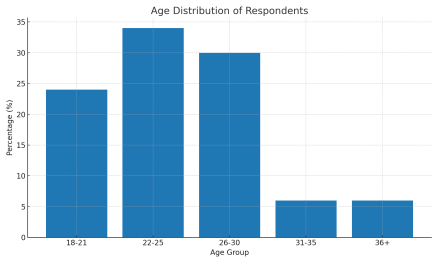
Figure 1. Distribution of respondents by age group, showing that over 60% are between 22 and 30 years old.
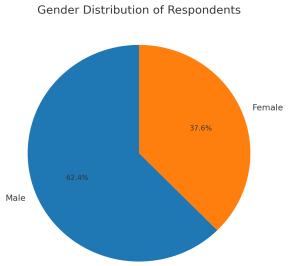
Figure 2. Gender distribution of respondents, indicating a male majority (62.4%) compared to female respondents (37.6%).
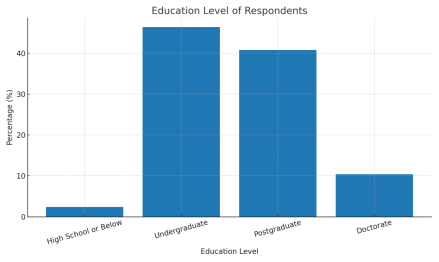
Figure 3. Educational background of respondents, highlighting the dominance of undergraduate (46.4%) and postgraduate (40.8%) qualifications.
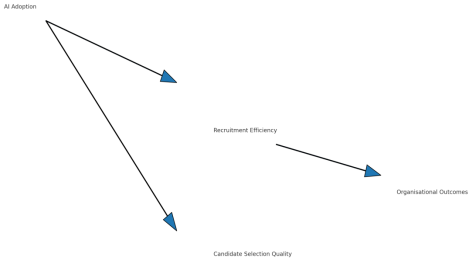
Figure 4. Conceptual framework illustrating hypothesised relationships between AI adoption, recruitment efficiency, candidate selection quality, organisational outcomes, and trust.

Information



 Share This Article
 Twitter
 Linked In
 Facebook
 Copy
Copy Download