Abstract
Kenya’s Competency-Based Curriculum (CBC) emphasizes creativity, critical thinking and learner-centered pedagogy but implementation disparities persist across rural and urban schools due to unequal access to infrastructure, trained educators and digital tools. This study proposes a gender-sensitive and Artificial Intelligence (AI)-driven education model platform to support equitable CBC delivery at the junior secondary level. The model platform incorporates AI tools for adaptive learning and interactive instruction. Using a mixed-methods approach we assess how contextual factors such as digital access, ICT infrastructure, teacher preparedness and location affect AI adoption. Quantitative analysis was conducted using ordinal logistic regression and gender-disaggregated comparisons to evaluate adoption patterns and usability perceptions. Data were drawn from two purposively selected junior secondary schools in contrasting settings. This study revealed that digital access and teacher preparedness are significant predictors of AI adoption (p < 0.05), location shows a marginal effect (p ≈ 0.06) while ICT infrastructure and gender were not statistically significant. These insights suggest that strengthening teacher capacity and improving digital access are critical to advancing AI integration under the CBC framework. These results inform inclusive EdTech design and policy strategies aimed at closing regional and gender-related gaps in AI-driven learning.
Keywords
Artificial Inteligence, Gender, Competence Based Curriculum, Adoption
1. Introduction
The current global education landscape is increasingly influenced by technological advancements and the demand for 21st-century skills such as creativity and digital literacy. In response, Kenya introduced the Competency-Based Curriculum (CBC) in 2017 which promotes learner-centered instruction and practical skills development moving away from traditional exam-based models
| [11] | Kimutai, S. (2025). An evaluation of Kenya TVET trainers on use of AI in instruction design and delivery. Africa Journal of Technical and Vocational Education and Training (AfriTVET), 10(1), 13–27. https://doi.org/10.69641/afritvet.2025.101193 |
[11]
. Despite this progressive shift, the implementation of CBC has highlighted a significant urban-rural divide where marginalized communities in rural areas face substantial challenges such as inadequate infrastructure and limited access to digital learning tools
| [7] | Chikwe, C., Dagunduro, A., Ajuwon, O., & Ediae, A. (2024). Sociological barriers to equitable digital learning: A data-driven approach. Comprehensive Research Review in Multidisciplinary Studies, 2(1), 27–34.
https://doi.org/10.57219/crrms.2024.2.1.0038 |
| [12] | Matere, A. (2024). Effectiveness of artificial intelligence tools in teaching and learning in higher education institutions in Kenya. Journal of the Kenya National Commission for UNESCO (JKNCU), 5(1).
https://doi.org/10.62049/jkncu.v5i1.177 |
[7, 12]
. As a result, these disparities hinder the realization of CBC's objectives and exacerbate inequalities in education access and quality
. The COVID-19 pandemic has further exposed these structural vulnerabilities as many educational institutions lacked the necessary digital infrastructure to continue learning during school closures
| [12] | Matere, A. (2024). Effectiveness of artificial intelligence tools in teaching and learning in higher education institutions in Kenya. Journal of the Kenya National Commission for UNESCO (JKNCU), 5(1).
https://doi.org/10.62049/jkncu.v5i1.177 |
[12]
. As educational systems adapt, AI is emerging as a potent tool to address these barriers. AI-driven platforms can enhance learning outcomes by providing personalized learning experiences, adaptive content delivery and real-time feedback
| [14] | Muslimin, M., & Indrawati, R. (2024). Digitalization and education equity in remote areas: Challenges and strategic solutions. Journal of Education Humaniora and Social Sciences (JEHSS), 7(2), 376–383.
https://doi.org/10.34007/jehss.v7i2.2356 |
| [15] | Omariba, A. (2025). Enhancing student outcomes through AI-driven personalized learning: A study on implementation and effectiveness at the universities in Kenya. East African Journal of Education Studies, 8(2), 512–529.
https://doi.org/10.37284/eajes.8.2.3048 |
[14, 15]
. In low-resource settings, AI can compensate for teacher shortages by offering instructional scaffolding though such features are not widely available in many existing platforms in Kenya
| [4] | Breen, C., Fatehkia, M., Yan, J., Zhao, X., Leasure, D., Weber, I., … Kashyap, R. (2024). Mapping subnational gender gaps in internet and mobile adoption using social media data. OSF Preprints. https://doi.org/10.31235/osf.io/qnzsw |
| [8] | Gnambs, T., & Hawrot, A. (2025). The development of disparities in digital competencies across adolescence. OSF Preprints. https://doi.org/10.31234/osf.io/gjr6w |
[4, 8]
.
Incorporating AI into education frameworks in the context of the CBC raises critical concerns about inclusivity, specifically regarding gender disparities. Research indicates that girls disproportionately encounter barriers to accessing and utilizing digital tools due to socio-cultural norms and lower levels of digital literacy
. Without conscious efforts to develop AI tools through a gender-sensitive lens educational technologies risk perpetuating existing inequalities rather than alleviating them
| [16] | Shah, S. S. (2025). Gender bias in artificial intelligence: Empowering women through digital literacy. Premier Journal of Artificial Intelligence, 1, Article 1000088.
https://doi.org/10.70389/PJAI.1000088 |
[16]
. Evidence suggests that many AI-based educational interventions in Africa do not incorporate gender-disaggregated impact assessments which impairs the understanding and addressing of these gaps
| [11] | Kimutai, S. (2025). An evaluation of Kenya TVET trainers on use of AI in instruction design and delivery. Africa Journal of Technical and Vocational Education and Training (AfriTVET), 10(1), 13–27. https://doi.org/10.69641/afritvet.2025.101193 |
[11]
.
This paper presents a study proposing the development of a model AI-driven educational technology platform to be tailored for the implementation of the CBC in junior secondary schools. The platform would provide adaptive and interactive digital learning resources aligned with CBC pedagogical approaches
| [14] | Muslimin, M., & Indrawati, R. (2024). Digitalization and education equity in remote areas: Challenges and strategic solutions. Journal of Education Humaniora and Social Sciences (JEHSS), 7(2), 376–383.
https://doi.org/10.34007/jehss.v7i2.2356 |
[14]
. To validate its necessity the study will be piloted in two schools: Kiamabudu DEB Junior Secondary School representing a rural setup and Jogoo Junior Secondary School representing an urban setup. This comparative analysis will yield insights regarding the platform's contextual relevance and scalability
. The study assesses how metadata points such as ICT infrastructure and teacher preparedness impact the adoption of AI educational technologies in Kenyan junior secondary schools
| [15] | Omariba, A. (2025). Enhancing student outcomes through AI-driven personalized learning: A study on implementation and effectiveness at the universities in Kenya. East African Journal of Education Studies, 8(2), 512–529.
https://doi.org/10.37284/eajes.8.2.3048 |
[15]
. Additionally, the proposed model will align AI functionalities with CBC requirements while addressing gendered differences in perception and usability among students
. Employing a mixed-methods approach enables a comprehensive exploration of these dimensions combining qualitative insights from educators with quantitative survey data
. Participatory co-design is crucial to ensure the platform's contextual adaptability and acceptance among its users
| [5] | Brown, B., Hurrell, C., Roberts, V., & Jacobsen, M. (2021). Open education co-design as a participatory pedagogy in an online graduate program. The Open/Technology in Education, Society and Scholarship Association Conference, 1(1), 1–8. https://doi.org/10.18357/otessac.2021.1.1.41 |
[5]
. Ethics are an essential component of this study's design ensuring that algorithms do not perpetuate biases and that data privacy is maintained. The AI model platform is intended to enhance rather than replace traditional teaching roles, emphasizing its design for low-bandwidth environments to accommodate diverse user capabilities
.
In conclusion, this study presents a localized model platform which would integrate AI into the CBC implementation framework. It aims to contribute meaningful insights to the academic discourse on AI in education while equipping policymakers with evidence-based recommendations for addressing digital divides in Kenya’s educational landscape
| [10] | Juma, L., Chavula, P., Kayusi, F., Omwenga, M., Mishra, R., & Mwewa, T. (2025). AI in dissertation examination: Opportunities for undergraduates and postgraduates in Zambia, Rwanda, and Kenya. Latin American Transactions on Intelligent Applications (LatIA), 3, 329.
https://doi.org/10.62486/latia2025329 |
[10]
.
2. Methodology
We employed a convergent mixed-methods design to investigate the feasibility and contextual relevance of an AI-driven model platform for supporting CBC delivery in junior secondary schools. The design allowed for the collection and analysis of both quantitative and qualitative data simultaneously to triangulate findings and enhance explanatory power. This approach was suitable for capturing both the measurable aspects of AI adoption such as digital access, ICT infrastructure, teacher preparedness, geographical location and gendered perceptions. To ensure context-specific insights, the research was conducted in two contrasting school environments with Kiamabudu DEB Junior Secondary School representing rural setup and Jogoo Junior Secondary School representing urban setup. These schools were purposively selected to reflect differences in digital infrastructure teacher capacity and learner demographics. A modest sample of 15 participants per school were selected comprising both students and teachers.
2.1. Research Design
The study adopted a descriptive survey research design, which was considered appropriate for collecting perceptions and experiences of respondents regarding digital readiness and access within the learning environment. This design enabled the researcher to gather quantitative insights while capturing contextual nuances from the participants.
2.2. Study Area and Population
The study was conducted within selected learning institutions comprising both rural and urban settings. The target population included teachers and students, who are the primary stakeholders in the integration of digital technologies in education. Students were included as direct users of learning technologies, while teachers served as facilitators of instructional delivery.
2.3. Sampling Technique
A purposive and convenience sampling technique was employed to select respondents who had direct interaction with digital learning tools or platforms. A total of 30 participants were engaged, consisting of 20 students (66.7%) and 10 teachers (33.3%). The higher representation of students was intentional given their larger overall population within schools compared to teachers thereby offering a more realistic reflection of user perspectives.
2.4. Instruments
Data was collected using a structured questionnaire, designed with both closed-ended and categorical items. Sections of the instrument captured demographic characteristics (gender, role and location) while other components assessed ICT infrastructure, digital access and technology preparedness using a 5-point Likert scale ranging from 1 = Strongly Disagree to 5 = Strongly Agree.
2.5. Validity and Reliability
To ensure content validity the questionnaire was reviewed by two subject-matter experts in educational technology and research methodology. Content validity was ensured through expert review by two education technology specialists and one gender expert. A pilot test was conducted with 5 respondents outside the sample schools hence yielding a Cronbach’s Alpha reliability score of 0.78 indicating acceptable internal consistency.
2.6. Data Collection Procedure
The study utilizes a streamlined data collection strategy comprising structured questionnaires with Likert-scale items and focus group discussions (FGDs). We obtained consent from institutional authorities before administering the instruments and respondents were briefed on the purpose of the study and assured of confidentiality and anonymity. Questionnaires were administered in person and completed forms were retrieved immediately to ensure adequate response rates.
The target population consisted of all teachers and junior secondary school learners enrolled in Kiamabudu DEB (rural) and Jogoo Junior Secondary School (urban) with an estimated total population of approximately 40 teachers and 277 learners. From this population, a total of 30 respondents (15 per school) were selected using stratified purposive sampling to ensure representation by gender and role (teachers vs learners). Questionnaires are administered to both teachers and students to capture quantitative data on digital access and AI awareness. Two FGDs were conducted (one per school), each consisting of 6 participants (3 male, 3 female) drawn from both teachers and students. These FGDs provided qualitative insights into the usability and perceived value of AI in supporting CBC learning.
2.7. Conceptual Model of the AI-Driven CBC Platform
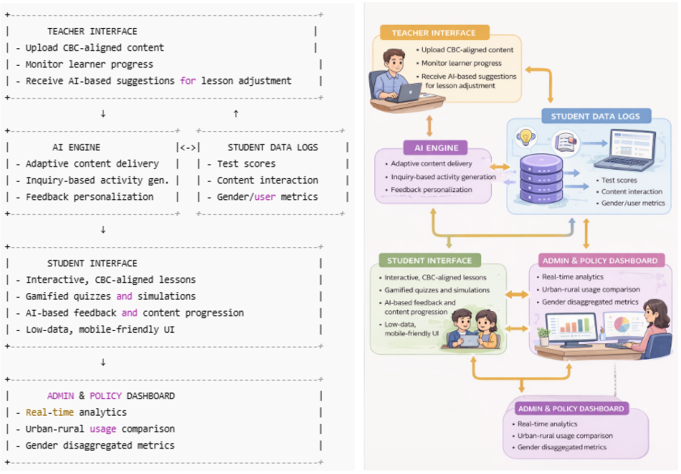
The study focused on the development of a conceptual model of an AI-driven learning platform. This model is designed to simulate the core components and interactions necessary for an effective AI-enhanced CBC learning environment. The model incorporated features informed directly by the data collected from users and stakeholders in the pilot schools. Diagrammatically the conceptual model is represented as:
Figure 1. Conceptual Model of the AI-Driven CBC Learning Platform.
Figure 1 represents a conceptual AI-driven education technology tailored for Kenya’s Competency-Based Curriculum (CBC). The model is structured into five main functional layers illustrating the flow of data, feedback and personalized learning between teachers, learners and the AI engine.
The functionalities of the layers are; teacher interface where teachers interact with an input dashboard, submit lesson objectives, student progress updates and assessment results; AI engine and student data logs which gets data from teacher interface and uses AI algorithms for content personalization, adaptive feedback and intelligent task recommendation. It also draws data from student data logs that capture usage patterns, quiz performance and gender-disaggregated insights; Student interface which is a mobile/web platform informed by AI engine through which students access CBC-aligned interactive content, inquiry-based tasks, gamified assessments and a user-friendly design optimized for low-bandwidth environments; admin and policy dashboard which is an analytics and monitoring dashboard to support administrators and policymakers by providing real-time metrics on gender participation, urban-rural engagement and teacher-student interactions.
This conceptual model guides the eventual development of a real prototype by mapping input-output relationships and prioritizing user roles (teacher, student and administrator). It highlights AI capabilities like adaptive content delivery, progress monitoring and inquiry-based task generation integrated with data-driven decision support for both teachers and education policymakers.
2.8. Descriptive and Comparative Statistics
Descriptive statistics were computed using the mean , group means with respect to gender, standard deviation and interquartile range to assess central tendency and variability across AI adoption scores, digital access levels and related variables. The independent samples t-test will assess whether there is a statistically significant difference in AI adoption scores between male and female participants. This analysis enables the study to determine whether gender is associated with differing perceptions or engagement with the AI system. The paired sample t-test equation considered is:
where:
= Mean score of males.
= Mean score of females.
= Variance of male and female respectively
n= Sample size (same for both sets)
t=t-statistic used to test for significant difference in means
2.9. Ordinal Logistic Regression Analysis
Ordinal Logistic Regression analysis is employed to evaluate how key variables such as ICT infrastructure, teacher preparedness, gender and digital access influence the adoption and engagement with the AI-driven platform. It helps determine the strength and direction of influence each variable has on the likelihood of learners or teachers engaging with AI tools hence providing insights into the most critical barriers or enablers. Ordinal Logistic Regression equation is expressed as:
for each threshold if your outcome Y has k ordered categories (5-point Likert scale).
where:
Y= likelihood of adopting AI tools
=ICT infrastructure
=Teacher preparedness
=Gender (dummy variable)
=Digital access
= Geographical location (dummy variable)
3. Data Analysis, Results and Discussion
In this section we use data obtained from Kiamabudu DEB Junior Secondary School representing rural setup and Jogoo Junior Secondary School representing urban setup. We will also segregate the data in terms of male and female in order get a gender informed decision. R-software is used to analyses the data to obtained the values for descriptive, comparative statistics and ordinal logistic regression analysis. FGD transcripts were analyzed using thematic analysis where three dominant themes emerged: (1) Perceived Benefits of AI for Personalized Learning, (2) Concerns About Infrastructure and Bandwidth and (3) Gendered Confidence Levels in Technology Use.
3.1. Respondent Demographics
This section presents the demographic profile of the respondents who participated in the study, focusing on their gender and role distribution. Understanding these characteristics is essential in interpreting the findings within the appropriate contextual framework.
Table 1. Respondent Demographics.
Characteristics | Frequency | Percentage |
Male | 14 | 46.7% |
Female | 16 | 53.3% |
Teachers | 10 | 33.3% |
Students | 20 | 66.7% |
Rural | 15 | 50% |
Urban | 15 | 50% |
Table 1 summarises the demographic characteristics of the respondents. The sample consisted of 46.7% male and 53.3% female participants indicating a fairly balanced gender distribution. In terms of role representation, students comprised the majority at 66.7% while teachers accounted for 33.3% of the respondents. This higher proportion of students is attributed to their naturally larger population within the target institutions compared to teachers. Residence was evenly split, with 50% residing in rural areas and 50% in urban settings suggesting a well-distributed geographical representation across different learning environments.
3.2. Mean Score and Standard Deviation Estimation
Mean values were computed to examine the average levels of key factors affecting AI adoption within the CBC framework providing insight into overall trends and perceptions across the sample.
Table 2. Mean scores of variables.
Variable | Mean |
ICT infrastructure | 4.37 |
Teacher preparedness | 4.33 |
Gender | 0.47 |
Digital access | 4.43 |
Location | 0.50 |
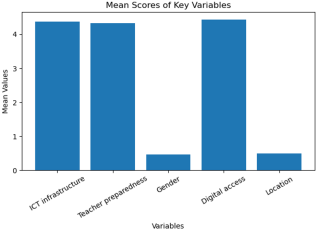
Table 2 presents the mean values of the main variables used in the analysis. On a scale of 1 to 5 participants reported relatively high levels of ICT infrastructure (M = 4.37), teacher preparedness (M = 4.33) and digital access (M = 4.43) indicating strong perceptions of readiness and access to digital tools. Regarding gender 46.7% of respondents were male while the remaining 53.3% were female. Location-wise 50% of participants resided in urban areas suggesting an even distribution between rural and urban settings. Diagrammatically it can be illustrated as:
Figure 2. Factors affecting AI adoption.
The variability of key factors influencing AI adoption within the CBC framework was assessed using standard deviations.
Table 3. Standard deviation of variables.
Variable | Standard deviation |
ICT infrastructure | 0.668775 |
Teacher preparedness | 0.606478 |
Gender | 0.507416 |
Digital access | 0.568321 |
Location | 0.508548 |
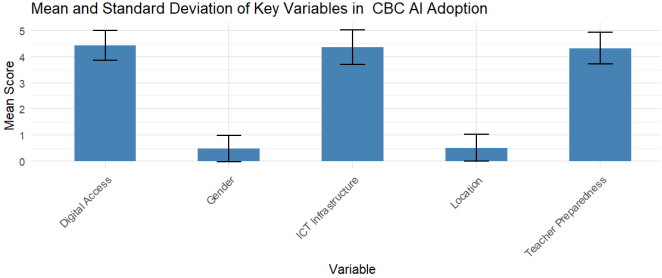
ICT infrastructure showed the highest variation among respondents (SD = 0.67), indicating diverse levels of access or quality across the sample. Teacher preparedness (SD = 0.61) and digital access (SD = 0.57) also demonstrated moderate variability reflecting differences in readiness and availability of digital tools essential for AI integration. Gender (SD = 0.51) and location (SD = 0.51) both categorical variables, showed less variation suggesting a relatively balanced distribution across these groups. Understanding these variations is crucial for tailoring AI adoption strategies to address gaps in infrastructure and capacity within CBC implementation.
Figure 2 illustrates that ICT infrastructure and digital access had the highest mean scores indicating generally favorable conditions while gender and location showed lower means and less variability reflecting their nature as categorical variables.
Figure 3. Mean scores with standard deviations for key factors influencing AI adoption in CBC implementation.
3.3. Grouped Means by Gender and Interquartile Range
Grouped mean values were calculated to explore differences in average perceptions of key factors influencing AI adoption across demographic categories offering comparative insight into how variables such as gender shape responses within the CBC framework.
Table 4. Grouped means by gender.
Gender | AI Adoption | ICT Infrastructure | Digital Access | Teacher Preparedness |
0 (Female) | 4.31 | 4.44 | 4.25 | 4.31 |
1 (Male) | 4.36 | 4.29 | 4.64 | 4.36 |
Results in
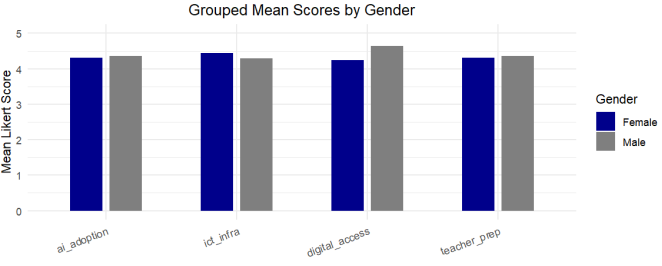
Table 4 showed slight variations with males reporting higher mean scores in AI adoption (M = 4.36) and digital access (M = 4.64) compared to females (M = 4.31 and M = 4.25 respectively). This indicates marginally greater confidence or access among male respondents. In contrast, females rated ICT infrastructure slightly higher (M = 4.44) than males (M = 4.29) while teacher preparedness scores were nearly identical (female M = 4.31 and male M = 4.36) indicating similar levels of perceived readiness. While the differences are modest they highlight the value of considering gender when designing inclusive AI integration strategies in education. The values of group mean can be represented graphically as:
Figure 4. Grouped mean scores by gender.
The interquartile range (IQR) for ICT infrastructure, teacher preparedness, gender, digital access and location was consistently 1. This indicates a moderate level of variability within the central 50% of responses suggesting a relatively consistent perception of these factors among respondents.
3.4. Welch's t-test Statistics Estimation
Gender-based comparisons of key factors influencing AI adoption within the CBC framework were conducted using Welch’s t-test. This approach enabled the identification of statistically significant differences in mean perceptions between male and female respondents hence offering insights into gender-related disparities in digital access, ICT infrastructure and teacher preparedness. It also accounts for unequal variances and sample sizes between the groups, providing a robust assessment of gender-based differences in perceptions and preparedness.
Table 5. Welch's t-test Results Comparing Mean Scores by Gender.
Variable | Male Mean | Female Mean | t-value | df | p-value | 95% CI | Interpretation |
AI Adoption | 4.36 | 4.31 | 0.202 | 26.89 | 0.841 | [-0.408, 0.497] | No significant difference |
Teacher Preparedness | 4.36 | 4.31 | 0.202 | 26.89 | 0.841 | [-0.408, 0.497] | No significant difference |
ICT Infrastructure | 4.29 | 4.44 | -0.608 | 25.97 | 0.549 | [-0.665, 0.362] | No significant difference |
Digital Access | 4.64 | 4.25 | 2.002 | 27.997 | 0.055 | [-0.009, 0.795] | Slight difference (not statistically significant) |
Welch’s t-test in
Table 5 revealed no statistically significant differences in the mean scores for AI adoption (t = 0.20,
p = 0.84), teacher preparedness (t = 0.20,
p = 0.84) or ICT infrastructure (t = -0.61,
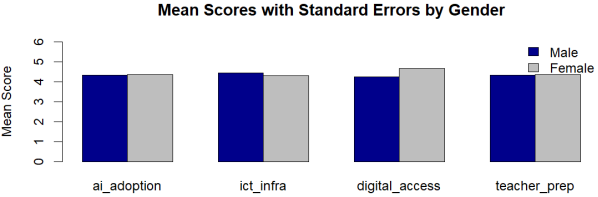
p = 0.55) suggesting that both male and female respondents shared similar perceptions in these areas. However, digital access showed a marginal difference between genders (t = 2.00,
p = 0.055) with male respondents reporting slightly higher access (mean = 4.64) than females (mean = 4.25). While this difference did not meet the conventional threshold for statistical significance (
p < 0.05) it may still indicate a practical disparity worth exploring in further studies or policy design aimed at inclusive technology adoption.
Figure 5. Bar plot of gender differences in mean scores with error bars.
3.5. Ordinal Logistic Regression Estimation
Ordinal logistic regression was employed to estimate the likelihood of higher levels of AI adoption based on predictor variables such as ICT infrastructure, teacher preparedness, digital access, geographical location and gender. This method allows for assessment of the influence of each factor while accounting for the ordered nature of the response.
Table 6. Ordinal logistic regression coefficients for predictors of AI adoption.
Predictor | Coefficient () | Std. Error | t-value | p-value | Significance |
ICT Infrastructure | 1.2449 | 0.8814 | 1.412 | 0.1578 | Not significant |
Teacher Preparedness | 2.5252 | 1.1028 | 2.290 | 0.0220 | Significant |
Digital Access | 3.5744 | 1.4930 | 2.394 | 0.0167 | Significant |
Gender (Male=1) | -0.5873 | 1.2587 | -0.467 | 0.6408 | Not significant |
Location | 2.5327 | 1.3783 | 1.838 | 0.0661 | Marginal |
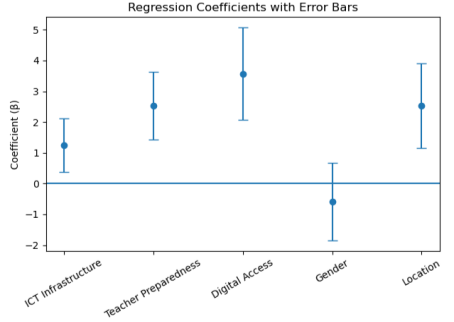
Figure 6. Effects of ICT Infrastructure, Teacher Preparedness, and Digital Access on AI adoption.
The results in
Table 6 show that teacher preparedness (β = 2.53, p = 0.022) and digital access (β = 3.57, p = 0.017) are significant predictors of AI adoption under the CBC framework. Location also shows a positive influence (β = 2.53, p = 0.066) though only marginally significant. Meanwhile, ICT infrastructure and gender were not statistically significant suggesting that improvements in teacher readiness and digital access may have the most direct impact on advancing AI integration. The coefficient plot in
Figure 6 shows that digital access and teacher preparedness have significant positive effects while ICT infrastructure and gender are not statistically significant predictors and location shows a marginal effect. This is illustrated diagrammatically as:
Table 7. Intercepts (thresholds) from the ordinal logistic regression model.
Intercepts | Estimates | Std. Error | t-value | p-value |
1|2 | 12.0964 | 97.5710 | 0.1240 | 0.9013 |
2|3 | 16.3223 | 72.2482 | 0.2259 | 0.8213 |
3|4 | 27.8639 | 9.1202 | 3.0552 | 0.0022 |
4|5 | 34.3060 | 10.4551 | 3.2813 | 0.0010 |
Table 7 shows the model intercepts that define the boundaries between AI adoption levels. The thresholds between lower categories (1|2 and 2|3) are not statistically significant while the intercepts between higher levels (3|4 and 4|5) are significant with p-values below 0.01. This suggests that the model more confidently distinguishes between respondents with higher levels of AI adoption aligning with a clearer differentiation in attitudes or readiness at advanced stages. The model yielded an AIC of 44.45 suggesting a relatively good fit given the number of predictors and sample size.
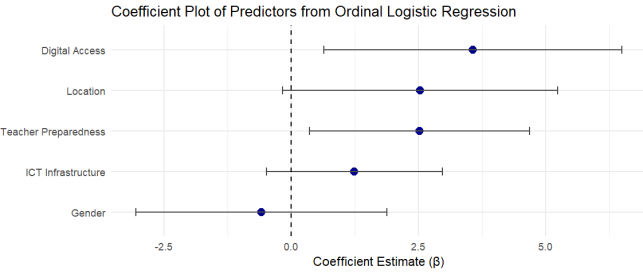
Figure 7. Coefficient plot on the effect of key predictors on AI adoption.
Figure 5 shows coefficient plot displaying the estimated effects of key predictors on AI adoption under the CBC framework. The dots represent coefficient estimates (β) and the horizontal lines indicate 95% confidence intervals. Positive values suggest a higher likelihood of AI adoption. Digital access, teacher preparedness, location and ICT infrastructure all have positive coefficients indicating they are positively associated with increased AI adoption. Gender has a negative coefficient suggesting a lower likelihood of adoption for males although this effect was not statistically significant.
4. Conclusion
This study examined the integration of AI tools within the CBC framework by analyzing how ICT infrastructure, teacher preparedness, digital access, gender and location influence AI adoption in junior secondary schools. The results revealed that digital access (β = 3.57, p = 0.017) and teacher preparedness (β = 2.53, p = 0.022) were statistically significant predictors of AI adoption while location (β = 2.53, p = 0.066) was marginally significant. ICT infrastructure (β = 1.24, p = 0.158) and gender (β = -0.59, p = 0.641) showed no statistically significant effects. Gender-based descriptive analysis showed minimal differences in mean scores across factors with slightly higher digital access among male respondents. These findings suggest that enhancing teacher capacity and ensuring equitable digital access could significantly advance AI integration in CBC delivery particularly in under-resourced settings. The conceptual model offers a context-sensitive pathway for scaling AI adoption in education while addressing equity and inclusion.
5. Recommendations
Based on the findings the following recommendations are proposed:
1) The Ministry of Education should prioritize teacher AI upskilling as the strongest predictor of adoption.
2) Schools should implement gender-responsive digital access interventions such as monitored device sharing and mentorship for girls.
3) AI solution developers must design for low-bandwidth rural contexts to ensure equitable scaling.
Abbreviations
AI | Artificial Intelligence |
CBC | Competency-Based Curriculum |
DEB | District Education Board |
FGD | Focus Group Discussions |
SD | Standard Deviation |
IQR | Interquartile Range |
AIC | Akaike Information Criterion |
Conflicts of Interest
The authors declare that there is no conflict of interest regarding the publication of this manuscript and that all research activities were conducted independently and without influence from any external parties or funding bodies.
References
| [1] |
Almjeld, J. (2017). Getting “girly” online. In S. C. Howard (Ed.), Critical examinations of digital technologies in girls’ and women’s lives (pp. 87–105). IGI Global.
https://doi.org/10.4018/978-1-5225-1718-4.ch006
|
| [2] |
Bag, P., & Mitra, P. (2025). Gender perspectives on digital education: A comparative analysis. TSSR, 3(2).
https://doi.org/10.70096/tssr.250302031
|
| [3] |
Benouachane, H. (2024). AI in higher education: Balancing pedagogical benefits and ethical challenges. Mohammed V University.
https://doi.org/10.6084/m9.figshare.26349289
|
| [4] |
Breen, C., Fatehkia, M., Yan, J., Zhao, X., Leasure, D., Weber, I., … Kashyap, R. (2024). Mapping subnational gender gaps in internet and mobile adoption using social media data. OSF Preprints.
https://doi.org/10.31235/osf.io/qnzsw
|
| [5] |
Brown, B., Hurrell, C., Roberts, V., & Jacobsen, M. (2021). Open education co-design as a participatory pedagogy in an online graduate program. The Open/Technology in Education, Society and Scholarship Association Conference, 1(1), 1–8.
https://doi.org/10.18357/otessac.2021.1.1.41
|
| [6] |
Chand, M., K. C., S., & Maharjan, M. (2024). Unveiling disparities: A case of digital divide in Nepal. Journal of Economic Concerns, 15(1), 130–142.
https://doi.org/10.3126/tjec.v15i1.70246
|
| [7] |
Chikwe, C., Dagunduro, A., Ajuwon, O., & Ediae, A. (2024). Sociological barriers to equitable digital learning: A data-driven approach. Comprehensive Research Review in Multidisciplinary Studies, 2(1), 27–34.
https://doi.org/10.57219/crrms.2024.2.1.0038
|
| [8] |
Gnambs, T., & Hawrot, A. (2025). The development of disparities in digital competencies across adolescence. OSF Preprints.
https://doi.org/10.31234/osf.io/gjr6w
|
| [9] |
Jat, R., & Chakravorty, D. (2025). A study of online learning challenges on teacher trainees of B. Ed colleges. International Journal for Multidisciplinary Research, 7(2).
https://doi.org/10.36948/ijfmr.2025.v07i02.42850
|
| [10] |
Juma, L., Chavula, P., Kayusi, F., Omwenga, M., Mishra, R., & Mwewa, T. (2025). AI in dissertation examination: Opportunities for undergraduates and postgraduates in Zambia, Rwanda, and Kenya. Latin American Transactions on Intelligent Applications (LatIA), 3, 329.
https://doi.org/10.62486/latia2025329
|
| [11] |
Kimutai, S. (2025). An evaluation of Kenya TVET trainers on use of AI in instruction design and delivery. Africa Journal of Technical and Vocational Education and Training (AfriTVET), 10(1), 13–27.
https://doi.org/10.69641/afritvet.2025.101193
|
| [12] |
Matere, A. (2024). Effectiveness of artificial intelligence tools in teaching and learning in higher education institutions in Kenya. Journal of the Kenya National Commission for UNESCO (JKNCU), 5(1).
https://doi.org/10.62049/jkncu.v5i1.177
|
| [13] |
Muasya, J. (2025). Gender digital divide and education: A reflection from the University of Nairobi, Kenya. East African Journal of Information Technology, 8(1), 1–12.
https://doi.org/10.37284/eajit.8.1.2640
|
| [14] |
Muslimin, M., & Indrawati, R. (2024). Digitalization and education equity in remote areas: Challenges and strategic solutions. Journal of Education Humaniora and Social Sciences (JEHSS), 7(2), 376–383.
https://doi.org/10.34007/jehss.v7i2.2356
|
| [15] |
Omariba, A. (2025). Enhancing student outcomes through AI-driven personalized learning: A study on implementation and effectiveness at the universities in Kenya. East African Journal of Education Studies, 8(2), 512–529.
https://doi.org/10.37284/eajes.8.2.3048
|
| [16] |
Shah, S. S. (2025). Gender bias in artificial intelligence: Empowering women through digital literacy. Premier Journal of Artificial Intelligence, 1, Article 1000088.
https://doi.org/10.70389/PJAI.1000088
|
Cite This Article
-
ACS Style
Mwau, C.; Vincent, B. M. Gender-Sensitive Predictive Modelling of AI Adoption in Kenya’s Junior Secondary Schools Under the CBC Framework. Sci. Discov. Artif. Intell. 2026, 1(2), 87-97. doi: 10.11648/j.sdai.20260102.14
 Copy
|
Copy
|
 Download
AMA Style
Mwau C, Vincent BM. Gender-Sensitive Predictive Modelling of AI Adoption in Kenya’s Junior Secondary Schools Under the CBC Framework. Sci Discov Artif Intell. 2026;1(2):87-97. doi: 10.11648/j.sdai.20260102.14
Copy
|
Download
-
@article{10.11648/j.sdai.20260102.14,
  author = {Cynthia Mwau and Bulinda Major Vincent},
  title = {Gender-Sensitive Predictive Modelling of AI Adoption in Kenya’s Junior Secondary Schools Under the CBC Framework},
  journal = {Science Discovery Artificial Intelligence},
  volume = {1},
  number = {2},
  pages = {87-97},
  doi = {10.11648/j.sdai.20260102.14},
  url = {https://doi.org/10.11648/j.sdai.20260102.14},
  eprint = {https://article.sciencepublishinggroup.com/pdf/10.11648.j.sdai.20260102.14},
  abstract = {Kenya’s Competency-Based Curriculum (CBC) emphasizes creativity, critical thinking and learner-centered pedagogy but implementation disparities persist across rural and urban schools due to unequal access to infrastructure, trained educators and digital tools. This study proposes a gender-sensitive and Artificial Intelligence (AI)-driven education model platform to support equitable CBC delivery at the junior secondary level. The model platform incorporates AI tools for adaptive learning and interactive instruction. Using a mixed-methods approach we assess how contextual factors such as digital access, ICT infrastructure, teacher preparedness and location affect AI adoption. Quantitative analysis was conducted using ordinal logistic regression and gender-disaggregated comparisons to evaluate adoption patterns and usability perceptions. Data were drawn from two purposively selected junior secondary schools in contrasting settings. This study revealed that digital access and teacher preparedness are significant predictors of AI adoption (p p ≈ 0.06) while ICT infrastructure and gender were not statistically significant. These insights suggest that strengthening teacher capacity and improving digital access are critical to advancing AI integration under the CBC framework. These results inform inclusive EdTech design and policy strategies aimed at closing regional and gender-related gaps in AI-driven learning.},
 year = {2026}
}
Copy
|
Download
-
TY  - JOUR
T1  - Gender-Sensitive Predictive Modelling of AI Adoption in Kenya’s Junior Secondary Schools Under the CBC Framework
AU  - Cynthia Mwau
AU  - Bulinda Major Vincent
Y1  - 2026/04/23
PY  - 2026
N1  - https://doi.org/10.11648/j.sdai.20260102.14
DO  - 10.11648/j.sdai.20260102.14
T2  - Science Discovery Artificial Intelligence
JF  - Science Discovery Artificial Intelligence
JO  - Science Discovery Artificial Intelligence
SP  - 87
EP  - 97
PB  - Science Publishing Group
SN  - 3071-5385
UR  - https://doi.org/10.11648/j.sdai.20260102.14
AB  - Kenya’s Competency-Based Curriculum (CBC) emphasizes creativity, critical thinking and learner-centered pedagogy but implementation disparities persist across rural and urban schools due to unequal access to infrastructure, trained educators and digital tools. This study proposes a gender-sensitive and Artificial Intelligence (AI)-driven education model platform to support equitable CBC delivery at the junior secondary level. The model platform incorporates AI tools for adaptive learning and interactive instruction. Using a mixed-methods approach we assess how contextual factors such as digital access, ICT infrastructure, teacher preparedness and location affect AI adoption. Quantitative analysis was conducted using ordinal logistic regression and gender-disaggregated comparisons to evaluate adoption patterns and usability perceptions. Data were drawn from two purposively selected junior secondary schools in contrasting settings. This study revealed that digital access and teacher preparedness are significant predictors of AI adoption (p p ≈ 0.06) while ICT infrastructure and gender were not statistically significant. These insights suggest that strengthening teacher capacity and improving digital access are critical to advancing AI integration under the CBC framework. These results inform inclusive EdTech design and policy strategies aimed at closing regional and gender-related gaps in AI-driven learning.
VL  - 1
IS  - 2
ER  -
Copy
|
Download





 Share This Article
 Twitter
 Linked In
 Facebook