Abstract
As global freshwater scarcity intensifies, reclaiming alternative water sources like highly saline oilfield produced water has become an ecological imperative; however, its inherent toxicity traditionally induces acute phytotoxicity in terrestrial vegetation. This preliminary study investigates a non-chemical, mechanically driven alternative by evaluating the physiological and phenotypic effects of irrigating diverse plant species with hydrodynamic cavitated produced water compared to standard local well water. Over an intensive five-day experimental period, identical plant cohorts were maintained under uniform ambient conditions and treated with either non-chemically modified, cavitated produced water or a standard well water baseline. Phenotypic and morphological variations were macroscopically tracked alongside volumetric fluid consumption rates and subsequent resilience to acute desiccation stress. The experimental plants did not merely survive; they exhibited significantly enhanced structural biomass, deeper pigmentation indicative of elevated chlorophyll concentrations, decreased volumetric water consumption rates, and superior turgor pressure maintenance during a simulated mini-drought event. These findings suggest that hydrodynamic cavitation fundamentally alters the chemical matrix of produced water—breaking down complex hydrocarbons into bio-available carbon fragments, elevating dissolved oxygen levels, and reducing active sodium chloride (NaCl) concentrations by over 90%. We conclude that this mechanical treatment breaks the osmotic barrier of industrial waste fluids, transforming them into viable agricultural assets. Furthermore, these phenomena are contextualized through modern interfacial water physics, specifically exploring the generation of structured Exclusion Zone (EZ) water matrices to explain the observed structural transformations and frictionless, low-energy cellular uptake.
|
Published in
|
American Journal of Agriculture and Forestry (Volume 14, Issue 4)
|
|
DOI
|
10.11648/j.ajaf.20261404.13
|
|
Page(s)
|
185-192 |
|
Creative Commons
|

This is an Open Access article, distributed under the terms of the Creative Commons Attribution 4.0 International License (http://creativecommons.org/licenses/by/4.0/), which permits unrestricted use, distribution and reproduction in any medium or format, provided the original work is properly cited.
|
|
Copyright
|
Copyright © The Author(s), 2026. Published by Science Publishing Group
|
Keywords
Hydrodynamic Cavitation, Produced Water Reclamation, Water Use Efficiency (WUE), Exclusion Zone (EZ) Water, Agricultural Sustainability, Hydrocarbon Degradation
1. Introduction and Background
1.1. The Fundamentals of Photosynthesis
Plants are autotrophic organisms that convert radiant solar energy into stable chemical energy through the process of photosynthesis. This fundamental biochemical pathway occurs within specialized organelles known as chloroplasts, where atmospheric carbon dioxide (CO
2), water (H
2O), and light energy interact to synthesize carbohydrates and release oxygen (O
2) as a metabolic byproduct. The net chemical stoichiometry of oxygenic photosynthesis is represented by the classical balanced equation
:
6CO2+ 6H2O + light energyC6H12O6+ 6O2
In conventional agricultural paradigms, CO2 is acquired almost exclusively from the troposphere via stomatal diffusion, while water is absorbed through the root architecture from the surrounding soil matrix. The efficiency of this pathway dictates overall plant biomass accumulation, phenotypic vigor, and stress tolerance. Optimization of any component within this thermodynamic equation holds profound implications for crop yields and ecological management.
1.2. The Challenge and Potential of Produced Water
Produced water represents the largest volumetric byproduct stream associated with the oil and gas extraction industry. When hydrocarbons are extracted from subterranean reservoirs, massive quantities of highly saline, chemically complex water are co-produced. This water typically contains elevated concentrations of:
1) Total Dissolved Solids (TDS), specifically sodium chloride (NaCl).
2) Dissolved and emulsified hydrocarbons (polycyclic aromatic hydrocarbons, volatile organic compounds).
3) Heavy metals and organic acids.
Historically, produced water has been treated as an industrial waste liability, requiring expensive deep-well injection or complex multi-stage chemical desalination before disposal. However, as global freshwater scarcity intensifies, the reclamation of alternative water sources for non-potable, industrial, or secondary agricultural applications has transitioned from an environmental luxury to an economic and ecological imperative.
1.3. Hydrodynamic Cavitation: A Green Treatment Alternative
Hydrodynamic cavitation provides a non-chemical, mechanically driven remediation technique for complex fluids. This process can be conceptualized as a highly controlled "super-vortexing" of water. When a fluid passes through localized micro-orifices or rapidly changing geometries within a reactor, significant localized pressure differentials are generated.
According to Bernoulli's principle, if the local static pressure drops below the vapor pressure of the liquid, the fluid undergoes localized boiling, precipitating the rapid formation of millions of microscopic vapor bubbles or cavities. As these micro-bubbles transition into zones of higher downstream pressure, they undergo an asymmetrical, violent collapse (implosion) within nanosecond timescales. Historically, produced water has been treated as an industrial waste liability, requiring expensive deep-well injection or complex multi-stage chemical desalination before disposal. However, as global freshwater scarcity intensifies, the reclamation of alternative water sources for non-potable, industrial, or secondary agricultural applications has transitioned from an environmental luxury to an economic and ecological imperative. In hyper-arid regions and drylands, reclaiming oil and gas effluents represents an essential pathway within the water-energy-food nexus to alleviate severe local resource deficits
| [2] | Echchelh, A., Hess, T., & Sakrabani, R. (2018). Reusing oil and gas produced water for irrigation of food crops in drylands. Agricultural Water Management, 206, 124-134.
https://doi.org/10.1016/j.agwat.2018.05.006 Cited by: 133. |
[2]
. Large-scale water management frameworks highlight that implementing such advanced nonconventional treatment systems can provide stable, circular-economy water supplies for agricultural production while protecting existing freshwater reserves
| [3] | Christou, A., Beretsou, V. G., Iakovides, I. C., Karaolia, P., Michael, C., Benmarhnia, T., Chefetz, B., Donner, E., Gawlik, B. M., Lee, Y., Lim, T. T., Lundy, L., Maffettone, R., Rizzo, L., Topp, E., & Fatta-Kassinos, D. (2024). Sustainable wastewater reuse for agriculture. Nature Reviews Earth & Environment, 5(7), 504-521. https://doi.org/10.1038/s43017-024-00560-y Cited by: 242. |
[3]
.
The physical phenomena associated with these implosions are extreme, generating localized "hot spots" with transient temperatures approaching 5000 K, pressures exceeding 1000 atm, and intense shear forces. Crucially, this violent mechanical environment facilitates advanced oxidation processes (AOPs) through the homolytic cleavage of water molecules into highly reactive hydroxyl (OH) and hydrogen (H) free radicals, all achieved without the addition of exogenous chemical reagents. The physical phenomena associated with these implosions are extreme, generating localized "hot spots" with transient temperatures approaching 5000 K, pressures exceeding 1000 atm, and intense shear forces. Crucially, this violent mechanical environment facilitates advanced oxidation processes (AOPs) through the homolytic cleavage of water molecules into highly reactive hydroxyl (OH) and hydrogen (H) free radicals, all achieved without the addition of exogenous chemical reagents. Broad engineering reviews demonstrate that this multi-mechanistic environment effectively degrades highly persistent, bio-refractory, and toxic organic pollutants by structurally breaking down complex molecular configurations
| [4] | Mancuso, G., Langone, M., & Andreottola, G. (2020). A critical review of the current technologies in wastewater treatment plants by using hydrodynamic cavitation process: Principles and applications. Journal of Environmental Health Science and Engineering, 18(1), 311-333.
https://doi.org/10.1007/s40201-020-00444-5 Cited by: 114. |
[4]
. Because hydrodynamic cavitation operates purely via spatial hydraulic changes and pressure differentials, it serves as an energy-efficient alternative to intensify water purification workflows without relying on secondary chemical additions
| [5] | Yeneneh, A. M., Al Balushi, K., Jafary, T., & Al Marshudi, A. S. (2024). Hydrodynamic cavitation and advanced oxidation for enhanced degradation of persistent organic pollutants: A review. Sustainability, 16(11), Article 4601.
https://doi.org/10.3390/su16114601 Cited by: 28. |
[5]
.
2. Experimental Methodology
To evaluate the biological compatibility and potential growth-stimulating properties of cavitated produced water, BrightWater Environmental, LLC. initiated a preliminary empirical study in January, 2024.
2.1. Baseline Hypothesis
The baseline hypothesis for this exploratory study was strictly binary: Would plants subjected to raw oilfield produced water treated solely via hydrodynamic cavitation survive, or would they exhibit acute phytotoxicity and die? Because raw produced water is traditionally toxic to terrestrial vegetation due to osmotic shock and hydrocarbon poisoning, any outcome demonstrating survival—let alone flourishing growth—would represent a significant deviation from expected agronomic baselines.
2.2. Specimen Selection and Experimental Design
To minimize confounding variables arising from genetic or phenotypic variation within a single plant type, a multi-species comparative matrix was established.
1) Identical-looking specimens from various distinct plant species were acquired.
2) The specimens were separated into two precisely balanced cohorts, ensuring each group possessed an equal representation of species types, initial structural heights, and leaf-surface areas.
Table 1. Water Source vs Treatment.
Experimental Group | Water Source Type | Pre-Treatment Modifications |
Control Group | Local Well Water | None (Standard baseline agricultural water) |
Experimental Group | Cavitated Produced Water | Hydrodynamic Cavitation Only (Zero chemical additives) |
Both groups were maintained in identical ambient environmental conditions regarding light exposure, atmospheric temperature, and relative humidity over an intensive five-day observational window. Both groups received equivalent initial volumes of water.
3. Observations and Results
To our surprise, the experimental cohort did not merely survive; it displayed accelerated morphological changes that drastically outperformed the control group within a 120-hour period.
3.1. Visual and Structural Differentiation
By the conclusion of the five-day evaluation, distinct macroscopic variations were clearly visible to the naked eye across all species pairs:
1) Biomass Density: The experimental plants irrigated with cavitated produced water displayed visibly fuller, thicker growth. Branching patterns appeared more robust, and new leaf emergence was accelerated relative to the well-watered controls.
2) Pigmentation Vigor: Foliage in the experimental group developed a deeper, more vivid green coloration. In plant physiology, this sudden intensification of green hue is a primary phenotypical indicator of elevated chlorophyll concentrations and enhanced light-harvesting complex efficiency within the thylakoid membranes.
Figure 1. Cavitated Produced Water (left) vs. Ground Water (right).
3.2. Hydrological Consumption Disparity
A key quantitative anomaly observed during the study was the difference in fluid consumption. The plants watered with cavitated produced water drew notably less total volume of water over the five days than the control group, yet they achieved superior biomass accumulation.
This implies a substantial inflation in Water Use Efficiency (WUE), a physiological metric defining the ratio of carbon fixed via biomass to the volume of water transpired.
3.3. Acute Micro-Drought Resilience
Following the primary five-day tracking window, an unexpected environmental stress test occurred. The research site was left unattended for several days, during which the specimens were subjected to zero irrigation and exposed to severe ambient winds—simulating a rapid, high-evaporation "mini-drought" event.
Upon return, the visual divergence between the cohorts was stark:
1) Control Plants: Exhibited systemic wilting, structural sagging, and chlorotic margin stress, indicating severe turgor pressure loss.
2) Experimental Plants: Maintained structural integrity, minimal wilting, and superior cellular turgor.
This indicates that irrigation with cavitated produced water alters cellular or metabolic reserves, imparting enhanced resistance against acute environmental and desiccation stresses.
4. Discussion of Mechanisms: Why Does This Happen
The extraordinary phenotypic expressions recorded over a short duration require a multi-disciplinary explanatory model encompassing organic chemistry, fluid mechanics, and interfacial water physics.
4.1. Hydrocarbon Cleavage and Bio-Available Carbon Supplementation
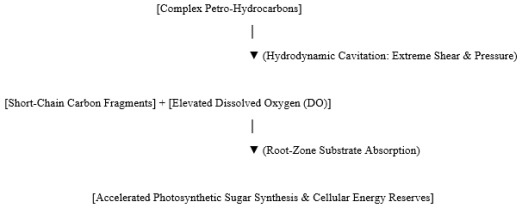
Raw produced water is heavily laden with complex, long-chain petroleum hydrocarbons (CnHm). These hydrophobic compounds typically coat soil particles and root hairs, choking off oxygen transport and inducing root rot. However, laboratory data gathered from BrightWater’s previous operational phases revealed that hydrodynamic cavitation breaks apart these long carbon chains into progressively shorter fractions.
The mechanical shear forces and localized thermal spikes generated during bubble collapse cleave the strong covalent C-C and C-H sigma bonds. This ultra-sonochemical degradation reduces toxic, heavy molecular-weight hydrocarbons down to light, short-chain organic fractions, eventually liberating a portion as uncommitted, highly reactive carbon atoms or simple organic carbon molecules. The mechanical shear forces and localized thermal spikes generated during bubble collapse cleave the strong covalent C-C and C-H sigma bonds. This ultra-sonochemical degradation reduces toxic, heavy molecular-weight hydrocarbons down to light, short-chain organic fractions, eventually liberating a portion as uncommitted, highly reactive carbon atoms or simple organic carbon molecules. Empirical models verifying standalone hydrodynamic cavitation reactors confirm that these severe transient implosions generate significant oxidative and radical-driven activity, resulting in high rates of chemical oxygen demand (COD) reduction and complete structural mineralization of complex contaminants into basic, non-inhibitory compounds
| [6] | Patil, Y., Sonawane, S. H., Shyam, P., Sun, X., & Manickam, S. (2023). Hybrid hydrodynamic cavitation (HC) technique for the treatment and disinfection of lake water. Ultrasonics Sonochemistry, 97, Article 106454.
https://doi.org/10.1016/j.ultsonch.2023.106454 Cited by: 36. |
[6]
.
Simultaneously, dissolved oxygen probes verified that cavitated water experiences a massive increase in Dissolved Oxygen (DO) levels in addition to the total elimination of residual complex hydrocarbons.
Figure 2. Hydrocarbon Cavitation and Sugar Synthesis.
In standard plant biology, carbon is a limiting substrate obtained via atmospheric extraction. We hypothesize that the direct delivery of highly bio-available, short-chain carbon fragments and elevated dissolved oxygen directly to the root architecture bypasses traditional metabolic bottlenecks. Instead of expending metabolic energy to fix atmospheric CO2 under restrictive stomatal conditions, the root system absorbs these pre-cleaved carbon building blocks.
This supplemental carbon source can combine directly with the amplified dissolved oxygen within the cellular matrix, stimulating rapid, high-efficiency internal carbohydrate synthesis (C6H12O6) and giving the plant a larger pool of energy reserves to draw upon during drought conditions.
4.2. Desalination and Sodium Chloride Reduction
High salinity is one of the most destructive elements of produced water, causing osmotic stress that prevents roots from absorbing fluid. A major factor contributing to the success of our experimental group was the reduction of sodium chloride (NaCl) levels within the treated water matrix:
Pre-Cavitation NaCl:30.0 mg/LPost-Cavitation NaCl:2.50 mg/L
While the absolute mechanisms behind this salt reduction require further molecular tracking, we hypothesize that the extreme localized physical parameters of cavitation trigger localized mineral precipitation or bind sodium and chloride ions into alternative crystalline complexes or volatile compounds that leave the active aqueous solution. By lowering the active NaCl concentrations by over 90%, the osmotic barrier is broken, allowing the root system to take up water without salt-induced cellular stress.
4.3. Interfacial Physics: Exclusion Zone (EZ) Water and Phase Dynamics
To explain how the water molecule structure itself might be transformed, we must look to the pioneering physics of Dr. Gerald Pollack. Pollack proposed that water is not merely limited to three distinct phases (solid, liquid, gas), but features a physical fourth phase known as Exclusion Zone (EZ) Water
| [7] | Pollack, G. H. (2013). The 4th Phase of Water: Beyond Solid, Liquid, Vapor. Ebner & Sons Publishers. |
[7]
.
EZ water forms when liquid water is exposed to radiant or mechanical energy next to hydrophilic surfaces. In this zone, water molecules spontaneously organize into a highly ordered, hexagonal molecular honeycomb lattice. This ordered state exhibits unique physical properties:
1) It rejects solutes and ions entirely (hence "exclusion" zone).
2) It shifts its chemical formula from standard H2O to a net negatively charged H3O2 matrix.
3) It acts as a natural battery, separating negative charge within the structured EZ lattice from positive hydronium ions (H3O+) concentrated in the adjacent "bulk" water.
Hydrodynamic cavitation supplies a massive amount of concentrated mechanical and kinetic energy to the fluid. We propose that this intensive energy input "supercharges" reactive ion formation and forces a widespread transition of standard bulk water into structured, high-energy EZ water.
This concept aligns with the historical observations of Austrian naturalist Viktor Schauberger, who documented that high-velocity vortexing imparted "vitality" and unusual energetic properties to water solutions
| [7] | Pollack, G. H. (2013). The 4th Phase of Water: Beyond Solid, Liquid, Vapor. Ebner & Sons Publishers. |
[7]
. Similarly, at the turn of the 20th century, Rudolf Steiner integrated intense fluid vortexing into "biodynamic farming" methodologies, reporting amplified crop yields and disease resistance without the application of chemical fertilizers
| [7] | Pollack, G. H. (2013). The 4th Phase of Water: Beyond Solid, Liquid, Vapor. Ebner & Sons Publishers. |
[7]
.
The structural transition into H3O2 honeycombs offers an elegant explanation for the observed reduction in water consumption: highly structured EZ water matches the internal cellular water configurations of healthy plant tissue, allowing for frictionless, low-energy cellular uptake and optimal metabolic transport efficiency.
5. Contextualization with Contemporary Plant Biology Literatures
To validate our findings against broader academic frameworks, we must evaluate how elevated carbon levels affect plant nutrition and physiological development.
5.1. The Atmospheric Parallel: Elevated Carbon Dilemmas
On a macro-ecological scale, it is widely documented that rising atmospheric concentrations of carbon dioxide stimulate plant growth rates through a phenomenon known as the "CO
2 fertilization effect"
. When atmospheric CO
2 increases, plants optimize their photosynthetic rates, producing higher amounts of non-structural carbohydrates (sugars and starches).
These sugars act as critical signaling molecules, traveling to the roots where they regulate gene expression patterns, stimulate root branching, and alter hormone production profiles
| [9] | Cho, M. H., & Core, A. (2017). Effects of elevated carbon dioxide on photosynthesis and carbon partitioning: A perspective on root sugar sensing and hormonal crosstalk. National Center for Biotechnology Information.
https://www.ncbi.nlm.nih.gov/pmc/articles/PMC5550704/ |
[9]
. This matches our observations of increased root-zone vitality and overall fuller growth.
However, large-scale climate studies tracking long-term atmospheric carbon elevation reveal a critical drawback: nutrient dilution
. When plants are flooded with excess carbon
without a matching increase in soil macronutrients (especially nitrogen, nitrates, and nitrites), the internal Carbon-to-Nitrogen (C: N) ratio becomes highly skewed
. Over time, this leads to a systematic decline in the plant's overall protein and mineral concentration, causing nutrient deficiencies and lowering the nutritional profile of food crops
.
5.2. The Nitrogen Balance Matrix in Produced Water
The primary reason our five-day study did not exhibit the initial signs of carbon-induced nutrient dilution or malnourishment is likely linked to the raw chemical composition of the oilfield produced water itself.
Produced water matrices from deep oil reservoirs frequently contain native nitrogenous compounds
. Nitrogen gas (N
2) is highly prevalent, existing in a dissolved state due to prolonged geological contact with reservoir organic matter and crude oil matrices. Additionally, varying concentrations of:
1) Nitrates (NO3-)
2) Nitrites (NO2-)
are often present in these deep fluids.
If these nitrogen forms are present alongside the liberated carbon fragments during hydrodynamic cavitation, they could provide a naturally balanced, pre-packaged liquid fertilizer substrate. The high cavitation energy may help fix dissolved N
2 or complex organic nitrogen into bio-available ionic nitrates (NO
3-). If these nitrogen forms are present alongside the liberated carbon fragments during hydrodynamic cavitation, they could provide a naturally balanced, pre-packaged liquid fertilizer substrate. The high cavitation energy may help fix dissolved N
2 or complex organic nitrogen into bio-available ionic nitrates (NO
3). Agronomic field analyses confirm that reusing treated alternative wastewater can act as an excellent nonconventional fertilizer stream, enriching soil profiles with critical macronutrients like nitrogen and potassium to boost yield configurations
| [12] | Ofori, S., Abebrese, D. K., Růžičková, I., & Wanner, J. (2024). Reuse of treated wastewater for crop irrigation: Water suitability, fertilization potential, and impact on selected soil physicochemical properties. Water, 16(3), Article 484.
https://doi.org/10.3390/w16030484 Cited by: 40. |
[12]
. However, environmental monitoring emphasizes that the exact composition must be continuously evaluated to minimize risk factors like high chemical accumulation or subsequent soil salinization over multiple crop cycles
| [13] | Trotta, V., Baaloudj, O., & Brienza, M. (2024). Risks associated with wastewater reuse in agriculture: Investigating the effects of contaminants in soil, plants, and insects. Frontiers in Environmental Science, 12, Article 1358842.
https://doi.org/10.3389/fenvs.2024.1358842 Cited by: 47. |
[13]
.
If future long-term testing indicates a lack of sufficient native nitrogen within certain produced water batches, this can be easily corrected by adding supplemental nitrate fertilizers to balance the C: N ratio, preventing any long-term plant malnourishment
.
6. Comprehensive Review of Supporting Scientific Literature
To ground this preliminary research within the broader academic landscape, we examine several foundational concepts drawn from plant physiology, environmental science, and agricultural biotechnology datasets.
6.1. Carbon Allocation and Root-Level Sugar Sensing
Research demonstrates that the way plants allocate carbon fractions internally dictates their ultimate survival profile during environmental stress
. When plants absorb excess carbon building blocks, they prioritize the production of osmotic protectants—such as sucrose, fructose, and sugar alcohols.
These molecules serve two roles: they act as direct energy reserves and function as crucial osmotic stabilizers within cell vacuoles. This physiological mechanism clarifies our results during the "mini-drought" phase. The experimental cohort, rich in cavitation-delivered carbon compounds, accumulated elevated baseline sugar reserves that allowed cells to retain water molecules and maintain structural turgor even when external soil moisture dropped to zero.
6.2. The Nutrient Dilution Phenomenon
Extensive trials published in
The Scientist Magazine confirm that across nearly all evaluated terrestrial plant species, elevated carbon exposure causes a drop in essential minerals like iron, zinc, and calcium if nitrogen availability remains fixed
. This highlights the need for precise chemical monitoring of cavitated water matrices.
To turn this treatment method into a sustainable commercial reality, the mineral and nitrate profiles of post-cavitation fluids must be continually balanced. This ensures that accelerated plant growth does not compromise the nutritional quality or structural health of the vegetation over extended seasonal cycles
.
6.3. Quantitative Biomass Metrics and Morphological Scaling
To understand how these growth changes occur, we can look to baseline academic plant biology models, such as those from the University of Sydney
. These studies show that when plants are given highly efficient, bio-available nutrients, their Root-to-Shoot Ratio (R: S) changes dramatically.
Instead of growing long, thin, inefficient roots to search for scarce water molecules, plants given high-energy, structured water can build highly localized, dense root networks. This optimized root system easily supports a much larger, more robust above-ground shoot and leaf structure, resulting in the fuller, thicker foliage we observed.
Furthermore, tropical plant physiology models—such as those analyzing fast-growing species like bamboo—illustrate that rapid changes in cellular growth are directly tied to the efficiency of internal water conduction channels (xylem vessels)
. When the incoming water source features lower viscosity and structural organization (as seen in EZ water), the physical resistance within these microscopic xylem pipelines drops significantly.
The plant can move nutrients upwards with far less energy expenditure, allowing it to reallocate its metabolic resources toward rapid physical growth and deeper chlorophyll pigmentation.
7. Conclusions, Limitations, and Future Outlook
7.1. Summary of Preliminary Findings
Although this exploratory study was conducted over a short five-day period, the stark visual and structural differences between the two plant cohorts are compelling.
1) Plants irrigated with hydrodynamic cavitated produced water displayed superior biomass density, richer coloration, and enhanced drought resilience.
2) These plants achieved this superior growth while consuming less total water volume than their well-watered counterparts.
The combination of hydrocarbon breakdown into basic carbon building blocks, elevated dissolved oxygen, structural transition toward Exclusion Zone (H3O2) configurations, and an 83.3% drop in active NaCl levels created an optimal growth medium from what was previously considered a toxic industrial waste stream.
7.2. Methodological Limitations
The authors acknowledge that these initial findings are preliminary and have specific limitations:
1) Duration: The five-day tracking window is too short to observe potential long-term issues like nutrient dilution or chronic salt accumulation in the soil.
2) Sample Size: The sample size must be scaled up significantly to establish statistical significance across diverse plant families.
3) Analytical Testing: Future studies require direct laboratory measurements, including leaf tissue chlorophyll analysis, destructive dry-biomass weighing, and real-time gas exchange tracking (pore-level stomatal conductance).
7.3. Future Research and Commercial Applications
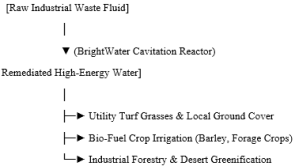
The implications of this technology for sustainable agriculture and industrial water management are profound. If simple mechanical cavitation can turn toxic oilfield produced water into an agricultural resource, it opens up a massive new water supply for non-potable irrigation.
Figure 3. Recovered Fluid Waste Potential Applications.
We recommend further long-term studies to test this cavitated water source on high-volume commercial crops, including utility turf grasses, barley, and specialized bio-fuel crops. By exploring this intersection of fluid mechanics, advanced oxidation physics, and plant physiology, we can transform an environmental liability into a powerful tool for global water conservation.
Abbreviations
AOP | Advanced Oxidation Process |
C:N | Carbon-to-Nitrogen |
CO2 | Ratio Carbon Dioxide |
DO | Dissolved Oxygen |
EZ | Exclusion Zone |
H2O | Water |
H3O2 | Exclusion Zone Wate / Fourth Phase Matrix |
H3O+ | Hydronium Ion |
N2 | Nitrogen Gas |
NaCl | Sodium Chloride (Salt) |
NO2- | Nitrite |
NO3- | Nitrate |
O2 | Oxygen |
OH | Hydroxyl Radical |
R:S | Root-to-Shoot Ratio |
TDA | Total Dissolved Solids |
WUE | Water Use Efficiency |
Author Contributions
Russ Hill: Conceptualization, Data curation, Methodology, Writing – original draft, Writing – review & editing
Mark Malmquist: Methodology, Project administration, Resources, Supervision, Validation, Visualization
Conflicts of Interest
The authors declare no conflicts of interest.
References
| [1] |
Taub, D. R. (2010). Effects of rising atmospheric concentrations of carbon dioxide on plants. Nature Education Knowledge, 3(10), 21.
https://www.nature.com/scitable/knowledge/library/effects-of-rising-atmospheric-concentrations-of-carbon-13254108/
|
| [2] |
Echchelh, A., Hess, T., & Sakrabani, R. (2018). Reusing oil and gas produced water for irrigation of food crops in drylands. Agricultural Water Management, 206, 124-134.
https://doi.org/10.1016/j.agwat.2018.05.006
Cited by: 133.
|
| [3] |
Christou, A., Beretsou, V. G., Iakovides, I. C., Karaolia, P., Michael, C., Benmarhnia, T., Chefetz, B., Donner, E., Gawlik, B. M., Lee, Y., Lim, T. T., Lundy, L., Maffettone, R., Rizzo, L., Topp, E., & Fatta-Kassinos, D. (2024). Sustainable wastewater reuse for agriculture. Nature Reviews Earth & Environment, 5(7), 504-521.
https://doi.org/10.1038/s43017-024-00560-y
Cited by: 242.
|
| [4] |
Mancuso, G., Langone, M., & Andreottola, G. (2020). A critical review of the current technologies in wastewater treatment plants by using hydrodynamic cavitation process: Principles and applications. Journal of Environmental Health Science and Engineering, 18(1), 311-333.
https://doi.org/10.1007/s40201-020-00444-5
Cited by: 114.
|
| [5] |
Yeneneh, A. M., Al Balushi, K., Jafary, T., & Al Marshudi, A. S. (2024). Hydrodynamic cavitation and advanced oxidation for enhanced degradation of persistent organic pollutants: A review. Sustainability, 16(11), Article 4601.
https://doi.org/10.3390/su16114601
Cited by: 28.
|
| [6] |
Patil, Y., Sonawane, S. H., Shyam, P., Sun, X., & Manickam, S. (2023). Hybrid hydrodynamic cavitation (HC) technique for the treatment and disinfection of lake water. Ultrasonics Sonochemistry, 97, Article 106454.
https://doi.org/10.1016/j.ultsonch.2023.106454
Cited by: 36.
|
| [7] |
Pollack, G. H. (2013). The 4th Phase of Water: Beyond Solid, Liquid, Vapor. Ebner & Sons Publishers.
|
| [8] |
Imperial College London. (2018, September 11). How Plants Use Carbon Affects Their Response to Climate Change. Imperial News.
https://www.imperial.ac.uk/news/187327/how-plants-carbon-affects-their-response/
|
| [9] |
Cho, M. H., & Core, A. (2017). Effects of elevated carbon dioxide on photosynthesis and carbon partitioning: A perspective on root sugar sensing and hormonal crosstalk. National Center for Biotechnology Information.
https://www.ncbi.nlm.nih.gov/pmc/articles/PMC5550704/
|
| [10] |
Kozlov, M. (2022, August 2). As Carbon Dioxide Goes Up, Plants' Nutrient Content Declines. The Scientist Magazine. Https://
www.the-scientist.com/as-carbon-dioxide-goes-up-plants-nutrient-content-declines-70720
|
| [11] |
Financial, T., & Terrer, C. (2021). Carbon sequestration: Counterintuitive feedback of plant growth. Quantitative Plant Biology, 2, Article E4.
https://doi.org/10.1017/qpb.2021.3
|
| [12] |
Ofori, S., Abebrese, D. K., Růžičková, I., & Wanner, J. (2024). Reuse of treated wastewater for crop irrigation: Water suitability, fertilization potential, and impact on selected soil physicochemical properties. Water, 16(3), Article 484.
https://doi.org/10.3390/w16030484
Cited by: 40.
|
| [13] |
Trotta, V., Baaloudj, O., & Brienza, M. (2024). Risks associated with wastewater reuse in agriculture: Investigating the effects of contaminants in soil, plants, and insects. Frontiers in Environmental Science, 12, Article 1358842.
https://doi.org/10.3389/fenvs.2024.1358842
Cited by: 47.
|
| [14] |
University of Sydney. (2021). Scientific Report: From Molecules to Ecosystems (BIOL1007). Studocu.
https://www.studocu.com/en-au/document/university-of-sydney/from-molecules-to-ecosystems/scientific-report-biol1007/6272194
|
| [15] |
TROP ICSU. (2019). Lesson Plan on Uganda: Plant Physiology and Bamboo Ecosystem Dynamics. Climate Science Teaching Educational Portal.
https://climatescienceteaching.org/lesson/plant-physiology/overview
|
Cite This Article
-
APA Style
Hill, R., Malmquist, M. (2026). Preliminary Study on Extraordinary Plant Growth Using Cavitated Produced Water. American Journal of Agriculture and Forestry, 14(4), 185-192. https://doi.org/10.11648/j.ajaf.20261404.13
 Copy
|
Copy
|
 Download
ACS Style
Hill, R.; Malmquist, M. Preliminary Study on Extraordinary Plant Growth Using Cavitated Produced Water. Am. J. Agric. For. 2026, 14(4), 185-192. doi: 10.11648/j.ajaf.20261404.13
Copy
|
Download
AMA Style
Hill R, Malmquist M. Preliminary Study on Extraordinary Plant Growth Using Cavitated Produced Water. Am J Agric For. 2026;14(4):185-192. doi: 10.11648/j.ajaf.20261404.13
Copy
|
Download
-
@article{10.11648/j.ajaf.20261404.13,
  author = {Russ Hill and Mark Malmquist},
  title = {Preliminary Study on Extraordinary Plant Growth Using Cavitated Produced Water},
  journal = {American Journal of Agriculture and Forestry},
  volume = {14},
  number = {4},
  pages = {185-192},
  doi = {10.11648/j.ajaf.20261404.13},
  url = {https://doi.org/10.11648/j.ajaf.20261404.13},
  eprint = {https://article.sciencepublishinggroup.com/pdf/10.11648.j.ajaf.20261404.13},
  abstract = {As global freshwater scarcity intensifies, reclaiming alternative water sources like highly saline oilfield produced water has become an ecological imperative; however, its inherent toxicity traditionally induces acute phytotoxicity in terrestrial vegetation. This preliminary study investigates a non-chemical, mechanically driven alternative by evaluating the physiological and phenotypic effects of irrigating diverse plant species with hydrodynamic cavitated produced water compared to standard local well water. Over an intensive five-day experimental period, identical plant cohorts were maintained under uniform ambient conditions and treated with either non-chemically modified, cavitated produced water or a standard well water baseline. Phenotypic and morphological variations were macroscopically tracked alongside volumetric fluid consumption rates and subsequent resilience to acute desiccation stress. The experimental plants did not merely survive; they exhibited significantly enhanced structural biomass, deeper pigmentation indicative of elevated chlorophyll concentrations, decreased volumetric water consumption rates, and superior turgor pressure maintenance during a simulated mini-drought event. These findings suggest that hydrodynamic cavitation fundamentally alters the chemical matrix of produced water—breaking down complex hydrocarbons into bio-available carbon fragments, elevating dissolved oxygen levels, and reducing active sodium chloride (NaCl) concentrations by over 90%. We conclude that this mechanical treatment breaks the osmotic barrier of industrial waste fluids, transforming them into viable agricultural assets. Furthermore, these phenomena are contextualized through modern interfacial water physics, specifically exploring the generation of structured Exclusion Zone (EZ) water matrices to explain the observed structural transformations and frictionless, low-energy cellular uptake.},
 year = {2026}
}
Copy
|
Download
-
TY  - JOUR
T1  - Preliminary Study on Extraordinary Plant Growth Using Cavitated Produced Water
AU  - Russ Hill
AU  - Mark Malmquist
Y1  - 2026/07/27
PY  - 2026
N1  - https://doi.org/10.11648/j.ajaf.20261404.13
DO  - 10.11648/j.ajaf.20261404.13
T2  - American Journal of Agriculture and Forestry
JF  - American Journal of Agriculture and Forestry
JO  - American Journal of Agriculture and Forestry
SP  - 185
EP  - 192
PB  - Science Publishing Group
SN  - 2330-8591
UR  - https://doi.org/10.11648/j.ajaf.20261404.13
AB  - As global freshwater scarcity intensifies, reclaiming alternative water sources like highly saline oilfield produced water has become an ecological imperative; however, its inherent toxicity traditionally induces acute phytotoxicity in terrestrial vegetation. This preliminary study investigates a non-chemical, mechanically driven alternative by evaluating the physiological and phenotypic effects of irrigating diverse plant species with hydrodynamic cavitated produced water compared to standard local well water. Over an intensive five-day experimental period, identical plant cohorts were maintained under uniform ambient conditions and treated with either non-chemically modified, cavitated produced water or a standard well water baseline. Phenotypic and morphological variations were macroscopically tracked alongside volumetric fluid consumption rates and subsequent resilience to acute desiccation stress. The experimental plants did not merely survive; they exhibited significantly enhanced structural biomass, deeper pigmentation indicative of elevated chlorophyll concentrations, decreased volumetric water consumption rates, and superior turgor pressure maintenance during a simulated mini-drought event. These findings suggest that hydrodynamic cavitation fundamentally alters the chemical matrix of produced water—breaking down complex hydrocarbons into bio-available carbon fragments, elevating dissolved oxygen levels, and reducing active sodium chloride (NaCl) concentrations by over 90%. We conclude that this mechanical treatment breaks the osmotic barrier of industrial waste fluids, transforming them into viable agricultural assets. Furthermore, these phenomena are contextualized through modern interfacial water physics, specifically exploring the generation of structured Exclusion Zone (EZ) water matrices to explain the observed structural transformations and frictionless, low-energy cellular uptake.
VL  - 14
IS  - 4
ER  -
Copy
|
Download




 Share This Article
 Twitter
 Linked In
 Facebook