Abstract
Stress is an important psychological and physiological response that may influence physical symptoms and health-related behaviours, although its effects vary across individuals. The present study examined the associations between recent stressful experiences, somatic symptom severity, and drug use, with particular attention to the presence and recency of drug use and the distribution of somatic symptom severity. A total of 487 adults completed an online questionnaire assessing recent major stressful events, somatic symptoms, illicit drug use and recency of use. Recent stress was not associated with drug-use status, with similar proportions of participants reporting drug use among those with and without recent stress. The exploratory analysis of the temporal relationship between stress and drug use did not provide evidence of a significant association, although interpretation was limited by the small number of participants reporting both experiences. In contrast, participants reporting recent stress showed significantly higher overall somatic symptom severity than those without recent stress. Although the distribution of symptom severity categories showed a descriptive shift toward moderate and high symptom levels among participants reporting recent stress, the overall categorical distribution did not differ significantly between groups. These findings suggest that recent stressful experiences may be associated with greater somatic symptom burden, although the magnitude of this association appears to be modest. In contrast, no evidence of an association between recent stress and drug-use status was observed in this sample. The findings highlight the relevance of recent stress in understanding individual differences in somatic symptomatology while suggesting that its relationship with substance use may depend on additional individual and behavioural factors. Longitudinal research using repeated assessments of stress, somatic symptoms, and substance-related behaviours is warranted to clarify the temporal and individual-level processes underlying these associations.
|
Published in
|
American Journal of Applied Psychology (Volume 15, Issue 6)
|
|
DOI
|
10.11648/j.ajap.20261506.11
|
|
Page(s)
|
198-204 |
|
Creative Commons
|

This is an Open Access article, distributed under the terms of the Creative Commons Attribution 4.0 International License (http://creativecommons.org/licenses/by/4.0/), which permits unrestricted use, distribution and reproduction in any medium or format, provided the original work is properly cited.
|
|
Copyright
|
Copyright © The Author(s), 2026. Published by Science Publishing Group
|
Keywords
Stress, Somatic Symptoms, Substance Use
1. Introduction
Stress is a common psychological and physiological response to challenging or demanding circumstances and represents an important factor in the development and maintenance of a broad range of mental and physical health problems. Exposure to stressful experiences may affect emotional regulation, physiological functioning, and health-related behaviours, with the consequences depending on the intensity, duration, and timing of the stressor, as well as on individual vulnerability
| [1] | McEwen, B. S. (2007). Physiology and neurobiology of stress and adaptation: Central role of the brain. Physiological Reviews, 87(3), 873-904. https://doi.org/10.1152/physrev.00041.2006 |
| [2] | Slavich, G. M. (2020). Social safety theory: A biologically based evolutionary perspective on life stress, health, and behavior. Annual Review of Clinical Psychology, 16, 265-295.
https://doi.org/10.1146/annurev-clinpsy-032816-045159 |
| [3] | Troy, A. S., Willroth, E. C., Shallcross, A. J., Giuliani, N. R., Gross, J. J., & Mauss, I. B. (2023). Psychological resilience: An affect-regulation framework. Annual Review of Psychology, 74, 547-576.
https://doi.org/10.1146/annurev-psych-020122-041854 |
[1-3]
. In particular, repeated or persistent stress has been associated with alterations in stress-response systems and with maladaptive coping processes that may increase vulnerability to psychological and behavioural symptoms
. Importantly, the relationship between stress and health outcomes is not uniform across individuals, suggesting that individual differences and contextual factors play an important role in determining how stress is experienced and expressed
.
One relevant manifestation of psychological distress is the presence of somatic symptoms. Somatic symptoms refer to physical complaints such as pain, fatigue, gastrointestinal disturbances, dizziness, or other bodily sensations that may occur in the absence of a sufficient medical explanation or may be disproportionate to an identified medical condition
| [5] | American Psychiatric Association. (2013). Diagnostic and statistical manual of mental disorders (5th ed.). American Psychiatric Publishing. |
[5]
. Although somatic symptoms are common in the general population, greater symptom burden is associated with impaired functioning, reduced quality of life, and increased psychological distress
| [6] | de Waal, M. W. M., Arnold, I. A., Eekhof, J. A. H., & van Hemert, A. M. (2004). Somatoform disorders in general practice: Prevalence, functional impairment and comorbidity with anxiety and depressive disorders. The British Journal of Psychiatry, 184(6), 470-476. https://doi.org/10.1192/bjp.184.6.470 |
| [7] | Hilderink, P. H., Collard, R., Rosmalen, J. G. M., & Oude Voshaar, R. C. (2013). Prevalence of somatoform disorders and medically unexplained symptoms in older people. Age and Ageing, 42(4), 511-516. https://doi.org/10.1093/ageing/aft057 |
| [8] | Löwe, B., Toussaint, A., Rosmalen, J. G. M., Huang, W.-L., Burton, C., Weigel, A., Levenson, J. L., & Henningsen, P. (2024). Persistent physical symptoms: Definition, genesis, and management. The Lancet, 403(10444), 2649-2662.
https://doi.org/10.1016/S0140-6736(24)00623-8 |
[6-8]
. Contemporary models conceptualize somatic symptoms within a biopsychosocial framework, in which biological, psychological, and social factors interact in shaping the perception, interpretation, and persistence of bodily symptoms
| [9] | Førde, S., Herner, L. B., Helland, I. B., & Diseth, T. H. (2022). The biopsychosocial model in paediatric clinical practice—An interdisciplinary approach to somatic symptom disorders. Acta Paediatrica, 111(11), 2115-2124.
https://doi.org/10.1111/apa.16517 |
| [10] | Rief, W., & Broadbent, E. (2007). Explaining medically unexplained symptoms—Models and mechanisms. Clinical Psychology Review, 27(7), 821-841.
https://doi.org/10.1016/j.cpr.2007.07.005 |
[9, 10]
. A recent systematic review and meta-analysis identified several psychological factors associated with somatic symptom disorder and symptom severity, supporting the relevance of psychological processes in the experience of somatic symptoms
| [11] | Smakowski, A., Hüsing, P., Völcker, S., Löwe, B., Rosmalen, J. G. M., Shedden-Mora, M., & Toussaint, A. (2024). Psychological risk factors of somatic symptom disorder: A systematic review and meta-analysis of cross-sectional and longitudinal studies. Journal of Psychosomatic Research, 181, 111608. https://doi.org/10.1016/j.jpsychores.2024.111608 |
[11]
. Stress may represent one of the psychological and contextual factors contributing to somatic symptom expression. Psychosocial stress has long been considered a potential precipitating or perpetuating factor for functional somatic symptoms
| [8] | Löwe, B., Toussaint, A., Rosmalen, J. G. M., Huang, W.-L., Burton, C., Weigel, A., Levenson, J. L., & Henningsen, P. (2024). Persistent physical symptoms: Definition, genesis, and management. The Lancet, 403(10444), 2649-2662.
https://doi.org/10.1016/S0140-6736(24)00623-8 |
| [12] | Deary, V., Chalder, T., & Sharpe, M. (2007). The cognitive behavioural model of medically unexplained symptoms: A theoretical and empirical review. Clinical Psychology Review, 27(7), 781-797. https://doi.org/10.1016/j.cpr.2007.07.002 |
[8, 12]
. Evidence suggests that this association is complex and may vary substantially between individuals. For example, prospective diary-based research has shown that increases in stress may precede increases in somatic symptoms in some, but not all, individuals, highlighting substantial heterogeneity in the temporal relationship between stress and bodily symptoms
| [13] | van Gils, A., Burton, C., Bos, E. H., Janssens, K. A. M., Schoevers, R. A., & Rosmalen, J. G. M. (2014). Individual variation in temporal relationships between stress and functional somatic symptoms. Journal of Psychosomatic Research, 77(1), 34-39.
https://doi.org/10.1016/j.jpsychores.2014.04.006 |
[13]
. Similarly, additional evidence indicates that exposure to psychological trauma is associated with an increased likelihood of functional somatic syndromes, further supporting the relevance of adverse and stressful experiences to somatic symptomatology
| [14] | Afari, N., Ahumada, S. M., Johnson Wright, L., Mostoufi, S., Golnari, G., Reis, V., & Cuneo, J. G. (2014). Psychological trauma and functional somatic syndromes: A systematic review and meta-analysis. Psychosomatic Medicine, 76(1), 2-11.
https://doi.org/10.1097/PSY.0000000000000010 |
[14]
. These findings suggest that recent stress may be particularly relevant when examining individual differences in somatic symptom severity.
Beyond somatic manifestations, stress may also influence health-related behaviours, including substance use. One potential pathway involves the use of substances as a maladaptive strategy for coping with stress and associated negative affect. Coping motives represent an important motivational dimension of substance use, whereby individuals may use substances in an attempt to alleviate or regulate distressing emotional states
| [15] | Hand, L. J., Paterson, L. M., & Lingford-Hughes, A. R. (2024). Re-evaluating our focus in addiction: Emotional dysregulation is a critical driver of relapse to drug use. Translational Psychiatry, 14, 467.
https://doi.org/10.1038/s41398-024-03159-5 |
| [16] | Votaw, V. R., & Witkiewitz, K. (2021). Motives for substance use in daily life: A systematic review of studies using ecological momentary assessment. Clinical Psychological Science, 9(4), 535-562.
https://doi.org/10.1177/2167702620978614 |
[15, 16]
. Consistent with this perspective, stress has been implicated in several stages of substance use, including initiation, maintenance, escalation, and relapse, with stress-related alterations in emotional, cognitive, and neurobiological processes potentially contributing to craving and drug-seeking behaviour, particularly among individuals who are vulnerable to substance-related problems
| [4] | Sinha, R. (2008). Chronic stress, drug use, and vulnerability to addiction. Annals of the New York Academy of Sciences, 1141, 105-130. https://doi.org/10.1196/annals.1441.030 |
| [17] | Koob, G. F., & Schulkin, J. (2019). Addiction and stress: An allostatic view. Neuroscience & Biobehavioral Reviews, 106, 245-262. https://doi.org/10.1016/j.neubiorev.2018.09.008 |
| [18] | Juliano, V. A. L., Albernaz-Mariano, K. A., Covre, L. H. H., Jucá, P. M., Pereira, R. M., Shigeo-de-Almeida, A., Sampaio, L. L., Duque, E. A., & Munhoz, C. D. (2025). Neurobiological intersections of stress and substance use disorders. Frontiers in Neuroscience, 19, 1548372.
https://doi.org/10.3389/fnins.2025.1548372 |
[4, 17, 18]
. Earlier research similarly suggested that stress may influence several stages of the course of substance use, from initial experimentation to regular use and relapse
| [19] | Lijffijt, M., Hu, K., & Swann, A. C. (2014). Stress modulates illness-course of substance use disorders: A translational review. Frontiers in Psychiatry, 5, 83.
https://doi.org/10.3389/fpsyt.2014.00083 |
[19]
. Recent evidence further suggests that chronic and repeated stress, together with alterations associated with drug exposure, withdrawal, and abstinence, may disrupt adaptive stress responses and contribute to maladaptive coping processes that increase vulnerability to continued substance use and relapse
| [20] | Sinha, R. (2024). Stress and substance use disorders: Risk, relapse, and treatment outcomes. Journal of Clinical Investigation, 134(16), e172883.
https://doi.org/10.1172/JCI172883 |
[20]
. Thus, substance use may represent another way in which stress is expressed behaviourally, particularly when individuals rely on substances to manage stress or negative affect.
Taken together, these findings indicate that recent stress, somatic symptoms, and drug use may represent interconnected, yet conceptually distinct, dimensions of psychological and behavioural functioning. Examining their relationships may therefore provide a more comprehensive understanding of how recent stressful experiences are associated with physical symptom burden and substance-use behaviour. Importantly, investigating both the presence and recency of drug use may help characterize whether recent stress is associated not only with drug-use status but also with the temporal proximity of substance use. Similarly, examining somatic symptom scores as both a continuous measure and according to severity categories may provide complementary information about the relationship between recent stress and somatic symptomatology. Accordingly, the present study examined the association between recent stress, somatic symptoms, and drug use. Specifically, we investigated whether recent stress was associated with drug-use status and with the recency of drug use, and whether individuals reporting recent stress differed in overall somatic symptom severity and in the distribution of somatic symptom severity categories compared with those who did not report recent stress.
2. Materials and Methods
2.1. Participants
Participants were recruited through the researchers’ personal networks using a snowball sampling method. Data collection was conducted online via the Qualtrics platform, and the survey link was distributed through various social media channels. Completion of the questionnaire required approximately 10 minutes, and no compensation was offered for participation. Prior to participation, all respondents provided informed consent in accordance with ethical research standards.
The sample comprised 487 participants, of whom 384 (78.9%) were female and 103 (21.1%) were male. Age data were available for 475 participants (97.5%), while age was missing for 12 participants (2.5%). The mean age was 30.21 years (SD = 12.29). Mean age was similar among female participants (n = 375, M = 30.24, SD = 12.51) and male participants (n = 100, M = 30.08, SD = 11.53).
Regarding educational attainment, 248 participants (50.9%) reported a university degree or tertiary diploma, 206 (42.3%) had completed upper-secondary school or vocational education, 24 (4.9%) held a postgraduate degree or specialization, and 9 (1.8%) had completed lower-secondary school. Half of the sample were students (n = 244, 50.1%), while 201 participants (41.3%) were employed, 34 (7.0%) were unemployed, and 8 (1.6%) were homemakers.
2.2. Measures
Participants completed a structured questionnaire assessing socio-demographic characteristics, recent stressful life events, and drug use. Socio-demographic information included age, gender, educational level, employment status, and marital status. The questionnaire also included specific items assessing whether participants had experienced a recent major emotional stressor and whether they used illicit drugs, as well as the recency of these experiences or behaviours.
Recent stressful life events. Participants were asked whether they had recently experienced a major emotional stressor (e.g., bereavement, divorce, or other significant stressful life events). Responses were recorded dichotomously (yes/no). Those who reported having experienced a major recent stressor were subsequently asked to indicate when the event had occurred, with four response options: (a) less than one week ago, (b) less than one month ago, (c) less than three months ago, and (d) more than three months ago.
Drug use. Participants were asked whether they used illicit drugs, with responses recorded dichotomously (yes/no). Those who reported drug use were subsequently asked to indicate when they had last used drugs, with four response options: (a) within the past three days, (b) within the past week, (c) more than one week ago, and (d) more than one month ago.
Subsequently, participants completed a standardized self-report measure assessing somatic symptoms. In particular, somatic symptoms were assessed using the
DSM-5 Level 2 Somatic Symptom—Adult questionnaire, a standardized self-report measure adapted from the Patient Health Questionnaire Physical Symptoms (PHQ-15)
. The instrument evaluates the severity of common somatic symptoms experienced during the previous seven days using items rated on a 3-point Likert scale, with higher scores indicating greater somatic symptom burden. The validated Italian version edited by Fossati, Borroni, and Del Corno was administered in the present study
| [22] | Fossati, A., Borroni, S., & Del Corno, F. (2015). Scale di valutazione adulti: DSM-5. Raffaello Cortina Editore. |
[22]
.
2.3. Statistical Analyses
First, a Pearson chi-square test was used to assess whether having experienced recent stress was associated with drug use; both variables were dichotomous. For descriptive purposes, the association between the recency of stress and the recency of drug use was then examined using Pearson chi-square test, Kendall’s tau-b correlation and a contingency analysis.
A one-way between-subjects analysis of variance was subsequently used to examine whether participants who had experienced recent stress differed in somatic symptom scores from those who had not. Finally, a Pearson chi-square test assessed whether the distribution of somatic symptom severity categories differed according to recent stress status. All tests were two-tailed, with the significance level set at α =.05.
3. Results
Recent Stress and Drug Use
Drug use was reported by 12.5% of participants without recent stress (46/368) and 12.6% of participants with recent stress (15/119). These proportions were virtually identical. The chi-square test showed no association between recent stress and drug use, χ
2(1, N = 487) = 0.001, p = .976, Cramer’s V = .001 (see
Table 1).
Table 1. Drug use according to recent stress status.
Drug use | No recent stress n (%) | Recent stress n (%) | Total n (%) |
No | 322 (87.5) | 104 (87.4) | 426 (87.5) |
Yes | 46 (12.5) | 15 (12.6) | 61 (12.5) |
Total | 368 (100.0) | 119 (100.0) | 487 (100.0) |
Recency of Stress and Drug Use
Fifteen participants reported both recent stress and drug use. Of these, 14 provided information on the recency of both events. Stress recency was coded as less than one week (0), less than one month (1), less than three months (2), or more than three months (3). Drug-use recency was coded as use in the past three days (0), in the past week (1), or more than one month earlier (2).
Among the 14 participants, eight reported drug use in the past three days, five in the past week, and one more than one month earlier. With respect to stress, two reported an event less than one week earlier, five less than one month earlier, one less than three months earlier, and six more than three months earlier. No statistically significant association emerged between the two recency measures, χ2(6, N = 14) = 7.140, p =.308; Kendall’s tau-b = −.221, p =.393. Because every expected cell count was below 5, the asymptotic chi-square result is unreliable and the analysis should be regarded as exploratory.
Recent Stress and Somatic Symptom Scores
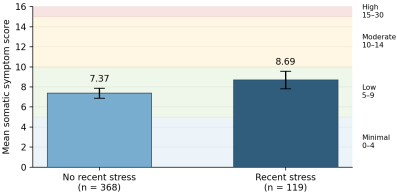
Participants who had experienced recent stress reported significantly higher somatic symptom scores (n = 119, M = 8.69, SD = 5.43) than participants without recent stress (n = 368, M = 7.37, SD = 4.62), F (1, 485) = 6.724, p =.010, partial η
2 = .014. The effect was small, accounting for approximately 1.4% of the variance in symptom scores. Both group means fell within the low symptom range (5-9) (see
Table 2, see
Figure 1).
Table 2. Somatic symptom scores according to recent stress status.
Group | n | Mean | SD | 95% CI for mean |
No recent stress | 368 | 7.37 | 4.62 | [6.88, 7.86] |
Recent stress | 119 | 8.69 | 5.43 | [7.82, 9.56] |
Total | 487 | 7.69 | 4.85 | — |
Figure 1. Mean somatic symptom scores and 95% confidence intervals by recent stress status.
Somatic Symptom Severity Categories
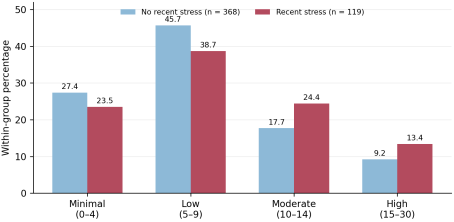
Somatic symptom scores were classified as minimal (0-4), low (5-9), moderate (10-14), or high (15-30). In both stress groups, the most frequent category was low severity: 45.7% among participants without recent stress and 38.7% among those with recent stress. Compared with participants without recent stress, participants with recent stress showed descriptively lower percentages in the minimal and low categories and higher percentages in the moderate and high categories. Specifically, moderate symptoms were observed in 24.4% versus 17.7%, and high symptoms in 13.4% versus 9.2%, respectively. However, the overall distribution of severity categories did not differ significantly by stress status, χ
2(3, N = 487) = 5.17, p =.160, Cramer’s V =.103 (see
Table 3, see
Figure 2).
Table 3. Somatic symptom severity categories by recent stress status.
Severity category | No recent stress n (%) | Recent stress n (%) | Total n (%) |
Minimal (0-4) | 101 (27.4) | 28 (23.5) | 129 (26.5) |
Low (5-9) | 168 (45.7) | 46 (38.7) | 214 (43.9) |
Moderate (10-14) | 65 (17.7) | 29 (24.4) | 94 (19.3) |
High (15-30) | 34 (9.2) | 16 (13.4) | 50 (10.3) |
Total | 368 (100.0) | 119 (100.0) | 487 (100.0) |
Figure 2. Somatic symptom severity distribution by recent stress status.
In conclusion, recent stress was unrelated to whether participants reported drug use. In contrast, participants with recent stress had significantly higher mean somatic symptom scores, although the effect was small. The categorical analysis showed a descriptive shift toward moderate and high symptoms among participants with recent stress, but the overall category distribution was not statistically significant. Findings concerning the timing of stress and drug use remain inconclusive because of the very small subsample and sparse contingency table.
4. Discussion
The present study examined the associations between recent stressful experiences, somatic symptoms, and drug use. The findings revealed a differentiated pattern across the outcomes examined. Most notably, participants who reported a recent stressful event had significantly higher somatic symptom scores than those who did not report recent stress. Although the magnitude of this difference was small, the finding suggests that recent stressful experiences may be relevant to individual differences in somatic symptom burden. In contrast, recent stress was not associated with drug-use status, and the exploratory analysis of the temporal relationship between stress and drug use did not provide conclusive evidence of an association.
The significant association between recent stress and somatic symptom severity represents the main finding of the present study. Participants reporting recent stress showed higher mean somatic symptom scores than those without recent stress, with an effect size indicating a small but meaningful difference in symptom burden. This finding is consistent with previous research linking psychological stress and adverse experiences to somatic symptomatology
| [10] | Rief, W., & Broadbent, E. (2007). Explaining medically unexplained symptoms—Models and mechanisms. Clinical Psychology Review, 27(7), 821-841.
https://doi.org/10.1016/j.cpr.2007.07.005 |
| [11] | Smakowski, A., Hüsing, P., Völcker, S., Löwe, B., Rosmalen, J. G. M., Shedden-Mora, M., & Toussaint, A. (2024). Psychological risk factors of somatic symptom disorder: A systematic review and meta-analysis of cross-sectional and longitudinal studies. Journal of Psychosomatic Research, 181, 111608. https://doi.org/10.1016/j.jpsychores.2024.111608 |
| [12] | Deary, V., Chalder, T., & Sharpe, M. (2007). The cognitive behavioural model of medically unexplained symptoms: A theoretical and empirical review. Clinical Psychology Review, 27(7), 781-797. https://doi.org/10.1016/j.cpr.2007.07.002 |
| [14] | Afari, N., Ahumada, S. M., Johnson Wright, L., Mostoufi, S., Golnari, G., Reis, V., & Cuneo, J. G. (2014). Psychological trauma and functional somatic syndromes: A systematic review and meta-analysis. Psychosomatic Medicine, 76(1), 2-11.
https://doi.org/10.1097/PSY.0000000000000010 |
[10-12, 14]
. The present results therefore provide further support for the relevance of recent stressful experiences when considering individual differences in physical symptom burden. Importantly, the observed association should not be interpreted as evidence that stress is the sole or primary determinant of somatic symptoms. Rather, the small effect size suggests that recent stress may represent one contributing factor within a broader network of biological, psychological, and contextual influences. Stress-related physiological arousal, heightened attention to bodily sensations, emotional distress, and changes in symptom interpretation may represent possible pathways through which stressful experiences are associated with increased somatic symptom reporting
. The pattern observed in the present study is also consistent with evidence that the relationship between stress and somatic symptoms is heterogeneous across individuals. Previous prospective research has shown that increases in stress may precede increases in somatic symptoms in some individuals, whereas other individuals show weaker or different temporal patterns
| [13] | van Gils, A., Burton, C., Bos, E. H., Janssens, K. A. M., Schoevers, R. A., & Rosmalen, J. G. M. (2014). Individual variation in temporal relationships between stress and functional somatic symptoms. Journal of Psychosomatic Research, 77(1), 34-39.
https://doi.org/10.1016/j.jpsychores.2014.04.006 |
[13]
. Thus, the present group-level finding may reflect an increased vulnerability to somatic symptom expression among a subset of individuals experiencing recent stress rather than a uniform effect across the population.
The categorical analysis provides additional, although more tentative, support for this interpretation. Participants reporting recent stress showed descriptively higher proportions of moderate and high symptom severity than those without recent stress. Although the overall distribution of severity categories did not reach statistical significance, the direction of this pattern was consistent with the significant difference observed in the continuous symptom scores. This convergence is noteworthy because it suggests that the higher mean symptom burden in the recent-stress group was not simply attributable to small differences across the lower end of the symptom distribution. At the same time, the nonsignificant categorical analysis indicates that the evidence is stronger for a difference in overall symptom burden than for a clear separation into clinically defined severity categories.
In contrast to the somatic symptom findings, recent stress was not associated with drug-use status. The proportion of participants reporting drug use was almost identical in the recent-stress and no-stress groups, and the corresponding effect size was negligible. Thus, within this sample, recent stress did not appear to distinguish participants according to whether they reported drug use. This finding does not necessarily contradict previous evidence linking stress with substance use and relapse
| [4] | Sinha, R. (2008). Chronic stress, drug use, and vulnerability to addiction. Annals of the New York Academy of Sciences, 1141, 105-130. https://doi.org/10.1196/annals.1441.030 |
| [17] | Koob, G. F., & Schulkin, J. (2019). Addiction and stress: An allostatic view. Neuroscience & Biobehavioral Reviews, 106, 245-262. https://doi.org/10.1016/j.neubiorev.2018.09.008 |
| [19] | Lijffijt, M., Hu, K., & Swann, A. C. (2014). Stress modulates illness-course of substance use disorders: A translational review. Frontiers in Psychiatry, 5, 83.
https://doi.org/10.3389/fpsyt.2014.00083 |
| [20] | Sinha, R. (2024). Stress and substance use disorders: Risk, relapse, and treatment outcomes. Journal of Clinical Investigation, 134(16), e172883.
https://doi.org/10.1172/JCI172883 |
[4, 17, 19, 20]
. One possible explanation is that the present study assessed drug use as a binary outcome, whereas the relationship between stress and substance use may be more apparent for specific dimensions of substance involvement, such as frequency, quantity, craving, problematic use, or relapse. The effect of stress may also depend on previous substance-use history and individual vulnerability.
The analysis of the recency of stress and drug use did not identify a statistically significant association. However, this analysis was based on only 14 participants with complete information on the timing of both experiences, substantially limiting statistical power and producing sparse expected cell counts. The result should therefore be regarded as exploratory. At the same time, the descriptive data provide some indication that several participants reporting recent stress also reported relatively recent drug use. However, the available sample is too small to determine whether the temporal proximity of these experiences reflects a meaningful relationship. Prospective repeated-measures studies would be better suited to determining whether increases in stress precede changes in craving or substance use within individuals and future research should therefore examine more specific indicators of substance involvement and potential moderating factors, rather than treating drug use as a homogeneous behaviour.
Taken together, these findings support the relevance of recent stress in relation to somatic symptom burden, while suggesting a more complex association between stress and substance use. Specifically, the relationship between recent stress and physical symptoms appears to be more readily detectable than that between recent stress and drug use in a general online sample. This distinction highlights the possibility that stress may be expressed differently across domains of functioning.
5. Conclusion
Overall, the present findings indicate that recent stressful experiences were associated with higher somatic symptom severity, whereas no association was observed between recent stress and drug-use status. Although the effect on somatic symptoms was small, the finding was statistically significant and was accompanied by a descriptive shift toward greater moderate and high symptom severity among participants reporting recent stress. These results support the relevance of recent stress as one potential correlate of somatic symptom burden while indicating that its relationship with substance use may be more dependent on specific characteristics of substance involvement and individual vulnerability.
Longitudinal research using repeated assessments of stress, somatic symptoms, and substance-related behaviours is warranted to determine the temporal direction of these associations and to identify the individual characteristics that may explain why stress is associated with greater somatic symptom burden in some individuals but not others.
Abbreviations
PHQ | Patient Health Questionnaire Physical Symptoms |
Author Contributions
Paola Surcinelli: Conceptualization, Data curation, Investigation, Methodology, Writing – original draft, Writing – review & editing
Ornella Montebarocci: Conceptualization, Data curation, Investigation, Writing – review & editing
Sara Giovagnoli: Data curation, Formal Analysis, Investigation, Methodology, Writing – original draft, Writing – review & editing
Data Availability Statement
The data is available from the corresponding author upon reasonable request.
Conflicts of Interest
The authors declare no conflicts of interest.
References
| [1] |
McEwen, B. S. (2007). Physiology and neurobiology of stress and adaptation: Central role of the brain. Physiological Reviews, 87(3), 873-904.
https://doi.org/10.1152/physrev.00041.2006
|
| [2] |
Slavich, G. M. (2020). Social safety theory: A biologically based evolutionary perspective on life stress, health, and behavior. Annual Review of Clinical Psychology, 16, 265-295.
https://doi.org/10.1146/annurev-clinpsy-032816-045159
|
| [3] |
Troy, A. S., Willroth, E. C., Shallcross, A. J., Giuliani, N. R., Gross, J. J., & Mauss, I. B. (2023). Psychological resilience: An affect-regulation framework. Annual Review of Psychology, 74, 547-576.
https://doi.org/10.1146/annurev-psych-020122-041854
|
| [4] |
Sinha, R. (2008). Chronic stress, drug use, and vulnerability to addiction. Annals of the New York Academy of Sciences, 1141, 105-130.
https://doi.org/10.1196/annals.1441.030
|
| [5] |
American Psychiatric Association. (2013). Diagnostic and statistical manual of mental disorders (5th ed.). American Psychiatric Publishing.
|
| [6] |
de Waal, M. W. M., Arnold, I. A., Eekhof, J. A. H., & van Hemert, A. M. (2004). Somatoform disorders in general practice: Prevalence, functional impairment and comorbidity with anxiety and depressive disorders. The British Journal of Psychiatry, 184(6), 470-476.
https://doi.org/10.1192/bjp.184.6.470
|
| [7] |
Hilderink, P. H., Collard, R., Rosmalen, J. G. M., & Oude Voshaar, R. C. (2013). Prevalence of somatoform disorders and medically unexplained symptoms in older people. Age and Ageing, 42(4), 511-516.
https://doi.org/10.1093/ageing/aft057
|
| [8] |
Löwe, B., Toussaint, A., Rosmalen, J. G. M., Huang, W.-L., Burton, C., Weigel, A., Levenson, J. L., & Henningsen, P. (2024). Persistent physical symptoms: Definition, genesis, and management. The Lancet, 403(10444), 2649-2662.
https://doi.org/10.1016/S0140-6736(24)00623-8
|
| [9] |
Førde, S., Herner, L. B., Helland, I. B., & Diseth, T. H. (2022). The biopsychosocial model in paediatric clinical practice—An interdisciplinary approach to somatic symptom disorders. Acta Paediatrica, 111(11), 2115-2124.
https://doi.org/10.1111/apa.16517
|
| [10] |
Rief, W., & Broadbent, E. (2007). Explaining medically unexplained symptoms—Models and mechanisms. Clinical Psychology Review, 27(7), 821-841.
https://doi.org/10.1016/j.cpr.2007.07.005
|
| [11] |
Smakowski, A., Hüsing, P., Völcker, S., Löwe, B., Rosmalen, J. G. M., Shedden-Mora, M., & Toussaint, A. (2024). Psychological risk factors of somatic symptom disorder: A systematic review and meta-analysis of cross-sectional and longitudinal studies. Journal of Psychosomatic Research, 181, 111608.
https://doi.org/10.1016/j.jpsychores.2024.111608
|
| [12] |
Deary, V., Chalder, T., & Sharpe, M. (2007). The cognitive behavioural model of medically unexplained symptoms: A theoretical and empirical review. Clinical Psychology Review, 27(7), 781-797.
https://doi.org/10.1016/j.cpr.2007.07.002
|
| [13] |
van Gils, A., Burton, C., Bos, E. H., Janssens, K. A. M., Schoevers, R. A., & Rosmalen, J. G. M. (2014). Individual variation in temporal relationships between stress and functional somatic symptoms. Journal of Psychosomatic Research, 77(1), 34-39.
https://doi.org/10.1016/j.jpsychores.2014.04.006
|
| [14] |
Afari, N., Ahumada, S. M., Johnson Wright, L., Mostoufi, S., Golnari, G., Reis, V., & Cuneo, J. G. (2014). Psychological trauma and functional somatic syndromes: A systematic review and meta-analysis. Psychosomatic Medicine, 76(1), 2-11.
https://doi.org/10.1097/PSY.0000000000000010
|
| [15] |
Hand, L. J., Paterson, L. M., & Lingford-Hughes, A. R. (2024). Re-evaluating our focus in addiction: Emotional dysregulation is a critical driver of relapse to drug use. Translational Psychiatry, 14, 467.
https://doi.org/10.1038/s41398-024-03159-5
|
| [16] |
Votaw, V. R., & Witkiewitz, K. (2021). Motives for substance use in daily life: A systematic review of studies using ecological momentary assessment. Clinical Psychological Science, 9(4), 535-562.
https://doi.org/10.1177/2167702620978614
|
| [17] |
Koob, G. F., & Schulkin, J. (2019). Addiction and stress: An allostatic view. Neuroscience & Biobehavioral Reviews, 106, 245-262.
https://doi.org/10.1016/j.neubiorev.2018.09.008
|
| [18] |
Juliano, V. A. L., Albernaz-Mariano, K. A., Covre, L. H. H., Jucá, P. M., Pereira, R. M., Shigeo-de-Almeida, A., Sampaio, L. L., Duque, E. A., & Munhoz, C. D. (2025). Neurobiological intersections of stress and substance use disorders. Frontiers in Neuroscience, 19, 1548372.
https://doi.org/10.3389/fnins.2025.1548372
|
| [19] |
Lijffijt, M., Hu, K., & Swann, A. C. (2014). Stress modulates illness-course of substance use disorders: A translational review. Frontiers in Psychiatry, 5, 83.
https://doi.org/10.3389/fpsyt.2014.00083
|
| [20] |
Sinha, R. (2024). Stress and substance use disorders: Risk, relapse, and treatment outcomes. Journal of Clinical Investigation, 134(16), e172883.
https://doi.org/10.1172/JCI172883
|
| [21] |
Kroenke, K., Spitzer, R. L., & Williams, J. B. W. (2002). The PHQ-15: Validity of a new measure for evaluating the severity of somatic symptoms. Psychosomatic Medicine, 64(2), 258-266.
https://doi.org/10.1097/00006842-200203000-00008
|
| [22] |
Fossati, A., Borroni, S., & Del Corno, F. (2015). Scale di valutazione adulti: DSM-5. Raffaello Cortina Editore.
|
Cite This Article
-
APA Style
Surcinelli, P., Montebarocci, O., Giovagnoli, S. (2026). Stressful Life Events, Somatic Symptoms, and Substance Use in Italian Young Adults. American Journal of Applied Psychology, 15(6), 198-204. https://doi.org/10.11648/j.ajap.20261506.11
 Copy
|
 Download
ACS Style
Surcinelli, P.; Montebarocci, O.; Giovagnoli, S. Stressful Life Events, Somatic Symptoms, and Substance Use in Italian Young Adults. Am. J. Appl. Psychol. 2026, 15(6), 198-204. doi: 10.11648/j.ajap.20261506.11
Copy
|
Download
AMA Style
Surcinelli P, Montebarocci O, Giovagnoli S. Stressful Life Events, Somatic Symptoms, and Substance Use in Italian Young Adults. Am J Appl Psychol. 2026;15(6):198-204. doi: 10.11648/j.ajap.20261506.11
Copy
|
Download
-
@article{10.11648/j.ajap.20261506.11,
  author = {Paola Surcinelli and Ornella Montebarocci and Sara Giovagnoli},
  title = {Stressful Life Events, Somatic Symptoms, and Substance Use in Italian Young Adults},
  journal = {American Journal of Applied Psychology},
  volume = {15},
  number = {6},
  pages = {198-204},
  doi = {10.11648/j.ajap.20261506.11},
  url = {https://doi.org/10.11648/j.ajap.20261506.11},
  eprint = {https://article.sciencepublishinggroup.com/pdf/10.11648.j.ajap.20261506.11},
  abstract = {Stress is an important psychological and physiological response that may influence physical symptoms and health-related behaviours, although its effects vary across individuals. The present study examined the associations between recent stressful experiences, somatic symptom severity, and drug use, with particular attention to the presence and recency of drug use and the distribution of somatic symptom severity. A total of 487 adults completed an online questionnaire assessing recent major stressful events, somatic symptoms, illicit drug use and recency of use. Recent stress was not associated with drug-use status, with similar proportions of participants reporting drug use among those with and without recent stress. The exploratory analysis of the temporal relationship between stress and drug use did not provide evidence of a significant association, although interpretation was limited by the small number of participants reporting both experiences. In contrast, participants reporting recent stress showed significantly higher overall somatic symptom severity than those without recent stress. Although the distribution of symptom severity categories showed a descriptive shift toward moderate and high symptom levels among participants reporting recent stress, the overall categorical distribution did not differ significantly between groups. These findings suggest that recent stressful experiences may be associated with greater somatic symptom burden, although the magnitude of this association appears to be modest. In contrast, no evidence of an association between recent stress and drug-use status was observed in this sample. The findings highlight the relevance of recent stress in understanding individual differences in somatic symptomatology while suggesting that its relationship with substance use may depend on additional individual and behavioural factors. Longitudinal research using repeated assessments of stress, somatic symptoms, and substance-related behaviours is warranted to clarify the temporal and individual-level processes underlying these associations.},
 year = {2026}
}
Copy
|
Download
-
TY  - JOUR
T1  - Stressful Life Events, Somatic Symptoms, and Substance Use in Italian Young Adults
AU  - Paola Surcinelli
AU  - Ornella Montebarocci
AU  - Sara Giovagnoli
Y1  - 2026/11/13
PY  - 2026
N1  - https://doi.org/10.11648/j.ajap.20261506.11
DO  - 10.11648/j.ajap.20261506.11
T2  - American Journal of Applied Psychology
JF  - American Journal of Applied Psychology
JO  - American Journal of Applied Psychology
SP  - 198
EP  - 204
PB  - Science Publishing Group
SN  - 2328-5672
UR  - https://doi.org/10.11648/j.ajap.20261506.11
AB  - Stress is an important psychological and physiological response that may influence physical symptoms and health-related behaviours, although its effects vary across individuals. The present study examined the associations between recent stressful experiences, somatic symptom severity, and drug use, with particular attention to the presence and recency of drug use and the distribution of somatic symptom severity. A total of 487 adults completed an online questionnaire assessing recent major stressful events, somatic symptoms, illicit drug use and recency of use. Recent stress was not associated with drug-use status, with similar proportions of participants reporting drug use among those with and without recent stress. The exploratory analysis of the temporal relationship between stress and drug use did not provide evidence of a significant association, although interpretation was limited by the small number of participants reporting both experiences. In contrast, participants reporting recent stress showed significantly higher overall somatic symptom severity than those without recent stress. Although the distribution of symptom severity categories showed a descriptive shift toward moderate and high symptom levels among participants reporting recent stress, the overall categorical distribution did not differ significantly between groups. These findings suggest that recent stressful experiences may be associated with greater somatic symptom burden, although the magnitude of this association appears to be modest. In contrast, no evidence of an association between recent stress and drug-use status was observed in this sample. The findings highlight the relevance of recent stress in understanding individual differences in somatic symptomatology while suggesting that its relationship with substance use may depend on additional individual and behavioural factors. Longitudinal research using repeated assessments of stress, somatic symptoms, and substance-related behaviours is warranted to clarify the temporal and individual-level processes underlying these associations.
VL  - 15
IS  - 6
ER  -
Copy
|
Download





 Share This Article
 Twitter
 Linked In
 Facebook