Abstract
Unloading caused by the excavation of foundation pit will lead to the deformation of the surrounding strata and the adjacent metro structures. Excessive structural deformation will threaten the normal metro operation and even the safety of the subway, so effective deformation control measures are indispensable. This study takes a deep excavation project neighboring two operating metro lines in Shanghai as an example and the deformation control techniques of foundation pit excavation are introduced. Overall, the plane division excavation is adopted to reduce the exposed length and the time-space effect of the foundation pit. In order to effectively control the deformation of the enclosure structure adjacent to the subway, the high-stiffness diaphragm walls are utilized as the retaining structure along the metro sides and the concrete axial force servo system is adopted for the second strut to achieve active deformation control. Meanwhile, triaxial cement-soil mixing pile reinforcement is arranged inside the pit to enhance the resistance of the passive soil zone. Furthermore, some of the diaphragm walls deepen as penetrating curtain to control the adverse environmental impacts of dewatering of micro-confined aquifer. The deformation of diaphragm walls and the metro structures is monitored and analyzed. The result shows that the maximum displacements of the diaphragm walls and the metro structures are 15.7mm and 4.8mm, respectively, both complying with the relevant deformation control standards and verifying the effectiveness of the proposed deformation control methods.
|
Published in
|
American Journal of Civil Engineering (Volume 14, Issue 4)
|
|
DOI
|
10.11648/j.ajce.20261404.15
|
|
Page(s)
|
273-281 |
|
Creative Commons
|

This is an Open Access article, distributed under the terms of the Creative Commons Attribution 4.0 International License (http://creativecommons.org/licenses/by/4.0/), which permits unrestricted use, distribution and reproduction in any medium or format, provided the original work is properly cited.
|
|
Copyright
|
Copyright © The Author(s), 2026. Published by Science Publishing Group
|
Keywords
Soft Soil Area, Foundation Pit, Adjacent Metro, Deformation Control, Concrete Axial Force Servo System,
Confined Groundwater
1. Introduction
With the continuous improvement of the urban rail transit network in China and the high-intensity land development in central urban areas, an increasing number of new foundation pit projects are constructed adjacent to operating rail transit facilities. Stratum displacement and stress redistribution induced by foundation pit excavation exert direct impacts on the mechanical and deformation performance of existing subway tunnels and station structures
| [1] | Li, C. W., Li, W., Liang, Z. R.. Design and Analysis on Synchronous Constructions of Deep Foundation Pit on Both Sides of Tunnels in Soft Soils. Chinese Journal of Underground Space and Engineering. 2018, 14(S1), 193-199.
https://doi.org/10.20174/j.juse.2018.s1.029 |
| [2] | Liang, P. J.. Application and Analysis of Deformation Control Technology for Deep Foundation Pits in Complex Environments in Suzhou Area. Architecture Technology. 2026, 57(6), 656-660.
https://doi.org/10.13731/j.jzjs.2026.06.0656 |
| [3] | Xu, Z. H., Zong, L. D., Shen, J., et al. Deformation of a Deep Excavation Adjacent to Metro Tunnels in Soft Soils. Chinese Journal of Geotechnical Engineering. 2019, 41(S1), 41-44.
https://doi.org/10.11779/CJGE2019S1011 |
| [4] | Chen, J. H.. Design, Research and Practice of Ultra-deep five-basement Station Foundation Pit in Soft Soil and Water-rich Complex Environment. Chinese Journal of Geotechnical Engineering. 2025, 47(S2), 187-192.
https://doi.org/10.11779/CJGE2025S20034 |
| [5] | Xiong, H. W., Wang, Z., Shi, W. T., et al. Influence and Control of Foundation Pit Construction on Subway Tunnel Deformation. Building Structure. 2023, 53(S2), 2505-2515.
https://doi.org/10.19701/j.jzjg.23S2584 |
| [6] | Gu, X. W., Yi, Z. H., Wang, Z., et al. Influences of Excavation of Deep Foundation Pits on Deformation of Adjacent Double-line Subway Tunnels through Measurement Analysis. Chinese Journal of Geotechnical Engineering. 2023, 45(S2), 214-219.
https://doi.org/10.11779/CJGE2023S20030 |
[1-6]
. Zhao et al
| [7] | Zhao, Y. H., Zhen, J., Li, Q. H., et al. Analysis of Influence of Ultra-deep Foundation Pit on Existing Subway Deformation in Soft Soil Areas. Chinese Journal of Geotechnical Engineering. 2025, 47(S2), 205-211.
https://doi.org/10.11779/CJGE2025S20025 |
[7]
reveal that the settlement of tunnel structure shows significant spatiotemporal characteristics with the horizontal displacement of the foundation pit wall. Chen et al
| [8] | Chen, J. J., Wang, J. H., Du, Y., et al. Displacement Characteristics of Shallow Buried Operating Tunnels Under the Influence of Bilateral Deep Foundation Pit Excavation. Chinese Journal of Underground Space and Engineering. 2011, 7(6), 1163-1167+1173.
https://doi.org/10.3969/j.issn.1673-0836.2011.06.021 |
[8]
numerically studied the movement of shallow tunnel caused by adjacent deep exaction on both sides and shown that tunnel heaves because of the small distance of the adjacent excavations and the usage of the tunnel’s diaphragm as the retaining wall of new excavation. Liu et al
| [9] | Liu, W. Q., Liu, Y., Liu, Y., et al. Influences of Proximity Excavation of Bilateral Foundation Pits with Common Diaphragm Walls on Displacement Deformation of Subway Stations. Journal of University of Jinan (Science and Technology). 2025, 39(4), 602-608
https://doi.org/10.13349/j.cnki.jdxbn.20240625.001 |
[9]
studied the displacement of subway stations induced by excavation of bilateral foundation pits wit common diaphragm walls shared with subway stations, and found that the deformation of the subway station is significantly influenced by proximity excavation processes of bilateral foundation pits. Many studies have been conducted to explore the impact of foundation pit excavation on the displacement deformation of underlying subway
| [10] | Li, G. M., Du, Z. T., Li, H. Construction Control Technology for Overpassing Existing Tunnels in Foundation Pit Works of Underground Connecting Passage. China Railway. 2024, 1, 75-82 https://doi.org/10.19549/j.issn.1001-683x.2023.09.20.004 |
| [11] | Han, Y. F., Xu, Q. W., Huang, T., et al. Impact Numerical Simulation of Steel Sheet Pile Foundation Pit Excavation on Underlying Metro Tunnels. Urban Mass Transit. 2025, 28(7), 37-43 https://doi.org/10.16037/j.1007-869x.20245958 |
| [12] | Hu, W., Gu, X. W., Liu, Y., et al. Field Study on the Effect of Excavation of Strip-shaped Foundation Pit on Existing Underlying Subway Tunnels in Soft Soil. Building Structure. 2023, 53(S1), 2815-2822
https://doi.org/10.19701/j.jzjg.23S1718 |
| [13] | Wu, L. L., Wang, W., Zhong, Y., et al. Measurement and Analysis of the Influence of Deep Foundation Pit Excavation in Soft Soil Areas on the Underlying Subway Tunnel. Journal of Guilin University of Technology. 2023, 43(3), 436-431
https://doi.org/10.3969/j.issn.1674-9057.2023.03.010 |
[10-13]
. Such foundation pit projects near subway are confronted with core challenges including sensitive surrounding environments, stringent deformation control standards, and prominent construction disturbance risks. Thus different deformation control measures has been investigated to protect the metro tunnels adjacent to deep excavation pits
| [14] | Zou, C. R., Fu, P., Xiang, J. T., et al. Influence of Deep Foundation Pit Construction on Deformation of Subway Station and Control Effect of Isolation Pile. Building Structure. 2023, 53(S1), 2809-2814 https://doi.org/10.19701/j.jzjg.23S1359 |
| [15] | Deng, X., Zhen, J., Lin, S. B., et al. Loading Control for the Uplift of Subway Structures Induced by Adjacent Excavation. Journal of Railway Science and Engineering. 2024, 21(6), 2417-2429
https://doi.org/10.19713/j.cnki.43-1423/u.T20231472 |
| [16] | Shi, W., Zheng, J. G., Cao, J. Y., et al. Microdeformation Control Method of a Loess Foundation Pit Closely Crossing Above a Metro Tunnel [J] . Tunnel Construction, 2025, 45(2): 361-374. https://doi.org/10.3973/j.issn.2096-4498.2025.02.012 |
| [17] | Wang, W. D.. Analytical Methods and Controlling Techniques for Deformation and Environmental Influence of Deep Excavations in Soft Soils. Chinese Journal of Geotechnical Engineering. 2024, 46(1), 1-25.
https://doi.org/10.11779/CJGE20231146 |
[14-17]
. Wang
| [17] | Wang, W. D.. Analytical Methods and Controlling Techniques for Deformation and Environmental Influence of Deep Excavations in Soft Soils. Chinese Journal of Geotechnical Engineering. 2024, 46(1), 1-25.
https://doi.org/10.11779/CJGE20231146 |
[17]
systematically investigated the analytical methods and proposed various low-environment-influence controlling techniques for the deformations due to the deep excavations, such as digital micro-disturbance soil mixing piles, automatically force-compensating concrete struts.
Taking a residential deep foundation pit project in Yangpu District, Shanghai as an example, this paper presents the support scheme and deformation control technologies for deep foundation pits adjacent to subways in soft soil areas, and analyzes the deformation monitoring results of the foundation pit enclosure structure and subway facilities.
2. Overview of the Foundation Pit Project
The project is located in Yangpu District, Shanghai, bordering Jiangpu Road to the east, Changyang Road to the south, Changyang Experimental School to the west, and a residential community to the north. The project covers a land area of approximately 8,193 m2, with planned 17-story residential buildings and 1–2 basement floors. The foundation pit has an excavation area of about 6,020 m2, among which the two-basement zone occupies roughly 4,480 m2 with an excavation depth of 10.25 m.
2.1. Surrounding Environmental Conditions
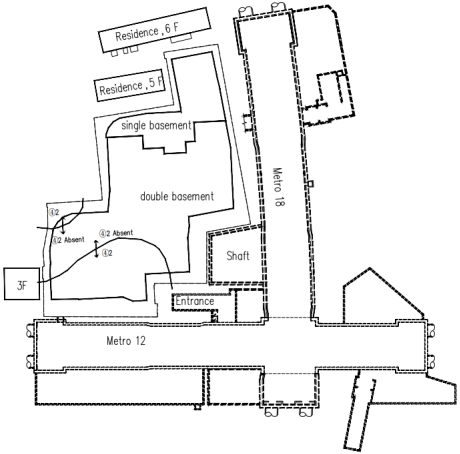
The foundation pit is surrounded by an extremely complex environment. Metro Line 18 runs beneath Jiangpu Road to the east of the pit, and Metro Line 12 is located below Changyang Road to the south. To the west stands the 3-story teaching building of Changyang Experimental School, with a minimum distance of about 4.1 m from the pit. To the north lie 5–6-story residential buildings in Lane 989 Jiangpu Road, with a closest distance of approximately 5.5 m to the pit.
Figure 1. Schematic diagram of the foundation pit surrounding environment.
The main structure of Metro Line 18 is a three-basement structure, with a top burial depth of about 3.2 m and a bottom burial depth of roughly 23.2 m. The auxiliary ventilation shaft has a top burial depth of about 3.2 m and a bottom burial depth of approximately 16.1 m. The foundation pit is about 10.0 m away from the main structure and ventilation shaft of Metro Line 18.
The main structure of Metro Line 12 is a two-basement structure, with a top burial depth of about 4.0 m and a bottom burial depth of roughly 17.3 m. The auxiliary entrance has a top burial depth of about 4.0 m and a bottom burial depth of approximately 9.5 m. The foundation pit is about 9.8 m away from the main structure and entrances of Metro Line 12.
According to the Pre-construction Damage Trend Detection of Commodity Residential Project at Plot 02-07, Unit C090202, Yangpu District (Shanghai Housing Appraisal (013) Certificate No. 2025-015) prepared by Shanghai Geotechnical Investigations & Design Institute Co., Ltd., the teaching building on the west and the residential buildings on the north of the foundation pit adopt shallow foundations on natural ground, featuring poor deformation resistance, and the buildings have suffered varying degrees of inclination and settlement.
Therefore, reasonable and reliable support measures must be taken in the design and construction of the foundation pit to protect the adjacent rail transit structures, teaching building and residential buildings, and strictly control the additional deformation caused by foundation pit construction.
2.2. Engineering Geological Conditions
According to the geotechnical engineering investigation report, the project site belongs to a coastal plain landform. From top to bottom, the site consists of Layer ② clay, Layer ③ silty muddy clay, Layer ④ muddy clay, Layer ④₂ silty sand (locally distributed), Layer ⑤₁ silty clay, Layer ⑤₃ silty clay, Layer ⑤₄ silty clay, and Layer ⑦ silty sand.
Phreatic water, micro-confined water in Layer ④₂, and confined water in Layer ⑦ are distributed within the site. The buried depth of the confined aquifer in Layer ⑦ exceeds 2.5 times the excavation depth of the foundation pit, so there is no risk of confined water inrush during foundation pit excavation. The top burial depth of the micro-confined aquifer in Layer ④₂ is about 19.37 m, and the critical excavation depth for the foundation pit to resist confined water is 8.5 m. The excavation depth of the two-basement foundation pit in this project is 10.25 m, and the excavation depth of local water collecting wells reaches 12.65 m, both exceeding the critical excavation depth. Accordingly, measures must be taken to lower the micro-confined water head inside the pit to prevent foundation pit inrush and control the impacts of confined water drawdown on the surrounding environment.
Table 1. Physical and mechanical properties of soil layers.
Layer No. | Soil name | Unit Weight/ (kN·m⁻³) | Cohesion/kPa | Internal Friction Angle / (°) |
② | Clay | 18.7 | 21 | 16.5 |
③ | Silty muddy clay | 18.0 | 10 | 22.5 |
④ | Muddy clay | 16.7 | 12 | 10.5 |
④₂ | Sandy silt | 18.5 | 5 | 29.5 |
⑤₁ | Silty clay | 18.2 | 16 | 18.5 |
⑤₃ | Silty clay | 18.3 | 17 | 18.0 |
3. Foundation Pit Support Design
3.1. Difficulties in Foundation Pit Support Design
Metro Line 18 is located beneath Jiangpu Road to the east of the foundation pit, and Metro Line 12 runs below Changyang Road to the south. The excavation boundary of the foundation pit is about 9.8–10.0 m away from the main structure and auxiliary structures of the metro. In accordance with the Shanghai engineering construction code Technical Standard for Safety Protection of Urban Rail Transit Structures (DG/TJ 08-2024-2023) and the requirements of the metro supervision department, the foundation pit of this project lies within the rail transit protection area. The environmental protection level of the foundation pit on the metro side is Grade I, the maximum lateral displacement control index of the foundation pit enclosure structure is 1.8‰H (H refers to the foundation pit excavation depth), the deformation of the metro structure shall be controlled within 10 mm, and no water leakage is allowed at the joints of the metro structure. Thus, controlling the additional deformation imposed on surrounding protected objects by foundation pit construction is the primary task in the design and construction of this project.
In addition, the micro-confined aquifer of Layer ④₂ is locally distributed in the site, bringing a risk of micro-confined water inrush during the excavation of the two-basement foundation pit. Controlling the micro-confined water head inside the pit during construction, preventing micro-confined water inrush, and mitigating the impacts of dewatering on the surrounding environment are also key points in the design and construction of this foundation pit project.
3.2. Foundation Pit Support Design Scheme
Given the extremely strict deformation control requirements for the rail transit environment on the east and south sides of the foundation pit and the risk of micro-confined water inrush during the excavation of the two-basement foundation pit, targeted technical measures are adopted in the foundation pit support design for deformation control and micro-confined water control to ensure the smooth implementation of the project.
3.2.1. Overall Scheme of the Foundation Pit
Pursuant to the relevant provisions of the Shanghai engineering construction code Technical Standard for Foundation Pit Engineering (DG/TJ 08-61-2018), the safety level of the one-basement foundation pit is Grade III, and that of the two-basement foundation pit is Grade II. The environmental protection level of the foundation pit on the east, south sides and adjacent to the teaching building and residential buildings is Grade I, while other areas are Grade II.
Combined with the distribution of basement floors, project progress and metro protection, the foundation pit support design adopts the plane division following the principle of “deep first, shallow later”. The two-basement foundation pit is excavated first, and the one-basement foundation pit is excavated after the two-basement zone is completed to the ground floor elevation. Division excavation controls the exposed scope of foundation pit excavation, effectively reduces the time-space effect of excavation unloading, and minimizes the impacts on the metro.
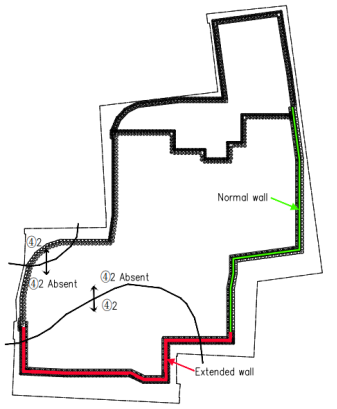
According to the project characteristics, the foundation pit support generally adopts the structural form of plate enclosure + internal bracing. Diaphragm walls are used as the enclosure structure for the two-basement foundation pit on the metro side, and bored piles are adopted for the other sides of the two-basement foundation pit and the one-basement foundation pit. Two reinforced concrete internal braces are set in the two-basement zone, and one reinforced concrete internal brace is arranged in the one-basement zone. Focusing on the research theme of this paper, only the foundation pit support on the metro side of the two-basement foundation pit is introduced in detail.
Figure 2. Layout plan of the foundation pit enclosure structure.
3.2.2. Enclosure Structure Design
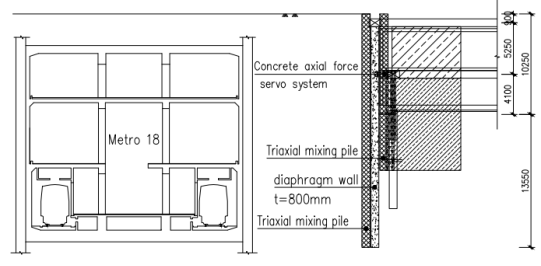
An 800 mm-thick diaphragm wall is designed as the foundation pit enclosure structure on the metro side of the two-basement foundation pit. In line with the stability control requirements of the foundation pit, the depth of the diaphragm wall is 22.5 m.
Triaxial cement-soil mixing piles are installed for trench wall reinforcement on both the inner and outer sides of the diaphragm wall. The pile bottom depth of the outer mixing piles is consistent with that of the diaphragm wall, and the inner mixing piles are the same as the internal pit reinforcement in terms of pile bottom depth. Trench wall reinforcement improves the trench stability during diaphragm wall construction and reduces additional deformation caused by diaphragm wall construction. Before the construction of mixing piles, test piles shall be adopted to verify construction parameters and control the impacts of mixing pile construction on the surrounding environment.
3.2.3. Support System Design
Two reinforced concrete internal braces are arranged in the two-basement zone. To better control the deformation of the enclosure structure and the additional deformation of the metro structure on the adjacent metro side, a concrete axial force servo system is installed on the metro side. The concrete axial force servo system applies graded loading of 500 kN, 1,000 kN, 1,500 kN and 2,000 kN in accordance with the strength development of the concrete. If the deformation of the enclosure structure or metro structure reaches 80% of the alarm value during excavation, continuous loading at 250 kN per stage up to 3,000 kN can be implemented.
Reinforced concrete braces feature high rigidity and favorable deformation control performance. The concrete axial force servo system enables the support system to exert its deformation control capacity as early as possible, and actively controls the deformation of the enclosure structure by applying thrust, thereby reducing the impacts of foundation pit excavation unloading on the metro structure.
3.2.4. Internal Pit Reinforcement Design
To better control the deep horizontal displacement of the enclosure structure during foundation pit excavation, triaxial cement-soil mixing pile skirt reinforcement is adopted, with a reinforcement width of 8 m and a reinforcement depth ranging from the bottom of the first brace to 6 m below the pit bottom. The cement content is 20% below the second brace and 13% above the second brace. Skirt reinforcement improves the mechanical properties of soil in the passive zone and reduces the deformation of the enclosure structure and surrounding protected objects caused by excavation unloading.
3.2.5. Micro-Confined Water Control Design
The micro-confined aquifer of Layer ④₂ is locally distributed on the south side of the foundation pit adjacent to Metro Line 12, leading to a risk of micro-confined water inrush during two-basement excavation. Therefore, pressure relief wells are arranged inside the pit to draw down the micro-confined water and lower the water head so as to prevent foundation pit inrush. The pressure relief wells adopt 273 mm-diameter steel pipe wells with a depth of 27 m, a filter pipe top burial depth of 21 m and a filter pipe length of 5 m.
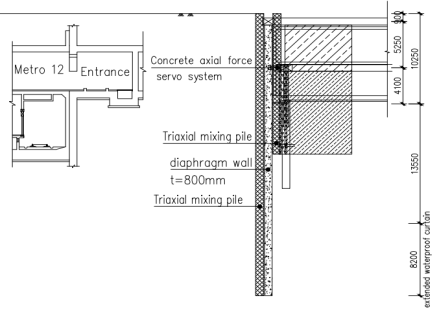
To avoid the drop of the water level outside the pit caused by the drawdown of micro-confined water inside the pit and threats to the safety of surrounding protected objects, extended diaphragm walls and triaxial mixing piles are used to cut off the micro-confined aquifer. According to the geotechnical engineering investigation report, the diaphragm wall in the distribution area of the micro-confined aquifer of Layer ④₂ is extended to 30.7 m, and the triaxial cement-soil mixing piles outside the diaphragm wall are extended synchronously.
Figure 3. Enclosure profile adjacent to Metro Line 18.
Figure 4. Enclosure profile adjacent to Metro Line 12.
4. Analysis of Foundation Pit Project Implementation
4.1. Implementation of the Foundation Pit Project
The construction of engineering piles and enclosure piles of the project commenced on May 7, 2025. The two-basement structure was completed to the ground floor elevation on January 23, 2026, and the earth excavation of the one-basement foundation pit started then. The one-basement structure was finished to the ground floor elevation on March 31, 2026. The construction conditions of the two-basement foundation pit are as follows:
Condition 1: Construction of the foundation pit enclosure structure;
Condition 2: Excavation of the first layer of earth and construction of the first concrete brace;
Condition 3: Excavation of the second layer of earth, construction of the second concrete brace, and installation of the concrete axial force servo system;
Condition 4: Excavation of the third layer of earth to the pit bottom, construction of the cushion and bottom slab;
Condition 5: Sequential removal of concrete braces and synchronous construction of the basement structure.
During the construction of the foundation pit project, the construction unit entrusted a testing institution to conduct full-process monitoring of the foundation pit enclosure structure and surrounding environment, and carried out real-time supervision of the metro structure, guiding the construction arrangement based on monitoring results. The monitoring and metro supervision results show that the additional deformation caused by foundation pit construction to the main structure and auxiliary facilities of the metro, residential buildings and teaching building all meet the deformation control requirements, and the deformation of all protected objects is safe and controllable.
4.2. Analysis of Monitoring Results
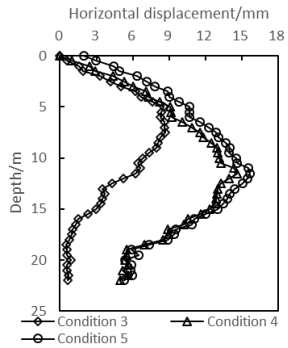
Figure 5. Deep horizontal displacement of the east enclosure structure.
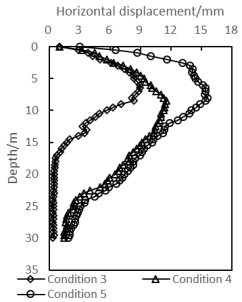
Figure 6. Deep horizontal displacement of the south enclosure structure.
Figure 5 and
Figure 6 present the deep horizontal displacement of the enclosure structure at typical locations adjacent to Metro Line 18 on the east side and Metro Line 12 on the south side of the foundation pit. It can be seen that the maximum horizontal displacement of the enclosure structure on the east side of the foundation pit is about 15.7 mm, and that on the south side is approximately 15.5 mm, both less than 1.8‰H, satisfying the code requirements for enclosure structure deformation. This indicates that measures including adopting high-stiffness diaphragm walls as the foundation pit enclosure structure, applying the concrete axial force servo system for the second brace, and setting passive zone soil reinforcement can effectively control the deformation of the foundation pit enclosure structure and reduce the impacts of foundation pit construction on the surrounding environment.
By comparing the deep horizontal displacement of the enclosure structure under Condition 3 and Condition 4, it is found that with the increase of foundation pit excavation depth, the deep horizontal displacement of the enclosure structure increases gradually, the buried depth of the maximum displacement point deepens progressively, and the horizontal displacement near the pit bottom is the largest, which is consistent with the development law of deep horizontal displacement of foundation pit enclosure structures in Shanghai. However, the deformation of the enclosure structure above the second brace does not change significantly with the increase of excavation depth, which is mainly attributed to the application of the concrete axial force servo system for the second brace that effectively controls the horizontal deformation of the foundation pit at this position.
By comparing the deep horizontal displacement of the enclosure structure under Condition 4 and Condition 5, it is revealed that during the period of bottom slab pouring, internal brace removal and basement back-construction, the horizontal displacement of the enclosure structure increases slightly, especially the part below the pit bottom. This is because the bottom slab poured to the edge of the enclosure pile can well restrict the deformation of the enclosure structure.
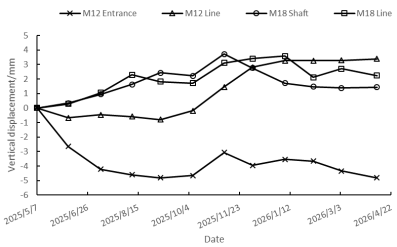
The metro monitoring results show that during the construction of the foundation pit project, the deformation of adjacent metro main structures and their auxiliary facilities is less than 5 mm, meeting the metro deformation control requirements.
Figure 7 shows the settlement time-history curve at the position with the maximum cumulative metro deformation. It can be seen that the entrance of Metro Line 12 experienced large settlement during enclosure pile construction and small deformation during foundation pit excavation; the track of Metro Line 12 settled slightly during enclosure structure construction and rose significantly during excavation; the track and ventilation shaft of Metro Line 18 showed uplift during both enclosure structure construction and excavation. After the completion of foundation pit back-construction, the deformation of adjacent metro structures and their auxiliary facilities tended to be stable. The maximum displacement of the metro structures is 4.8mm, which complies the deformation control standards.
Figure 7. Settlement time-history curve of surrounding metro structures.
5. Conclusions
Taking a residential deep foundation pit project in Shanghai as an example, this paper introduces the key points of enclosure design for deep foundation pits adjacent to subways in soft soil areas. Following the principle of division sequential construction (deep first, shallow later), targeted technical measures such as high-stiffness diaphragm walls, concrete axial force servo system, passive zone skirt reinforcement, triaxial cement-soil mixing pile trench wall reinforcement, and extended diaphragm walls to cut off the micro-confined aquifer are adopted to control the additional deformation of adjacent metro structures caused by foundation pit construction.
Based on the project implementation, foundation pit monitoring and metro supervision results, the technical measures adopted in the foundation pit support design have effectively controlled the impacts of foundation pit excavation unloading on the surrounding environment and ensured the safety and normal operation of metro structures.
Acknowledgments
Zhirong Liang, Xiang Wei and Jun Zhao are acknowledged for their support of this work.
Author Contributions
Jingde Liu: Writing – original draft
Funding
This work is sponsored by Shanghai Rising-Star Program (B type) (NO. 20QB1404500) and Research Project of Arcplus Group (NO. 24-1-0113-Di).
Data Availability Statement
The data is available from the corresponding author upon reasonable request.
Conflicts of Interest
The authors declare no conflicts of interest.
References
| [1] |
Li, C. W., Li, W., Liang, Z. R.. Design and Analysis on Synchronous Constructions of Deep Foundation Pit on Both Sides of Tunnels in Soft Soils. Chinese Journal of Underground Space and Engineering. 2018, 14(S1), 193-199.
https://doi.org/10.20174/j.juse.2018.s1.029
|
| [2] |
Liang, P. J.. Application and Analysis of Deformation Control Technology for Deep Foundation Pits in Complex Environments in Suzhou Area. Architecture Technology. 2026, 57(6), 656-660.
https://doi.org/10.13731/j.jzjs.2026.06.0656
|
| [3] |
Xu, Z. H., Zong, L. D., Shen, J., et al. Deformation of a Deep Excavation Adjacent to Metro Tunnels in Soft Soils. Chinese Journal of Geotechnical Engineering. 2019, 41(S1), 41-44.
https://doi.org/10.11779/CJGE2019S1011
|
| [4] |
Chen, J. H.. Design, Research and Practice of Ultra-deep five-basement Station Foundation Pit in Soft Soil and Water-rich Complex Environment. Chinese Journal of Geotechnical Engineering. 2025, 47(S2), 187-192.
https://doi.org/10.11779/CJGE2025S20034
|
| [5] |
Xiong, H. W., Wang, Z., Shi, W. T., et al. Influence and Control of Foundation Pit Construction on Subway Tunnel Deformation. Building Structure. 2023, 53(S2), 2505-2515.
https://doi.org/10.19701/j.jzjg.23S2584
|
| [6] |
Gu, X. W., Yi, Z. H., Wang, Z., et al. Influences of Excavation of Deep Foundation Pits on Deformation of Adjacent Double-line Subway Tunnels through Measurement Analysis. Chinese Journal of Geotechnical Engineering. 2023, 45(S2), 214-219.
https://doi.org/10.11779/CJGE2023S20030
|
| [7] |
Zhao, Y. H., Zhen, J., Li, Q. H., et al. Analysis of Influence of Ultra-deep Foundation Pit on Existing Subway Deformation in Soft Soil Areas. Chinese Journal of Geotechnical Engineering. 2025, 47(S2), 205-211.
https://doi.org/10.11779/CJGE2025S20025
|
| [8] |
Chen, J. J., Wang, J. H., Du, Y., et al. Displacement Characteristics of Shallow Buried Operating Tunnels Under the Influence of Bilateral Deep Foundation Pit Excavation. Chinese Journal of Underground Space and Engineering. 2011, 7(6), 1163-1167+1173.
https://doi.org/10.3969/j.issn.1673-0836.2011.06.021
|
| [9] |
Liu, W. Q., Liu, Y., Liu, Y., et al. Influences of Proximity Excavation of Bilateral Foundation Pits with Common Diaphragm Walls on Displacement Deformation of Subway Stations. Journal of University of Jinan (Science and Technology). 2025, 39(4), 602-608
https://doi.org/10.13349/j.cnki.jdxbn.20240625.001
|
| [10] |
Li, G. M., Du, Z. T., Li, H. Construction Control Technology for Overpassing Existing Tunnels in Foundation Pit Works of Underground Connecting Passage. China Railway. 2024, 1, 75-82
https://doi.org/10.19549/j.issn.1001-683x.2023.09.20.004
|
| [11] |
Han, Y. F., Xu, Q. W., Huang, T., et al. Impact Numerical Simulation of Steel Sheet Pile Foundation Pit Excavation on Underlying Metro Tunnels. Urban Mass Transit. 2025, 28(7), 37-43
https://doi.org/10.16037/j.1007-869x.20245958
|
| [12] |
Hu, W., Gu, X. W., Liu, Y., et al. Field Study on the Effect of Excavation of Strip-shaped Foundation Pit on Existing Underlying Subway Tunnels in Soft Soil. Building Structure. 2023, 53(S1), 2815-2822
https://doi.org/10.19701/j.jzjg.23S1718
|
| [13] |
Wu, L. L., Wang, W., Zhong, Y., et al. Measurement and Analysis of the Influence of Deep Foundation Pit Excavation in Soft Soil Areas on the Underlying Subway Tunnel. Journal of Guilin University of Technology. 2023, 43(3), 436-431
https://doi.org/10.3969/j.issn.1674-9057.2023.03.010
|
| [14] |
Zou, C. R., Fu, P., Xiang, J. T., et al. Influence of Deep Foundation Pit Construction on Deformation of Subway Station and Control Effect of Isolation Pile. Building Structure. 2023, 53(S1), 2809-2814
https://doi.org/10.19701/j.jzjg.23S1359
|
| [15] |
Deng, X., Zhen, J., Lin, S. B., et al. Loading Control for the Uplift of Subway Structures Induced by Adjacent Excavation. Journal of Railway Science and Engineering. 2024, 21(6), 2417-2429
https://doi.org/10.19713/j.cnki.43-1423/u.T20231472
|
| [16] |
Shi, W., Zheng, J. G., Cao, J. Y., et al. Microdeformation Control Method of a Loess Foundation Pit Closely Crossing Above a Metro Tunnel [J] . Tunnel Construction, 2025, 45(2): 361-374.
https://doi.org/10.3973/j.issn.2096-4498.2025.02.012
|
| [17] |
Wang, W. D.. Analytical Methods and Controlling Techniques for Deformation and Environmental Influence of Deep Excavations in Soft Soils. Chinese Journal of Geotechnical Engineering. 2024, 46(1), 1-25.
https://doi.org/10.11779/CJGE20231146
|
Cite This Article
-
APA Style
Liu, J. (2026). Application of Deformation Control Technology for Deep Foundation Pits Adjacent to Subways in Soft Soil Areas. American Journal of Civil Engineering, 14(4), 273-281. https://doi.org/10.11648/j.ajce.20261404.15
 Copy
|
Copy
|
 Download
ACS Style
Liu, J. Application of Deformation Control Technology for Deep Foundation Pits Adjacent to Subways in Soft Soil Areas. Am. J. Civ. Eng. 2026, 14(4), 273-281. doi: 10.11648/j.ajce.20261404.15
Copy
|
Download
AMA Style
Liu J. Application of Deformation Control Technology for Deep Foundation Pits Adjacent to Subways in Soft Soil Areas. Am J Civ Eng. 2026;14(4):273-281. doi: 10.11648/j.ajce.20261404.15
Copy
|
Download
-
@article{10.11648/j.ajce.20261404.15,
  author = {Jingde Liu},
  title = {Application of Deformation Control Technology for Deep Foundation Pits Adjacent to Subways in Soft Soil Areas},
  journal = {American Journal of Civil Engineering},
  volume = {14},
  number = {4},
  pages = {273-281},
  doi = {10.11648/j.ajce.20261404.15},
  url = {https://doi.org/10.11648/j.ajce.20261404.15},
  eprint = {https://article.sciencepublishinggroup.com/pdf/10.11648.j.ajce.20261404.15},
  abstract = {Unloading caused by the excavation of foundation pit will lead to the deformation of the surrounding strata and the adjacent metro structures. Excessive structural deformation will threaten the normal metro operation and even the safety of the subway, so effective deformation control measures are indispensable. This study takes a deep excavation project neighboring two operating metro lines in Shanghai as an example and the deformation control techniques of foundation pit excavation are introduced. Overall, the plane division excavation is adopted to reduce the exposed length and the time-space effect of the foundation pit. In order to effectively control the deformation of the enclosure structure adjacent to the subway, the high-stiffness diaphragm walls are utilized as the retaining structure along the metro sides and the concrete axial force servo system is adopted for the second strut to achieve active deformation control. Meanwhile, triaxial cement-soil mixing pile reinforcement is arranged inside the pit to enhance the resistance of the passive soil zone. Furthermore, some of the diaphragm walls deepen as penetrating curtain to control the adverse environmental impacts of dewatering of micro-confined aquifer. The deformation of diaphragm walls and the metro structures is monitored and analyzed. The result shows that the maximum displacements of the diaphragm walls and the metro structures are 15.7mm and 4.8mm, respectively, both complying with the relevant deformation control standards and verifying the effectiveness of the proposed deformation control methods.},
 year = {2026}
}
Copy
|
Download
-
TY  - JOUR
T1  - Application of Deformation Control Technology for Deep Foundation Pits Adjacent to Subways in Soft Soil Areas
AU  - Jingde Liu
Y1  - 2026/08/06
PY  - 2026
N1  - https://doi.org/10.11648/j.ajce.20261404.15
DO  - 10.11648/j.ajce.20261404.15
T2  - American Journal of Civil Engineering
JF  - American Journal of Civil Engineering
JO  - American Journal of Civil Engineering
SP  - 273
EP  - 281
PB  - Science Publishing Group
SN  - 2330-8737
UR  - https://doi.org/10.11648/j.ajce.20261404.15
AB  - Unloading caused by the excavation of foundation pit will lead to the deformation of the surrounding strata and the adjacent metro structures. Excessive structural deformation will threaten the normal metro operation and even the safety of the subway, so effective deformation control measures are indispensable. This study takes a deep excavation project neighboring two operating metro lines in Shanghai as an example and the deformation control techniques of foundation pit excavation are introduced. Overall, the plane division excavation is adopted to reduce the exposed length and the time-space effect of the foundation pit. In order to effectively control the deformation of the enclosure structure adjacent to the subway, the high-stiffness diaphragm walls are utilized as the retaining structure along the metro sides and the concrete axial force servo system is adopted for the second strut to achieve active deformation control. Meanwhile, triaxial cement-soil mixing pile reinforcement is arranged inside the pit to enhance the resistance of the passive soil zone. Furthermore, some of the diaphragm walls deepen as penetrating curtain to control the adverse environmental impacts of dewatering of micro-confined aquifer. The deformation of diaphragm walls and the metro structures is monitored and analyzed. The result shows that the maximum displacements of the diaphragm walls and the metro structures are 15.7mm and 4.8mm, respectively, both complying with the relevant deformation control standards and verifying the effectiveness of the proposed deformation control methods.
VL  - 14
IS  - 4
ER  -
Copy
|
Download




 Share This Article
 Twitter
 Linked In
 Facebook