
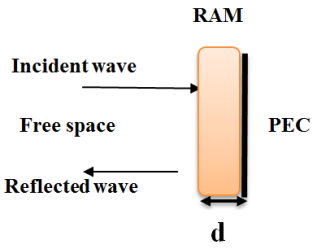
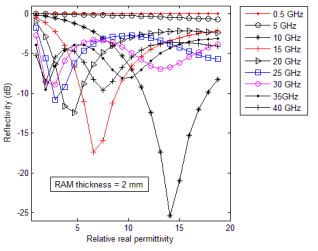
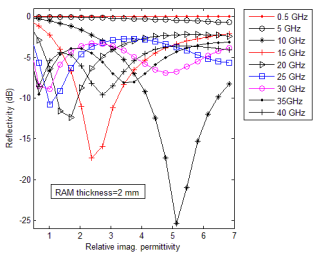
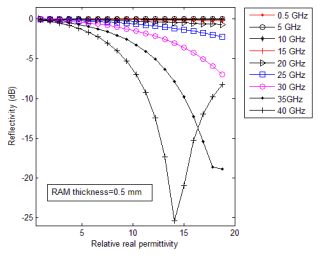
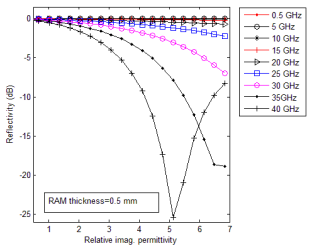
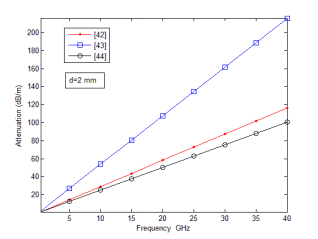
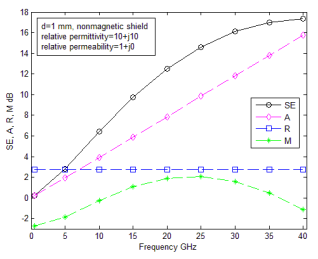
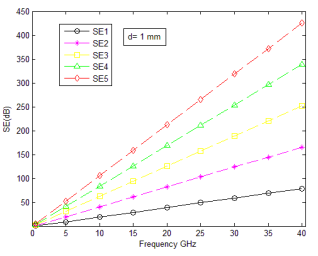
The goal of this work is to examine radar absorbing material (RAM); which -in the simplest case- is composed of a single metal-packed coating layer, reflectivity (R) through a frequency (f) range from 0.5 GHz to 40 GHz; this range covers applications of long-range radar, missile detection, surface target tracking, and airborne precision ground radars. Variation of nonmagnetic, homogeneous, and non-dispersive RAM R is reformed to facilitate calculations. Effect of dielectric parameters; permittivity and permeability (ϵ and μ) on R for one layer-metal-packed RAM with two different thicknesses (they influence the electromagnetic wave absorption due to attenuation and matching models) are given. Electromagnetic interference shielding effectiveness (EMISE) which characterises the behaviour of a material depends on material conductivity (σ), relative permittivity (ϵ_r) and relative permeability (μ_r). reflection loss (R), absorption loss (A), and internal loss (M) for one and two layers located between two semi-infinite free space media are derived. Attenuation (α) variations with f, ϵ, μ, and layer thickness for single and double layers are examined. Results indicate that most waves are reflected from inside interfaces of RAM also high conductivity, high permeability, and increasing thickness are necessary to configure good absorbent. Calculations and graphs are carried on using MATLAB R2013a.
| Published in | American Journal of Electromagnetics and Applications (Volume 14, Issue 1) |
| DOI | 10.11648/j.ajea.20261401.12 |
| Page(s) | 17-23 |
| Creative Commons |
This is an Open Access article, distributed under the terms of the Creative Commons Attribution 4.0 International License (http://creativecommons.org/licenses/by/4.0/), which permits unrestricted use, distribution and reproduction in any medium or format, provided the original work is properly cited. |
| Copyright |
Copyright © The Author(s), 2026. Published by Science Publishing Group |
Radar Absorbing Material, Electromagnetic Shield, Attenuation, Loss
RAM | Radar Absorbing Material |
R | Reflectivity |
f | Frequency |
EMISE | Electromagnetic Interference Shielding Effectiveness |
R | Reflection Loss |
A | Absorption Loss |
M | Internal Loss |
α | Attenuation |
RCS | Radar Cross Section |
PEC | Perfect Electric Conductor |
δₑ | Electric Loss Angle |
| [1] | E. F. Knott, J. E. Shaeffer, and M. T. Tuley, Radar Cross Section, 2nd edition, Chapter 7, Scitech, 2004. |
| [2] | David C. Jenn, Radar and Laser Cross Section Engineering, AIAA, 1995. |
| [3] | R. C. Parida, D. Singh and N. K Agarwal, Implementation of multilayer ferrite radar absorbing coating with genetic algorithm for radar cross-section reduction at X-band 2007 Indian Journal of Radio & Space Physics 36 145-152. |
| [4] | Paul Saville, Review of Radar Absorbing Materials, Defence Research and Development Canada, Defence R&D Canada - Atlantic DEFENCE Technical Memorandum, DRDC Atlantic TM 2005-003, Report 3, January, 2005. |
| [5] | Bluma Guenther Soares, Guilherme M. O. Barra, and Tamara Indrusiak, Conducting Polymeric Composites Based on Intrinsically Conducting Polymers as Electromagnetic Interference Shielding/Microwave Absorbing Materials—A Review. J. Compos. Sci. 2021, 5, 173. |
| [6] | IEEE Standard Dictionary of Electrical and Electronics Terms, 3rd ed., ANSI/IEEE standard 100-1984. |
| [7] | Joseph P. Camacho, Federal Radar Spectrum Requirements, NTIA Special Publication 00-40, U. S. DEPARTMENT OF COMMERCE, May 2000. |
| [8] |
John R. Hoehn, Jill C. Gallagher, and Kelley M. Sayler, Overview of Department of Defense Use of the Electromagnetic Spectrum, Congressional Research Service,
https://crsreports.congress.gov R46564, August 10, 2021. |
| [9] | NATO, Radar Spectrum Engineering and Management, STO TECHNICAL REPORT, TR-SET-182, Final Report of Task Group SET-182, April 2016. |
| [10] | John A. Stine and David L. Portigal, An Introduction to Spectrum Management, MTR 04W0000048, MITRE TECHNICAL REPORT, Spectrum 101, MITRE, March 2004. |
| [11] | Laird Technologies, Microwave Absorbing Materials, ABSORB-CAT-2006, |
| [12] | J. R. Wait, Electromagnetic wavea in stratified media, 2nd Ed. Oxford. Pergamon, Chapter 2, 1970. |
| [13] | Perhi J and Cohen L S, Design of broad-band radar absorbing materials for large angles of incidence, IEEE Transactions on Electromagnetic Compatibility 35 223-230, 1993. |
| [14] | D. M. Pozar, Microwave Engineering. Hoboken, NJ, USA: Wiley, 2012. |
| [15] | Z. Zhang, Z. Wang, L. Wang, Design principle of single- or double-layer wave-absorbers containing left-handed materials, Vol. 30; Iss. 9, Materials & Design, 2009. |
| [16] | Jussi Säily and Antti V. Räisänen, STUDIES ON SPECULAR AND NON-SPECULAR REFLECTIVITIES OF RADAR ABSORBING MATERIALS (RAM) AT SUBMILLIMETRE WAVELENGTHS, Helsinki University of Technology Radio Laboratory Publications, Teknillisen korkeakoulun Radiolaboratorion julkaisuja, Espoo, February, 2003 REPORT S 258. |
| [17] | K. Gaylor, RADAR ABSORBING MATERIALS - MECHANMS AND MATERIALS, MRL Technical Report, MRL-TR-89-1, AR No. 005-686, DSTO Materials Research Laborstory, Commonwealth of Australia 1989. |
| [18] | S. A. Schelkunoff, Electromagnetic Waves, Van Nostrand, New York, 1945. |
| [19] | A. D. S. Gomes, New Polymers for Special Applications, 2012. |
| [20] | Huo J, Wang L and Yu H. Polymeric nanocomposites for electromagnetic wave absorption. J Mater Sci 2009; 44: 3917-3927. |
| [21] | Shan, L.; Chen, X.; Tian, X.; Chen, J.; Zhou, Z.; Jiang, M.; Xu, X.; Hui, D. Fabrication of polypyrrole/nano-exfoliated graphite composites by in situ intercalation polymerization and their microwave absorption properties. Compos. Part B Eng., 73, 181-187, 2015. |
| [22] | H. Wang, D. Zhu, W. Zhou, and F. Luo, Temperature dependence of the electromagnetic and microwave absorption properties of polyimide/Ti3SiC2 composites in the X band, RSC Advances 2015, Issue 105, Page 85983 to 86848. |
| [23] | Chung, D. D. L. Materials for electromagnetic interference shielding. Volume 255, 15 November 2020, 123587, Elsevier. |
| [24] | J. A. STRATTON, ELECTROMAGNETIC THEORY, JOHN WILEY, Hoboken, New Jersey, 2007. |
| [25] |
Parker Hannifin, Conductive Elastomer Engineering Handbook Products and Customer Solutions, Parker Chomerics.
https://www.parker.com › Literature › Chomerics. |
| [26] | M. Sadiku, Elements of Electromagnetics, Ch. 10, 5th Edition, OXFORD UNIVERSITY PRESS, 2011. |
| [27] | Jiang D., Murugadoss V., Wang, Y., Lin J., Ding, T., Wang Z., Shao Q. Wang C., Liu H., Lu N. et al, Electromagnetic Interference Shielding Polymers and Nanocomposites—A Review. Polym. Rev. 2019, 59, 280-337. |
| [28] | A. P. Singh, A. Kumar, A. Chandra, and S. K. Dhawan1, Conduction mechanism in Polyaniline-flyash composite material for shielding against electromagnetic radiation in X-band & Ku band, AIP ADVANCES 1, 022147 2011. |
| [29] | Munir, A. Microwave Radar Absorbing Properties of Multiwalled Carbon Nanotubes Polymer Composites: A Review. Adv. Polym. Technol. 2017, 36, 362-370. |
| [30] | H. W. Ott, Noise Reduction Techniques in Electronic systems, Wiley, New York, 1987. |
| [31] | Maosheng Caoa, c,*, 1, Ruru Qinb, Chengjun Qiuc, Jing Zhua, Matching design and mismatching analysis towards radar absorbing coatings based on conducting plate, Materials and Design 24 (2003) 391-396, ELSEVIER. |
| [32] | A. Zamanian and C. Hardiman, Electromagnetic Radiation and Human Health: A Review of Sources and Effects, High Frequency Design, EMR & HUMAN HEALTH, July 2005 High Frequency Electronics, Summit Technical Media. |
| [33] | J. F. B. Bolte and M. J. M. Pruppers, Electromagnetic fields in the working environment, Ministry of Social Affairs and Employment (SZW) report, RIVM no. 610015001, June 2006. |
| [34] | I. Eliyahu, R. Luria, R. Hareuveny, M. Margaliot, N. Meiran, 2 and G. Shani, Effects of Radiofrequency Radiation Emitted By CellularTelephones on the Cognitive Functions of Humans, Bioelectromagnetics 27: 119-126 (2006). |
| [35] | World Health Organization, ESTABLISHING A DIALOGUE ON RISKS FROM ELECTROMAGNETIC FIELDS RADIATION AND ENVIRONMENTAL HEALTH, DEPARTMENT OF PROTECTION OF THE HUMAN ENVIRONMENT, W. H. O. GENEVA, SWITZERLAND, 2002, ISBN 92 4 154571 2. |
| [36] | J. C. Lin, Human Exposure to RF, Microwave, and Millimeter-Wave Electromagnetic Radiation, IEEE Microwave Magazine, June 2016. |
| [37] | W. Wiatr, R. Frender, and M. Żebrowski, CHARACTERIZATION OF MICROWAVE ABSORBING MATERIALS USING A WIDEBAND T/R MEASUREMENT TECHNIQUE, MIKON 2008 - 17th International Conference on Microwaves, Radar and Wireless Communications. |
| [38] | L. Sun, H. Cheng, Y. Zhou, and Jun Wang, Design of a Lightweight Magnetic Radar Absorber Embedded with Resistive FSS, IEEE ANTENNAS AND WIRELESS PROPAGATION LETTERS, VOL. 11, 2012. |
| [39] | D. J. Panagopoulos and L. H. Margaritis, The effect of exposure duration on the biological activity of mobile telephony radiation, Volume 699, Issues 1-2, 17 June 2010, Pages 17-22, Elsevier. |
| [40] | Yuzcelik, Cihangir Kemal, Radar absorbing material design, Monterey, California. Naval Postgraduate School, Downloaded from NPS Archive: Calhoun, |
| [41] | R. G. Geyer, Dielectric Characterization and Reference Materials, NIST Technical Note 1338. |
| [42] | ] P. Zhou, L. Huang, J. Xie, D. Liang, H. Lu, and L. Deng, A Study on the Effective Permittivity of Carbon/PI Honeycomb Composites for Radar Absorbing Design, IEEE TRANSACTIONS ON ANTENNAS AND PROPAGATION, VOL. 60, NO. 8, AUGUST 2012. |
| [43] | D. Vladimirov. E. Khandogina, L. Gazian, V. Larin, AMORPHOUS MICROWIRE - UNIQUE MATERIAL FOR MODERN MICROWAVE ABSORBERS, International Conference on Antenna Theory and Techniques, 9-12 September, 2003, Sevastopol, Ukraine pp. 682-683. |
| [44] | K. Chao, Y. Liu, and R. Yang, Application of The Microgenetic Algorithm to The Optimization of Multilayered ZnO Whisker Radar Absorbing Coating, 7th International Symposium on Antennas, Propagation & EM Theory, Guilin, China, 26-29 Oct. 2006. |
| [45] | N. Vohra and M. El-Shenawee, K- and W-Band Free-Space Characterizations of Highly Conductive Radar Absorbing Materials, IEEE TRANSACTIONS ON INSTRUMENTATION AND MEASUREMENT, VOL. 70, 2021. |
| [46] | A. Toktas, D. Ustun, and M. Tekbas, Multi-Objective Design of Multi-Layer Radar Absorber Using Surrogate-Based Optimization, IEEE TRANSACTIONS ON MICROWAVE THEORY AND TECHNIQUES, VOL. 67, NO. 8, AUGUST 2019. |
| [47] | Y. Zhao, J. Liu, Z. Song, and X. Xi, Novel Closed-Form Expressions for Effective Electromagnetic Parameters of Honeycomb Radar-Absorbing Structure, IEEE TRANSACTIONS ON ANTENNAS AND PROPAGATION, VOL. 64, NO. 5, MAY 2016. |
| [48] | Q. Yu, Y. Zeng, and G. Ma, A radar-infrared compatible broadband absorbing surface, Design and analysis, Chin. Phys. B Vol. 30, No. 7 (2021) 078402. |
| [49] | R. Kaur and G. D. Aul, Review on Microwave Absorbing Material using Different Carbon Composites, International Journal of Engineering Research & Technology (IJERT), ISSN: 2278-0181, Vol. 3 Issue 5, May 2014. |
APA Style
Sallam, T. A., Sallam, A. R. M. (2026). On the Radar Absorbing Material Reflectivity and Electromagnetic Interference Shielding Effectiveness. American Journal of Electromagnetics and Applications, 14(1), 17-23. https://doi.org/10.11648/j.ajea.20261401.12
ACS Style
Sallam, T. A.; Sallam, A. R. M. On the Radar Absorbing Material Reflectivity and Electromagnetic Interference Shielding Effectiveness. Am. J. Electromagn. Appl. 2026, 14(1), 17-23. doi: 10.11648/j.ajea.20261401.12
@article{10.11648/j.ajea.20261401.12,
  author = {Tarek Abdulrahman Sallam and Abdel Rahman Mohammad Sallam},
  title = {On the Radar Absorbing Material Reflectivity and Electromagnetic Interference Shielding Effectiveness},
  journal = {American Journal of Electromagnetics and Applications},
  volume = {14},
  number = {1},
  pages = {17-23},
  doi = {10.11648/j.ajea.20261401.12},
  url = {https://doi.org/10.11648/j.ajea.20261401.12},
  eprint = {https://article.sciencepublishinggroup.com/pdf/10.11648.j.ajea.20261401.12},
  abstract = {The goal of this work is to examine radar absorbing material (RAM); which -in the simplest case- is composed of a single metal-packed coating layer, reflectivity (R) through a frequency (f) range from 0.5 GHz to 40 GHz; this range covers applications of long-range radar, missile detection, surface target tracking, and airborne precision ground radars. Variation of nonmagnetic, homogeneous, and non-dispersive RAM R is reformed to facilitate calculations. Effect of dielectric parameters; permittivity and permeability (ϵ and μ) on R for one layer-metal-packed RAM with two different thicknesses (they influence the electromagnetic wave absorption due to attenuation and matching models) are given. Electromagnetic interference shielding effectiveness (EMISE) which characterises the behaviour of a material depends on material conductivity (σ), relative permittivity (ϵ_r) and relative permeability (μ_r). reflection loss (R), absorption loss (A), and internal loss (M) for one and two layers located between two semi-infinite free space media are derived. Attenuation (α) variations with f, ϵ, μ, and layer thickness for single and double layers are examined. Results indicate that most waves are reflected from inside interfaces of RAM also high conductivity, high permeability, and increasing thickness are necessary to configure good absorbent. Calculations and graphs are carried on using MATLAB R2013a.},
 year = {2026}
}
TY  - JOUR
T1  - On the Radar Absorbing Material Reflectivity and Electromagnetic Interference Shielding Effectiveness
AU  - Tarek Abdulrahman Sallam
AU  - Abdel Rahman Mohammad Sallam
Y1  - 2026/11/11
PY  - 2026
N1  - https://doi.org/10.11648/j.ajea.20261401.12
DO  - 10.11648/j.ajea.20261401.12
T2  - American Journal of Electromagnetics and Applications
JF  - American Journal of Electromagnetics and Applications
JO  - American Journal of Electromagnetics and Applications
SP  - 17
EP  - 23
PB  - Science Publishing Group
SN  - 2376-5984
UR  - https://doi.org/10.11648/j.ajea.20261401.12
AB  - The goal of this work is to examine radar absorbing material (RAM); which -in the simplest case- is composed of a single metal-packed coating layer, reflectivity (R) through a frequency (f) range from 0.5 GHz to 40 GHz; this range covers applications of long-range radar, missile detection, surface target tracking, and airborne precision ground radars. Variation of nonmagnetic, homogeneous, and non-dispersive RAM R is reformed to facilitate calculations. Effect of dielectric parameters; permittivity and permeability (ϵ and μ) on R for one layer-metal-packed RAM with two different thicknesses (they influence the electromagnetic wave absorption due to attenuation and matching models) are given. Electromagnetic interference shielding effectiveness (EMISE) which characterises the behaviour of a material depends on material conductivity (σ), relative permittivity (ϵ_r) and relative permeability (μ_r). reflection loss (R), absorption loss (A), and internal loss (M) for one and two layers located between two semi-infinite free space media are derived. Attenuation (α) variations with f, ϵ, μ, and layer thickness for single and double layers are examined. Results indicate that most waves are reflected from inside interfaces of RAM also high conductivity, high permeability, and increasing thickness are necessary to configure good absorbent. Calculations and graphs are carried on using MATLAB R2013a.
VL  - 14
IS  - 1
ER  -
School of Computer Science and Technology, Shandong Xiehe University, Jinan, China;Faculty of Engineering at Shoubra, Benha University, Cairo, Egypt
Microwave Lab., National Institute of Standards (NIS), Giza, Egypt

Information



 Share This Article
 Twitter
 Linked In
 Facebook

 Copy
 Download