Abstract
Artificial Intelligence (AI) and Machine Learning (ML) are changing Library and Information Science (LIS) by impacting on user services, cataloguing, and information retrieval; however, the literature on how this is happening has not been systematically catalogued. To fill this gap, this study was conducted using a bibliometric analysis of the papers pertaining to AI, ML and LIS published from 2015 to 2024. The aim of the study is to analyse the growth of publication, citation trends, characteristics of authors, keyword co-occurrence networks, and international collaboration in this field to discover the intellectual structures and future trends of the field. A total of 2180 documents from 436 sources were retrieved by applying a structured keyword search strategy, after removing the duplicates and the irrelevant documents, the retrieved documents were analysed with the help of the Bibliometrix package in RStudio and VOSviewer for descriptive bibliometric analysis and network-based bibliometric analysis respectively. Results indicate an increase at an annual rate of 43.16%, with only 2024 reporting 707 publications or 32.43% of the total. The data set contained 7,623 authors, each of whom authored an average of 3.84 co-authors per document, and only 71 documents (3.26%) had a single author, showing a very collaborative research culture. The most common and most cited author keywords were “machine learning” (7,633 citations), “deep learning” (4,182), and “learning systems” (3,272). The document with the most citations garnered 351 citations, with India becoming the top among the contributing countries and the largest node in the international co-authorship networks. From these results, it can be inferred that AI/ML research in LIS is growing rapidly, is collaborative in nature and has a higher focus on machine learning and deep learning applications. Based on the study, the researcher concludes that this bibliometric mapping will be a baseline reference for researchers, librarians and policy makers to understand the evolution of AI and ML in LIS and to identify emerging research areas like generative AI, explainable AI and intelligent digital libraries.
Keywords
Artificial Intelligence, Machine Learning, Library and Information Science, Bibliometric Analysis, Citation Analysis, Knowledge Structure, Research Trends
1. Introduction
Artificial Intelligence has changed 21st-century healthcare, education, business, and information management. LIS is interested in AI because it may enhance information retrieval, automate tedious operations, improve resource management, and personalise user services
| [1] | Adetayo, A. J., Aborisade, M. O., & Sanni, B. A. (2024). Microsoft Copilot and Anthropic Claude AI in education and library service. Library Hi Tech News. Advance online publication. https://doi.org/10.1108/LHTN-01-2024-0002 |
[1]
. Libraries are using AI to boost productivity and user engagement while building digital information resources fast. Libraries must adapt to changing user needs in an era of rapid technological innovation and massive digital information growth
| [14] | Nie, B., Wang, T., Lund, B. D., & Chen, F. (2022). How does AI make libraries smart? A case study of Hangzhou Public Library. In M. Lamba (Ed.), Technological Advancements in Library Service Innovation (pp. 43–58). IGI Global Scientific Publishing. https://doi.org/10.4018/978-1-7998-8942-7.ch003 |
[14]
. Due to the volume and complexity of digital resources, traditional information structure and retrieval approaches fail to fulfill current demands
| [13] | Moonasar, A., Ngoepe, M. (2023). Disruptive changes in the role of academic libraries and librarians: A case study of a university of technology in South Africa. Innovation: Journal of Appropriate Librarianship and Information Work in Southern Africa, 67, 4–31.
https://doi.org/10.10520/ejc-innovation_v2023_n67_a2 |
[13]
. Libraries must provide seamless, efficient, and customised services to diverse user groups to be relevant in a digital age
. Libraries may solve these concerns by automating procedures, optimising resource consumption, and offering creative services using AI. AI-powered recommendation systems, search engines, virtual assistants, and chatbots may enhance user experiences and decision-making
| [14] | Nie, B., Wang, T., Lund, B. D., & Chen, F. (2022). How does AI make libraries smart? A case study of Hangzhou Public Library. In M. Lamba (Ed.), Technological Advancements in Library Service Innovation (pp. 43–58). IGI Global Scientific Publishing. https://doi.org/10.4018/978-1-7998-8942-7.ch003 |
[14]
. AI improves information finding, metadata generation, content classification, and predictive analytics, improving libraries' digital knowledge ecosystem participation
| [5] | Borgohain, D. J., Bhardwaj, R. K., & Verma, M. K. (2022). Mapping the literature on the application of artificial intelligence in libraries (AAIL): A scientometric analysis. Library Hi Tech, 42(1), 149–179.
https://doi.org/10.1108/LHT-07-2022-0331 |
[5]
.
AI in libraries has sparked worldwide research. AI implementation has been investigated in machine learning, intelligent information retrieval, digital library development, automated cataloguing, and user-centred information services
| [7] | Fernandez, P. (2023). “Through the looking glass: Envisioning new library technologies” AI-text generators as explained by ChatGPT. Library Hi Tech News, 40(3), 11–14.
https://doi.org/10.1108/LHTN-02-2023-0017 |
[7]
Thus, AI and LIS scientific literature has developed, requiring extensive evaluation of research output, subject evolution, citation impact and cooperation patterns. Comparing publication trends, citation performance, research subjects and collaboration networks, bibliometric analysis may measure scientific discipline progress
| [19] | Talafidaryani, M., Jalali, S. M. J., & Moro, S. (2023). Tracing the evolution of digitalisation research in business and management fields: Bibliometric analysis, topic modelling and deep learning trend forecasting. Journal of Information Science. Advance online publication.
https://doi.org/10.1177/01655515221148365 |
[19]
. Assessments of important authors, institutions, locations, and research disciplines show a discipline's intellectual structure and future directions.
The research environment for AI in Library and Information Science must be reviewed due to its fast growth. Thus, this study examines 2015–2024 Scopus-indexed AI, ML, and library and information science literature. The study evaluates publication growth, citation patterns, authorship characteristics, important contributors, keyword co-occurrence networks, and international collaborations to identify AI-driven LIS research knowledge structure and trends. Academics, librarians, policymakers, and information workers should learn about the field's past and find new research opportunities.
2. Objectives
1) To examine the annual publication growth and productivity trends of AI and ML research in Library and Information Science indexed in Scopus between 2015 and 2024.
2) To analyse citation patterns and identify the most highly cited documents, authors, and sources within this research domain.
3) To examine authorship and collaboration patterns, including co-authorship intensity and the proportion of single- versus multi-authored publications.
4) To map keyword co-occurrence networks in order to identify the dominant research themes and thematic clusters in AI/ML-related LIS research.
5) To evaluate international collaboration networks and identify the leading countries contributing to, and collaborating within, this research field.
3. Literature Review
Mane (2024), Artificial intelligence is reshaping the library and information science industries by improving operational efficiency, user services, and information retrieval. Natural language processing–based intelligent search engines, automated cataloging with highly developed metadata, and user-tailored recommendation systems are all significant applications. Library patrons' habits and the resources they use may be better understood with the use of AI-powered catboats and big data analytics. Artificial intelligence plays a crucial role in digitization and information preservation via image recognition systems. On the other hand, concerns about algorithmic biases and user data privacy are significant ethical concerns that arise with the incorporation of AI. As libraries progressively use AI technology, it is crucial that they tackle these difficulties in order to fully experience the benefits of AI in terms of enhanced library services and equal access to information. Because of this constant change, those who work in information science and libraries need to be adaptable and keep learning
.
Omame, Isaiah, and Juliet Alex-Nmecha (2020) One of the new developments and uses of computers in libraries is artificial intelligence (AI). It entails teaching computers to do tasks that, when performed by humans, would be considered intellectually demanding. Artificial intelligence (AI) has great potential for libraries, with the end goal of creating computer systems or computers that can think, act, and really compete with human intellect. This obviously has far-reaching consequences for librarianship. Artificial intelligence (AI) is now widely used in library services. There are a lot of examples, such as virtual reality for immersive learning, robots that read books and shelves, and expert systems for reference services. Incorporating AI into libraries may seem like a step away from patrons and librarians alike, but in reality, it will likely expand library services rather than eliminate them. Their service delivery will be improved. Libraries will be more important in today's rapidly evolving digital culture, and AI will make library operations and services much better
| [15] | Omame, I. M., & Alex-Nmecha, J. C. (2020). Artificial intelligence in libraries. In N. E. Osuigwe (Ed.), Managing and adapting library information services for future users (pp. 120–144). IGI Global. https://doi.org/10.4018/978-1-7998-1116-9.ch008 |
[15]
.
Patil (2024) In order to better understand the effects of AI on libraries, this study aims to draw attention to key bibliometric features, research topics, and ideas found in the academic literature. By using a methodical search technique, the necessary data was retrieved from the Scopus database. There were 107 papers produced. To do bibliometric analysis and visualization, the 'biblioshiny' online interface of the 'bibliometrix' package of R-studio was used. All of the bibliometric characteristics, including yearly scientific output, prolific sources, and highly cited papers, were located using the bibliometric approach. Through the use of theme and factorial analysis, the publications' conceptual structure was uncovered. According to the research, 2024 was the most prolific year for articles discussing AI applications in libraries. Emerald Publishing's "Library Hi Tech" magazine had the highest output. Machine learning, artificial intelligence technology, management technology, and generative AI are the four primary topics that emerged from the thematic analysis. Important new lines of inquiry and potential future approaches have emerged from these topics and subthemes. To determine how closely related the author's keywords were to the entire subject, three bibliometric factorial analysis approaches were employed: correspondence analysis, multidimensional scaling analysis, and multiple correspondence analysis
| [17] | Patil, S. B. (2024). Artificial intelligence (AI) and libraries: A review of influential aspects and conceptual structure. In D. C. Kar, S. Khan, A. Durrany, & P. K. Jain (Eds.), Innovative technologies in librarianship: Challenges and opportunities (pp. 37–46). Ocean Publishing House. |
[17]
.
Sharma et al. (2019) The capacity to take in new information, process it, draw conclusions, and apply reasoning are all components of intelligence. Recent developments in technology have raised the possibility of artificially imbuing robots with intelligence. According to this theory, the purpose of creating smart systems is to increase human potential. Libraries are increasingly turning to artificial intelligence (AI) technology in an effort to expand the range of services they provide to patrons. This article provides a general introduction to AI before delving into the possible applications of AI in library settings. Experts in the field will benefit from the paper's presentation of AI methods for use in library machine learning environments, which will deepen their familiarity with the technology and its potential uses
| [18] | Sharma, A., Ranjan, A., Yadav, A., & Tripathi, H. K. (2019, April). Artificial intelligence in libraries: An overview [Conference presentation]. Digital Age Strategies in Information Management for Sustainable Librarianship, New Delhi, India. |
[18]
.
Gasparini and Kautonen (2022) These days, many academic endeavors use some type of artificial intelligence (AI). Research libraries will also be impacted by AI in terms of the services they provide, the data they retain, and the future uses of that data. Library staff and administration are unsure of how to proceed since the current situation is complicated and hazy. To give you a sense of how research libraries perceive, respond to, and collaborate with AI, we've compiled a comprehensive literature review. This study takes a look at the imagined functions of libraries, librarians, library patrons, and artificial intelligence. To wrap things off, design thinking is introduced as a way to address new AI problems and create strategic possibilities
| [8] | Gasparini, A., & Kautonen, H. (2022). Understanding artificial intelligence in research libraries: An extensive literature review. LIBER Quarterly: The Journal of the Association of European Research Libraries, 32(1), 1–36.
https://doi.org/10.53377/lq.10934 |
[8]
.
The present analysis is complemented by two closely related bibliometric studies. The findings of Attri, Kapoor and Upadhyay (2026)
| [3] | Attri, R. K., Upadhyay, A. K. (2024). The future of Indian renewable energy research: Insights from a bibliometric analysis. Educational Administration: Theory and Practice, 30(3), 2966–2976. . https://doi.org/10.53555/kuey.v30i3.8840 |
[3]
on AI, ML and Library science research from the Scopus database (2015–2024) are similar to the present study, reporting 2180 documents with 16200 citations, the most common collaboration pattern as dual authorship and leading contributor as Vinay Kukreja, and hence serve as a useful external check point. With a more focused dataset from Scopus, covering only articles and conference papers published between 2018 and 2022, Islam and Guangwei (2025)
followed the development, trends, and thematic spaces of AI applications in libraries, highlighting the need for collaboration between different sectors, with policy makers, technology developers, and educators to bring about the transformative potential of AI in libraries; their thematic results are an additional point of comparison for the clusters of keywords identified here.
The reviewed studies above highlight the increasing research interest in AI and ML in LIS, but most previous bibliometric research projects are of limited scope. Some use much smaller numbers of documents (Patil, 2024, for example, focuses on 107 documents from Scopus); others employ only academic libraries (Hussain & Ahmad, 2024)
or a single institution (Nie et al., 2022)
| [14] | Nie, B., Wang, T., Lund, B. D., & Chen, F. (2022). How does AI make libraries smart? A case study of Hangzhou Public Library. In M. Lamba (Ed.), Technological Advancements in Library Service Innovation (pp. 43–58). IGI Global Scientific Publishing. https://doi.org/10.4018/978-1-7998-8942-7.ch003 |
[14]
; and few study the more recent years (2020–2024), when the field has been dramatically transformed by generative AI. Furthermore, there are a few existing reviews, which are narrative or conceptual in nature (Omame & Alex-Nmecha, 2020; Sharma et al., 2019)
| [15] | Omame, I. M., & Alex-Nmecha, J. C. (2020). Artificial intelligence in libraries. In N. E. Osuigwe (Ed.), Managing and adapting library information services for future users (pp. 120–144). IGI Global. https://doi.org/10.4018/978-1-7998-1116-9.ch008 |
[15]
rather than using large-scale, quantitative bibliometric techniques which can simultaneously map the citation impact, authorship collaboration, and the keyword co-occurrence networks. Even data of scale and time frame similar to the present one, such as by Even, Attri and Kapoor (2026)
| [3] | Attri, R. K., Upadhyay, A. K. (2024). The future of Indian renewable energy research: Insights from a bibliometric analysis. Educational Administration: Theory and Practice, 30(3), 2966–2976. . https://doi.org/10.53555/kuey.v30i3.8840 |
[3]
, present growth and citation statistics, with only a basic keyword co-occurrence analysis or author network and country-collaboration analysis, but without a thorough discussion of the results. To date, the only study that incorporates a 10-year (2015–2024) and a large dataset (2,180 documents) in Scopus and a comprehensive bibliometric analysis of scientific output, including growth, citation impact, network of authors, and thematic/geographic network mapping, with an in-depth interpretive discussion, is the present study. This paper fills this gap and thus provides a complete, current and methodologically coherent picture of research on AI and ML in LIS.
4. Research Methodology
Bibliometric analysis was used in this work to assess the progress, citations, collaboration, knowledge, and creativity structure of research in AI, ML, and LIS. To better comprehend new study fields, prominent writers, institutions, and topical shifts, bibliometric analysis is a quantitative approach to reviewing a field's published scientific literature.
4.1. Data Source and Search Strategy
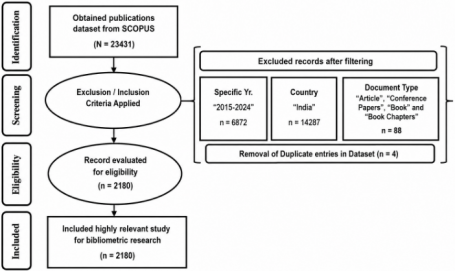
The bibliographical information cited above was obtained from Scopus, one of the largest citation databases available across many disciplines. Searches of bibliographic information used combinations of keywords associated with (AI), (ML) and (LS) using only those records published in Scopus from 2015 to 2024. All records included in this research were limited to those records related to the research topic.
4.2. Data Collection and Screening
The first search result from Scopus came back in CSV format and had all the bibliographic information which could be found for each reference. This included the title, author(s), association, source title, summary, keywords, citation numbers, or references. A manual review (screening and cleaning of the data) was performed to find and remove any potentially duplicate or irrelevant records. The final dataset upon completion of the screening process contained 2180 files to be included in the final analysis.
4.3. Bibliometric Indicators
The study employed several bibliometric indicators to evaluate research performance and impact, including:
1) Total Publications (TP)
2) Total Citations (TC)
3) Average Citations per Publication (ACPP)
4) Cited Papers (CP)
5) Non-Cited Papers (NCP)
6) Annual Publication Growth Rate
7) Authorship Patterns
8) Prolific Authors
9) Highly Cited Documents
10) Keyword Occurrence and Co-occurrence
11) Country-wise Collaboration Networks
These indicators were used to assess publication productivity, citation impact, collaboration behavior, and thematic evolution within the research domain.
4.4. Data Analysis Tools
The Bibliometrix package in RStudio and VOSviewer were used to analyse our study data. We performed descriptive bibliometric analysis using Bibliometrix, including publication trends, citation analysis, authorship patterns, and source analysis. Networks of term co-occurrence & nation cooperation were constructed and visualised using VOSviewer. We need five keyword occurrences for keyword analysis. We gathered 14,244 author keywords, however only 974 satisfied our five-occurrence criterion for network visualisations. Another study limited international cooperation to nations with at least two publications and one citation.
4.5. Network Visualization and Knowledge Structure Analysis
To examine academic content or topics and research development, VOSviewer and author keywords and co-authorship by nation were used. The clusters created theme aspects within the field and identified authorship groups in visualisations based on Total Link Strength (TLS), a statistic that measures keyword or author country links. These visualisations were used to identify the key academic focus in the AI, ML, and LIS/RIS literature, emerging trends and key contributors, and international connections related to author collaboration and disciplinary research output, providing a comprehensive view of the structure and development of the body of knowledge in these three intersecting fields during the period under review.
Figure 1. Diagram illustrating the four stages of the filtering process.
5. Result and Discussion
Table 1 displays the 2,180 publications found in this study covering the years 2015–2024 in the fields of library science, artificial intelligence, and machine learning. All all, there are 4,361 sources and 7,623 writers covered in these 21,80,000 research pieces. The average number of scholarly co-authors is 3.84 out of 21,80,000 research articles, with 71 being single-authored. With an average of 7.431 citations per manuscript, the number of publications increased by 43.16% year. There are 11,137 keywords in all 2180 research publications and 14,244 author keywords. Journals, books, chapters, and conference papers are documents.
Table 1. Information on Publications and Primary Bibliometric Data (2015–2024).
Description | Results | Description | Results |
MAIN INFORMATION | AUTHOR |
Timespan | 2015–2024 | Authors | 7,623 |
Sources (Journals, Books, etc.) | 436 | COLLABORATION | |
Documents | 2,180 | Co-authors per Document | 3.84 |
Annual Growth Rate (%) | 43.16 | AUTHORED | |
Average Citations per Document | 7.431 | Single-authored Documents | 71 |
References | 17,934 | | |
DOCUMENT CONTENT | DOCUMENT TYPE |
Keywords Plus (ID) | 11,137 | Articles | 558 |
Author's Keywords (DE) | 14,244 | Books | 92 |
| | Book Chapters | 214 |
| | Conference Papers | 1,316 |
Source: Compiled from bibliometric analysis of the dataset (2015–2024).
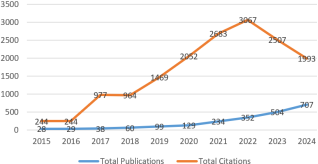
Figure 2 displays the output of research articles published in the fields of " (AI)", " (ML)", & "Library Science" journals. Productivity in research spans the years 2015–2024. Publications are increasing and are expected to keep doing so. Following 2024 with 707 (32.43%), 2023 with 504 (23.12%), and 2022 with 352 (16.15%), the total number of publications peaked in 2023. In 2022, the most often cited TC-3067 was 18.93%, in 2021 it was TC-2683 (16.56%), and in 2023 it was TC-2507 (15.48%). In 2022, there were the most citations.
Figure 2. Trends in publications and citations.
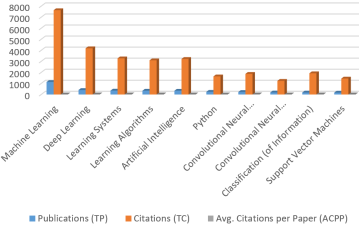
The poll lists the top author keywords. Bibliometric data showed that "machine learning" (7633 citations), "deep learning" (4182) and "learning systems" (3272) were the most cited. "Classification (of information)" received 10.99% citations per article, followed by "deep learning" (10.35%) and "artificial intelligence" (9.46%) (Hodonu-Wusu, 2025). The most uncited papers were on "machine learning" (NCP-323), "deep learning" (NCP-98), and "learning algorithms" (NCP-95). The most referenced work (CP-807) was on "machine learning" and the least (CP-126) on "support vector machines".
The present analysis examines 2015–2024 literary authorship trends. All articles have 1–10 authors, according to data. From 2015 to 2024, 493 publications (22.61%) included collaboration between two authors, 479 articles (21.97%) featured collaboration between three authors, and 446 articles (20.46%) featured collaboration between four authors. The majority of the work (65.04%) was created by teams with two to four writers. With 3,773 citations, two-author patterns far outnumbered all others. With 493 citations (3.26%), the single-authored pattern placed tenth (Attri & Upadhyay, 2024)
| [3] | Attri, R. K., Upadhyay, A. K. (2024). The future of Indian renewable energy research: Insights from a bibliometric analysis. Educational Administration: Theory and Practice, 30(3), 2966–2976. . https://doi.org/10.53555/kuey.v30i3.8840 |
[3]
.
The recent trends of authorship in research work on AI, ML & LIS. The results show a marked favouritism for group efforts in research, with most articles including several authors. Most articles had two authors, accounting for 493 (22.62%), while 479 (21.96%) had three authors. The number of four-author articles (446 publications, 20.47%) was very high, followed by 326 papers (14.94%), and 240 papers (11.02%). These multidisciplinary fields are increasingly defined by teamwork, as opposed to the limited number of publications that are single authored (71 papers, 3.25% of the total output).
The total number of citations for papers with two authors was 3,773, while those with three authors came in second with 3,713. Even though publications with 10 authors comprised only 1.27 per cent of the total output, the publications with 10 authors recorded the highest(ACPP) of 26.43. Articles with seven and nine authors also had very high ACPP values of 14.11 and 12.06, respectively. It seems that collaborative research is more likely to get academic attention since the percentage of referenced publications remained high regardless of authorship category. Collaborative and multidisciplinary nature of AI/ML/LIS is reflected in the high rate of co-authorship in the research.
Individuals who have made significant contributions to the fields of AI, ML, and LIS via their writing. Vinay Kukreja & K. R. Senthilkumar were the most prolific writers out of the 7,623 found in the dataset. They published nine documents apiece over the research period. The number of citations obtained by K. R. Senthilkumar was 150, whilst Vinay Kukreja collected 52. Ketan V. Kotecha had the most citations (568 total) and the greatest average citations per publication (81.14 total), placing him first in terms of citation impact, although he only published seven times overall. A total of 93 citations and an ACPP of 13.29 were accumulated by Dweepna Garg's seven articles. In addition to the aforementioned individuals, six publications were provided by M. Niranjanamurthy & A. Subaveerapandiyan, five by Mohammad Imran Siddiqi, C. Pethuru Raj, Rupak Chakravarty, Hariharan Shanmugasundaram, and Amit Kumar Tyagi, respectively. K. R. Senthilkumar had an ACPP of 16.67, second only to Rupak Chakravarty, who placed second in terms of citation impact with 19.20. The results show that while authors' publication output varied, the citation performance demonstrated the significant academic impact of academics like Ketan V. Kotecha. Over the course of the research period, these writers have had a major impact on the development of artificial intelligence (AI), machine learning (ML), and library and information science (LIS) as fields.
Table 2 lists the top ten 2015–2024 AI, ML, and library science papers (Aria & Cuccurullo, 2017)
. "Heart Disease Prediction Using Machine Learning Algorithms" (Singh, Archana) in "ICE3 2020" and "A Review of Graph Neural Networks: Concepts, Architectures, Techniques, Challenges, Datasets, Applications and More" (Congedo, Marco)
in "BrainComputer Interfaces" had the second-highest number of citations (351), ahead of "Heart Disease Prediction Using Machine Learning Algorithms" (304).
Table 2. The Top Ten Documents with the Most Citations.
Total Citations | Document Title | First Author / Institution & Country | Author, Year, Source |
351 | Riemannian Geometry for EEG-Based Brain–Computer Interfaces: A Primer and a Review | Université Grenoble Alpes, Saint Martin d'Hères, France | Congedo, Marco; 2017; Brain-Computer Interfaces |
304 | Heart Disease Prediction Using Machine Learning Algorithms | Madan Mohan Malaviya University of Technology, Gorakhpur, India | Singh, Archana; 2020; ICE3 2020 |
218 | Deep Learning and Neural Networks: Concepts, Architectures, Techniques, Challenges, Datasets, Applications, and Future Directions | Symbiosis Institute of Technology, Pune, India | Khemani, Bharti; 2024; Journal of Big Data |
200 | PySyft: A Library for Easy Federated Learning | Technische Universität München, Munich, Germany | Ziller, Alexander; 2021; Studies in Computational Intelligence |
190 | Predicting Severity of Parkinson’s Disease Using Deep Learning | Indira Gandhi Delhi Technical University for Women, New Delhi, India | Grover, Srishti; 2018; Procedia Computer Science |
178 | Classification and Survival Prediction from Histopathology Images Using Deep Learning | International Institute of Information Technology, Hyderabad, India | Tabibu, Sairam; 2019; Scientific Reports |
154 | Deep Learning Based Respiratory Sound Analysis for Detection of Chronic Obstructive Pulmonary Disease | Symbiosis Institute of Technology, Pune, India | Srivastava, Arpan; 2021; PeerJ Computer Science |
134 | Smart Libraries: An Emerging and Innovative Technological Habitat of the 21st Century | University of Kashmir, Garhwal, India | Gul, Sumeer; 2019; The Electronic Library |
133 | Machine Learning Models for Thermal and Electrical Performance Prediction of High-Capacity Lithium-Ion Battery | University of Waterloo, Canada | Tran, Manh Kien; 2022; International Journal of Energy Research |
125 | A Comparative Analysis of Hyperopt as Against Other Approaches for Hyper-Parameter Optimization of XGBoost | University of Waterloo, Canada | Putatunda, Sayan; 2018; ACM International Conference Proceeding Series |
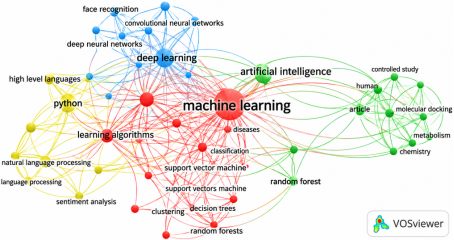
Researchers in the academic world study AI, ML, and LS (
Figure 3). Viewer for VOS displayed keywords. I counted each sentence carefully, and I made sure it occurred five times. We investigated 974 of 14248 keywords. Top 50 words were coloured by connection strength. Keywords increased with cluster size. Keyword research publications affect node collaboration.
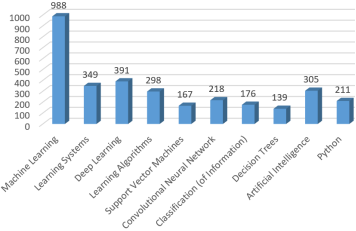
Figure 3 shows researchers utilised “Machine Learning”, “Learning System”, “Deep Learning”, “Learning Algorithms”, and “Support Vector Machines”.
Figure 4 displays four study domain term clusters. The first red cluster comprises 19 words, mostly related to classification, information classification and data mining. The second green cluster uses 13 phrases, articles, AI, and chemistry most often. The third cluster, which is blue in colour, has ten terms related to computer vision, convolution, or convolutional neural networks. The fourth cluster in yellow contains eight terms related to language processing, high-level languages, adversarial machine learning.
Figure 3. Commonly Used Author Keywords.
Figure 4. The Most Frequently Used Terms.
Figure 5. Co-occurrence mapping of author keywords.
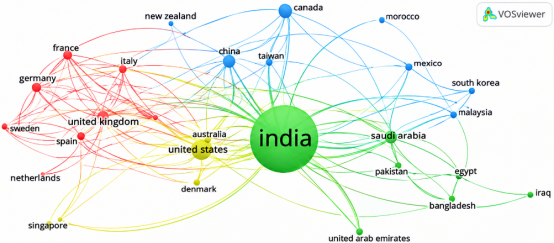
The photographs show the top AI, ML, and Library Science coauthor countries (
Figure 4). Bibliometric study and visualisation of high-co-authorship countries employed SCOPUS and VOS viewer. Total document counting for 21 countries. Countries need two publications and one citation. Analysis is available for 56 of 90 nations. Five colours represented top 30 keyword strength. Countries with text labels demonstrate their influence by colour and map location. India, the largest green contributor, is essential to joint research. Researchers from different nations focus on their most common co-authorship countries. Australia tops the first cluster of 13 red nations with 18 publications, 420 citations, and 60 connections. With 8 papers, 80 citations, and 22 connections, Bangladesh leads the green second cluster of 7 nations. With 15 publications, 314 citations, and 45 links, Canada leads the blue third cluster of 6 nations. In the fourth yellow cluster of 2 nations, Singapore leads with 11 publications, 136 citations, and 20 links. New Zealand tops the purple fifth cluster of 2 nations with 3 articles, 29 citations, and 14 connections. The US, UK, and Saudi Arabia may lead Asian AI, ML, and library science cooperation.
Figure 6. Co-authorship country mapping.
6. Discussion
This section decodes above results with the view of the five research objectives of the study, puts the results in comparison with the results found in the previous studies and discusses the wider implications for the study for the LIS field.
6.1. Publication Growth and Productivity (Objective 1)
The data shows a robust annual growth rate of 43.16% with the highest figure of 707 documents in 2024 (32.43% of the total production of 2,180 documents), indicating a rapid acceleration of AI/ML research activities in LIS instead of just a growth in research production. This has been a significant increase compared to previous, more limited, searches, like Patil (2024), that had a more limited number of documents (107) and a shorter time span of search (2012–2016), which did not reflect the full extent of recent growth. It is in line with the findings of Hodonu-Wusu (2025) and Borgohain et al. (2022) that the use of AI in libraries has from a niche interest, has become a mainstream research theme, plausibly compounded by the genesis and evolution of generative AI tools since 2022.
6.2. Citation Impact and Highly Cited Work (Objective 2)
The impact of citations is not so high as in other growing up fast and interdisciplinary computational fields, with a median of 7.431 citations per document, and a most cited document counting 351 citations. It is interesting to note that the most cited papers in the dataset (such as Congedo, Barachant & Bhatia, 2017: brain-computer interfaces; Singh, 2020: disease prediction using machine-learning) are not directly related to LIS, and so the influence on citations of those papers is likely more with respect to general AI/ML methodology papers than with respect to LIS specific applications. Such a nuance is not observed in the previous narrative reviews (Omame & Alex-Nmecha, 2020; Sharma et al., 2019)
| [15] | Omame, I. M., & Alex-Nmecha, J. C. (2020). Artificial intelligence in libraries. In N. E. Osuigwe (Ed.), Managing and adapting library information services for future users (pp. 120–144). IGI Global. https://doi.org/10.4018/978-1-7998-1116-9.ch008 |
[15]
and this is a unique contribution of the current quantitative review.
6.3. Citation Analysis: Summary Indicators
Table 3 provides a summary of the key citation-impact indicators that have been identified from the data set and presented together to provide one-stop access to the citation performance in this field, summarising the productivity, citation and author level information reported in Section 5.
Table 3. Citation Analysis: Summary Impact Indicators.
Indicator | Value |
Total documents (TP) | 2,180 |
Total sources | 436 |
Average citations per document (ACPP) | 7.431 |
Total citations (TC) | 16,200 (consistent with Attri, Kapoor & Upadhyay, 2026) |
Most-cited single document | 351 citations (Congedo, Barachant & Bhatia, 2017) |
Author with highest total citations | Ketan V. Kotecha (568 citations, ACPP 81.14) |
Most prolific authors | Vinay Kukreja & K. R. Senthilkumar (9 documents each) |
Highest citation share by author keyword | “machine learning” (7,633 citations) |
Leading contributing country | India |
As shown in
Table 3, although the average citation rate (7.431 citations per document) is moderate, the impact of the citation is highly skewed, with a small number of authors (notably Ketan V. Kotecha, with an ACPP of 81.14) and a few number of documents receiving a disproportionate share of citations, a pattern typical of emerging interdisciplinary fields and Lotka's law of scientific productivity. The field's intellectual backbone is lacking in its even distribution, with this concentration focusing on a small group of highly visible contributors instead of being equally spread among the 7,623 identified authors. Notably, the total-citation figure of 16,200 matches the figure of 16,305 reported in Attri, Kapoor, and Upadhyay (2026)
| [3] | Attri, R. K., Upadhyay, A. K. (2024). The future of Indian renewable energy research: Insights from a bibliometric analysis. Educational Administration: Theory and Practice, 30(3), 2966–2976. . https://doi.org/10.53555/kuey.v30i3.8840 |
[3]
, who studied the same time frame (2015–2024), and a similar number of documents (1,472,788) (see Appendix 1 for details). The external validity of the citation-impact statistics reported herein is bolstered by a comparison of these two figures, which is considered near-identical.
6.4. Authorship and Collaboration Patterns (Objective 3)
Given the average number of co-authors per document of 3.84 and the fact that only 3.26% of documents was single authored, it is clear that the research conducted on AI/ML in LIS is a collaborative effort. The extent of collaboration is similar to other studies of technology-related fields, such as the study by Attri and Upadhyay (2024)
| [3] | Attri, R. K., Upadhyay, A. K. (2024). The future of Indian renewable energy research: Insights from a bibliometric analysis. Educational Administration: Theory and Practice, 30(3), 2966–2976. . https://doi.org/10.53555/kuey.v30i3.8840 |
[3]
on renewable energy research, which similarly found that the majority of papers had only one author. The higher the number of authors on the team, the more the average citation per publication (ACPP) for mid-sized author teams (groups with seven, nine and ten authors) as compared to the contribution of a single author, as indicated by the concentration of the highest average citations per publication (ACPP) in this field by mid-sized author teams (seven-, nine-, and ten-author teams).
6.5. Thematic Structure and Keyword Networks (Objective 4)
The dominance of the terms “machine learning” or “deep learning” or “learning systems” and the emergence of four distinct keyword clusters (classification/data mining; article-based/chemistry-adjacent terms; computer vision; and language processing) closely resembles the four quadrant thematic structure identified by Patil (2024)
| [17] | Patil, S. B. (2024). Artificial intelligence (AI) and libraries: A review of influential aspects and conceptual structure. In D. C. Kar, S. Khan, A. Durrany, & P. K. Jain (Eds.), Innovative technologies in librarianship: Challenges and opportunities (pp. 37–46). Ocean Publishing House. |
[17]
for a smaller sample of documents based on the same dataset. Both of these independently developed thematic maps point to the fact that machine learning and deep learning are the core themes of research within the field of AI/ML in LIS, and that generative AI represents an emerging theme, as Patil (2024) suggested. This thematic convergence is also supported by Islam and Guangwei (2025)
, who analysed a relatively limited subset of literature from the database Scopus between 2018 and 2022 for library science that deals with the applications of AI. They similarly found that the library science's dominant thematic land is machine-learning applications.
6.6. International Collaboration (Objective 5)
The emerging power of India as a primary contributor node in the co-authorship network, along with well-established regional clusters of Australia, Bangladesh, Canada, Singapore and New Zealand, suggests that AI/ML-LIS research is an international undertaking, focusing notably in South and Southeast Asia. This builds upon Gasparini and Kautonen (2022)
| [8] | Gasparini, A., & Kautonen, H. (2022). Understanding artificial intelligence in research libraries: An extensive literature review. LIBER Quarterly: The Journal of the Association of European Research Libraries, 32(1), 1–36.
https://doi.org/10.53377/lq.10934 |
[8]
qualitative observation that the adoption of AI by research libraries is a challenge across the world and offers quantitative data of where that scholarly engagement is geographically located.
6.7. Significance
The overall trend of increasing growth rate, the focus on machine learning and deep learning, and the central role of LIS in the collaboration network point to a shift from experimentation to the institutionalization of AI tools and their implications for the ethical and equitable governance of AI-enabled services (Barsha & Munshi, 2023)
| [4] | Barsha, S., Munshi, S. A. (2023). Implementing artificial intelligence in library services: A review of current prospects and challenges of developing countries. Library Hi Tech News, 41(1), 7–10. https://doi.org/10.1108/LHTN-07-2023-0126 |
[4]
, and for professional training (Hodonu-Wusu, 2025)
| [9] | Hodonu-Wusu, J. O. (2025). The rise of artificial intelligence in libraries: The ethical and equitable methodologies, and prospects for empowering library users. AI and Ethics, 5, 755–765. https://doi.org/10.1007/s43681-024-00432-7 |
[9]
. This study will quantitatively identify the focus of scholarly attention and citation impact, complementing the qualitative descriptions in Gasparini and Kautonen (2022)
| [8] | Gasparini, A., & Kautonen, H. (2022). Understanding artificial intelligence in research libraries: An extensive literature review. LIBER Quarterly: The Journal of the Association of European Research Libraries, 32(1), 1–36.
https://doi.org/10.53377/lq.10934 |
[8]
and other articles, and provide librarians, educators and policy makers with a foundation for making evidence-based decisions about the need to support AI literacy, investment in AI infrastructure, and research collaboration.
7. Conclusion
The aim of this bibliometric study was to trace the development of AI and ML studies in LIS from 2015 to 2024 in terms of growth, performance of studies cited, authorial structure, thematic composition, and international collaboration. As outlined above, the results show that the field has grown rapidly (43.16% annual growth rate, with an average of 2180 documents from 436 sources), that it is dominated thematically by machine learning and deep learning applications, that it is mostly collaborative (with an average of 3.84 co-authors per document and only 3.26% being single authored), and that it is anchored internationally by India as the leading country contributor. This study fulfills the gap identified in Section 3.1 by existing smaller or narrower studies like Hussain & Ahmad (2024) or Patil (2024) because they were limited to 10-year publication periods, and strives to offer a comprehensive yet methodologically cohesive overview of this field of study on a large scale over the course of a decade. Building on this, in the coming decade, AI-related technologies will be more and more integrated into digital information systems, knowledge management, and library services, and more research is needed in the emerging areas identified in this analysis, such as generative AI, explainable AI, intelligent digital libraries, semantic information retrieval, and the ethics of AI-based information services. The findings provide a solid evidence-based understanding of the evolution and trajectory of AI and ML research in LIS to the researchers, librarians, information professionals and policy makers.
Abbreviations
ACPP | Average Citation Per Publication |
AI | Artificial Intelligent |
LIS | Library and Information Science |
ML | Machine Learning |
TLS | Total Link Strength |
Author Contributions
Vinayak Savatagi: Conceptualization, Data curation, Formal Analysis, Investigation, Methodology, Writing – original draft
Umesha Naik: Conceptualization, Formal Analysis, Methodology, Supervision, Validation, Writing – review & editing
Conflicts of Interest
The author declares no conflicts of interest.
References
| [1] |
Adetayo, A. J., Aborisade, M. O., & Sanni, B. A. (2024). Microsoft Copilot and Anthropic Claude AI in education and library service. Library Hi Tech News. Advance online publication.
https://doi.org/10.1108/LHTN-01-2024-0002
|
| [2] |
Aria, M., Cuccurullo, C. (2017). Bibliometrix: An R-tool for comprehensive science mapping analysis. Journal of Informetrics, 11(4), 959–975.
https://doi.org/10.1016/j.joi.2017.08.007
|
| [3] |
Attri, R. K., Upadhyay, A. K. (2024). The future of Indian renewable energy research: Insights from a bibliometric analysis. Educational Administration: Theory and Practice, 30(3), 2966–2976. .
https://doi.org/10.53555/kuey.v30i3.8840
|
| [4] |
Barsha, S., Munshi, S. A. (2023). Implementing artificial intelligence in library services: A review of current prospects and challenges of developing countries. Library Hi Tech News, 41(1), 7–10.
https://doi.org/10.1108/LHTN-07-2023-0126
|
| [5] |
Borgohain, D. J., Bhardwaj, R. K., & Verma, M. K. (2022). Mapping the literature on the application of artificial intelligence in libraries (AAIL): A scientometric analysis. Library Hi Tech, 42(1), 149–179.
https://doi.org/10.1108/LHT-07-2022-0331
|
| [6] |
Congedo, M., Barachant, A., & Bhatia, R. (2017). Riemannian geometry for EEG-based brain–computer interfaces: A primer and a review. Brain–Computer Interfaces, 4(3), 155–174.
https://doi.org/10.1080/2326263X.2017.1297192
|
| [7] |
Fernandez, P. (2023). “Through the looking glass: Envisioning new library technologies” AI-text generators as explained by ChatGPT. Library Hi Tech News, 40(3), 11–14.
https://doi.org/10.1108/LHTN-02-2023-0017
|
| [8] |
Gasparini, A., & Kautonen, H. (2022). Understanding artificial intelligence in research libraries: An extensive literature review. LIBER Quarterly: The Journal of the Association of European Research Libraries, 32(1), 1–36.
https://doi.org/10.53377/lq.10934
|
| [9] |
Hodonu-Wusu, J. O. (2025). The rise of artificial intelligence in libraries: The ethical and equitable methodologies, and prospects for empowering library users. AI and Ethics, 5, 755–765.
https://doi.org/10.1007/s43681-024-00432-7
|
| [10] |
Hussain, A., Ahmad, S. (2024). Mapping the literature on artificial intelligence in academic libraries: A bibliometrics approach. Science & Technology Libraries, 43(2), 1–16.
https://doi.org/10.1080/0194262X.2023.2238198
|
| [11] |
Islam, M. N., & Guangwei, H. (2025). Trends and patterns of artificial intelligence research in libraries: A bibliometric analysis. SAGE Open, 15(2).
https://doi.org/10.1177/21582440251327528
|
| [12] |
Mane, V. S. (2024). Artificial intelligence in library and information science. Aayushi International Interdisciplinary Research Journal, 11(Special Issue 139), 50–55.
https://www.aiirjournal.com/uploads/Articles/1765871533139.%20Final%20upload.pdf
|
| [13] |
Moonasar, A., Ngoepe, M. (2023). Disruptive changes in the role of academic libraries and librarians: A case study of a university of technology in South Africa. Innovation: Journal of Appropriate Librarianship and Information Work in Southern Africa, 67, 4–31.
https://doi.org/10.10520/ejc-innovation_v2023_n67_a2
|
| [14] |
Nie, B., Wang, T., Lund, B. D., & Chen, F. (2022). How does AI make libraries smart? A case study of Hangzhou Public Library. In M. Lamba (Ed.), Technological Advancements in Library Service Innovation (pp. 43–58). IGI Global Scientific Publishing.
https://doi.org/10.4018/978-1-7998-8942-7.ch003
|
| [15] |
Omame, I. M., & Alex-Nmecha, J. C. (2020). Artificial intelligence in libraries. In N. E. Osuigwe (Ed.), Managing and adapting library information services for future users (pp. 120–144). IGI Global.
https://doi.org/10.4018/978-1-7998-1116-9.ch008
|
| [16] |
Panda, S., Chakravarty, R. (2022). Adapting intelligent information services in libraries: A case of smart AI chatbots. Library Hi Tech News, 39(1), 12–15.
https://doi.org/10.1108/LHTN-11-2021-0081
|
| [17] |
Patil, S. B. (2024). Artificial intelligence (AI) and libraries: A review of influential aspects and conceptual structure. In D. C. Kar, S. Khan, A. Durrany, & P. K. Jain (Eds.), Innovative technologies in librarianship: Challenges and opportunities (pp. 37–46). Ocean Publishing House.
|
| [18] |
Sharma, A., Ranjan, A., Yadav, A., & Tripathi, H. K. (2019, April). Artificial intelligence in libraries: An overview [Conference presentation]. Digital Age Strategies in Information Management for Sustainable Librarianship, New Delhi, India.
|
| [19] |
Talafidaryani, M., Jalali, S. M. J., & Moro, S. (2023). Tracing the evolution of digitalisation research in business and management fields: Bibliometric analysis, topic modelling and deep learning trend forecasting. Journal of Information Science. Advance online publication.
https://doi.org/10.1177/01655515221148365
|
Cite This Article
-
APA Style
Savatagi, V., Naik, U. (2026). Artificial Intelligence in Library and Information Science Research: Trends, Citation Patterns, and Knowledge Structure Analysis. American Journal of Information Science and Technology, 10(3), 101-111. https://doi.org/10.11648/j.ajist.20261003.12
 Copy
|
Copy
|
 Download
ACS Style
Savatagi, V.; Naik, U. Artificial Intelligence in Library and Information Science Research: Trends, Citation Patterns, and Knowledge Structure Analysis. Am. J. Inf. Sci. Technol. 2026, 10(3), 101-111. doi: 10.11648/j.ajist.20261003.12
Copy
|
Download
AMA Style
Savatagi V, Naik U. Artificial Intelligence in Library and Information Science Research: Trends, Citation Patterns, and Knowledge Structure Analysis. Am J Inf Sci Technol. 2026;10(3):101-111. doi: 10.11648/j.ajist.20261003.12
Copy
|
Download
-
@article{10.11648/j.ajist.20261003.12,
  author = {Vinayak Savatagi and Umesha Naik},
  title = {Artificial Intelligence in Library and Information Science Research: Trends, Citation Patterns, and Knowledge Structure Analysis},
  journal = {American Journal of Information Science and Technology},
  volume = {10},
  number = {3},
  pages = {101-111},
  doi = {10.11648/j.ajist.20261003.12},
  url = {https://doi.org/10.11648/j.ajist.20261003.12},
  eprint = {https://article.sciencepublishinggroup.com/pdf/10.11648.j.ajist.20261003.12},
  abstract = {Artificial Intelligence (AI) and Machine Learning (ML) are changing Library and Information Science (LIS) by impacting on user services, cataloguing, and information retrieval; however, the literature on how this is happening has not been systematically catalogued. To fill this gap, this study was conducted using a bibliometric analysis of the papers pertaining to AI, ML and LIS published from 2015 to 2024. The aim of the study is to analyse the growth of publication, citation trends, characteristics of authors, keyword co-occurrence networks, and international collaboration in this field to discover the intellectual structures and future trends of the field. A total of 2180 documents from 436 sources were retrieved by applying a structured keyword search strategy, after removing the duplicates and the irrelevant documents, the retrieved documents were analysed with the help of the Bibliometrix package in RStudio and VOSviewer for descriptive bibliometric analysis and network-based bibliometric analysis respectively. Results indicate an increase at an annual rate of 43.16%, with only 2024 reporting 707 publications or 32.43% of the total. The data set contained 7,623 authors, each of whom authored an average of 3.84 co-authors per document, and only 71 documents (3.26%) had a single author, showing a very collaborative research culture. The most common and most cited author keywords were “machine learning” (7,633 citations), “deep learning” (4,182), and “learning systems” (3,272). The document with the most citations garnered 351 citations, with India becoming the top among the contributing countries and the largest node in the international co-authorship networks. From these results, it can be inferred that AI/ML research in LIS is growing rapidly, is collaborative in nature and has a higher focus on machine learning and deep learning applications. Based on the study, the researcher concludes that this bibliometric mapping will be a baseline reference for researchers, librarians and policy makers to understand the evolution of AI and ML in LIS and to identify emerging research areas like generative AI, explainable AI and intelligent digital libraries.},
 year = {2026}
}
Copy
|
Download
-
TY  - JOUR
T1  - Artificial Intelligence in Library and Information Science Research: Trends, Citation Patterns, and Knowledge Structure Analysis
AU  - Vinayak Savatagi
AU  - Umesha Naik
Y1  - 2026/10/09
PY  - 2026
N1  - https://doi.org/10.11648/j.ajist.20261003.12
DO  - 10.11648/j.ajist.20261003.12
T2  - American Journal of Information Science and Technology
JF  - American Journal of Information Science and Technology
JO  - American Journal of Information Science and Technology
SP  - 101
EP  - 111
PB  - Science Publishing Group
SN  - 2640-0588
UR  - https://doi.org/10.11648/j.ajist.20261003.12
AB  - Artificial Intelligence (AI) and Machine Learning (ML) are changing Library and Information Science (LIS) by impacting on user services, cataloguing, and information retrieval; however, the literature on how this is happening has not been systematically catalogued. To fill this gap, this study was conducted using a bibliometric analysis of the papers pertaining to AI, ML and LIS published from 2015 to 2024. The aim of the study is to analyse the growth of publication, citation trends, characteristics of authors, keyword co-occurrence networks, and international collaboration in this field to discover the intellectual structures and future trends of the field. A total of 2180 documents from 436 sources were retrieved by applying a structured keyword search strategy, after removing the duplicates and the irrelevant documents, the retrieved documents were analysed with the help of the Bibliometrix package in RStudio and VOSviewer for descriptive bibliometric analysis and network-based bibliometric analysis respectively. Results indicate an increase at an annual rate of 43.16%, with only 2024 reporting 707 publications or 32.43% of the total. The data set contained 7,623 authors, each of whom authored an average of 3.84 co-authors per document, and only 71 documents (3.26%) had a single author, showing a very collaborative research culture. The most common and most cited author keywords were “machine learning” (7,633 citations), “deep learning” (4,182), and “learning systems” (3,272). The document with the most citations garnered 351 citations, with India becoming the top among the contributing countries and the largest node in the international co-authorship networks. From these results, it can be inferred that AI/ML research in LIS is growing rapidly, is collaborative in nature and has a higher focus on machine learning and deep learning applications. Based on the study, the researcher concludes that this bibliometric mapping will be a baseline reference for researchers, librarians and policy makers to understand the evolution of AI and ML in LIS and to identify emerging research areas like generative AI, explainable AI and intelligent digital libraries.
VL  - 10
IS  - 3
ER  -
Copy
|
Download





 Share This Article
 Twitter
 Linked In
 Facebook