
To analyze the cooling process of raw cotton, a mathematical model is proposed in the form of a boundary value problem for a system of thermal conductivity equations. The developed model makes it possible to describe the distribution and propagation of heat within a fibrous mass represented in the form of a ball. Such an approach provides an opportunity to investigate the thermal state of raw cotton during the cooling process and to determine the main regularities of heat transfer inside the fibrous material. The proposed mathematical formulation takes into account the thermal conductivity processes occurring within the fibrous mass and allows the temperature field to be determined as a function of spatial coordinates and time. The boundary and initial conditions are formulated in accordance with the physical characteristics of the cooling process. This makes it possible to obtain a mathematical description that adequately reflects the changes in temperature inside the considered fibrous medium during cooling. Using the method of separated variables, an analytical solution to the proposed initial-boundary value problem is obtained. The application of this method makes it possible to represent the solution in a convenient analytical form and to analyze the dependence of the temperature distribution on the main parameters of the process. The obtained analytical results provide a theoretical basis for studying the dynamics of heat propagation and evaluating the cooling efficiency of the fibrous mass. The results of the study can be used to improve and optimize technological processes associated with the cooling of raw cotton. In particular, the proposed mathematical model can contribute to the selection of appropriate cooling conditions and technological parameters aimed at reducing excessive temperature increases and minimizing possible losses in fiber quality. The obtained results may also be useful for developing more effective approaches to controlling thermal processes during the processing and storage of fibrous materials. The work is of interest to specialists in the fields of thermal physics, heat transfer, mathematical modeling, fibrous materials processing technology, cotton processing, and related scientific and engineering areas concerned with the analysis and control of thermal processes in fibrous materials.
| Published in | American Journal of Mechanics and Applications (Volume 13, Issue 4) |
| DOI | 10.11648/j.ajma.20261304.15 |
| Page(s) | 84-89 |
| Creative Commons |
This is an Open Access article, distributed under the terms of the Creative Commons Attribution 4.0 International License (http://creativecommons.org/licenses/by/4.0/), which permits unrestricted use, distribution and reproduction in any medium or format, provided the original work is properly cited. |
| Copyright |
Copyright © The Author(s), 2026. Published by Science Publishing Group |
Heat Transfer, Cooling, Raw Cotton, Fiber Quality, Initial Temperature, Thermal Conductivity, Parabolic Type, Orthogonally of Function, Characteristic Equation
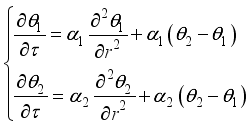
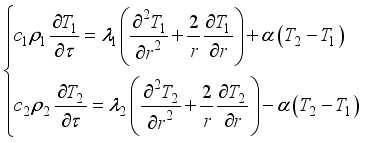 (1)
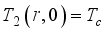
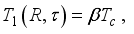
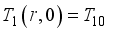 ,

 are the heat capacity, thermal conductivity, and density of the fibrous mass and air, respectivly;
 is the heat transfer coefficient between the fibrous mass and air;
 is the temperature of the fibrous mass, air, and the external environment, respectively; and
 is the initial temperature of the fibrous mass
 .
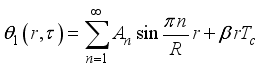
 (2)


 .
 ,
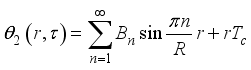 .




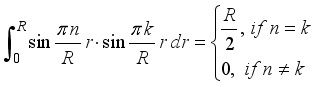 .
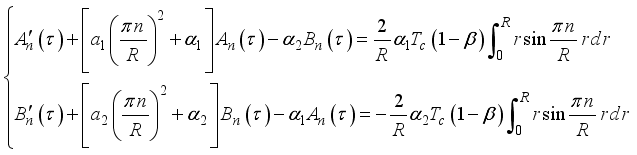
 .
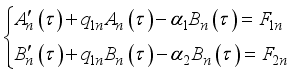 (3)
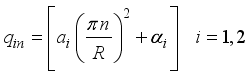 ,
 ,
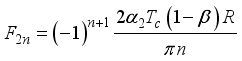 .
 .
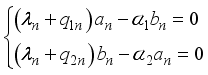 .
 ,

 , we introduce the notation
 .
 ,
 ,
 (4)
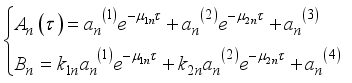 (5)
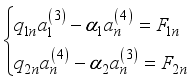 .
 (6)
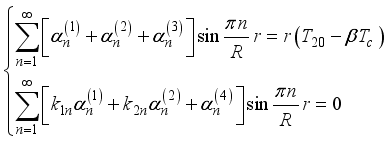 .
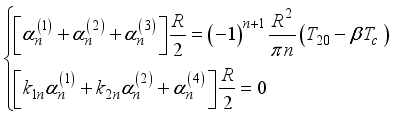 .
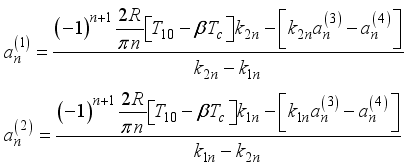 (7).
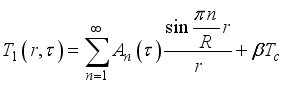 ,
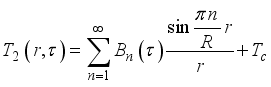 ,
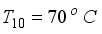 ;
 ;
 ;
 ;
 ;
 .
R, mm | 200 | 150 | 30 | ||||
|---|---|---|---|---|---|---|---|
, a secund | Experimental | Calculations | Experimental | Calculations | Experimental | Calculations | |
0 |
| 70 | 70 | 70 | 70 | 70 | 70 |
50 |
| 62 | 63,36 | 60 | 61,81 | 56 | 57,71 |
100 |
| 46 | 47,15 | 41 | 41,98 | 24 | 25,18 |
150 |
| 30 | 30.98 | 27 | 28,31 | 38 | 38,96 |
200 |
| 21 | 21,81 | 19 | 19,95 | 16 | 16,92 |
| 70 kg/m3 | 160 kg/m3 | 200 kg/m3 | ||||
|---|---|---|---|---|---|---|---|
, Time | Experimental | Calculations | Experimental | Calculations | Experimental | Calculations | |
0 |
| 70 | 70 | 70 | 70 | 70 | 70 |
20 |
| 46 | 46,96 | 58 | 59,01 | 68 | 69,11 |
40 |
| 28 | 28,75 | 40 | 41,05 | 57 | 58,08 |
60 |
| 19 | 19.91 | 24 | 24,61 | 50 | 50,82 |
80 |
| 20 | 19,82 | 41 | 41,65 | ||
100 |
| 38 | 38,52 | ||||
| Temperature |
| [1] | Mamatov A., Parpiev A., Shorakhmedova M. Mathematical model for calculating the temperature field of a direct-flow drying drum // Journal of Physics: Conference Series, 2021, 2131(5), 052067. |
| [2] | Mamatov A. Z., Usmankulov A. K., Abbazov I. Z., Norboyev U. A., Mukhametshina E. T. Determination of Temperature of Components of Cotton-Raw Material in a Drum Dryer with a Constant. IOP Conference Series: Earth and Environmental Sciencethis link is disabled, 2021, 939 (1), 012052. |
| [3] | Mamatov A. Z., Pardaev X. N., Mardonov J. S. H., Plekhanov A. F. Determining of the heat-moisture stateof raw cotton in a drum dryer. Izvestiya Vysshikh Uchebnykh Zavedenii, Seriya Teknologiya Tekstil’noi Promyshlennostithis link is disabled, 2021, 391(1), c. 46-49. |
| [4] | Mamatov A. Z., Pardaev H., Bomuratov Sh. Analytical solution of one problem of cooling seeds in the fluff of raw cotton// Devolment of science. - ISSN 3030-3007, 2025. |
| [5] | Zhamuratov, K., Umarov, K., & Dodobayev, A. Drainage of a semi-infinite aquifer in the presence of evaporation. In AIP Conference Proceedings (Vol. 3147, No. 1). AIP Publishing. AIP Conf. Proc. 3147, 030036 (2024), |
| [6] | Mamatov A. Z. Modeling of raw cotton drying technology to improve fiber quality. Dissertation for the degree of Doctor of Technical Sciences. Tashkent, 1995. |
| [7] | Abdullaev H. A., Rakhimov S. R. Thermophysical properties of raw cotton and their influence on fiber quality. - Tashkent: Fan, 1985. |
| [8] | Ismailov Sh. I., Karimov M. K. Heat transfer in fibrous materials during cotton processing. - Tashkent: Uzbekistan, 1990. |
| [9] | Nurmatov A. N., Saidov M. S. Mathematical Modeling of Raw Cotton Drying and Cooling Processes. - Dushanbe: Donish, 1988. |
| [10] | Isachenko V. P., Osipova V. A., Sukomel A. S. Heat Transfer: Textbook for Universities. - Moscow: Energia, 1975. |
| [11] | Lykov A. V. Theory of Heat Conductivity. - Moscow: Vysshaya shkola, 1967. |
| [12] | Tikhonov A. N., Samarskii A. A. Equations of Mathematical Physics. - Moscow: Nauka, 1977. |
| [13] | Kutateladze S. S. Fundamentals of Heat Transfer Theory. - Moscow: Atomizdat, 1979. |
| [14] | Dulnev G. N., Parfenov V. G. Heat and Mass Transfer in Radioelectronic Equipment. - Moscow: Energy, 1971. |
| [15] | Baer G. D., Brown R. A. Heat Transfer in Fibrous Materials. - Moscow: Mir, 1985. |
| [16] | Pavlov K. F., Romankov P. G., Noskov A. A. Examples and Problems in the Course on Processes and Apparatus of Chemical Engineering. - Leningrad: Chemistry, 1981. |
| [17] | Kreit F., Black W. Fundamentals of Heat Transfer. - Moscow: Mir, 1983. |
| [18] | Wang H., Li X. Heat and mass transfer in fibrous materials. - Journal of Applied Physics, 2015. |
APA Style
Zulunovich, M. A., Turdaliyevich, J. R. (2026). Analytical Solution to One Problem of Cooling Fiber Mass. American Journal of Mechanics and Applications, 13(4), 84-89. https://doi.org/10.11648/j.ajma.20261304.15
ACS Style
Zulunovich, M. A.; Turdaliyevich, J. R. Analytical Solution to One Problem of Cooling Fiber Mass. Am. J. Mech. Appl. 2026, 13(4), 84-89. doi: 10.11648/j.ajma.20261304.15
AMA Style
Zulunovich MA, Turdaliyevich JR. Analytical Solution to One Problem of Cooling Fiber Mass. Am J Mech Appl. 2026;13(4):84-89. doi: 10.11648/j.ajma.20261304.15
@article{10.11648/j.ajma.20261304.15,
  author = {Mamatov Alisher Zulunovich and Jamshidbek Rakhmonov Turdaliyevich},
  title = {Analytical Solution to One Problem of Cooling Fiber Mass},
  journal = {American Journal of Mechanics and Applications},
  volume = {13},
  number = {4},
  pages = {84-89},
  doi = {10.11648/j.ajma.20261304.15},
  url = {https://doi.org/10.11648/j.ajma.20261304.15},
  eprint = {https://article.sciencepublishinggroup.com/pdf/10.11648.j.ajma.20261304.15},
  abstract = {To analyze the cooling process of raw cotton, a mathematical model is proposed in the form of a boundary value problem for a system of thermal conductivity equations. The developed model makes it possible to describe the distribution and propagation of heat within a fibrous mass represented in the form of a ball. Such an approach provides an opportunity to investigate the thermal state of raw cotton during the cooling process and to determine the main regularities of heat transfer inside the fibrous material. The proposed mathematical formulation takes into account the thermal conductivity processes occurring within the fibrous mass and allows the temperature field to be determined as a function of spatial coordinates and time. The boundary and initial conditions are formulated in accordance with the physical characteristics of the cooling process. This makes it possible to obtain a mathematical description that adequately reflects the changes in temperature inside the considered fibrous medium during cooling. Using the method of separated variables, an analytical solution to the proposed initial-boundary value problem is obtained. The application of this method makes it possible to represent the solution in a convenient analytical form and to analyze the dependence of the temperature distribution on the main parameters of the process. The obtained analytical results provide a theoretical basis for studying the dynamics of heat propagation and evaluating the cooling efficiency of the fibrous mass. The results of the study can be used to improve and optimize technological processes associated with the cooling of raw cotton. In particular, the proposed mathematical model can contribute to the selection of appropriate cooling conditions and technological parameters aimed at reducing excessive temperature increases and minimizing possible losses in fiber quality. The obtained results may also be useful for developing more effective approaches to controlling thermal processes during the processing and storage of fibrous materials. The work is of interest to specialists in the fields of thermal physics, heat transfer, mathematical modeling, fibrous materials processing technology, cotton processing, and related scientific and engineering areas concerned with the analysis and control of thermal processes in fibrous materials.},
 year = {2026}
}
TY  - JOUR
T1  - Analytical Solution to One Problem of Cooling Fiber Mass
AU  - Mamatov Alisher Zulunovich
AU  - Jamshidbek Rakhmonov Turdaliyevich
Y1  - 2026/10/26
PY  - 2026
N1  - https://doi.org/10.11648/j.ajma.20261304.15
DO  - 10.11648/j.ajma.20261304.15
T2  - American Journal of Mechanics and Applications
JF  - American Journal of Mechanics and Applications
JO  - American Journal of Mechanics and Applications
SP  - 84
EP  - 89
PB  - Science Publishing Group
SN  - 2376-6131
UR  - https://doi.org/10.11648/j.ajma.20261304.15
AB  - To analyze the cooling process of raw cotton, a mathematical model is proposed in the form of a boundary value problem for a system of thermal conductivity equations. The developed model makes it possible to describe the distribution and propagation of heat within a fibrous mass represented in the form of a ball. Such an approach provides an opportunity to investigate the thermal state of raw cotton during the cooling process and to determine the main regularities of heat transfer inside the fibrous material. The proposed mathematical formulation takes into account the thermal conductivity processes occurring within the fibrous mass and allows the temperature field to be determined as a function of spatial coordinates and time. The boundary and initial conditions are formulated in accordance with the physical characteristics of the cooling process. This makes it possible to obtain a mathematical description that adequately reflects the changes in temperature inside the considered fibrous medium during cooling. Using the method of separated variables, an analytical solution to the proposed initial-boundary value problem is obtained. The application of this method makes it possible to represent the solution in a convenient analytical form and to analyze the dependence of the temperature distribution on the main parameters of the process. The obtained analytical results provide a theoretical basis for studying the dynamics of heat propagation and evaluating the cooling efficiency of the fibrous mass. The results of the study can be used to improve and optimize technological processes associated with the cooling of raw cotton. In particular, the proposed mathematical model can contribute to the selection of appropriate cooling conditions and technological parameters aimed at reducing excessive temperature increases and minimizing possible losses in fiber quality. The obtained results may also be useful for developing more effective approaches to controlling thermal processes during the processing and storage of fibrous materials. The work is of interest to specialists in the fields of thermal physics, heat transfer, mathematical modeling, fibrous materials processing technology, cotton processing, and related scientific and engineering areas concerned with the analysis and control of thermal processes in fibrous materials.
VL  - 13
IS  - 4
ER  -
Department of Mathematics and Computer Science, Tashkent Institute of Textile and Light Industry, Tashkent, Uzbekistan
Biography: Mamatov Alisher Zulunovich is a Doctor of Technical Sciences (DSc) and Professor at Tashkent Institute of Textile and Light Industry, Uzbekistan. He is associated with the Department of Mathematics and Computer Science. His research interests include mathematical modeling, differential equations, heat and mass transfer, and modeling of cotton drying processes.
Research Fields: Mathematical Analysis, Differential Equations, Fourier Series, Numerical Methods, Mathematical Modeling.

Department of Mathematics and Computer Science, Gulistan State Pedagogical Institute, Gulistan, Uzbekistan
Biography: Jamshidbek Rakhmonov Turdaliyevich is a mathematics specialist and Senior Lecturer at Gulistan State Pedagogical Institute, Uzbekistan. His research interests include mathematical analysis, differential equations, Fourier series, and numerical methods. He has contributed to research on the Galerkin method and mathematical modeling of differential problems.
Research Fields: Mathematical Modeling, Differential Equations, Heat and Mass Transfer, Cotton Processing Technologies, Drying Processes.


Information



 Share This Article
 Twitter
 Linked In
 Facebook

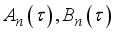 are calculated using formulas (

 , Density

 Copy
 Download