
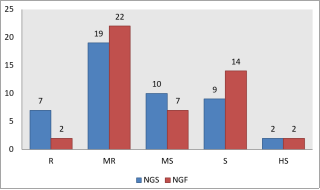
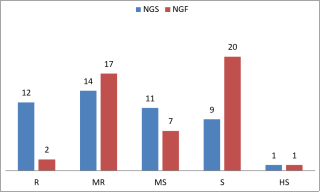
Fusarium wilt, caused by Fusarium oxysporum f. sp. ciceris, is a major constraint to chickpea production worldwide, resulting in substantial yield reduction and deterioration of crop quality. The effectiveness of host resistance is often challenged by the emergence of new pathogen races, necessitating the continuous identification of resistant germplasm for breeding programs. This study was conducted to identify chickpea genotypes with resistance to Fusarium wilt and to select promising materials for further breeding. A total of 47 chickpea genotypes, along with two standard checks (Geletu and Dimtu), were evaluated under field conditions during the 2022 and 2023 main cropping seasons using an augmented experimental design. Disease incidence was recorded at both seedling and flowering stages, and genotypes were classified according to the ICRISAT disease rating scale. Considerable variation in disease response was observed among the tested genotypes. Two genotypes exhibited resistant reactions, while seventeen were categorized as moderately resistant. Overall, nineteen genotypes demonstrated desirable levels of resistance and were identified as valuable sources of resistance for future chickpea improvement programs. These genotypes can be advanced to subsequent breeding stages for the development of Fusarium wilt-resistant chickpea varieties.
| Published in | American Journal of Plant Biology (Volume 11, Issue 2) |
| DOI | 10.11648/j.ajpb.20261102.12 |
| Page(s) | 33-38 |
| Creative Commons |
This is an Open Access article, distributed under the terms of the Creative Commons Attribution 4.0 International License (http://creativecommons.org/licenses/by/4.0/), which permits unrestricted use, distribution and reproduction in any medium or format, provided the original work is properly cited. |
| Copyright |
Copyright © The Author(s), 2026. Published by Science Publishing Group |
Chick Pea Genotypes, Chickpea Fusarium Wilt, Resistant
Genotype | 2022 | 2023 | Over all mean | |||
|---|---|---|---|---|---|---|
DIS% | DIF% | DIS% | DIF% | DIS% | DIF% | |
DZ-2012-Ck- 0281 | 37.50 | 20.00 | 33.33 | 10.20 | 35.42 | 15.10 |
DZ-2012-Ck-0007 | 14.29 | 13.33 | 12.77 | 23.33 | 13.53 | 18.33 |
DZ-2012-ck-0212 | 50.00 | 45.45 | 58.33 | 44.74 | 54.17 | 45.10 |
DZ-2012-Ck-0245 | 16.67 | 16.00 | 11.11 | 16.67 | 13.89 | 16.33 |
DZ-2012-Ck-0220 | 42.86 | 41.67 | 37.50 | 42.31 | 40.18 | 41.99 |
DZ-2012-Ck-0224 | 36.67 | 31.58 | 31.71 | 33.33 | 34.19 | 32.46 |
DZ-2012-Ck-0070 | 34.62 | 35.29 | 36.36 | 30.00 | 35.49 | 32.65 |
DZ-2012-Ck-0288 | 20.00 | 20.83 | 14.29 | 20.00 | 17.14 | 20.42 |
DZ-2012-Ck-0282 | 9.09 | 13.33 | 7.32 | 10.42 | 8.20 | 11.88 |
DZ-2012-ck-0265 | 7.41 | 4.00 | 9.09 | 15.38 | 8.25 | 9.69 |
DZ-2012-Ck-0246 | 33.33 | 35.71 | 22.22 | 37.50 | 27.78 | 36.61 |
DZ-2012-Ck-0266 | 11.76 | 20.00 | 11.11 | 38.46 | 11.44 | 29.23 |
DZ-2012-ck-0273 | 15.79 | 12.50 | 14.81 | 15.79 | 15.30 | 14.14 |
DZ-2012-ck-0255 | 23.81 | 31.25 | 25.00 | 33.33 | 24.40 | 32.29 |
DZ-2012-Ck-0202 | 28.57 | 30.00 | 25.00 | 35.71 | 26.79 | 32.86 |
DZ-2012-ck-0302 | 7.69 | 16.67 | 7.32 | 23.26 | 7.50 | 19.96 |
DZ-2012-ck-280 | 10.71 | 16.00 | 7.41 | 8.33 | 9.06 | 12.17 |
DZ-2012-Ck-0279 | 11.76 | 13.33 | 7.69 | 18.00 | 9.73 | 15.67 |
DZ-2012-Ck-0243 | 4.17 | 13.04 | 7.14 | 11.32 | 5.65 | 12.18 |
DZ-2012-Ck-0251 | 27.59 | 33.33 | 20.00 | 45.45 | 23.79 | 39.39 |
DZ-2012-Ck-0299 | 22.50 | 25.81 | 21.05 | 33.33 | 21.78 | 29.57 |
DZ-2012-Ck-0285 | 12.20 | 22.22 | 7.41 | 25.00 | 9.80 | 23.61 |
DZ-2012-Ck-0252 | 33.33 | 44.44 | 28.57 | 40.00 | 30.95 | 42.22 |
DZ-2012-Ck-0300 | 23.53 | 30.77 | 25.00 | 31.03 | 24.26 | 30.90 |
DZ-2012-Ck-0229 | 12.12 | 17.24 | 11.36 | 15.38 | 11.74 | 16.31 |
DZ-2012-Ck-0208 | 19.61 | 12.20 | 11.76 | 15.79 | 15.69 | 13.99 |
DZ-2012-Ck-0287 | 10.81 | 18.18 | 18.92 | 19.57 | 14.86 | 18.87 |
DZ-2012-Ck-0083 | 25.00 | 33.33 | 27.50 | 31.25 | 26.25 | 32.29 |
DZ-2012-Ck-0303 | 25.00 | 33.33 | 22.58 | 38.89 | 23.79 | 36.11 |
DZ-2012-Ck-0283 | 11.76 | 20.00 | 15.69 | 20.83 | 13.73 | 20.42 |
DZ-2012-Ck-0218 | 23.81 | 25.00 | 20.75 | 34.48 | 22.28 | 29.74 |
DZ-2012-Ck-0296 | 11.54 | 17.39 | 20.00 | 16.00 | 15.77 | 16.70 |
Flip -09-187c | 10.53 | 17.65 | 3.64 | 21.95 | 7.08 | 19.80 |
Flip -07-128c | 6.90 | 3.70 | 4.17 | 15.15 | 5.53 | 9.43 |
Flip -07-35c | 14.29 | 11.11 | 10.00 | 10.81 | 12.14 | 10.96 |
Flip -09-159c | 16.00 | 23.81 | 27.78 | 30.00 | 21.89 | 26.90 |
Flip -06-158c | 3.85 | 12.00 | 5.71 | 8.70 | 4.78 | 10.35 |
DZ-2012-Ck-0268 | 5.71 | 12.12 | 5.13 | 12.50 | 5.42 | 12.31 |
DZ-2012-Ck-0199 | 11.76 | 16.67 | 10.53 | 11.76 | 11.15 | 14.22 |
Flip -93-146c | 30.77 | 44.44 | 37.14 | 46.88 | 33.96 | 45.66 |
DZ-2012-Ck-0250 | 40.00 | 55.56 | 42.86 | 46.15 | 41.43 | 50.85 |
Flip -09-100c | 23.08 | 30.00 | 25.64 | 33.33 | 24.36 | 31.67 |
Flip -09-154c | 44.44 | 40.00 | 35.59 | 42.86 | 40.02 | 41.43 |
ICC- 3279 | 60.00 | 50.00 | 39.53 | 54.55 | 49.77 | 52.27 |
Flip -00-20c | 10.53 | 17.65 | 18.64 | 12.96 | 14.59 | 15.31 |
Flip -13-298c | 17.39 | 15.79 | 15.52 | 33.33 | 16.45 | 24.56 |
Flip -10-260c | 25.93 | 35.00 | 31.43 | 35.71 | 28.68 | 35.36 |
Mean | 22.61 | 24.24 | 21.49 | 26.45 | 20.44 | 25.34 |
ICRISAT | International Crops Research Institute for the Semi-Arid Tropics |
| [1] | Armstrong, G. M., and Armstrong, J. K. (1981). “Formae speciales and races of Fusarium oxysporum causing wilt disease,” in Fusarium: Diseases, Biology and Taxonomy, eds P. Nelson, T. Toussoun, and R. Cook (University Park, PA: Pennsylvania State University Press), 391-399. |
| [2] | Arunodhayam K, Reddy NPE, Madhuri B (2014). Pathogenicity and management of Fusarium wilt of chickpea, Cicer arietinum L.- A review. Current Biotica 7(4): 343-358. |
| [3] | Asrat Z, Tolesa B (2019). Evaluation of lentil varieties and seedbed types for the management of lentil Fusarium wilt disease (Fusarium oxysporum f. sp. lentils) in central highlands of Ethiopia. African Journal of Agricultural Research, 14(24), 1012-1019. |
| [4] | Asrat Z, Tolesa B (2018). Evaluation of improved chickpea varieties for resistance to Fusarium wilt (Fusarium oxysporum) under field condition in sick plot. African Journal of Agricultural Research 13(52): 2930-2935. |
| [5] | Bakhsh A, Iqbal SM, Haq IK (2007). Evolution of chickpea germplasm for wilt resistance. Pakistan Journal of Botany 39(2): 583-593. |
| [6] | Chibbar, RN., Ambigaipalan, P., Hoover, R., 2010. Molecular diversity in pulse seed starch and complex carbohydrates and its role in human nutrition and health. Cereal Chemistry. 87: 342- 352. |
| [7] | Duzdemir O, Selvi B, Yanar Y, Yildirimi A (2014). Sources of resistance in chickpea (Cicer arietinum L.) land races against Ascochyta rabiei causal agent of Ascochyta blight disease. Pakistan Journal of Botany 46(4): 1479-1483. |
| [8] | Fall, A. L., Byrne, P. F., Jung, G., and Coyne, D. P. (2001). Detection and mapping of a major locus for Fusarium wilt resistance in common bean. Crop Sci. 41, 1494-1498. |
| [9] | FAOSTAT (2020). Food and Agriculture Organization of the United Nations (FAO) statistical databases. |
| [10] | Gecit, H. (1989). Chickpea utilization in Turkey. In Proceedings of the Consultants Meeting, Andra Pradesh, India; pp. 69-74. |
| [11] | Haware MP, Nene YL (1980). Sources of resistance to wilt and root rots of chickpea. International Chickpea Newsletter 3: 11-12. |
| [12] | Haware, M. P., Nene, Y. L., and Rajeshwari, R. (1978). Eradication of Fusarium oxysporum f. sp. ciceri transmitted in chickpea seed. Phytopathology 68, 1364- 1367. |
| [13] | Iqbal, A.; Ateeq, N.; Khalil, I. A.; Perveen, S.; Saleemullah, S., (2010). Physicochemical characteristics and amino acid profile of chickpea cultivars grown in Pakistan. J. Foodserv. 17, 94-101. |
| [14] | Jimenez-Diaz, R. M., A Trapero-Casas and Cabrera de la J. Colina. 1989. Races of Fusarium oxysporum f.sp. ciceri infecting chickpeas in southern Spain. 515-520. In: Vascular wilt diseases of plants (Eds.): E. C. Tjamos and C. Beckman. NATO ASI Series, vol. H28. Berlin, Federal Republic of Germany: North Atlantic Treaty Organization. |
| [15] | Karimi K, Amini J, Harighi B, Bahramnejad B (2012). Evaluation of biocontrol potential of Pseudomonas and Bacillus spp. against Fusarium wilt of chickpea. Australian Journal of Crop Science 6(4): 695-703. |
| [16] | Khilare VC, Ahmed R, Chavan SS, Kohire OD (2009). Management of Fusarium oxysporum f. sp. ciceris by different fungicides. Bioinfolet 6: 4143. |
| [17] | Kraft, J. M., Larsen, R. C., and Inglis, D. A. (1998). “Diseases of pea,” in The Pathology of Food and Pasture Legumes, eds D. J. Allen and J. M. Lenneì (WALLINGFORD: . CAB International), 325-370. |
| [18] | Kumar, M.; Yusuf, M. A.; Nigam, M.; Kumar, M (2018). An update on genetic modification of chickpea for increased yield and stress tolerance. Mol. Biotechnol. 60, 651-663. |
| [19] | Ladizinsky, G., (1975). A new Cicer from Turkey. In Notes from the Royal Botanic Garden; Royal Botanic Garden: Edinburgh, UK; Volume 34, pp. 201-202. |
| [20] | Maitlo, S. A., Syed, R. N., Rustamani, M. A., Khuhro, R. D., Lodhi, A. M. (2014): Comparative efficacy of different fungicides against fusarium wilt of chickpea (Cicer arietinum L.). - Pakistan Journal of Botany 46(6): 2305-2312. |
| [21] | Muhammad AA, Sheikh MI, Najma A, Yasmin A, Abida A (2010). Identification of Resistance Sources in Chickpea against Fusarium Wilt. Pakistan Journal of Botany 42(1): 417-426. |
| [22] | Ramalho Ribeiro JMC, Portugal Melo IM (1990). Composition and nutritive value of chickpea. Options Mediterranean's - Serie Seminaires. 9: 107-111. |
| [23] | Ratnaparkhe M, Santra DK, Tullu A et al (1998) Inheritance of inter-simple-sequence-repeat polymorphisms and linkagewith a Fusarium wilt resistance gene in chickpea. Theor Appl Genet 96: 348-353. |
| [24] | Reddy, M. V., Sharma, S. B., and Nene, Y. L. (1990). “Pigeonpea: disease management,” in The Pigeonpea, eds Y. L. Nene, S. D. Hall, and V. K. Sheila (Wallingford: CAB International), 303-348. |
| [25] | Shanmugam V, Kanoujia N, Singh M, Singh S, Prasad R (2011) Biocontrol of vascular wilt and corm rot of gladiolus caused by Fusarium oxysporum f.sp. gladioli using plant growth promoting rhizobacterial mixture. Crop Prot 30: 807-813. |
| [26] | Sharma M, Nagavardhini A, Thudi M, Ghosh R, Pande S, Varshney RK. Development of DArT markers and assessment of diversity in Fusarium Oxysporum F. Sp. Ciceris, Wilt Pathogen of Chickpea (Cicer Arietinum L.). BMC genomics. 2014; 15(1): 454-514. |
| [27] | Shivalingappa H, Jayalakshmi SK, Suhas PD (2018). Screening for resistant sources in chickpea entries against Fusarium wilt. Journal of Pharmacognosy and Phytochemistry 7(5): 663-665. |
| [28] | Smith, S. N., Helms, D. M., Temple, S. R., and Frate, C. (1999). The distribution of Fusarium wilt of blackeyed cowpeas within California caused by Fusarium oxysporum f. sp. tracheiphilum race 4. Plant Disease, 83(7), 694. |
| [29] | Thaware DS, Gholve VM, Ghante PH (2016). Screening of Chickpea Varieties. Cultivars and Genotypes against Fusarium oxysporum f. sp. ciceris. International Journal of Current Microbiology and Applied Sciences 5(12): 896-904. |
| [30] | Thudi, M.; Chitikineni, A.; Liu, X.; He, W.; Roorkiwal, M.; Yang, W.; Jian, J.; Doddamani, D.; Gaur, P. M.; Rathore, A.; et al. (2016) Recent breeding programs enhanced genetic diversity in both desi and kabuli varieties of chickpea (Cicer arietinum L.). Sci. Rep., 6, 38636. |
| [31] | Tariq MS, Muhammad I, Babar MA, Muhammad S, Muhammad A, Khalid H (2015). Screening of chickpea advanced lines for sources of resistance against blight and wilt two major diseases of chickpea. Pakistan Journal of Botany 47(6): 2443-2448. |
| [32] | Wade, B. L. (1929). Inheritance of Fusarium Wilt Resistance in Canning Peas. Madison, WI: Agricultural Experiment Station of the University of Wisconsin, 1-32. |
| [33] | Zhang, J. J.; Guo, C.; Chen, W. F.; Shang, Y. M.; de Lajudie, P.; Yang, X.; Mao, P. H.; Zheng, J. Q.; Wang, E. T (2018). Dynamic succession of chickpea rhizobia over years and sampling sites in Xinjiang, China. Plant Soil, 425, 241-251. |
APA Style
Etafa, D. (2026). Screening of Chickpea Genotypes for Fusarium Wilt (Fusarium oxysporum) Resistance Under Field Condition in West Hararghe, Oromia. American Journal of Plant Biology, 11(2), 33-38. https://doi.org/10.11648/j.ajpb.20261102.12
ACS Style
Etafa, D. Screening of Chickpea Genotypes for Fusarium Wilt (Fusarium oxysporum) Resistance Under Field Condition in West Hararghe, Oromia. Am. J. Plant Biol. 2026, 11(2), 33-38. doi: 10.11648/j.ajpb.20261102.12
@article{10.11648/j.ajpb.20261102.12,
  author = {Daba Etafa},
  title = {Screening of Chickpea Genotypes for Fusarium Wilt (Fusarium oxysporum) Resistance Under Field Condition in West Hararghe, Oromia},
  journal = {American Journal of Plant Biology},
  volume = {11},
  number = {2},
  pages = {33-38},
  doi = {10.11648/j.ajpb.20261102.12},
  url = {https://doi.org/10.11648/j.ajpb.20261102.12},
  eprint = {https://article.sciencepublishinggroup.com/pdf/10.11648.j.ajpb.20261102.12},
  abstract = {Fusarium wilt, caused by Fusarium oxysporum f. sp. ciceris, is a major constraint to chickpea production worldwide, resulting in substantial yield reduction and deterioration of crop quality. The effectiveness of host resistance is often challenged by the emergence of new pathogen races, necessitating the continuous identification of resistant germplasm for breeding programs. This study was conducted to identify chickpea genotypes with resistance to Fusarium wilt and to select promising materials for further breeding. A total of 47 chickpea genotypes, along with two standard checks (Geletu and Dimtu), were evaluated under field conditions during the 2022 and 2023 main cropping seasons using an augmented experimental design. Disease incidence was recorded at both seedling and flowering stages, and genotypes were classified according to the ICRISAT disease rating scale. Considerable variation in disease response was observed among the tested genotypes. Two genotypes exhibited resistant reactions, while seventeen were categorized as moderately resistant. Overall, nineteen genotypes demonstrated desirable levels of resistance and were identified as valuable sources of resistance for future chickpea improvement programs. These genotypes can be advanced to subsequent breeding stages for the development of Fusarium wilt-resistant chickpea varieties.},
 year = {2026}
}
TY  - JOUR
T1  - Screening of Chickpea Genotypes for Fusarium Wilt (Fusarium oxysporum) Resistance Under Field Condition in West Hararghe, Oromia
AU  - Daba Etafa
Y1  - 2026/07/17
PY  - 2026
N1  - https://doi.org/10.11648/j.ajpb.20261102.12
DO  - 10.11648/j.ajpb.20261102.12
T2  - American Journal of Plant Biology
JF  - American Journal of Plant Biology
JO  - American Journal of Plant Biology
SP  - 33
EP  - 38
PB  - Science Publishing Group
SN  - 2578-8337
UR  - https://doi.org/10.11648/j.ajpb.20261102.12
AB  - Fusarium wilt, caused by Fusarium oxysporum f. sp. ciceris, is a major constraint to chickpea production worldwide, resulting in substantial yield reduction and deterioration of crop quality. The effectiveness of host resistance is often challenged by the emergence of new pathogen races, necessitating the continuous identification of resistant germplasm for breeding programs. This study was conducted to identify chickpea genotypes with resistance to Fusarium wilt and to select promising materials for further breeding. A total of 47 chickpea genotypes, along with two standard checks (Geletu and Dimtu), were evaluated under field conditions during the 2022 and 2023 main cropping seasons using an augmented experimental design. Disease incidence was recorded at both seedling and flowering stages, and genotypes were classified according to the ICRISAT disease rating scale. Considerable variation in disease response was observed among the tested genotypes. Two genotypes exhibited resistant reactions, while seventeen were categorized as moderately resistant. Overall, nineteen genotypes demonstrated desirable levels of resistance and were identified as valuable sources of resistance for future chickpea improvement programs. These genotypes can be advanced to subsequent breeding stages for the development of Fusarium wilt-resistant chickpea varieties.
VL  - 11
IS  - 2
ER  -
Oromia Agricultural Research Institute, Mechara Agricultural Research Center, Plant Pathology Research Team, Mechara, Ethiopia

Information



 Share This Article
 Twitter
 Linked In
 Facebook
 Copy
Copy Download