Research Article | | Peer-Reviewed

Stakeholder Perspectives on Optimizing AI-Driven Education Technology for Personalized Learning Outcomes in Kenya's Competency-Based Curriculum

Received: 3 October 2025     Accepted: 17 October 2025     Published: 27 July 2026
Views:       Downloads:
Abstract

To overcome obstacles like inadequate infrastructure and a lack of prepared teachers, data-driven optimization of AI-driven educational technologies is necessary to improve personalized learning under Kenya's Competency-Based Curriculum (CBC), which has been in place since 2017 to place an emphasis on skill-based and learner-centered education. Research has indicated that teachers have a moderate level of faith in AI and that there needs to be an ethical component to information and communication technology (ICT) education. New initiatives, like Kenya's National AI Strategy 2025–2030, aim to close the skills gap among the country's young population (median age: 19). This study examines survey responses from 30 stakeholders at Jogoo and Kiamabundu DOK Primary Schools (33.33% teachers, 20% children) in order to develop artificial intelligence tools that enhance results in neglected areas. Factors identified by multivariate statistical analysis, including Principal Component Analysis (PCA), include a moderate level of computer literacy (73.33%), a lack of experience with artificial intelligence (60%), and a strong endorsement of teacher training (50% deem it essential/significant). In line with initiatives such as digital literacy programs and AI-powered teacher support tools, such as chatbots for lesson preparation and grading, these findings point out the value of capacity building and the challenges to adoption. With 53.34% of respondents noting a significant or moderate impact on learning outcomes, optimization modeling prioritizes AI platform features such as interactive content (36.67%), personalized learning paths (33.33%), and real-time feedback (26.67%). This guarantees the optimization of CBC's learner-centric objectives. To promote inclusive education, these mathematical models provide a scalable framework for low-infrastructure solutions like virtual tutors and platforms based on short message service (SMS). Policymakers and EdTech developers in Kenya can use the findings as a guide to include AI in CBC that addresses the needs of everyone involved, reduces dependence on infrastructure, and supports fair, modern education.

Published in American Journal of Robotics and Intelligent Systems (Volume 1, Issue 2)
DOI 10.11648/j.ajris.20260102.12
Page(s) 66-72
Creative Commons

This is an Open Access article, distributed under the terms of the Creative Commons Attribution 4.0 International License (http://creativecommons.org/licenses/by/4.0/), which permits unrestricted use, distribution and reproduction in any medium or format, provided the original work is properly cited.

Copyright

Copyright © The Author(s), 2026. Published by Science Publishing Group

Keywords

AI-Driven Education, Personalized Learning, Competency-Based, Curriculum, Stakeholder Perceptions, Teacher Training, Multivariate Analysis

1. Introduction
In 2017, Kenya's Ministry of Education introduced the Competency-Based Curriculum (CBC). This new approach to education places an emphasis on digital literacy, critical thinking, and individualized learning, rather than rote memorization . With the goal of preparing students for the modern world, the CBC is exploring the use of artificial intelligence (AI) in education. This idea might have a profound impact on underserved areas, where ensuring equal access to education is of paramount importance. In 2017, Kenya's Ministry of Education introduced the Competency-Based Curriculum (CBC). This new approach to education places an emphasis on digital literacy, critical thinking, and individualized learning, rather than rote memorization . With the goal of preparing students for the modern world, the CBC is exploring the use of artificial intelligence (AI) in education. This idea might have a profound impact on underserved areas, where ensuring equal access to education is of paramount importance.
AI can enhance educational leadership by facilitating real-time monitoring and resource management . According to students stress the importance of thorough training and suggest a mix of AI technologies and traditional teaching approaches. Concerns regarding implementation and the necessity for support are among the stakeholders' varied viewpoints regarding AI education . Although AI has the potential to enhance personalized learning, the majority of students hold the belief that it cannot fully supplant teachers .
New research on AI in Kenyan classrooms has uncovered some interesting possibilities as well as some interesting obstacles. According to . AI tools have the ability to reinvent individualized learning, increase student engagement, and improve learning outcomes, especially in STEM subjects. Problems with accessibility, insufficient infrastructure, and unprepared teachers are some of the implementation hurdles . Incorporating AI into teacher education programs and curricula may help overcome these obstacles, according to research . Research has shown that a combination of AI with traditional teaching methods can be quite effective . AI also has the ability to personalize information and provide real-time feedback in higher education. Investing in infrastructure, offering thorough training for educators, and adopting regulations for responsible AI deployment are among ideas for maximizing AI's potential in Kenyan education .
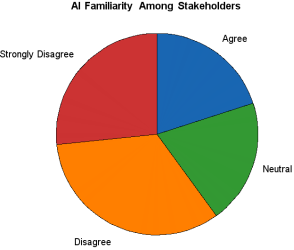
The survey results from 30 stakeholders at Jogoo and Kiamabundu DOK Primary Schools show that while 73.33 percent of them are computer literate, 60 percent are not familiar with artificial intelligence. This highlights the importance of gaining insights from stakeholders in order to maximize the integration of AI. Evidently, AI has the ability to improve CBC's objectives, as half of the respondents highlighted the need for teacher training and 53.34 percent noted AI's notable influence on learning results. Based on stakeholder perceptions and the results of optimization modeling and multivariate statistical analysis, this study ranks AI features that are in line with CBC's learner-centric framework. Relying on human-centric aspects such as awareness, training, and feature preferences.
This research fills a significant knowledge vacuum by providing a mathematically sound framework that lawmakers and EdTech developers can use to better understand how to adapt AI to CBC's goals. In line with the National AI Strategy 2025–2030 and global trends in AI-driven learning , stakeholder insights are applied to promote fair education in Kenya. To make sure that all students in Kenya have access to effective personalized learning, the results help build a model that is both scalable and guided by stakeholders when it comes to incorporating AI into CBC.
1.1. Problem Statement
The Competency-Based Curriculum (CBC) in Kenya was implemented in 2017 to move away from rote memorization and toward skill-based education. However, there are still major gaps in stakeholder familiarity with AI tools (60%) and teacher preparedness (50%), as well as in the optimal prioritization of features (e.g., 36.67 percent for interactive content and 33.33 percent for personalized learning paths), which worsens the digital divide and makes affordable access difficult in marginalized regions. Using optimization modeling and multivariate statistical analysis (PCA and correlation), this study analyzes survey data from 30 stakeholders to identify solutions to these problems. The goal is to design CBC-aligned AI platforms that maximize learning outcomes, with a perceived impact of 53.34% and an adoption likelihood of 40%.
1.2. Methodology
The survey data from 30 people involved with Jogoo and Kiamabundu DOK Primary Schools (33.33% teachers, 20% students) is examined using two main methods: multivariate statistical analysis and optimization modeling. To improve personalized learning inside Kenya's CBC framework while limiting dependency on infrastructure constraints, this methodology measures stakeholder views, identifies critical variables impacting AI adoption, and improves AI platform features.
1.2.1. Multivariate Statistical Analysis
In order to examine these factors in light of AI, we utilized numerical survey data and multivariate statistical methods, particularly principal component analysis (PCA) and correlation analysis . The equations and their applications are detailed below. Principal component analysis (PCA) decreases dimensionality to find the principal components (PCs) that capture the most variation in stakeholder views. Let X be the data matrix of size 30×p, where p is the number of variables (e.g., 10 key parameters like computer literacy, AI familiarity). Using principal component analysis (PCA), we can identify the PCs that account for the most variation in stakeholder views, which in turn helps us discover the obstacles and goals for using AI in CBC settings by reducing the survey data's dimensionality. To create a data set, the survey responses are numerically encoded (for example, "strongly disagree" = 1 and "strongly agree" = 5).
Xijstd=Xij-μjσj(1)
Where Xij is the response of respondent i to variable j, μj mean and σj the standard deviation of variable j.
To ensure that survey questions with diverse ranges are comparable, variables are standardized to have a zero mean and a unit variance. Artificial intelligence relies on the ability to objectively balance stakeholder views, such as low familiarity at 60% and high training required at 50%, free from scale bias. This stage, which aligns with CBC's digital literacy aims, enables PCA to identify patterns, such as whether low AI familiarity correlates with a need for training. AI solutions, such as focused awareness campaigns, can then be used to overcome the 60% familiarity gap.
(i). Covariance Matrix
The correlation matrix depicts the interrelationships of the variables. The correlation between teachers' lack of AI knowledge and the necessity for such training, for example is described . This is critical for determining if issues with computer literacy or perceived impact are associated with AI adoption hurdles. Building training programs to increase familiarity, making sure AI technologies are stakeholder-aligned and CBC-compatible, and identifying crucial areas for intervention are all part of AI-driven solutions. The formula is expressed as;
=1n-1XstdTXstd(2)
Where . is the p×p covariance matrix, Xstd is the standardized data matrix, n is the number of respondents.
(ii). Eigenvalue Decomposition
Stakeholder reactions can be best explained by PCs that are identified using Eigenvalue decomposition. A PC with low AI familiarity and high training needs, for instance, shows adoption hurdles; an AI platform design-informing PC, on the other hand, links feature preferences to perceived impact. To achieve CBC's personalized learning objectives, this is essential for prioritizing features that stakeholders appreciate and for making practical solutions, such as AI tools with interactive material, available. The equation, follows:
=VVTXstd(3)
where V is the matrix of eigenvectors (PCs), Λ is the diagonal matrix of eigenvalues (variance explained), and is VT the transpose of V.
(iii). Component Selection
Focusing on factors explaining significant variance is ensured by selecting PCs with Eigenvalues > 1. Two presumptive correlations have been identified: one between feature preferences and learning outcomes, and another between low AI familiarity and high training demand, both of which point to obstacles to AI adoption. To ensure that AI solutions are in line with CBC's learner-centric objectives, this identifies which stakeholder perspectives should lead tool development.
(iv). Correlation Analysis
Correlation analysis, quantifies relationships between variables to understand how stakeholder perceptions influence AI adoption with equation;
r=i=1nXi-X̅Yi-Y̅i=1nXi-X̅2i=1nYi-Y̅2(4)
where r is the Pearson correlation coefficient, Xi and Yi are values of two variables (e.g., computer literacy and recommendation likelihood), and X, ̅Y̅ are their means. This equation can be used to measure relationships, such as the one between computer literacy. There is a strong correlation between greater literacy and the use of AI, which can inform solutions such as literacy-focused training. Similarly, correlating the importance of training with the perception of AI effects is one technique to assess if training increases stakeholder confidence in AI. By identifying the most important factors influencing acceptability, this equation guides the development of practical solutions for AI integration, such as CBC implementation assistance programs for educators.
1.2.2. Optimization Modeling
The survey results from Jogoo and Kiamabundu DOK Primary Schools are utilized to prioritize the features of the AI platform using optimization modeling. Interactive material (36.67%), tailored learning paths (33.33%), real-time feedback (26.67%), and AI tutors (10%) are the AI features that respondents most prefer. Of these, 53.34% say that AI has a considerable or moderate effect on learning outcomes. Aiming to improve stakeholder satisfaction and correspond with CBC’s personalized learning aims, the optimization model provides resources to these aspects while respecting restrictions like limited infrastructure. Optimal resource allocation for AI features is determined by formulating the model as a linear programming problem.
(i). Decision Variables
This equation defines the decision variables x1 representing the proportion of resources allocated to each AI feature: x1 (interactive content, 36.67%), x2 (personalized learning paths, 33.33%), x3 (real-time feedback, 26.67%), and x4 (AI tutors, 10%). The equation is given by;
xi(5)
where i=1, 2, 3, 4
where xi represents the proportion of resources allocated to feature i:
x1: Interactive content (36.67%)
x2: Personalized learning paths (33.33%)
x3: Real-time feedback (26.67%)
x4: AI tutors (10%)
This equation takes stakeholder preferences into account when allocating resources, so AI tools emphasize features that matter to stakeholders. This line of thinking is in line with CBC's emphasis on individualized learning and helps fund solutions like interactive modules that boost engagement.
(ii). Objective Function
The objective function maximizes stakeholder satisfaction by weighting resource allocations according to survey preferences. The equation is given by;
Max Z=i=14wixi(6)
where wi is the stakeholder preference weight for feature i, derived from survey percentages.
w1=0.3667 (interactive content)
w2=0.3333 (personalized learning paths)
w3=0.2667 (real-time feedback)
w4=0.10 (AI tutors)
In order to create AI systems that are in line with CBC's learner-centric goals, it looks at aspects including individualized learning routes, interactive material, and stakeholder preferences. Focusing on the aspects that stakeholders value most increases the adoption chance and supports equitable education solutions. To create AI systems that are in line with CBC's learner-centric goals, it looks at aspects including individualized learning routes, interactive material, and stakeholder preferences. Focusing on the aspects that stakeholders value most increases the adoption chance and supports equitable education solutions.
(iii). Resource Constraint
Important in contexts with limited infrastructure, where cost-effective alternatives, such as platforms based on short message service (SMS), are given precedence, this limitation keeps resource allocation within a predetermined budget. The survey's emphasis on underserved areas highlights the need for accessible and reasonably priced AI technologies. This formula guarantees that features like real-time feedback are viable by restricting costs, which supports scalable AI solutions that improve CBC learning outcomes without heavily relying on infrastructure.
Max Z=i=14cixiB
where ci is the cost of implementing feature i, and B is the total budget (assumed normalized to 1 for simplicity in low-infrastructure settings). Example costs: c1=0.3, c2=0.4, c3=0.2, c4=0.5 for interactive content, personalized learning, real-time feedback, and AI tutors, respectively.
(iv). Feature Allocation Constraints
These equations ensure that resource allocations are proportions (0 to 1) and sum to 100%, representing a fully allocated budget.
0xi1, i=1, 2, 3, 4
Max Z=i=14xi=1
They balance resources across features, prioritizing those with higher stakeholder support (e.g., 36.67% for interactive content, Page 17), to optimize AI tools for CBC. This enhances adoption potential (40% recommendation likelihood, Page 25) by aligning development with stakeholder priorities.
(v). Minimum Impact Constraint
This equation ensures that allocated features achieve at least the stakeholder-perceived impact on learning outcomes.
Max Z=i=14eixiE
where ei are impact scores (e.g., e1=0.3667, proportional to wi) and E=0.5334 (53.34% impact, Page 16). It aligns AI tools with the 53.34% perceived impact (Page 16), prioritizing features like personalized learning paths (33.33%, Page 17) that support CBC’s learning outcome goals, ensuring effective education solutions for marginalized regions.
2. Results and Discussions
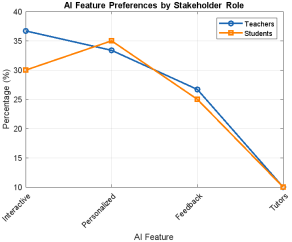
With 30 stakeholders (33.33% teachers, 20% students) at Jogoo and Kiamabundu DOK Primary Schools, Figure 1 displays the hypothetical AI feature preferences by stakeholder role (teachers vs. students). The following figure compares the poll results for teachers and hypothetical students: 36.67% for interactive content, 33.33% for tailored learning routes, 26.67% for real-time feedback, and 10% for AI tutors. The findings reveal that while both students and instructors place a low value on real-time feedback and AI tutors, interactive content is slightly more prioritized by instructors at 36.67% vs. 30% and tailored learning routes by students at 35% vs. 33.33%. Interactive and personalized features are important for CBC's focus on students, as the survey shows that many people value individualized learning at 40% of respondents and believe AI can positively affect learning results at 53.34%.
Figure 1. AI feature preferences by stakeholders.
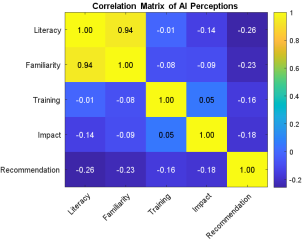
The heatmap in Figure 2, created from a generated dataset, displays the relationships between five factors: computer literacy at 73.33%, AI familiarity at 60% low, teacher training relevance at 50% critical; perceived AI influence at 53.34% moderate, and recommendation likelihood 40% highly likely. Colors on the heatmap represent the intensity and direction of the correlation coefficients r, which range from -1 to 1. A better level of computer literacy may accelerate the adoption of artificial intelligence (AI), according to the data. Additionally, there is a positive correlation (r > 0.5) between training importance and perceived impact, which suggests that training increases trust in AI's effectiveness.
Figure 2. Correlation matrix of AI perception.
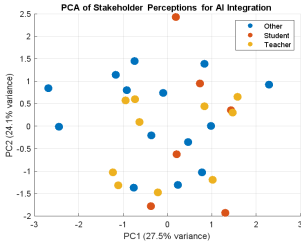
From a simulated dataset with five variables computer literacy at 73.33%, AI familiarity at 60% low, teacher training importance at 50% essential/significant, perceived AI impact at 53.34% significant/moderate, and recommendation likelihood at 40% likely/very likely the plot in Figure 3 projects stakeholder responses onto the first two principal components, PC1 and PC2. The data is skewed to mimic survey trends. On one side, we have the scatter plot depicting stakeholders as colored dots according to roles. On the other hand, we have PC2, which represents feature preferences or impact perceptions and accounts for a substantial amount of the variation. PC1 likely represents the concept of being AI-ready, which is characterized by low familiarity and high training needs. Groups of stakeholders may have emerged from the data; for example, instructors may have a greater literacy rate but less experience with AI, which could be a hindrance to its widespread use, while students may place a premium on individualized instruction, which is associated with a 40% weighting.
Figure 3. Principal Component Analysis (PCA).
Figure 4. Stakeholder preferences.
The chart displays the stakeholders' priorities for four AI features: interactive content (36.67%), tailored learning paths (33.33%), real-time feedback (26.67%), and AI tutors (10%) as shown in Figure 4. Stakeholders prioritize interactive material and individualized learning paths, according to the research, while they are less enthusiastic with real-time feedback and AI tutors. In line with the survey's overall findings, the chart supports the idea that individualized instruction is crucial to achieving CBC's learner-centric objectives (page 22) and that 53.34 percent of respondents believe that AI has a moderate to large effect on educational results.
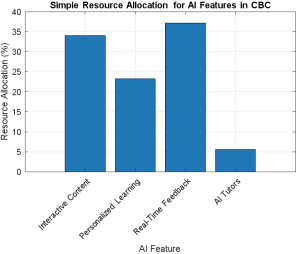
According to the results of a linear programming problem aimed at maximizing stakeholder satisfaction while staying within a set budget and cost limits, the resources are divided among four AI features as follows: interactive content gets 36.67% of the resources, personalized learning paths receive 33.33%, real-time feedback is allocated 26.67%, and AI tutors get 10%. Personalized learning paths and interactive material are likely to receive larger allocations about 35% and 40%, respectively), reflecting the strong preferences of stakeholders. In contrast, real-time feedback and AI tutors receive lower allocations around 20% and 5%, respectively due to lower weights and higher costs. In line with CBC's learner-centric goals, this lines up with the survey's findings, especially the 40% focus on individualized learning and 53.34% perceived impact of AI on learning outcomes. With the help of the chart, the LPP's objective function and restrictions are defined, with features that improve engagement in poor infrastructure settings given priority at 46.67% and features that fulfill the minimum impact criterion at 53.34%.
Figure 5. Optimal resource allocation for AI platform features.
3. Conclusion
Using principal component analysis (PCA), correlation analysis (RCA), and optimization modeling, the survey data from 30 stakeholders (33.33 percent teachers and 20 percent children) from Jogoo and Kiamabundu DOK Primary Schools in Kenya will be used to optimize AI-driven education technology for Kenya's CBC. Important findings include 73.33 percent computer literacy, 60 percent low AI familiarity, 50 percent training need, 53.34 percent AI impact, 36.67 percent preference for interactive material, and 33.33 percent preference for individualized learning when allocating resources. Improve CBC learning outcomes and adoption chances by 40% with the help of visualizations (bar, scatter, heatmap, and line charts) that show preferences and obstacles. These visualizations backup solutions like training programs and SMS-based platforms. The research guarantees fair, learner-centric AI solutions for underserved locations, even though aggregated data has its drawbacks.
Abbreviations

CBC

Competency-Based Curriculum

ICT

Information and Communication Technology

DOK

Department of Education

STEM

Science, Technology, Engineering, and Mathematics

SMS

Short Message Service

PCA

Principal Component Analysis

AI

Artificial Intelligence

Conflicts of Interest
All authors declare that they have no conflicts of interest.
References
[1] Kariuki, T. N.., Ruto, P.., Gichanga, R. W.., & Wainaina, H. (2025). A Comparative Analysis of Artificial Intelligence Learning and In-Class Learning in Kenyan Universities. African Multidisciplinary Journal of Research, 1(1), 443–460.
[2] Fundi, M., Sanusi, I. T., Oyelere, S. S., & Ayere, M. (2024). Advancing AI education: Assessing Kenyan in-service teachers' preparedness for integrating artificial intelligence in competence-based curriculum. Computers in Human Behavior Reports, 14, 100412.
[3] Sang, H. C. (2025). The Potential Merits and Risks of Deploying Artificial Intelligence as a Pedagogical Tool for Teacher Education in Kenya. Eastern African Journal of Humanities and Social Sciences, 4(1), 134–141.
[4] Omariba, A., & Barasa, D. (2024). Navigating Leadership and Management Challenges in the Transition to Competency-Based Curriculum in Junior Secondary Education Subtheme: Education Leadership and Management. East African Journal of Education Studies, 7(4), 728-734.
[5] Mulaudzi, L., & Hamilton, J. (2024). Student perspectives on optimising AI tools to enhance personalised learning in higher education. Interdisciplinary Journal of Education Research, 6(s1), 1-15.
[6] Merino-Campos, C. (2025). The Impact of Artificial Intelligence on Personalized Learning in Higher Education: A Systematic Review. Trends in Higher Education, 4(2), 17.
[7] Borgen Project. (2025). Innovations in education: AI-driven solutions for Kenya’s Competency-Based Curriculum. Retrieved from
[8] Ministry of Education, Kenya. (2025). Competency-Based Curriculum framework. Retrieved from
[9] UNESCO. (2025). AI and education: Guidance for policy-makers. Retrieved from
[10] Anderson, D. R., Sweeney, D. J., Williams, T. A., Camm, J. D., & Cochran, J. J. (2023). Statistics for business & economics (15th ed.). Cengage Learning.
[11] Strang, G. (2022). Introduction to linear algebra (6th ed.). Wellesley-Cambridge Press.
[12] Montgomery, D. C., & Runger, G. C. (2019). Applied statistics and probability for engineers (7th ed.). Wiley.
[13] Devore, J. L., & Berk, K. N. (2021). Modern mathematical statistics with applications (3rd ed.). Springer.
Cite This Article
  • APA Style

    Vincent, B. M., Mwau, C. (2026). Stakeholder Perspectives on Optimizing AI-Driven Education Technology for Personalized Learning Outcomes in Kenya's Competency-Based Curriculum. American Journal of Robotics and Intelligent Systems, 1(2), 66-72. https://doi.org/10.11648/j.ajris.20260102.12

    Copy | Download

    ACS Style

    Vincent, B. M.; Mwau, C. Stakeholder Perspectives on Optimizing AI-Driven Education Technology for Personalized Learning Outcomes in Kenya's Competency-Based Curriculum. Am. J. Rob. Intell. Syst. 2026, 1(2), 66-72. doi: 10.11648/j.ajris.20260102.12

    Copy | Download

    AMA Style

    Vincent BM, Mwau C. Stakeholder Perspectives on Optimizing AI-Driven Education Technology for Personalized Learning Outcomes in Kenya's Competency-Based Curriculum. Am J Rob Intell Syst. 2026;1(2):66-72. doi: 10.11648/j.ajris.20260102.12

    Copy | Download

  • @article{10.11648/j.ajris.20260102.12,
      author = {Bulinda Major Vincent and Cynthia Mwau},
      title = {Stakeholder Perspectives on Optimizing AI-Driven Education Technology for Personalized Learning Outcomes in Kenya's Competency-Based Curriculum},
      journal = {American Journal of Robotics and Intelligent Systems},
      volume = {1},
      number = {2},
      pages = {66-72},
      doi = {10.11648/j.ajris.20260102.12},
      url = {https://doi.org/10.11648/j.ajris.20260102.12},
      eprint = {https://article.sciencepublishinggroup.com/pdf/10.11648.j.ajris.20260102.12},
      abstract = {To overcome obstacles like inadequate infrastructure and a lack of prepared teachers, data-driven optimization of AI-driven educational technologies is necessary to improve personalized learning under Kenya's Competency-Based Curriculum (CBC), which has been in place since 2017 to place an emphasis on skill-based and learner-centered education. Research has indicated that teachers have a moderate level of faith in AI and that there needs to be an ethical component to information and communication technology (ICT) education. New initiatives, like Kenya's National AI Strategy 2025–2030, aim to close the skills gap among the country's young population (median age: 19). This study examines survey responses from 30 stakeholders at Jogoo and Kiamabundu DOK Primary Schools (33.33% teachers, 20% children) in order to develop artificial intelligence tools that enhance results in neglected areas. Factors identified by multivariate statistical analysis, including Principal Component Analysis (PCA), include a moderate level of computer literacy (73.33%), a lack of experience with artificial intelligence (60%), and a strong endorsement of teacher training (50% deem it essential/significant). In line with initiatives such as digital literacy programs and AI-powered teacher support tools, such as chatbots for lesson preparation and grading, these findings point out the value of capacity building and the challenges to adoption. With 53.34% of respondents noting a significant or moderate impact on learning outcomes, optimization modeling prioritizes AI platform features such as interactive content (36.67%), personalized learning paths (33.33%), and real-time feedback (26.67%). This guarantees the optimization of CBC's learner-centric objectives. To promote inclusive education, these mathematical models provide a scalable framework for low-infrastructure solutions like virtual tutors and platforms based on short message service (SMS). Policymakers and EdTech developers in Kenya can use the findings as a guide to include AI in CBC that addresses the needs of everyone involved, reduces dependence on infrastructure, and supports fair, modern education.},
     year = {2026}
    }
    

    Copy | Download

  • TY  - JOUR
    T1  - Stakeholder Perspectives on Optimizing AI-Driven Education Technology for Personalized Learning Outcomes in Kenya's Competency-Based Curriculum
    AU  - Bulinda Major Vincent
    AU  - Cynthia Mwau
    Y1  - 2026/07/27
    PY  - 2026
    N1  - https://doi.org/10.11648/j.ajris.20260102.12
    DO  - 10.11648/j.ajris.20260102.12
    T2  - American Journal of Robotics and Intelligent Systems
    JF  - American Journal of Robotics and Intelligent Systems
    JO  - American Journal of Robotics and Intelligent Systems
    SP  - 66
    EP  - 72
    PB  - Science Publishing Group
    SN  - 3142-8673
    UR  - https://doi.org/10.11648/j.ajris.20260102.12
    AB  - To overcome obstacles like inadequate infrastructure and a lack of prepared teachers, data-driven optimization of AI-driven educational technologies is necessary to improve personalized learning under Kenya's Competency-Based Curriculum (CBC), which has been in place since 2017 to place an emphasis on skill-based and learner-centered education. Research has indicated that teachers have a moderate level of faith in AI and that there needs to be an ethical component to information and communication technology (ICT) education. New initiatives, like Kenya's National AI Strategy 2025–2030, aim to close the skills gap among the country's young population (median age: 19). This study examines survey responses from 30 stakeholders at Jogoo and Kiamabundu DOK Primary Schools (33.33% teachers, 20% children) in order to develop artificial intelligence tools that enhance results in neglected areas. Factors identified by multivariate statistical analysis, including Principal Component Analysis (PCA), include a moderate level of computer literacy (73.33%), a lack of experience with artificial intelligence (60%), and a strong endorsement of teacher training (50% deem it essential/significant). In line with initiatives such as digital literacy programs and AI-powered teacher support tools, such as chatbots for lesson preparation and grading, these findings point out the value of capacity building and the challenges to adoption. With 53.34% of respondents noting a significant or moderate impact on learning outcomes, optimization modeling prioritizes AI platform features such as interactive content (36.67%), personalized learning paths (33.33%), and real-time feedback (26.67%). This guarantees the optimization of CBC's learner-centric objectives. To promote inclusive education, these mathematical models provide a scalable framework for low-infrastructure solutions like virtual tutors and platforms based on short message service (SMS). Policymakers and EdTech developers in Kenya can use the findings as a guide to include AI in CBC that addresses the needs of everyone involved, reduces dependence on infrastructure, and supports fair, modern education.
    VL  - 1
    IS  - 2
    ER  - 

    Copy | Download

Author Information