
Optical losses due to surface reflection remain one of the major factors limiting the conversion efficiency of silicon solar cells, since a significant fraction of incident light is reflected before it can be absorbed and converted into electrical energy. This paper presents a theoretical study of the optical performance of a silicon solar cell coated with anti-reflective layers, with the aim of reducing this reflection and increasing the fraction of incident light available for conversion. The refractive index of silicon was calculated using Sellmeier's equation, and the reflectance of bare silicon was derived from the Fresnel relation at normal incidence. Four coating materials — MgF2, SiO2, ZrO2 and TiO2 — were selected for their refractive indices close to the optimal value obtained from the index-matching condition between air and silicon, evaluated at reference wavelengths of 600 nm and 800 nm, with quarter-wave optical thicknesses determined accordingly. The reflectance of the coated cell was then obtained from a multiple-interference model accounting for the Fresnel coefficients at the air/coating and coating/silicon interfaces, while the external quantum efficiency was computed from a one-dimensional minority-carrier transport model over a wavelength range of 400 to 900 nm. The theoretical results showed that bare silicon has a high reflectance coefficient, ranging from 33 to 55 per cent, which justifies the deposition of an anti-reflective coating. Among the materials studied, ZrO2 and TiO2 offer the greatest reductions in reflectance, enabling the external quantum efficiency to be improved from 63 per cent for bare silicon to 95 per cent for the coated cell. These results establish the optical basis on which the electrical performance of the coated cell, examined in a companion study, can be understood. Consequently, silicon solar cells equipped with an anti-reflective coating, particularly one made of ZrO2, offer considerable potential for reducing optical losses and improving the overall performance of photovoltaic devices.
| Published in | Advances in Materials (Volume 15, Issue 4) |
| DOI | 10.11648/j.am.20261504.13 |
| Page(s) | 161-171 |
| Creative Commons |
This is an Open Access article, distributed under the terms of the Creative Commons Attribution 4.0 International License (http://creativecommons.org/licenses/by/4.0/), which permits unrestricted use, distribution and reproduction in any medium or format, provided the original work is properly cited. |
| Copyright |
Copyright © The Author(s), 2026. Published by Science Publishing Group |
Silicon, Anti-Reflective Coating, Refractive Index, Reflectance, External Quantum Efficiency
λ (nm) | 399.90 | 427.50 | 459.90 | 495.90 | 539.00 | 590.40 | 652.50 | 729.30 | 826.50 |
n | 5.570 | 4.961 | 4.583 | 4.320 | 4.123 | 3.969 | 3.847 | 3.752 | 3.673 |
Material | MgF2 | SiO2 | ZrO2 | TiO2 |
|---|---|---|---|---|
Index n | 1.37 | 1.46 | 1.95 | 2.20 |
Materials for the anti-reflective coating | MgF2 | SiO2 | ZrO2 | TiO2 |
|---|---|---|---|---|
Thickness (nm) for λ = 400 nm | 72 | 64 | 44 | 35 |
Thickness (nm) for λ = 800 nm | 145 | 130 | 92 | 79 |
PV | Photovoltaic |
ARC | Anti-Reflective Coating |
EQE | External Quantum Efficiency |
FF | Fill Factor |
ZCE | Space Charge Region |
| [1] | Liangwei Chen, Jingwen Zhang, Xinyue Zhang, Hao Liu, « A new low-carbon project scheduling problem with renewable and traditional energy: a comprehensive analysis and its solution », Journal of Cleaner Production, volume 468, 2024, pp. 143089, |
| [2] | Richard Hanna, Phil Heptonstall, Robert Gross, « Job creation in a low carbon transition to renewables and energy efficiency: a review of international evidence », Sustainability Science, volume 19, 2024, pp. 125–150, |
| [3] | Menghan Li, Xiaoxiao Liu, Mian Yang, « Analyzing the regional inequality of renewable energy consumption and its driving factors: evidence from China », Renewable Energy, volume 223, 2024, pp. 120043, |
| [4] | Zhixin Qian, Tao He, Haozhe Wang, Shi Peng, Jing Zhang, Xu Yu, « Recoating by atmospheric pressure plasma jet dual-layer SiO2/TiO2 films for in-situ restoration of the anti-reflective coating on solar cell modules », Surfaces and Interfaces, volume 74, 2025, pp. 107683, |
| [5] | Arafa H. Aly, Hassan Sayed, Hussein A. Elsayed, « Development of the monolayer silicon solar cell based on photonic crystals », Silicon, volume 11, 2019, pp. 1377–1382, |
| [6] | Chunxue Ji, Wen Liu, Yidi Bao, Xiaoling Chen, Guiqiang Yang, Bo Wei, Fuhua Yang, Xiaodong Wang, « Recent applications of antireflection coatings in solar cells », Photonics, volume 9, 2022, pp. 906, |
| [7] | Hussein A. Elsayed, Hassan Sayed, T. A. Taha, Abdullah G. Alharbi, Asma M. Alenad, Basheer A. Alshammari, Ashour M. Ahmed, Ahmed Mehaney, Arafa H. Aly, « Simple and efficient design towards a significant improvement of the optical absorption of amorphous silicon solar cell », Journal of Quantitative Spectroscopy and Radiative Transfer, volume 275, 2021, pp. 107890, |
| [8] | E. Radziemska, « The effect of temperature on the power drop in crystalline silicon solar cells », Renewable Energy, volume 28, n°1, 2003, pp. 1–12, |
| [9] | K. Kacha, F. Djeffal, H. Ferhati, D. Arar, M. Meguellati, « Numerical investigation of a double-junction a: SiGe thin-film solar cell including the multi-trench region », Journal of Semiconductors, volume 36, n°6, 2015, pp. 064004, |
| [10] | Yuqiang Liu, Yajuan Li, Yiliang Wu, Guangtao Yang, Luana Mazzarella, Paul Procel-Moya, Adele C. Tamboli, Klaus Weber, Mathieu Boccard, Olindo Isabella, Xinbo Yang, Baoquan Sun, « High-efficiency silicon heterojunction solar cells: materials, devices and applications », Materials Science and Engineering: R: Reports, volume 142, 2020, pp. 100579, |
| [11] | Zhaoqing Sun, Xiaoqing Chen, Yongcai He, Jingjie Li, Jianqiang Wang, Hui Yan, Yongzhe Zhang, « Toward efficiency limits of crystalline silicon solar cells: recent progress in high-efficiency silicon heterojunction solar cells », Advanced Energy Materials, volume 12, 2022, pp. 2200015, |
| [12] | Yunlai Yuan, Zhe Chen, Hui Peng, Xixiang Xu, Minghao Qu, Shi Yin, Xiaoning Ru, Wangping Wu, Lvzhou Li, Qinqin Wang, Jianning Ding, « Study on the process of hydrogen-doped indium oxide for silicon heterojunction solar cell mass production », Solar Energy Materials and Solar Cells, volume 271, 2024, pp. 112836, |
| [13] | Hong-Ping Ma, Hong-Liang Lu, Jia-He Yang, Xiao-Xi Li, Tao Wang, Wei Huang, Guang-Jie Yuan, Fadei F. Komarov, David Wei Zhang, « Measurements of microstructural, chemical, optical, and electrical properties of silicon-oxygen-nitrogen films prepared by plasma-enhanced atomic layer deposition », Nanomaterials, volume 8, 2018, pp. 1008, |
| [14] | Wei Zhang, Jielei Tu, Weixu Long, Wangfu Lai, Yuqing Sheng, Tengteng Guo, « Preparation of SiO2 anti-reflection coatings by sol-gel method », Energy Procedia, volume 130, 2017, pp. 72–76, |
| [15] | Nordine Sahouane, Abdellatif Zerga, « Optimization of antireflection multilayer for industrial crystalline silicon solar cells », Energy Procedia, volume 44, 2014, pp. 118–125, |
| [16] | M. Claudia Troparevsky, Adrian S. Sabau, Andrew R. Lupini, Zhenyu Zhang, « Transfer-matrix formalism for the calculation of optical response in multilayer systems: from coherent to incoherent interference », Optics Express, volume 18, n°24, 2010, pp. 24715–24721, |
| [17] | KartikaChandra Sahoo, Men-Ku Lin, Edward-Yi Chang, Yi-Yao Lu, Chun-Chi Chen, Jin-Hua Huang, Chun-Wei Chang, « Fabrication of antireflective sub-wavelength structures on silicon nitride using nano cluster mask for solar cell application », Nanoscale Research Letters, volume 4, n°7, 2009, pp. 680–683, |
| [18] | Kuk-Hyun Cho, Hyo Sik Chang, « A study on the thermal stability of an Al2O3/SiON stack structure for c-Si solar cell passivation application », Journal of the Korean Ceramic Society, volume 51, n°3, 2014, pp. 197–200, |
| [19] | A. Soutar, B. Fokkink, Z. Xianting, T. S. Nee, L. Wu, « Sol-gel Antireflective Coatings », SIM Tech Technical Report, 2001. |
| [20] | Alexandros Cruz, Darja Erfurt, Philipp Wagner, Anna B. Morales-Vilches, Florian Ruske, Rutger Schlatmann, Bernd Stannowski, « Optoelectrical analysis of TCO+silicon oxide double layers at the front and rear side of silicon heterojunction solar cells », Solar Energy Materials and Solar Cells, volume 236, 2022, pp. 111493, |
| [21] | Can Han, Rudi Santbergen, Max van Duffelen, Paul Procel, Yifeng Zhao, Guangtao Yang, Xiaodan Zhang, Miro Zeman, Luana Mazzarella, Olindo Isabella, « Towards bifacial silicon heterojunction solar cells with reduced TCO use », Progress in Photovoltaics: Research and Applications, volume 30, n°7, 2022, pp. 750–762, |
| [22] | Martin A. Green, Alistair B. Sproul, Tom Puzzer, Guang Fu Zheng, Paul Basore, Trevor Young, « Silicon Parallel Multilayer Thin Film Solar Cells », MRS Online Proceedings Library, volume 426, 1996, pp. 103–110, |
| [23] | Modou Pilor, Alassane Diaw, Bouchaib Hartiti, Papa Touty Traore, Bassirou Ba, « Passive Cooling of Photovoltaic Modules Using Nanofluid Layers: Thermal Modeling and Efficiency Improvement Under Outdoor Conditions », European Journal of Advances in Engineering and Technology, volume 12, n°7, 2025, pp. 60–65. |
| [24] | D. M. Chapin, C. S. Fuller, G. L. Pearson, « A New Silicon p-n Junction Photocell for Converting Solar Radiation into Electrical Power », Journal of Applied Physics, volume 25, 1954, pp. 676–677, |
| [25] | L. Remache, A. Mahdjoub, E. Fourmond, J. Dupuis, M. Lemiti, « Design of porous silicon, PECVD SiOx antireflection coatings for silicon solar cells », in Proceedings of the International Conference on Renewable Energies and Power Quality (ICREPQ), Granada, Spain, 2010, |
| [26] | Abdulkarem H. M. Almawgani, Ahmad Alzahrani, Ali Hajjiah, Ahmed Mehaney, Hussein A. Elsayed, Hassan Sayed, « Optical absorption performance of CZTS/ZnO thin film solar cells comprising anti-reflecting coating of texturing configuration », RSC Advances, volume 13, 2023, pp. 31554–31568, |
| [27] | Bing Hao, Yimeng Song, Conghui Jiang, Jiufang Han, Yang Jiang, Zhi Deng, Wenxin Wang, Haiqiang Jia, Hong Chen, Chunhua Du, « Comparing single-, double- and triple-layer anti-reflection coatings for ultra-low reflectance in silicon heterojunction solar cells », Japanese Journal of Applied Physics, volume 62, 2023, pp. 061002, |
| [28] | Seok Jin Jang, Muhammad Quddamah Khokhar, Hasnain Yousuf, Alamgeer, Junhan Bae, Yeojin Jeong, Yunhui Jang, Youngkuk Kim, Sangheon Park, Woo Kyoung Kim, Junsin Yi, « Improvement of optoelectrical properties of silicon heterojunction solar cells by using ITO/SiOx DLARC with NH3 plasma treatment », Current Applied Physics, volume 80, 2025, pp. 72–81, |
| [29] | Muhammad Aleem Zahid, Muhammad Quddamah Khokhar, Somin Park, Shahzada Qamar Hussain, Youngkuk Kim, Junsin Yi, « Influence of Al2O3/IZO double-layer antireflective coating on the front side of rear emitter silicon heterojunction solar cell », Vacuum, volume 200, 2022, pp. 110967, |
| [30] | N. Mbengue, M. Diagne, F. Dia, S. Ndiaye, O. A. Niasse, A. Dieye, M. Niane, B. Ba, « Simulation Study of Optical Reflection and Transmission Properties of the Anti-Reflection Coatings on the Silicon Solar Cells », International Journal of Scientific Engineering and Technology, volume 5, n°3, 2016, pp. 161–164, |
| [31] | N. Mbengue, M. Diagne, F. Dia, M. Niane, A. Dieye, W. Diallo, O. A. Niasse, B. Ba, « Influence of the Refractive Index of Anti-Reflective Coating on the External Quantum Efficiency of the Silicon Solar Cells », International Journal of Engineering Research, volume 5, n°4, 2016, pp. 226–230, |
| [32] | N. Mbengue, M. Diagne, M. Niane, A. Dieye, O. A. Niasse, B. Ba, « Optimization of Double Anti-Reflective Coating SiOx/SiNx on the Solar Cells with Silicon Conventional », International Journal of Engineering Trends and Technology, volume 20, n°2, 2015, pp. 101–104, |
| [33] | Akbari et al., « Designing novel plasmonic architectures for highly efficient CIGS solar cells », Solar Energy, volume 274, 2024, pp. 112589, |
| [34] | Vasquez et al., « Optical, electrical and chemical characterization of inorganic hole transporting materials for the recombination junction in two-terminal perovskite/silicon heterojunction solar cells », Solar Energy, volume 273, 2024, pp. 112375, |
| [35] | Pruthaba Jadeja et al., « Investigating the impact of various electron transport layers on the performance of Sn-based perovskite solar cells: A device simulation using SCAPS-1D », Journal of Physics and Chemistry of Solids, volume 208, 2026, pp. 113088, |
| [36] | Ajay Kumar et al., « Advanced perspectives on chalcogenide perovskite solar cells using CZTS as HTL for optimum efficiency », Journal of Physics and Chemistry of Solids, volume 208, 2026, pp. 113101, |
| [37] | M. Pilor, A. Diaw, P. T. Traore, N. Mbengue, M. Diagne, O. A. Niasse, B. Ba, « Influence of the Refraction Index, The Thickness of the Antireflection Layer, The Spectral Response and The Texturization of a Silicon Solar Cell: Application to Antireflective Multilayers », European Journal of Advances in Engineering and Technology, volume 10, n°5, 2023, pp. 66–75, |
| [38] | A. Diaw, M. Pilor, N. Mbengue, P. T. Traore, « Impact of Thickness, Refractive Index and Diffusion Length of Minority Carriers on Antireflection Materials: Study on the Spectral Response of a Monocrystalline Silicon Solar Cell », Journal of Scientific and Engineering Research, volume 10, n°5, 2023, pp. 229–235, |
| [39] | Z. Fang, Q. Chen, J. Yuan, « Bi-layered closed-pore structure anti-reflective coatings with ZnO quantum dots for further improving the solar cell efficiency », Solar Energy Materials and Solar Cells, volume 294, 2026, pp. 113936, |
| [40] | N. Mbengue, M. Diagne, M. Niane, O. A. Niasse, B. Ba, « External Quantum Efficiency of a Solar Cell ZnO/CdTe: Effect of Emitter and Base Thicknesses », International Journal of Engineering Trends and Technology, volume 20, n°2, 2015, pp. 105–108, |
| [41] | M. Diagne, W. Diallo, N. Mbengue, F. Dia, O. A. Niasse, « External Quantum Efficiency of a ZnO/CdTe Solar Cell: Effects of Space Charge Zones, Diffusion Length & Recombination Rate, Calculated by the Dielectric Function Method », International Journal for Scientific Research & Development, volume 6, n°7, 2018, pp. 591–594, |
| [42] | M. Diagne, W. Diallo, N. Mbengue, F. Dia, O. A. Niasse, B. Ba, « External Quantum Efficiency of a Solar Cell ZnO/CdTe: Effects of Excitons by the Method of Calculating the Dielectric Function », International Journal of Engineering Sciences & Research Technology, volume 7, n°9, 2018, pp. 300–308, |
| [43] | A. Diaw, O. A. Niasse, N. Mbengue, B. Ba, « Simulations of Antireflecting Coating on a Monocrystalline Silicon Solar Cell: Influence of Optical Parameters on a Double Layers », American Journal of Energy Research, volume 11, n°1, 2023, pp. 27–30, |
| [44] | A. Dieye, N. Mbengue, O. A. Niasse, F. Dia, M. Diagne, B. Ba, « Influence of Multi Anti-Reflective Layers on the Silicon Solar Cells », Journal of Materials Science & Surface Engineering, volume 5, n°8, 2017, pp. 729–732, |
| [45] | M. M. Diop, A. Diaw, N. Mbengue, O. Ba, M. Diagne, O. A. Niasse, B. Ba, J. Sarr, « Optimization and Modeling of Antireflective Layers for Silicon Solar Cells: In Search of Optimal Materials », Materials Sciences and Applications, volume 9, 2018, pp. 705–722, |
| [46] | L. Remache, E. Fourmond, A. Mahdjoub, J. Dupuis, M. Lemiti, « Influence of PECVD SiOx and SiNx:H films on optical and passivation properties of antireflective porous silicon coatings for silicon solar cells », physica status solidi (c), volume 8, n°6, 2011, pp. 1893–1897, |
| [47] | A. Mahdjoub, L. Zighed, « New designs for graded refractive index antireflection coatings », Thin Solid Films, volume 478, 2005, pp. 299–304, |
APA Style
Diagne, M., Sambou, A., Badji, I., Niasse, O. A., Ba, B. (2026). Theoretical Study of the Optical Performance of a Silicon Solar Cell Coated with Anti-Reflective Layers: Refractive Index, Reflectance and External Quantum Efficiency. Advances in Materials, 15(4), 161-171. https://doi.org/10.11648/j.am.20261504.13
ACS Style
Diagne, M.; Sambou, A.; Badji, I.; Niasse, O. A.; Ba, B. Theoretical Study of the Optical Performance of a Silicon Solar Cell Coated with Anti-Reflective Layers: Refractive Index, Reflectance and External Quantum Efficiency. Adv. Mater. 2026, 15(4), 161-171. doi: 10.11648/j.am.20261504.13
AMA Style
Diagne M, Sambou A, Badji I, Niasse OA, Ba B. Theoretical Study of the Optical Performance of a Silicon Solar Cell Coated with Anti-Reflective Layers: Refractive Index, Reflectance and External Quantum Efficiency. Adv Mater. 2026;15(4):161-171. doi: 10.11648/j.am.20261504.13
@article{10.11648/j.am.20261504.13,
  author = {Moulaye Diagne and Abel Sambou and Ismaila Badji and Oumar Absatou Niasse and Bassirou Ba},
  title = {Theoretical Study of the Optical Performance of a Silicon Solar Cell Coated with Anti-Reflective Layers: Refractive Index, Reflectance and External Quantum Efficiency},
  journal = {Advances in Materials},
  volume = {15},
  number = {4},
  pages = {161-171},
  doi = {10.11648/j.am.20261504.13},
  url = {https://doi.org/10.11648/j.am.20261504.13},
  eprint = {https://article.sciencepublishinggroup.com/pdf/10.11648.j.am.20261504.13},
  abstract = {Optical losses due to surface reflection remain one of the major factors limiting the conversion efficiency of silicon solar cells, since a significant fraction of incident light is reflected before it can be absorbed and converted into electrical energy. This paper presents a theoretical study of the optical performance of a silicon solar cell coated with anti-reflective layers, with the aim of reducing this reflection and increasing the fraction of incident light available for conversion. The refractive index of silicon was calculated using Sellmeier's equation, and the reflectance of bare silicon was derived from the Fresnel relation at normal incidence. Four coating materials — MgF2, SiO2, ZrO2 and TiO2 — were selected for their refractive indices close to the optimal value obtained from the index-matching condition between air and silicon, evaluated at reference wavelengths of 600 nm and 800 nm, with quarter-wave optical thicknesses determined accordingly. The reflectance of the coated cell was then obtained from a multiple-interference model accounting for the Fresnel coefficients at the air/coating and coating/silicon interfaces, while the external quantum efficiency was computed from a one-dimensional minority-carrier transport model over a wavelength range of 400 to 900 nm. The theoretical results showed that bare silicon has a high reflectance coefficient, ranging from 33 to 55 per cent, which justifies the deposition of an anti-reflective coating. Among the materials studied, ZrO2 and TiO2 offer the greatest reductions in reflectance, enabling the external quantum efficiency to be improved from 63 per cent for bare silicon to 95 per cent for the coated cell. These results establish the optical basis on which the electrical performance of the coated cell, examined in a companion study, can be understood. Consequently, silicon solar cells equipped with an anti-reflective coating, particularly one made of ZrO2, offer considerable potential for reducing optical losses and improving the overall performance of photovoltaic devices.},
 year = {2026}
}
TY  - JOUR
T1  - Theoretical Study of the Optical Performance of a Silicon Solar Cell Coated with Anti-Reflective Layers: Refractive Index, Reflectance and External Quantum Efficiency
AU  - Moulaye Diagne
AU  - Abel Sambou
AU  - Ismaila Badji
AU  - Oumar Absatou Niasse
AU  - Bassirou Ba
Y1  - 2026/11/16
PY  - 2026
N1  - https://doi.org/10.11648/j.am.20261504.13
DO  - 10.11648/j.am.20261504.13
T2  - Advances in Materials
JF  - Advances in Materials
JO  - Advances in Materials
SP  - 161
EP  - 171
PB  - Science Publishing Group
SN  - 2327-252X
UR  - https://doi.org/10.11648/j.am.20261504.13
AB  - Optical losses due to surface reflection remain one of the major factors limiting the conversion efficiency of silicon solar cells, since a significant fraction of incident light is reflected before it can be absorbed and converted into electrical energy. This paper presents a theoretical study of the optical performance of a silicon solar cell coated with anti-reflective layers, with the aim of reducing this reflection and increasing the fraction of incident light available for conversion. The refractive index of silicon was calculated using Sellmeier's equation, and the reflectance of bare silicon was derived from the Fresnel relation at normal incidence. Four coating materials — MgF2, SiO2, ZrO2 and TiO2 — were selected for their refractive indices close to the optimal value obtained from the index-matching condition between air and silicon, evaluated at reference wavelengths of 600 nm and 800 nm, with quarter-wave optical thicknesses determined accordingly. The reflectance of the coated cell was then obtained from a multiple-interference model accounting for the Fresnel coefficients at the air/coating and coating/silicon interfaces, while the external quantum efficiency was computed from a one-dimensional minority-carrier transport model over a wavelength range of 400 to 900 nm. The theoretical results showed that bare silicon has a high reflectance coefficient, ranging from 33 to 55 per cent, which justifies the deposition of an anti-reflective coating. Among the materials studied, ZrO2 and TiO2 offer the greatest reductions in reflectance, enabling the external quantum efficiency to be improved from 63 per cent for bare silicon to 95 per cent for the coated cell. These results establish the optical basis on which the electrical performance of the coated cell, examined in a companion study, can be understood. Consequently, silicon solar cells equipped with an anti-reflective coating, particularly one made of ZrO2, offer considerable potential for reducing optical losses and improving the overall performance of photovoltaic devices.
VL  - 15
IS  - 4
ER  -
Semiconductor and Solar Energy Laboratory, Cheikh Anta Diop University, Dakar, Senegal
Research Fields: Modelling of photovoltaic cells, Anti-reflective coatings, Thin-film semiconductors, Solar energy applications
Photonics and Nanofabrication Laboratory, Cheikh Anta Diop University, Dakar, Senegal
Research Fields: Photonics, Nanofabrication, Thin films, Optical materials
Semiconductor and Solar Energy Laboratory, Cheikh Anta Diop University, Dakar, Senegal
Research Fields: Semiconductor physics, Photovoltaic conversion, Solar energy
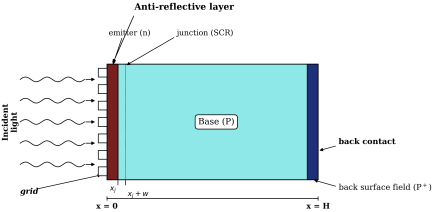
Figure 1. One-dimensional photovoltaic cell model.
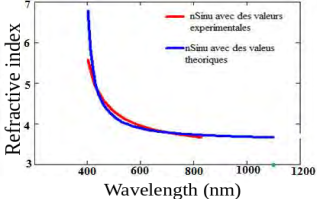
Figure 2. Characteristics of the variation in the refractive index n of bare silicon for different experimental and theoretical values as a function of wavelength.
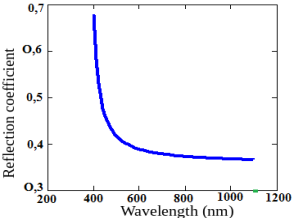
Figure 3. Graph showing the variation in the reflection coefficient of bare silicon as a function of wavelength.
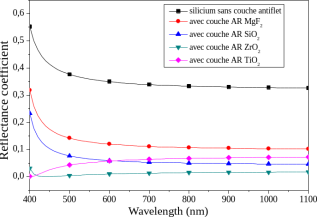
Figure 4. Characteristics of the variation in the reflectance coefficient of bare silicon and silicon with different anti-reflective coatings as a function of wavelength: for a reference wavelength λref = 600 nm.
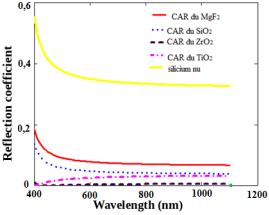
Figure 5. Characteristics of the variation in the reflectance coefficient of bare silicon and silicon with different anti-reflective coatings as a function of wavelength: for a reference wavelength λref = 800 nm.
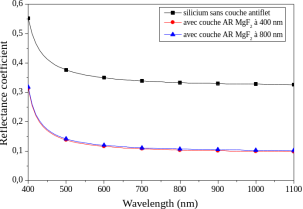
Figure 6. Reflectance of silicon as a function of wavelength (bare silicon and silicon coated with an MgF2 anti-reflective layer at reference wavelengths of 400 and 800 nm).
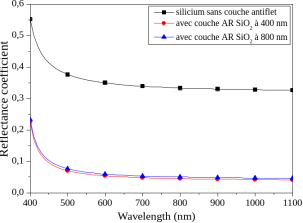
Figure 7. Reflectance of silicon as a function of wavelength (bare silicon and silicon coated with an SiO2 anti-reflective layer at the reference wavelengths of 400 nm and 800 nm).
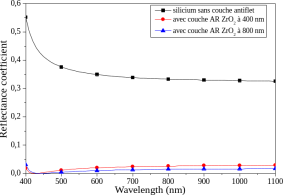
Figure 8. Reflectance of silicon as a function of wavelength (bare silicon and silicon coated with a ZrO2 anti-reflective layer at reference wavelengths of 400 nm and 800 nm).
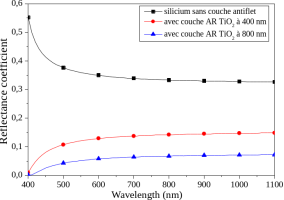
Figure 9. Reflectance of silicon as a function of wavelength (bare silicon and silicon coated with a TiO2 anti-reflective layer at reference wavelengths of 400 nm and 800 nm).
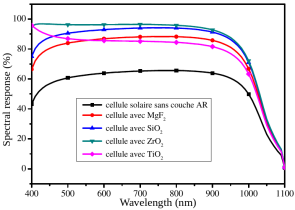
Figure 10. Spectrum of the external quantum efficiency of bare silicon and silicon with different anti-reflective coatings as a function of wavelength.

Information



 Share This Article
 Twitter
 Linked In
 Facebook

 Copy
 Download