
 ,
Marcelle Money,
Félicité Beudjé,
Kouao Maxime Diané,
Jean-Jacques Renaud Dechi,
Taté Roger Oulahi,
Solange Kakou-Ngazoa,
Mireille Dosso
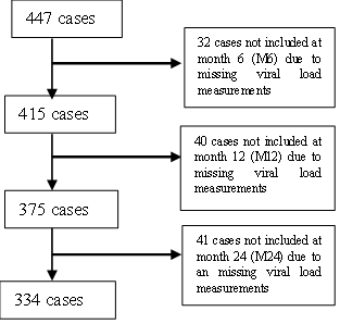
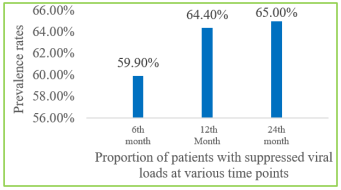
Background: Sustaining strict virological suppression is critical for mitigating treatment failure and preventing the emergence of drug-resistance mutations in people living with HIV. This multicenter. retrospective cohort study aimed to identify independent predictors of strict virological suppression (plasma viral load ≤ 20 copies/mL) at 6. 12. and 24 months post-antiretroviral therapy initiation among 334 PLHIV in Côte d’Ivoire. Methods and results: Sociodemographic and bioclinical data were retrieved from medical records across two health facilities between January 2019 and December 2025. Factors associated with strict virological suppression were evaluated using multivariable binary logistic regression analysis (reporting adjusted odds ratios and 95% confidence intervals). Diagnostic checks confirmed the absence of multicollinearity (variance inflation factors < 1.2). Strict virological suppression rates were 59.9% at 6 months. 64.4% at 12 months. and 65.0% at 24 months. Multivariable analysis demonstrated that high treatment adherence was the sole factor consistently and independently associated with virological success across all time points. Female sex and the healthcare facility level served as time-dependent independent predictors. Conclusion: Treatment adherence remains the paramount determinant of long-term strict virological suppression. Continuous strengthening of patient education and task-shifting toward primary care facilities are essential to sustain the long-term effectiveness of antiretroviral regimens.
| Published in | Central African Journal of Public Health (Volume 12, Issue 5) |
| DOI | 10.11648/j.cajph.20261205.17 |
| Page(s) | 317-326 |
| Creative Commons |
This is an Open Access article, distributed under the terms of the Creative Commons Attribution 4.0 International License (http://creativecommons.org/licenses/by/4.0/), which permits unrestricted use, distribution and reproduction in any medium or format, provided the original work is properly cited. |
| Copyright |
Copyright © The Author(s), 2026. Published by Science Publishing Group |
HIV/AIDS, Strict Virological Suppression, Treatment Adherence, Côte d’Ivoire
General specifications | Virological suppression at 6 months | Virological suppression at 12 months | Virological suppression at 24 months | ||||
|---|---|---|---|---|---|---|---|
n (%) | Yes n (%) | p-value | Yes n(%) | p-value | Yes n(%) | p-value | |
Total population | 334(100) | 200(59,9) | 215(64,4) | 217(65,0) | |||
Study site | |||||||
PPH | 212(63,5) | 137(64,6) | 0.020 | 147(69,3) | 0.012 | 157(74,1) | < .001 |
USAC | 122(36,5) | 63(51,6) | 68(55,7) | 60(49,2) | |||
Sex | |||||||
Woman | 221(66,2) | 143(64,7) | 0.012 | 153(69,2) | 0.010 | 147(66,5) | 0.408 |
Man | 113(33,8) | 57(50,4) | 62(54,9) | 70(61,9) | |||
Current age of patients | |||||||
[18-30] | 29(8,7) | 17(58,6) | 0.204 | 22(75,9) | 0.056 | 19(65,5) | 0.300 |
[30-40] | 69(20,6) | 43(62,3) | 35(50,7) | 45(65,2) | |||
[40-50] | 107(32,1) | 62(57,9) | 76(71,0) | 72(67,3) | |||
[50-60] | 94(28,1) | 51(54,3) | 60(63,8) | 54(57,4) | |||
≥ 60 | 35(10,5) | 27(77,1) | 22(62,9) | 27(77,1) | |||
Comorbidity | |||||||
No | 245(73,4) | 155(63,3) | 0.036 | 161(65,7) | 0.395 | 168(68,6) | 0.022 |
Yes | 89(26,6) | 45(50,6) | 54(60,7) | 49(55,1) | |||
HIV type | |||||||
HIV 1 | 314(94,0) | 187(59,6) | 0.362 | 202(64,3) | 0.488 | 202(64,3) | 0.748 |
HIV 1+2 | 17(5,1) | 10(58,8) | 10(58,8) | 13(76,5) | |||
HIV 2 | 3(0,9) | 3(100,0) | 3(100) | 2(66,7) | |||
Combination of ARVs | |||||||
TLD | 295(88,3) | 182(61,7) | 0.063 | 194(65,8) | 0.144 | 197(66,8) | 0.057 |
Other | 39(11,7) | 18(46,2) | 21(53,8) | 20(51,3) | |||
Medication adherence | |||||||
No | 61(18,3) | 19(31,1) | < .001 | 21(34,4) | < .001 | 14(23,0) | < .001 |
Yes | 273(81,7) | 181(66,3) | 194(71,1) | 203(74,4) | |||
Adjusted Odds Ratio (aOR) | p-value | 95% Confidence Interval (95% CI) | |
|---|---|---|---|
Study site: | |||
PPH | 1.12 | 0.682 | [0.65 - 1.95] |
USAC | 1 | ||
Age of patients: | |||
[18-30] | 1 | ||
[30-40] | 1.62 | 0.327 | [0.62 - 4.28] |
[40-50] | 1.03 | 0.955 | [0.42 - 2.51] |
[50-60] | 0.99 | 0.997 | [0.403 - 2.47] |
≥ 60 | 2.96 | 0.069 | [0.919 - 9.56] |
Sex: | |||
Woman | 1.96 | 0.009 | [1.185 - 3.23] |
Man | 1 | ||
Combination of ARVs: | |||
TLD | 1.385 | 0.414 | [0.63 - 3.03] |
Other | |||
Treatment adherence: | |||
YES | 4.311 | < .001 | [2.24 - 8.28] |
NO | 1 | ||
Comorbidities: | |||
NO | 1.56 | 0.112 | [0.902 - 2.72] |
Yes | 1 | ||
Note: Odds ratio for “Viral load suppression at 6 months = yes” versus “Viral load suppression at 6 months = no” | |||
Adjusted Odds Ratio (aOR) | p-value | 95% Confidence Interval (95% CI) | |
|---|---|---|---|
Study site: | |||
PPH | 1.54 | 0.125 | [0.89- 2.66] |
USAC | 1 | ||
Age of patients: | |||
[18-30] | 2.04 | 0.228 | [0.64 – 6.47] |
[30-40] | 0.67 | 0.390 | [0.27 – 1.66] |
[40-50] | 1.45 | 0.392 | [0.618 – 3.40] |
[50-60] | 1.09 | 0.849 | [0.46 – 2.56] |
≥ 60 | |||
Sex: | |||
Woman | 2.05 | 0.006 | [1.23 – 3.40] |
Man | 1 | ||
Combination of ARVs: | |||
TLD | 1.06 | 0.892 | [0.47 – 2.38] |
Other | 1 | ||
Medication adherence: | |||
Yes | 3.67 | < .001 | [1.96 – 6.94] |
No | 1 | ||
Note: Odds ratio for ‘Viral load suppression at 12 months = yes’ versus ‘Viral load suppression at 12 months = no’ | |||
Adjusted Odds Ratio (aOR) | p-value | 95% Confidence Interval (95% CI) | |
|---|---|---|---|
Study site: | |||
PPH | 2.04 | 0.012 | [1.17 – 3.57] |
USAC | 1 | ||
Comorbidity: | |||
No | 1.48 | 0.172 | [0.84 – 2.62] |
Yes | |||
Combination of ARVs: | |||
OTHER | 1.19 | 0.668 | [0.53 – 2.73] |
TLD | 1 | ||
Treatment adherence: | |||
YES | 8.33 | < .001 | [4.23 - 16.42] |
NO | |||
Note: Odds ratio for “Viral load suppression at 24 months = yes” versus “Viral load suppression at 24 months = no” | |||
Follow-up time | Independent factor | Reference category | ORa | 95% CI | p-value |
|---|---|---|---|---|---|
6 months (M6) | Gender (Female) | Man | 1,96 | [1,18 – 3,23] | 0,009 |
High adherence | No | 4,31 | [2,24 – 8,28] | < 0,001 | |
12 months (M12) | Gender (Female) | Man | 2,05 | [1,23 – 3,40] | 0,006 |
High adherence | No | 3,69 | [1,96 – 6,94] | < 0,001 | |
24 months (M24) | Site (PPH) | USAC | 2,04 | [1,17 – 3,57] | 0,012 |
High adherence | No | 8,33 | [4,23 – 16,42] | < 0,001 | |
PPH is Tertiary care center; High adherence: medication adherence (Yes) | |||||
USAC | Outpatient Care and Counselling Unit |
PMTCT | Program to Prevent Mother-to-Child Transmission |
TLD | Tenofovir Lamivudine Dolutegravir |
PLHIV | People Living with HIV |
ART | Antiretroviral Therapy |
WHO | World Health Organization |
UNAIDS | United Nations Programme on HIV/AIDS |
PPH | PneumoPtysiology Hospital |
| [1] | UNAIDS, « Fiche d’information — Dernières statistiques sur l’etat de l’epidemie de sida | UNAIDS », UNAIDS. Consulte le: 2 octobre 2026. [En ligne]. Disponible sur: |
| [2] | Rodolphe Garraffo, « Traitement de l’infection VIH: Les associations d’antiretroviraux à longue duree d’action, avantages et inconvenients », vih.org. Consulte le: 2 octobre 2026. [En ligne]. Disponible sur: |
| [3] | ONUSIDA, « Indetectable = Intransmissible — Sante publique et suppression de la charge virale du VIH », 2024. |
| [4] | G. A. Namayanja et al., « High viral suppression rates among PLHIV on dolutegravir who had an initial episode of viral non-suppression in Uganda September 2020-July 2021 », PloS One, vol. 19, no 6, p. e0305129, 2024, |
| [5] | WHO, « Le rôle de la suppression virale du VIH dans l’amelioration de la sante individuelle et la reduction de la transmission ». Consulte le: 2 octobre 2026. [En ligne]. Disponible sur: |
| [6] | H. Chaouch et al., « Reponse virologique au traitement par le Dolutegravir », 27es Journ. Natl. D’Infectiologie, vol. 5, no 2, Supplement, p. S157, juin 2026, |
| [7] | UNAIDS, « Strategie mondiale de lutte contre le sida 2026-2031 | UNAIDS ». Consulte le: 3 octobre 2026. [En ligne]. Disponible sur: |
| [8] | G. Y. Numbi et E. Al, « Les determinants associes à la suppression de la charge virale chez les personnes vivant avec le VIH sous traitement à base de Dolutegravir », Rev. Malienne Infect. Microbiol., vol. 20, no 3, p. 45‑55, 2025, |
| [9] | E. K. Maina, H. Mureithi, A. A. Adan, J. Muriuki, R. M. Lwembe, et E. A. Bukusi, « Incidences and factors associated with viral suppression or rebound among HIV patients on combination antiretroviral therapy from three counties in Kenya », Int. J. Infect. Dis., vol. 97, p. 151‑158, août 2020, |
| [10] | O. T. Bareng et al., « Low-Level Viremia among Adults Living with HIV on Dolutegravir-Based First-Line Antiretroviral Therapy Is a Predictor of Virological Failure in Botswana », Viruses, vol. 16, no 5, p. 720, mai 2024, |
| [11] | G. W. Assefa, T. Y. Yimer, et W. C. Tassew, « Rate of Viral Resuppression and Predictors Among PLHIV on Second-Line Antiretroviral Therapy at Gondar Comprehensive Specialized Hospital, Northwest, Ethiopia: A Retrospective Cohort Study », J. Int. Assoc. Provid. AIDS Care, vol. 25, p. 23259582261439620, 2026, |
| [12] | S. Mannheimer, G. Friedland, J. Matts, C. Child, et M. Chesney, « The consistency of adherence to antiretroviral therapy predicts biologic outcomes for human immunodeficiency virus-infected persons in clinical trials », Clin. Infect. Dis. Off. Publ. Infect. Dis. Soc. Am., vol. 34, no 8, p. 1115‑1121, avr. 2002, |
| [13] | Diakite M 1, Keita BB 2, Drabo M 2, Traore M 1, Keita B 3, Soumoutera A, « (PDF) Impact de la tritherapie antiretrovirale contenant le Dolutegravir sur la suppression de la charge virale chez les PVVIH suivis au Cen », ResearchGate, juin 2026, |
| [14] | F. Mosha, « Gender Differences in Human Immunodeficiency Virus (HIV) Disease Progression and Treatment Outcomes », Chapters, 2021, Consulte le: 3 octobre 2026. [En ligne]. Disponible sur: |
| [15] | M. Floridia, M. Giuliano, L. Palmisano, et S. Vella, « Gender differences in the treatment of HIV infection », Pharmacol. Res., vol. 58, no 3‑4, p. 173‑182, 2008, |
| [16] | A. L. Kwendra et al., « Reponses virologiques du VIH après un accompagnement à l’observance du traitement antiretroviral à Bunia, RD Congo : une etude de cohorte prospective », Kivu Med. J., vol. 4, no 1, p. 1‑12, juill. 2026, |
| [17] | C. Hawkins et al., « Sex differences in antiretroviral treatment outcomes among HIV-infected adults in an urban Tanzanian setting », AIDS, vol. 25, no 9, p. 1189‑1197, juin 2011, |
| [18] | A. Mongo-Delis et al., « Facteurs influençant la perte de vue et la mortalite chez les personnes vivant avec le VIH suivies au Centre de Traitement Ambulatoire de Koula-Moutou (Gabon) de 2005 à 2015 », Pan Afr. Med. J., vol. 24, 2016, |
| [19] | A. Billioux et al., « Durable Suppression of HIV-1 after Virologic Monitoring-Based Antiretroviral Adherence Counseling in Rakai, Uganda », PLoS ONE, vol. 10, no 5, p. e0127235, mai 2015, |
| [20] |
S. Boyer, « Decentralisation et performance des services de prise en charge des personnes vivant avec le VIH/SIDA dans les pays à faibles ressources : l’experience du Cameroun », juill. 2010.
https://doi.org/10.70675/5619ff5cz2ba2z4da8za8f9zd096a4c06d83 |
APA Style
Odegué, K. D., Money, M., Beudjé, F., Diané, K. M., Dechi, J. R., et al. (2026). Sociodemographic and Bioclinical Determinants of Strict Virological Suppression at 6 12 and 24 Months Among People Living with HIV: A Multicenter Retrospective Study (2019–2025) in Abidjan, Côte d’Ivoire. Central African Journal of Public Health, 12(5), 317-326. https://doi.org/10.11648/j.cajph.20261205.17
ACS Style
Odegué, K. D.; Money, M.; Beudjé, F.; Diané, K. M.; Dechi, J. R., et al. Sociodemographic and Bioclinical Determinants of Strict Virological Suppression at 6 12 and 24 Months Among People Living with HIV: A Multicenter Retrospective Study (2019–2025) in Abidjan, Côte d’Ivoire. Cent. Afr. J. Public Health 2026, 12(5), 317-326. doi: 10.11648/j.cajph.20261205.17
AMA Style
Odegué KD, Money M, Beudjé F, Diané KM, Dechi JR, et al. Sociodemographic and Bioclinical Determinants of Strict Virological Suppression at 6 12 and 24 Months Among People Living with HIV: A Multicenter Retrospective Study (2019–2025) in Abidjan, Côte d’Ivoire. Cent Afr J Public Health. 2026;12(5):317-326. doi: 10.11648/j.cajph.20261205.17
@article{10.11648/j.cajph.20261205.17,
  author = {Kpadraux Danielle Odegué and Marcelle Money and Félicité Beudjé and Kouao Maxime Diané and Jean-Jacques Renaud Dechi and Taté Roger Oulahi and Boko Alexandre Kouassi and Arsène Adon and Solange Kakou-Ngazoa and Mireille Dosso},
  title = {Sociodemographic and Bioclinical Determinants of Strict Virological Suppression at 6 12 and 24 Months Among People Living with HIV: A Multicenter Retrospective Study (2019–2025) in Abidjan, Côte d’Ivoire},
  journal = {Central African Journal of Public Health},
  volume = {12},
  number = {5},
  pages = {317-326},
  doi = {10.11648/j.cajph.20261205.17},
  url = {https://doi.org/10.11648/j.cajph.20261205.17},
  eprint = {https://article.sciencepublishinggroup.com/pdf/10.11648.j.cajph.20261205.17},
  abstract = {Background: Sustaining strict virological suppression is critical for mitigating treatment failure and preventing the emergence of drug-resistance mutations in people living with HIV. This multicenter. retrospective cohort study aimed to identify independent predictors of strict virological suppression (plasma viral load ≤ 20 copies/mL) at 6. 12. and 24 months post-antiretroviral therapy initiation among 334 PLHIV in Côte d’Ivoire. Methods and results: Sociodemographic and bioclinical data were retrieved from medical records across two health facilities between January 2019 and December 2025. Factors associated with strict virological suppression were evaluated using multivariable binary logistic regression analysis (reporting adjusted odds ratios and 95% confidence intervals). Diagnostic checks confirmed the absence of multicollinearity (variance inflation factors < 1.2). Strict virological suppression rates were 59.9% at 6 months. 64.4% at 12 months. and 65.0% at 24 months. Multivariable analysis demonstrated that high treatment adherence was the sole factor consistently and independently associated with virological success across all time points. Female sex and the healthcare facility level served as time-dependent independent predictors. Conclusion: Treatment adherence remains the paramount determinant of long-term strict virological suppression. Continuous strengthening of patient education and task-shifting toward primary care facilities are essential to sustain the long-term effectiveness of antiretroviral regimens.},
 year = {2026}
}
TY  - JOUR
T1  - Sociodemographic and Bioclinical Determinants of Strict Virological Suppression at 6 12 and 24 Months Among People Living with HIV: A Multicenter Retrospective Study (2019–2025) in Abidjan, Côte d’Ivoire
AU  - Kpadraux Danielle Odegué
AU  - Marcelle Money
AU  - Félicité Beudjé
AU  - Kouao Maxime Diané
AU  - Jean-Jacques Renaud Dechi
AU  - Taté Roger Oulahi
AU  - Boko Alexandre Kouassi
AU  - Arsène Adon
AU  - Solange Kakou-Ngazoa
AU  - Mireille Dosso
Y1  - 2026/10/31
PY  - 2026
N1  - https://doi.org/10.11648/j.cajph.20261205.17
DO  - 10.11648/j.cajph.20261205.17
T2  - Central African Journal of Public Health
JF  - Central African Journal of Public Health
JO  - Central African Journal of Public Health
SP  - 317
EP  - 326
PB  - Science Publishing Group
SN  - 2575-5781
UR  - https://doi.org/10.11648/j.cajph.20261205.17
AB  - Background: Sustaining strict virological suppression is critical for mitigating treatment failure and preventing the emergence of drug-resistance mutations in people living with HIV. This multicenter. retrospective cohort study aimed to identify independent predictors of strict virological suppression (plasma viral load ≤ 20 copies/mL) at 6. 12. and 24 months post-antiretroviral therapy initiation among 334 PLHIV in Côte d’Ivoire. Methods and results: Sociodemographic and bioclinical data were retrieved from medical records across two health facilities between January 2019 and December 2025. Factors associated with strict virological suppression were evaluated using multivariable binary logistic regression analysis (reporting adjusted odds ratios and 95% confidence intervals). Diagnostic checks confirmed the absence of multicollinearity (variance inflation factors < 1.2). Strict virological suppression rates were 59.9% at 6 months. 64.4% at 12 months. and 65.0% at 24 months. Multivariable analysis demonstrated that high treatment adherence was the sole factor consistently and independently associated with virological success across all time points. Female sex and the healthcare facility level served as time-dependent independent predictors. Conclusion: Treatment adherence remains the paramount determinant of long-term strict virological suppression. Continuous strengthening of patient education and task-shifting toward primary care facilities are essential to sustain the long-term effectiveness of antiretroviral regimens.
VL  - 12
IS  - 5
ER  -
Department of Technical and Technological, Pasteur Institute of Côte d’Ivoire (IPCI), Abidjan, Côte d’Ivoire
Biological Resources Centre (CEREB), Pasteur Institute of Côte d’Ivoire (IPCI), Abidjan, Côte d’Ivoire
Natural Substances and the Monitoring of Micro-organism Resistance to Anti-infectives (ASSURMI), Pasteur Institute of Côte d’Ivoire (IPCI), Abidjan, Côte d’Ivoire
Biological Resources Centre (CEREB), Pasteur Institute of Côte d’Ivoire (IPCI), Abidjan, Côte d’Ivoire
Laboratory of the Regional Blood Transfusion Centre, Yamoussoukro, Côte d’Ivoire
Department of General Hygiene and Health Promotion, National Institute of Public Health, Abidjan, Côte d'Ivoire
Department of Technical and Technological, Pasteur Institute of Côte d’Ivoire (IPCI), Abidjan, Côte d’Ivoire
Department of Bacteriology and Virology, Pasteur Institute of Côte d’Ivoire (IPCI), Abidjan, Côte d’Ivoire

Information


 Share This Article
 Twitter
 Linked In
 Facebook

 Copy
 Download