Review Article | | Peer-Reviewed

Pulsed Electromagnetic Fields in Cancer Therapy: A Review of Experimental and Clinical Evidence

Received: 18 February 2026     Accepted: 28 February 2026     Published: 10 March 2026
Views:       Downloads:
Abstract

Pulsed electromagnetic fields (PEMF) are emerging as a non-invasive adjunct in cancer therapy. Initially approved for orthopedic applications such as bone healing and tissue regeneration, PEMF has demonstrated broader biological effects including modulation of inflammation, angiogenesis, cellular metabolism, and signal transduction. Increasing experimental and early clinical evidence suggests that specific electromagnetic field exposures may inhibit tumor cell proliferation, induce apoptosis, disrupt mitotic spindle formation, and impair angiogenesis across multiple cancer types. This review synthesizes findings from studies investigating low- and high-intensity PEMF, intermediate-frequency tumor-treating alternating electric fields, and tumor-specific amplitude-modulated radiofrequency electromagnetic fields (AM-RF EMF) in cancer cell lines, animal models, and preliminary human clinical trials. Across these modalities, therapeutic responses appear highly dependent on field strength, frequency, waveform, exposure duration, and tumor biology. While intermediate-frequency alternating electric fields selectively target dividing cells through mitotic disruption, AM-RF EMF protocols have demonstrated early clinical activity in hepatocellular carcinoma and other malignancies without significant toxicity. Low- and higher-intensity PEMF exposures have also shown antiproliferative and pro-apoptotic effects in diverse tumor models, often enhancing sensitivity to chemotherapy, radiation, and targeted therapies. Despite encouraging results, clinical translation remains limited due to mechanistic heterogeneity and the absence of standardized treatment protocols. To address these challenges, this review proposes a framework integrating cancer genomics, structural biology, and thermodynamic modeling to guide rational design of electromagnetic field therapies. By estimating the electromagnetic field strengths required to perturb protein–ligand interactions or disrupt key oncogenic signaling pathways, PEMF protocols may be tailored to individual tumor molecular profiles. Although current biophysical estimates remain preliminary, they provide a conceptual basis for hypothesis-driven optimization. Rigorous randomized clinical trials, mechanistic validation, and standardized exposure parameters will be essential to establish the role of PEMF as a precision, mechanism-informed component of multimodal cancer therapy.

Published in Cancer Research Journal (Volume 14, Issue 1)
DOI 10.11648/j.crj.20261401.12
Page(s) 6-16
Creative Commons

This is an Open Access article, distributed under the terms of the Creative Commons Attribution 4.0 International License (http://creativecommons.org/licenses/by/4.0/), which permits unrestricted use, distribution and reproduction in any medium or format, provided the original work is properly cited.

Copyright

Copyright © The Author(s), 2026. Published by Science Publishing Group

Keywords

Pulsed Electromagnetic Fields, Oncology, Electromagnetic Therapy, Cell Proliferation, Mitotic Disruption, Structural Biology, Cancer Driver Genes, Non-invasive Therapy

1. Introduction
Pulsed Electromagnetic Field (PEMF) therapy is an FDA-approved, non-invasive modality widely used in orthopedics to support bone healing in conditions such as nonunion fractures, spinal fusions, and osteotomies. Devices like Orthofix’s Physio-Stim and Biomet’s EBI Bone Healing System deliver time-varying electromagnetic fields to stimulate cellular activity and promote osteogenesis and angiogenesis. These effects are mediated through mechanisms including modulation of ion binding, upregulation of growth factors (e.g., BMP-2, TGF-β), and increased expression of osteogenic markers .
Beyond orthopedics, PEMF is gaining attention as a complementary therapy for chronic pain, particularly musculoskeletal conditions such as osteoarthritis, fibromyalgia, and chronic low back pain. Although not FDA-approved for general pain relief, over-the-counter devices (e.g., Oska Pulse, BEMER) are marketed under Class I or II wellness exemptions. Studies suggest PEMF may reduce pain and improve function by modulating inflammation, nociceptive signaling, and microcirculation .
Emerging evidence now points to a potential role for PEMF in cancer therapy. Preclinical studies demonstrate that specific PEMF exposures can inhibit tumor cell proliferation, induce apoptosis, and impair angiogenesis in models of breast, lung, and brain cancers. Animal studies support these findings , and early clinical trials suggest PEMF may improve quality of life and even exert direct antitumor effects in certain contexts .
While clinical data are still limited, recent reviews emphasize the need for rigorous trials to optimize treatment protocols and clarify mechanisms . This review examines key findings from cellular and animal studies, as well as preliminary human trials, tracing the evolution of this field from early research on alternating fields and modulated radiofrequencies to current interest in PEMF for cancer treatment.
2. Low and Intermediate Frequency Alternating Electromagnetic Fields
Alternating electric fields in the intermediate frequency range (100–300 kHz) at field strengths of 1–2.5 V/cm (corresponding to magnetic fields of 0.44–1.1 μT) have been shown to suppress the proliferation of various rodent and human tumor cell lines—including Patricia C, U-118, U-87, H-1299, MDA231, PC3, B16F1, F-98, C-6, RG2, and CT-26—as well as malignant tumors in animal models. This inhibitory effect is both frequency- and intensity-dependent and is selective for actively dividing cells; non-proliferating (quiescent) cells remain unaffected. The mechanism of action of these tumor treating fields (TTFields) involves disruption of mitotic spindle formation, resulting in mitotic arrest and cell death . These findings have been extended to additional cell lines (e.g., MDA-MB-231 and H1299) and tumor models (e.g., intradermal B16F1 melanoma and intracranial F-98 glioma). In a pilot clinical study of 10 glioblastoma patients, TTFields therapy more than doubled both median progression-free survival and overall survival compared to historical controls .
In contrast, exposure of Caco-2 human colon adenocarcinoma cells to low-frequency (50 Hz), higher-intensity (1 mT) magnetic fields promoted cell growth rather than inhibiting it. This stimulation was time-dependent and accompanied by increased protein oxidation and elevated intracellular reactive oxygen species (ROS). These changes coincided with increased intracellular calcium levels and global activation of the 20S proteasome, along with a reduction in the pro-apoptotic protein p27 .
Other studies have reported no significant effects of 1 mT, 60 Hz electromagnetic fields on non-cancerous immortalized cell lines such as Jurkat (human T lymphocytes) and NIH3T3 (mouse embryonic fibroblasts). However, under the same conditions, both MCF-7 (human breast cancer) and MCF-10A (non-tumorigenic breast epithelial) cells exhibited significant reductions in cell number, viability, and DNA synthesis. These effects were attributed to cell cycle delay and induction of the pro-apoptotic gene PMAIP in a context-dependent manner .
Overall, the biological effects of low- and intermediate-frequency EMFs on cancer cells are complex and highly context-dependent. Responses vary by cell type, proliferative status, field parameters (frequency and intensity), and exposure duration, underscoring the importance of precise characterization in therapeutic and experimental applications.
3. Amplitude Modulated Radiofrequency Electromagnetic Fields
In 2009, Barbault et al. reported that cancer patients exhibited biofeedback responses to tumor-specific frequencies of amplitude-modulated (AM) radiofrequency electromagnetic fields (RF-EMF). These modulation frequencies, ranging from 0.1 Hz to 114 kHz, were specific to the type of tumor, while the carrier frequency was a fixed 27.12 MHz. The RF signal was generated at 100 mW into a 50-ohm load. In a limited compassionate-use clinical trial involving 28 patients with various cancer types, RF-EMF treatment was delivered intrabuccally for 60 minutes, three times daily, and continued until disease progression or death.
No significant side effects were reported. Of the 13 patients eligible for response evaluation, one breast cancer patient achieved a complete response, and another showed a partial response. Four additional patients (with thyroid, lung, pancreatic cancers, and leiomyosarcoma) exhibited stable disease. The authors concluded that the observed clinical responses were more likely due to systemic physiological effects rather than direct cytotoxic action, given the low field strength and the anatomical distance between the intrabuccal application site and the tumor sites. Estimated field strengths within 1 mm of the emitter were approximately 30 V/cm (electric) and 13 μT (magnetic).
A subsequent open-label phase I/II clinical trial involving 41 patients with hepatocellular carcinoma (HCC) confirmed the earlier findings. Using the same protocol of tumor-specific AM RF-EMF delivery, 28 patients were evaluable for response: 4 demonstrated partial responses, 16 had stable disease, and 8 showed disease progression. These preliminary outcomes were considered promising and formed the rationale for pursuing larger, randomized clinical trials .
Follow-up mechanistic studies investigated the effects of tumor-specific modulation frequencies on HCC (HepG2, Huh7) and breast cancer (MCF-7) cell lines. Direct in vitro exposure resulted in significant growth inhibition of malignant cells, whereas non-malignant counterparts—THLE-2 hepatocytes and MCF-10A breast epithelial cells—were unaffected. Growth suppression in HCC cells was accompanied by downregulation of the chemokine-related genes XCL2 and PLP2, as well as disruption of mitotic spindle architecture. Notably, reduced expression of XCL2 and PLP2 has been associated with improved prognosis in cancer patients .
4. Low Intensity PEMF
The biological effects of pulsed electromagnetic fields (PEMF) on tumor cell growth have been recognized for over two decades. Early studies demonstrated that PEMF exposure at a magnetic field intensity of 1.5 mT and pulse frequencies of 1 or 25 Hz enhanced the cytotoxicity of chemotherapeutic agents—vincristine, mitomycin, and cisplatin—against multidrug-resistant HCA-2/1cch human colon adenocarcinoma cells in vitro . At the same field intensity but a higher pulse frequency (75 Hz), PEMF upregulated A3 adenosine receptor (A3AR) expression in neural tumor cell lines, including PC12 (rat adrenal pheochromocytoma) and U87MG (human glioblastoma). This upregulation was associated with inhibition of NF-κB signaling and induction of p53, ultimately leading to suppressed proliferation, increased lactate dehydrogenase (LDH) release, and elevated caspase-3 activity—markers of cytotoxicity and apoptosis, respectively . Similarly, growth inhibition and apoptotic induction were observed in the SKOV3 human ovarian cancer cell line following PEMF exposure at 1 mT with pulse frequencies ranging from 8 to 64 Hz .
More recent studies have extended these findings to other tumor types. In vitro and in vivo experiments involving human breast cancer MCF-7 cells and human lung adenocarcinoma A549 cells revealed that low-intensity PEMF (0.68 and 1.19 mT) applied at higher pulse frequencies (3.846 and 40.85 kHz, respectively) significantly inhibited tumor growth . This effect was attributed to increased apoptotic activity, evidenced by elevated caspase-3/7 expression and greater annexin V staining, as well as an accumulation of cells in the G0 phase of the cell cycle. Gene expression analysis further indicated activation of pathways associated with DNA damage, cell cycle arrest, and growth suppression.
Notably, the systemic impact of PEMF has also been demonstrated in humans. In a recent double-blind, randomized clinical trial involving healthy female volunteers, participants were exposed to PEMF at 1 mT intensity and 50 Hz pulse frequency . Sera collected from treated individuals exhibited significant anti-cancer properties up to one month post-exposure, reducing breast cancer cell proliferation, migration, and invasiveness in vitro. These effects correlated with a reduction in epithelial-mesenchymal transition (EMT) markers, suggesting a systemic modulation of anti-tumor signaling pathways.
5. Higher Intensity PEMF Exposure
For the purposes of this review, high-intensity pulsed electromagnetic fields (PEMF) are defined as those with magnetic field strengths ranging from 2 to 400 mT, remaining within the public exposure limits recommended by the International Commission on Non-Ionizing Radiation Protection (ICNIRP) . The specific pulse frequencies and exposure durations varied across the studies discussed below.
Over the past two decades, a growing body of research involving both tumor cell lines and animal models has demonstrated that PEMF—either as a stand-alone treatment or in combination with chemotherapy or gamma irradiation—can exert antiproliferative and antiangiogenic effects. These studies typically used field intensities between 2 and 20 mT, pulse frequencies from 8 to 120 Hz, and diverse exposure regimens. Tumor types studied included breast, bladder, liver, hematopoietic cancers, osteosarcoma, and fibrosarcoma.
Breast cancer cell lines, particularly MCF-7, have shown notable sensitivity to PEMF. Exposure to PEMF at 3 mT and 20 Hz for 60 minutes daily over three days significantly inhibited proliferation . A separate protocol using full-square wave PEMF at 11 mT and 8 Hz, applied for 30 minutes twice daily over five days, yielded similar antiproliferative outcomes in both MCF-7 and MDA-MB-231 breast cancer cells . These effects were mechanistically linked to DNA damage, apoptosis, and the induction of cellular senescence markers. Importantly, these effects appeared to be selective for malignant cells; normal epithelial and fibroblast cells remained unaffected under the same treatment conditions.
The potential for PEMF to enhance chemotherapy has also been explored. In MCF-7 cells, PEMF exposure significantly potentiated the cytotoxic effects of doxorubicin and etoposide . Both agents inhibit cell proliferation through topoisomerase II inhibition and reactive oxygen species (ROS) generation, and these pathways appeared to be further activated in the presence of PEMF.
Findings from in vitro studies have been validated in vivo. For example, PEMF exposure inhibited the growth and vascularization of 16/C murine mammary adenocarcinoma tumors implanted in syngeneic C3H/HeJ mice. Treatment consisted of 10-minute daily exposures for 12 days using a 120 Hz pulse frequency and field intensities up to 20 mT . Further studies confirmed that tumor inhibition was dependent on increasing magnetic field intensity rather than increased exposure time at a fixed intensity . PEMF also enhanced the effects of gamma irradiation and the chemotherapeutic agent bleomycin in mouse models bearing human MDA-MB-231 breast cancer xenografts and triple-negative breast cancer (TNBC) MX-1 xenografts in SCID mice .
Beyond breast cancer, PEMF has demonstrated antitumor activity in models of bladder cancer , hematologic malignancies , osteosarcoma , and fibrosarcoma . Of particular interest is the reported synergy between PEMF and molecularly targeted therapies: in BCR/ABL (+) leukemia-derived TCC-S cells, PEMF enhanced the efficacy of the tyrosine kinase inhibitor imatinib .
6. Discussion
The growing body of evidence supports the continued development of pulsed electromagnetic fields (PEMF) as a complementary modality in cancer therapeutics. At present, PEMF demonstrates its greatest efficacy when combined with conventional treatments, such as cytotoxic chemotherapy or ionizing radiation. Several novel laboratory protocols have yielded promising results and merit translation into large-scale, double-blind clinical trials to evaluate therapeutic utility and safety in a controlled setting. However, current findings also highlight important areas for further refinement and optimization to overcome the clinical translation gap despite more than two decades of preclinical studies.
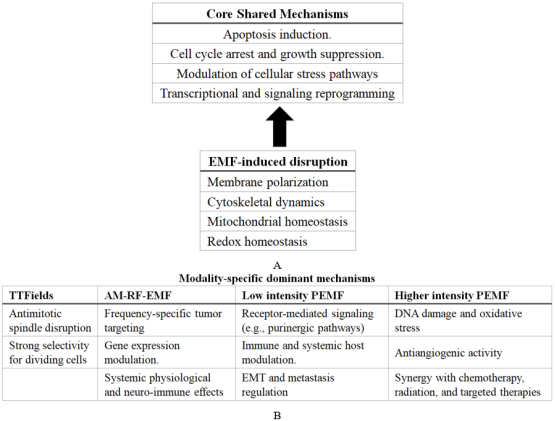
To date, no PEMF or EMF protocol has consistently achieved irreversible tumor regression as a stand-alone intervention either in preclinical studies or limited human trials . Moreover, the heterogeneity in field parameters—such as frequency, waveform, intensity, and exposure duration—across studies has impeded the establishment of a unified mechanism of action. Inhibition of cancer cell growth by PEMF appears to involve multiple, and potentially interacting, cellular processes, including alterations in membrane potential, disruption of mitochondrial function, interference with mitotic spindle formation, modulation of growth signaling pathways, increased generation of reactive oxygen species (ROS), and induction of apoptosis (Figure 1). While the preferential sensitivity of malignant cells compared to normal cells is encouraging, the underlying basis of this selectivity remains incompletely understood and warrants further mechanistic investigation.
Figure 1. Summary of antitumor mechanisms across treatment modalities.
Reliance on empirical trial-and-error testing may be inefficient and limiting, especially given current advances in cancer genomics and the characterization of key oncogenic driver mutations (34). Moving forward, it would be advantageous to rationally design PEMF protocols that specifically disrupt molecular pathways activated by such driver genes. This approach could yield targeted, mechanism-informed applications of PEMF with improved therapeutic indices. Tables 1through 6 summarize major classes of cancer-relevant signaling pathways and representative driver genes identified through high-throughput genome sequencing.
Table 1. Classical Tumor Suppressors & Oncogenes.

Gene

Mutation Frequency

Primary Pathway

Major Cancer Types

Therapeutic Relevance

TP53

>50% all cancers

Cell cycle checkpoint/Apoptosis

Pan-cancer (highest in ovarian, lung)

MDM2 inhibitors, p53 reactivators

KRAS

~30% all cancers

RAS/MAPK signaling

Pancreatic (90%), Colorectal (40%), Lung (25%)

KRAS G12C inhibitors (sotorasib, adagrasib)

PIK3CA

~20% solid tumors

PI3K/AKT/mTOR

Breast (45%), Colorectal (15%), Endometrial

PI3K inhibitors (alpelisib)

APC

80% colorectal

Wnt signaling

Colorectal, Gastric

Wnt pathway modulators (experimental)

Table 2. DNA Repair Pathway Genes.

Gene

Mutation Frequency

Primary Pathway

Major Cancer Types

Therapeutic Relevance

BRCA1/BRCA2

5-10% breast/ovarian

Homologous recombination

Breast, Ovarian, Prostate, Pancreatic

PARP inhibitors (olaparib, niraparib)

ATM

5-15% various

DNA damage response

CLL, Breast, Prostate

ATR inhibitors, PARP inhibitors

MLH1/MSH2/MSH6/PMS2

15% colorectal

Mismatch repair

Colorectal, Endometrial, Lynch syndrome

Immune checkpoint inhibitors

Table 3. Receptor Tyrosine Kinases & Growth Factors.

Gene

Mutation Frequency

Primary Pathway

Major Cancer Types

Therapeutic Relevance

EGFR

15% lung adenocarcinoma

RTK/MAPK signaling

Lung, Glioblastoma, Head/Neck

TKIs (erlotinib, osimertinib)

HER2 (ERBB2)

20% breast cancer

RTK signaling

Breast, Gastric

Trastuzumab, T-DM1, TKIs

ALK

5% lung adenocarcinoma

RTK fusion proteins

Lung, Lymphomas

ALK inhibitors (crizotinib, alectinib)

Table 4. Chromatin Remodeling & Epigenetic Regulators.

Gene

Mutation Frequency

Primary Pathway

Major Cancer Types

Therapeutic Relevance

ARID1A

10-50% various

SWI/SNF chromatin remodeling

Ovarian, Endometrial, Gastric

Synthetic lethal approaches

KMT2D

20% lymphomas

Histone methylation

Diffuse large B-cell lymphoma

Histone methyltransferase inhibitors

IDH1/IDH2

70% gliomas, 20% AML

Metabolic/Epigenetic

Glioma, AML, Cholangiocarcinoma

IDH inhibitors (ivosidenib, enasidenib)

Table 5. Cell Cycle Regulation.

Gene

Mutation Frequency

Primary Pathway

Major Cancer Types

Therapeutic Relevance

CDKN2A (p16)

30-50% various

G1/S checkpoint

Melanoma, Pancreatic, Lung

CDK4/6 inhibitors

RB1

90% retinoblastoma

G1/S checkpoint

Retinoblastoma, Small cell lung

CDK4/6 inhibitors, aurora kinase inhibitors

CCND1

15-20% breast

G1/S progression

Breast, Mantle cell lymphoma

CDK4/6 inhibitors (palbociclib)

Table 6. Emerging Drivers (Recent WGS Studies 2024 ).

Discovery

Context

Primary Pathway

Cancer Types

Therapeutic Potential

74 New Candidate Genes

Nature Genetics 2024 (10,478 genomes)

RNA processing, protein degradation

Pan-cancer analysis

Under investigation

Non-coding drivers

Regulatory elements, lncRNAs

Gene expression regulation

Multiple cancer types

Epigenetic modulators

Many of the downstream effectors of cancer-associated gene products—such as enzymes, receptors, transcription factors, DNA-binding proteins, and scaffolding proteins—have had their structures experimentally determined and deposited in the Protein Data Bank (RCSB.org) , or accurately predicted by AlphaFold (AlphaFold Protein Structure Database) . This structural information provides a powerful foundation for estimating the electromagnetic field (EMF) intensities required to perturb or disrupt their functional interactions. In particular, these insights open the door to the rational design of PEMF protocols targeting specific molecular interactions central to tumor growth and survival.
Functionally disrupting a protein's activity via EMF can be conceptualized as interfering with its interactions with a substrate, ligand, DNA target, or binding partner. This disruption can occur if the energy imparted by the EMF is sufficient to overcome the standard free energy of binding (ΔG⁰), or alternatively, the free energy required to partially unfold one or both interacting molecules (ΔGᵤ).
For binding interference, the minimum energy supplied by the EMF must match or exceed the standard free energy of binding. On a per-molecule basis, this requirement can be written as:
Eemf= (ΔG0/N)(1)
where N is the Avogadro number (6.022 x 10²³ mol-1) since ΔG0 values are often given per mole.
The energy provided by an electric field (E) to a dipole or charge depends on the interaction between the field and the molecule dipole moment (μ) or charge (q). For a dipole in an electric field, the potential energy (U) is the vectorial product of the electric field (E) and the dipole moment (μ), and maximum energy occurs when the dipole is aligned with the field and
Um= μE(2)
where μ is the magnitude of the dipole moment in Debyes or C.m, and E the electric field strength in V/m.
Since the energy required by the field to disrupt binding must at least be equal to the free binding energy,
μE = ΔG0/N(3)
Solving for E,
E = ΔG0/(Nμ)(4)
In practice, ΔG0 could be derived from the equilibrium binding constant Keq using,
ΔG0= -RTlnKeq(5)
where R is the universal gas constant (≈ 8.314 J⋅mol⁻¹⋅K⁻¹) and T the temperature in Kelvin (K).
The corresponding magnetic field strength could be derived from,
B = E/c(6)
a consequence of Maxwell’s equations and where c is the speed of light (≈ 3 x 10⁸ m/s).
Table 7. Estimated static magnetic field strengths required for disrupting interactions between oncogene products and cognate ligands or substrates.

Target (substrate)

PDB/AlphaFold ID2

Keq (M-1)3

B (mT)1

GTPase switch protein

Hras (GTP)

PDB 8ELK

9.3x10¹⁰

625

Kras (Raf1 Ras BD)

PDB 6XHA

2.8 x 10⁶

130

Protein tyrosine kinase

c-Abl (ATP)

AF-P00520-F1

8.3 x 10⁴

18

ALK (ATP)

AF-Q9UM73-F1-v4

2.4 x 10⁵

28

BTK (ATP)

AF-Q06187-F1

3.4 x 10⁴

43

EGFR (ATP)

AF-P00533-F1

5.9 x 10⁴

28

HER2 (ATP)

AF-P04626-F1

3.7 x 10⁴

23

c-kit (ATP)

AF-P10721-F1-v4

1.9 x 10⁴

18

SRC (ATP)

AF-P00523-F1-v4

1.2 x 10⁴

102

VEGFR1 (ATP)

AF-P17948-F1

7.7 x 10³

6

VEGFR2 (ATP)

AF-P35968-F1

7.7 x 10³

10

Protein serine/threonine kinase

AKT1 (ATP)

AF-P31749-F1

7.6 x 10³

36

AKT2 (ATP)

AF-P31751-F1

3.9 x 10³

53

ATR (ATP)

AF-Q13535-F1-v4

2.0 x 10⁷

28

Aurora 2 (ATP)

AF-O14965-F1

2.9 x 10⁴

30

Cdk2-PO4/Cyclin A (ATP)

PDB 1JST

4.3 x 10⁴

57

Cdk2/Cyclin E (ATP)

PDB 1W98

2.8 x 10⁵

44

Cdk4/Cyclin D1 (ATP)

PDB 2W96

2.4 x 10³

33

Cdk6/vCyclin (ATP)

PDB 1JOW

1.2 x 10⁵

61

Chk1 (ATP)

AF-O14757-F1

7.1 x 10⁵

72

Chk2 (ATP)

AF-O96017-F1

3.0 x 10⁵

30

pERK1 (ATP)

PDB 2ZOQ

3.2 x 10⁵

71

pERK2 (ATP)

PDB 6OPG

5.5 x 10⁵

63

GSK3β (ATP)

AF-49841-F1

2.0 x 10⁴

44

MEK1 (ATP)

AF-Q02750-F1

1.8 x 10⁵

58

RAF1 (ATP)

AF-P04049-F1

8.6 x 10⁴

36

Lipid phosphoinositol kinase

ATM (ATP)

PDB 7NI6

3.4 x 10⁴

19

PIK3CA (ATP)

AF-P42336-F1

5.0 x 10⁵

49

MTOR (ATP)

PDB 3JBZ

1.0 x 10³

15

Other enzymes

PARP1 (NAD)

AF-P09874-F1-v4

1.3 x 10⁶

29

PARP2 (NAD)

AF-Q9UGN5-F1-v4

5.3 x 10⁵

25

IDH1 (Isocitrate)

PDB 3INM

1.5 x 10⁴

306

IDH2 (Isocitrate)

PDB 5I95

1.7 x 10⁵

230

1Calculation of B (mT) was based on equations -6].
2The dipole moment (μ) of the proteins was calculated from coordinates provided in the corresponding PDB or AlphaFold files shown below, and using the Protein Dipole Moments Server. The server is described in Clifford E. Felder, Jaime Prilusky, Israel Silman, and Joel L. Sussman 2007, " A server and database for dipole moments of proteins", Nucleic Acids Research, 35, special Web Servers Issue. https://academic.oup.com/nar/article/35/suppl_2/W512/2922221.
3 The Keq in equation is 1/Kd for simple protein-ligand interaction, or 1/Km for enzyme substrate interaction. The catalytic Km is used as a first approximation of substrate affinity. Kd or Km values were obtained from the following sources: Hras (GTP): John, J., et al., 1993, Kras (Raf1 Ras BD): Tran, T. H., et al., 2021, c-Abl (ATP), BTK (ATP), EGFR (ATP), HER2 (ATP), c-kit (ATP), SRC (ATP), VEGFR1 (ATP), VEGFR2 (ATP), AKT1 (ATP), AKT2 (ATP), Aurora 2 (ATP), Cdk2-PO4/Cyclin A (ATP), Cdk2/Cyclin E (ATP), Cdk4/Cyclin D1 (ATP), Chk1 (ATP), Chk2 (ATP), GSK3β (ATP), MEK1 (ATP), RAF1 (ATP), ATM (ATP) & MTOR (ATP): Knight, Z. A. & Shokat, K. M., 2005, ALK (ATP): Bossi, R. T., et al., 2010, ATR: data from ReactionBiology and Eurofins, Cdk6/vCyclin (ATP): data from ReactionBiology, pERK1 (ATP) & pERK2 (ATP): Petrosino, M., et al., 2023, PIK3CA (ATP): Maheshwari, S., et al. 2017, PARP1 (NAD) & PARP2 (NAD): Thorsell A-G., et al., 2016, IDH1 (Isocitrate): Uniprot O75874, IDH2 (Isocitrate): Uniprot P48735.
Table 7 presents the calculated static magnetic field intensities required to disrupt the functions of selected therapeutic targets in cancer-related pathways. These values calculated using equations , should be considered preliminary, first-order approximations for several reasons.
First, the estimates are based on simplified dipole moment calculations that assume static electric fields interacting with permanent molecular dipoles. In contrast, pulsed electromagnetic fields (PEMF) are time-varying, and their interactions with biomolecules are considerably more complex. These interactions may involve induced dipole moments, frequency-dependent dielectric properties, shielding by surrounding tissues and water, as well as potential thermal effects. In addition, the calculated field strengths assume direct interactions with isolated proteins in a vacuum, whereas in vivo these proteins exist within highly complex cellular environments characterized by substantial dielectric screening.
Furthermore, electrostatic contributions from bound ligands were not included, although such interactions may significantly influence the net dipole moment of protein–ligand complexes. The application of more advanced computational chemistry approaches would likely improve the accuracy of these field strength estimates.
Despite these limitations, the current calculations provide a useful baseline framework to guide the development of more targeted and effective PEMF protocols. In particular, they may help inform the selection of key parameters such as field strength, pulse frequency, exposure duration, and considerations related to tissue penetration and attenuation.
As discussed earlier, a complementary approach to estimating the required magnetic field intensity involves the use of the free energy of unfolding (ΔGu) of the protein or protein-ligand complex. However, accurate ΔGu values typically require differential scanning calorimetry (DSC) data, which remain sparse in the literature for many of the cancer-associated targets included in this analysis.
Table 7 indicates that most products of cancer driver genes could, in principle, be disrupted within the higher range of magnetic field intensities (2–400 mT) defined earlier. Notably, approximately 82% of the listed cancer driver gene products are predicted to require field strengths greater than 20 mT to interfere with their interactions with cognate substrates or ligands. This suggests that enhanced antitumor effects across multiple cancer types may potentially be achieved by deploying PEMF protocols with maximum field intensities above 20 mT but below 400 mT, which is generally considered the upper acceptable limit for public magnetic field exposure. The only notable outlier is the HRAS–GTP interaction, which is predicted to require field strengths of up to approximately 625 mT.
Importantly, antiproliferative and antiangiogenic effects have already been observed at substantially lower intensities (2–20 mT) across a broad spectrum of cancers, including breast, bladder, liver, hematopoietic malignancies, osteosarcoma, and fibrosarcoma. These effects have been mechanistically associated with DNA damage, apoptosis, and the induction of cellular senescence markers. However, the extent to which these antitumor responses may also result from direct interference with oncogenic signaling pathways remains to be experimentally validated.
Such validation could be achieved by employing tumor models driven by well-characterized cancer driver genes, enabling systematic assessment of whether PEMF exposure modulates specific oncogenic pathways in a target-dependent manner.
Table 7 further indicates that, in most cases, the magnetic field strengths needed to interfere with key oncogenic pathways fall within the operational range of FDA-approved PEMF devices used for specific clinical indications. Furthermore, some PEMF systems marketed for general wellness are capable of producing high peak magnetic field intensities—up to 100 mT—though often at lower frequencies. Clinical experience in areas such as bone regeneration and pain control suggests that efficacy is not solely determined by maximum field strength. Rather, an optimized combination of intensity, frequency, pulse width, and duty cycle is likely required for therapeutic benefit.
Future advances in PEMF technology—guided by personalized cancer genomic data and supported by rigorous clinical trials—may help establish electromagnetic field modulation as a viable adjunct or alternative in cancer therapy. A rigorous regulatory framework for PEMF devices used in cancer therapy as well as guidelines for safety and contraindications could then be established. Such progress will be essential to gaining broader acceptance within the medical community and among the general public.
7. Conclusion
This review has examined the expanding body of experimental and early clinical evidence supporting the use of pulsed electromagnetic fields (PEMF) and amplitude-modulated radiofrequency electromagnetic fields (AM-RF EMF) as potential adjuncts in cancer therapy. Originally developed and approved for orthopedic indications such as bone healing, PEMF technologies have demonstrated broader biological activity, including modulation of inflammation, angiogenesis, cellular metabolism, and signal transduction. These pleiotropic effects provide a biologically plausible foundation for their investigation in oncology.
Across multiple in vitro and in vivo tumor models, electromagnetic field exposure has been shown to inhibit proliferation, disrupt mitotic spindle formation, induce apoptosis, impair angiogenesis, and enhance sensitivity to chemotherapy and radiation. Notably, intermediate-frequency alternating electric fields (tumor treating fields) selectively target dividing cells through disruption of mitosis, while tumor-specific AM-RF EMF protocols have demonstrated preliminary clinical activity in hepatocellular carcinoma and other malignancies without significant toxicity. Low- and higher-intensity PEMF exposures have likewise exhibited context-dependent antiproliferative effects across diverse cancer types, with encouraging evidence of synergy with cytotoxic agents and targeted therapies.
A consistent theme emerging from this literature is the marked heterogeneity of biological responses. Therapeutic effects vary according to field strength, frequency, waveform, exposure duration, tumor type, and proliferative state. Importantly, many studies report preferential sensitivity of malignant cells relative to non-transformed counterparts, suggesting a therapeutic window; however, the mechanistic basis for this selectivity remains incompletely defined. At present, no electromagnetic field protocol reliably induces durable tumor regression as a stand-alone intervention, underscoring the need for optimization and rational design.
To move beyond empirical parameter selection, this review proposes a framework grounded in structural biology and thermodynamics. By estimating the electromagnetic field strength required to perturb protein–ligand interactions or overcome binding free energies of key oncogenic targets, it may be possible to tailor PEMF protocols to disrupt specific driver pathways. Integration of cancer genomic data, structural databases, and quantitative biophysical modeling offers a path toward precision electromagnetic oncology. While current calculations are preliminary and subject to biophysical limitations, they provide a conceptual starting point for hypothesis-driven protocol development. Moving forward would include deployment of advanced computational tools to better estimate the required PEMF field strength, testing and optimizing protocols in tumor models with known cancer driver genes, and finally progressing towards human trials.
Ultimately, the clinical integration of PEMF and related electromagnetic modalities will depend on rigorous, adequately powered randomized trials, standardized exposure parameters, and mechanistic validation in well-characterized patient populations. If guided by advances in genomics, structural biology, and device engineering, electromagnetic field modulation may evolve from an empirically applied adjunct into a rationally designed, mechanism-informed component of multimodal cancer therapy.
Abbreviations

PEMF

Pulsed electromagnetic fields

TTFields

Tumor treating fields

ROS

Reactive oxygen species

AM

Amplitude-modulated

RF-EMF

Radiofrequency electromagnetic fields

EMT

Epithelial-mesenchymal transtion

LDH

Lactate dehydrogenase

Acknowledgments
The author thanks William T. Windsor for providing some of the literature cited in this review.
Author Contributions
Hung Van Le: Conceptualization, Data curation, Formal Analysis, Investigation, Funding Acquisition, Methodology, Project Administration, Resources, Software, Validation, Visualization, Writing-original draft, Writing – review & editing
Conflicts of Interest
The author declares no conflicts of interest.
References
[1] Bassett, C. A. L., Pawluk, R. J., & Pilla, A. A. Augmentation of bone repair by inductively coupled electromagnetic fields. Science. 1974, 184(4136), 575–577.
[2] Aaron, R. K., Ciombor, D. M., & Simon, B. J. Treatment of nonunions with electric and electromagnetic fields. Clinical Orthopaedics and Related Research. 2004, 419, 21–29.
[3] Foley-Nolan, D., Barry, C., Coughlan, R. J., et al. (). Pulsed high-frequency (27 MHz) electromagnetic therapy for persistent neck pain: A double-blind, placebo-controlled study of 20 patients. Orthopedics. 1990, 13(4), 445–451.
[4] Thomas, A. W., Graham, K., Prato, F. S., et al. A randomized, double-blind, placebo-controlled clinical trial using a low-frequency magnetic field in the treatment of musculoskeletal chronic pain. Pain Research & Management. 2007, 12(4), 249–258.
[5] Vadalà, M., Morales-Medina, J. C., Vallelunga, A., et al. Mechanisms and therapeutic effectiveness of pulsed electromagnetic field therapy in oncology. Cancer Medicine. 2016, 5(11), 3128–3139.
[6] Zimmermann, J. W., Pennison, M. J., Brezovich, I., et al. Cancer cell proliferation is inhibited by specific modulation frequencies. British Journal of Cancer. 2012, 106(2), 307–313.
[7] Xu, W., Xie, X., Wu, H., et al. Pulsed electromagnetic therapy in cancer treatment: Progress and outlook. View. 2022, 3, 20220029.
[8] Egg, M., & Kietzmann, T. Little strokes fell big oaks: The use of weak magnetic fields and reactive oxygen species to fight cancer. Redox Biology. 2025, 79, 103483.
[9] Kirson, E. D., Gurvich, Z., Schneiderman, R., et al. Disruption of cancer cell replication by alternating electric fields. Cancer Research. 2004, 64, 3288–3295.
[10] Kirson, E. D., Dbaly, V., Tovarys, F., et al. Alternating electric fields arrest cell proliferation in animal tumor models and human brain tumors. Proceedings of the National Academy of Sciences. 2007, 104, 10152–10157.
[11] Eleuteri, A. M., Amici, M., Bonfili, L., et al. 50 Hz extremely low frequency electromagnetic fields (ELF-EMF) enhance protein carbonyl groups content in cancer cells: Effects on proteasomal systems. Journal of Biomedicine and Biotechnology. 2009, 834239.
[12] Lee, H. C., Hong, M.-N., Jung, S. H., et al. Effect of extremely low frequency magnetic fields on cell proliferation and gene expression. Bioelectromagnetics. 2015, 36, 506-516.
[13] Barbault, A., Costa, F. P., Bottger, B., et al. Amplitude-modulated electromagnetic fields for the treatment of cancer: Discovery of tumour-specific frequencies and assessment of a novel therapeutic approach. Journal of Experimental & Clinical Cancer Research. 2009, 28, 51.
[14] Costa, F. P., de Oliveira, A. C., Meirelles, R., et al. Treatment of advanced hepatocellular carcinoma with very low levels of amplitude-modulated electromagnetic fields. British Journal of Cancer. 2011, 105, 640–648.
[15] Ruiz-Gómez, M. J., de la Peña, L., Prieto-Barcia, M. I., et al. Influence of 1 and 25 Hz, 1.5 mT magnetic fields on antitumour drug potency in a human adenocarcinoma cell line. Bioelectromagnetics. 2002, 23, 578-525.
[16] Vincenzi, F., Targa, M., Corciulo, C., et al. The anti-tumour effect of A3 adenosine receptors is potentiated by pulsed electromagnetic fields in cultured neural cancer cells. PLoS ONE. 2012, 7, e39317.
[17] Wang, Q., Wu, W., Chen, X., et al. Effect of pulsed electromagnetic field with different frequencies on the proliferation, apoptosis, and migration of human ovarian cancer cells. Sheng Wu Yi Xue Gong Cheng Xue Za Zhi = Journal of Biomedical Engineering. 2012, 29, 291–295.
[18] Chen, M. Y., Li, J., Zhang, N., et al. In vitro and in vivo study of the effect of osteogenic pulsed electromagnetic fields on breast and lung cancer cells. Technology in Cancer Research & Treatment. 2022, 21.
[19] Iversen, J. N., Tai, Y. K., Jasmine, Yap, J. L. Y., et al. One month of brief weekly magnetic field therapy enhances the anticancer potential of female human sera: Randomized double-blind pilot study. Cells. 2025, 14, 331.
[20] Yamaguchi-Sakino, S., Sakino, M., & Ueno, S. Biological effects of electromagnetic fields and recently updated safety guidelines for strong magnetic fields. Magnetic Resonance in Medical Sciences. 2011, 10, 1-10.
[21] Crocetti, S., Beyer, C., Schade, G., Egli, M., Fröhlich, J., & Franco-Obregón, A. Low intensity and frequency pulsed electromagnetic fields selectively impair breast cancer cell viability. PloS one. 2013, 8(9), e72944.
[22] Pantelis, P., Theocharous, G., Veroutis, D., et al. Pulsed electromagnetic fields (PEMFs) trigger cell death and senescence in cancer cells. International Journal of Molecular Sciences. 2024, 25, 2473.
[23] Woo, S.-H., & Kim, Y. S. Pulsed electromagnetic field enhances doxorubicin-induced reduction in the viability of MCF-7 breast cancer cells. Korean Journal of Clinical Laboratory Science. 2024, 56, 73-84.
[24] Woo, S.-H., Kim, B., Kim, S. H., et al. Pulsed electromagnetic field potentiates etoposide-induced MCF-7 cell death. BMB Reports. 2022, 55, 148-153.
[25] Williams, C. D., Markov, M. S., Hardman, W. E., et al. Therapeutic electromagnetic field effects on angiogenesis and tumor growth. Anticancer Research. 2001, 21, 3887-3892.
[26] Cameron, I. L., Markov, M., & Hardman, W. E. Optimization of a therapeutic electromagnetic field (EMF) to retard breast cancer tumor growth and vascularity. Cancer Cell International. 2014, 14, 125.
[27] Cameron, I. L., Sun, L.-Z., Short, N., et al. Therapeutic electromagnetic field (TEMF) and gamma irradiation on human breast cancer xenograft growth, angiogenesis and metastasis. Cancer Cell International. 2005, 5, 23.
[28] Berg, H., Günther, B., Hilger, I., et al. Bioelectromagnetic field effects on cancer cells and mice tumours. Electromagnetic Biology and Medicine. 2010, 29, 1–12.
[29] Sanberg, M., Whitman, W., Bissette, R., et al. Pulsed electromagnetic field therapy alters the genomic profile of bladder cancer cell line HT-1197. Journal of Personalized Medicine. 2025, 15, 143.
[30] Sanberg, M., Whitman, W., Ross, C., et al. Pulsed electromagnetic field therapy’s effect on bladder cancer cell line HT-1376. Journal of Clinical Oncology. 2025, 42(4, Suppl.).
[31] Radeva, M., & Berg, H. Differences in lethality between cancer cells and human lymphocytes caused by LF-electromagnetic fields. Bioelectromagnetics. 2004, 25, 503-507.
[32] Muramatsu, Y., Matsui, T., Deie, M., et al. Pulsed electromagnetic field stimulation promotes anti-cell proliferative activity in doxorubicin-treated mouse osteosarcoma cells. In Vivo. 2017, 31, 61-68.
[33] Omote, Y., Hosokawa, M., Komatsumoto, M., et al. Treatment of experimental tumors with a combination of pulsing electromagnetic field and antitumour drug. Japanese Journal of Cancer Research. 1990, 81, 956–961.
[34] Kinnersley, B., Sud, A., Everall, A., et al. Analysis of 10,478 cancer genomes identifies candidate driver genes and opportunities for precision oncology. Nature Genetics. 2024, 56, 1868–1877.
[35] H. M. Berman, J. Westbrook, Z. Feng, G. Gilliland, T. N. Bhat, H. Weissig, I. N. Shindyalov, P. E. Bourne, The Protein Data Bank. Nucleic Acids Research. 2000, 28: 235-242
[36] Fleming, J., Magana, P., Nair, S., Tsenkov, M., Bertoni, D., Pidruchna, I.,... & Velankar, S. AlphaFold Protein Structure Database and 3D-Beacons: New Data and Capabilities. Journal of Molecular Biology. 2025, 168967.
Cite This Article
  • APA Style

    Le, H. V. (2026). Pulsed Electromagnetic Fields in Cancer Therapy: A Review of Experimental and Clinical Evidence. Cancer Research Journal, 14(1), 6-16. https://doi.org/10.11648/j.crj.20261401.12

    Copy | Download

    ACS Style

    Le, H. V. Pulsed Electromagnetic Fields in Cancer Therapy: A Review of Experimental and Clinical Evidence. Cancer Res. J. 2026, 14(1), 6-16. doi: 10.11648/j.crj.20261401.12

    Copy | Download

    AMA Style

    Le HV. Pulsed Electromagnetic Fields in Cancer Therapy: A Review of Experimental and Clinical Evidence. Cancer Res J. 2026;14(1):6-16. doi: 10.11648/j.crj.20261401.12

    Copy | Download

  • @article{10.11648/j.crj.20261401.12,
      author = {Hung Van Le},
      title = {Pulsed Electromagnetic Fields in Cancer Therapy: 
    A Review of Experimental and Clinical Evidence},
      journal = {Cancer Research Journal},
      volume = {14},
      number = {1},
      pages = {6-16},
      doi = {10.11648/j.crj.20261401.12},
      url = {https://doi.org/10.11648/j.crj.20261401.12},
      eprint = {https://article.sciencepublishinggroup.com/pdf/10.11648.j.crj.20261401.12},
      abstract = {Pulsed electromagnetic fields (PEMF) are emerging as a non-invasive adjunct in cancer therapy. Initially approved for orthopedic applications such as bone healing and tissue regeneration, PEMF has demonstrated broader biological effects including modulation of inflammation, angiogenesis, cellular metabolism, and signal transduction. Increasing experimental and early clinical evidence suggests that specific electromagnetic field exposures may inhibit tumor cell proliferation, induce apoptosis, disrupt mitotic spindle formation, and impair angiogenesis across multiple cancer types. This review synthesizes findings from studies investigating low- and high-intensity PEMF, intermediate-frequency tumor-treating alternating electric fields, and tumor-specific amplitude-modulated radiofrequency electromagnetic fields (AM-RF EMF) in cancer cell lines, animal models, and preliminary human clinical trials. Across these modalities, therapeutic responses appear highly dependent on field strength, frequency, waveform, exposure duration, and tumor biology. While intermediate-frequency alternating electric fields selectively target dividing cells through mitotic disruption, AM-RF EMF protocols have demonstrated early clinical activity in hepatocellular carcinoma and other malignancies without significant toxicity. Low- and higher-intensity PEMF exposures have also shown antiproliferative and pro-apoptotic effects in diverse tumor models, often enhancing sensitivity to chemotherapy, radiation, and targeted therapies. Despite encouraging results, clinical translation remains limited due to mechanistic heterogeneity and the absence of standardized treatment protocols. To address these challenges, this review proposes a framework integrating cancer genomics, structural biology, and thermodynamic modeling to guide rational design of electromagnetic field therapies. By estimating the electromagnetic field strengths required to perturb protein–ligand interactions or disrupt key oncogenic signaling pathways, PEMF protocols may be tailored to individual tumor molecular profiles. Although current biophysical estimates remain preliminary, they provide a conceptual basis for hypothesis-driven optimization. Rigorous randomized clinical trials, mechanistic validation, and standardized exposure parameters will be essential to establish the role of PEMF as a precision, mechanism-informed component of multimodal cancer therapy.},
     year = {2026}
    }
    

    Copy | Download

  • TY  - JOUR
    T1  - Pulsed Electromagnetic Fields in Cancer Therapy: 
    A Review of Experimental and Clinical Evidence
    AU  - Hung Van Le
    Y1  - 2026/03/10
    PY  - 2026
    N1  - https://doi.org/10.11648/j.crj.20261401.12
    DO  - 10.11648/j.crj.20261401.12
    T2  - Cancer Research Journal
    JF  - Cancer Research Journal
    JO  - Cancer Research Journal
    SP  - 6
    EP  - 16
    PB  - Science Publishing Group
    SN  - 2330-8214
    UR  - https://doi.org/10.11648/j.crj.20261401.12
    AB  - Pulsed electromagnetic fields (PEMF) are emerging as a non-invasive adjunct in cancer therapy. Initially approved for orthopedic applications such as bone healing and tissue regeneration, PEMF has demonstrated broader biological effects including modulation of inflammation, angiogenesis, cellular metabolism, and signal transduction. Increasing experimental and early clinical evidence suggests that specific electromagnetic field exposures may inhibit tumor cell proliferation, induce apoptosis, disrupt mitotic spindle formation, and impair angiogenesis across multiple cancer types. This review synthesizes findings from studies investigating low- and high-intensity PEMF, intermediate-frequency tumor-treating alternating electric fields, and tumor-specific amplitude-modulated radiofrequency electromagnetic fields (AM-RF EMF) in cancer cell lines, animal models, and preliminary human clinical trials. Across these modalities, therapeutic responses appear highly dependent on field strength, frequency, waveform, exposure duration, and tumor biology. While intermediate-frequency alternating electric fields selectively target dividing cells through mitotic disruption, AM-RF EMF protocols have demonstrated early clinical activity in hepatocellular carcinoma and other malignancies without significant toxicity. Low- and higher-intensity PEMF exposures have also shown antiproliferative and pro-apoptotic effects in diverse tumor models, often enhancing sensitivity to chemotherapy, radiation, and targeted therapies. Despite encouraging results, clinical translation remains limited due to mechanistic heterogeneity and the absence of standardized treatment protocols. To address these challenges, this review proposes a framework integrating cancer genomics, structural biology, and thermodynamic modeling to guide rational design of electromagnetic field therapies. By estimating the electromagnetic field strengths required to perturb protein–ligand interactions or disrupt key oncogenic signaling pathways, PEMF protocols may be tailored to individual tumor molecular profiles. Although current biophysical estimates remain preliminary, they provide a conceptual basis for hypothesis-driven optimization. Rigorous randomized clinical trials, mechanistic validation, and standardized exposure parameters will be essential to establish the role of PEMF as a precision, mechanism-informed component of multimodal cancer therapy.
    VL  - 14
    IS  - 1
    ER  - 

    Copy | Download

Author Information