
Signalized intersections are the main bottlenecks of urban street networks, and in medium-sized cities of Uzbekistan buses and minibuses share the same lanes with private cars and are delayed in the same queues. Conventional signal timing, including most fuzzy logic controllers, treats every vehicle equally and therefore assigns the same weight to a car with one occupant and to a bus carrying forty passengers. The objective of this study is to develop a traffic signal control model that reduces person delay at isolated signalized intersections by combining the passenger load of public transport vehicles with a short-term prediction of congestion. The method has three components. First, each signal cycle is classified as free, pre-congested or congested according to the number of cycles a queued vehicle must wait, and the sequence of cycle states is described by a three-state Markov chain whose transition matrices depend on the degree of saturation; arrival rates are forecast with Holt exponential smoothing. Second, a passenger priority index is introduced that compares the number of public transport passengers waiting on the green and on the conflicting approach. Third, a Mamdani fuzzy inference system with four inputs (forecast degree of saturation of the green and red approaches, passenger priority index and congestion-risk difference) and 81 rules corrects the Webster green time within −15 to +20 s under pedestrian and cycle-length constraints. The controller was tested in a second-by-second simulation of a two-phase intersection with input parameters representative of arterial streets in Namangan, using 20 replications for each of three demand levels. Compared with fixed-time Webster control, the proposed controller reduced mean passenger delay by 12.8% at design demand and by 17.5% under oversaturation, and reduced the share of congested cycles from 5.7% to 3.9%. A vehicle-based fuzzy controller achieved reductions of only 8.2% and 5.7%, respectively, while at low demand the differences between controllers were not statistically significant. The results indicate that weighting signal decisions by passenger load is effective when demand approaches capacity, and that the congestion-prediction input protects the conflicting approach from queue growth at the cost of a small part of the passenger benefit. The model does not require loop detectors or bus-to-signal communication and can be implemented with video detection and operator GPS data; field calibration on Namangan intersections is the next step.
| Published in | Engineering and Applied Sciences (Volume 11, Issue 6) |
| DOI | 10.11648/j.eas.20261106.12 |
| Page(s) | 243-252 |
| Creative Commons |
This is an Open Access article, distributed under the terms of the Creative Commons Attribution 4.0 International License (http://creativecommons.org/licenses/by/4.0/), which permits unrestricted use, distribution and reproduction in any medium or format, provided the original work is properly cited. |
| Copyright |
Copyright © The Author(s), 2026. Published by Science Publishing Group |
Traffic Signal Control, Fuzzy Logic, Transit Signal Priority, Person Delay, Congestion Prediction, Markov Chain, Urban Public Transport
Variable | Term | Parameters |
|---|---|---|
β₁, β₂ | Low / Medium / High | [0, 0, 0.55, 0.75] / [0.60, 0.80, 1.00] / [0.85, 1.05, 1.5, 1.5] |
β₃ | Negative / Neutral / Positive | [−1, −1, −0.5, 0] / [−0.4, 0, 0.4] / [0, 0.5, 1, 1] |
β₄ | Negative / Neutral / Positive | [−1, −1, −0.4, −0.1] / [−0.25, 0, 0.25] / [0.1, 0.4, 1, 1] |
Δg, s | Large cut / Cut | [−15, −15, −12, −6] / [−12, −6, 0] |
No change / Extend / Large extension | [−5, 0, 5] / [8, 14] / [10, 16, 20] |
Parameter | Arterial | Cross street |
|---|---|---|
Saturation flow, pcu/h | 3600 (2 lanes) | 1800 (1 lane) |
Cars, veh/h (peak centre, 1.0·q) | 1350 | 600 |
Minibuses, veh/h (mean load 9 pax) | 70 | 30 |
Buses, veh/h (mean load 45 pax) | 30 | 8 |
Car occupancy, pax | 1.3 | 1.3 |
PCE: car / minibus / bus | 1.0 / 1.5 / 2.5 | 1.0 / 1.5 / 2.5 |
g_min / g_max, s | 15 / 70 | 12 / 50 |
Base timing: C⁰ = 69 s; g⁰, s | 32.8 | 28.5 |
Demand | Controller | Vehicle delay, s | Passenger delay, s (±95% CI) | Transit passenger delay, s | Arterial delay, s | Cross-street delay, s | Congested cycles,% | Passenger-hours lost |
|---|---|---|---|---|---|---|---|---|
0.9·q | Fixed-time | 20.2 | 20.9 ± 0.6 | 21.7 | 17.9 | 25.4 | 0.0 | 47 |
FLC-V | 19.1 | 19.8 ± 0.5 | 20.6 | 17.6 | 22.7 | 0.0 | 45 | |
FLC-P | 20.2 | 20.5 ± 0.5 | 20.8 | 17.9 | 25.4 | 0.0 | 46 | |
FLC-PR | 20.2 | 20.4 ± 0.5 | 20.8 | 17.9 | 25.3 | 0.0 | 46 | |
1.0·q | Fixed-time | 30.7 | 31.2 ± 3.5 | 31.8 | 26.6 | 39.7 | 0.2 | 80 |
FLC-V | 27.9 | 28.5 ± 3.5 | 29.3 | 24.9 | 34.5 | 0.1 | 73 | |
FLC-P | 27.2 | 26.7 ± 2.1 | 26.0 | 21.8 | 39.4 | 0.0 | 68 | |
FLC-PR | 27.2 | 26.6 ± 2.1 | 26.0 | 21.8 | 39.4 | 0.0 | 68 | |
1.1·q | Fixed-time | 84.1 | 83.8 ± 8.9 | 83.4 | 70.4 | 114.7 | 5.7 | 232 |
FLC-V | 79.3 | 79.2 ± 8.7 | 79.0 | 66.8 | 107.5 | 5.1 | 219 | |
FLC-P | 68.7 | 66.3 ± 8.1 | 63.5 | 47.6 | 116.2 | 5.4 | 184 | |
FLC-PR | 71.7 | 69.8 ± 9.3 | 67.7 | 55.3 | 108.7 | 3.9 | 194 |
FLC | Fuzzy Logic Controller |
FLC-V | Vehicle-based Fuzzy Logic Controller |
FLC-P | Fuzzy Logic Controller with Passenger Priority Index |
FLC-PR | Fuzzy Logic Controller with Passenger Priority and Congestion Risk Prediction |
TSP | Transit Signal Priority |
PCE | Passenger Car Equivalent |
CI | Confidence Interval |
GPS | Global Positioning System |
SUMO | Simulation of Urban Mobility |
| [1] |
Statistics Agency under the President of the Republic of Uzbekistan. The number of motor vehicles owned by the population exceeded 4.9 million. Available from:
https://stat.uz/uz/matbuot-markazi/qo-mita-yangiliklar/68806 (accessed 29 October 2026). |
| [2] |
Kun.uz. The President instructed to develop public transport on the basis of the agglomeration system. Available from:
https://kun.uz/news/2026/05/07/prezident-jamoat-transportini-aglomeratsiya-tizimi-asosida-rivojlantirishni-buyurdi (accessed 29 October 2026). |
| [3] |
Namangan Regional Department of Statistics. Demographic situation in Namangan region, January–March 2026. Available from:
https://namstat.uz/images/Pres-Reliz/2026/Demografiya2026_mart.pdf (accessed 29 October 2026). |
| [4] |
Tukhtabayev, M., Mamirov, U., Normirzaev, A. Implementation of innovative ideas in digitization of the transport sector in Namangan region. Scientific and Technical Journal of NamIET. 2021. Available from:
https://scienceweb.uz/publication/2678 (accessed 29 October 2026). |
| [5] | Webster, F. V. Traffic Signal Settings. Road Research Technical Paper No. 39. London: HMSO; 1958, pp. 1–44. |
| [6] | Transportation Research Board. Highway Capacity Manual: A Guide for Multimodal Mobility Analysis. 7th ed. Washington, DC: The National Academies Press; 2022. |
| [7] | Robertson, D. I., Bretherton, R. D. Optimizing networks of traffic signals in real time—the SCOOT method. IEEE Transactions on Vehicular Technology. 1991, 40(1), 11–15. |
| [8] | Sims, A. G., Dobinson, K. W. The Sydney coordinated adaptive traffic (SCAT) system philosophy and benefits. IEEE Transactions on Vehicular Technology. 1980, 29(2), 130–137. |
| [9] | Pappis, C. P., Mamdani, E. H. A fuzzy logic controller for a traffic junction. IEEE Transactions on Systems, Man, and Cybernetics. 1977, 7(10), 707–717. |
| [10] | Niittymäki, J., Pursula, M. Signal control using fuzzy logic. Fuzzy Sets and Systems. 2000, 116(1), 11–22. |
| [11] | Trabia, M. B., Kaseko, M. S., Ande, M. A two-stage fuzzy logic controller for traffic signals. Transportation Research Part C: Emerging Technologies. 1999, 7(6), 353–367. |
| [12] | Kushchenko, L. E. Improving the efficiency of traffic management in the city based on minimizing congestion. Ph.D. Thesis, Belgorod State Technological University named after V. G. Shukhov, Belgorod, 2015. |
| [13] | Furth, P. G., Muller, T. H. J. Conditional bus priority at signalized intersections: better service with less traffic disruption. Transportation Research Record. 2000, 1731, 23–30. |
| [14] | Christofa, E., Skabardonis, A. Traffic signal optimization with application of transit signal priority to an isolated intersection. Transportation Research Record. 2011, 2259, 192–201. |
| [15] | Christofa, E., Ampountolas, K., Skabardonis, A. Arterial traffic signal optimization: A person-based approach. Transportation Research Part C: Emerging Technologies. 2016, 66, 27–47. |
| [16] | Xu, M., Chai, J., Yan, Y., Qu, X. Multi-agent fuzzy-based transit signal priority control for traffic network considering conflicting priority requests. IEEE Transactions on Intelligent Transportation Systems. 2022, 23(2), 1554–1564. |
| [17] | Handrybida, V. O., Sevastianov, V. M. Adaptive traffic light control based on fuzzy logic with consideration of public transport priority. Visnyk of Vinnytsia Polytechnical Institute. 2025, 5, 8–16. |
| [18] | Mazaheri, A. New Signal Priority Strategies for Improving Public Transit Operations. Ph.D. Thesis, Concordia University, Montreal, 2023. |
| [19] | Kumar, N., Raubal, M. Applications of deep learning in congestion detection, prediction and alleviation: A survey. Transportation Research Part C: Emerging Technologies. 2021, 133, 103432. |
| [20] | Holt, C. C. Forecasting seasonals and trends by exponentially weighted moving averages. International Journal of Forecasting. 2004, 20(1), 5–10. |
| [21] | Mamdani, E. H., Assilian, S. An experiment in linguistic synthesis with a fuzzy logic controller. International Journal of Man-Machine Studies. 1975, 7(1), 1–13. |
| [22] | Lopez, P. A., Behrisch, M., Bieker-Walz, L., Erdmann, J., Flötteröd, Y.-P., Hilbrich, R., Lücken, L., Rummel, J., Wagner, P., Wießner, E. Microscopic traffic simulation using SUMO. In 21st International Conference on Intelligent Transportation Systems (ITSC). IEEE, USA, 2018; pp. 2575–2582. |
| [23] | Normirzaev, A. R. State of transport and logistics services in the Republic of Uzbekistan. Science, Research and Development. 2026, 1(15), 56–64. |
| [24] | Normirzaev, A. R. Development of a model of the transport and logistics system of Namangan region. Vestnik BelGTU. 2026, 210–216. |
APA Style
Ugli, S. O. A., Akhmadjanovich, T. M. (2026). Passenger-weighted Fuzzy Logic Traffic Signal Control with Congestion Risk Prediction for Urban Public Transport Efficiency. Engineering and Applied Sciences, 11(6), 243-252. https://doi.org/10.11648/j.eas.20261106.12
ACS Style
Ugli, S. O. A.; Akhmadjanovich, T. M. Passenger-weighted Fuzzy Logic Traffic Signal Control with Congestion Risk Prediction for Urban Public Transport Efficiency. Eng. Appl. Sci. 2026, 11(6), 243-252. doi: 10.11648/j.eas.20261106.12
@article{10.11648/j.eas.20261106.12,
  author = {Sidikov Otabek Abdunosir Ugli and Tukhtabayev Mirzokhid Akhmadjanovich},
  title = {Passenger-weighted Fuzzy Logic Traffic Signal Control with Congestion Risk Prediction for Urban Public Transport Efficiency},
  journal = {Engineering and Applied Sciences},
  volume = {11},
  number = {6},
  pages = {243-252},
  doi = {10.11648/j.eas.20261106.12},
  url = {https://doi.org/10.11648/j.eas.20261106.12},
  eprint = {https://article.sciencepublishinggroup.com/pdf/10.11648.j.eas.20261106.12},
  abstract = {Signalized intersections are the main bottlenecks of urban street networks, and in medium-sized cities of Uzbekistan buses and minibuses share the same lanes with private cars and are delayed in the same queues. Conventional signal timing, including most fuzzy logic controllers, treats every vehicle equally and therefore assigns the same weight to a car with one occupant and to a bus carrying forty passengers. The objective of this study is to develop a traffic signal control model that reduces person delay at isolated signalized intersections by combining the passenger load of public transport vehicles with a short-term prediction of congestion. The method has three components. First, each signal cycle is classified as free, pre-congested or congested according to the number of cycles a queued vehicle must wait, and the sequence of cycle states is described by a three-state Markov chain whose transition matrices depend on the degree of saturation; arrival rates are forecast with Holt exponential smoothing. Second, a passenger priority index is introduced that compares the number of public transport passengers waiting on the green and on the conflicting approach. Third, a Mamdani fuzzy inference system with four inputs (forecast degree of saturation of the green and red approaches, passenger priority index and congestion-risk difference) and 81 rules corrects the Webster green time within −15 to +20 s under pedestrian and cycle-length constraints. The controller was tested in a second-by-second simulation of a two-phase intersection with input parameters representative of arterial streets in Namangan, using 20 replications for each of three demand levels. Compared with fixed-time Webster control, the proposed controller reduced mean passenger delay by 12.8% at design demand and by 17.5% under oversaturation, and reduced the share of congested cycles from 5.7% to 3.9%. A vehicle-based fuzzy controller achieved reductions of only 8.2% and 5.7%, respectively, while at low demand the differences between controllers were not statistically significant. The results indicate that weighting signal decisions by passenger load is effective when demand approaches capacity, and that the congestion-prediction input protects the conflicting approach from queue growth at the cost of a small part of the passenger benefit. The model does not require loop detectors or bus-to-signal communication and can be implemented with video detection and operator GPS data; field calibration on Namangan intersections is the next step.},
 year = {2026}
}
TY  - JOUR
T1  - Passenger-weighted Fuzzy Logic Traffic Signal Control with Congestion Risk Prediction for Urban Public Transport Efficiency
AU  - Sidikov Otabek Abdunosir Ugli
AU  - Tukhtabayev Mirzokhid Akhmadjanovich
Y1  - 2026/11/25
PY  - 2026
N1  - https://doi.org/10.11648/j.eas.20261106.12
DO  - 10.11648/j.eas.20261106.12
T2  - Engineering and Applied Sciences
JF  - Engineering and Applied Sciences
JO  - Engineering and Applied Sciences
SP  - 243
EP  - 252
PB  - Science Publishing Group
SN  - 2575-1468
UR  - https://doi.org/10.11648/j.eas.20261106.12
AB  - Signalized intersections are the main bottlenecks of urban street networks, and in medium-sized cities of Uzbekistan buses and minibuses share the same lanes with private cars and are delayed in the same queues. Conventional signal timing, including most fuzzy logic controllers, treats every vehicle equally and therefore assigns the same weight to a car with one occupant and to a bus carrying forty passengers. The objective of this study is to develop a traffic signal control model that reduces person delay at isolated signalized intersections by combining the passenger load of public transport vehicles with a short-term prediction of congestion. The method has three components. First, each signal cycle is classified as free, pre-congested or congested according to the number of cycles a queued vehicle must wait, and the sequence of cycle states is described by a three-state Markov chain whose transition matrices depend on the degree of saturation; arrival rates are forecast with Holt exponential smoothing. Second, a passenger priority index is introduced that compares the number of public transport passengers waiting on the green and on the conflicting approach. Third, a Mamdani fuzzy inference system with four inputs (forecast degree of saturation of the green and red approaches, passenger priority index and congestion-risk difference) and 81 rules corrects the Webster green time within −15 to +20 s under pedestrian and cycle-length constraints. The controller was tested in a second-by-second simulation of a two-phase intersection with input parameters representative of arterial streets in Namangan, using 20 replications for each of three demand levels. Compared with fixed-time Webster control, the proposed controller reduced mean passenger delay by 12.8% at design demand and by 17.5% under oversaturation, and reduced the share of congested cycles from 5.7% to 3.9%. A vehicle-based fuzzy controller achieved reductions of only 8.2% and 5.7%, respectively, while at low demand the differences between controllers were not statistically significant. The results indicate that weighting signal decisions by passenger load is effective when demand approaches capacity, and that the congestion-prediction input protects the conflicting approach from queue growth at the cost of a small part of the passenger benefit. The model does not require loop detectors or bus-to-signal communication and can be implemented with video detection and operator GPS data; field calibration on Namangan intersections is the next step.
VL  - 11
IS  - 6
ER  -
The Department of Logistics, Namangan State Technical University, Namangan, Uzbekistan
Biography: Sidikov Otabek Abdunosir Ugli is a Ph.D. researcher at the Department of Logistics, Namangan State Technical University, Uzbekistan. His research concerns the organization of urban passenger transport and traffic signal control at signalized intersections. He received his Bachelor’s degree in 2019 and his Master’s degree in Transport Vehicles and Systems in 2021, both from Namangan Engineering Construction Institute (now Namangan State Technical University). He began his career in 2021 as a methodologist at the Faculty of Transport. Since 2022 he has worked as an assistant lecturer, first at the Department of Transport Logistics and, since 2024, at the Department of Logistics. He is the author of 13 scientific publications, including 4 articles in international peer-reviewed journals and 9 papers in conference proceedings, on urban passenger transport and traffic flow management.
Research Fields: Urban Passenger Transport, Traffic Signal Control, Fuzzy Logic Control, Public Transport Priority, Traffic Flow Modelling, Congestion Prediction

The Department of Logistics, Namangan State Technical University, Namangan, Uzbekistan
Biography: Tukhtabayev Mirzokhid Akhmadjanovich is an Associate Professor (Ph.D.) at the Department of Logistics, Namangan State Technical University, Uzbekistan, where he teaches courses in transport logistics and intelligent transport systems. His research covers urban passenger transport, intelligent transport systems and transport telematics. He completed his PhD in Technical science from Scientific-research institute for Agricultural Mechanization (Uzbekistan) in 2019, and his Master of Engineering in Exploitation and repairing transport vehicles from the same institution in 2007. He currently serves on the supervisor of numerous students and two PhD researcher at the University. He has participated in multiple international research collaboration projects in recent years. Now he is Head of the state fundamental project is planned for 2025-2027. He currently serves on the Editorial Boards of three journals.
Research Fields: Transport Logistics, Intelligent Transport Systems, Urban Passenger Transport, Transport Telematics, Traffic Management, Electric Vehicles

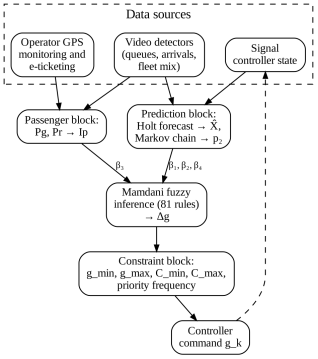
Figure 1. Framework of the passenger-weighted fuzzy signal controller.
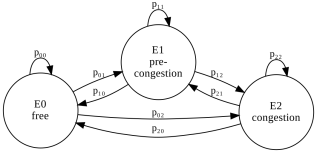
Figure 2. Three-state Markov chain of cycle states at a signalized approach.
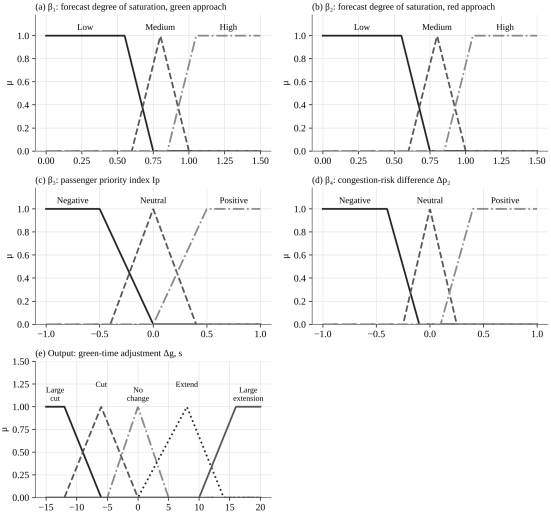
Figure 3. Membership functions of the input variables (a–d) and of the output variable (e).
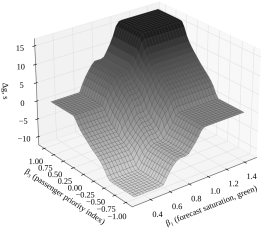
Figure 4. Control surface Δg = f(β₁, β₃) at β₂ = 0.8 and β₄ = 0.
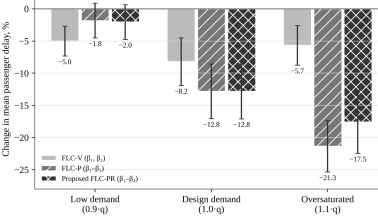
Figure 5. Change in mean passenger delay relative to fixed-time control, with 95% confidence intervals.

Information



 Share This Article
 Twitter
 Linked In
 Facebook

 Copy
 Download