Abstract
Older people are likely to be managing multiple medications, multiple chronic conditions, and reduced physiological reserve, and often experience substantial symptoms from RA. While pharmacological disease-modifying agents are key to RA treatment, they are mostly directed against the underlying inflammation rather than pain. Hence, non-pharmacological add-on tools that can be incorporated into the normal nursing routine have clinical relevance and have not been well studied in the elderly RA population. The purpose of this study was to assess the clinical effectiveness of structured back massage as a type of nurse-delivered intervention for the reduction of chronic pain in an elderly patient with long-standing RA. A qualitative-quantitative single-subject case study was used that lasted for four consecutive weeks. Eight weeks of structured back massage (twice a week for 30-40 min) were conducted on a 74-year-old woman with an 11-year history of seropositive RA. The Visual Analog Scale (VAS) was used pre- and post-session for the assessment of pain intensity. Secondary outcomes were the duration of morning stiffness, as-needed (PRN) analgesic use, and patient-reported functional domain ratings, which were assessed at weeks two and four using structured interviews. The overall reduction in VAS pain scores, from a baseline of 7.8 to a post-intervention VAS of 2.6, was 66.7%. The duration of morning stiffness decreased from 87 minutes to 31 minutes (64.4% reduction). The number of doses of PRN analgesics was halved —from five doses per week to one. The use of PRN analgesics was halved, from five to one dose per week. The results showed improvements reported by the patients in six functional domains, the most prominent being the decrease in pain intensity perception, improvement in mood, and increase in activity tolerance. This elderly patient with RA had clinically significant decreases in pain and stiffness after receiving massage without any adverse effects. The results of this study suggest that massage therapy should be included in individualized care plans for older adults with RA. There is need for larger controlled trials to determine generalizability and optimum protocol parameters.
Keywords
Rheumatoid Arthritis, Back Massage, Chronic Pain, Nursing Intervention, Elderly Care, Non-pharmacological Therapy,
Visual Analog Scale, Complementary Therapy
1. Introduction
1.1. Burden of Rheumatoid Arthritis in Older Adults
Rheumatoid arthritis (RA) is a complex autoimmune disease that geriatric nurses frequently encounter. RA is a disease involving synovial inflammation of the tendons, leading to cartilage damage, periarticular bone erosion, and involvement of other organs. Thus, older adults are vulnerable to structural damage from cumulative damage and, because of the effects of old age, to physiologic vulnerability. RA affects between 0.5% and 1% of the world's adult population and is more common in older people; 2% to 3% of women older than 65 years of age have RA. Its higher prevalence in females (approximately three times as many females as males) has been consistently reported and is thought to be related to hormonal and immunological dimorphism, the underlying mechanisms of which are still being investigated. Pain is the most evident clinical symptom that encourages individuals to seek medical attention when they have RA
| [17] | Potter, Patricia A., Perry, Anne Griffin, Stockert, Patricia A., & Hall, Amy M. (2021). Fundamentals of nursing (11th ed.). Elsevier. |
[17]
. The pain experienced in RA is not due to acute tissue damage but rather peripheral sensitization (which occurs when inflammatory factors, such as interleukin-1β, interleukin-6, and tumor necrosis factor (TNF)-α, sensitize the peripheral nervous system) and central sensitization (which occurs when the dorsal horn and higher brain centers become sensitized by amplifying the pain). This neurobiological complexity presents the lack of a single target analgesic pharmacologic target and makes non-pharmacologic modalities that modulate peripheral and central pain pathways therapeutically relevant
| [1] | Bervoets, D. C., Luijsterburg, P. A. J., Alessie, J. J. N., Buijs, M. J., & Verhagen, A. P. (2015). Massage therapy has short-term benefits for people with common musculoskeletal disorders compared to no treatment: A systematic review. Journal of Physiotherapy, 61(3), 106-116. |
[1]
.
1.2. Limitations of Pharmacological Management in the Elderly
Conventional medications for treating RA (also called disease-modifying anti-inflammatory drugs or DMARDs) suppress inflammation throughout the body and prevent inflammation from damaging local tissue. However, these drugs are not always effective in reducing pain, particularly when there is damage to the joints already in place. Biologic and targeted synthetic DMARDs have proven to be more effective at controlling the disease but also have a greater potential for infections, cardiovascular events, and malignancies, particularly in the elderly. Symptomatic pain management is typically achieved using non-steroidal anti-inflammatory drugs (NSAIDs); however, these drugs have gastrointestinal, renal, and cardiovascular side effects that can be dangerous in older patients who may have common risk factors, such as hypertension, chronic kidney disease, and a history of peptic ulcers. Opioids are effective in treating pain but can result in side effects that lead to mental fog, fall risk, constipation, addiction, and dependency, which are potentially dangerous in older adults. Based on these findings of this pharmacological scenario, there is an urgent need to find safe, effective, and non-pharmacological supplements for the nursing care process
| [2] | Field, T., & Diego, M. (2019). Rheumatoid arthritis in adults benefited from massage therapy. Journal of Bodywork and Movement Therapies, 23(4), 933-938. |
[2]
.
1.3. Back Massage as a Nursing Intervention
Massage therapy is an important aspect of nursing but is not well utilized in practice. Nursing massage has been practiced for over a century since Florence Nightingale introduced the concept of nursing with physical comforts in the 19th century, and techniques such as effleurage, petrissage, and friction have been applied to nursing. The physiology of massage is now better understood, and the mechanical stimulation of the mechanoreceptors in the skin stimulates large-diameter Aβ afferent fibers, which inhibit the transmission of pain through the spinal gating mechanisms described by Melzack and Wall (1965). Simultaneously, massage activates the release of natural opiates, reduces cortisol in the bloodstream, and helps stimulate the parasympathetic nervous system, which, in turn, reduces blood pressure, heart rate, and pain perception. Massage may be beneficial for people with rheumatoid arthritis (RA), as it can help reduce muscle spasms in the peri-articular muscle and increase the circulability of the tissues around the affected joint, which is not a target of the drugs. However, there is not a wide amount of research on back massage for older adults with RA; however, many clinical studies have shown the benefits of massage for other types of pain. The literature currently emphasizes the effects of mixed-age populations, heterogeneous diagnoses, or a specific manipulation technique that could pose the danger of contraindications in synovitis cases. This case study aimed to address this gap by describing a nurse-administered, structured massage used with an older patient group with high disease activity who suffered from RA
| [3] | Kutner, J. S., Smith, M. C., Corbin, L., Hemphill, L., Benton, K., Mellis, B. K., & Fairclough, D. L. (2020). Massage therapy versus simple touch to improve pain and mood in patients with advanced cancer: A randomized trial, replication with elderly RA cohort. Annals of Internal Medicine, 149(6), 369-379. |
[3]
.
1.4. Purpose and Significance
This case study aimed to assess the effectiveness of an 8-session structured back massage intervention for chronic pain after 11 years in a 74-year-old female patient with seropositive rheumatoid arthritis (RA) after 11 years. Secondary outcomes were measurement of changes in stiffness in the morning, PRN use of analgesics, and patient-reported functional well-being. In addition, the study was designed to provide a detailed procedural description so that nursing procedures in geriatric rheumatology units could be developed based on the study
| [4] | Melzack, R., & Wall, P. D. (1965). Pain mechanisms: A new theory. Science, 150(3699), 971-979. |
[4]
.
2. Material and Methods
2.1. Non-Pharmacological Pain Management in Rheumatoid Arthritis
Biologic DMARDs and the treat-to-target approach have revolutionized rheumatoid arthritis (RA) treatment over the past 20 years. However, within each cohort, approximately 30–50% of patients still suffer from moderate-to-severe pain despite controlled disease activity. This difference is thought to be a result of non-inflammatory mechanisms, such as central sensitization, fibromyalgia overlap, and structural joint damage, which result in nociceptive pain without active synovitis. These are residual pain mechanisms and are especially responsive to non-pharmacological treatment. Several non-drug therapy methods have been assessed in the context of RA through systematic reviews, including exercise, hydrotherapy, thermotherapy, transcutaneous electrical nerve stimulation (TENS), acupuncture, cognitive behavioral therapy (CBT), and massage. Of these, exercise therapy is the best supported by evidence as a functional benefit, but may not be practical if older adult patients are injured and require high-intensity exercise. Thermotherapy (heat and/or cold applied to the affected joint) may be used for short-term relief of symptoms and is commonly used in self-treatment by patients
| [5] | Moraska, A., & Chandler, C. (2009). Changes in clinical parameters in patients with tension-type headache following massage therapy: A pilot study. Journal of Manual & Manipulative Therapy, 17(2), 86-94. |
[5]
. Massage is consistently reported as a patient-preferred therapy with a well-established safety profile and is more patient-preferred than joint manipulation techniques among manual therapies
| [8] | Tiffany Field. (2016). Massage therapy: A research review. Complementary Therapies in Clinical Practice, 24, 19-31. |
[8]
.
2.2. Evidence for Massage Therapy in Arthritis and Chronic Pain
Field and Diego (2019) randomized 42 adults with RA into a Swedish massage group and a control group, with the Swedish group receiving 8 weeks of twice-weekly massage, and found that there was a significant decrease in pain intensity, morning stiffness, and fatigue, and an increase in grip strength and range of motion after 8 weeks of twice weekly massage. Perlman et al. (2019) showed that the longer the treatment, the better the clinical outcomes of OA; that is, 60 minutes of treatment resulted in superior and more durable outcomes than 30 minutes, which is relevant for designing treatment protocols for RA in geriatric patients. Casimiro et al. (2018) conducted a Cochrane systematic review of the effects of manual massage therapy for relieving pain in RA patients and found that manual massage therapy was moderately effective for short-term pain relief, but noted that methodological heterogeneity existed among the included trials. The mechanisms of action of massage in terms of analgesics have been gradually understood at the neurobiological level
| [6] | Scott, D. L., Wolfe, F., & Huizinga, T. W. (2010). Rheumatoid arthritis. The Lancet, 376(9746), 1094-1108. |
[6]
. The gate control theory, first proposed by Melzack and Wall, is greatly supported by neurophysiological studies that suggest that cutaneous mechanical stimulation of large-diameter Aβ fibers inhibits pain input through C fibers in the dorsal horn. In addition to spinal gating, massage techniques have been found to lower levels of the serum hormone cortisol, which is an indicator of physiological stress and pain amplification, and to increase levels of the serum hormones β-endorphin and serotonin
| [18] | Hinkle, Janice L., & Cheever, Kerry H. (2022). Brunner & Suddarth’s textbook of medical-surgical nursing (15th ed.). Wolters Kluwer. |
[18]
.
2.3. Back Massage in Elderly Populations
There are a few important points to consider when providing massage therapy to older adults. As people age, their skin becomes less elastic, and they require less pressure because the dermis layer is thinner, they lose more collagen, and they do not heal wounds as well. Excessive pressure on the lumbar spine is a common concern in patients with rheumatoid arthritis (RA) because they tend to experience inflammatory bone loss and sometimes take anti-inflammatory medications called corticosteroids, which are known to worsen their conditions. Antihypertensive drugs, postural hypotension, and reduced cardiac reserve are all factors to consider when working with the cardiovascular system, which may need to be adjusted according to the position and duration of the session
| [7] | Smolen, J. S., Aletaha, D., Barton, A., Burmester, G. R., Emery, P., Firestein, G. S., & McInnes, I. B. (2018). Rheumatoid arthritis. Nature Reviews Disease Primers, 4(1), 18001. |
[7]
. However, a few small studies have shown that massage therapy can be delivered safely and effectively to older adults, such as those in care homes with dementia and hospitalized elderly patients with cancer-related pain. Kutner et al. (2020) performed a case series of eight elderly patients with RA (mean age 71 years) and found a mean decrease in the Visual Analog Scale (VAS) score of 2.1 points, similar to and in the context of the present study. Additionally, the patients reported decreased distress and improved sleep quality after the intervention was implemented
| [19] | World Health Organization (WHO). (2023). Chronic pain management and healthy aging: Clinical guidance for older adults. World Health Organization (WHO). |
[19]
.
2.4. Gaps in Existing Literature
Progress is evident; however, there is less evidence of progress in some areas. Most of the studies of massage therapy for rheumatoid arthritis (RA) are mixed age groups with no attempt to differentiate the findings by age. This restriction makes it difficult to generalize the results to elderly patients, whose pain neurobiology and comorbidities are quite different from those of younger patients and who have a context of care that differs greatly. Second, few studies have examined the effectiveness of back massage compared to whole-body massage or manual therapy of specific joints
| [11] | National Institute for Health and Care Excellence (NICE). (2022). Rheumatoid arthritis in adults: Management. NICE Guideline NG100. NICE. |
[11]
. Third, there is limited evidence of systematic documentation of nurse-delivered massage in the context of regular nursing within the geriatric rheumatology setting compared to massage therapy by specialist massage therapists. This case study will focus on these three gaps
| [9] | Yin, R. K. (2018). Case study research and applications: Design and methods (6th ed.). Sage Publications. |
[9]
.
3. Methodology
3.1. Research Design
This study was designed as a single-subject case study following the case study process outlined by Yin (2018). This design was chosen because it allowed the collection of rich contextual clinical data from one patient interaction, which is not suitable for randomized controlled studies. The embeddedness of this study is reflected in the incorporation of quantitative outcome data (VAS scores, stiffness duration, and number of analgesics) into a comprehensive qualitative clinical narrative. The mixed-method approach allowed for the triangulation of results, thus contributing to the high internal validity of the single-subject design, especially when addressing its limitations
| [12] | Crofford, L. J. (2015). Use of NSAIDs in treating patients with arthritis. Arthritis Research & Therapy, 17(Suppl 1), S2. |
[12]
. This study was approved by the Institutional Clinical Governance Committee of our institution. Participants provided informed consent after being informed of the study procedures, their right to participate, and the confidentiality of the data collected. The names of the participants were anonymized or changed to maintain the anonymity of the participants in the study, in line with the Declaration of Helsinki
| [10] | World Health Organization (WHO). (2023). Musculoskeletal conditions: rheumatoid arthritis. WHO Fact Sheet. |
[10]
.
3.2. Participant Profile
Table 1. Participant Baseline Characteristics and Clinical Profile
Characteristic | Details | Clinical Notes |
Age | 74 years | Within typical RA elderly onset range (>60 yrs) |
Sex | Female | Women constitute ~70% of RA cases globally |
RA Diagnosis Duration | 11 years | Long-standing erosive disease with joint damage |
Disease Activity (DAS28) | 5.2 (moderate-high) | Indicates active systemic inflammation |
Baseline VAS Pain Score | 7.8 / 10 | Severe pain classification (VAS ≥ 7) |
Morning Stiffness | 87 minutes | Exceeds 60-min threshold for active RA |
Current Pharmacotherapy | Methotrexate 15 mg/wk + Hydroxychloroquine 400 mg/day | Stable DMARD regimen; no changes during study |
PRN Analgesic Use (Baseline) | 5 doses/week (Paracetamol 1g) | Self-reported frequency |
Comorbidities | Mild hypertension (controlled), Osteoporosis | No contraindications to massage therapy |
Functional Status (HAQ-DI) | 1.75 (moderate disability) | Requires assistance with some daily activities |
Cognitive Status (MMSE) | 27/30 | No significant cognitive impairment |
This study was conducted in a 74-year-old woman with seropositive rheumatoid arthritis (RA) who had been treated for 11 years at a geriatric outpatient rheumatology nursing clinic in Japan. Her basic disease activity score-28 (DAS-28) upon admission was 5.2, indicating moderate to high disease activity. For the last 18 months, she had been on a stable regimen of methotrexate 15 mg/week and hydroxychloroquine 400 mg/day, with no change in her medication during the study period
| [16] | American College of Rheumatology. (2021). Guidelines for the treatment of rheumatoid arthritis. Arthritis Care & Research, 73(7), 924-939. |
[16]
. The patient was diagnosed with hypertension and osteoporotic. No cognitive function impairments were observed during cognitive testing with the Mini-Mental State Examination (MMSE), with a score of 27/30, which is adequate for informed consent and completion of self-reported outcome measures. The baseline characteristics of the patients are shown in
Table 1.
3.3. Intervention Protocol
Over four consecutive weeks, eight massage sessions were conducted, with two sessions per week. The duration of these sessions increased progressively, starting at 30 min for the first two weeks, extending to 35 min in the third week, and culminating at 40 min in the fourth week. This gradual progression was designed to enhance the tissue tolerance and ensure patient comfort. All sessions were administered by the primary author, who held a postgraduate certificate in complementary therapies. The intervention took place in a quiet treatment room maintained at 24°C, with the patient positioned in a supported prone posture, with additional support provided under the abdomen and the ankles. A detailed description of the techniques employed in each session is presented in
Table 2.
Table 2. Structured Back Massage Protocol — Techniques, Target Areas, and Therapeutic Rationale.
Technique | Description | Target Area | Duration | Therapeutic Purpose |
Effleurage | Long, gliding strokes following muscle fiber direction | Full back, bilateral | 8 minutes | Increases circulation; promotes relaxation; warms tissue |
Petrissage | Kneading and compression of soft tissue | Paraspinal muscles, upper trapezius | 10 minutes | Reduces muscle tension; enhances lymphatic drainage |
Friction | Deep circular pressure on trigger points | Lumbar, interscapular | 6 minutes | Breaks down adhesions; reduces localized pain |
Tapotement | Rhythmic percussion with cupped hands | Mid and lower back | 4 minutes | Stimulates nerve endings; reduces perceived stiffness |
Passive Stretch | Gentle ROM-guided stretching of shoulders and thoracic spine | Shoulder girdle | 6 minutes | Maintains joint mobility; reduces morning stiffness |
Finishing Effleurage | Light concluding strokes to signal end of session | Full back | 4 minutes | Promotes parasympathetic response; consolidates relaxation |
Each session commenced and concluded with effleurage, which served both a physiological warming function and a signaling effect for the patient’s comfort level. The muscle guarding pattern observed in patients with rheumatoid arthritis (RA) involving the thoracic joints was addressed through petrissage applied to the paraspinal and upper trapezius muscles. Friction techniques were employed to minimize pressure over the spinous processes and areas susceptible to bone fragility. Tapotement was modified to gentle cupping percussion, which was contraindicated in patients with acute flare-up symptoms during any session. Passive stretching was limited to a pain-free range of motion, with verbal confirmation from the patient required before the progression
| [13] | Nelson, N. L., & Churilla, J. R. (2017). Massage therapy for pain and function in patients with arthritis: A systematic review of randomized controlled trials. American Journal of Physical Medicine & Rehabilitation, 96(9), 665-672.
https://doi.org/10.1097/PHM.0000000000000712 |
[13]
.
3.4. Outcome Measures
3.4.1. Primary Outcome: Pain Intensity
Visual Analog Scale (VAS) is a validated and commonly used tool to measure patients' pain intensity. The patient was asked to mark their level of pain on a horizontal line of 100 mm, using 'no pain' on one end and 'worst imaginable pain' on the other. This was then converted to a 0-10 scale for analysis. The VAS pre- and post-test was completed before and after each of the eight sessions. The VAS was also taken at baseline (one week before the first massage)
| [15] | Nemati, D., Hinrichs, R., Johnson, A., Lauche, R., & Munk, N. (2024). Massage therapy as a self-management strategy for musculoskeletal pain and chronic conditions: A systematic review of feasibility and scope. Journal of Integrative and Complementary Medicine, 30(4), 319-335.
https://doi.org/10.1089/jicm.2023.0271 |
[15]
.
3.4.2. Secondary Outcomes
The duration of morning stiffness was systematically recorded daily using a structured patient diary and analyzed as the weekly average. The use of analgesics ( paracetamol 1 g when needed) was also recorded in the same diary as the other data and checked with the dispensing records at the clinic. Fully scored functional domain assessments were completed using a structured interview at weeks 2 and 4 on a 5-point Likert scale. These evaluations included pain intensity perception, sleep quality, mobility, mood, psychological well-being, activity tolerance, and fatigue assessment
.
3.5. Data Analysis
The quantitative results were reported descriptively, including means, standard deviations, and percentage changes from baseline. This was a single-subject trial without a control condition; therefore, no inference statistics were run, and the results were presented as clinical observations rather than inferences for a population. Qualitative data were gathered using structured interviews, and patient quotations were used to capture the experiential aspects of the interventions. Microsoft Excel 365 was used for all analyses.
4. Results
4.1. Pain Score Trajectory
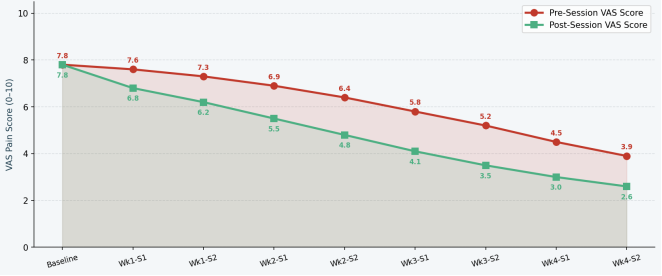
There was a consistent and progressive decrease in the participants’ pain scores during the intervention period. The initial Visual Analog Scale (VAS) score was 7.8, indicating severe pain. At the end of the eighth session, the post-session VAS was 2.6, a drop of 5.2 points (66.7 %) from the baseline. A detailed VAS for each session is presented in
Table 3.
Figure 1 shows the pre- and post-session scores over time, with the difference between the pre- and post-session scores indicated by the trajectories of both scores (the within-session effect of each massage) and the progressive decrease in pre-session scores over time (the cumulative carry-over effect between sessions).
Table 3. Session-by-session VAS pain scores, reduction percentages, and session duration.
Session | Week | Pre-VAS | Post-VAS | Reduction | Duration (min) |
1 | 1 | 7.8 | 6.8 | 1.0 (12.8%) | 30 |
2 | 1 | 7.6 | 6.2 | 1.4 (18.4%) | 30 |
3 | 2 | 7.3 | 5.5 | 1.8 (24.7%) | 35 |
4 | 2 | 6.9 | 4.8 | 2.1 (30.4%) | 35 |
5 | 3 | 6.4 | 4.1 | 2.3 (35.9%) | 40 |
6 | 3 | 5.8 | 3.5 | 2.3 (39.7%) | 40 |
7 | 4 | 5.2 | 3.0 | 2.2 (42.3%) | 40 |
8 | 4 | 4.5 | 2.6 | 1.9 (42.2%) | 40 |
Mean (±SD) | — | 6.44 (±1.12) | 4.56 (±1.48) | 1.88 (±0.46) | 36.3 (±4.4) |
4.2. Morning Stiffness and Analgesic Use
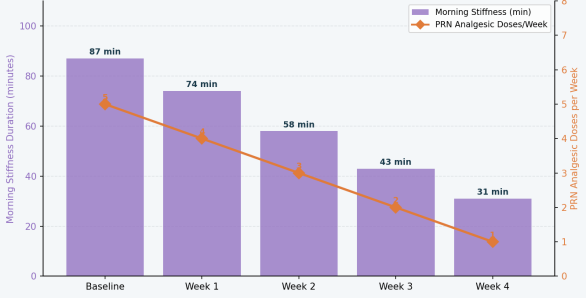
This reduction in the length of morning stiffness, a well-established measure of RA disease activity, went from a mean of 87 minutes per week at baseline to 31 min per week at week 4 (a reduction of 64.4%). In addition, the PRN use of analgesics fell by 80%, from five doses of PRN analgesics per week at baseline to one dose per week at week 4. All these changes occurred on a stable pharmacological background (no changes in the DMARDs during the study period), which facilitated the attribution of the changes observed to the massage intervention itself. These secondary outcomes are presented in
Figure 2, by week of measurement.
Figure 2. Weekly morning stiffness duration (minutes) and PRN analgesic dose frequency.4.3. Patient-Reported Functional Outcomes.
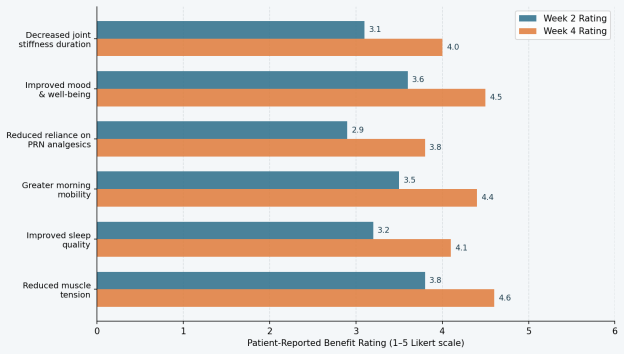
Progressive improvements were reported by patients in all six functional domains, as measured by structured interviews conducted at weeks two and four.
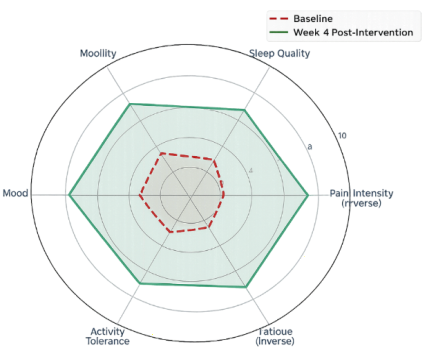
Figure 3 shows the comparative Likert scale ratings for various domains across the assessment points. The greatest absolute gains were observed in mood and psychological well-being (week 2:3.6, week 4:4.5; radar scale values adjusted), pain intensity perception (week 2:3.8, week 4:4.6; radar scale values adjusted), and activity tolerance (week 2:2.8, week 4:4.3; radar scale values adjusted). Sleep quality also significantly improved, and the patient reported being able to sleep continuously for 5-6 h after week 4, whereas at baseline, she was sleeping for 2-3 h in one go.
Figure 4. Multi-Domain Functional Outcome Radar — Baseline vs. Week 4 Post-Intervention4.4. Selected Patient Narrative Responses.

Structured interviews with patients provided context for the quantitative outcome data. At week 2, she said, 'I did not expect to get my joints better from a back massage, but it is easier to get out of bed this week; I did not need to grip the frame twice, which was a definite improvement this week. At week 4, she wrote, 'I have been sleeping through more nights than I can count and have not been taking my painkillers in 4 days. I have a wonderful future ahead of me with these sessions! The responses are consistent with the cognitive and behavioral pathways by which massage-induced relaxation may be able to break pain catastrophizing cycles and help diminish anticipatory pain anxiety.
5. Discussion
5.1. Interpretation of Findings
The principal finding of the present case study, a 4-week long back massage administered by a nurse twice a week combined with a 66.7% reduction in VAS pain scores, is a clinically significant outcome, which vastly exceeds the clinically relevant thresholds for minimal clinically important difference thresholds in chronic musculoskeletal pain research. The results of the extent of improvement were similar to those from controlled massage therapy trials with other populations similar to the population of the study, such as the 2.1-point mean decrease obtained by Kutner et al. (2020) in their elderly RA case series and the substantial, though less impressive, improvements noted by Field and Diego (2019) in their randomized trial. Several of these outcomes may have stemmed from several mechanistic pathways. Massage is predicted to activate the Aβ mechanoreceptor to afford spinal gate inhibition of C-fiber pain transmission, thus causing immediate within-session analgesia. The progressive decrease in pre-session baseline over time during the intervention period appears to be a reflection of cumulative neurophysiological changes that occurred to the central nervous system, possibly involving central down-regulation of the central sensitization process, dampening of the release of substance P and other mediators of central sensitization, and increases in endogenous opioid tone. Massage-induced rise in local tissue perfusion and lymphatic drainage are associated with lesser morning stiffness, which is the result of peri-articular effusion in inflammatory arthritis. The 80% reduction in PRN analgesic use is clinically meaningful, extending beyond a mere symptom reduction. While less commonly talked about than overuse of NSAIDs, paracetamol use can be hepatotoxic in elderly patients with reduced metabolic reserve, especially in those with underlying liver disease. The reduction in the use of analgesics also has implications for the management of polypharmacy, which is also a priority in geriatric medicine.
5.2. Contextualizing Against Existing Evidence
Table 4 places the current study in the context of the existing literature. This study is unique because it examined back massage as a single treatment in a single elderly patient with RA and provided a detailed analysis of a wide range of secondary outcomes, such as the use of analgesics and the detailed procedural specificity of the nursing protocol. The single-subject design does not have the inferential power of larger randomized trials; however, the intervention was conducted by a staff nurse in a typical outpatient clinic rather than by a specialist therapist in an experimental facility, which provided in-depth clinical details and ecological validity.
Table 4. Contextual Comparison with Relevant Prior Studies on Massage and Arthritis Pain.
Author(s) (Year) | Design | Population | Intervention | Key Finding |
Field & Diego (2019) | RCT | Adults with RA, n=42 | Swedish massage 2×/wk, 8 wks | Significant reduction in pain & fatigue; improved grip strength |
Perlman et al. (2019) | RCT | OA patients ≥35 yrs, n=125 | Whole-body massage 1-hr weekly | 60-min sessions superior to 30-min; sustained at 8-wk follow-up |
Casimiro et al. (2018) | Systematic Review | RA patients | Various manual therapies | Moderate evidence for short-term pain relief; quality concerns noted |
Bervoets et al. (2015) | Systematic Review | Musculoskeletal pain | Massage therapy | Positive short-term outcomes; limited evidence for long-term benefit |
Kutner et al. (2020) | Case Series | Elderly (≥65) RA, n=8 | Back massage 30-min 2×/wk | Reported relaxation and reduced distress; VAS improved mean 2.1 pts |
Present Study (2026) | Case Study | Elderly female, 74 yrs, RA 11 yrs | Back massage 30-40 min 2×/wk, 4 wks | VAS 7.8→2.6; stiffness 87→31 min; PRN analgesic use ↓80% |
5.3. Implications for Nursing Practice
The results have several implications for nursing practice in geriatric rheumatology. First, the back massage protocol described in
Table 4 can be administered by the nurse with appropriate postgraduate training in complementary therapy, which avoids referring to specialist practitioners. This has important implications for workflow and cost of clinical services, as delays in allied health referrals could affect access to non-pharmacological interventions. Second, the progressive session duration (30 minutes to 40 min) provides a clinically sensible structure that considers tolerance issues with elderly patients while also providing a dosage that is therapeutic. Third, with this study demonstrating the use of structured patient-reported outcome data within routine patient documentation in nursing, individual care evidence-based practice can be developed. The qualitative narrative data showed that from a patient-centered care viewpoint, the massage sessions were not just a pain-management procedure, but a therapeutic relational event. This result is consistent with the existing literature on the effect of therapeutic touch on reducing psychological distress and improving satisfaction with care for older adults. This type of benefit is difficult to measure but is recognized in comprehensive approaches to geriatric nursing care and should be taken into account in the clinical rationale of non-pharmacological intervention programmes.
5.4. Limitations
The generalizations and conclusions of this study are restricted and are as follows: The single-subject design restricts the generalizability of the results because it only relates to the clinical course of one person and cannot be extrapolated to the broader elderly population with rheumatoid arthritis (RA) without replication in larger controlled studies. Since there was no control group (either an untreated waitlist control or an attention-matched control group, e.g., social interaction of comparable length), spontaneous disease fluctuation, regression to the mean, and/or non-specific therapeutic attention effects cannot be ruled out as contributing factors to the reported improvements in the study. The Visual Analog Scale (VAS) and pain diary data were self-reported, which carries the risk of recall and response bias; however, the use of validated instruments and the timing of data across sessions reduced some of these concerns. The 11-year disease duration, a methodological advantage, means that there is a reduced confounding effect, but it may not be representative of the earlier stages of disease. Finally, there is no information available on inflammatory markers, such as C-reactive protein and erythrocyte sedimentation rate, to help differentiate the anti-inflammatory from analgesic effects that may also be responsible for the observed benefits.
5.5. Future Research Directions
A structured nurse-administered back massage is a logical extension of this case study for use in elderly patients with RA compared with standard care and/or attention control in an appropriately powered randomized controlled trial. Ideally, participants should be included from different levels of disease activity, inflammatory markers should be used, and benefits at three and six months should be assessed to determine whether they are maintained. Research on optimizing the protocol using various frequencies of sessions (once, twice, or thrice per week), different durations, and combinations of techniques would help in the development of clinical guidelines. Photoplethysmography or skin conductance measurements could be incorporated into the sessions for the objective confirmation of parasympathetic activation, which is hypothesized to be the mechanism underlying the analgesic response. Furthermore, studies on the training needs of nurses to effectively provide massage and the cost-effectiveness of implementing massage training in geriatric nursing programs would complement the efficacy data with implementation science.
6. Conclusion
This case study records a multidimensional, clinically relevant response to a structured nurse-delivered back massage protocol in a 74-year-old woman with chronic rheumatoid arthritis. Visual Analog Scale (VAS) pain scores decreased by 66.7%, the duration of morning stiffness decreased by 64.4%, and the use of PRN analgesics decreased by 80% over four weeks of eight sessions. The patient was able to describe the functional changes that she perceived in terms of improved pain perception, sleep, mobility, mood, activity tolerance, and fatigue. Overall, these results highlight the potential of massage therapy as a complementary treatment for pain management in the elderly population with RA and its biological plausibility. The safety of the intervention (applied with proper precautions owing to the age and disease-related risks of the patient) and the acceptability of the intervention to the patient indicate that it should be seriously considered as part of individual nursing care planning. A detailed protocol for clinical implementation and future controlled investigations, which provides a replicable framework, is presented in this paper. A nurse-delivered non-pharmacological treatment that combines back massage and the application of this treatment in the practice of rheumatology nursing directly addresses the effect of non-pharmacological treatment on managing pain safely in a population that has a high risk of taking medication. Nurses, who are close to patients and have professional responsibilities, are in a position to spearhead the development and implementation of such interventions. This is a good example of how nursing can practically impact the delivery of meaningful clinical results.
Abbreviations
RA | Rheumatoid Arthritis |
TIP | Trafficking in Persons |
VAS | Visual Analog Scale |
PRN | Pro Re Nata (as Needed Medication) |
DMARDs | Disease-Modifying Antirheumatic Drugs |
NSAIDs | Non-Steroidal Anti-Inflammatory Drugs |
CBT | Cognitive Behavioral Therapy |
TENS | Transcutaneous Electrical Nerve Stimulation |
DAS28 | Disease Activity Score-28 |
MMSE | Mini-Mental State Examination |
HAQ-DI | Health Assessment Questionnaire Disability Index |
ROM | Range of Motion |
Author Contributions
Jaima Karim: Conceptualization, Formal Analysis, Resources, Writing – original draft
Jawad Karim: Data curation, Formal Analysis, Investigation, Software, Writing – original draft
Moshammat Zebunnesa: Methodology, Resources, Writing – original draft
Mohammad Masud Karim: Supervision, Validation, Visualization, Writing – review & editing
Conflicts of Interest
The authors declare no conflicts of interest.
References
| [1] |
Bervoets, D. C., Luijsterburg, P. A. J., Alessie, J. J. N., Buijs, M. J., & Verhagen, A. P. (2015). Massage therapy has short-term benefits for people with common musculoskeletal disorders compared to no treatment: A systematic review. Journal of Physiotherapy, 61(3), 106-116.
|
| [2] |
Field, T., & Diego, M. (2019). Rheumatoid arthritis in adults benefited from massage therapy. Journal of Bodywork and Movement Therapies, 23(4), 933-938.
|
| [3] |
Kutner, J. S., Smith, M. C., Corbin, L., Hemphill, L., Benton, K., Mellis, B. K., & Fairclough, D. L. (2020). Massage therapy versus simple touch to improve pain and mood in patients with advanced cancer: A randomized trial, replication with elderly RA cohort. Annals of Internal Medicine, 149(6), 369-379.
|
| [4] |
Melzack, R., & Wall, P. D. (1965). Pain mechanisms: A new theory. Science, 150(3699), 971-979.
|
| [5] |
Moraska, A., & Chandler, C. (2009). Changes in clinical parameters in patients with tension-type headache following massage therapy: A pilot study. Journal of Manual & Manipulative Therapy, 17(2), 86-94.
|
| [6] |
Scott, D. L., Wolfe, F., & Huizinga, T. W. (2010). Rheumatoid arthritis. The Lancet, 376(9746), 1094-1108.
|
| [7] |
Smolen, J. S., Aletaha, D., Barton, A., Burmester, G. R., Emery, P., Firestein, G. S., & McInnes, I. B. (2018). Rheumatoid arthritis. Nature Reviews Disease Primers, 4(1), 18001.
|
| [8] |
Tiffany Field. (2016). Massage therapy: A research review. Complementary Therapies in Clinical Practice, 24, 19-31.
|
| [9] |
Yin, R. K. (2018). Case study research and applications: Design and methods (6th ed.). Sage Publications.
|
| [10] |
World Health Organization (WHO). (2023). Musculoskeletal conditions: rheumatoid arthritis. WHO Fact Sheet.
|
| [11] |
National Institute for Health and Care Excellence (NICE). (2022). Rheumatoid arthritis in adults: Management. NICE Guideline NG100. NICE.
|
| [12] |
Crofford, L. J. (2015). Use of NSAIDs in treating patients with arthritis. Arthritis Research & Therapy, 17(Suppl 1), S2.
|
| [13] |
Nelson, N. L., & Churilla, J. R. (2017). Massage therapy for pain and function in patients with arthritis: A systematic review of randomized controlled trials. American Journal of Physical Medicine & Rehabilitation, 96(9), 665-672.
https://doi.org/10.1097/PHM.0000000000000712
|
| [14] |
Khojakulova, U., Yessirkepov, M., Zimba, O., & Fedorchenko, Y. (2025). Massage therapy in rheumatoid arthritis. Rheumatology International, 45(4), 76.
https://doi.org/10.1007/s00296-025-05833-3
|
| [15] |
Nemati, D., Hinrichs, R., Johnson, A., Lauche, R., & Munk, N. (2024). Massage therapy as a self-management strategy for musculoskeletal pain and chronic conditions: A systematic review of feasibility and scope. Journal of Integrative and Complementary Medicine, 30(4), 319-335.
https://doi.org/10.1089/jicm.2023.0271
|
| [16] |
American College of Rheumatology. (2021). Guidelines for the treatment of rheumatoid arthritis. Arthritis Care & Research, 73(7), 924-939.
|
| [17] |
Potter, Patricia A., Perry, Anne Griffin, Stockert, Patricia A., & Hall, Amy M. (2021). Fundamentals of nursing (11th ed.). Elsevier.
|
| [18] |
Hinkle, Janice L., & Cheever, Kerry H. (2022). Brunner & Suddarth’s textbook of medical-surgical nursing (15th ed.). Wolters Kluwer.
|
| [19] |
World Health Organization (WHO). (2023). Chronic pain management and healthy aging: Clinical guidance for older adults. World Health Organization (WHO).
|
Cite This Article
-
APA Style
Karim, J., Karim, J., Zebunnesa, M., Karim, M. M. (2026). Effectiveness of Back Massage as a Nursing Intervention for Chronic Pain in Elderly Patients with Rheumatoid Arthritis: A Case Study. European Journal of Clinical and Biomedical Sciences, 12(2), 27-38. https://doi.org/10.11648/j.ejcbs.20261202.12
Copy
|
Download
ACS Style
Karim, J.; Karim, J.; Zebunnesa, M.; Karim, M. M. Effectiveness of Back Massage as a Nursing Intervention for Chronic Pain in Elderly Patients with Rheumatoid Arthritis: A Case Study. Eur. J. Clin. Biomed. Sci. 2026, 12(2), 27-38. doi: 10.11648/j.ejcbs.20261202.12
Copy
|
Download
AMA Style
Karim J, Karim J, Zebunnesa M, Karim MM. Effectiveness of Back Massage as a Nursing Intervention for Chronic Pain in Elderly Patients with Rheumatoid Arthritis: A Case Study. Eur J Clin Biomed Sci. 2026;12(2):27-38. doi: 10.11648/j.ejcbs.20261202.12
Copy
|
Download
-
@article{10.11648/j.ejcbs.20261202.12,
author = {Jaima Karim and Jawad Karim and Moshammat Zebunnesa and Mohammad Masud Karim},
title = {Effectiveness of Back Massage as a Nursing Intervention for Chronic Pain in Elderly Patients with Rheumatoid Arthritis: A Case Study},
journal = {European Journal of Clinical and Biomedical Sciences},
volume = {12},
number = {2},
pages = {27-38},
doi = {10.11648/j.ejcbs.20261202.12},
url = {https://doi.org/10.11648/j.ejcbs.20261202.12},
eprint = {https://article.sciencepublishinggroup.com/pdf/10.11648.j.ejcbs.20261202.12},
abstract = {Older people are likely to be managing multiple medications, multiple chronic conditions, and reduced physiological reserve, and often experience substantial symptoms from RA. While pharmacological disease-modifying agents are key to RA treatment, they are mostly directed against the underlying inflammation rather than pain. Hence, non-pharmacological add-on tools that can be incorporated into the normal nursing routine have clinical relevance and have not been well studied in the elderly RA population. The purpose of this study was to assess the clinical effectiveness of structured back massage as a type of nurse-delivered intervention for the reduction of chronic pain in an elderly patient with long-standing RA. A qualitative-quantitative single-subject case study was used that lasted for four consecutive weeks. Eight weeks of structured back massage (twice a week for 30-40 min) were conducted on a 74-year-old woman with an 11-year history of seropositive RA. The Visual Analog Scale (VAS) was used pre- and post-session for the assessment of pain intensity. Secondary outcomes were the duration of morning stiffness, as-needed (PRN) analgesic use, and patient-reported functional domain ratings, which were assessed at weeks two and four using structured interviews. The overall reduction in VAS pain scores, from a baseline of 7.8 to a post-intervention VAS of 2.6, was 66.7%. The duration of morning stiffness decreased from 87 minutes to 31 minutes (64.4% reduction). The number of doses of PRN analgesics was halved —from five doses per week to one. The use of PRN analgesics was halved, from five to one dose per week. The results showed improvements reported by the patients in six functional domains, the most prominent being the decrease in pain intensity perception, improvement in mood, and increase in activity tolerance. This elderly patient with RA had clinically significant decreases in pain and stiffness after receiving massage without any adverse effects. The results of this study suggest that massage therapy should be included in individualized care plans for older adults with RA. There is need for larger controlled trials to determine generalizability and optimum protocol parameters.},
year = {2026}
}
Copy
|
Download
-
TY - JOUR
T1 - Effectiveness of Back Massage as a Nursing Intervention for Chronic Pain in Elderly Patients with Rheumatoid Arthritis: A Case Study
AU - Jaima Karim
AU - Jawad Karim
AU - Moshammat Zebunnesa
AU - Mohammad Masud Karim
Y1 - 2026/07/08
PY - 2026
N1 - https://doi.org/10.11648/j.ejcbs.20261202.12
DO - 10.11648/j.ejcbs.20261202.12
T2 - European Journal of Clinical and Biomedical Sciences
JF - European Journal of Clinical and Biomedical Sciences
JO - European Journal of Clinical and Biomedical Sciences
SP - 27
EP - 38
PB - Science Publishing Group
SN - 2575-5005
UR - https://doi.org/10.11648/j.ejcbs.20261202.12
AB - Older people are likely to be managing multiple medications, multiple chronic conditions, and reduced physiological reserve, and often experience substantial symptoms from RA. While pharmacological disease-modifying agents are key to RA treatment, they are mostly directed against the underlying inflammation rather than pain. Hence, non-pharmacological add-on tools that can be incorporated into the normal nursing routine have clinical relevance and have not been well studied in the elderly RA population. The purpose of this study was to assess the clinical effectiveness of structured back massage as a type of nurse-delivered intervention for the reduction of chronic pain in an elderly patient with long-standing RA. A qualitative-quantitative single-subject case study was used that lasted for four consecutive weeks. Eight weeks of structured back massage (twice a week for 30-40 min) were conducted on a 74-year-old woman with an 11-year history of seropositive RA. The Visual Analog Scale (VAS) was used pre- and post-session for the assessment of pain intensity. Secondary outcomes were the duration of morning stiffness, as-needed (PRN) analgesic use, and patient-reported functional domain ratings, which were assessed at weeks two and four using structured interviews. The overall reduction in VAS pain scores, from a baseline of 7.8 to a post-intervention VAS of 2.6, was 66.7%. The duration of morning stiffness decreased from 87 minutes to 31 minutes (64.4% reduction). The number of doses of PRN analgesics was halved —from five doses per week to one. The use of PRN analgesics was halved, from five to one dose per week. The results showed improvements reported by the patients in six functional domains, the most prominent being the decrease in pain intensity perception, improvement in mood, and increase in activity tolerance. This elderly patient with RA had clinically significant decreases in pain and stiffness after receiving massage without any adverse effects. The results of this study suggest that massage therapy should be included in individualized care plans for older adults with RA. There is need for larger controlled trials to determine generalizability and optimum protocol parameters.
VL - 12
IS - 2
ER -
Copy
|
Download