Research Article | | Peer-Reviewed

Numerical Analysis of Magnetohydrodynamic (MHD) Glycerin Copper-Silver Hybrid Nano-Coolant Using Tiwari-Das Model

Received: 15 August 2025     Accepted: 29 August 2025     Published: 21 October 2026
Views:       Downloads:
Abstract

The existence of machines, electronic devices, environmental regulations and the blooming technology demands for endless efficient heat transfer fluid in automotive radiators, electronics heat sinks and dispersants in transformers coolers. The nanofluid flow is advanced with the aim of bridging the gap in fields such as engineering, industries and medical. The potential use of hydromagnetic (Cu/Ag-glycerine) hybrid nanofluid as a coolant is examined. The Tiwari-Das nanofluid model is applied in the formulation of the partial differential equations describing the flow. The introduction of similarity transformation variables converts the equations to nonlinear systems. The deployment of the state-space method linearizes the ordinary differential equations which numerically solves using the fourth-order Runge-Kutta method with a shooting technique in MATLAB. The ode45 function is invoked. The outputs of the simulation are displayed graphically and in tabular form. The results show the fluid velocity decays with the rise of magnetic strength and Prandtl number while it escalates with radiation parameter, Grashof and Darcy numbers correspondingly. Further, the temperature of the fluid increases with magnetic and radiation parameters and Eckert number. The opposite trend is observed with soaring Prandtl and Darcy numbers respectively. The local skin friction coefficient dwindles with the growth of porosity, magnetic field and radiation parameters. The rate of energy transfer is elevated with increase in magnetic field, radiation and porosity. The decrease in fluid velocity and the hike rate of heat transfer with magnetic field are utilized in thermal transfer, cooling and in heat flow management.

Published in Fluid Mechanics (Volume 11, Issue 1)
DOI 10.11648/j.fm.20261101.12
Page(s) 12-21
Creative Commons

This is an Open Access article, distributed under the terms of the Creative Commons Attribution 4.0 International License (http://creativecommons.org/licenses/by/4.0/), which permits unrestricted use, distribution and reproduction in any medium or format, provided the original work is properly cited.

Copyright

Copyright © The Author(s), 2026. Published by Science Publishing Group

Keywords

Magnetohydrodynamics, Hybrid-Nano-Coolant, Analysis

1. Introduction
The use of nanofluids as a working fluid in heat transfer applications continues to yield promising results. This is attributed to their better thermal network and rheological properties Okello ; Rahman . Nanofluids engineered using a single type nanoparticle have been deployed as coolants in industrial processes to help dissipate heat and in high-density heat flux devices such as computer microchips, laser diodes, transformers, miniaturized electronic devices, nuclear reactors and in car radiators El-Khouly ; Mutuku ; Nanan Kwanchai . To further enhance the cooling capability of nanofluids research has shown dispersing two or more nanoparticles could further improve their cooling ability and overall application as heat transfer fluid in thermal processes. This has been attributed to the synergetic effect of the different nanoparticles suspended in the fluid. The hybrid nanofluids developed as a result of suspension of two or more nanoparticles in conventional heat transfer fluids have found use in specialized cooling systems. Xian investigating the use of CGnP-TiO2 hybrid nanoparticles dispersed in a mixture of distilled water and ethylene glycol reported increments of 4.94%, 35.87%, and 20.48% in Nusselt number, heat transfer coefficient, and effectiveness of the radiator. Delving into the performance of ethylene-glycol-based hybrid nanofluid for car radiator cooling Okello posted better cooling performance by Cu-Al2O3/ethylene-glycol compared to the rest of the nano-coolants. Studying the use of Tungsten (III) oxide WO3- silver/transformer oil hybrid nano-coolants, Aberoumand and Jafarimoghaddam observed an increment of 41% in thermal conductivity in higher weight fraction. Mashhadzadeh presented improved breakdown voltage and heat transfer by 9% and 8% respectively in the transformer while using TiO2/CNT-transformer oil hybrid nanofluid. They also reported reduction in the levels of gases C2H4 and C2H6 dissolved in the transformer oil by over 70% as a result of the use of hybrid nanofluid. The experimental study by Hassaan involving use of hybrid nanofluids MWCNTs-Al2O3/water at different nanoparticle concentrations and Reynolds number 2500-12560 in a shell and tube heat exchanger realized a 10-28.5% growth in Nusselt number over distilled water. The effectiveness of the heat exchanger rose by 22.7% when using hybrid nanofluid compared to distilled water. Heat transfer analysis by Jangid on Copper-alumina/water hybrid nanofluid in a vertical microtube revealed enhancement in Nusselt number by 3.102% at higher alumina nanoparticle concentration in the hybrid mixture and a 3.098% increase at a higher copper nanoparticle concentration in the mixture signifying the effectiveness of alumina nanoparticles compared to copper nanoparticles. A probe by Kanti on thermal performance of Al2O3-TiO250:50/water hybrid nanofluid in turbulent flow noted a maximum enhancement of 15.77% and 70.4% in viscosity and Nusselt number respectively for 1 vol% of hybrid nanofluid compared to the base fluid. Similarly, the hybrid nanofluids achieved a remarkable reduction in total entropy generation of 46% in contrast to the base fluid. Study by Mezrakchi on various hybrid nanocoolants in a shell and tube thermal exchanger across eight discrete inlet velocities revealed superior heat transfer capabilities of the hybrid nanofluid compared to the base fluid across all the conditions. The CuO-ZnO/water hybrid nanocoolants emerged as a better coolant with a substantial increase of over 9% in temperature reduction as opposed to the approximately 6% attained by other hybrid nanofluids at a lower velocity of 0.5m/s. The evaluation by Kargaran on the cooling efficiency of a photovoltaic panel equipped with a three-dimensional oscillating heat pipe integrated with hybrid nanofluids GO-CuO, CNT-CuO, MWCNT-CuO at 0.1 and 0.2g/L concentration of each nanofluid observed improved electrical power output by 12.07% in CNT-CuO hybrid nanofluid at 0.2g/L concentration. The CNT-CuO hybrid nanofluid outperformed other nanofluids registering a maximum exergy efficiency of 31.2%. The numerical investigation by Huminic and Huminic into the use of MWCNT-Fe3O4/water hybrid nanofluid as an automotive coolant reported a 31% enhancement in heat transfer compared to water at low Reynolds numbers. The simulation was performed for the range of Reynold numbers 50-1000 and for nanoparticle volume concentrations of 0.1% and 0.3%. The study by Bouras on improving cooling of high voltage transformers by incorporating nanofluids revealed improvement in the rate of heat transfer by 10% as a result of increasing solid volume nanoparticle concentration by 10% which made the fluid to become more conductive. Investigations by Boukounacha on thermal performance of mineral oils adulterated with different nanoparticles SiC, TiO2, Al2O3 showed increased values of thermal conductivity, viscosity, and density as a result of addition of nanoparticles. The enhanced thermal conductivity contributed to better cooling of the transformer by the nanocoolant. Study on performance of a solar dish system with hybrid nanofluid as a coolant by Sheikholeslami reported increase in maximum power output by 3.23% as a result of using nanocoolant. The examination by Shaalan on the cooling efficacy of a ZnO/TiO2 hybrid nanofluid in a photovoltaic (PV) system noted a 12.1% increase in electrical efficiency and a 10.4% reduction in panel temperature which were attributed to the use of nanocoolant. Investigations into the thermophysical properties of TiO2 nanofluids by V and B for prospective use in enhanced cooling applications in renewable energy systems and smart grids reported a 28% enhancement in thermal conductivity at 0.5% nanoparticle volume concentration making it ideal for use as a coolant in renewable energy systems and hybrid grids. From the aforementioned, a study on MHD glycerin Copper-Silver hybrid nanocoolant using Tiwari-Das model will be an insightful contribution to literature and offer an alternative coolant for industrial and engineering applications.
2. Mathematical Formulation
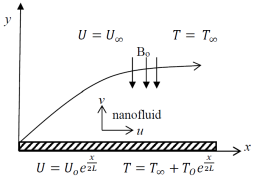
A steady, incompressible, laminar, two-dimensional x, y boundary layer flow of an electrically conducting Cu/Ag-glycerine hybrid nanofluid past a vertical semi-infinite flat plate under the influence of a transversely imposed magnetic field is considered (see Figure 1).
Figure 1. Flow configuration and coordinate system.
A transverse magnetic field with variable strength B0 is applied parallel to the y-axis. There is no applied voltage and the magnetic Reynolds number is small, hence the induced magnetic field and Hall effects are negligible. The use of the model proposed by Tiwari and Das is based on its inclusion of volume fraction to the thermophysical properties of the base fluid and it quantifies the concentration of the combining particles. It is more accurate. However, the short-comes such as particles sedimentation and agglomeration associated with the model are minimized by use of surfactants, choice of size and uniformed shape of nanometals, higher viscosity of the base fluid effects and the external applied magnetic fields suspends the particles. Assuming that the base fluid and the nanoparticles are at thermal equilibrium without slip condition, the mixture is uniform, non-interactive particles, with constant thermophysical properties and the solution is dilute. Under the a forestated assumptions the governing equations for the continuity, momentum and energy in laminar incompressible boundary layer flow in a nanofluid can be expressed as;
Mass equation
∂u∂x+∂v∂y=0(1)
Momentum equation
u∂u∂x+v∂u∂y=U∞∂U∞∂x+μhnfρhnf∂2U∞∂y2+gβT-T∞-σhnfρhnfβ02u-μhnfku (2)
Energy equation
u∂T∂x+v∂T∂y=αhnf∂2T∂y2-∂qρCp∂y (3)
The boundary conditions governing the flow are:
y=0, U∞=U0ex2l,v=0, T=T∞+Toex2ly→0,U∞→∞,T→∞(4)
2.1. Thermophysical Properties
The choice for the base fluid and the nanometal considers the physical and chemical properties of the combinates. Glycerin is non-toxic, biodegradable, stably boils at higher temperature, miscible with other liquids, higher heat capacity and non-decomposes at higher temperatures. Silver has excellent electrical and thermal conductivity. Its antimicrobial properties inhibit germination and growth of motile microorganisms enhancing efficiency and reliability of the nanofluid. Silver is less corrosive compared to other metals such as copper. 60% of water is mixed with 40% of glycerin using volume weighted average model to obtain the density, specific heat capacity, thermal conductivity and viscosity of the base fluid as follows
ρbf=0.6ρw+0.4ρg(5)
Cp,bf=0.6ρwCp,w+0.4ρgCp,gρbf(6)
kbf=0.6kw+0.4kg(7)
During deformation, non-Newtonian nanofluid exhibit nonlinear relation obtained as
μbf=μw0.6+μg0.4(8)
μbf=e0.6In(μw)+e0.4In(μg)(9)
Taking volume fractions of copper and silver as ϕc and ϕg, the total nanoparticle volume fraction is stated as
ϕnp=ϕc+ϕa.(10)
Assuming the mixture is uniform and the nanometals are spherical, the effective thermophysical characteristic of density, heat capacity, viscosity and thermal expansion are obtained as
ρhnf=1-ϕnpρbf+ϕcρc+ϕaρa(11)
ρCphnf=1-ϕnpρbfCp,bf+ϕcρcCp,c+Cp,aϕaρa(12)
Specific heat capacity of hybrid nanofluid
Cphnf=ρCphnfρhnf(13)
We used Brinkman model to approximate the combined viscosity as
μhnf=μbf1-ϕhnf2.5(14)
The thermal conductivity of the hybrid nanofluid is determined by Maxwell-Garnette model given as
khnf=kfbkc+2kbf-2ϕckbf-kckc+2kbf+ϕckc-kbfxka+2kbf-2ϕakbf-kaka+2kbf+ϕaka-kbf(15)
Where kc, ka-are the effective thermal conductivity of copper and silver respectively
The combined electrical conductivity of the nanometal
σhnf=ϕcσc+ϕaσa(16)
The combined thermal expansion of the base fluid and nanoparticles is stated as
βhnf=1-ϕc-ϕaβbf+ϕcβc+ϕaβa(17)
With βbf,βc,βa as thermal expansion of the base fluid, copper and silver respectively.
Table 1. Thermophysical properties.

Property

Water

Glycerin

Copper

Silver

Density (ρ)

997.05

1260

8935

10500

Specific heat capacity (Cp)

4180

2415

385

235

Thermal Conductivity (k)

0.606

0.285

400

429

Thermal expansion (β)

2.07x10⁻⁴

5.1x10⁻⁴

5.0x10⁻⁵

1.9x10⁻⁵

Electrical conductivity (σ)

-

-

5.96x10⁷

6.30x10⁷

Viscosity (μ)

0.00089

1.5

-

-

To enhance thermal absorption, the base fluid is dyed black and the mean absorption coefficient empirically determined as kbf̅=450 m-1. The nanofluid flows through porous medium of porosity K=0.85-0.98. The power law is used to estimate the mean absorption coefficient of the nanometal as follows
k*=kbf̅1+ϕaCa+ϕcCc
The fitting constants for copper Cc=250m-1 and silver Ca=800m-1 are also empirically stated.
2.2. Non-Dimesionalization
The equations (1-3) and the boundary conditions 4 are expressed in dimensionless form by introducing the similarity variables defined as
ψx,y=Uγx12f,η=yUγx,θ=T-T∞Toex2l(18)
The free stream function can be stated as
u=∂ψ∂y,v=-∂ψ∂xu=Uoexlf',v=-Uoγhnflex2l12f+η2f'(19)
Assuming the fluid flow has small variation in temperature, we expand T4 about T∞using Taylor series up to second term.
T4≈T∞4+4T∞3T-T∞
Since T∞4 is a constant initial ambient temperature
∂T4∂y=-4T∞3, ∂qrρCphnf∂y=-16σ*T∞33k*ρCphnf∂2T∂y2
Substituting equations (18)-(19) into equations (1-3), equation (1) is satisfied while equations (2)-(3) converts to dimensionless nonlinear ODEs for momentum, energy and the boundary conditions obtained as
f'''+12ff''-f'2+λθ-Mf'+δf'(20)
θ''+Pr0.5fθ'-f'θ-Rdθ''+EcMf'2(21)
with the boundary conditions
f=0,f'=1,f''=s1,θ=1,θ'=s2 at y=0f'→1,θ→0 at y=∞(22)
where M, Pr, Ec, λ,δ, Rd, are Hartman, Prandtl, Eckert, Thermal Grashof numbers, Darcy and Radiation.
Parameters respectively and are stated as follows
M=σhnfβo2xρhnfUo,Pr=μhnfCphnfkhnf,Ec=Uo2CpTo,λ=gβhnfToxUo2,δ=μhnfKUoρhnf,Rd=16σ*T∞33k*khnf
Deploying the wall shear stress definition τ=μ∂u∂y and Fourier law q=k∂T∂y, the non-dimensional form of skin friction (Cf), Nusselt (Nux) and Reynold Rex numbers respectively are determined as
Cf=τw12ρhnfU2,τw=μhnf∂u∂y,Rex=xUoγhnf
CfRex12=2μhnfρhnff''(23)
Nux=xqxkfTw-T∞,qx=-khnf∂T∂y
NuxRex-12=-khnfkbfθ'(24)
3. Numerical Procedure
The states variables are introduced to linearize the nonlinear ODEs of equations (20)-(21) together with the constrains in equation (22) as follows
f1=f,f2=f',f3=f'',θ1=θ,θ2=θ'(25)
f1'=f2(26)
f2'=f3(27)
f3'=-0.5f1f3+f22-λθ1+Mf2-δf2(28)
θ1'=θ2(29)
θ2'=11+Rd-Pr0.5f1θ2-f2θ1-EcMf22(30)
The constraints
f1=0,f2=1,θ1=1 at η=0 f2=1,θ1=0 at η=∞(31)
The shooting technique is employed by guessing targets s1 and s2. The Runge-Kutta fourth order scheme is performed using a computer software MATLAB for numerical analysis.
4. Results and Discussion
The effect of pertinent parameters on dimensionless velocity and temperature profiles, skin friction coefficient and local Nusselt number are depicted graphically and in tabular form and discussed in details.
4.1. Effects of Parameter Variation on Velocity Profile
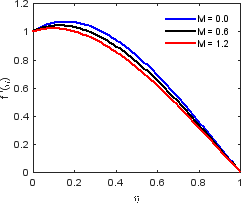
From Figures 2-6 the maximum fluid velocity occurs at the surface of the plate and it decays to zero free stream value far away from the plate satisfying the given boundary conditions. Figure 2 shows increase in magnetic parameter raises Lorentz force in the flow. Motion of the flow retards. Figure 3 illustrates escalation of Prandtl number thins velocity due to the kinematic viscosity and the internal resistance. Figure 4 denotes the velocity of the fluid increases with Darcy number. The rise of Darcy number increments porosity of the medium making the fluid to flow more easily. Figure 5, demonstrates radiation ascents with the velocity of the fluid. Thermal radiation consequently improves temperature and convectional currents. Figure 6, depicts Grashof number climbs with velocity profiles. Upthrust force in the flow prompts the fluid to move more swiftly leading to elevated velocity.
λ = 7, δ = 0.3, Rd = 0.7, Ec = 0.1
Figure 2. Velocity profiles for different values of Magnetic parameter.
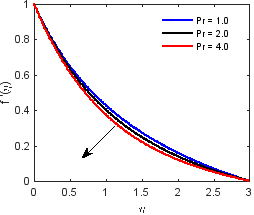
λ=0.5, δ=0.3, Rd=0.4, Ec=0.6, M=0.8
Figure 3. Velocity profiles for different values of Prandtl number.
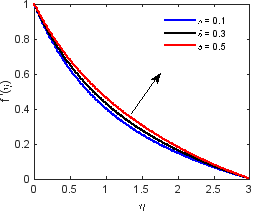
λ=0.5,Rd=0.4,Ec=0.6,M=0.8,Pr=0.9
Figure 4. Velocity profiles for different values of Darcy number.
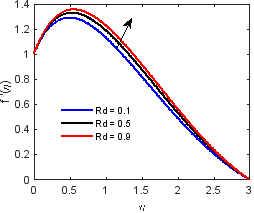
λ=5,δ= 0.5,Ec= 0.6,M=0.5,Pr=0.9
Figure 5. Velocity profiles for different values of radiation parameter.
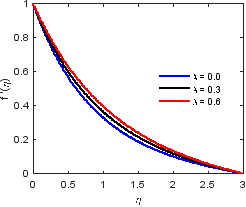
δ=0.5,Ec=0.8,M=1,Pr=3, Rd=0.3
Figure 6. Velocity profiles for different values of Grashof number.
4.2. Effects of Parameter Variation on Temperature Profiles
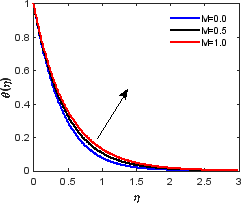
The effect of different parameters on dimensionless temperature profile is presented in Figures 7-11. The maximum fluid temperature occurs on the plate surface and it decays to zero far away from the plate surface. Figure 7 depicts increase in fluid temperature with magnetic parameter. Magnetic strength induces resistive force in the flow building up heat between the layers of the fluid caused by the soring viscous drag. On Figure 8 the temperature dwindles with increase in Prandtl number which lowers thermal diffusivity. Figure 9 depicts the effect of radiation on temperature profile. Radiation adds energy into the fluid. Figure 10 gives the effect of Darcy number on the temperature profile of the fluid. Large Darcy number means more space for passage of the fluid thus quick and efficient distribution of heat. Figure 11 presents upsurge of Eckert number with temperature. The friction between layers and particles of the fluid cause significant growth of heat.
λ=0.3,δ=0.5,Rd=0.7,Pr=8,Ec=0.8
Figure 7. Temperature profiles for different values of magnetic parameter.
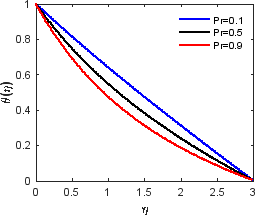
λ=0.3,δ=0.5,Rd=0.7,Ec=0.03,M=0.03
Figure 8. Temperature profiles for different values of Prandtl number.
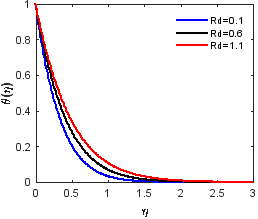
λ=0.3,δ=0.5,Ec=0.03,M=0.03,Pr=8
Figure 9. Temperature profiles for different values of Radiation parameter.
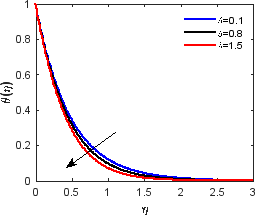
λ=0.3,Ec=0.03,M=0.8,Pr=8,Rd=0.7
Figure 10. Temperature profiles for different values of Darcy number.
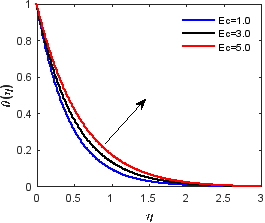
M=0.8,Pr=8,Rd=0.4,δ=0.6,λ=0.3
Figure 11. Temperature profiles for different values of Eckert number.

4.3. Effects of Magnetic Field, Radiation and Porosity on Skin Friction and Rate of Energy Transfer
Table 2. Effect of Magnetic field on local skin friction and rate of energy transfer.

M

CfxRex12x10-2

NuxRex-12

0.0

1.785

0.5068

0.3

1.731

0.5128

0.6

1.678

0.5189

0.9

1.624

0.5250

Table 3. Effect of Rd on local skin friction and rate of energy transfer.

Rd

CfxRex12x10-2

NuxRex-12

0.1

1.767

0.50879

0.2

1.749

0.51082

0.3

1.731

0.51284

0.4

1.714

0.51487

Tables 2-4 reveals the effect of magnetic field parameter, Radiation parameter and porosity on local skin friction and rate of energy transfer. The skin friction coefficient decreases with increase in magnetic field strength, radiation energy and porosity. The rate of energy transfer is elevated with a rise of magnetic field, radiation and porosity.
Table 4. Effect of porosity on local skin friction and rate of energy transfer.

δ

CfxRex12x10-2

NuxRex-12

0.01

1.782

0.50697

0.02

1.781

0.50717

0.03

1.780

0.50737

0.04

1.778

0.50757

5. Conclusion
This study examined the magnetohydrodynamic flow of a Cu/Ag-glycerine hybrid nano-coolant based on the Tiwari-Das nanofluid model. The partial differential equations governing the flow were formulated and transformed into ordinary differential system of equations by applying appropriate transformation variables. The resultant ODEs were solved numerically using the fourth-order Runge-Kutta method with a shooting technique. The results were indicated graphically and in tabular form. Matlab ode45 function was deployed. The following results were obtained from the study:
1) The velocity lowers with the growth of magnetic strength and Prandtl number while it escalates with Darcy, radiation and Grashoff number.
2) While Darcy and Prandtl numbers diminish temperature, magnetic strength, radiation and Eckert numbers extends it.
3) The positive deviation of magnetic strength, radiation and porosity contracted the local skin coefficient.
4) The rate of energy transfer was elevated with the expansion of magnetic field, radiation and porosity.
For use of this nanofluid as a coolant time contact with the heat source is increased with magnetic field and Prandtl number at low radiation, Darcy and Grashof numbers. Larger Darcy and Prandtl numbers minimize overheating of a system. Opposite trend is registered with the hike of magnetic strength, radiation and viscosity. While the reduction of these parameters improve the slipperiness of the nanofluid, their rise enhances the rate of energy migration. Further study can be extended by investigating unsteady flow past a vertical sheet using different nanoparticles.
Abbreviations

MHD

Hydromagnetic

ODE

Ordinary Differential Equation

MATLAB

Matrix Laboratory

PV

Photovoltaic Cell

Conflicts of Interest
The authors declare no conflicts of interest.
Appendix: Greek Letters and Symbols

Cu

Copper

Ag

Silver

kc,ka

Thermal conductivity of copper and silver (Wm-1k-1)

khnf,kbf

Thermal conductivity of hybrid nanofluid and base fluid (Wm-1k-1)

k*,k̅bf

Mean absorption coefficient of combinates and base fluid (m-1)

Cc,Ca

Fitting constants of copper and silver (m-1)

q

Heat flux (W/m2)

Nux

Nusselt number

Cf

Skin friction N/m2

Rex

Reynolds number

M

Hartman number

Pr

Prandtl number

Rd

Radiation (J)

Ec

Eckert number

u,v

Velocity in the x and y directions (m/s)

u∞

Far field velocity (m/s)

T,T∞

Temperature near and far the plate (K)

Bo

Initial magnetic field (A/m)

kw,kg

Thermal conductivity of water and silver (Wm-1K-1)

To

Initial temperature (K)

x

Distance along x (m)

L

Length of the plate (m)

Cp,bf

Specific heat capacity of the base fluid (Jkg-1, k-1)

ρbf,ρw,ρg,ρhnf

Density of the base fluid, water, glycerin and hybrid nanofluid (kgm-3)

μbf,μw,μg

Viscosity of base fluid, water and glycerin (Pa.s)

ϕc,ϕa

Volume Fraction of Copper and Silver

ρc,ρa

Density of Copper and Silver

Cphnf

Specific Heat Capacity of hybrid nanofluid

ϕhnf

Volume Fraction of Hybrid Nanofluid

σc,σa

Electrical conductivity of copper and silver (S/m)

βhnf,βbf,βc,βa

Thermal Expansion of Hybrid, Base, Copper and Silver (K-1)

ψ

Free Stream Function

η

Similarity Variable

θ

Temperature Variable

τ

Shear Wall Stress (Nm-2)

γ

Kinematic Viscosity (m2s-1)

δ

Darcy Number

λ

Grashof Number

References
[1] Aberoumand, S., & Jafarimoghaddam, A. (2018). Tungsten (III) oxide (WO3) – Silver/transformer oil hybrid nanofluid: Preparation, stability, thermal conductivity and dielectric strength. Alexandria Engineering Journal, 57(1), 169–174.
[2] Boukounacha, A. Y., Zegnini, B., Yousfi, B., & Seghier, T. (2025). Numerical modeling of the thermophysical performance of mineral oil-based dielectric nanofluids to improve the cooling in power transformers. Thermal Science, 00, 75–75.
[3] Bouras, A., Taloub, D., Chamkha, A. J., & Driss, Z. (2024). Evaluation of thermal conductivity using nanofluids to improve the cooling of high voltage transformers. Thermal Science, 28(4 Part A), 3081–3092.
[4] El-Khouly, M. M., El Bouz, M. A., & Sultan, G. I. (2021). Experimental and computational study of using nanofluid for thermal management of electronic chips. Journal of Energy Storage, 39, 102630.
[5] Hassaan, A. M. (2025). Evaluating experimentally the viability of employing hybrid nanofluids as an operating fluid in a shell-and-tube heat exchanger. Scientific Reports, 15(1), 4030.
[6] Huminic, G., & Huminic, A. (2017). Numerical analysis of hybrid nanofluids as coolants for automotive applications. International Journal of Heat and Technology, 35(Special Issue1), S288–S292.
[7] Jangid, P., Kumar, A., Tripathi, D., & Sharma, K. (2025). Heat transfer analysis in membrane-based pumping flow of hybrid nanofluids. The European Physical Journal Plus, 140(2), Article 2.
[8] Kanti, P. K., Wanatasanappan, V. V., Said, N. M., Saini, S., Mishra, V., Paramasivam, P., & Yusuf, M. (2025). Thermal performance, entropy generation, and machine learning insights of Al₂O₃-TiO₂ hybrid nanofluids in turbulent flow. Scientific Reports, 15(1), 16035.
[9] Kargaran, M., Goshayeshi, H. R., Azarberahman, S., & Chaer, I. (2025). Advanced Cooling of Photovoltaic Panels Using Hybrid Nanofluids Incorporating Graphene Oxide and Carbon Nanotubes. International Journal of Energy Research, 2025(1), 4345236.
[10] Mashhadzadeh, A. H., Ghanbari, M., Koochaki, A., & Ahangari, M. G. (2021). Improving the Thermal and Electrical Properties of Transformer Oil Using ‎Hybrid Nanofluid. Journal of Operation and Automation in Power Engineering, Online First.
[11] Mezrakchi, R. A. (2024). Investigation of various hybrid nanofluids to enhance the performance of a shell and tube heat exchanger. AIMS Energy, 12(1), Article energy-12-01-011.
[12] Mutuku, W. N. (2016). Ethylene glycol (EG)-based nanofluids as a coolant for automotive radiator. Asia Pacific Journal on Computational Engineering, 3(1), 1.
[13] Nanan Kwanchai, Chuwattanakul Varesa, Pramuanjaroenkij Anchasa, & Eiamsa-Ard Smith. (2024). Effect of a TiO2/water Nanofluid on the Thermal Cooling of a Central Processing Unit. Chemical Engineering Transactions, 109, 595–600.
[14] Okello, J. A., Mutuku, W. N., & Oyem, A. O. (2020a). A Review of Nanofluids Synthesis, Factors Influencing Their Thermophysical Properties and Applications. Journal of Engineering Research and Reports, 1–17.
[15] Okello, J. A., Mutuku, W. N., & Oyem, A. O. (2020b). Analysis of Ethylene Glycol (EG)-based ((Cu-Al2O3), (Cu-TiO2), (TiO2-Al2O3)) Hybrid Nanofluids for Optimal Car Radiator Coolant. Journal of Engineering Research and Reports, 34–50.
[16] Rahman, M. A., Hasnain, S. M. M., Pandey, S., Tapalova, A., Akylbekov, N., & Zairov, R. (2024). Review on Nanofluids: Preparation, Properties, Stability, and Thermal Performance Augmentation in Heat Transfer Applications. ACS Omega, 9(30), 32328–32349.
[17] Shaalan, Z. A., Hussein, A. M., Abdullah, M. Z., Alsayah, A. M., Alshukri, M. J., & Khaled, M. (2025). Enhanced photovoltaic cooling using ZnO/TiO₂ hybrid nanofluids: Numerical and experimental analysis. International Journal of Thermofluids, 27, 101222.
[18] Sheikholeslami, M., Ataollahi, N., Scardi, P., & Malagutti, M. A. (2025). Performance evaluation of a solar dish system with hybrid nanofluid cooling and sustainable thermoelectric power generation: Incorporating experimental property data. Solar Energy Materials and Solar Cells, 285, 113508.
[19] Tiwari, R. K., & Das, M. K. (2007). Heat transfer augmentation in a two-sided lid-driven differentially heated square cavity utilizing nanofluids. International Journal of Heat and Mass Transfer, 50(9), 2002–2018.
[20] V, S., & B, S. B. (2025). Enhanced Thermo-Physical Properties of Titanium Dioxide Nanofluids: Applications in Renewable Energy Systems and Smart Grid Cooling Technologies. 2025 International Conference on Electronics and Renewable Systems (ICEARS), 1–5.
[21] Xian, H. W., Sidik, N. A. C., & Saidur, R. (2022). Hybrid nanocoolant for enhanced heat transfer performance in vehicle cooling system. International Communications in Heat and Mass Transfer, 133, 105922.
Cite This Article
  • APA Style

    Wekesa, S. W., Okello, J. A., Mutuku, W. N. (2026). Numerical Analysis of Magnetohydrodynamic (MHD) Glycerin Copper-Silver Hybrid Nano-Coolant Using Tiwari-Das Model. Fluid Mechanics, 11(1), 12-21. https://doi.org/10.11648/j.fm.20261101.12

    Copy | Download

    ACS Style

    Wekesa, S. W.; Okello, J. A.; Mutuku, W. N. Numerical Analysis of Magnetohydrodynamic (MHD) Glycerin Copper-Silver Hybrid Nano-Coolant Using Tiwari-Das Model. Fluid Mech. 2026, 11(1), 12-21. doi: 10.11648/j.fm.20261101.12

    Copy | Download

    AMA Style

    Wekesa SW, Okello JA, Mutuku WN. Numerical Analysis of Magnetohydrodynamic (MHD) Glycerin Copper-Silver Hybrid Nano-Coolant Using Tiwari-Das Model. Fluid Mech. 2026;11(1):12-21. doi: 10.11648/j.fm.20261101.12

    Copy | Download

  • @article{10.11648/j.fm.20261101.12,
      author = {Simon Waswa Wekesa and John Achola Okello and Winifred Nduku Mutuku},
      title = {Numerical Analysis of Magnetohydrodynamic (MHD) Glycerin Copper-Silver Hybrid Nano-Coolant Using Tiwari-Das Model},
      journal = {Fluid Mechanics},
      volume = {11},
      number = {1},
      pages = {12-21},
      doi = {10.11648/j.fm.20261101.12},
      url = {https://doi.org/10.11648/j.fm.20261101.12},
      eprint = {https://article.sciencepublishinggroup.com/pdf/10.11648.j.fm.20261101.12},
      abstract = {The existence of machines, electronic devices, environmental regulations and the blooming technology demands for endless efficient heat transfer fluid in automotive radiators, electronics heat sinks and dispersants in transformers coolers. The nanofluid flow is advanced with the aim of bridging the gap in fields such as engineering, industries and medical. The potential use of hydromagnetic (Cu/Ag-glycerine) hybrid nanofluid as a coolant is examined. The Tiwari-Das nanofluid model is applied in the formulation of the partial differential equations describing the flow. The introduction of similarity transformation variables converts the equations to nonlinear systems. The deployment of the state-space method linearizes the ordinary differential equations which numerically solves using the fourth-order Runge-Kutta method with a shooting technique in MATLAB. The ode45 function is invoked. The outputs of the simulation are displayed graphically and in tabular form. The results show the fluid velocity decays with the rise of magnetic strength and Prandtl number while it escalates with radiation parameter, Grashof and Darcy numbers correspondingly. Further, the temperature of the fluid increases with magnetic and radiation parameters and Eckert number. The opposite trend is observed with soaring Prandtl and Darcy numbers respectively. The local skin friction coefficient dwindles with the growth of porosity, magnetic field and radiation parameters. The rate of energy transfer is elevated with increase in magnetic field, radiation and porosity. The decrease in fluid velocity and the hike rate of heat transfer with magnetic field are utilized in thermal transfer, cooling and in heat flow management.},
     year = {2026}
    }
    

    Copy | Download

  • TY  - JOUR
    T1  - Numerical Analysis of Magnetohydrodynamic (MHD) Glycerin Copper-Silver Hybrid Nano-Coolant Using Tiwari-Das Model
    AU  - Simon Waswa Wekesa
    AU  - John Achola Okello
    AU  - Winifred Nduku Mutuku
    Y1  - 2026/10/21
    PY  - 2026
    N1  - https://doi.org/10.11648/j.fm.20261101.12
    DO  - 10.11648/j.fm.20261101.12
    T2  - Fluid Mechanics
    JF  - Fluid Mechanics
    JO  - Fluid Mechanics
    SP  - 12
    EP  - 21
    PB  - Science Publishing Group
    SN  - 2575-1816
    UR  - https://doi.org/10.11648/j.fm.20261101.12
    AB  - The existence of machines, electronic devices, environmental regulations and the blooming technology demands for endless efficient heat transfer fluid in automotive radiators, electronics heat sinks and dispersants in transformers coolers. The nanofluid flow is advanced with the aim of bridging the gap in fields such as engineering, industries and medical. The potential use of hydromagnetic (Cu/Ag-glycerine) hybrid nanofluid as a coolant is examined. The Tiwari-Das nanofluid model is applied in the formulation of the partial differential equations describing the flow. The introduction of similarity transformation variables converts the equations to nonlinear systems. The deployment of the state-space method linearizes the ordinary differential equations which numerically solves using the fourth-order Runge-Kutta method with a shooting technique in MATLAB. The ode45 function is invoked. The outputs of the simulation are displayed graphically and in tabular form. The results show the fluid velocity decays with the rise of magnetic strength and Prandtl number while it escalates with radiation parameter, Grashof and Darcy numbers correspondingly. Further, the temperature of the fluid increases with magnetic and radiation parameters and Eckert number. The opposite trend is observed with soaring Prandtl and Darcy numbers respectively. The local skin friction coefficient dwindles with the growth of porosity, magnetic field and radiation parameters. The rate of energy transfer is elevated with increase in magnetic field, radiation and porosity. The decrease in fluid velocity and the hike rate of heat transfer with magnetic field are utilized in thermal transfer, cooling and in heat flow management.
    VL  - 11
    IS  - 1
    ER  - 

    Copy | Download

Author Information