Abstract
The strategic advancement of digital pedagogy presents a pivotal opportunity to resolve enduring contradictions within university teaching evaluation, specifically its administrative overemphasis and the consequent marginalization of developmental objectives. In response to national policy directives advocating for educational digitalization and Digital Empowerment Action for Teacher Development, this analysis critically deconstructs the constraints inherent in conventional evaluation frameworks. These limitations pertain to the homogenization of evaluators, simplification of evaluation content, superficial application of data, and a predominant managerialist orientation. The study aims to formulate a novel paradigm for developmental evaluation, intrinsically powered by digital technologies and fundamentally oriented toward the sustained professional growth of instructors. By architecting a synergistic framework incorporating multi-source evidence aggregation, intelligent diagnostic analytics, and personalized feedback loops, the model institutes a recursive, ascending cycle of “evaluation, diagnosis, enhancement, and re- evaluation.” This structure enables a foundational transformation in the evaluation paradigm, shifting its core function from selective judgment to developmental guidance. The Findings indicate that a digitally-empowered developmental evaluation system can effectively catalyze professional self-directedness among faculty. It achieves three critical transformations: from singular judgment to pluralistic development; from static appraisal to dynamic growth; and from external constraint to internal motivation. The study contributes both theoretical and practical scaffolding for the reform of instructional evaluation in higher education. It enriches teacher development theory by integrating an educational evaluation perspective and offers an actionable framework for resolving the long-standing tension between evaluation and development. Future research should explore deeper AI applications, disciplinary adaptability, and the ethical governance of evaluation data to further refine this paradigm.
Keywords
Digital Education, Teacher Professional Development, Teaching Evaluation, Developmental Evaluation, Artificial Intelligence
1. Introduction
The contemporary landscape of higher education is undergoing a profound reconfiguration driven by pervasive digital technologies, notably artificial intelligence (AI) and big data analytics. This digital transformation has evolved beyond the mere adoption of tools, emerging as a central catalyst for redefining educational paradigms, refreshing pedagogical approaches, and restructuring governance models. At the heart of enhancing educational quality lies the continuous development of teaching faculty, for which a robust and scientifically-grounded evaluation system is an indispensable mechanism to unlock pedagogical potential and assure instructional standards. Recent policy instruments, including the Guiding Opinions on Accelerating the Digitalization of Education (2025)
, explicitly champion “AI-facilitated large-scale personalized instruction” and stress data-empowered innovation in educational evaluation.
This direction is reinforced by the Notice on Organizing and Implementing the Digital Empowerment Action for Teacher Development (2022)
| [2] | General Office of the Ministry of Education of the People's Republic of China. "Notice on Organizing and Implementing the Digital Empowerment Action for Teacher Development." Ministry of Education of the People's Republic of China, 3 July 2025, www.moe.gov.cn/srcsite/A10/s7034/202507/t20250704_1196586.html |
[2]
, which calls for establishing evaluative mechanisms anchored in big data and AI, underscoring the synergistic progression of instructors’ digital competencies and professional advancement. Collectively, these policies highlight the strategic imperative to harness intelligent technologies for educator evaluation and growth. Motivated by this policy impetus and practical exigencies, this research articulates a developmental evaluation framework underpinned by digital capabilities, designed to achieve precise diagnostic insight and the continuous refinement of teaching proficiency.
Scholarly discourse on technology-enhanced evaluation has matured into a dynamic interdisciplinary domain. Research trajectories, however, reveal notable disjuncture. Scholars such as Li Jianlong et al. (2025)
| [3] | Li, Jianlong, and Zhendong Niu. "Research on AI-Enabled Teaching Evaluation in Higher Education Under the 'Technology-Education' Mutual Construction Framework." Chinese Higher Education Research, no. 11, 2025, pp. 15-23.
https://doi.org/10.16298/j.cnki.1004-3667.2025.11.03 |
[3]
identify a lack of effective mutual shaping between technology and pedagogy as a constraint on evaluation efficacy. Investigations by Lu Yuanyuan et al. (2022)
| [4] | Lu, Yuanyuan, et al. "Research on the Application Framework of Intelligent Technologies to Promote Teachers' Classroom Teaching Behavior Evaluation." Modern Educational Technology, vol. 32, no. 12, 2022, pp. 76-84. |
[4]
and Wang Mengke et al. (2024)
| [7] | Wang, Mengke, et al. "Design and Application Effect of a Multimodal Interactive Teaching Evaluation Framework Supported by Intelligent Technology." Modern Educational Technology, vol. 34, no. 9, 2024, pp. 91-101. |
[7]
explore automated analytical frameworks for classroom behaviors and multimodal interactive evaluation, respectively. Concurrently, Ji Yilong et al. (2024)
| [5] | Ji, Yilong, et al. "Intelligent Technology Empowering Teacher Teaching Evaluation: Theoretical Framework and Practical Directions." Contemporary Educational Science, no. 2, 2024, pp. 71-80. |
[5]
propose integrative theoretical models, while Yan Hanbing et al. (2024)
| [6] | Yan, Hanbing, Yi Chen, and Shuzhen Yu. "Unobtrusive Evaluation for Teacher Development: Connotation Elucidation, Value Examination, and Practical Approach." China Educational Technology, no. 10, 2024, pp. 1-8. |
[6]
note a convergence between contemporary evaluation practices and the concept of unobtrusive evaluation. The scholarly focus extends to the synergistic development of teachers and students
| [8] | Yang, Shiyu, Liyan Liu, and Shuo Li. "Construction of an Evaluation Indicator System for University Teachers' Teaching Ability: An Investigation and Analysis Based on the Delphi Method." Higher Education Exploration, no. 12, 2021, pp. 66-73. |
[8]
, the coupling of evaluation with academic innovation
| [9] | Niu, Fengrui. "The Reform Dilemma and Its Tensions of the University Teacher Evaluation System." Journal of National Academy of Education Administration, no. 4, 2022, pp. 52-60. |
[9]
, and the application of AI in generating diagnostic feedback and digital profiles
| [10] | Liu, Bangqi, and Huanhuan Yin. "Artificial Intelligence Empowers the Improvement of Teachers' Digital Literacy: Strategies, Scenarios, and Evaluation Feedback Mechanisms." Modern Educational Technology, vol. 34, no. 7, 2024, pp. 23-31. |
[10]
. Despite these advancements, a critical schism persists between research ambition and practical implementation. As Zhou Ling et al. (2024)
| [11] | Zhou, Ling, Xinyi Wang, and Huiting Zhang. "The Logical Dilemma and Value Return of Developmental Teacher Evaluation in Universities." Journal of Education of Renmin University of China, no. 2, 2024, pp. 33-53+4. |
[11]
contend, the ideal of developmental evaluation remains elusive in practice. Thus, a primary research lacuna involves translating the high-level principle of “digital empowerment in higher education” into a coherent, operational, and sustainably motivating evaluation model within institutional contexts. The inherent tension between “technological potential” and “philosophical foundation,” alongside that between “policy aspiration” and “operational reality,” constitutes the fundamental point of departure for this inquiry.
2. Practical Dilemmas in University Teaching Evaluation
The cultivation of high-quality instruction is contingent upon the effective integration of faculty, curriculum, professional support, and evaluation
| [12] | Darling-Hammond, Linda. Empowered Educators: How High-Performing Systems Shape Teaching Quality Around the World. Jossey-Bass, 2022. |
[12]
. A critical analysis of prevailing university teaching evaluation practices reveals a substantial divergence from modern evaluation philosophies and the demands of digital transformation, manifesting across several interconnected dimensions.
2.1. Homogenization of Evaluation Subjects
Current systems exhibit a predominant, and often excessive, reliance on student ratings. Other critical perspectives—including peer review, supervisory observation, self- evaluation, and administrative oversight—frequently operate in isolation, failing to coalesce into a synergistic, multi-perspective whole. The unique interpretive lenses offered by these distinct stakeholder groups are not effectively synthesized, resulting in a fragmented and sometimes unreliable portrayal of teaching effectiveness. Different evaluators naturally emphasize different facets of pedagogical practice; these dimensions should be both independent and complementary. Sole dependence on student feedback, which is susceptible to various subjective biases, inevitably compromises the authority and comprehensiveness of the evaluation outcomes.
2.2. Simplification of Evaluation Content
Evaluation protocols in numerous institutions remain narrowly focused on observable classroom performance, primarily capturing the delivery phase of instruction. This approach neglects the dynamic evaluation of the complete teaching continuum. Critical yet less tangible dimensions, such as the strategic foresight embedded in instructional design, the depth of post-instructional reflection, and the tangible outcomes of pedagogical innovation, receive inadequate scrutiny. Furthermore, the application of generic, one-size-fits-all indicators across disparate course types (e.g., foundational lectures, advanced seminars, laboratory sessions) renders them insufficient for capturing the diverse pedagogical demands and intended outcomes of different instructional formats.
2.3. Superficial Application of Data
A significant research frontier involves leveraging data mining techniques on evaluative data to identify key determinants of teaching quality and guide instructional innovation. Presently, however, evaluation results within universities seldom undergo sophisticated analysis. Vast repositories of teaching-related data remain at the level of descriptive statistics, lacking the application of advanced big data analytics and AI for deep mining, pattern recognition, and intelligent diagnosis. This deficiency severely curtails the potential of evaluation data to serve predictive, early-warning, and personalized guidance functions, thereby limiting its transformative power.
2.4. Managerialist Orientation of Evaluation
The prevailing orientation of teaching evaluation is overwhelmingly managerialist. Evaluation data are routinely utilized for simplistic ranking exercises and workload calculations, with results directly tethered to consequential decisions regarding rewards, sanctions, and promotion. Rarely are these results systematically linked to tailored professional growth opportunities or supportive interventions. This overemphasis on the inherent selective and screening function of evaluation has led to the severe marginalization of its core developmental purpose: fostering continuous professional growth. Consequently, faculty often perceive evaluation as an external imposition of control rather than an authentic opportunity for development. Compounding this issue, delayed feedback and the absence of structured follow-up mechanisms reduce the evaluative process to a perfunctory annual exercise, preventing the establishment of a genuine, iterative cycle of continuous improvement.
3. Theoretical Reconstruction of Evaluation from a Teacher Professional Development Perspective
3.1. Theoretical Foundations of Developmental Evaluation
The paradigm of developmental evaluation is rooted in theories of teacher professional development and constructivist learning. Teacher professional development theory conceptualizes growth as a continuous, career-long process, positing that evaluation should function primarily as a supportive scaffold for this development, not as a managerial instrument. Constructivist learning theory suggests that teacher learning and development constitute an active, internal process of knowledge construction; therefore, evaluation should be designed to ignite intrinsic motivation and cultivate reflective praxis.
A fundamental philosophical chasm separates developmental evaluation from traditional punitive appraisal. Punitive evaluation is predominantly retrospective, focusing on judging past performance against standardized metrics. In contrast, developmental evaluation is inherently prospective, concentrating on future growth potential and individualized progress pathways. The former employs uniform standards for cross-sectional comparison, while the latter values individual differences and longitudinal advancement. Functionally, punitive evaluation emphasizes identification, selection, and accountability, whereas developmental evaluation prioritizes guidance, support, and empowerment. This philosophical shift is congruent with broader trends in contemporary educational evaluation reform and resonates with the cultivation of a professional educator identity
| [13] | State Council of the People's Republic of China. "Opinions on Carrying Forward the Spirit of Educators and Strengthening the Construction of High-Quality and Professional Teaching Staff in the New Era." Central People's Government of the People's Republic of China, 6 Aug. 2024, www.gov.cn/zhengce/2024-08/06/content_7008981.htm |
[13]
.
3.2. Dual Drivers: Policy Orientation and Digital Empowerment
National policy directives provide robust, high-level endorsement for a developmental turn in evaluation. The Guiding Opinions (2025)
explicitly advocate for “establishing an educational evaluation mechanism supported by big data and artificial intelligence, improving outcome evaluation, and implementing multidimensional process evaluation, value-added evaluation, and comprehensive evaluation.” This framework of “Four Evaluations” aligns seamlessly with developmental principles. The concept of value-added evaluation, which measures growth in teaching capability rather than mere static performance, epitomizes the developmental ethos.
Concurrently, digital technology furnishes the technical capacity to operationalize this paradigm. AI algorithms can discern complex correlations between specific teaching behaviors and student learning outcomes. Big data analytics can process and interpret immense volumes of behavioral and interaction data. Cloud computing platforms facilitate the real-time aggregation, sharing, and collaborative analysis of evaluative data. Intelligent systems can generate precise, individualized insights into a teacher’s developmental needs and trajectories. These technological affordances render feasible the multi-dimensional, whole-process, dynamic, and personalized evaluations that were historically impractical. Therefore, digital empowerment entails not merely the digitization of existing processes, but the fundamental re-engineering of evaluation paradigms and methodologies through technological innovation.
3.3. A Collaborative Network of Evaluation Subjects
The implementation of developmental evaluation necessitates the construction of a collaborative network of evaluative agents. This network should strategically incorporate five core stakeholders: the instructor (self-evaluation), students, peer experts, teaching mentors/supervisors, and academic leadership. Empirical investigation confirms that each stakeholder contributes a unique and valuable perspective; in concert, they form a holistic, multi-faceted portrait of teaching effectiveness.
Instructor self-evaluation is fundamental for fostering professional agency, guiding educators to critically reflect on goal attainment, methodological efficacy, and student engagement. Student evaluations provide vital feedback on the lived learning experience, competency development, and intellectual stimulation. Peer evaluation focuses on the scholarly rigor of curriculum design, content accuracy, and pedagogical approach. Teaching supervision offers mentorship, quality assurance, and guidance aimed at stimulating pedagogical inquiry and refining practice. Administrative evaluation oversees the fulfillment of broader teaching responsibilities and institutional objectives, ensuring alignment with departmental and university missions.
3.4. An Evaluation Content System Covering the Entire Teaching Process
A developmental approach demands a comprehensive content framework that encompasses the entire instructional process. This system should integrate three primary dimensions: Instructional Design (encompassing preparatory elements like learning objective formulation, content architecture, and resource development); Instructional Implementation (addressing in-class execution, including interaction dynamics, pedagogical strategy application, and classroom climate); and Instructional Effectiveness (evaluating outcomes related to goal achievement, student development, and teaching innovation).
Crucially, within each dimension, evaluation indicators must be differentiated according to course type and the instructor’s career stage. For early-career faculty, evaluation might emphasize the mastery of core pedagogical principles and classroom management. For mid-career and senior instructors, the focus could shift toward pedagogical innovation, curriculum leadership, and the development of a distinctive teaching philosophy. Similarly, indicators must be tailored for theoretical, practical, foundational, and specialized courses. Such differentiation ensures the relevance and utility of evaluation, enabling results to genuinely inform and propel individualized professional development.
4. Constructing a Digitally-Enabled Teaching Evaluation Model and Implementation Pathway
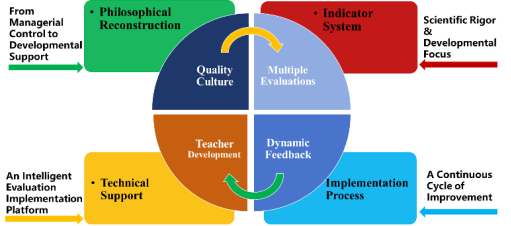
This research argues that reforming university teaching evaluation requires a fundamental paradigm shift from a logic of “managerial control” to one of “developmental support.” Digital technology serves as the critical enabler for this transformation. Moving beyond an instrumental view of technology, this section delineates how digital capabilities can systematically restructure the teaching evaluation ecosystem across four interdependent layers: philosophy, indicators, technology, and process. We propose an “Evidence-Based, Development-Core, Technology-Supported Digital-Enabled Developmental Evaluation Model,” offering a coherent and actionable systematic solution for university evaluation reform. This model, as schematized in
Figure 1, embeds the developmental philosophy throughout the evaluative cycle, leveraging digital integration to forge a sustainable mechanism for continuous improvement.
Figure 1. The Data-Driven Developmental Evaluation Model for University Teacher’ Teaching Faculty.
4.1. Philosophical Reconstruction: From Managerial Control to Developmental Support
Philosophical reorientation is the essential precursor to systemic change. Traditional evaluation often positions the teacher as an object of management, emphasizing external control and standardization. Developmental evaluation, conversely, reconceptualizes the teacher as an active agent in their own professional growth, focusing on intrinsic motivation and personalized progression. This shift necessitates a functional transformation from selection to guidance, an expansion in content from fragmented judgment to holistic diagnosis, and a methodological transition from predominantly summative to formative evaluation.
Achieving this philosophical reconstruction demands confronting entrenched institutional inertia. Historically designed as an accountability tool, existing evaluation systems and processes are deeply infused with a control-oriented logic. Cultivating a developmental approach requires reshaping the institutional culture surrounding evaluation, fostering relationships built on trust and mutual professional respect. Academic leaders must transition from supervisors to supporters, and faculty must be empowered to move from passive evaluation recipients to engaged, reflective participants in their own developmental journey.
Digital technology provides novel pathways for actualizing this philosophical shift. Digital construction is steadily transforming traditional pedagogical approaches and classroom management systems, bringing both new challenges and possibilities [14]. E-portfolios can comprehensively document a teacher’s instructional narrative and growth trajectory, providing a rich evidence base for developmental evaluation. Intelligent recommendation systems can deliver personalized learning resources and actionable suggestions aligned with individual development profiles. Virtual professional learning communities can facilitate asynchronous collaboration and reflective dialogue among faculty, thereby broadening the avenues and support structures for professional growth.
4.2. Indicator System Design: Balancing Scientific Rigor and Developmental Focus
A developmental evaluation indicator system must possess the dual attributes of scientific rigor and developmental focus. Scientific rigor ensures reliability and validity, while the developmental orientation guarantees the system's guiding and motivating functions. Alongside quantifiable teaching behavior data (e.g., interaction frequency derived from video analysis), the system must incorporate qualitative evaluation of teaching philosophy, emotional attitudes, and ethical values through teaching narratives, reflective journals, and in-depth interviews. This approach enables a holistic portrayal of teaching practice.
The proposed framework adopts a three-tiered “Dimension-Domain-Indicator” architecture. It spans multiple integrated dimensions: Instructional Design, Implementation, and Effectiveness, as previously outlined, with the critical addition of a Teaching Innovation & Reflection dimension. Distinct observational foci and indicators are calibrated for different course typologies and disciplinary contexts.
The assignment of weights within the indicator system must carefully reflect its developmental guidance. Weighting schemes should be adaptive, accounting for disciplinary norms, course types, and the teacher’s career stage (e.g., novice, proficient, expert). For example, indicators for novice teachers may place greater emphasis on foundational competencies, while those for expert teachers may prioritize scholarly teaching, mentorship, and educational leadership. The weighting system itself should incorporate mechanisms for periodic review and dynamic adjustment, allowing it to evolve in response to shifting institutional priorities and emerging understandings of effective teaching. Effective developmental evaluation is, at its core, responsive to individual context and need
| [15] | Liu, Lisha, et al. "Exploring the current status and influencing factors of Scholarship of Learning and Teaching (SOTL) among Chinese university faculty in centers for learning and teaching." Higher Education Research & Development, 2025, pp. 1-19. https://doi.org/10.1080/07294360.2025.2548276 |
[15]
.
4.3. Technological Support: An Intelligent Evaluation Implementation Platform
Operationalizing a digitally-enabled model requires a robust, integrated technological platform. This platform should be architected around four core functionalities: (1) automated, multi-modal data capture and aggregation across the teaching lifecycle; (2) intelligent analytics and diagnostic problem-identification using AI and machine learning algorithms; (3) generation of personalized, actionable feedback and guidance; and (4) predictive modeling and early-warning capabilities based on longitudinal data trends.
Platform design must prioritize usability, practicality, and ethical data stewardship. User interfaces should be intuitive, with workflows aligned to natural teaching and evaluation rhythms. Sophisticated data visualization tools are essential to help instructors intuitively comprehend their results, identify strengths, and pinpoint areas for growth. Mobile compatibility ensures evaluative activities and feedback access can occur flexibly, enhancing engagement and timeliness. Paramount to the platform’s success and adoption is the rigorous assurance of data security, privacy protection, and the establishment of transparent, ethical data governance protocols.
The integration of AI within the platform must be pedagogically informed. Natural Language Processing (NLP) can analyze sentiment and thematic content in qualitative student feedback. Machine learning can model complex relationships between specific teaching strategies and student outcome measures. Intelligent recommendation engines can curate and suggest personalized professional development resources based on a teacher’s unique profile and evaluation results. These smart functionalities not only enhance operational efficiency but, more importantly, deepen the accuracy, nuance, and guidance value of the evaluative feedback provided.
4.4. Implementation Process: A Continuous Cycle of Improvement
The implementation of developmental evaluation should establish a continuous improvement cycle. This cycle comprises four stages: the Planning stage, where teachers formulate improvement goals and development plans based on evaluation results; the Implementation stage, where teachers enact improvement measures in their practice; the Checking stage, which uses formative evaluation to gauge improvement effectiveness; and the Acting stage, which involves consolidating successful experiences and identifying new areas for growth.
Each stage requires institutional support and organizational backing. Universities should establish dedicated centers for faculty development and teaching evaluation, providing individualized consulting and guidance. At the departmental level, regular teaching research activities and peer exchanges foster a collaborative developmental culture. Individually, teachers must cultivate reflective habits and a growth mindset, actively utilizing evaluation results for self-improvement. This multi-level, comprehensive implementation system ensures the genuine integration of developmental evaluation.
Particular attention must be paid to feedback delivery during implementation. Feedback should be timely, specific, and constructive, acknowledging achievements while clearly indicating areas for improvement. Feedback formats can be diverse, including data reports, one-on-one consultations, and group discussions. Ultimately, teachers must perceive the evaluative process as supportive, fostering willingness to accept feedback and enact change.
5. Conclusion and Prospects
5.1. Theoretical Contribution and Practical Significance
Teaching evaluation grounded in teacher development aims to help educators enhance their capabilities through effective reflection, not merely to rank performance or determine relative standing. As an evaluative method promoting the synergistic development of the institution, faculty, and students, its core purpose is to leverage the guiding function of evaluation effectively. Infusing teacher development principles into evaluation creates a positive, mutually beneficial growth process for teachers and students. This model assesses all teaching phases (pre-class, in-class, and post-class), extending quality assurance across the entire instructional process. It enables teachers to promptly identify and address issues, thereby ensuring quality at every stage.
This study's digitally-enabled developmental evaluation model enriches teacher development theory by incorporating an educational evaluation perspective, proposing a new paradigm for the deep integration of developmental evaluation and digital technology. Practically, it provides an actionable framework for university evaluation reform, helping resolve the long-standing tension between evaluation and development. The model's core value lies in achieving three transformations: from singular judgment to pluralistic development, from static appraisal to dynamic growth, and from external constraint to internal motivation. This evolution aligns with the trajectory of digital education and the inherent logic of teacher professional development. Through innovative technological applications, it offers teachers more precise, timely, and personalized support.
5.2. Future Research Directions
Future research should explore several avenues. First, investigating the deeper application of AI in evaluation, such as automated analysis of qualitative comments using Natural Language Processing and intelligent recognition of teaching behaviors via computer vision. Second, examining the adaptability of the evaluation model across different disciplinary cultures to develop more personalized schemes. Third, addressing the ethical norms and secure governance of evaluation data, ensuring technological innovation proceeds in tandem with responsible practices.
Furthermore, comparative international studies are needed to learn from advanced experiences in developmental teacher evaluation within developed nations. Longitudinal tracking research is also essential to verify the long-term impact of developmental evaluation on teacher professional growth. Such inquiries will refine the theoretical system and practical models of digitally-enabled teacher evaluation.
Reconstructing a digitally-empowered developmental evaluation model for university teaching is a systemic endeavor requiring coordinated innovation in philosophy, institution, technology, and culture. Only by adhering to a developmental orientation, leveraging digital empowerment, and strengthening support services can we establish a new teacher evaluation ecology that is both scientifically sound and humanistically caring, ultimately achieving the dual goals of teacher development and education quality enhancement.
Abbreviations
AI | Artificial Intelligence |
NLP | Natural Language Processing |
Author Contributions
Lili Lu: Formal Analysis, Resources, Writing – review & editing
Caiyun Sun: Conceptualization, Funding acquisition, Investigation, Methodology, Writing – original draft
Funding
This paper is part of the research project "A Study on the Practical Pathways of Digital Empowerment for Enhancing Teaching Quality in Higher Education in Xinjiang" (Project HEK2024006) funded by the Key Project of the Autonomous Region's Education Science Planning. Additionally, partial results from the research project "Research on the Reform Path of Teaching Quality Evaluation under the Background of Big Data" (Project 2023-Z06) funded by the 2023 Annual Jiangsu Province Higher Education Quality Assurance and Evaluation Research Project have been incorporated into this work.
Conflicts of Interest
The authors declare no conflicts of interest.
References
| [1] |
Ministry of Education of the People's Republic of China, et al. "Opinions on Accelerating the Digitalization of Education." Ministry of Education of the People's Republic of China, 15 Apr. 2025,
http://www.moe.gov.cn/srcsite/A01/s7048/202504/t20250416_1187476.html
|
| [2] |
General Office of the Ministry of Education of the People's Republic of China. "Notice on Organizing and Implementing the Digital Empowerment Action for Teacher Development." Ministry of Education of the People's Republic of China, 3 July 2025,
www.moe.gov.cn/srcsite/A10/s7034/202507/t20250704_1196586.html
|
| [3] |
Li, Jianlong, and Zhendong Niu. "Research on AI-Enabled Teaching Evaluation in Higher Education Under the 'Technology-Education' Mutual Construction Framework." Chinese Higher Education Research, no. 11, 2025, pp. 15-23.
https://doi.org/10.16298/j.cnki.1004-3667.2025.11.03
|
| [4] |
Lu, Yuanyuan, et al. "Research on the Application Framework of Intelligent Technologies to Promote Teachers' Classroom Teaching Behavior Evaluation." Modern Educational Technology, vol. 32, no. 12, 2022, pp. 76-84.
|
| [5] |
Ji, Yilong, et al. "Intelligent Technology Empowering Teacher Teaching Evaluation: Theoretical Framework and Practical Directions." Contemporary Educational Science, no. 2, 2024, pp. 71-80.
|
| [6] |
Yan, Hanbing, Yi Chen, and Shuzhen Yu. "Unobtrusive Evaluation for Teacher Development: Connotation Elucidation, Value Examination, and Practical Approach." China Educational Technology, no. 10, 2024, pp. 1-8.
|
| [7] |
Wang, Mengke, et al. "Design and Application Effect of a Multimodal Interactive Teaching Evaluation Framework Supported by Intelligent Technology." Modern Educational Technology, vol. 34, no. 9, 2024, pp. 91-101.
|
| [8] |
Yang, Shiyu, Liyan Liu, and Shuo Li. "Construction of an Evaluation Indicator System for University Teachers' Teaching Ability: An Investigation and Analysis Based on the Delphi Method." Higher Education Exploration, no. 12, 2021, pp. 66-73.
|
| [9] |
Niu, Fengrui. "The Reform Dilemma and Its Tensions of the University Teacher Evaluation System." Journal of National Academy of Education Administration, no. 4, 2022, pp. 52-60.
|
| [10] |
Liu, Bangqi, and Huanhuan Yin. "Artificial Intelligence Empowers the Improvement of Teachers' Digital Literacy: Strategies, Scenarios, and Evaluation Feedback Mechanisms." Modern Educational Technology, vol. 34, no. 7, 2024, pp. 23-31.
|
| [11] |
Zhou, Ling, Xinyi Wang, and Huiting Zhang. "The Logical Dilemma and Value Return of Developmental Teacher Evaluation in Universities." Journal of Education of Renmin University of China, no. 2, 2024, pp. 33-53+4.
|
| [12] |
Darling-Hammond, Linda. Empowered Educators: How High-Performing Systems Shape Teaching Quality Around the World. Jossey-Bass, 2022.
|
| [13] |
State Council of the People's Republic of China. "Opinions on Carrying Forward the Spirit of Educators and Strengthening the Construction of High-Quality and Professional Teaching Staff in the New Era." Central People's Government of the People's Republic of China, 6 Aug. 2024,
www.gov.cn/zhengce/2024-08/06/content_7008981.htm
|
| [14] |
Li, F., Wang, C. Artificial intelligence and edge computing for teaching quality evaluation based on 5G-enabled wireless communication technology. J Cloud Comp 12, 45 (2023).
https://doi.org/10.1186/s13677-023-00418-6
|
| [15] |
Liu, Lisha, et al. "Exploring the current status and influencing factors of Scholarship of Learning and Teaching (SOTL) among Chinese university faculty in centers for learning and teaching." Higher Education Research & Development, 2025, pp. 1-19.
https://doi.org/10.1080/07294360.2025.2548276
|
Cite This Article
-
ACS Style
Lu, L.; Sun, C. Digital Empowerment: Reconstructing the Developmental Evaluation Model for University Teachers’ Teaching Faculty. High. Educ. Res. 2026, 11(1), 20-26. doi: 10.11648/j.her.20261101.13
 Copy
|
Copy
|
 Download
AMA Style
Lu L, Sun C. Digital Empowerment: Reconstructing the Developmental Evaluation Model for University Teachers’ Teaching Faculty. High Educ Res. 2026;11(1):20-26. doi: 10.11648/j.her.20261101.13
Copy
|
Download
-
@article{10.11648/j.her.20261101.13,
  author = {Lili Lu and Caiyun Sun},
  title = {Digital Empowerment: Reconstructing the Developmental Evaluation Model for University Teachers’ Teaching Faculty},
  journal = {Higher Education Research},
  volume = {11},
  number = {1},
  pages = {20-26},
  doi = {10.11648/j.her.20261101.13},
  url = {https://doi.org/10.11648/j.her.20261101.13},
  eprint = {https://article.sciencepublishinggroup.com/pdf/10.11648.j.her.20261101.13},
  abstract = {The strategic advancement of digital pedagogy presents a pivotal opportunity to resolve enduring contradictions within university teaching evaluation, specifically its administrative overemphasis and the consequent marginalization of developmental objectives. In response to national policy directives advocating for educational digitalization and Digital Empowerment Action for Teacher Development, this analysis critically deconstructs the constraints inherent in conventional evaluation frameworks. These limitations pertain to the homogenization of evaluators, simplification of evaluation content, superficial application of data, and a predominant managerialist orientation. The study aims to formulate a novel paradigm for developmental evaluation, intrinsically powered by digital technologies and fundamentally oriented toward the sustained professional growth of instructors. By architecting a synergistic framework incorporating multi-source evidence aggregation, intelligent diagnostic analytics, and personalized feedback loops, the model institutes a recursive, ascending cycle of “evaluation, diagnosis, enhancement, and re- evaluation.” This structure enables a foundational transformation in the evaluation paradigm, shifting its core function from selective judgment to developmental guidance. The Findings indicate that a digitally-empowered developmental evaluation system can effectively catalyze professional self-directedness among faculty. It achieves three critical transformations: from singular judgment to pluralistic development; from static appraisal to dynamic growth; and from external constraint to internal motivation. The study contributes both theoretical and practical scaffolding for the reform of instructional evaluation in higher education. It enriches teacher development theory by integrating an educational evaluation perspective and offers an actionable framework for resolving the long-standing tension between evaluation and development. Future research should explore deeper AI applications, disciplinary adaptability, and the ethical governance of evaluation data to further refine this paradigm.},
 year = {2026}
}
Copy
|
Download
-
TY  - JOUR
T1  - Digital Empowerment: Reconstructing the Developmental Evaluation Model for University Teachers’ Teaching Faculty
AU  - Lili Lu
AU  - Caiyun Sun
Y1  - 2026/01/31
PY  - 2026
N1  - https://doi.org/10.11648/j.her.20261101.13
DO  - 10.11648/j.her.20261101.13
T2  - Higher Education Research
JF  - Higher Education Research
JO  - Higher Education Research
SP  - 20
EP  - 26
PB  - Science Publishing Group
SN  - 2578-935X
UR  - https://doi.org/10.11648/j.her.20261101.13
AB  - The strategic advancement of digital pedagogy presents a pivotal opportunity to resolve enduring contradictions within university teaching evaluation, specifically its administrative overemphasis and the consequent marginalization of developmental objectives. In response to national policy directives advocating for educational digitalization and Digital Empowerment Action for Teacher Development, this analysis critically deconstructs the constraints inherent in conventional evaluation frameworks. These limitations pertain to the homogenization of evaluators, simplification of evaluation content, superficial application of data, and a predominant managerialist orientation. The study aims to formulate a novel paradigm for developmental evaluation, intrinsically powered by digital technologies and fundamentally oriented toward the sustained professional growth of instructors. By architecting a synergistic framework incorporating multi-source evidence aggregation, intelligent diagnostic analytics, and personalized feedback loops, the model institutes a recursive, ascending cycle of “evaluation, diagnosis, enhancement, and re- evaluation.” This structure enables a foundational transformation in the evaluation paradigm, shifting its core function from selective judgment to developmental guidance. The Findings indicate that a digitally-empowered developmental evaluation system can effectively catalyze professional self-directedness among faculty. It achieves three critical transformations: from singular judgment to pluralistic development; from static appraisal to dynamic growth; and from external constraint to internal motivation. The study contributes both theoretical and practical scaffolding for the reform of instructional evaluation in higher education. It enriches teacher development theory by integrating an educational evaluation perspective and offers an actionable framework for resolving the long-standing tension between evaluation and development. Future research should explore deeper AI applications, disciplinary adaptability, and the ethical governance of evaluation data to further refine this paradigm.
VL  - 11
IS  - 1
ER  -
Copy
|
Download




 Share This Article
 Twitter
 Linked In
 Facebook