
Single petal red camellia (Camellia rubriflora) is a rare endemic species with high ornamental, medicinal, and conservation value in northern Vietnam. However, its large-scale cultivation remains constrained by high mortality and inconsistent early growth due to the lack of standardized agronomic practices. This study provides a systematic evaluation of key cultivation factors affecting the establishment phase of C. rubriflora, aiming to develop an optimized technical framework for its sustainable production. Three independent experiments were conducted using a randomized complete block design (RCBD) with three replications at Thai Nguyen University of Agriculture and Forestry from 2023 to 2024. The study investigated the effects of planting season (spring, autumn, winter), planting method (open-field monoculture vs. intercropping), and fertilization regime (varying levels of organic manure combined with NPK 16: 16: 8) on survival rate and growth performance. Plant height, basal diameter, and survival rate were monitored over 12 months and analyzed using ANOVA and LSD tests (p < 0.05). The results revealed that planting season significantly influenced long-term plant performance, with spring planting achieving the highest survival rate (85.55%) and superior growth. Intercropping systems markedly improved microclimatic and soil conditions, resulting in significantly higher survival (88.89%) and enhanced vegetative growth compared with monoculture systems. The optimal fertilization regime was identified as 5 kg of well-decomposed manure combined with 0.3 kg NPK per planting hole, ensuring balanced growth and maximum survival (90.89%). These findings provide novel insights into the integrated effects of ecological and nutritional factors on C. rubriflora, offering a robust scientific basis for developing standardized cultivation protocols and supporting sustainable expansion of this valuable species.
| Published in | International Journal of Applied Agricultural Sciences (Volume 12, Issue 3) |
| DOI | 10.11648/j.ijaas.20261203.11 |
| Page(s) | 74-83 |
| Creative Commons |
This is an Open Access article, distributed under the terms of the Creative Commons Attribution 4.0 International License (http://creativecommons.org/licenses/by/4.0/), which permits unrestricted use, distribution and reproduction in any medium or format, provided the original work is properly cited. |
| Copyright |
Copyright © The Author(s), 2026. Published by Science Publishing Group |
Camellia rubriflora, Single Petal Red Camellia, Planting Method, Fertilization, Planting Season
Treatment | Survival rate after (%) | |||
|---|---|---|---|---|
3 months | 6 months | 9 months | 12 months | |
Spring planting (February) | 95.55 | 88.89 | 87.78 | 85.55 |
Autumn planting (August) | 97.78 | 81.1 | 80 | 68.89 |
Winter planting (November) | 98.89 | 86.45 | 85.3 | 81.1 |
LSD0.05 | 3.1 | |||
CV (%) | 5.02 | |||
Treatment | Plant height (cm) | Basal diameter (cm) | ||||||
|---|---|---|---|---|---|---|---|---|
3 months | 6 months | 9 months | 12 months | 3 months | 6 months | 9 months | 12 months | |
Spring planting (February) | 17.67 | 23 | 36.67 | 41.3 | 0.63 | 0.71 | 0.77 | 0.87 |
Autumn planting (August) | 16 | 21.3 | 25 | 28 | 0.63 | 0.68 | 0.74 | 0.79 |
Winter planting (November) | 14.3 | 17 | 31.3 | 36.3 | 0.54 | 0.67 | 0.69 | 0.73 |
LSD0.05 | 2.2 | 0.09 | ||||||
CV (%) | 2.3 | 2.2 | ||||||
Treatment | Survival rate after (%) | |||
|---|---|---|---|---|
3 months | 6 months | 9 months | 12 months | |
T1 | 90 | 83.3 | 80 | 73.3 |
T2 | 96.67 | 94.45 | 92.2 | 88.89 |
LSD0,05 | 9.4 | |||
CV% | 3.4 | |||
Treatment | Plant height (cm) | Basal diameter (cm) | ||||||
|---|---|---|---|---|---|---|---|---|
3 months | 6 months | 9 months | 12 months | 3 months | 6 months | 9 months | 12 months | |
T1 | 16.3 | 20.3 | 25 | 28.3 | 0.53 | 0.62 | 0.69 | 0.75 |
T2 | 18 | 23.67 | 29.67 | 35.67 | 0.6 | 0.71 | 0.81 | 0.88 |
LSD0,05 | 0.8 | 0.06 | ||||||
CV% | 1.4 | 1.0 | ||||||
Treatment | Survival rate after (%) | |||
|---|---|---|---|---|
3 months | 6 months | 9 months | 12 months | |
T1 | 90.4 | 89.3 | 86 | 83.3 |
T2 | 97.67 | 96.45 | 93.2 | 90.89 |
T3 | 86.9 | 83.3 | 80.2 | 74.3 |
T4 | 86.67 | 82.45 | 78.2 | 71.89 |
LSD0,05 | 5.4 | |||
CV% | 2.4 | |||
Treatment | Plant height (cm) | Basal diameter (cm) | ||||||
|---|---|---|---|---|---|---|---|---|
3 months | 6 months | 9 months | 12 months | 3 months | 6 months | 9 months | 12 months | |
T1 | 15.67 | 21.67 | 29.3 | 38 | 0.51 | 0.65 | 0.74 | 0.8 |
T2 | 17.67 | 27 | 33.3 | 43 | 0.56 | 0.7 | 0.8 | 0.89 |
T3 | 13.67 | 29.3 | 21.47 | 37.52 | 0.52 | 0.63 | 0.75 | 0.86 |
T4 | 15.3 | 27.3 | 24.3 | 39.3 | 0.49 | 0.59 | 0.67 | 0.7 |
LSD0,05 | 1.2 | 0.02 | ||||||
CV% | 1.1 | 0.7 | ||||||
RCBD | Randomized Complete Block Design |
NPK | Nitrogen – Phosphorus – Potassium Fertilizer |
LSD | Least Significant Difference |
CV | Coefficient of Variation |
ANOVA | Analysis of Variance |
IEER | Institute for Excellence in Education and Research |
T | Treatment |
| [1] |
Camellia rubriflora Ninh & Hakoda. (2016), Plants of the World Online, Kew Science.
https://powo.science.kew.org/taxon/urn:lsid:ipni.org:names:77204095-1 |
| [2] | Ninh, T. T., & Hakoda, N. (1998). Camellia rubriflora, a new species from Vietnam. International Camellia Journal, 30, 78–82. |
| [3] | Rivers, M. C & Orel, G. (2018). Camellia rubriflora. The IUCN Red List of Threatened Species. |
| [4] | Lang Son Department of Science and Technology, (2023). Intensive Cultivation Techniques for Yellow Camellia (Camellia chrysantha) in Dinh Lap District. |
| [5] | Zhong, Y., Li, J., Chen, X., Zhang, H., & Wang, Y. (2019). Effects of planting season and cultivation practices on survival and early growth of Camellia oleifera. Journal of Forestry Research, 30(4), 1351–1360. |
| [6] | Liu, Q., & Wei, H. (2020). Influence of planting time and management practices on growth performance of Camellia chekiangoleosa seedlings. Forests, 11(6), 642. |
| [7] | Chen, L., Xu, D., Zhang, X., & Huang, J. (2018). Effects of environmental factors on establishment and early growth of woody plant species under subtropical conditions. Forest Ecology and Management, 429, 236–244. |
| [8] | Wang, X., Chen, G., Du, S., Wu, H., Fu, R., & Yu, X. (2021). Light, nutrient and microclimate effects on growth and physiological characteristics of native woody species during establishment stage. Frontiers in Ecology and Evolution, 9, 636804. |
| [9] | Nguyen Van Hoa. (2017). Study on the rooting ability of cuttings and the effects of some plant growth regulators on yellow camellia (Camellia sp.) cultivars. Journal of Forestry Science and Technology, 4, 112 - 120. |
| [10] | Nguyen Huu Tho. (2026). A review on organic amendments for sustainable production of Pomelo. Journal of Applied Biology & Biotechnology, 14(3), 35-46. |
| [11] | Nguyen Thi Tinh, Nguyen H. T., et al. (2026). Effects of Cutting Size and Cutting Season on Propagation Efficiency of Double Petaled Red Camellia (Camellia Japonica L.), Global Journal of Engineering and Technology Research, 2(1) 1-6. |
| [12] | Nguyen Van Hong, Ung L. Q., Tho N. H. (2023), Effects of light on growth and biomass of Dendrobium officinale (Kimura et Migo) grown in Thai Nguyen province, Vietnam. World Journal of Advanced Research and Reviews, 19(03), 524–531. |
| [13] | Nguyen Huu Tho and Nguyen Van Hong, (2022). In vitro Propagation of Papaya (Carica papaya L. Cv. Tainung No. 2) from Nodal Segments in Response to Nutritional and Growth Hormonal Factors, African Journal of Biological Sciences. 4(1). 238-255. |
APA Style
Tinh, N. T., Hoai, D. T. T., Ha, N. T. T., Binh, N. X., Tho, N. H. (2026). Effects of Planting Season, Planting Method, and Fertilization Regime on Survival and Early Growth of Camellia rubriflora. International Journal of Applied Agricultural Sciences, 12(3), 74-83. https://doi.org/10.11648/j.ijaas.20261203.11
ACS Style
Tinh, N. T.; Hoai, D. T. T.; Ha, N. T. T.; Binh, N. X.; Tho, N. H. Effects of Planting Season, Planting Method, and Fertilization Regime on Survival and Early Growth of Camellia rubriflora. Int. J. Appl. Agric. Sci. 2026, 12(3), 74-83. doi: 10.11648/j.ijaas.20261203.11
@article{10.11648/j.ijaas.20261203.11,
  author = {Nguyen Thi Tinh and Duong Thi Thu Hoai and Nguyen Thi Thu Ha and Ngo Xuan Binh and Nguyen Huu Tho},
  title = {Effects of Planting Season, Planting Method, and Fertilization Regime on Survival and Early Growth of Camellia rubriflora},
  journal = {International Journal of Applied Agricultural Sciences},
  volume = {12},
  number = {3},
  pages = {74-83},
  doi = {10.11648/j.ijaas.20261203.11},
  url = {https://doi.org/10.11648/j.ijaas.20261203.11},
  eprint = {https://article.sciencepublishinggroup.com/pdf/10.11648.j.ijaas.20261203.11},
  abstract = {Single petal red camellia (Camellia rubriflora) is a rare endemic species with high ornamental, medicinal, and conservation value in northern Vietnam. However, its large-scale cultivation remains constrained by high mortality and inconsistent early growth due to the lack of standardized agronomic practices. This study provides a systematic evaluation of key cultivation factors affecting the establishment phase of C. rubriflora, aiming to develop an optimized technical framework for its sustainable production. Three independent experiments were conducted using a randomized complete block design (RCBD) with three replications at Thai Nguyen University of Agriculture and Forestry from 2023 to 2024. The study investigated the effects of planting season (spring, autumn, winter), planting method (open-field monoculture vs. intercropping), and fertilization regime (varying levels of organic manure combined with NPK 16: 16: 8) on survival rate and growth performance. Plant height, basal diameter, and survival rate were monitored over 12 months and analyzed using ANOVA and LSD tests (p C. rubriflora, offering a robust scientific basis for developing standardized cultivation protocols and supporting sustainable expansion of this valuable species.},
 year = {2026}
}
TY  - JOUR
T1  - Effects of Planting Season, Planting Method, and Fertilization Regime on Survival and Early Growth of Camellia rubriflora
AU  - Nguyen Thi Tinh
AU  - Duong Thi Thu Hoai
AU  - Nguyen Thi Thu Ha
AU  - Ngo Xuan Binh
AU  - Nguyen Huu Tho
Y1  - 2026/05/19
PY  - 2026
N1  - https://doi.org/10.11648/j.ijaas.20261203.11
DO  - 10.11648/j.ijaas.20261203.11
T2  - International Journal of Applied Agricultural Sciences
JF  - International Journal of Applied Agricultural Sciences
JO  - International Journal of Applied Agricultural Sciences
SP  - 74
EP  - 83
PB  - Science Publishing Group
SN  - 2469-7885
UR  - https://doi.org/10.11648/j.ijaas.20261203.11
AB  - Single petal red camellia (Camellia rubriflora) is a rare endemic species with high ornamental, medicinal, and conservation value in northern Vietnam. However, its large-scale cultivation remains constrained by high mortality and inconsistent early growth due to the lack of standardized agronomic practices. This study provides a systematic evaluation of key cultivation factors affecting the establishment phase of C. rubriflora, aiming to develop an optimized technical framework for its sustainable production. Three independent experiments were conducted using a randomized complete block design (RCBD) with three replications at Thai Nguyen University of Agriculture and Forestry from 2023 to 2024. The study investigated the effects of planting season (spring, autumn, winter), planting method (open-field monoculture vs. intercropping), and fertilization regime (varying levels of organic manure combined with NPK 16: 16: 8) on survival rate and growth performance. Plant height, basal diameter, and survival rate were monitored over 12 months and analyzed using ANOVA and LSD tests (p C. rubriflora, offering a robust scientific basis for developing standardized cultivation protocols and supporting sustainable expansion of this valuable species.
VL  - 12
IS  - 3
ER  -
Institute for Excellence in Education and Research (IEER), Thai Nguyen University, Thai Nguyen, Vietnam
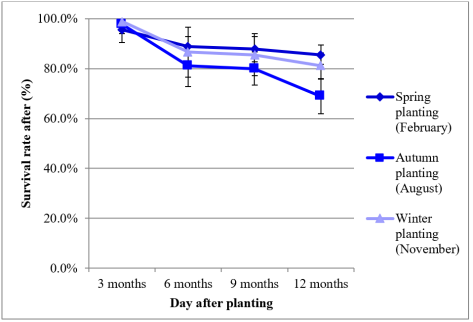
Figure 1. Effect of planting season on the survival rate of single petal Camellia rubriflora.
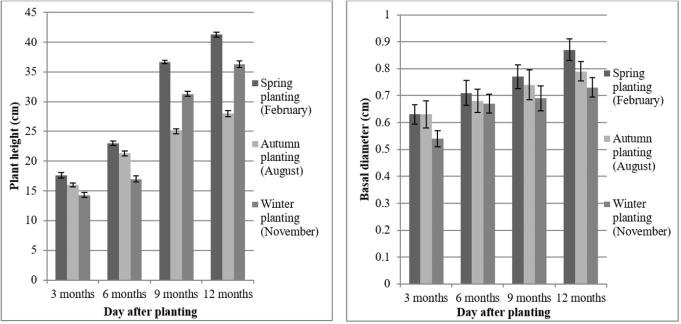
Figure 2. Effect of planting season on the growth of single petal Camellia rubriflora.
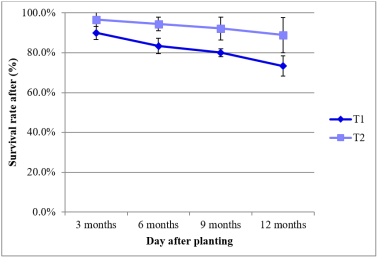
Figure 3. Effect of planting methods on the survival rate of single petal Camellia rubriflora.
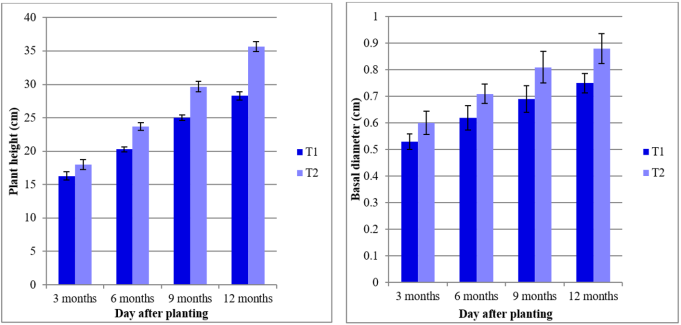
Figure 4. Effect of planting methods on the growth of single petal Camellia rubriflora.
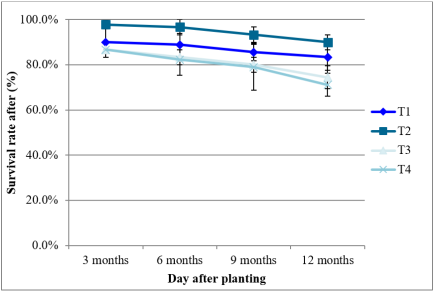
Figure 5. Effect of fertilization on the survival rate of single petal Camellia rubriflora.
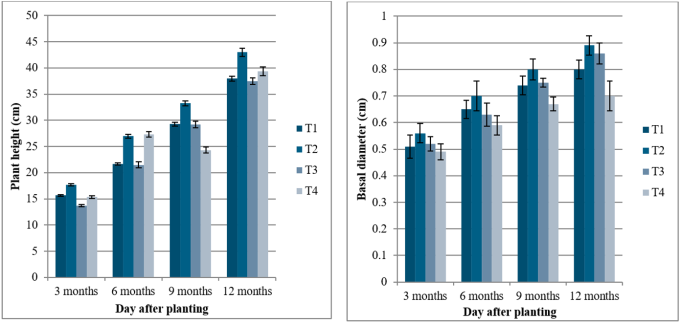
Figure 6. Effect of fertilization on the growth of single petal Camellia rubriflora.

Information



 Share This Article
 Twitter
 Linked In
 Facebook
 Copy
Copy Download