
Maize is a vital staple crop in Kenya, essential to both food security and rural livelihoods, especially in key producing regions like Uasin Gishu and Transzoia Counties. Despite their potential, maize yields in these counties remain significantly below optimum levels-averaging 400,000 and 600,000 metric tons respectively, against potentials of 900,000 and 1,000,000 metric tons. This discrepancy signals inefficiencies in resource use among smallholder farmers. To investigate this issue, the study focused on assessing the level of technical efficiency in maize production and identifying the factors contributing to inefficiency. Rooted in the Stochastic Frontier Analysis (SFA) framework and guided by the Cobb-Douglas production function, the study adopted a descriptive survey design. A sample of 274 farmers was selected from a target population of 16,300 using Cochran’s 1963 formula and stratified random sampling. Primary data were collected through structured, self-administered questionnaires. The results revealed that technical efficiency among farmers ranged from 0.75 to 0.91, with significant inefficiency driven by factors such as education level, farm size, and access to extension services. These findings indicate that productivity could be improved by up to 25% through more efficient resource utilization. The study recommends targeted policy interventions, including farmer training, expanded extension services, and improved access to modern inputs to enhance maize productivity and food security in the region.
| Published in | International Journal of Agricultural Economics (Volume 11, Issue 5) |
| DOI | 10.11648/j.ijae.20261105.13 |
| Page(s) | 178-185 |
| Creative Commons |
This is an Open Access article, distributed under the terms of the Creative Commons Attribution 4.0 International License (http://creativecommons.org/licenses/by/4.0/), which permits unrestricted use, distribution and reproduction in any medium or format, provided the original work is properly cited. |
| Copyright |
Copyright © The Author(s), 2026. Published by Science Publishing Group |
Technical Efficiency, Maize Production, Resource Utilization, Stochastic Frontier Analysis, Smallholder Farmers, Kenya
The level of technical efficiency Variable | Mean | Standard Deviation | Minimum | Maximum |
|---|---|---|---|---|
Efficiency of Input Use | 3.45 | 0.79 | 1 | 5 |
Yield Potential | 3.85 | 0.72 | 1 | 5 |
Resource Utilization Efficiency | 3.60 | 0.85 | 1 | 5 |
Overall Technical Efficiency | 3.60 | 0.75 | 1 | 5 |
Technical Efficiency | Primary/Secondary Education | College/University Education | Chi-Square Value | p-value |
|---|---|---|---|---|
Efficient | 90 | 110 | 5.56 | 0.018 |
Inefficient | 70 | 40 |
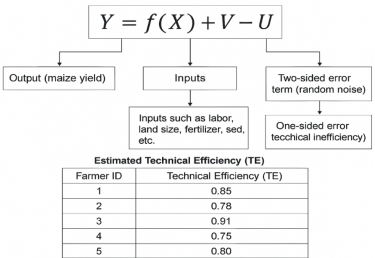
Farmer ID | The level of technical efficiency (TE) |
|---|---|
1 | 0.85 |
2 | 0.78 |
3 | 0.91 |
4 | 0.75 |
5 | 0.80 |
SFA | Stochastic Frontier Analysis |
FAO | Food and Agriculture Organization |
MALF | Ministry of Agriculture, Livestock and Fisheries |
KALRO | Kenya Agricultural and Livestock Research Organization |
CIMMYT | International Maize and Wheat Improvement Center |
ORCID | Open Researcher and Contributor ID |
TE | Technical Efficiency |
| [1] | Aigner, D., Lovell, C. A. K., & Schmidt, P. (1977). Formulation and estimation of stochastic frontier production function models. Journal of Econometrics, 6(1), 21–37. |
| [2] | Akinola, A., Alene, A. D., Adeyemo, R., Sanogo, D., & Olanrewaju, A. (2017). Impact of education and extension services on maize production in Nigeria. International Journal of Agricultural Economics and Extension, 5(4), 455–463. |
| [3] | Akudugu, M. A., Guo, E., & Dadzie, S. K. (2013). Adoption of modern agricultural production technologies by farm households in Ghana: What factors influence their decisions? Journal of Biology, Agriculture and Healthcare, 3(5), 2224–3208. |
| [4] | Coelli, T. J., & Battese, G. E. (2006). An Introduction to Efficiency and Productivity Analysis (2nd ed.). Springer. |
| [5] | Coelli, T. J., Rao, D. S. P., O’Donnell, C. J., & Battese, G. E. (2005). An Introduction to Efficiency and Productivity Analysis (2nd ed.). Springer. |
| [6] | Coelli, T., Prasada Rao, D. S., & Battese, G. E. (1998). An introduction to efficiency and productivity analysis. Kluwer Academic Publishers. |
| [7] | County Integrated Development Plan. (2018–2022). Transzoia County Government. |
| [8] | CIMMYT. (2019). Improving maize productivity through sustainable intensification practices. International Maize and Wheat Improvement Center. |
| [9] | Fare, R., Grosskopf, S., & Lovell, C. A. K. (1985). The Measurement of Efficiency of Production. Springer. |
| [10] | FAO. (2019). The State of Food and Agriculture 2019. Food and Agriculture Organization of the United Nations. |
| [11] | FAO. (2020). Kenya Country Programming Framework (2020–2024). Food and Agriculture Organization. |
| [12] | FAO. (2022). FAOSTAT: Crops and livestock products. Food and Agriculture Organization. |
| [13] | Getachew, M., & Bamlak, T. (2014). Technical efficiency of smallholder maize production in Ethiopia: Stochastic frontier approach. African Journal of Agricultural Research, 9(20), 1544–1553. |
| [14] | Jat, M. L., Wani, S. P., Sahrawat, K. L., & Singh, P. (2018). Climate smart technologies for agriculture: Improving productivity, resilience and emissions. International Journal of Agricultural Sustainability, 16(3), 187–205. |
| [15] | Kalro-KCEP. (2016). Baseline Survey Report: Kenya Cereal Enhancement Programme. Kenya Agricultural and Livestock Research Organization. |
| [16] | Kenya Markets Trust. (2020). Post-harvest handling and maize market inefficiencies in Kenya. |
| [17] | Kenya Revenue Authority. (2023). Agricultural input tax review and implications. |
| [18] | Kothari, C. R. (2004). Research Methodology: Methods and Techniques (2nd ed.). New Age International. |
| [19] | Kumbhakar, S. C., Wang, H.-J., & Horncastle, A. P. (2014). A Practitioner's Guide to Stochastic Frontier Analysis Using Stata. Cambridge University Press. |
| [20] | Liu, Y., Zhou, Y., & Li, Y. (2021). Examining the role of education in agricultural efficiency. Journal of Rural Studies, 81, 185–193. |
| [21] | Majiwa, E., & Mugodo, D. (2018). Technical efficiency and technology gaps in rice farming in Kenya: A meta-frontier analysis. African Journal of Agricultural Research, 13(23), 1189–1200. |
| [22] | MALF. (2020). Annual Agriculture Report 2020. Ministry of Agriculture, Livestock and Fisheries. |
| [23] | MALF. (2021). Kenya Agriculture Sector Transformation and Growth Strategy. Ministry of Agriculture. |
| [24] | MALF. (2023). County Maize Production Potential Report. Ministry of Agriculture, Livestock and Fisheries. |
| [25] | Maredia, M. K., Reyes, B., & Paredes, D. (2020). Education and technology adoption in developing countries. World Development, 129, 104907. |
| [26] | Munyua, H., Omondi, D. A., & Musyoka, R. N. (2014). Technical efficiency of maize production in Uganda. Journal of Development and Agricultural Economics, 6(8), 345–352. |
| [27] | Ngeno, V. K., Kimeli, L., & Bett, C. (2014). Analysis of technical efficiency in maize production in Uasin Gishu County. Kenya Journal of Agricultural Economics, 6(2), 45–52. |
| [28] | Ogada, M. J., Mwabu, G., & Muchai, D. (2014). Farm technology adoption in Kenya: A simultaneous estimation of demand and supply. Agricultural Economics, 45(6), 585–596. |
| [29] | Rahi, S. (2017). Research design and methods: A systematic review of research paradigms, sampling issues and instruments development. International Journal of Economics & Management Sciences, 6(2), 1–5. |
| [30] | Saha, B., Chakraborty, P., & Dutta, S. (2022). Farm structure and efficiency: A micro-level study. Agricultural Economics Research Review, 35(1), 15–28. |
| [31] | Schmidt, P. (1976). On the statistical estimation of parametric frontier production functions. Review of Economics and Statistics, 58(2), 238–239. |
| [32] | Seaman, C. E., Thompson, D., & Harris, J. (2022). Choosing and implementing research design in agricultural economics. Journal of Applied Research in Agricultural Economics, 12(3), 101–115. |
| [33] | Shafiq, M., & Rehman, T. (2000). The extent of resource use inefficiencies in cotton production in Pakistan’s Punjab: An application of data envelopment analysis. Agricultural Economics, 22(3), 321–330. |
| [34] | Silva, C., Duarte, R., & Silva, P. (2021). Survey research in agricultural policy: Trends and perspectives. Journal of Rural Studies, 84, 47–55. |
| [35] |
World Bank. (2021). Climate Change and Agriculture in Africa: Impacts and Responses.
https://www.worldbank.org/en/news/feature/2021/04/05/climate-change-and-agriculture-in-africa |
| [36] | Zhang, Y., Liu, C., & Xiao, Y. (2021). The impact of farmer education on agricultural efficiency: Evidence from rural China. Sustainability, 13(9), 4657. |
APA Style
Kimais, N. K. (2026). Level of Technical Efficiency in Maize Production in Uasin Gishu and Transzoia Counties in Kenya. International Journal of Agricultural Economics, 11(5), 178-185. https://doi.org/10.11648/j.ijae.20261105.13
ACS Style
Kimais, N. K. Level of Technical Efficiency in Maize Production in Uasin Gishu and Transzoia Counties in Kenya. Int. J. Agric. Econ. 2026, 11(5), 178-185. doi: 10.11648/j.ijae.20261105.13
@article{10.11648/j.ijae.20261105.13,
  author = {Nickson Kiprotich Kimais},
  title = {Level of Technical Efficiency in Maize Production in Uasin Gishu and Transzoia Counties in Kenya},
  journal = {International Journal of Agricultural Economics},
  volume = {11},
  number = {5},
  pages = {178-185},
  doi = {10.11648/j.ijae.20261105.13},
  url = {https://doi.org/10.11648/j.ijae.20261105.13},
  eprint = {https://article.sciencepublishinggroup.com/pdf/10.11648.j.ijae.20261105.13},
  abstract = {Maize is a vital staple crop in Kenya, essential to both food security and rural livelihoods, especially in key producing regions like Uasin Gishu and Transzoia Counties. Despite their potential, maize yields in these counties remain significantly below optimum levels-averaging 400,000 and 600,000 metric tons respectively, against potentials of 900,000 and 1,000,000 metric tons. This discrepancy signals inefficiencies in resource use among smallholder farmers. To investigate this issue, the study focused on assessing the level of technical efficiency in maize production and identifying the factors contributing to inefficiency. Rooted in the Stochastic Frontier Analysis (SFA) framework and guided by the Cobb-Douglas production function, the study adopted a descriptive survey design. A sample of 274 farmers was selected from a target population of 16,300 using Cochran’s 1963 formula and stratified random sampling. Primary data were collected through structured, self-administered questionnaires. The results revealed that technical efficiency among farmers ranged from 0.75 to 0.91, with significant inefficiency driven by factors such as education level, farm size, and access to extension services. These findings indicate that productivity could be improved by up to 25% through more efficient resource utilization. The study recommends targeted policy interventions, including farmer training, expanded extension services, and improved access to modern inputs to enhance maize productivity and food security in the region.},
 year = {2026}
}
TY  - JOUR
T1  - Level of Technical Efficiency in Maize Production in Uasin Gishu and Transzoia Counties in Kenya
AU  - Nickson Kiprotich Kimais
Y1  - 2026/10/15
PY  - 2026
N1  - https://doi.org/10.11648/j.ijae.20261105.13
DO  - 10.11648/j.ijae.20261105.13
T2  - International Journal of Agricultural Economics
JF  - International Journal of Agricultural Economics
JO  - International Journal of Agricultural Economics
SP  - 178
EP  - 185
PB  - Science Publishing Group
SN  - 2575-3843
UR  - https://doi.org/10.11648/j.ijae.20261105.13
AB  - Maize is a vital staple crop in Kenya, essential to both food security and rural livelihoods, especially in key producing regions like Uasin Gishu and Transzoia Counties. Despite their potential, maize yields in these counties remain significantly below optimum levels-averaging 400,000 and 600,000 metric tons respectively, against potentials of 900,000 and 1,000,000 metric tons. This discrepancy signals inefficiencies in resource use among smallholder farmers. To investigate this issue, the study focused on assessing the level of technical efficiency in maize production and identifying the factors contributing to inefficiency. Rooted in the Stochastic Frontier Analysis (SFA) framework and guided by the Cobb-Douglas production function, the study adopted a descriptive survey design. A sample of 274 farmers was selected from a target population of 16,300 using Cochran’s 1963 formula and stratified random sampling. Primary data were collected through structured, self-administered questionnaires. The results revealed that technical efficiency among farmers ranged from 0.75 to 0.91, with significant inefficiency driven by factors such as education level, farm size, and access to extension services. These findings indicate that productivity could be improved by up to 25% through more efficient resource utilization. The study recommends targeted policy interventions, including farmer training, expanded extension services, and improved access to modern inputs to enhance maize productivity and food security in the region.
VL  - 11
IS  - 5
ER  -
Faculty of Management, University of Bradford, Bradford, United Kingdom

Information



 Share This Article
 Twitter
 Linked In
 Facebook
 Copy
Copy Download