Abstract
The study researched how interest rate, inflation, and economic growth affect loan repayment of small and medium enterprises (SMEs) in Kenya. SMEs contribute Ninety eight percent of the business population and provide employment, economic growth, goods and services for low and middle income population in Kenya. The target population of the study was commercial, micro finances, and online lenders in Nairobi, Kenya. Secondary data was collected from financial lenders in Nairobi. SPSS tools of descriptive and inferential analysis were employed to analyze the data. The result indicated that interest rate is negatively and significantly correlated with loan repayment (r = -.431, p=.000). In the regression analysis result, interest rate is negatively and significantly related to loan repayment (β=-0.564, p=0.015). Inflation and economic growth were positively related to loan repayment, but not significantly. This means that, when lenders charge high interest rates, default rate increases thus reducing loan repayment rate. The study concluded that lenders should reduce interest rate as much as possible in order to reduce default rate and improve loan repayment. Payment period should be also extended to give the borrowers a leeway and reduced payment amount per term.
Keywords
Interest Rate, Inflation, Loan Repayment, Economic Growth, Correlation, Regression
1. Introduction
Small business is defined as an enterprise with annual sales of less than 1 million ($8000), or employs 10 to 49 workers, while medium business is an enterprise with annual sales of less than 50 million ($400,000) or 50-99 employees. Small and Medium Enterprises (SMEs) are the pillars of any developing economy. SMEs in Kenya account for 98% of all businesses, and are instrumental in innovation, employment, wealth distribution, and providing essential goods and services. SME employs 90% of the workforce, contributes up to 40% of the GDP, and is a social transformation tool. On the other hand, commercial and non-commercial lenders participate in creating employment by giving capital and other financial services, mainly to low-income entrepreneurs.
However, their creation, survival, and growth are hindered by various challenges. Melo et al.
| [1] | Melo, et. al (2023). Sustainable digital transformation in small and medium enterprises (SMEs): A review on performance. Heliyon, 9(3). |
[1]
revealed that the main constraints of lenders emanate from high default rate, regulatory paperwork, and multiple and expensive licensing process, required for the same businesses. Other major constraints include: lack of capital, access to markets, expensive loans, poor infrastructure, competition among the lenders, and insecurity, while minor constraints include: inadequate business training, and technology inept by the borrowers.
Common sources of finances for SMEs are venture capital, crowd funding, financial angles, business incubators, grants, and loans from commercial banks or SACCOs. Many lenders set a minimum annual turnover above SME turnover, which deters accessibility of loans for SMEs. The little bespoke capital by the government is not sufficient and most businesses will not be able to access due to corruption and cumbersome paperwork processes. On the other hand, loan repayment is the process of returning the borrowed money plus charges like the principal, interest, and any associated cost within a set timeframe. Access to loans from commercial banks is very difficult for SMEs due to their riskiness and lack of collateral. The majority of SMEs startups depend on savings and loans from family and friends for capital, which is not adequate.
High-interest debt is any account that has an interest rate of 8% or higher
| [2] | Liu, E., Mian, A., & Sufi, A. (2022). Low interest rates, market power, and productivity growth. Econometrica, 90(1), 193-221. |
[2]
. In Kenya and Africa in general, the average interest rate is between 16-22% annually. Fidow, Odoyo, and Wambalaba,
| [3] | Fidow, A. N., Odoyo, S., & Wambalaba, F. (2022). The effect of transaction cost on the performance of SMEs in Kenya. International Journal of Accounting, Finance and Risk Management, 12(2), 11-19. |
[3]
found that the average profit for SMEs in Kenya is 9% annually. This indicates that taking a loan for SME investment in Kenya is poisonous. The time that it will take to kill the business depends on the size and the opportunity that exists in the economy, but eventually, it will kill the business due to the difference between the cost of finance and the expected profits. Interest rate has a strong effect on the economy as a whole. However, SMEs are vulnerable to high interest rates rather than big corporations who enjoy economies of scale and are able to absorb more expenses than SMEs.
2. Theoretical Framework
Theory is a hypothesis or a system of ideas designed to explain something, especially one based on general principles. Lochner, and Monge-Naranjo,
| [4] | Lochner, L., & Monge-Naranjo, A. (2016). Student loans and repayment: Theory, evidence, and policy. In Handbook of the Economics of Education (Vol. 5, pp. 397-478). Elsevier. |
[4]
defined theory as a structured, tested, and validated explanation for a set of natural or social phenomena, built upon evidence rather than a mere guess.
2.1. Loanable Funds Theory
The theory explains how interest rate is determined by the transaction between the suppliers and demanders of loanable funds in the economy. It highlights how interest rate serves as a balancing factor between the savings offered for loans and the funds demanded for investment. The theory explains how the interaction of supply (savers) and demand (borrowers) in financial markets determine interest rate. Keynes theory also indicates that interest rate is a monetary phenomenon that balances the supply and demand of money. People hold part of their savings to cope with future uncertainty about the returns from long-term bonds, which leads the interest rate to be a monetary phenomenon. Robertson criticised the Keynesian theory and indicated that interest rate depends on the demand for loanable funds, but supply is independent of saving and investment decisions. Loanable funds come from household savings, business profits, government surpluses, and foreign investment
| [5] | Korzeniowska, A. M., & Ulman, P. (2023). Household saving motives and socio-demographic factors. Ruch Prawniczy, Ekonomiczny i Socjologiczny, 85(4), 177-197. |
[5]
. Using the theory of loanable funds,
| [6] | Ashogbon, M., Onyenebo, I., & Orefuwa, F. (2022). Does interest rate affect the growth of small and medium scale enterprises (smes) in Nigeria. Nigerian Journal of Management Sciences, 23(2). |
[6]
investigated the “effect of interest rate on the growth of SMEs in Nigeria.” They used Autoregressive Distribution Lag (ARDL) to analyse the data and found an increase of loan rate by 1% reduces 1.6% of the SME’s GDP, thus reducing the profitability and loan repayment. The study found that monetary policy has a positive effect on the growth of SME growth, while commercial loans affect negatively. The study recommended that loan rates by commercial banks should be reduced to improve SMEs growth. The capital of SMEs should not come only from expensive commercial loans, but rather from accessible and cheap sources in the formal and informal financial sector.
2.2. General Theory of Employment, Interest, and Money
John Keynes published this theory in 1936 and states that the rate of interest determines the level of employment, affects the supply and demand of money, and transforms the investment processes in the economy. In Keynes theory, interest is referred to as the “reward for parting liquidity for a specified period of time.” Keynes critiqued the government policies of his era, especially the hypothesis that a normally functioning market economy would result in full employment and interest reduction. Keynes theory proposed government intervention to curb inherent inequalities and instabilities of the unregulated market functions. Interest rate, on the other hand, plays a vital role in obtaining capital and enhances resources and economic growth of the state.
Chakraborty, and Gupta,
| [7] | Chakraborty, T., & Gupta, A. (2023). Loan repayment behaviour of farmers: analysing Indian households. Indian Institute of Management Calcutta. |
[7]
explored loan repayment behaviour of Indian households. The study categorised the loans taken as formal and informal sectors and how it affects the subsequent loan repayment behaviour. The study used general theory of employment and found that the people who borrowed from the formal sector tend to have higher consumption, lower investment, and lower repayment rate than those who borrowed from the informal sector. The study concluded that repayment rate is low on loans that were taken from sources, which impose lesser punishment. Makorere,
| [8] | Makorere, R. F. (2014). Factors affecting loan repayment behaviour in Tanzania: Empirical evidence from Dar es Salaam and Morogoro regions. International Journal of Development and Sustainability, 3(3), 481-492. |
[8]
investigated “factors affecting loan repayment behaviour in Tanzania.” The study used general theory of employment, interest, and money, and found that interest rate; grace period, profitability, moral hazard, electricity rationing, and economic stability have strong correlation with loan repayment.
3. Empirical Review
Odhiambo,
| [9] | Odhiambo, L. A. (2013). The effect of changes in interest rates on the demand for credit and loan repayments by small and medium enterprises in Kenya. University of Nairobi. |
[9]
investigated “effect of changes in interest rates on the demand for credit and loan repayments by small and medium enterprises in Kenya.” The researcher used secondary data from Kenya commercial banks from 2007 to 2012 and found that high interest rate decreases demand for credit. Negatu,
| [10] | Negatu, B. S. (2021). A study on impact of interest rates on credit and loan repayment in Ethiopia with reference to credit cooperative unions. Ilkogretim Online-Elementary Education Online, 20(5), 7371-7376. |
[10]
explored the impact of interest rate on loan repayment in Ethiopia. The study found that loan repayment is negatively correlated with interest. This means that high interest rates result in low loan repayment and vice-versa. Kassegn, and Endris,
| [11] | Kassegn, A., & Endris, E. (2022). Factors affecting loan repayment rate among smallholder farmers got loans from the Amhara Credit and Saving Institution: In the case of Habru District, Amhara Regional State, Ethiopia. International Area Studies Review, 25(1), 73-96. |
[11]
studied “Factors affecting loan repayment rate among small and medium enterprises in Ethiopia.” The study employed stratified multistage sampling techniques on 384 respondents of SME borrowers. The study found that age, household size, education level, training received, and loan use as the main factors that affect loan repayment. Household size is negatively correlated, while education level, age of the business, and training received affect positively. They argued that some business people might take high cost capital due to overoptimistic repayment.
Allcott, Taubinsky, and Zinman,
| [12] | Allcott, H., Kim, J., Taubinsky, D., & Zinman, J. (2022). Are high-interest loans predatory? theory and evidence from payday lending. The Review of Economic Studies, 89(3), 1041-1084. |
[12]
studied if high-interest loans are predatory. The study found that first time borrowers are vulnerable to default as 2/3 of them failed to repay their loans on time, while 1/3 of the experienced borrowers repaid their loans on time. Wisang, Dince, and Sanga
| [13] | Wisang, M. D. N., Dince, M. N., & Sanga, K. P. (2024). Management of Bad Loans and Their Impact on Financial Performance at KSP Kopdit Suru Pudi Koting. Neo Journal of economy and social humanities, 3(4), 324-335. |
[13]
researched the Management of Bad Loans and Their Impact on Financial Performance in South Korea. The study used descriptive qualitative data analysis. The study found that bad loans have a significant impact on the financial performance of cooperatives and commercial banks in Kopdit Suru. Abimbola, and Kolawole,
| [14] | Abimbola, O. A., & Kolawole, A. A. (2021). Understanding the factors influencing loan repayment performance of Nigerian microfinance banks. Journal of Management Sciences, 4(3), 89-99. |
[14]
investigated “factors affecting loan repayment in southwest Nigeria.” They used a purposive sampling method with 20 credit institutions and 124 respondents. The study found that age, educational level, monthly income, repayment mode, and time period have significantly and positively influenced loan repayment, while interest rates have negatively correlated with loan repayment. They recommended that lenders should reduce interest rate and prolong repayment periods to decrease default rate of borrowers.
Njeru, and Ondabu,
| [15] | Njeru, M. D., Njeru, A., & Ondabu, I. T. (2015). Effect of loan repayment on financial performance of deposit taking Saccos in Mount Kenya Region. |
[15]
investigated the effect of loan repayment on financial performance of deposit taking SACCOs in Kenya. The study employed simple random sampling, and adopted descriptive statistics. The study found significant negative correlation between interest rate and loan repayment. The researcher concluded that proper regulation policy of lenders is required to control interest charge on loans. Munene, and Guyo
| [16] | Munene, H. N., & Guyo, S. H. (2013). Factors influencing loan repayment default in micro-finance institutions: The experience of Imenti North District, Kenya. |
[16]
Investigated “Factors influencing loan repayment default in micro-finance institutions in Kenya.” The study used cluster sampling and found a negative significant correlation between loan repayment and business age, type, and the skills of entrepreneurs. They indicated that micro finance institutions in Kenya experience significant loan default, which result in cash flow problems and decreased employment for the lenders.
4. Methodology
Research methodology is the organised and the scientific plan a researcher follows to conduct a study, covering the strategy, tools and techniques used to gather and analyse the data. It justifies why specific methods are chosen, ensuring the research is systematic, reliable, and valid. This study adopted the descriptive and inferential research design. The target population of the study was 20 micro-finance lenders and 20 commercial banks. The study investigated how the rate of interest affects loan repayment of SMEs in Nairobi, Kenya.
4.1. Framework
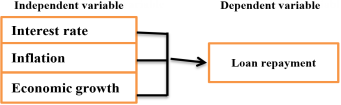
A research framework is the conceptual structure that connects dependent and independent variables to the theories, and concepts, that the researcher wants to investigate. It identifies the key ideas, research questions, and how those ideas are related to each other.
Figure 1. Framework of the study.
4.2. Model Specification
Model specification is the process of selecting the appropriate form of statistical model to represent the relationship between the variables. It involves choosing which predictor to include or exclude in the mathematical form to ensure reliable, and unbiased estimates.
LR=loan repayment
IN= inflation
EG=economic growth
LR= β0+ β1IR+ β2IN+ β3EG+ ε (2)
5. Findings
The research findings are presented in the following sections, including correlation, variations, and regression analyses.
5.1. Data Analysis and Results
Data analysis is the process used by a researcher to reduce data to a story and interpret it to derive insights and comprehension.
| [17] | LeCompte, M. D. (2000). Analyzing qualitative data. Theory into practice, 39(3), 146-154. |
[17]
data analysis process helps reduce large chunks of data into smaller fragments, which makes sense.
5.2. Descriptive Statistics
Descriptive statistics summarises quantitative data sets. It is the first step of data analysis to give an overview of data distribution in the research.
Table 1. Descriptive Statistics.
| Interest | Inflation | Economic growth | Loan repayment rate |
Mean | 17.75 | 4.87 | 5.35 | 67.67 |
Median | 16.70 | 4.17 | 4.34 | 59.30 |
Modal | 18 | 5.4 | 4.8 | 64 |
Minimum | 16.8 | 4.2 | 3.90 | 56.20 |
Maximum | 23 | 5.8 | 5.98 | 72.10 |
Std Dev. | 2.28 | 0.68 | 0.74 | 4.43 |
Skewness | 0.58 | -0.243 | 0.314 | -0.613 |
Kurtosis | -1.46 | -1.24 | 2.14 | -0.830 |
Source: output of data analysis
Although the maximum interest rate of 23% is recorded, the mean of interest rate was recorded as 17.75. This shows a high interest rate in the Kenyan economy compared to developed countries. The means of inflation and economic growth are almost analogous, indicating a very small margin of real economic growth.
5.3. Correlation Analysis
Correlation is the statistical relationship between two or more variables. Pearson's correlation result is indicated in the table below.
Table 2. Correlation analysis.
| | Loan repayment | Inflation | Interest | Economic growth |
Loan repayment | Pearson’s correlation | 1.00 | 0.372 | -0.431 | 0.612 |
| Sig. (2-tailed) | - | 0.438 | 0.000 | 0.56 |
Inflation | Pearson’s correlation | 0.372 | 1.00 | -0.793 | -0.48 |
| Sig. (2-tailed) | 0.438 | - | 0.412 | 0.621 |
Interest | Pearson’s correlation | -0.431 | -0.793 | 1.00 | -0.461 |
| Sig. (2-tailed) | 0.000 | -0.412 | - | 0.062 |
Economic growth | Pearson’s correlation | 0.612 | -0.48 | -0.461 | 1.00 |
| Sig. (2-tailed) | 0.56 | 0.612 | 0.062 | |
Source: output of data analysis
The correlation results from
Table 2 indicate that the interest rate is negatively and significantly related to loan repayment (r=-.431, p=0.000). This concurs with
| [18] | Tyson, J. (2021). Financial-sector development and inclusive and sustainable economic growth in sub-Saharan Africa. Joint FSDA and ODI working paper. |
[18]
who articulated that to improve loan repayment, it is essential to reduce the rate of interest to relieve the loan repayment burden to amounts that clients can pay within the agreed period. Inflation is inversely related to interest rate but not significantly, which means that low interest rates cause large amounts of money circulating in the economy, thus causing inflation. Economic growth is inversely related to interest rate due to the fact that reduced interest rate improves economic growth.
5.4. Regression Analysis
Regression analysis is a set of statistical methods used to estimate the strength and the direction of relationship between the variables of the data. Simple linear regression was used and the result is presented in the table below.
Table 3. Linear Regression.
Model | R | R2 | Adjusted R Square | Std. Error of the Estimate | Durbin Watson |
1 | .460 | .211 | .113 | 2.083 | 1.906 |
2 | .297 | .091 | .049 | 1.12 | 2.12 |
3 | .401 | .161 | .112 | 1.98 | 1.761 |
Source: output of data analysis
The results from
Table 3 portray that the interest rate satisfactorily explained loan repayment in Kenya. This was supported by the coefficient of determination, also known as the R square of 0.211. This implies that the interest rate explains 21.1% of loan repayment. Inflation also explains 9% of loan repayment, while economic growth explains 16.1% of loan repayment in Kenya.
Table 4. Analysis of Variance.
Model | Sum of squares | df | Mean square | F | Sign. |
1 | Regression | 33.306 | 1 | 33.306 | 12.228 | .012 |
Residual | 119.594 | 29 | .949 | | |
Total | 152.90 | 30 | | | |
2 | Regression | 29.351 | 1 | 29.351 | 2.162 | .1700 |
Residual | 105.844 | 29 | .567 | | |
Total | 135.195 | 30 | | | |
3 | Regression | 23.179 | 1 | 23 | 2.63 | .310 |
Residual | 83.445 | 29 | | | |
Total | 106.624 | 30 | | | |
Source: output of data analysis
The results in
Table 4 show that the overall model was statistically significant. The results indicate that interest rate is a good predictor of loan repayment in Kenya. This was supported by an F statistic of 12.228 and the reported p-value of less than 0.05. Both inflation and economic growth are not significant in predicting loan repayment but have some degree of effect. Banks and micro-finance lenders can work on regulating the factors that negatively affect or cause reduction of interest rates since the variable was fundamental in determining the level of loan repayment.
5.5. Regression of Coefficient
Regression of coefficient measures how a unit change in an independent variable affects the dependent variable.
Table 5. Regression of Coefficient.
| Unstandardized Coefficients | Standardized Coefficients | t | Sign. |
B std Error | Beta |
Constant | 0.375 0.0724 | | 5.179 | 0.001 |
Interest rate | -0.564 0.257 | 0.213 | 2.043 | 0.015 |
Source: output of data analysis
The results of the combined independent variables against dependent variables indicated that interest rate is negatively and significantly related to loan repayment (β=-0.525, p=0.015). This was supported by the t statistic of 2.043, which is larger than the critical t-statistic of 1.96. The results indicated that when the interest rate increases by one unit, the loan repayment reduces by 0.525 units while holding other factors. Chen and Liu
| [18] | Tyson, J. (2021). Financial-sector development and inclusive and sustainable economic growth in sub-Saharan Africa. Joint FSDA and ODI working paper. |
[18]
noted that there is a need to modify lending terms and lower the interest rate to ensure customers realise profits and can pay their loans while lenders will be able to reduce loan default.
5.6. Graph of Loan Repayment Against Interest Rate
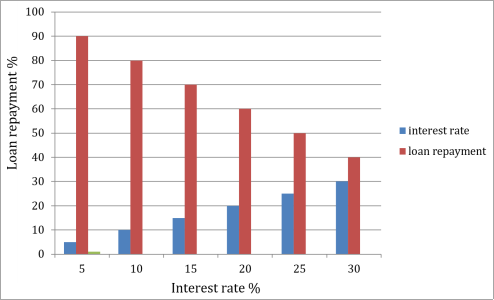
Graph is a diagram showing the relation between variable quantities, typically of two variables, each measured along one of a pair of axes at right angles. The graph below was formed by loan repayment against interest rate.
Figure 2. Loan Repayment Against Interest Rate.
The graph shows that at 5% of interest rate, 90% of borrowers paid their loan, while at an interest rate of 20%, only 60% of borrowers paid their debt and the rest, while at 30% interest rate, only 40% of the borrowers paid their loan and the rest defaulted. This indicates a direct inverse relationship between interest rate and loan repayment in Kenya.
6. Conclusion and Recommendations
The study concluded that interest rate is negatively and significantly correlated with loan repayment. When interest rate increases by one unit, the loan repayment would reduce by 0.564 units while holding other factors constant. The main causes of banking are high-interest rates, limited funds offered for loan, absence of entrepreneurship skills and high taxes. Inflation is positively correlated with loan repayment, but not significantly. This is because high inflation helps the borrowers to pay less value of what they borrowed, but hyperinflation is what hurts the economy. On the other hand, economic growth is positively related to loan repayment because low interest rate means availability of cheap capital and high economic growth, thus supporting loan repayment.
The study recommends that financial institution managers need to make the interest rates inexpensive by any means without hurting profitability. The banking institutions should extend the repayment period to enhance the payback percentage. Microfinance institutions should scrutinise clients who borrow extensively before the loan is provided. The government must regulate interest and capital charges to tame shylocks. There are some borrowers who paid 400% within a period of less than 2 years, and at the end, their assets and collateral was auctioned. Interest and other charges should not exceed 100% within a period of less than 5 years, and 200% if the loan period is extended up to 10 years.
Lenders have a leeway of auctioning the collateral without informing or consulting the borrower. This causes selling the collateral and the assets at a throwaway price subsequently, demanding more payments from the borrower, and claiming that the proceeds from collateral and asset sale were insufficient. There were cases where the collateral was sold cheaply to insiders of the lending institutions or well-connected businessmen at cut-rate prices. There was a case in court, where a bank sold a house with a market price of 20 million at only 5 million to an employee of the lender. The government must put a law that will prohibit the lender from selling the collateral without the consent of the borrower or court order in case they cannot agree. On the other hand, some unscrupulous borrowers obtain loans without the intention of repaying, while others use fake or cheap collateral in co-operation with some employees of the lenders and it becomes difficult to recover through the existing decrees. The government has to bring laws that compel the borrowers to pay their dues of the lender or face jail term in case of default without satisfactory reasons.
There are also large online-app lenders without any regulations. These apps charge between 300-400%p.a interest rate, using different methods of hoodwinking. They use misleading advertisements to attract borrowers, only to realise the real cost of their loan later on. Tricks they apply include: reducing the amount agreed, halving time period, and using compound interest calculations instead of the agreed simple interest rate. The government should also regulate and licence these loan apps.
Abbreviations
SME | Small and Medium Enterprises |
LR | Loan Repayment |
Author Contributions
Abdikadir Noor Fidow: Conceptualization, Data curation, Formal Analysis, Funding acquisition, Investigation, Methodology, Validation, Visualization
Conflicts of Interest
The author declares no conflicts of interest.
References
| [1] |
Melo, et. al (2023). Sustainable digital transformation in small and medium enterprises (SMEs): A review on performance. Heliyon, 9(3).
|
| [2] |
Liu, E., Mian, A., & Sufi, A. (2022). Low interest rates, market power, and productivity growth. Econometrica, 90(1), 193-221.
|
| [3] |
Fidow, A. N., Odoyo, S., & Wambalaba, F. (2022). The effect of transaction cost on the performance of SMEs in Kenya. International Journal of Accounting, Finance and Risk Management, 12(2), 11-19.
|
| [4] |
Lochner, L., & Monge-Naranjo, A. (2016). Student loans and repayment: Theory, evidence, and policy. In Handbook of the Economics of Education (Vol. 5, pp. 397-478). Elsevier.
|
| [5] |
Korzeniowska, A. M., & Ulman, P. (2023). Household saving motives and socio-demographic factors. Ruch Prawniczy, Ekonomiczny i Socjologiczny, 85(4), 177-197.
|
| [6] |
Ashogbon, M., Onyenebo, I., & Orefuwa, F. (2022). Does interest rate affect the growth of small and medium scale enterprises (smes) in Nigeria. Nigerian Journal of Management Sciences, 23(2).
|
| [7] |
Chakraborty, T., & Gupta, A. (2023). Loan repayment behaviour of farmers: analysing Indian households. Indian Institute of Management Calcutta.
|
| [8] |
Makorere, R. F. (2014). Factors affecting loan repayment behaviour in Tanzania: Empirical evidence from Dar es Salaam and Morogoro regions. International Journal of Development and Sustainability, 3(3), 481-492.
|
| [9] |
Odhiambo, L. A. (2013). The effect of changes in interest rates on the demand for credit and loan repayments by small and medium enterprises in Kenya. University of Nairobi.
|
| [10] |
Negatu, B. S. (2021). A study on impact of interest rates on credit and loan repayment in Ethiopia with reference to credit cooperative unions. Ilkogretim Online-Elementary Education Online, 20(5), 7371-7376.
|
| [11] |
Kassegn, A., & Endris, E. (2022). Factors affecting loan repayment rate among smallholder farmers got loans from the Amhara Credit and Saving Institution: In the case of Habru District, Amhara Regional State, Ethiopia. International Area Studies Review, 25(1), 73-96.
|
| [12] |
Allcott, H., Kim, J., Taubinsky, D., & Zinman, J. (2022). Are high-interest loans predatory? theory and evidence from payday lending. The Review of Economic Studies, 89(3), 1041-1084.
|
| [13] |
Wisang, M. D. N., Dince, M. N., & Sanga, K. P. (2024). Management of Bad Loans and Their Impact on Financial Performance at KSP Kopdit Suru Pudi Koting. Neo Journal of economy and social humanities, 3(4), 324-335.
|
| [14] |
Abimbola, O. A., & Kolawole, A. A. (2021). Understanding the factors influencing loan repayment performance of Nigerian microfinance banks. Journal of Management Sciences, 4(3), 89-99.
|
| [15] |
Njeru, M. D., Njeru, A., & Ondabu, I. T. (2015). Effect of loan repayment on financial performance of deposit taking Saccos in Mount Kenya Region.
|
| [16] |
Munene, H. N., & Guyo, S. H. (2013). Factors influencing loan repayment default in micro-finance institutions: The experience of Imenti North District, Kenya.
|
| [17] |
LeCompte, M. D. (2000). Analyzing qualitative data. Theory into practice, 39(3), 146-154.
|
| [18] |
Tyson, J. (2021). Financial-sector development and inclusive and sustainable economic growth in sub-Saharan Africa. Joint FSDA and ODI working paper.
|
Cite This Article
-
APA Style
Fidow, A. N. (2026). Effect of Interest Rate on Loan Repayment for Small and Medium Enterprises in Kenya. International Journal of Accounting, Finance and Risk Management, 11(3), 116-123. https://doi.org/10.11648/j.ijafrm.20261103.11
 Copy
|
Copy
|
 Download
ACS Style
Fidow, A. N. Effect of Interest Rate on Loan Repayment for Small and Medium Enterprises in Kenya. Int. J. Account. Finance Risk Manag. 2026, 11(3), 116-123. doi: 10.11648/j.ijafrm.20261103.11
Copy
|
Download
AMA Style
Fidow AN. Effect of Interest Rate on Loan Repayment for Small and Medium Enterprises in Kenya. Int J Account Finance Risk Manag. 2026;11(3):116-123. doi: 10.11648/j.ijafrm.20261103.11
Copy
|
Download
-
@article{10.11648/j.ijafrm.20261103.11,
  author = {Abdikadir Noor Fidow},
  title = {Effect of Interest Rate on Loan Repayment for Small and Medium Enterprises in Kenya},
  journal = {International Journal of Accounting, Finance and Risk Management},
  volume = {11},
  number = {3},
  pages = {116-123},
  doi = {10.11648/j.ijafrm.20261103.11},
  url = {https://doi.org/10.11648/j.ijafrm.20261103.11},
  eprint = {https://article.sciencepublishinggroup.com/pdf/10.11648.j.ijafrm.20261103.11},
  abstract = {The study researched how interest rate, inflation, and economic growth affect loan repayment of small and medium enterprises (SMEs) in Kenya. SMEs contribute Ninety eight percent of the business population and provide employment, economic growth, goods and services for low and middle income population in Kenya. The target population of the study was commercial, micro finances, and online lenders in Nairobi, Kenya. Secondary data was collected from financial lenders in Nairobi. SPSS tools of descriptive and inferential analysis were employed to analyze the data. The result indicated that interest rate is negatively and significantly correlated with loan repayment (r = -.431, p=.000). In the regression analysis result, interest rate is negatively and significantly related to loan repayment (β=-0.564, p=0.015). Inflation and economic growth were positively related to loan repayment, but not significantly. This means that, when lenders charge high interest rates, default rate increases thus reducing loan repayment rate. The study concluded that lenders should reduce interest rate as much as possible in order to reduce default rate and improve loan repayment. Payment period should be also extended to give the borrowers a leeway and reduced payment amount per term.},
 year = {2026}
}
Copy
|
Download
-
TY  - JOUR
T1  - Effect of Interest Rate on Loan Repayment for Small and Medium Enterprises in Kenya
AU  - Abdikadir Noor Fidow
Y1  - 2026/08/10
PY  - 2026
N1  - https://doi.org/10.11648/j.ijafrm.20261103.11
DO  - 10.11648/j.ijafrm.20261103.11
T2  - International Journal of Accounting, Finance and Risk Management
JF  - International Journal of Accounting, Finance and Risk Management
JO  - International Journal of Accounting, Finance and Risk Management
SP  - 116
EP  - 123
PB  - Science Publishing Group
SN  - 2578-9376
UR  - https://doi.org/10.11648/j.ijafrm.20261103.11
AB  - The study researched how interest rate, inflation, and economic growth affect loan repayment of small and medium enterprises (SMEs) in Kenya. SMEs contribute Ninety eight percent of the business population and provide employment, economic growth, goods and services for low and middle income population in Kenya. The target population of the study was commercial, micro finances, and online lenders in Nairobi, Kenya. Secondary data was collected from financial lenders in Nairobi. SPSS tools of descriptive and inferential analysis were employed to analyze the data. The result indicated that interest rate is negatively and significantly correlated with loan repayment (r = -.431, p=.000). In the regression analysis result, interest rate is negatively and significantly related to loan repayment (β=-0.564, p=0.015). Inflation and economic growth were positively related to loan repayment, but not significantly. This means that, when lenders charge high interest rates, default rate increases thus reducing loan repayment rate. The study concluded that lenders should reduce interest rate as much as possible in order to reduce default rate and improve loan repayment. Payment period should be also extended to give the borrowers a leeway and reduced payment amount per term.
VL  - 11
IS  - 3
ER  -
Copy
|
Download





 Share This Article
 Twitter
 Linked In
 Facebook