Abstract
This study analyzes the methodological development of cognitive metaphor translation research from 1980 to 2025, with particular attention to evidence types, analytical units and comparability conditions. International studies were retrieved from the Web of Science Core Collection, and Chinese studies were retrieved from CNKI, with Chinese sources limited to Peking University Core and CSSCI journals. After title and abstract screening, removal of irrelevant uses of the term translation, de-duplication and manual verification, the Web of Science dataset contained 478 records and the Chinese candidate set contained 75 records. The analysis combined annual publication counts with close methodological reading of research questions, material boundaries, identification procedures, process indicators and cross evidence correspondence. The results identify two relatively formed stages and one emerging trend. From 1980 to 2005, the field was shaped by conceptual metaphor theory and debates on translatability, with evidence mainly drawn from product comparison and small textual samples. From 2006 to 2019, discourse conditions, contextual variables, metaphor identification procedures and early process data entered the explanatory frame. From 2020 to 2025, corpus evidence, translation products and process data were more often placed within the same research design, increasing the need for explicit reporting of sampling rules, task settings, metric windows and correspondence rules. This study proposes a checklist for assessing whether findings from different studies can be compared. Its contribution lies in transforming a stage account of the field into a research tool for evaluating methodological alignment and inference scope. The checklist helps researchers assess whether findings from different studies address the same phenomenon under comparable conditions, thereby preventing inappropriate cross study comparison.
Keywords
Cognitive Metaphor, Metaphor Translation, Research Methodology, Comparability, Evidence Design
1. Introduction
Since the concept of conceptual metaphor was proposed, metaphor has often been understood as a systematic mapping across conceptual domains, and metaphorical language has been treated as a discourse level manifestation of conceptual mapping
| [1] | Lakoff, G., Johnson, M. Metaphors We Live By. Chicago: University of Chicago Press; 1980. |
[1]
. Later research has paid more attention to the conditions under which metaphor is produced and understood in real communication, bringing discourse development, communicative purpose and context into the analysis
. Kövecses further consolidated contextual dimensions of metaphor and provided a stable basis for discussing metaphor variation and selection across situations
.
Early research on metaphor translation concentrates on translatability and on the treatment of source text metaphors in target texts. It commonly proceeds through source text and target text comparison and uses this comparison to discuss the boundaries and constraints of translatability
. The cognitive turn offers this line of research a different explanatory basis. Attention gradually shifts from surface expression to conceptual correspondence and contextual conditions, including genre norms, communicative intention and reader expectation
| [9] | Mandelblit, N. The cognitive view of metaphor and its implications for translation theory. In Translation and Meaning, Part 3, Thelen, M., Lewandowska Tomasczyk, B., Eds. Maastricht: Hogeschool Maastricht; 1995, pp. 482-495. |
[9]
. The discourse effects of metaphor translation, such as functional orientation, stance presentation and textual coherence, become especially visible in studies of political discourse and popular science translation
| [10] | Schäffner, C. Metaphor and translation: Some implications of a cognitive approach. Journal of Pragmatics. 2004, 36(7), 1253-1269. https://doi.org/10.1016/j.pragma.2003.10.012 |
| [11] | Shuttleworth, M. Translational Behaviour at the Frontiers of Scientific Knowledge: A Multilingual Investigation into Popular Science Metaphor in Translation. The Translator. 2011, 17(2), 301-323.
https://doi.org/10.1080/13556509.2011.10799491 |
| [12] | Deignan, A., Semino, E. Translating Science for Young People Through Metaphor. The Translator. 2020, 25(4), 369-384.
https://doi.org/10.1080/13556509.2020.1735759 |
[10-12]
.
Research based on this field must therefore account for more than the publication status quo. Existing surveys, such as Sun’s review of four decades of overseas metaphor translation research, have mainly reconstructed theoretical trends and publication development
| [13] | Sun, Y. A tracing into metaphor translation studies abroad during the past four decades (1976-2015). Foreign Language Learning Theory and Practice. 2017, 3, 80-90. |
[13]
. Building on these review efforts, the present study treats the literature as a methodological object. It asks how research questions, data sources, analytical units and evidence types have changed across stages, and how these changes affect the possibility of comparing findings from different strands of studies in this field.
This study addresses three research questions. First, how has the object of explanation in cognitive metaphor translation research changed from 1980 to 2025? Second, what kinds of evidence have been used to support claims about metaphor translation? Third, which reporting conditions are needed before findings from different studies can be compared? The contribution of this study lies in turning a stage account of the field into a set of methodological comparability conditions.
The need for this design is also practical. Cognitive metaphor translation studies now work with heterogeneous evidence. A study based on a few translated examples, a corpus study based on annotated metaphor instances and an eye tracking study based on task segments may all use the same general label of metaphor translation. These studies, however, do not necessarily observe the same object. Some observe a translation solution, some observe a distributional pattern, and some observe processing behaviour under an experimental task. Without an account of evidence type and analytical unit, the field can easily accumulate findings that appear comparable in topic but remain difficult to compare in method.
This study therefore treats the literature as research material. It does not attempt to judge individual studies by one universal standard. Its purpose is to identify the methodological information that must be available before a reader can compare claims across studies. The distinction is important. The conclusions of different types of studies become difficult to align when the study does not make clear what material was selected, how metaphor was identified, what unit was counted or observed, and how the evidence supports the stated claim.
On this basis, this study is positioned as a research article rather than a general review. The literature is used as a dataset for a methodological analysis of stage formation, evidence design and comparability. The expected outcome is therefore not a comprehensive history of all metaphor translation studies, but a structured account of how explanatory objects and evidence conditions have changed and how future studies can report their designs more transparently.
2. Materials and Methods
2.1. Data Sources and Search Scope
This study uses two literature sources. International research is retrieved from the Web of Science Core Collection. Chinese research is retrieved from CNKI professional search, with source journals limited to Peking University Core and CSSCI journals. The time span for both sources is set as 1980 to 2025. The starting year is connected with the publication of
Metaphors We Live By, which gives cognitive metaphor research a recognizable theoretical background
| [1] | Lakoff, G., Johnson, M. Metaphors We Live By. Chicago: University of Chicago Press; 1980. |
[1]
. The endpoint is set at 2025 because 2026 records are likely to be affected by indexing delay and database update cycles.
For the Web of Science search, title and abstract information are screened by combining metaphor related terms with the stem translat, so that translate, translation, translating and translator can all be covered. Records in which translation referred to biological processes are removed through manual inspection. The initial retrieval produced 3307 records. After field filtering, candidate reduction and manual verification, 478 records formed the drawing set used for the annual publication figure and the stage discussion.
For the CNKI search, title, keyword and abstract fields are searched through combinations of metaphor related terms and translation related terms. Supplementary terms cover cognitive orientation and method related vocabulary, including cognition, embodiment, context, discourse, corpus, eye tracking, keylogging, experiment, annotation and identification. After de-duplication and manual verification, 75 Chinese records form the candidate set. Research articles and methodological or survey papers are retained as scholarly evidence. Book reviews, meeting notices and other non research items are excluded.
2.2. Screening and Analytical Procedure
The analysis combines a quantitative reference with qualitative methodological reading. Annual publication counts from the Web of Science set are used only as background information for observing publication change. They are not used as an independent basis for theoretical periodization. The Chinese set is used as a supplementary material pool for examining research writing, material organization and method reporting. It is not used for direct trend comparison with the Web of Science set, because databases differ in coverage, indexing standards and update rhythm.
The qualitative reading focuses on four dimensions: research question, material boundary, analytical unit and evidence type. Research question refers to whether the study explains translatability, conceptual correspondence, discourse effect, translator processing or multi source evidence alignment. Material boundary refers to the source of the corpus or texts, language direction, text type, time range and version information. Analytical unit refers to words, phrases, metaphor instances, sentences, task segments, areas of interest or textual units. Evidence type refers to product comparison, corpus distribution, annotation data, eye tracking, keylogging, retrospective report and other process or physiological measures.
2.3. Stage Definition and Methodological Limits
The stage division is developed from the interaction between theoretical development and method reporting. The first window, from 1980 to 2005, covers the introduction of cognitive metaphor theory into translation research and the continued debate on metaphor translatability. The second window, from 2006 to 2019, covers the stronger presence of discourse context, metaphor identification procedures and early process evidence. The third window, from 2020 to 2025, is treated as an emerging trend because the period is short and recent indexing is still unstable.
This study is a methodological analysis with a limited quantitative reference. Publication counts provide a reproducible reference for the field profile, while the central findings come from methodological comparison. The stage labels are analytical windows. They help identify changes in evidence design and reporting demands. They should not be read as implying that all studies within the same stage share one method or one theoretical position.
2.4. Coding Categories for Methodological Reading
Each retained study is read for a set of methodological categories. The first category is the explanatory object, which includes translatability, translation strategy, conceptual mapping, discourse function, translator cognition and cross evidence alignment. The second category is material organization, including text type, genre, language direction, translation version, source of data and sample size. The third category is metaphor identification, including whether a formal procedure such as MIP or MIPVU is used, whether the unit of identification is a lexical item, phrase, metaphor instance or larger segment, and whether basic meaning and contextual meaning are explicitly distinguished. The fourth category is evidence type. Product evidence covers source text and target text comparison, strategy classification and close textual interpretation; corpus evidence covers frequency, distribution, co-occurrence, concordance and annotated metaphor sets; process evidence covers eye tracking, keylogging, pause data, retrospective protocols and physiological measures such as EEG where available. The final category records whether the study makes clear how different forms of evidence are connected. This category is especially important for recent studies that combine product, corpus and process materials.
The coding does not produce a statistical model. It produces a comparability matrix. This matrix makes it possible to ask whether two studies can be compared at the level of research question, material boundary, identification procedure, analytical unit and inference scope. When these elements are not stated, it is not treated as weak in an absolute sense, but as less available for cross study comparison. This distinction allows this study to evaluate reporting conditions without imposing an experimental standard on all forms of scholarship. This study codes the records using a uniform coding sheet. The coding categories record reportable design features, including data source, text type, analytical unit, identification procedure and evidence type. Since these categories mainly involve documentary verification, no intercoder reliability coefficient is calculated. When a case is ambiguous, the original article is checked before the final category is assigned. However, the absence of independent double coding is acknowledged as a limitation.
2.5. Treatment of Quantitative References
The publication count from the Web of Science set is used as a descriptive reference. It helps locate periods of sparse activity, increasing publication and recent methodological diversification. It does not determine the stages by itself. Stage boundaries are set by combining the publication pattern with changes in theoretical vocabulary, evidence type and reporting demand. For this reason, the year 2006 marks the increasing relevance of discourse context, explicit identification procedures and process-oriented translation research, while 2020 marks a recent trend toward multi source evidence and stronger attention to ecological validity.
The Chinese set is handled with greater caution. It is not placed in direct numerical comparison with the Web of Science set because the two databases differ in coverage, language distribution, journal inclusion and indexing practice. Chinese studies are used to identify local emphases, especially works drawing on embodied cognition, Chinese political discourse and strategy description. This treatment keeps the article from making an unstable cross database claim while still allowing Chinese scholarship to inform the methodological discussion.
3. Results
3.1. Publication Pattern and Analytical Windows
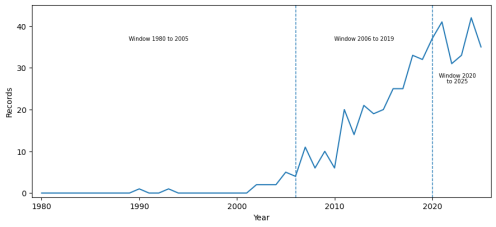
The Web of Science drawing set shows limited activity before the early 2000s, followed by a clearer increase after 2006 and stronger concentration after 2020.
Figure 1 presents this annual distribution. The increase supports the use of publication counts as a background reference, while the stage division still depends on changes in research questions and evidence design. The figure also shows why the final window is treated with caution. Records from 2020 to 2025 are recent and may still be affected by indexing delay.
Figure 1. Annual number of Web of Science Core Collection records on cognitive metaphor translation from 1980 to 2025. Dashed lines mark the analytical windows used in this study; they are not statistically detected breakpoints.
3.2. Product-centered Explanations from 1980 to 2005
From 1980 to 2005, cognitive metaphor translation research gradually introduces cognitive linguistic concepts into an older discussion of metaphor translatability. Researchers use image schemas, construal and cross domain mapping to explain the conditions under which metaphor might be carried across languages
| [9] | Mandelblit, N. The cognitive view of metaphor and its implications for translation theory. In Translation and Meaning, Part 3, Thelen, M., Lewandowska Tomasczyk, B., Eds. Maastricht: Hogeschool Maastricht; 1995, pp. 482-495. |
| [14] | Tabakowska, E. Cognitive Linguistics and Poetics of Translation. Tübingen: Gunter Narr Verlag; 1993. |
| [15] | Halverson, S. Image Schemas, Metaphoric Processes and the “Translate” Concept. Metaphor and Symbol. 1999, 14(3), 199-219. https://doi.org/10.1207/S15327868MS140303 |
[9, 14, 15]
. Mandelblit uses similar and different mapping conditions to describe cross language variation, while Dagut continues to serve as a reference point for the limits of translatability
| [6] | Dagut, M. Can “Metaphor” Be Translated. Babel. 1976, 22(1), 21-33. https://doi.org/10.1075/babel.22.1.05dag |
| [7] | Dagut, M. More about the Translatability of Metaphor. Babel. 1987, 33(2), 77-83. https://doi.org/10.1075/babel.33.2.06dag |
| [9] | Mandelblit, N. The cognitive view of metaphor and its implications for translation theory. In Translation and Meaning, Part 3, Thelen, M., Lewandowska Tomasczyk, B., Eds. Maastricht: Hogeschool Maastricht; 1995, pp. 482-495. |
[6, 7, 9]
.
This stage remains strongly product centered. Many studies rely on examples or small textual samples and discuss translation procedures through source text and target text comparison
| [8] | van den Broeck, R. The Limits of Translatability Exemplified by Metaphor Translation. Poetics Today. 1981, 2(4), 73-87.
https://doi.org/10.2307/1772487 |
| [16] | Dobrzyńska, T. Translating metaphor: Problems of meaning. Journal of Pragmatics. 1995, 24(6), 595-604.
https://doi.org/10.1016/0378-2166(95)00022-K |
| [17] | Kurth, E. N. Altered images: Cognitive and pragmatic aspects of metaphor translation. In Translation and the Relocation of Meaning, Vandaele, J., Ed. Leuven: CETRA; 1999, pp. 97-116. |
| [18] | Al Harrasi, A. N. K. Metaphor in Arabic into English Translation with Specific Reference to Metaphorical Concepts and Expressions in Political Discourse. Ph.D. Thesis, Aston University, Birmingham, United Kingdom, 2001. |
| [19] | Jensen, A. Coping with metaphor: A cognitive approach to translating metaphor. Hermes: Journal of Language and Communication in Business. 2005, 35, 183-209.
https://doi.org/10.7146/hjlcb.v18i35.25823 |
| [20] | Fuertes Olivera, P. A., Velasco Sacristán, M. A contrastive analysis of the manner of translating metaphorical expressions from English into Spanish. Revista Alicantina de Estudios Ingleses. 2001, 14, 83-101. |
[8, 16-20]
. Dickins offers a more systematic model of metaphor translation options, and corpus-based translation studies provide a methodological background for later quantitative work
| [21] | Dickins, J. Two models for metaphor translation. Target. 2005, 17(2), 227-273. https://doi.org/10.1075/target.17.2.03dic |
| [22] | Baker, M. Corpus Linguistics and Translation Studies: Implications and Applications. In Text and Technology: In Honour of John Sinclair, Baker, M., Francis, G., Tognini Bonelli, E., Eds. Amsterdam and Philadelphia: John Benjamins; 1993, pp. 233-250. https://doi.org/10.1075/z.64.15bak |
| [23] | Laviosa, S. Corpus Based Translation Studies: Theory, Findings, Applications. Amsterdam and New York: Rodopi; 2002. |
| [24] | Olohan, M. Introducing Corpora in Translation Studies. London and New York: Routledge; 2004.
https://doi.org/10.4324/9780203640005 |
| [25] | Zanettin, F. Translation Driven Corpora: Corpus Resources for Descriptive and Applied Translation Studies. London: Routledge; 2012. https://doi.org/10.4324/9781315759661 |
[21-25]
. Process evidence is still rare, although think aloud work already shows how translator decisions could be studied through process traces as well as products
| [26] | Tirkkonen Condit, S. Metaphors in translation processes and products. Quaderns: Revista de Traducció. 2001, 6, 11-15. |
[26]
.
The main methodological risk of this stage lies in the boundary between local examples and wider claims. When the sample range, text type and comparison unit remain implicit, claims about metaphor translatability can easily travel beyond the materials that support them. Cognitive linguistics helps the field move from expression matching to conceptual explanation, yet the evidential basis of many claims still depends on small and unevenly described textual samples
.
More detailed reading shows that this early product centered pattern is not methodologically empty. It establishes a vocabulary for comparing translation solutions. Studies in this period distinguish reproduction, substitution, paraphrase, deletion and explanatory rendering, and they often relate these choices to conceptual overlap or divergence between languages
| [16] | Dobrzyńska, T. Translating metaphor: Problems of meaning. Journal of Pragmatics. 1995, 24(6), 595-604.
https://doi.org/10.1016/0378-2166(95)00022-K |
| [17] | Kurth, E. N. Altered images: Cognitive and pragmatic aspects of metaphor translation. In Translation and the Relocation of Meaning, Vandaele, J., Ed. Leuven: CETRA; 1999, pp. 97-116. |
| [18] | Al Harrasi, A. N. K. Metaphor in Arabic into English Translation with Specific Reference to Metaphorical Concepts and Expressions in Political Discourse. Ph.D. Thesis, Aston University, Birmingham, United Kingdom, 2001. |
| [19] | Jensen, A. Coping with metaphor: A cognitive approach to translating metaphor. Hermes: Journal of Language and Communication in Business. 2005, 35, 183-209.
https://doi.org/10.7146/hjlcb.v18i35.25823 |
| [20] | Fuertes Olivera, P. A., Velasco Sacristán, M. A contrastive analysis of the manner of translating metaphorical expressions from English into Spanish. Revista Alicantina de Estudios Ingleses. 2001, 14, 83-101. |
| [21] | Dickins, J. Two models for metaphor translation. Target. 2005, 17(2), 227-273. https://doi.org/10.1075/target.17.2.03dic |
[16-21]
. Such works give later studies a necessary descriptive base. Its limitation lies in the fact that the description of translation solutions was often stronger than the description of sampling conditions.
The relation between cognitive explanation and textual evidence also remains uneven. Mandelblit connects translation difficulty to similar mapping conditions and different mapping conditions
| [9] | Mandelblit, N. The cognitive view of metaphor and its implications for translation theory. In Translation and Meaning, Part 3, Thelen, M., Lewandowska Tomasczyk, B., Eds. Maastricht: Hogeschool Maastricht; 1995, pp. 482-495. |
[9]
. This formulation is productive because it supplies a cognitive reason for different translation patterns. Yet many later applications treat mapping difference as self-evident from the example itself. When the researcher moves directly from a small set of examples to a claim about language wide conceptualization, the evidential path becomes fragile. The problem is not the use of examples but unstated inferential boundaries.
This stage also contains early resources for later methodological development. Corpus-based translation studies begin to show how comparable and parallel corpora could organize evidence more systematically
| [22] | Baker, M. Corpus Linguistics and Translation Studies: Implications and Applications. In Text and Technology: In Honour of John Sinclair, Baker, M., Francis, G., Tognini Bonelli, E., Eds. Amsterdam and Philadelphia: John Benjamins; 1993, pp. 233-250. https://doi.org/10.1075/z.64.15bak |
| [23] | Laviosa, S. Corpus Based Translation Studies: Theory, Findings, Applications. Amsterdam and New York: Rodopi; 2002. |
| [24] | Olohan, M. Introducing Corpora in Translation Studies. London and New York: Routledge; 2004.
https://doi.org/10.4324/9780203640005 |
| [25] | Zanettin, F. Translation Driven Corpora: Corpus Resources for Descriptive and Applied Translation Studies. London: Routledge; 2012. https://doi.org/10.4324/9781315759661 |
[22-25]
. Tirkkonen Condit suggests that metaphors can be examined through both translation products and process materials
| [26] | Tirkkonen Condit, S. Metaphors in translation processes and products. Quaderns: Revista de Traducció. 2001, 6, 11-15. |
[26]
. These developments are still peripheral to mainstream cognitive metaphor translation research, but they prepare the field for later work in which evidence will no longer be restricted to selected product examples.
3.3. Contextual and Process Oriented Explanations from 2006 to 2019
From 2006 to 2019, the field increasingly places contextual conditions inside the explanation of translation choice. Genre, discourse position and audience expectation became important factors in the analysis. In political discourse, metaphor translation often affects stance and textual organization
. In popular science translation, researchers examine how retaining, weakening or replacing metaphors may affect discourse function under genre norms and reader expectations
.
Metaphor identification also becomes more explicit. The Metaphor Identification Procedure and MIPVU provide operational steps for deciding which words or segments count as metaphorically used
| [29] | Pragglejaz Group. MIP: A Method for Identifying Metaphorically Used Words in Discourse. Metaphor and Symbol. 2007, 22(1), 1-39. https://doi.org/10.1080/10926480709336752 |
| [30] | Steen, G. J., Dorst, A. G., Herrmann, J. B., Kaal, A. A., Krennmayr, T., Pasma, T. A Method for Linguistic Metaphor Identification: From MIP to MIPVU. Amsterdam and Philadelphia: John Benjamins; 2010.
https://doi.org/10.1075/celcr.14 |
[29, 30]
. At the same time, metaphor research continues to develop contextual and discourse-oriented accounts
| [2] | Gibbs, R. W. Metaphor Interpretation as Embodied Simulation. Mind & Language. 2006, 21(3), 434-458.
https://doi.org/10.1111/j.1468-0017.2006.00285.x |
| [3] | Gibbs, R. W., Cameron, L. The social cognitive dynamics of metaphor performance. Cognitive Systems Research. 2008, 9(1-2), 64-75. https://doi.org/10.1016/j.cogsys.2007.06.008 |
| [4] | Kövecses, Z. Where Metaphors Come From: Reconsidering Context in Metaphor. Oxford: Oxford University Press; 2015. https://doi.org/10.1093/acprof:oso/9780190224868.001.0001 |
| [5] | Kövecses, Z. Extended Conceptual Metaphor Theory. Cambridge: Cambridge University Press; 2020.
https://doi.org/10.1017/9781108859127 |
| [31] | Kövecses, Z. Metaphor in Culture: Universality and Variation. Cambridge: Cambridge University Press; 2005.
https://doi.org/10.1017/CBO9780511614408 |
| [32] | Semino, E. Metaphor in Discourse. Cambridge: Cambridge University Press; 2008. |
[2-5, 31, 32]
. Chinese research introduces embodied cognition and embodied cognitive linguistics, emphasizing experiential grounding and models of metaphorical discourse
| [33] | Wang, Y. Embodied-Cognitive Linguistics in the Viewpoint of Postmodernism. Foreign Language and Literature. 2014, 30(6), 61-67. |
| [34] | Wen, X., Hua, H. The working model of metaphorical expression in Chinese: From the perspective of embodied cognition. Foreign Language Learning Theory and Practice. 2018, 162(4), 7-12. |
[33, 34]
. Translation studies around cognition and process research also make it more plausible to discuss translator choice through task conditions and information processing
| [35] | Shreve, G. M., Angelone, E., Eds. Translation and Cognition. Amsterdam and Philadelphia: John Benjamins; 2010.
https://doi.org/10.1075/ata.xv |
| [36] | O’Brien, S., Ed. Cognitive Explorations of Translation. London: Continuum; 2011. |
| [37] | Wang, Y. Translation process from the perspective of cognitive linguistics. Chinese Translators Journal. 2017, 38(6), 5-10. |
| [38] | Wang, Y. Embodied Cognitive Translatology. Beijing: Peking University Press; 2021. |
[35-38]
.
Product analysis and corpus analysis remain central, while eye tracking, keylogging and other process data begin to enter the field. Eye tracking and keylogging can show where translators pause, look back and revise
| [39] | O’Brien, S. Eye tracking in translation process research: Methodological challenges and solutions. In Methodology, Technology and Innovation in Translation Process Research, Mees, I. M., Alves, F., Göpferich, S., Eds. Copenhagen: Copenhagen Studies in Language; 2009, pp. 251-266. |
[39]
. In metaphor translation, process-oriented research begins to connect cognitively demanding segments with final translation solutions
| [40] | Sjørup, A. C. Cognitive effort in metaphor translation: An eye tracking and key logging study. In Cognitive Explorations of Translation, O’Brien, S., Ed. London: Continuum; 2011. |
[40]
. This development makes method reporting more demanding. Task setup, segment definition, threshold setting and metric calculation all affect comparison. Pause thresholds, statistical windows and algorithms may change the conclusion even when the research question appears similar
| [41] | Korpal, P. Eye tracking in translation and interpreting studies: The growing popularity and methodological problems. In Accessing Audiovisual Translation, Bogucki, Ł., Deckert, M., Eds. Frankfurt am Main: Peter Lang; 2015, pp. 199-212. |
| [42] | Hvelplund, K. T. Eye tracking in translation process research. In The Handbook of Translation and Cognition, Schwieter, J. W., Ferreira, A., Eds. Malden: Wiley Blackwell; 2017, pp. 248-264. https://doi.org/10.1002/9781119241485.ch12 |
[41, 42]
.
The explanatory problem in this stage becomes more layered. Cross language and cross-cultural studies show that conceptual correspondence is often partial and context dependent
| [43] | Maalej, Z. Translating metaphor between unrelated cultures: A cognitive pragmatic perspective. Sayyab Translation Journal. 2008, 1, 60-82. |
[43]
. When conceptual mapping, genre norms and audience expectations are discussed in the same study, the inference path must be stated more clearly. Readers need to know which claims derive from conceptual structure, which claims derive from contextual conditions, and which claims depend on product or process evidence
.
The methodological gain of this stage can be seen most clearly in the rise of explicit metaphor identification. MIP and MIPVU do not remove interpretation from metaphor analysis. They make interpretation more accountable by asking the analyst to compare contextual meaning with a more basic meaning and then decide whether contrast and comparison were present
| [29] | Pragglejaz Group. MIP: A Method for Identifying Metaphorically Used Words in Discourse. Metaphor and Symbol. 2007, 22(1), 1-39. https://doi.org/10.1080/10926480709336752 |
| [30] | Steen, G. J., Dorst, A. G., Herrmann, J. B., Kaal, A. A., Krennmayr, T., Pasma, T. A Method for Linguistic Metaphor Identification: From MIP to MIPVU. Amsterdam and Philadelphia: John Benjamins; 2010.
https://doi.org/10.1075/celcr.14 |
[29, 30]
. For translation research, this is a major change. It means that the object being translated can be identified before the evaluation of translation strategy begins. It also makes it easier to separate disagreements about metaphor status from disagreements about translation quality.
At the same time, the entry of context into the explanatory frame creates new reporting demands. Context can refer to genre, discourse community, institution, ideology, communicative purpose, reader expectation or local co text. These levels are not interchangeable. A political speech and a scientific article may both contain metaphor, but the social force of a metaphorical choice differs across discourse settings
| [10] | Schäffner, C. Metaphor and translation: Some implications of a cognitive approach. Journal of Pragmatics. 2004, 36(7), 1253-1269. https://doi.org/10.1016/j.pragma.2003.10.012 |
| [11] | Shuttleworth, M. Translational Behaviour at the Frontiers of Scientific Knowledge: A Multilingual Investigation into Popular Science Metaphor in Translation. The Translator. 2011, 17(2), 301-323.
https://doi.org/10.1080/13556509.2011.10799491 |
| [12] | Deignan, A., Semino, E. Translating Science for Young People Through Metaphor. The Translator. 2020, 25(4), 369-384.
https://doi.org/10.1080/13556509.2020.1735759 |
[10-12]
. For this reason, a study that invokes context must specify which level of context is active in the analysis. Otherwise, context becomes a general explanatory label rather than a controlled condition.
Process research sharpens the same issue in another way. Eye tracking and keylogging data can indicate attention, hesitation, revision and processing effort, but the meaning of these indicators depends on task design and calculation rules
| [39] | O’Brien, S. Eye tracking in translation process research: Methodological challenges and solutions. In Methodology, Technology and Innovation in Translation Process Research, Mees, I. M., Alves, F., Göpferich, S., Eds. Copenhagen: Copenhagen Studies in Language; 2009, pp. 251-266. |
| [40] | Sjørup, A. C. Cognitive effort in metaphor translation: An eye tracking and key logging study. In Cognitive Explorations of Translation, O’Brien, S., Ed. London: Continuum; 2011. |
| [41] | Korpal, P. Eye tracking in translation and interpreting studies: The growing popularity and methodological problems. In Accessing Audiovisual Translation, Bogucki, Ł., Deckert, M., Eds. Frankfurt am Main: Peter Lang; 2015, pp. 199-212. |
| [42] | Hvelplund, K. T. Eye tracking in translation process research. In The Handbook of Translation and Cognition, Schwieter, J. W., Ferreira, A., Eds. Malden: Wiley Blackwell; 2017, pp. 248-264. https://doi.org/10.1002/9781119241485.ch12 |
[39-42]
. A long pause may indicate metaphor difficulty, dictionary consultation, uncertainty about terminology or ordinary typing interruption. A fixation pattern may reflect lexical difficulty, syntactic structure, screen layout or task fatigue. These indicators become useful for metaphor translation only when the study defines the segment, the comparison condition and the link between process data and product choice.
3.4. Multi Source Evidence and Comparability Demands from 2020 to 2025
Around 2020, metaphor translation research shows a stronger tendency to combine corpus evidence, translation products and process data within one design. Recent studies of metaphor translation also show growing attention to political discourse, institutional mediation and methodological reporting
| [45] | Božović, P. How are metaphors rendered in legal translation? A corpus based study of the European Court of Human Rights judgments. The Journal of Specialised Translation. 2022, 38, 277-297. https://doi.org/10.26034/cm.jostrans.2022.092 |
| [46] | Wang, Y. The impact of linguistic metaphor on translation unit in target text processing: An eye tracking and keylogging English Chinese translation study. Ampersand. 2023, 11, 100129. https://doi.org/10.1016/j.amper.2023.100129 |
| [47] | Liu, T., Wang, Y., Wang, Z., Yu, H. Exploring cognitive effort and divergent thinking in metaphor translation using eye tracking and EEG technology. Scientific Reports. 2025, 15, 18177. https://doi.org/10.1038/s41598-025-03248-5 |
| [51] | Song, Q., Zhang, J. Ideological mediation: Metaphor shifts in translating the Communist Party of China's centenary speech. Critical Arts. 2024, 37(6), 1-17.
https://doi.org/10.1080/02560046.2024.2303431 |
[45-47, 51]
. This change signals a shift in the field. The important issue is no longer only whether more evidence is used. It is how evidence types are aligned under comparable conditions.
Chinese and international studies show different combinations of explanatory focus and evidence organization. Chinese studies often use embodied cognition or embodied cognitive linguistics as major explanatory resources and discuss the experiential basis of metaphor understanding. Studies of political discourse translation usually delimit a specific text series and its official translation, state sampling rules and then use frequency counts or example distributions to support strategy claims
| [48] | Li, Y., Zhang, Z. [Features and strategies of political metaphor English translation in Xi Jinping: The Governance of China, Volume III. Chinese Translators Journal. 2025, 46(1), 142-148. |
| [49] | Yin, D., Li, D. Strategies for Translating Metaphors in Chinese Political Discourse from an Embodied-Cognitive Perspective. Foreign Languages in China. 2024, 21(3), 98-105.
https://doi.org/10.13564/j.cnki.issn.1672-9382.2024.03.008 |
[48, 49]
. International studies more often divide the explanatory problem into conditions that can be compared, combining corpus statistics, product analysis and process experiments while reporting ecological validity and comparability
| [46] | Wang, Y. The impact of linguistic metaphor on translation unit in target text processing: An eye tracking and keylogging English Chinese translation study. Ampersand. 2023, 11, 100129. https://doi.org/10.1016/j.amper.2023.100129 |
| [47] | Liu, T., Wang, Y., Wang, Z., Yu, H. Exploring cognitive effort and divergent thinking in metaphor translation using eye tracking and EEG technology. Scientific Reports. 2025, 15, 18177. https://doi.org/10.1038/s41598-025-03248-5 |
| [50] | Freiwald, J., Miljanović, Z., Heilmann, A., Neumann, S. Ecological validity in corpus based and experimental translation research. Ampersand. 2024, 12, 100155.
https://doi.org/10.1016/j.amper.2023.100155 |
[46, 47, 50]
.
Corpus evidence and process experiments answer different questions. Corpus analysis uses explicit procedures and annotation rules to show where certain metaphors occur, how they are distributed and how they are adjusted in translation
| [45] | Božović, P. How are metaphors rendered in legal translation? A corpus based study of the European Court of Human Rights judgments. The Journal of Specialised Translation. 2022, 38, 277-297. https://doi.org/10.26034/cm.jostrans.2022.092 |
[45]
. Process experiments use controlled task design to relate translators’ processing behaviour to final output under specific conditions
. Eye tracking and EEG designs extend observation to cognitive effort and divergent thinking
| [47] | Liu, T., Wang, Y., Wang, Z., Yu, H. Exploring cognitive effort and divergent thinking in metaphor translation using eye tracking and EEG technology. Scientific Reports. 2025, 15, 18177. https://doi.org/10.1038/s41598-025-03248-5 |
[47]
. These designs have also made ecological validity a more visible concern, especially when experimental materials and natural corpora are discussed together
.
The central risk in this stage appears when different evidence types are treated as automatic confirmation of one another. Corpus evidence usually answers distributional and contextual questions. Process evidence answers questions about behaviour under a task condition. To discuss them together, researchers need to specify analytical units, metric windows and the scope of inference. A defensible design links cultural explanation, contextual cues and strategy judgments to annotatable units, then reports threshold settings, statistical windows and correspondence rules across evidence types
| [46] | Wang, Y. The impact of linguistic metaphor on translation unit in target text processing: An eye tracking and keylogging English Chinese translation study. Ampersand. 2023, 11, 100129. https://doi.org/10.1016/j.amper.2023.100129 |
| [47] | Liu, T., Wang, Y., Wang, Z., Yu, H. Exploring cognitive effort and divergent thinking in metaphor translation using eye tracking and EEG technology. Scientific Reports. 2025, 15, 18177. https://doi.org/10.1038/s41598-025-03248-5 |
| [53] | Muñoz Martín, R., Apfelthaler, M. A task segment framework to study keylogged translation processes. Translation and Interpreting. 2022, 14(2), 8-31.
https://doi.org/10.12807/ti.114202.2022.a02 |
[46, 47, 53]
.
3.5. Cross Stage Synthesis of Evidence Types
Across the three stages, the field shows a change in what counts as sufficient evidence. In the first stage, a convincing argument often depended on the quality of textual comparison and the plausibility of conceptual explanation. In the second stage, textual comparison increasingly needed support from discourse context, identification procedure or process observation. In the emerging third stage, a study is expected to explain how different evidence streams are aligned. The evidential burden has therefore shifted from example-based plausibility to reportable methodological correspondence.
This shift does not make earlier work obsolete. Early studies remain useful because they formulate the central problems of metaphor translatability and establish a set of strategy distinctions. Later studies make these problems more complex by showing that metaphor translation cannot be explained by conceptual mapping alone. Recent studies have added another layer by asking how claims derived from corpus patterns, product choices and process indicators can be held together. The historical development of the field is therefore best understood as a gradual increase in evidence differentiation.
The main result of the analysis is the identification of comparability as a methodological problem in its own right. The field already contains many studies on metaphor translation, but their findings cannot always be accumulated directly. A claim about strategy frequency, a claim about discourse effect and a claim about cognitive effort are not the same type of claim. They require different materials and different units of analysis. Cross study comparison becomes credible only when these units are made visible.
3.6. A Comparability Checklist for Metaphor Translation Research
The checklist is derived from the coding categories used in this study and refined with reference to broader discussions of methodological transparency and reproducibility in applied linguistics and empirical research
| [54] | Marsden, E. J. Methodological transparency in applied linguistics and its consequences for the quality and scope of research. In The Routledge Handbook of Research Methods in Applied Linguistics, McKinley, J., Rose, H., Eds. London: Routledge; 2020, pp. 15-28. https://doi.org/10.4324/9780367824471 |
| [55] | Nosek, B. A., Alter, G., Banks, G. C., Borsboom, D., Bowman, S. D., Breckler, S. J., et al. Promoting an open research culture. Science. 2015, 348(6242), 1422-1425.
https://doi.org/10.1126/science.aab2374 |
| [56] | Peng, R. D. Reproducible Research in Computational Science. Science. 2011, 334(6060), 1226-1227.
https://doi.org/10.1126/science.1213847 |
| [57] | Goodman, S. N., Fanelli, D., Ioannidis, J. P. A. What does research reproducibility mean. Science Translational Medicine. 2016, 8(341), 341ps12.
https://doi.org/10.1126/scitranslmed.aaf5027 |
[54-57]
.
Table 1. Checklist for comparing cognitive metaphor translation studies across research stages.
Checklist dimension | Operational check item | Minimum information to report | Risk when missing |
Material source and boundary | Are corpus or text sources, genre field and version range stated? | Corpus source, genre or domain, language direction, time range, translation version, translator type. | Confounds genre/version with metaphor effects. |
Sampling rule and exclusion standard | Are sampling rules, exclusions and sample size given? | Full sampling, stratified sampling or random sampling, exclusion conditions, text count, word count, metaphor count. | Overextends claims beyond the sample. |
Identification and annotation basis | Are metaphor identification procedure, unit and judgment basis reported? | MIP, MIPVU or self-built rule, lexical or phrase unit, dictionary basis for basic meaning. | Merges incompatible metaphor units. |
Annotation checkability | Are boundary cases and agreement information reported? | Number and training of annotators, review rule, adjudication rule, kappa, alpha or equivalent explanation. | Leaves annotation decisions unauditable. |
Process data collection condition | Are process data type and collection conditions stated? | Eye tracking, keylogging or retrospective report, software, equipment, sampling rate, calibration and task environment. | Confounds task/equipment effects with processing effects. |
Comparison unit definition | Is the unit of comparison defined and generated by rule? | Source and target segment rule, area of interest rule, task segment rule, log unit generation. | Misaligns product and process units. |
Metric definition and window | Are thresholds, algorithms and statistical windows stated? | Pause threshold, first pass or total gaze measure, window by word, sentence, segment or task. | Makes the same metric label non-comparable. |
Control condition and inference scope | Are comparison conditions and inference boundaries stated? | Matching principle for length, frequency, difficulty and genre, statistical unit, model and controls. | Weakens the comparison premise. |
Cross evidence correspondence | Are correspondence rules and conflict handling stated? | How corpus units map onto process units, how each metaphor instance maps onto product choice and process window. | Creates false cross evidence confirmation. |
Overall comparability judgment | Can the study be directly compared with another study? | Core dimensions are present and compatible, especially material, unit and evidence conditions. | Direct comparison is not recommended if three or more core dimensions are missing or incompatible. |
4. Discussion
4.1. Reporting Conditions for Cross Study Comparison
As shown in
Table 1, the central reporting conditions for cross study comparison include material boundaries, analytical units, identification procedures, evidence types and correspondence rules. The checklist is aimed at research design, reporting and peer review. It does not require all studies to adopt the same method. It identifies the minimum information that allows readers to judge whether two studies share comparable conditions and how far their conclusions may be extended.
The results show that differences within cognitive metaphor translation research often begin before the conclusion. They begin with material boundaries, analytical units and evidence types. Early product centered studies require clearer sample description if their conclusions are to be compared. Contextual studies require explicit statements about the level at which context operates. Process oriented studies require task details, segmentation rules and metric definitions. Multi source designs require correspondence rules that explain how corpus, product and process evidence relate to one another.
4.2. Methodological Implications
The checklist also clarifies the relation between metaphor translation research and broader discussions of methodological transparency. In applied linguistics and empirical research more generally, reproducibility and transparency depend on explicit reporting of data, procedure, coding decisions and inferential limits
| [54] | Marsden, E. J. Methodological transparency in applied linguistics and its consequences for the quality and scope of research. In The Routledge Handbook of Research Methods in Applied Linguistics, McKinley, J., Rose, H., Eds. London: Routledge; 2020, pp. 15-28. https://doi.org/10.4324/9780367824471 |
| [55] | Nosek, B. A., Alter, G., Banks, G. C., Borsboom, D., Bowman, S. D., Breckler, S. J., et al. Promoting an open research culture. Science. 2015, 348(6242), 1422-1425.
https://doi.org/10.1126/science.aab2374 |
| [56] | Peng, R. D. Reproducible Research in Computational Science. Science. 2011, 334(6060), 1226-1227.
https://doi.org/10.1126/science.1213847 |
| [57] | Goodman, S. N., Fanelli, D., Ioannidis, J. P. A. What does research reproducibility mean. Science Translational Medicine. 2016, 8(341), 341ps12.
https://doi.org/10.1126/scitranslmed.aaf5027 |
[54-57]
. Cognitive metaphor translation research has its own disciplinary questions, yet it faces a similar problem when it combines qualitative interpretation, corpus evidence and process measurements.
For future studies, the strongest design is likely to be one in which the research question determines the evidence type. Product comparison is suitable for describing translation solutions. Corpus analysis is suitable for distributional and contextual patterns. Process evidence is suitable for claims about translator effort, attention and task behaviour. When these forms of evidence are combined, the study must specify the unit through which they are connected. Without such a unit, multi-source evidence may create a surface appearance of support while the different data streams answer different questions.
4.3. Implications for Research Article Design
The findings have direct implications for turning a literature-based study into a research article. A research article in this area should not merely summarize previous publications. It needs a defined object of analysis, a reproducible search procedure, a set of coding categories and a result that changes how the field can be evaluated. In the present study, the object is not cognitive metaphor theory in general. The object is the relation between evidence types and comparability conditions in metaphor translation research. This object allows the article to move from chronological description to methodological analysis.
The structure of such a paper can remain close to the conventional sequence of materials, methods, results and discussion, even though the materials are publications rather than experimental participants. Materials and Methods can specify databases, time span, search logic, screening rules and categories for methodological reading. Results can report the stage pattern and the evidence profile. Discussion can then interpret why those patterns matter for future research design. This structure gives the article a research form without forcing it to imitate a laboratory experiment.
For authors in cognitive metaphor translation studies, the most important implication is to align claims with evidence. If the claim concerns translation strategy, product evidence may be sufficient when the sample boundary is clear. If the claim concerns discourse function, contextual level and textual position need to be specified. If the claim concerns translator processing, task design and process indicators become necessary. If the claim concerns the relation between product and process, the study must explain how the product unit and the process unit correspond. These distinctions prevent a single term such as metaphor translation from carrying several incompatible research objects at once.
4.4. Limitations
The present study has three limits. First, the Web of Science and CNKI searches cannot exhaust the field. Books, dissertations, book chapters and articles outside the selected indexing ranges may contain important methodological discussions. Second, the Chinese set is used as a supplementary material pool rather than a numerical basis for trend comparison. This choice reduces the risk of unstable cross database comparison, but it also means that the paper does not claim to provide a full quantitative account of Chinese research. Third, the stage division is analytical. It identifies dominant tendencies within time windows, while individual studies may anticipate later developments or retain earlier methods.
These limits do not weaken the central point of the study. They define its scope. The article does not claim to provide a complete bibliometric map of cognitive metaphor translation research. It offers a methodological account of how evidence design has changed and what information is needed for cross study comparison. Later studies can extend this work by constructing a larger bibliometric dataset, coding more variables and testing the checklist against a wider set of research articles.
5. Conclusions
This study examines cognitive metaphor translation research from 1980 to 2025 through evidence types and comparability conditions. The field develops from product centered discussions of metaphor translatability, through contextual and process-oriented explanations, to recent designs that combine corpus evidence, translation products and process data. Each development stage expands what the field could claim, and each also increases the amount of methodological information that must be reported.
The proposed checklist identifies material boundary, sampling rule, identification procedure, annotation checkability, process data condition, comparison unit, metric window, control condition and cross evidence correspondence as central conditions for comparison. These conditions help readers decide whether findings from different studies can be placed together and how far their conclusions may be extended. For cognitive metaphor translation research, methodological progress depends on clearer alignment between research questions, evidence types and reporting practices.
For future research, the checklist proposed here can serve two uses. During research design, it can help authors decide what information needs to be recorded before analysis begins. During peer review, it can help reviewers distinguish between a substantive disagreement and a reporting gap. A study may make a persuasive interpretive claim even when it does not contain process data. A process study may produce useful results even when its ecological scope is narrow. What matters is that the inference matches the evidence and that the conditions of comparison are visible.
The broader implication is that methodological progress in this field depends on alignment among questions, units and evidence types. Corpus methods, MIPVU annotation, eye tracking, keylogging and EEG can strengthen metaphor translation research when they answer a clear question. They can weaken an article when they are added without a defined relation to the claim being made. By turning the historical account into a comparability checklist, this study shifts attention from what the field has found to the conditions under which those findings can be compared. The next stage of cognitive metaphor translation research will depend on the precision with which evidence types are connected to research questions.
Abbreviations
CNKI | China National Knowledge Infrastructure |
CSSCI | Chinese Social Sciences Citation Index |
EEG | Electroencephalography |
MIP | Metaphor Identification Procedure |
MIPVU | Metaphor Identification Procedure Vrije Universiteit |
WoS | Web of Science |
Author Contributions
Shiqi Zhang: Conceptualization, Data curation, Formal analysis, Investigation, Methodology, Resources, Validation, Visualization, Writing – original draft, Writing – review & editing
Data Availability Statement
The data supporting the outcomes of this research work have been reported in this manuscript.
Conflicts of Interest
The author declares no conflicts of interest.
References
| [1] |
Lakoff, G., Johnson, M. Metaphors We Live By. Chicago: University of Chicago Press; 1980.
|
| [2] |
Gibbs, R. W. Metaphor Interpretation as Embodied Simulation. Mind & Language. 2006, 21(3), 434-458.
https://doi.org/10.1111/j.1468-0017.2006.00285.x
|
| [3] |
Gibbs, R. W., Cameron, L. The social cognitive dynamics of metaphor performance. Cognitive Systems Research. 2008, 9(1-2), 64-75.
https://doi.org/10.1016/j.cogsys.2007.06.008
|
| [4] |
Kövecses, Z. Where Metaphors Come From: Reconsidering Context in Metaphor. Oxford: Oxford University Press; 2015.
https://doi.org/10.1093/acprof:oso/9780190224868.001.0001
|
| [5] |
Kövecses, Z. Extended Conceptual Metaphor Theory. Cambridge: Cambridge University Press; 2020.
https://doi.org/10.1017/9781108859127
|
| [6] |
Dagut, M. Can “Metaphor” Be Translated. Babel. 1976, 22(1), 21-33.
https://doi.org/10.1075/babel.22.1.05dag
|
| [7] |
Dagut, M. More about the Translatability of Metaphor. Babel. 1987, 33(2), 77-83.
https://doi.org/10.1075/babel.33.2.06dag
|
| [8] |
van den Broeck, R. The Limits of Translatability Exemplified by Metaphor Translation. Poetics Today. 1981, 2(4), 73-87.
https://doi.org/10.2307/1772487
|
| [9] |
Mandelblit, N. The cognitive view of metaphor and its implications for translation theory. In Translation and Meaning, Part 3, Thelen, M., Lewandowska Tomasczyk, B., Eds. Maastricht: Hogeschool Maastricht; 1995, pp. 482-495.
|
| [10] |
Schäffner, C. Metaphor and translation: Some implications of a cognitive approach. Journal of Pragmatics. 2004, 36(7), 1253-1269.
https://doi.org/10.1016/j.pragma.2003.10.012
|
| [11] |
Shuttleworth, M. Translational Behaviour at the Frontiers of Scientific Knowledge: A Multilingual Investigation into Popular Science Metaphor in Translation. The Translator. 2011, 17(2), 301-323.
https://doi.org/10.1080/13556509.2011.10799491
|
| [12] |
Deignan, A., Semino, E. Translating Science for Young People Through Metaphor. The Translator. 2020, 25(4), 369-384.
https://doi.org/10.1080/13556509.2020.1735759
|
| [13] |
Sun, Y. A tracing into metaphor translation studies abroad during the past four decades (1976-2015). Foreign Language Learning Theory and Practice. 2017, 3, 80-90.
|
| [14] |
Tabakowska, E. Cognitive Linguistics and Poetics of Translation. Tübingen: Gunter Narr Verlag; 1993.
|
| [15] |
Halverson, S. Image Schemas, Metaphoric Processes and the “Translate” Concept. Metaphor and Symbol. 1999, 14(3), 199-219.
https://doi.org/10.1207/S15327868MS140303
|
| [16] |
Dobrzyńska, T. Translating metaphor: Problems of meaning. Journal of Pragmatics. 1995, 24(6), 595-604.
https://doi.org/10.1016/0378-2166(95)00022-K
|
| [17] |
Kurth, E. N. Altered images: Cognitive and pragmatic aspects of metaphor translation. In Translation and the Relocation of Meaning, Vandaele, J., Ed. Leuven: CETRA; 1999, pp. 97-116.
|
| [18] |
Al Harrasi, A. N. K. Metaphor in Arabic into English Translation with Specific Reference to Metaphorical Concepts and Expressions in Political Discourse. Ph.D. Thesis, Aston University, Birmingham, United Kingdom, 2001.
|
| [19] |
Jensen, A. Coping with metaphor: A cognitive approach to translating metaphor. Hermes: Journal of Language and Communication in Business. 2005, 35, 183-209.
https://doi.org/10.7146/hjlcb.v18i35.25823
|
| [20] |
Fuertes Olivera, P. A., Velasco Sacristán, M. A contrastive analysis of the manner of translating metaphorical expressions from English into Spanish. Revista Alicantina de Estudios Ingleses. 2001, 14, 83-101.
|
| [21] |
Dickins, J. Two models for metaphor translation. Target. 2005, 17(2), 227-273.
https://doi.org/10.1075/target.17.2.03dic
|
| [22] |
Baker, M. Corpus Linguistics and Translation Studies: Implications and Applications. In Text and Technology: In Honour of John Sinclair, Baker, M., Francis, G., Tognini Bonelli, E., Eds. Amsterdam and Philadelphia: John Benjamins; 1993, pp. 233-250.
https://doi.org/10.1075/z.64.15bak
|
| [23] |
Laviosa, S. Corpus Based Translation Studies: Theory, Findings, Applications. Amsterdam and New York: Rodopi; 2002.
|
| [24] |
Olohan, M. Introducing Corpora in Translation Studies. London and New York: Routledge; 2004.
https://doi.org/10.4324/9780203640005
|
| [25] |
Zanettin, F. Translation Driven Corpora: Corpus Resources for Descriptive and Applied Translation Studies. London: Routledge; 2012.
https://doi.org/10.4324/9781315759661
|
| [26] |
Tirkkonen Condit, S. Metaphors in translation processes and products. Quaderns: Revista de Traducció. 2001, 6, 11-15.
|
| [27] |
Wang, B. Metaphorical terms for translation. Perspectives. 2003, 11(3), 189-195.
https://doi.org/10.1080/0907676X.2003.9961473
|
| [28] |
Shuttleworth, M. Studying Scientific Metaphor in Translation: An Inquiry into Cross Lingual Translation Practices. London: Routledge; 2017.
https://doi.org/10.4324/9781315678085
|
| [29] |
Pragglejaz Group. MIP: A Method for Identifying Metaphorically Used Words in Discourse. Metaphor and Symbol. 2007, 22(1), 1-39.
https://doi.org/10.1080/10926480709336752
|
| [30] |
Steen, G. J., Dorst, A. G., Herrmann, J. B., Kaal, A. A., Krennmayr, T., Pasma, T. A Method for Linguistic Metaphor Identification: From MIP to MIPVU. Amsterdam and Philadelphia: John Benjamins; 2010.
https://doi.org/10.1075/celcr.14
|
| [31] |
Kövecses, Z. Metaphor in Culture: Universality and Variation. Cambridge: Cambridge University Press; 2005.
https://doi.org/10.1017/CBO9780511614408
|
| [32] |
Semino, E. Metaphor in Discourse. Cambridge: Cambridge University Press; 2008.
|
| [33] |
Wang, Y. Embodied-Cognitive Linguistics in the Viewpoint of Postmodernism. Foreign Language and Literature. 2014, 30(6), 61-67.
|
| [34] |
Wen, X., Hua, H. The working model of metaphorical expression in Chinese: From the perspective of embodied cognition. Foreign Language Learning Theory and Practice. 2018, 162(4), 7-12.
|
| [35] |
Shreve, G. M., Angelone, E., Eds. Translation and Cognition. Amsterdam and Philadelphia: John Benjamins; 2010.
https://doi.org/10.1075/ata.xv
|
| [36] |
O’Brien, S., Ed. Cognitive Explorations of Translation. London: Continuum; 2011.
|
| [37] |
Wang, Y. Translation process from the perspective of cognitive linguistics. Chinese Translators Journal. 2017, 38(6), 5-10.
|
| [38] |
Wang, Y. Embodied Cognitive Translatology. Beijing: Peking University Press; 2021.
|
| [39] |
O’Brien, S. Eye tracking in translation process research: Methodological challenges and solutions. In Methodology, Technology and Innovation in Translation Process Research, Mees, I. M., Alves, F., Göpferich, S., Eds. Copenhagen: Copenhagen Studies in Language; 2009, pp. 251-266.
|
| [40] |
Sjørup, A. C. Cognitive effort in metaphor translation: An eye tracking and key logging study. In Cognitive Explorations of Translation, O’Brien, S., Ed. London: Continuum; 2011.
|
| [41] |
Korpal, P. Eye tracking in translation and interpreting studies: The growing popularity and methodological problems. In Accessing Audiovisual Translation, Bogucki, Ł., Deckert, M., Eds. Frankfurt am Main: Peter Lang; 2015, pp. 199-212.
|
| [42] |
Hvelplund, K. T. Eye tracking in translation process research. In The Handbook of Translation and Cognition, Schwieter, J. W., Ferreira, A., Eds. Malden: Wiley Blackwell; 2017, pp. 248-264.
https://doi.org/10.1002/9781119241485.ch12
|
| [43] |
Maalej, Z. Translating metaphor between unrelated cultures: A cognitive pragmatic perspective. Sayyab Translation Journal. 2008, 1, 60-82.
|
| [44] |
Toury, G. Descriptive Translation Studies and Beyond. Amsterdam and Philadelphia: John Benjamins; 1995.
https://doi.org/10.1075/btl.4
|
| [45] |
Božović, P. How are metaphors rendered in legal translation? A corpus based study of the European Court of Human Rights judgments. The Journal of Specialised Translation. 2022, 38, 277-297.
https://doi.org/10.26034/cm.jostrans.2022.092
|
| [46] |
Wang, Y. The impact of linguistic metaphor on translation unit in target text processing: An eye tracking and keylogging English Chinese translation study. Ampersand. 2023, 11, 100129.
https://doi.org/10.1016/j.amper.2023.100129
|
| [47] |
Liu, T., Wang, Y., Wang, Z., Yu, H. Exploring cognitive effort and divergent thinking in metaphor translation using eye tracking and EEG technology. Scientific Reports. 2025, 15, 18177.
https://doi.org/10.1038/s41598-025-03248-5
|
| [48] |
Li, Y., Zhang, Z. [Features and strategies of political metaphor English translation in Xi Jinping: The Governance of China, Volume III. Chinese Translators Journal. 2025, 46(1), 142-148.
|
| [49] |
Yin, D., Li, D. Strategies for Translating Metaphors in Chinese Political Discourse from an Embodied-Cognitive Perspective. Foreign Languages in China. 2024, 21(3), 98-105.
https://doi.org/10.13564/j.cnki.issn.1672-9382.2024.03.008
|
| [50] |
Freiwald, J., Miljanović, Z., Heilmann, A., Neumann, S. Ecological validity in corpus based and experimental translation research. Ampersand. 2024, 12, 100155.
https://doi.org/10.1016/j.amper.2023.100155
|
| [51] |
Song, Q., Zhang, J. Ideological mediation: Metaphor shifts in translating the Communist Party of China's centenary speech. Critical Arts. 2024, 37(6), 1-17.
https://doi.org/10.1080/02560046.2024.2303431
|
| [52] |
Jankowiak, K., Lehka Paul, O. Novel metaphor translation is modulated by translation direction. Applied Psycholinguistics. 2022, 43(1), 177-192.
https://doi.org/10.1017/S0142716421000461
|
| [53] |
Muñoz Martín, R., Apfelthaler, M. A task segment framework to study keylogged translation processes. Translation and Interpreting. 2022, 14(2), 8-31.
https://doi.org/10.12807/ti.114202.2022.a02
|
| [54] |
Marsden, E. J. Methodological transparency in applied linguistics and its consequences for the quality and scope of research. In The Routledge Handbook of Research Methods in Applied Linguistics, McKinley, J., Rose, H., Eds. London: Routledge; 2020, pp. 15-28.
https://doi.org/10.4324/9780367824471
|
| [55] |
Nosek, B. A., Alter, G., Banks, G. C., Borsboom, D., Bowman, S. D., Breckler, S. J., et al. Promoting an open research culture. Science. 2015, 348(6242), 1422-1425.
https://doi.org/10.1126/science.aab2374
|
| [56] |
Peng, R. D. Reproducible Research in Computational Science. Science. 2011, 334(6060), 1226-1227.
https://doi.org/10.1126/science.1213847
|
| [57] |
Goodman, S. N., Fanelli, D., Ioannidis, J. P. A. What does research reproducibility mean. Science Translational Medicine. 2016, 8(341), 341ps12.
https://doi.org/10.1126/scitranslmed.aaf5027
|
Cite This Article
-
APA Style
Zhang, S. (2026). Methodological Analysis of Evidence Types and Comparability in Cognitive Metaphor Translation Research from 1980 to 2025. International Journal of Applied Linguistics and Translation, 12(2), 44-53. https://doi.org/10.11648/j.ijalt.20261202.13
 Copy
|
Copy
|
 Download
ACS Style
Zhang, S. Methodological Analysis of Evidence Types and Comparability in Cognitive Metaphor Translation Research from 1980 to 2025. Int. J. Appl. Linguist. Transl. 2026, 12(2), 44-53. doi: 10.11648/j.ijalt.20261202.13
Copy
|
Download
AMA Style
Zhang S. Methodological Analysis of Evidence Types and Comparability in Cognitive Metaphor Translation Research from 1980 to 2025. Int J Appl Linguist Transl. 2026;12(2):44-53. doi: 10.11648/j.ijalt.20261202.13
Copy
|
Download
-
@article{10.11648/j.ijalt.20261202.13,
  author = {Shiqi Zhang},
  title = {Methodological Analysis of Evidence Types and Comparability in Cognitive Metaphor Translation Research from 1980 to 2025},
  journal = {International Journal of Applied Linguistics and Translation},
  volume = {12},
  number = {2},
  pages = {44-53},
  doi = {10.11648/j.ijalt.20261202.13},
  url = {https://doi.org/10.11648/j.ijalt.20261202.13},
  eprint = {https://article.sciencepublishinggroup.com/pdf/10.11648.j.ijalt.20261202.13},
  abstract = {This study analyzes the methodological development of cognitive metaphor translation research from 1980 to 2025, with particular attention to evidence types, analytical units and comparability conditions. International studies were retrieved from the Web of Science Core Collection, and Chinese studies were retrieved from CNKI, with Chinese sources limited to Peking University Core and CSSCI journals. After title and abstract screening, removal of irrelevant uses of the term translation, de-duplication and manual verification, the Web of Science dataset contained 478 records and the Chinese candidate set contained 75 records. The analysis combined annual publication counts with close methodological reading of research questions, material boundaries, identification procedures, process indicators and cross evidence correspondence. The results identify two relatively formed stages and one emerging trend. From 1980 to 2005, the field was shaped by conceptual metaphor theory and debates on translatability, with evidence mainly drawn from product comparison and small textual samples. From 2006 to 2019, discourse conditions, contextual variables, metaphor identification procedures and early process data entered the explanatory frame. From 2020 to 2025, corpus evidence, translation products and process data were more often placed within the same research design, increasing the need for explicit reporting of sampling rules, task settings, metric windows and correspondence rules. This study proposes a checklist for assessing whether findings from different studies can be compared. Its contribution lies in transforming a stage account of the field into a research tool for evaluating methodological alignment and inference scope. The checklist helps researchers assess whether findings from different studies address the same phenomenon under comparable conditions, thereby preventing inappropriate cross study comparison.},
 year = {2026}
}
Copy
|
Download
-
TY  - JOUR
T1  - Methodological Analysis of Evidence Types and Comparability in Cognitive Metaphor Translation Research from 1980 to 2025
AU  - Shiqi Zhang
Y1  - 2026/06/05
PY  - 2026
N1  - https://doi.org/10.11648/j.ijalt.20261202.13
DO  - 10.11648/j.ijalt.20261202.13
T2  - International Journal of Applied Linguistics and Translation
JF  - International Journal of Applied Linguistics and Translation
JO  - International Journal of Applied Linguistics and Translation
SP  - 44
EP  - 53
PB  - Science Publishing Group
SN  - 2472-1271
UR  - https://doi.org/10.11648/j.ijalt.20261202.13
AB  - This study analyzes the methodological development of cognitive metaphor translation research from 1980 to 2025, with particular attention to evidence types, analytical units and comparability conditions. International studies were retrieved from the Web of Science Core Collection, and Chinese studies were retrieved from CNKI, with Chinese sources limited to Peking University Core and CSSCI journals. After title and abstract screening, removal of irrelevant uses of the term translation, de-duplication and manual verification, the Web of Science dataset contained 478 records and the Chinese candidate set contained 75 records. The analysis combined annual publication counts with close methodological reading of research questions, material boundaries, identification procedures, process indicators and cross evidence correspondence. The results identify two relatively formed stages and one emerging trend. From 1980 to 2005, the field was shaped by conceptual metaphor theory and debates on translatability, with evidence mainly drawn from product comparison and small textual samples. From 2006 to 2019, discourse conditions, contextual variables, metaphor identification procedures and early process data entered the explanatory frame. From 2020 to 2025, corpus evidence, translation products and process data were more often placed within the same research design, increasing the need for explicit reporting of sampling rules, task settings, metric windows and correspondence rules. This study proposes a checklist for assessing whether findings from different studies can be compared. Its contribution lies in transforming a stage account of the field into a research tool for evaluating methodological alignment and inference scope. The checklist helps researchers assess whether findings from different studies address the same phenomenon under comparable conditions, thereby preventing inappropriate cross study comparison.
VL  - 12
IS  - 2
ER  -
Copy
|
Download





 Share This Article
 Twitter
 Linked In
 Facebook