
Phosphate being one of the most essential elements required for numerous positive purposes, also plays negative function with respect to eutrophication. Eutrophication refers to deterioration of water health status due to addition of phosphate and other nutrious elements like nitrogen in waterbodies. In this study "Phosphate impact on eutrophication hazards of Niger - River ecosystem in Asaba for biosystem engineering and other functions using bioindex", the measured phosphate values, eutrophication values prior bioindex generative value classification for hazards were deployed in obtaining the potential negative effects, impacted from the phosphate presence in the river ecosystem water. Results showed that the early hours had 0.57 mg/L phosphate level with 1.14 EPI recording low hazard, mid - day hours had 5.92 mg/L phosphate level with 11.85 EPI recording medium hazard, while late hours had 4.83 mg/L phosphate with 9.66 EPI recording low hazard. It was concluded, that the river water system had low eutrophication potential hazards with overall and average values of 90.56 EPI and 7.55 EPI from 45.28 mg/L and 3.77 mg/L phosphate presence. This Indices a healthy condition of the river system, insighting more understanding for future decision of the aquatic bioenvironment, and, incorporate conservation and management idealogies for quality status improvement of waterbodies.
| Published in | International Journal of Ecotoxicology and Ecobiology (Volume 11, Issue 4) |
| DOI | 10.11648/j.ijee.20261104.11 |
| Page(s) | 66-73 |
| Creative Commons |
This is an Open Access article, distributed under the terms of the Creative Commons Attribution 4.0 International License (http://creativecommons.org/licenses/by/4.0/), which permits unrestricted use, distribution and reproduction in any medium or format, provided the original work is properly cited. |
| Copyright |
Copyright © The Author(s), 2026. Published by Science Publishing Group |
Phosphorus, Phosphate, Phosphate Cycle, Contamination Hazards, Eutrophication
SN | Month | Phosphate (mg/L) | EP Index, EPI | EP Hazard Rating |
|---|---|---|---|---|
1 | January | 0.30 | 0.60 | Low |
2 | February | 1.60 | 3.20 | Low |
3 | March | 0.60 | 1.20 | Low |
4 | April | 0.23 | 0.46 | Low |
5 | May | 0.61 | 1.22 | Low |
6 | June | 0.36 | 0.72 | Low |
7 | July | 0.31 | 0.62 | Low |
8 | August | 0.81 | 1.62 | Low |
9 | September | 0.59 | 1.18 | Low |
10 | October | 0.41 | 0.82 | Low |
11 | November | 0.63 | 1.26 | Low |
12 | December | 0.39 | 0.78 | Low |
Total | - | 6.84 | 13.68 | - |
Average | - | 0.57 | 1.14 | Low |
SN | Month | Phosphate (mg/L) | EP Index, EPI | EP Hazard Rating |
|---|---|---|---|---|
1 | January | 4.67 | 9.34 | Low |
2 | February | 7.83 | 15.66 | Medium |
3 | March | 5.33 | 10.66 | Medium |
4 | April | 4.16 | 8.32 | Low |
5 | May | 6.37 | 12.74 | Medium |
6 | June | 4.99 | 9.98 | Low |
7 | July | 4.07 | 8.14 | Low |
8 | August | 2.72 | 5.44 | Low |
9 | September | 3.26 | 6.52 | Low |
10 | October | 9.53 | 19.06 | Medium |
11 | November | 7.22 | 14.44 | Medium |
12 | December | 10.92 | 21.84 | Medium |
Total | - | 71.07 | 142.14 | - |
Average | - | 5.92 | 11.85 | Medium |
SN | Month | Phosphate (mg/L) | EP Index, EPI | EP Hazard Rating |
|---|---|---|---|---|
1 | January | 3.85 | 7.70 | Low |
2 | February | 6.80 | 13.60 | Medium |
3 | March | 4.51 | 9.02 | Low |
4 | April | 3.44 | 6.88 | Low |
5 | May | 4.99 | 9.98 | Low |
6 | June | 5.84 | 11.68 | Medium |
7 | July | 4.29 | 8.58 | Low |
8 | August | 4.30 | 8.60 | Low |
9 | September | 4.07 | 8.14 | Low |
10 | October | 5.09 | 10.18 | Medium |
11 | November | 4.69 | 9.38 | Low |
12 | December | 6.06 | 12.12 | Medium |
Total | - | 57.93 | 115.86 | - |
Average | - | 4.83 | 9.66 | Low |
SN | Month | Phosphate (mg/L) | EP Index, EPI | EP Hazard Rating |
|---|---|---|---|---|
1 | January | 2.94 | 5.88 | Low |
2 | February | 5.41 | 10.82 | Medium |
3 | March | 3.48 | 6.96 | Low |
4 | April | 2.61 | 5.22 | Low |
5 | May | 3.99 | 7.98 | Low |
6 | June | 3.73 | 7.46 | Low |
7 | July | 2.89 | 5.78 | Low |
8 | August | 2.61 | 5.22 | Low |
9 | September | 2.64 | 5.28 | Low |
10 | October | 5.01 | 10.02 | Medium |
11 | November | 4.18 | 8.36 | Low |
12 | December | 5.79 | 11.58 | Medium |
Total | - | 45.28 | 90.56 | - |
Average | - | 3.77 | 7.55 | Low |
SN | Serial Number |
EP | Eutrophication Potential |
EPI | Eutrophication Potential Index |
mg/L | Milligrams per Liter |
| [1] | Sinclair J. S., Fraker M. E., Hood J. M., Reavie E. D., Ludsin S. A. Eutrophication, Water Quality, And Fisheries: A Wicked Management Problem with Insights From A Century Of Change In Lake Erie. Ecology And Society. 2023, 28(3), p 4. |
| [2] |
Earth How. EH: How Does Eutrophication Work? Causes, Process And Examples. Water Science, 2025, p 1. Available From:
https://earthhow.com/eutrophication-causes-process-examples/ |
| [3] |
Eat For Health. EFH: Nutrient Reference Values For Australia And New Zealand - Phosphorus. Australian Government, 2025, p 1. Available From:
https://eatforhealth.gov.au/nutrient-reference-values/nutrients/phosphorus |
| [4] | Wagner C. A. The Basics Of Phosphate Metabolism. Nephrol Dial Transplant. 2023, 39(2), p 191. |
| [5] |
Water Science School. WSS: Phosphorus And Water. United States Geological Survey (USGS), USA; 2018, p 1, &, 3. Available From:
https://usgs.gov/water-science-school/science/phosphorus-and-water#overview |
| [6] | Johnston A. E. Understanding Phosphate. Potash Development Association - United Kingdom, 2019, p 1, &, 3. Available From: |
| [7] | Biology Libre Texts. BLT: The Phosphorus Cycle. UC Davis Library, California State University; 2024, p 2. Available From: |
| [8] | Qadeer H. A., Bashir K. Physiology: Phosphate. National Library Of Medicine - National Center For Biotechnology Information, United States: Stat Pearls Publishing; 2022, p 1. Available From: |
| [9] | University Of California Museum Of Paleontology. UCMP: Phosphorus - Understanding Global Change. The Berkeley Natural History Museums, 2025, p 1. Available From: |
| [10] |
Southwest Research And Outreach Center. SWROC: Phosphorus Cycle. College Of Food, Agricultural And Natural Resource Sciences: University Of Minnesota; 2025, p 3. Available From:
https://swroc.cfans.umn.edu/research/soil-water/phosphorus-cycle |
| [11] | Texas Education Agency. TEA: Biogeochemical Cycles. Texas Gateway, USA; 2025, p 13. Available From: |
| [12] | Food Safety Authority Of Ireland. FSAI: Types Of Hazards. Ireland Nation, 2025, p 1. Available From: |
| [13] | International Federation Of Red Cross And Red Crescent Societies. IFRC: Hazard Definitions. Red Cross Worldwide, 2021, p 1, Available From: |
| [14] |
Okolotu G. I. Shear Stress Impact On Coastal Water Defense Structures In Asaba River Niger Waterways. Tuijin Jishu/ Journal Of Propulsion Technology. 2024, 45(3), p 3187.
https://propulsiontechjournal.com/index.php/journal/article/view/7718 |
| [15] | Garcia S. M. Niger River Map. Standard (7.4.1), 2024. Available From: |
| [16] | Ai H., Zhang K., Zhang H. Efficient Smartphone - Based Measurement Of Phosphorus In Water. Water Research X. 2024, 22(100217), p 2. |
| [17] | Zhang Y., Li M., Dong J., Yang H., Zwieten L. V., Lu H., Alshameri A., Zhan Z., Chen X., Jiang X., Xu W., Bao Y., Wang H. A Critical Review Of Methods For Analyzing Freshwater Eutrophication. Water. 2021, 13(2), 225, p 2. |
APA Style
Okolotu, G. I., Nwadiolu, R., Akwenuke, O. M., Okeke, C. G. (2026). Phosphate Impact on Eutrophication Hazards of Niger - River Ecosystem in Asaba for Biosystem Engineering and Other Functions Using Bioindex. International Journal of Ecotoxicology and Ecobiology, 11(4), 66-73. https://doi.org/10.11648/j.ijee.20261104.11
ACS Style
Okolotu, G. I.; Nwadiolu, R.; Akwenuke, O. M.; Okeke, C. G. Phosphate Impact on Eutrophication Hazards of Niger - River Ecosystem in Asaba for Biosystem Engineering and Other Functions Using Bioindex. Int. J. Ecotoxicol. Ecobiol. 2026, 11(4), 66-73. doi: 10.11648/j.ijee.20261104.11
@article{10.11648/j.ijee.20261104.11,
  author = {Godspower Ikechukwu Okolotu and Romanus Nwadiolu and Onoziogie Moses Akwenuke and Chineze Glory Okeke},
  title = {Phosphate Impact on Eutrophication Hazards of Niger - River Ecosystem in Asaba for Biosystem Engineering and Other Functions Using Bioindex},
  journal = {International Journal of Ecotoxicology and Ecobiology},
  volume = {11},
  number = {4},
  pages = {66-73},
  doi = {10.11648/j.ijee.20261104.11},
  url = {https://doi.org/10.11648/j.ijee.20261104.11},
  eprint = {https://article.sciencepublishinggroup.com/pdf/10.11648.j.ijee.20261104.11},
  abstract = {Phosphate being one of the most essential elements required for numerous positive purposes, also plays negative function with respect to eutrophication. Eutrophication refers to deterioration of water health status due to addition of phosphate and other nutrious elements like nitrogen in waterbodies. In this study "Phosphate impact on eutrophication hazards of Niger - River ecosystem in Asaba for biosystem engineering and other functions using bioindex", the measured phosphate values, eutrophication values prior bioindex generative value classification for hazards were deployed in obtaining the potential negative effects, impacted from the phosphate presence in the river ecosystem water. Results showed that the early hours had 0.57 mg/L phosphate level with 1.14 EPI recording low hazard, mid - day hours had 5.92 mg/L phosphate level with 11.85 EPI recording medium hazard, while late hours had 4.83 mg/L phosphate with 9.66 EPI recording low hazard. It was concluded, that the river water system had low eutrophication potential hazards with overall and average values of 90.56 EPI and 7.55 EPI from 45.28 mg/L and 3.77 mg/L phosphate presence. This Indices a healthy condition of the river system, insighting more understanding for future decision of the aquatic bioenvironment, and, incorporate conservation and management idealogies for quality status improvement of waterbodies.},
 year = {2026}
}
TY  - JOUR
T1  - Phosphate Impact on Eutrophication Hazards of Niger - River Ecosystem in Asaba for Biosystem Engineering and Other Functions Using Bioindex
AU  - Godspower Ikechukwu Okolotu
AU  - Romanus Nwadiolu
AU  - Onoziogie Moses Akwenuke
AU  - Chineze Glory Okeke
Y1  - 2026/11/11
PY  - 2026
N1  - https://doi.org/10.11648/j.ijee.20261104.11
DO  - 10.11648/j.ijee.20261104.11
T2  - International Journal of Ecotoxicology and Ecobiology
JF  - International Journal of Ecotoxicology and Ecobiology
JO  - International Journal of Ecotoxicology and Ecobiology
SP  - 66
EP  - 73
PB  - Science Publishing Group
SN  - 2575-1735
UR  - https://doi.org/10.11648/j.ijee.20261104.11
AB  - Phosphate being one of the most essential elements required for numerous positive purposes, also plays negative function with respect to eutrophication. Eutrophication refers to deterioration of water health status due to addition of phosphate and other nutrious elements like nitrogen in waterbodies. In this study "Phosphate impact on eutrophication hazards of Niger - River ecosystem in Asaba for biosystem engineering and other functions using bioindex", the measured phosphate values, eutrophication values prior bioindex generative value classification for hazards were deployed in obtaining the potential negative effects, impacted from the phosphate presence in the river ecosystem water. Results showed that the early hours had 0.57 mg/L phosphate level with 1.14 EPI recording low hazard, mid - day hours had 5.92 mg/L phosphate level with 11.85 EPI recording medium hazard, while late hours had 4.83 mg/L phosphate with 9.66 EPI recording low hazard. It was concluded, that the river water system had low eutrophication potential hazards with overall and average values of 90.56 EPI and 7.55 EPI from 45.28 mg/L and 3.77 mg/L phosphate presence. This Indices a healthy condition of the river system, insighting more understanding for future decision of the aquatic bioenvironment, and, incorporate conservation and management idealogies for quality status improvement of waterbodies.
VL  - 11
IS  - 4
ER  -
Department of Agricultural Engineering, Southern Delta University, Ozoro, Nigeria
Biography: Godspower Ikechukwu Okolotu (B. Eng., M. Eng., M. NSE, PhD, Re-COREN) is an academia of Southern Delta University, Ozoro Nigeria, West Africa, in the department of Agricultural Engineering 2023 to present. He attained the climax of his education in 2021 with a PhD in Soil and water engineering from department of Agricultural and Bioresource Engineering, at the Enugu State University of Science and Technology, Nigeria, upon M. Eng., and B. Eng., (2015 and 2011) in same. He also holds a certificate of practicing from Council for the regulation of Engineering In Nigeria from 2021 to present. Scholarly, he has authored multiple published papers.
Research Fields: soil and water conservation and management, hydro status and health, aquatic environments, sphere water recharges, ecosystem, etc.

Department of Agricultural Economics, Southern Delta University, Ozoro, Nigeria
Biography: Romanus Nwadiolu is an academia of Southern Delta University, Ozoro Nigeria (2021 till date). He holds his PhD, masters degree, and bachelors degree in the area of agricultural economics, faculty of agriculture. He has authored various research works, and has registered a substantial record in academics.
Research Fields: agriculture, agroresource, agroconservation, agro safe environment, water relative to agriculture, etc.

Department of Civil and Water Resources Engineering, Southern Delta University, Ozoro, Nigeria
Biography: Onoziogie Moses Akwenuke (B. Eng., M. Eng., PhD, Re-COREN), graduated with a B. Eng in Civil Engineering from Bendel State University in 1986, M. Sc in Environmental Resources Management, Lagos State University, Ojo, Lagos, 2000, PhD in Water Resources/ Environmental Health Engineering, University of Benin, 2015, have published a number of international, national and local research articles in reputable journals, have practiced civil engineering over the years both in the private and public sectors that involves design, construction, management and lecturing.
Research Fields: water resources management and conservation, environment, soil, groundwater, Waterways, etc.

Department of Agricultural and Bioresource Engineering, Enugu State University of Science and Technology, Enugu, Nigeria
Biography: Chineze Glory Okeke (B. Eng., M. Eng., PhD, Re-COREN), an academia of Enugu State University of Science and Technology, Nigeria, holds a PhD (2019) in Bioprocessing Engineering from the department of Agricultural and Bioresource Engineering at Enugu State University of Science and Technology, Nigeria. She has published various research papers in various publishing places.
Research Fields: bio processing, crop processing, agricultural processing, agroconservation, agroenvironments, etc.

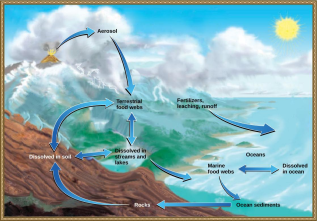
Figure 1.
Phosphorus (phosphate) cycle [11].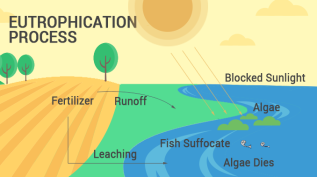
Figure 2. Eutrophication Processes [2].
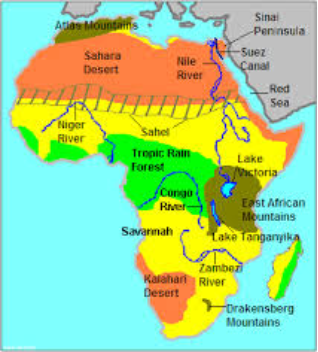
Figure 3. Niger River location in Africa [15].
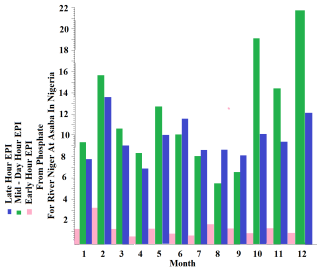
Figure 4.
Eutrophication potential index (EPI) for early, mid-day, and late hours.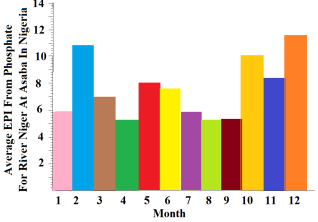
Figure 5.
Average eutrophication potential index (EPI) for the area.
Information



 Share This Article
 Twitter
 Linked In
 Facebook

 Copy
 Download