1. Introduction
There has been an increasing emphasis on the role literature plays in helping learners learn English as a foreign language (EFL) and enhance their writing and pronunciation of the language
| [35] | Yunus, M. M., Salehi, H., Amini, M. EFL Teachers' Cognition of Teaching English Pronunciation Techniques: A Mixed-Method Approach. English Language Teaching. 2016, 9(2), 20–42. https://doi.org/10.5539/elt.v9n2p20 |
[35]
. As long as English is still the language of all people, there will be a greater demand for innovative and successful language teaching methods. Literature offers a unique opportunity to transform language learning because of its diverse range of genres, styles, and cultural contexts
| [16] | Esfandiari, R., Noor, P. Iranian EFL Raters' Cognitive Processes in Rating IELTS Speaking Tasks: The Effect of Expertise. Journal of Modern Research in English Language Studies. 2018, 5(2), 41–76. https://doi.org/10.30479/jmrels.2019.9383.1248 |
[16]
. Literary works provide a realistic and immersive experience for learners, exposing them to a wide range of sentence patterns, complex expressions, and rich vocabulary, in contrast to traditional language resources. Interpreting literature promotes deeper understanding of linguistic intricacies and nuances and improves written communication.
According to the study by Alghazo
, with its focus on expressive language, rhythm, and intonation, literature serves as a flexible instrument for tackling oral and written communication, the two important facets of language competency. Learners who study literature improve both their oral and writing communication abilities, understanding spoken and written language as well as being able to communicate in real time when speaking, becoming more natural and precise in their pronunciation and more effective and flawless in their writing. Knowing the potential of literature in EFL instruction is essential in this digital age because language learning is not limited to traditional classroom settings
. This study investigates the most effective ways to include literature into language curricula to enhance learners' proficiency in writing and pronunciation. Through an investigation of the relationship between language acquisition and literature, this project hopes to offer insights that can inform curriculum designers, educators, and policymakers, resulting in a more dynamic and effective approach to EFL education globally.
1.1. Problem Statement
The issue that the present study attempts to address is the difficulties that come with teaching English to EFL learners, especially with regard to their writing abilities and pronunciation of the language. Learners’ abilities in written and spoken English are hampered by the fact that traditional language education techniques sometimes fail to offer them a thorough and interesting learning experience. The shortcomings of traditional language resources are one facet of the issue
| [31] | Nguyen, T. A., Le, T. T., Vang, M. D., Phuong, Y. H., Huynh, T. T. A., Nguyen, T. H., Pham, T. T. Vietnamese EFL High School Teachers' Perceptions of Difficulties When Implementing Competency-Based English Teaching Curriculum and Their Proposed Solutions. Forum for Linguistic Studies. 2023, 5(2), 1863. https://doi.org/10.59400/fls.v5i2.1863 |
[31]
. These resources frequently lack the depth and authenticity of literary works, which provide an immersive experience with a wide range of expressions, complex vocabulary, and unique sentence patterns. Because traditional resources are inadequate, kids are not exposed to real-world language usage, which hinders their ability to write well and pronounce words clearly.
Another aspect of the issue is the relationship between writing abilities and pronunciation. Instead of addressing these issues jointly, many language programs have a tendency to handle them independently. Through the simultaneous improvement in oral and written communication, literature offers a comprehensive approach to language acquisition through its focus on rhythm, intonation, and expressive language usage
. An approach to language training that is disjointed is a result of the inability to identify and utilize this relationship.
Furthermore, the study recognizes how education is changing in the digital era. It is imperative to modify language teaching strategies when online and digital learning environments either supplement or replace traditional classroom environments. The issue statement aims to bridge the knowledge gap on the optimal integration of literature into EFL curriculum to enhance writing skills and pronunciation, while taking into account the evolving nature of language education.
1.2. Aims and Objectives
The main aim of the study is to investigate the application of literature in enhancing writing skills and English pronunciation among EFL learners. The specific objectives of the study include.
1) Examine the influence of exposure to literature on the development of writing skills and English pronunciation among EFL learners, aiming to measure the extent of improvement quantitatively and qualitatively.
2) Explore how active engagement with literary works contributes to the enhancement of vocabulary, sentence structures, narrative techniques, and overall writing proficiency among EFL learners.
3) Evaluate the effectiveness of incorporating literature in improving English pronunciation, specifically focusing on aspects such as intonation, rhythm, and accurate phonetic production through activities like reading aloud and mimicking literary language.
1.3. Research Questions
1) How do literary concepts in writing contribute to the enhancement of English writing skills and pronunciation proficiency?
2) In what specific ways do literary concepts in pronunciation contribute to the effectiveness of English writing and pronunciation skills?
1.4. Importance of this Research
This study is crucial for anyone teaching EFL because it can potentially alter language training approaches. Several significant features highlight the relevance of researching the use of literature in improving writing skills and English pronunciation amongst EFL learners. To begin with, the study tackles a major gap in traditional language teaching approaches by investigating how literature might simultaneously act as a bridge to improve both writing abilities and English pronunciation. This comprehensive approach aligns with the changing needs of language competency in a globalized environment. Secondly the study enhances cultural and language enrichment: As a cultural artifact, literature exposes learners to various language patterns and cultural settings
| [1] | Afifuddin, M., Nafis, R. N. The Representation of Local Culture of Instructor's Literary Competence in English Language Classrooms. In Advances in Social Science, Education and Humanities Research: Proceedings of the 20th AsiaTEFL-68th TEFLIN-5th iNELTAL Conference (ASIATEFL 2022). 2023, 463–477. https://doi.org/10.2991/978-2-38476-054-1_41 |
[1]
.
Examining how literature affects writing and pronunciation improves students’ experiences in learning the language and fosters a deeper understanding of the complexities of the English language. It is crucial to comprehend the importance of literature in the digital age, when online and hybrid learning methods are widely used
.
This study offers insights into whether literary works may be effectively integrated into digital language curricula while meeting the dynamic demands of today’s educational settings. The research findings will add to the current studies on the use of literature to improve writing skills and English pronunciation in EFL students. Those who want to explore the same topic will find it simple since they may utilize the conclusions of this study as secondary data and a literature review.
1.5. Scope of the Study
This study focuses on utilizing literature in the context of EFL instruction, especially on improving learners’ writing abilities and English pronunciation. The scope includes a multifaceted analysis of the impact of literature on language ability, acknowledging the interrelated nature of both writing and pronouncing abilities. First, the study analyzes diverse literary genres and styles, including fiction, nonfiction, and poetry. The research attempts to determine the differential influence of various genres on literary works.
Secondly, the study examines three competency levels: beginning, intermediate, and proficient EFL learners. This inclusive approach enables nuanced understandings of how literature might support language skill development throughout time and accommodate a range of linguistic talents. The study also considers contextual and cultural aspects, recognizing that different cultural backgrounds may have different effects on the usefulness of literature in language instruction. Examining these variables thoroughly explains how applicable and flexible literary resources are in various EFL contexts using tests, textual output analysis, oral exams, and perceptual research.
2. Literature Review
2.1. Theoretical Literature Review
2.1.1. Contrastive Rhetoric Theory
Robert Kaplan’s
| [26] | Kaplan, R. Cultural Thought Patterns in Inter-Cultural Education. In Silva, T., Matsuda, P. K., Eds. Landmark Essays on ESL Writing; Lawrence Erlbaum Associates: Mahwah, NJ, 2001; pp 11–27. |
[26]
study established contrastive rhetoric as a field of study, stating that every language and culture has a distinct paragraph structure, and mastering a language’s logical structure is a necessary component of learning it. The theory provides an insightful framework for comprehending how language learners translate rhetorical devices from their home language to the language of instruction
| [12] | Brown, J. D. (Re) turning to Contrastive Rhetoric's Basic Communication Principles: A Common Ground Theory Perspective. Australian Journal of Applied Linguistics. 2022, 5(2), 77–87. https://doi.org/10.29140/ajal.v5n2.783 |
[12]
. Alghazo
, argues that, for EFL students, this notion becomes especially pertinent when it comes to improving writing abilities and English pronunciation. According to the theory of cross-linguistic rhetoric, writers from diverse linguistic backgrounds may incorporate cultural norms and rhetorical devices into their work while moving from their original language to the target language
. The application of this theory to the improvement of writing abilities is crucial in identifying the difficulties that EFL students face while adjusting to English rhetorical standards. Through the identification and resolution of these transfer challenges, teachers may customize interventions aimed at improving students’ writing skills.
When addressing phonological tendencies impacted by the learners’ original languages, contrastive rhetoric may also be employed in the context of English pronunciation
. The accuracy of pronunciation and intelligibility in spoken English can be affected by the incorporation of phonetic and prosodic elements from the first language.
For instance, because some vowel differences are absent from a language, a speaker of that language may find it difficult to distinguish between different English vowel sounds. Teachers might create focused pronunciation activities to address particular difficulties by identifying these contrastive phonetic elements
. Learners can get beyond pronunciation challenges brought on by the phonology of their home language by receiving feedback and practicing under guidance.
There are two ways to incorporate Contrastive Rhetoric Theory into EFL training. First and foremost, educators must draw attention to the phonological and rhetorical distinctions between the learners’ home languages and English
| [4] | Ali, I., Gul, R., Khan, S. S., Karim, K. An Evaluative Study of English Contrastive Rhetoric in Pashtu Speaking Areas of Pakistan: A Case Study of District Swat. Linguistica Antverpiensia. 2021, 1, 2183–2203. |
[4]
. This step of raising awareness lays the groundwork for focused teaching. Teachers can create activities and solutions that specifically target contrastive features that have been discovered. In terms of writing abilities, this might entail helping learners comprehend and adjust to English rhetorical structures
. Pronunciation exercises that concentrate on certain phonetic difficulties may be part of the program.
Teachers can use Contrastive Rhetoric Theory (CRT) in conjunction with literary application to improve writing skills and English pronunciation in learners of EFL
| [4] | Ali, I., Gul, R., Khan, S. S., Karim, K. An Evaluative Study of English Contrastive Rhetoric in Pashtu Speaking Areas of Pakistan: A Case Study of District Swat. Linguistica Antverpiensia. 2021, 1, 2183–2203. |
[4]
. CRT helps learners recognize and navigate the phonological and rhetorical differences between their home languages and English, which are frequently seen in literary works
| [33] | Pickering, L. Discourse Intonation: A Discourse-Pragmatic Approach to Teaching the Pronunciation of English. University of Michigan Press: Ann Arbor, MI, 2018. |
[33]
. Teachers might modify literature-based exercises to focus on particular difficulties by examining the ways in which various literary genres use phonetic components and rhetorical structures. Through the dynamic interaction of CRT and literature, this technique enables a nuanced investigation of language subtleties, enriching spoken and written communication for EFL learners.
2.1.2. Cognitive Process Theory of Writing
Flower and Hayes
| [17] | Flower, L., Hayes, J. R. A Cognitive Process Theory of Writing. College Composition and Communication. 1981, 32(4), 365–387. https://doi.org/10.2307/356600 |
[17]
established a model of the cognitive process model through the cognitive process theory of writing. They argued that writing is not an arrangement of sequential steps or distinct phases, but rather a collection of hierarchically structured thought processes
| [17] | Flower, L., Hayes, J. R. A Cognitive Process Theory of Writing. College Composition and Communication. 1981, 32(4), 365–387. https://doi.org/10.2307/356600 |
[17]
. Writing restrictions are like a busy switchboard operator managing inbound and outgoing calls at the same time. Flower and Hayes proposed that the best way for writers to manage the cognitive overload associated with writing is to view it as a problem-solving exercise.
Cognitive Process Theory of Writing (CPTW) is a difficult cognitive endeavor that requires a number of different mental processes, such as organizing, outlining, rewriting, and editing
| [19] | Gregg, L. W., Steinberg, E. R. Cognitive Processes in Writing. Routledge: London, 2016. |
[19]
. This theory provides insightful information on the cognitive complexities of language expression when it comes to improving writing abilities and English pronunciation in (EFL) learners. Collins and Gentner
| [14] | Collins, A., Gentner, D. A Framework for a Cognitive Theory of Writing. In Gregg, L. W., Steinberg, E. R., Eds. Cognitive Processes in Writing; Erlbaum: Hillsdale, NJ, 1980; pp 51–72. |
[14]
, observed that cognitive planning, in which writers produce ideas, arrange ideas, and sketch a logical framework, is the first step in writing effectively, according to CPTW. This idea may be applied by teachers to help learners with pre-writing tasks in EFL classes, encouraging them to employ cognitive processes like outlining and brainstorming. Teachers may improve their learners’ writing skills by focusing on cognitive planning, which assists learners in developing a structured and unambiguous method of expressing themselves in writing.
CPTW emphasizes the value of editing and revising while highlighting the iterative writing process. Teachers can use this part of the theory in the context of EFL by motivating learners to go back and edit their written work. Critically assessing language use, structure, and content is part of cognitive revision. Learners who participate in reflective processes improve their writing abilities and become more proficient in English communication
| [24] | Huang, Y. M., Shadiev, R., Sun, A., Hwang, W. Y., Liu, T. Y. A Study of the Cognitive Diffusion Model: Facilitating Learners' High-Level Cognitive Processes with Authentic Support. Educational Technology Research and Development. 2017, 65(3), 505–531. https://doi.org/10.1007/s11423-016-9476-4 |
[24]
.
CPTW emphasizes the value of editing and revising while highlighting the iterative writing process. Teachers can use this part of the theory in the context of EFL by motivating students to go back and edit their written work. Critically assessing language use, structure, and content is part of cognitive revision. Students who participate in reflective processes improve their writing abilities and become more proficient in English communication
| [24] | Huang, Y. M., Shadiev, R., Sun, A., Hwang, W. Y., Liu, T. Y. A Study of the Cognitive Diffusion Model: Facilitating Learners' High-Level Cognitive Processes with Authentic Support. Educational Technology Research and Development. 2017, 65(3), 505–531. https://doi.org/10.1007/s11423-016-9476-4 |
[24]
.
Pronunciation is a function of the cognitive processes that contribute to language creation. CPTW highlights the importance of cognitive auditory processing in improving spoken language
| [34] | Sharifinik, M., Ahadi, M., Rahimi, V. Bilingualism and Cognitive and Auditory Processing: A Comprehensive Review. Iranian Rehabilitation Journal. 2021, 19(3), 231–240.
https://doi.org/10.32598/irj.19.3.1408.1 |
[34]
. Teachers can stress the value of active listening as well as internalizing proper pronunciation patterns when teaching EFL. By engaging cognitive processes associated with auditory discrimination, pupils can enhance their accuracy in reproducing English sounds
| [14] | Collins, A., Gentner, D. A Framework for a Cognitive Theory of Writing. In Gregg, L. W., Steinberg, E. R., Eds. Cognitive Processes in Writing; Erlbaum: Hillsdale, NJ, 1980; pp 51–72. |
[14]
.
According to Huang et al
| [24] | Huang, Y. M., Shadiev, R., Sun, A., Hwang, W. Y., Liu, T. Y. A Study of the Cognitive Diffusion Model: Facilitating Learners' High-Level Cognitive Processes with Authentic Support. Educational Technology Research and Development. 2017, 65(3), 505–531. https://doi.org/10.1007/s11423-016-9476-4 |
[24]
, precise articulator coordination is necessary for proper pronunciation. Pronunciation requires motor abilities that align with CPTW’s focus on cognitive-motor planning. To help learners achieve precise and natural pronunciation, instructors might include pronunciation activities that include cognitive processes associated with coordinating speech organs.
Teachers may use CPTW to improve writing abilities and English pronunciation by creating lesson plans that follow the main ideas of the theory. Writing assignments can be designed in a way that helps learners through the processes that include cognitive planning, drafting, and revision. Exercises to improve pronunciation include cognitive motor planning activities, accurate articulation, and cognitive auditory processing procedures like listening to real English speech
| [25] | Hyland, K. Teaching and Researching Writing. Routledge: London, 2015. |
[25]
.
2.2. Empirical Literature Review
2.2.1. Impact of Literature on Writing Skills
According to the study by Khatib and Meihami
| [27] | Khatib, M., Meihami, H. Languaging and Writing Skill: The Effect of Collaborative Writing on EFL Learners' Writing Performance. Advances in Language and Literary Studies. 2015, 6(1), 203–211. https://doi.org/10.7575/aiac.alls.v.6n.1p.203 |
[27]
, incorporating works of literature into the curriculum for EFL is a crucial aspect of supporting learners’ writing skills development. Literary works give learners real-world examples of how to use language, exposing them to a wide range of vocabulary, complex idioms, and sentence patterns. Learners gain an understanding of character development, storytelling techniques, and stylistic features specific to many genres via their engagement with literary works, which serves as a basis for their own artistic expression.
A variety of writing approaches and rhetorical strategies can be modeled after literary works. Learners gain the ability to modify and apply these aspects into their own work via exposure to a variety of literary genres
| [7] | Atayeva, M., Putro, N. H. P. S., Kassymova, G., Kosbay, S. Impact of Reading on Learners' Writing Ability. In Materials of International Practical Internet Conference. 2019. (pp. 5-13). |
[7]
. Their comprehension of rhetorical norms is improved, and their writing style is encouraged to be experimental and creative as a result of this exposure. Alghazo
holds the view that evaluation of written outputs, tasks, and evaluations is necessary to determine how beneficial literature is for improving writing abilities. Exposure to masterfully constructed language in literary works frequently leads to increased clarity in writing. Learners who are impacted by literary examples typically express themselves more clearly, using exact terminology and avoiding ambiguity.
According to the study by Habibi et al
| [20] | Habibi, H., Salleh, A. H., Sarjit Singh, M. K. The Effect of Reading on Improving the Writing of EFL Learners. Pertanika Journal of Social Sciences & Humanities. 2015, 23(4), 1115–1138. |
[20]
, as learners study how authors organize narratives and arguments in literary works, they also build coherence, another important component. Learners get the ability to rationally arrange their ideas through the use of literary models, guaranteeing a smooth writing flow. The original concepts, creative language, and creative structures that learners use in their writing are additional indications of how reading influences creativity.
Azizi et al
| [9] | Azizi, M., Tkácová, H., Pavlíková, M., Jenisová, Z. Extensive Reading and the Writing Ability of EFL Learners: The Effect of Group Work. European Journal of Contemporary Education. 2020, 9(4), 726–739. https://doi.org/10.13187/ejced.2020.4.726 |
[9]
, argue that learners are encouraged to think creatively and unconventionally by literary works, which results in a more dynamic and unique approach to composing. All things considered, the inclusion of literary works in the EFL curriculum acts as a stimulant for the comprehensive growth of writing abilities
| [6] | Anggraini, R., Rozimela, Y., Anwar, D. The Effects of Collaborative Writing on EFL Learners' Writing Skills and Their Perception of the Strategy. Journal of Language Teaching and Research. 2020, 11(2), 335–341.
https://doi.org/10.17507/jltr.1102.25 |
[6]
. The effectiveness of using literary components in language training is confirmed by the examination of written outputs, which shows the measurable influence on coherence, clarity, and inventiveness. This method fosters a greater appreciation for the beauty and richness of the English language in addition to improving language skills
| [30] | Muhammed, A. A. Literature and Its Effectiveness in Improving English Language and Its Cultural Understandings. International Journal of Social Sciences and Educational Studies. 2023, 10(1), 200–208.
https://doi.org/10.23918/ijsses.v10i1p200 |
[30]
.
2.2.2. Role of Literature in Improving English Pronunciation
According to Gilakjani and Sabouri
| [18] | Gilakjani, A. P., Sabouri, N. B. How Can EFL Teachers Help EFL Learners Improve Their English Pronunciation? Journal of Language Teaching and Research. 2016, 7(5), 967–972. https://doi.org/10.17507/jltr.0705.18 |
[18]
, beyond its obvious benefits to language learners in terms of exposure to new cultures and languages, literature is also a vital, and sometimes underappreciated, resource for improving English pronunciation. Literary works may be a useful and effective technique for (EFL) learners to improve their pronunciation. Here, we explore the many ways that literature helps people pronounce words in English more accurately.
A wide variety of linguistic trends and phonetic subtleties may be found in literary works, which exposes learners to a wide range of pronunciations. Learners interact with characters from various eras, socioeconomic backgrounds, and geographical locations, and they experience variances in speech, accent, and intonation
. This exposure provides an in-depth experience with the flow of spoken English outside of the traditional classroom.
Improved pronunciation is greatly aided by the rhythm and prosody found in poetry and some types of prose. Pardede
| [32] | Pardede, P. Improving EFL Learners' English Pronunciation by Using the Explicit Teaching Approach. Journal of English Teaching. 2018, 4(3), 143–155.
https://doi.org/10.33541/jet.v4i3.852 |
[32]
, argues that poetry’s meter, rhyme, and rhythm make it an ideal aid for learners trying to understand English rhythm. Reading poetry passages aloud to kids helps them to imitate the rhythmic patterns, which further helps them acquire the intonation and pattern of stress that are necessary for pronouncing words correctly
| [16] | Esfandiari, R., Noor, P. Iranian EFL Raters' Cognitive Processes in Rating IELTS Speaking Tasks: The Effect of Expertise. Journal of Modern Research in English Language Studies. 2018, 5(2), 41–76. https://doi.org/10.30479/jmrels.2019.9383.1248 |
[16]
. Through this exposure, learners are better able to absorb the English language’s melodic qualities, which enhances the authenticity in their spoken articulation
| [8] | Rahman, S. A. S. A., Yunos, D. R. M., Whanchit, W., Rahmat, N. H., Ngadiran, N. M. Perceived Difficulties and Use of Online Reading Strategies: A Study among Undergraduates. International Journal of Academic Research in Business and Social Sciences. 2023, 13(7).
https://doi.org/10.6007/IJARBSS/v13-i7/17414 |
[8]
.
Books that are rich in dialogue, in particular, provide learners with a conversational engagement that simulates conversations in real life. By interacting with conversation through plays, novels, or short stories, learners may learn about informal language, slang terms, and the nuances of daily speech
| [9] | Azizi, M., Tkácová, H., Pavlíková, M., Jenisová, Z. Extensive Reading and the Writing Ability of EFL Learners: The Effect of Group Work. European Journal of Contemporary Education. 2020, 9(4), 726–739. https://doi.org/10.13187/ejced.2020.4.726 |
[9]
.
According to Belhoum and Benhattab
| [10] | Belhoum, S., Benhattab, A. L. The Importance of Prosody in a Proper English Pronunciation for EFL Learners. Arab World English Journal. 2016, 7(2), 316–327.
https://doi.org/10.24093/awej/vol7no2.21 |
[10]
, novels frequently require readers to infer the voices of the characters from textual descriptions. As part of this cognitive process, learners must imagine how to pronounce certain letters, adding to a mental bank of various vocalizations. By actively participating in character articulation, learners get an internalized understanding of pronunciation diversity, which strengthens their capacity to properly replicate a variety of language patterns.
Reading literature with emotion improves memory retention, and the same is true for pronunciation. The phonetic specifics connected to such events become more recalled when learners relate emotionally to the characters or stories
| [33] | Pickering, L. Discourse Intonation: A Discourse-Pragmatic Approach to Teaching the Pronunciation of English. University of Michigan Press: Ann Arbor, MI, 2018. |
[33]
. When pronunciation is connected to a story, it is frequently easier to remember. This creates a mnemonic anchor that helps learners remember how to pronounce words correctly in future conversations.
2.2.3. Synergy Between Writing Skills and Pronunciation Enhancement
According to Pardede
| [32] | Pardede, P. Improving EFL Learners' English Pronunciation by Using the Explicit Teaching Approach. Journal of English Teaching. 2018, 4(3), 143–155.
https://doi.org/10.33541/jet.v4i3.852 |
[32]
, language competency is mutually reinforced by the symbiotic link between writing abilities and pronunciation. This synergy is demonstrated by a number of interrelated components that go into a person’s total language proficiency. Diwaly & Bahri Abduljabbar
| [15] | Diwaly Muhammed, J., Bahri Abduljabbar, S. The Impact of Pronunciation Practice on English Listening Comprehension: A Case Study of High School Learners in Duhok. Academic Journal of Nawroz University. 2023, 12(4), 17–25.
https://doi.org/10.25007/ajnu.v12n4a1895 |
[15]
observed that writing proficiency and phonological awareness, the capacity to identify and work with a language’s sounds, are closely related. People use their underlying knowledge of phonetics unconsciously when they write. Accurate depiction of sounds and words on paper is facilitated by the increased sensitivity to phonological trends that comes with developing great writing abilities. As people grow more sensitive to the subtleties of spoken language, their pronunciation improves as a result of their increased understanding of phonetics.
Before writing words and sentences down on paper, the act of writing requires internal word formation. This mental articulation serves as a kind of pronunciation practice
| [2] | Afzal, N. A Study on Vocabulary-Learning Problems Encountered by BA English Majors at the University Level of Education. Arab World English Journal. 2019, 10(3), 81–98.
https://doi.org/10.24093/awej/vol10no3.6 |
[2]
. Constructing written sentences involves cognitive processes related to vocal articulation that people engage in concurrently. As people improve their capacity to enunciate sounds through writing, this activity helps to promote a more careful and accurate approach to pronunciation
.
In the development of vocabulary and pronunciation, writing abilities are essential for expanding one’s vocabulary. One’s lexical vocabulary is expanded by the active use of new words and their incorporation into written discourse
| [11] | Bin-Hady, W. R. A., Hazaea, A. N. EFL Learners' Achievement and Attitudes Towards Flipped Pronunciation Class: Correlational Study. PSU Research Review. 2022, 6(3), 175–189. https://doi.org/10.1108/PRR-09-2020-0029 |
[11]
. Pronunciation is positively impacted by this larger vocabulary. Those who can articulate themselves clearly and accurately in writing are more inclined to have a sophisticated understanding of word pronunciation.
According to Anggraini et al.
| [6] | Anggraini, R., Rozimela, Y., Anwar, D. The Effects of Collaborative Writing on EFL Learners' Writing Skills and Their Perception of the Strategy. Journal of Language Teaching and Research. 2020, 11(2), 335–341.
https://doi.org/10.17507/jltr.1102.25 |
[6]
, language patterns influence pronunciation learned through writing, including the structure of sentences, grammar principles, and stylistic aspects. Good writers are frequently better at translating these patterns into spoken language
| [28] | Kuo, L. J., Uchikoshi, Y., Kim, T. J., Yang, X. Bilingualism and Phonological Awareness: Re-Examining Theories of Cross-Language Transfer and Structural Sensitivity. Contemporary Educational Psychology. 2016, 46, 1–9.
https://doi.org/10.1016/j.cedpsych.2016.03.002 |
[28]
. This transferability helps ensure that language is used coherently and consistently in oral and written communication. Writing exercises improve phonemic awareness, which is the capacity to identify and work with specific sounds, or phonemes, in words. People who practice spelling words by paying close attention to phonetic nuances become more sensitive to the sounds in their language
. When people grow more discriminating in articulating phonemes, their pronunciation improves due to increased awareness.
3. Methodology
3.1. Research Design
The study used quantitative research methodology and a cross-sectional survey research design. The cross-sectional research strategy depended on a detailed investigation of a group or event in order to unearth the roots of numerous underlying principles related to the research topic or study subject. The cross-sectional research design made it easy to concentrate on assessing the application of literature in enhancing writing skills and English pronunciation among EFL learners.
3.2. Target Population
The research centered on diverse EFL learners with different L1 background at King Saud University in Saudi Arabia. This particular community served as the ideal sample for investigating the effective utilization of literature to improve writing skills and English pronunciation within the EFL student population.
3.3. Sample Size
The study utilized 128 EFL learners who were enrolled in an EFL student education program at King Saud University. The number of respondents in the study was determined using the Kish Leslie formula of 1965.
Where:
n= the required sample size
d= the maximum likely error (taken as 0.05)
z= the standard normal deviation 1.96 and confidence interval level of 95%
p= the proportion of compliance 90%
q=1-p
n=128
3.4. Sampling Technique
The research used stratified and simple random sample methods, among other probability sampling approaches. In this case, a stratified sampling technique was used to construct the target sample, and a straightforward random sampling technique was used to extract the final sample from the strata. Simple random sampling has the advantage of generating samples that are quite representative of the population. Working with big samples, however, could be time-consuming and difficult. Additionally, the purposive sampling technique was utilized to select the secondary study participants who were the EFL learners in King Saud University, Saudi Arabia.
3.5. Data Collection
The selected EFL learners’ responses to a well-structured questionnaire containing categorical questions were gathered. To guarantee simple coding during data analysis, the questionnaire included both closed-ended and categorical items. The use of literature in enhancing writing skills and English pronunciation among EFL learners was the subject of a closed-ended questionnaire. The respondents were asked to provide answers based on their familiarity with and experience with English in writing and speaking.
3.6. Data Analysis
The data collected through completed questionnaires was analyzed in alignment with the research objectives. SPSS (Statistical Package for the Social Sciences) version 27 was utilized to generate tables and graphs. Both predictors and dependent variables were categorical, prompting the initial application of a multinomial logistic regression model. However, this approach encountered challenges, with many parameters becoming redundant, resulting in several being set to zero. Additionally, a floating-point overflow occurred, prompting the need to transition to Linear Probability Model (LPM) which is simply a simple OLS (Ordinary Least Squares) with binary Y as explained by Chatla and Shmueli
| [13] | Chatla, S., Shmueli, G. Linear Probability Models (LPM) and Big Data: The Good, the Bad, and the Ugly. Indian School of Business Research Paper Series. 2016.
https://doi.org/10.2139/ssrn.2353841 |
[13]
.
To address the issues mentioned and facilitate the use of Linear Probability Model (LPM), the dependent variable, ‘effectiveness of English writing and pronunciation skills,’ was further categorized into two groups. Specifically, ‘Ability to avoid spelling mistakes,’ ‘ability to speak and write fluently,’ and ‘ability to join consonants in pronunciation’ were coded into Group 1, represented by the value 1. Conversely, ‘ability to be creative in speech’ and ‘using new words in writing and speaking’ were grouped into Group 0, represented by the value 0.
3.7. Ethical Considerations
Ethical approval for the study was obtained from the relevant institutional review board, ensuring that the research adhered to ethical standards for human research. Participant confidentiality and anonymity were prioritized, and informed consent was obtained before data collection.
4. Results
4.1. Frequencies and Demographic Characteristics
Table 1. Frequencies and demographic characteristics.
Variable | Categories | Frequency | Percent (%) |
Gender | Female | 42 | 32.80% |
Male | 86 | 67.20% |
Age group (bracket) | 20-25 years | 67 | 52.30% |
Above 25 years | 4 | 3.10% |
Below 20 years | 57 | 44.50% |
From
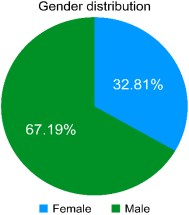
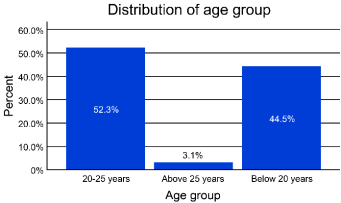
Table 1 above the study encompassed 128 participants, revealing a gender distribution of 32.8% female and 67.2% male, suggesting a predominant representation of male participants. In terms of age, the majority (52.3%) fell within the 20-25 age bracket, with 44.5% below 20 years and a smaller percentage (3.1%) above 25 years. These demographic characteristics set the stage for exploring the impact of literature on writing skills and English pronunciation among EFL learners. Their presentations are shown in
Figures 1 & 2 below.
Figure 1. Gender Distribution.
Figure 2. Distribution of Age Group.
Table 2. Aspects of effective English writing and pronunciation.
| Frequency | Percent (%) |
Ability to be creative in speech | 30 | 23.4% |
Ability to speak and write fluently | 52 | 40.6% |
Ability to join consonants in pronunciation | 18 | 14.1% |
Ability to avoid spelling mistakes | 24 | 18.8% |
Using new words in writing and speaking | 4 | 3.1% |
The findings from
Table 2 above revealed that out of the five different aspects studied, the most common skill is being able to talk and write smoothly. About 40.6% of the participants in the study are good at this. Next, being creative in speech is also important, and 23.4% of participants show they can do this well. Another skill is joining consonants in pronunciation, which means saying sounds clearly. This was important for 14.1% of the participants in the study. Also, avoiding spelling mistakes reported 18.8% of participants were good at it, showing how important it is to write things correctly. Lastly, using new words in both writing and speaking is seen in a small group, about 3.1%, suggesting that this is an area where participants might need more focus for language development.
Table 3. Literacy concepts in Pronunciation.
| Frequency | Percent (%) |
Intonation in speech | 10 | 7.8% |
Rhythmic speaking | 4 | 3.1% |
Unique vocabulary | 21 | 16.4% |
Using individual sounds of language | 9 | 7.0% |
Word and sentence | 84 | 65.6% |
Table 3 presents the literacy concepts associated with pronunciation, offering an important understanding of how participants engage with different aspects of spoken language. Each concept is presented with corresponding frequencies and percentages, providing valuable insights into the participants’ proficiency in these specific areas. Notably, a modest but significant 7.8% of participants demonstrate an adept use of intonation in speech, showcasing an understanding of pitch variations that contribute to effective communication. Rhythmic speaking, observed in 3.1% of participants, indicates a capacity for maintaining a smooth and rhythmic flow in verbal expression. The incorporation of unique vocabulary is evident in 16.4% of participants, suggesting a diverse and varied use of language beyond common lexicon. Additionally, 7.0% exhibit skill in using individual sounds of language, emphasizing clear articulation and pronunciation. The majority, comprising 65.6%, excel in employing literacy concepts at the levels of words and sentences, highlighting a strong focus on constructing coherent and meaningful spoken language.
Table 4. Literary concepts in writing.
| Frequency | Percent (%) |
Interactive Writing | 12 | 9.4% |
Poetic Writing | 68 | 53.1% |
Creative Writing | 17 | 13.3% |
Transformative Writing | 21 | 16.4% |
Writing Concisely | 10 | 7.8% |
From
Table 4 above its evident that 53.1% of participants exhibit a preference for poetic writing, emphasizing a substantial inclination towards expressive and imaginative use of language in their written compositions. On the other hand, creative writing is demonstrated by 13.3% of participants, showcasing an ability to craft narratives that extend beyond conventional norms. Transformative writing is evident in 16.4% of participants, indicating a willingness to explore writing as a means of personal or societal reflection and change. Interactive writing, observed in 9.4% of participants, suggests an engagement with written communication that encourages participation and dialogue. Additionally, 7.8% demonstrate proficiency in writing concisely.
4.2. Linear Probability Model
Table 5. ANOVA.
Model | Sum of Squares | df | Mean Square | F | Sig. |
1 | Regression | 6.381 | 2 | 3.191 | 21.457 | .000 |
Residual | 18.588 | 125 | .149 | | |
Total | 24.969 | 127 | | | |
The ANOVA results from
Table 5 above revealed that the regression model is statistically significant (Sig. = 0.000), suggesting that the independent variables jointly predict the dependent variable well. The F-statistic of 21.457 further supports this conclusion.
Table 6. Linear probability model coefficients.
Model | Unstandardized Coefficients | Standardized Coefficients | t | Sig. |
B | Std. Error | Beta |
1 | (Constant) | 2.205 | .243 | | 9.076 | .000 |
literary concepts in writing | -.179 | .042 | -.424 | -4.300 | .000 |
literary concepts in pronunciation | -.225 | .034 | -.645 | -6.544 | .000 |
The findings from
Table 6, which presents the linear probability model coefficients, offer valuable insights into the relationship between literary concepts in writing and pronunciation and the effectiveness of English writing and pronunciation skills among EFL learners. The literary concepts in writing reported a negative coefficient (-0.179) with an associated p-value of.000, suggesting a statistically significant impact. This negative coefficient implies that as the level of exposure to literary concepts in writing increases, there is a decrease in the effectiveness of English writing and pronunciation skills. This finding provides a nuanced perspective on the relationship between literary engagement in writing and language proficiency.
Similarly, literary concepts in pronunciation reported a negative coefficient (-0.225) which was statistically significant at 5% level of significant. This indicates that heightened exposure to literary concepts in pronunciation is associated with a decrease in the effectiveness of English writing and pronunciation skills. This negative impact may reflect the initial challenges or adjustments that EFL learners may face as they incorporate literary elements into their pronunciation, affecting aspects such as intonation, rhythm, and accurate phonetic production.





 Share This Article
 Twitter
 Linked In
 Facebook
 Copy
Copy Download