
The market for halal products is constantly growing. It is estimated to be worth approximately 2.3 million USD. With an estimated annual growth rate of 20%, the sector is expected to be valued at approximately 560 billion USD per year in 2030. The principal objective of this study was to evaluate the constraints associated with the implementation of optimal farming and slaughtering practices in accordance with the halal standard within the Vina Division of Cameroon. The study was conducted in the six largest agro-pastoral district municipalities of Vina. Interviews were conducted with religious leaders, farmers, livestock traders, and personnel involved in the slaughtering process. The results demonstrate that the majority of farmers in the Nyambaka district possess the majority of Islamic knowledge related to farming (82.9%) and are of the Fulani ethnicity (71.7%). The primary constraints to the marketing of livestock are the lack of halal bank loans (21.7%) and the inflation of feed prices for livestock (27.2%). The majority of the slaughtering process is carried out manually (91.6%), and the absence of effective hygiene measures at the livestock level (20%) was observed. At the marketing level, over half of the traders have a non-Islamic bank account (68.2%). The primary constraints to the implementation of 'halal' practices are the lack of qualified slaughterhouse personnel (47.6%) and the limited number of slaughterhouses (14.2%).
| Published in | International Journal of Food Science and Biotechnology (Volume 11, Issue 1) |
| DOI | 10.11648/j.ijfsb.20261101.14 |
| Page(s) | 29-46 |
| Creative Commons |
This is an Open Access article, distributed under the terms of the Creative Commons Attribution 4.0 International License (http://creativecommons.org/licenses/by/4.0/), which permits unrestricted use, distribution and reproduction in any medium or format, provided the original work is properly cited. |
| Copyright |
Copyright © The Author(s), 2026. Published by Science Publishing Group |
Halal, Age Group, Cameroon, Slaughtering Practices
Characteristic | Terms | Workforce | Frequencies (%) |
|---|---|---|---|
Possession of skills | NO | 26 | 6.3 |
Yes | 384 | 93.7 | |
Duration in pratice | 1-5 | 59 | 12.8 |
6-10 | 135 | 29.3 | |
11-15 | 96 | 20.8 | |
16-20 | 45 | 9.8 | |
Over 20 | 126 | 27.3 | |
Knowledge of Islamic prescriptions | No | 76 | 17.1 |
Yes | 369 | 82.9 | |
Are you continuously trained | No | 147 | 32.7 |
Yes | 303 | 67.3 |
Criteria | Terms | Workforce | Frequencies (%) |
|---|---|---|---|
Livestock feed monitoring in the Department of Vina. | |||
Travel for food | There are private fields for fodder | 60 | 13.2 |
Personal/particular composition | 35 | 7.7 | |
I move them and they feed in nature | 357 | 78.9 | |
Feeding frequency per day | Two | 80 | 17.3 |
Four | 195 | 42.3 | |
Three | 178 | 38.6 | |
Once | 8 | 1.7 | |
Food monitoring | No | 20 | 4.4 |
Yes | 427 | 95.5 | |
Health monitoring of livestock in the Department of Vina | |||
Animal health monitoring | No | 14 | 3.1 |
Yes | 435 | 96.8 | |
Vaccinated | No | 9 | 2 |
Yes | 442 | 98 | |
Listing criteria | Annuity business | 329 | 73.6 |
Age | 95 | 21.2 | |
Illness | 23 | 5.1 | |
Characteristic | Terms | Workforce | Frequencies(%) |
|---|---|---|---|
Payment of Zakat | No | 32 | 7.4 |
Yes | 396 | 92.5 | |
Activity area | Informal | 327 | 76.4 |
Formal | 101 | 23.6 | |
Possession of a bank account | No | 102 | 22.9 |
Yes | 330 | 77.1 | |
Type of account | Islamic | 105 | 31.7 |
Non-Islamic | 225 | 68.2 | |
Bank loans | No | 336 | 78.5 |
Yes | 92 | 21.5 | |
Transaction mechanism | Other | 11 | 2.5 |
Species | 355 | 82.9 | |
Payment | 62 | 14.4 |
Characteristic | Terms | Payment of Zakat | Chi-2 | P-value | |
|---|---|---|---|---|---|
No | Yes | ||||
Boroughs DDL=6 | Belel/Tello | 4(4.9) | 78(95.1) | 15.169 | 0.019 0.044* |
Martap/Likok | 5(11.6) | 38(88.4) | |||
Ngaoundere I | 3(33.3) | 6(66.7) | |||
Ngaoundere II | 3(3.7) | 79(96.3) | |||
Ngaoundere III | 0(0.0) | 23(100.0) | |||
Nyambaka | 12(8.3) | 132(91.7) | |||
Age range DDL=5 | [20-32[ | 10(15.9) | 53 (84.1) | 9.371 | 0.052 0.081* |
[32-44[ | 12(8.2) | 134(91.8) | |||
[44-56[ | 5(4.1) | 118(95.9) | |||
[56-68[ | 4(5.6) | 68(94.4) | |||
[68-80] | 1(4.2) | 23(95.8) | |||
Region of origin DDL=2 | Adamaoua | 29(8.1) | 327(91.9) | 2.184 | 0.335 0.383* |
Far-North | 2(8.0) | 23(92.0) | |||
North | 1(2.1) | 46(97.9) | |||
Instruction DDL=4 | None | 4(80.0) | 1(20.0) | 48.268 | < 0.0001 1.000* |
Koranic | 15(13.0) | 100(87.0) | |||
Primary | 9(4.7) | 182(95.3) | |||
Secondary | 4(3.8) | 102(96.2) | |||
University | 0(0.0) | 11(100.0) | |||
Duration in practice DDL=4 | 1-5 | 12(18.8) | 52(81.3) | 16.467 | 0.002 0.007* |
6-10 | 8(7.5) | 99(92.5) | |||
11-15 | 7(7.4) | 88(92.6) | |||
16-20 | 1(1.8) | 54(98.2) | |||
Over 20 | 4(3.7) | 103(96.3) | |||
Characteristic | Terms | Bank loan | Chi-2 | P-value | |
|---|---|---|---|---|---|
No | Yes | ||||
Boroughs DDL=6 | Belel/Tello | 66(80.5) | 16(19.5) | 6.0263 | 0.420 |
Martap/Likok | 36(83.7) | 7(16.3) | |||
Ngaoundere I | 8(88.9) | 1(11.1) | |||
Ngaoundere II | 65(79.3) | 17(20.7) | |||
Ngaoundere III | 19(82.6) | 4(17.4) | |||
Nyambaka | 104(72.2) | 40(27.8) | |||
Age range DDL=5 | [20-32[ | 45(71.4) | 18(28.6) | 13.321 | 0.010 |
[32-44[ | 109(74.7) | 37(25.3) | |||
[44-56[ | 94(76.4) | 29(23.6) | |||
[56-68[ | 66(91.7) | 6(8.3) | |||
[68-80] | 22(91.7) | 2(8.3) | |||
Region of origin DDL=2 | Adamaoua | 289(81.2) | 67(18.8) | 10.927 | 0.004 |
Far North | 14(56.0) | 11(44.0) | |||
North | 33(70.2) | 14(29.8) | |||
Instruction DDL=4 | None | 5(100.0) | 0(0.0) | 26.238 | < 0.0001 |
Koranic | 104(90.4) | 11(9.6) | |||
Primary | 152(79.6) | 39(20.4) | |||
Secondary | 69(65.1) | 37(34.9) | |||
University | 6(54.5) | 5(45.5) | |||
Duration in practice DDL=4 | 1-5 | 47(73.4) | 17(26.6) | 11.025 | 0.026 |
6-10 | 77(72.0) | 30(28.0) | |||
11-15 | 76(80.0) | 19(20.0) | |||
16-20 | 41(74.5) | 14(25.5) | |||
Over 20 | 95(88.8) | 12(11.2) | |||
Characteristic | Terms | Frequencies (%) |
|---|---|---|
Types of slaughterhouses | Modern/industrial | 8.3 |
Traditional | 91.6 | |
Group of animals | Cattle | 83.3 |
Cattle/Sheep | 16.6 | |
Are employees regularly trained | No | 75.0 |
Yes | 25.0 | |
Statut of employees | Formal | 8.3 |
Informal | 91.6 | |
Number of working hours | [2-4] | 58.3 |
[5-6] | 41.6 | |
Veterinary certificate | No | 66.6 |
Yes | 33.3 | |
The number of animals slaughtered per day | [2-8] | 50.0 |
[10-15] | 25.0 | |
[50-80] | 25.0 |
Characteristic | Terms | Workforce | Frequencies (%) |
|---|---|---|---|
Slaughter process | Manual | 11 | 91.6 |
Mechanical | 1 | 8.3 | |
Priests | Muslims | 20 | 100 |
Others | 0 | 0 | |
Spacing time between felling (minutes) | 5 | 5 | 45.4 |
10 | 1 | 9 | |
15 | 1 | 9 | |
Nothing to report | 4 | 36.3 | |
Slaughter of one animal in front of the next | Yes | 11 | 91.6 |
No | 1 | 8.3 | |
After slaughter is the carcass kept for maturation | Yes | 1 | 8.3 |
No | 11 | 91.6 | |
Washing | With borehole water | 2 | 18.1 |
With tap water | 4 | 36.3 | |
With lake water | 5 | 45.4 | |
Carcass marking | With the badges | 10 | 90.9 |
Aut of vigilance | 1 | 9 | |
Ink | Yes | 8 | 66.6 |
No | 4 | 33.3 | |
Do you have halal certification | No | 11 | 91.6 |
Yes | 1 | 8.3 |
Checkpoint | Municipalities of the department of Vina | |||||||||||||||||||||
|---|---|---|---|---|---|---|---|---|---|---|---|---|---|---|---|---|---|---|---|---|---|---|
Ngaoundere I | Ngaoundere II | Ngaoundere II (Djalingo) | Ngaoundere III (Manwi) | Ngaoundere III (Dang) | Ngaoundere III (Tchabal) | Nyambaka | Nyambaka (Dibi) | Nyambaka (Galdi) | Belel (Tello) | Martap (Likok) | ||||||||||||
Species | Pet allowed | |||||||||||||||||||||
Yes | No | Yes | No | Yes | No | Yes | No | Yes | No | Yes | No | Yes | No | Yes | No | Yes | No | Yes | No | Yes | No | |
× | × | × | × | × | × | × | × | × | × | × | ||||||||||||
Breeding | Animal protection | |||||||||||||||||||||
Yes | No | Yes | No | Yes | No | Yes | No | Yes | No | Yes | No | Yes | No | Yes | No | Yes | No | Yes | No | Yes | No | |
× | × | × | × | × | × | × | × | × | × | × | ||||||||||||
Slaughter process | Stunning | |||||||||||||||||||||
Yes | No | Yes | No | Yes | No | Yes | No | Yes | No | Yes | No | Yes | No | Yes | No | Yes | No | Yes | No | Yes | No | |
× | × | × | × | × | × | × | × | × | × | × | ||||||||||||
Blade | ||||||||||||||||||||||
C | I | C | I | C | I | C | I | C | I | C | I | C | I | C | I | C | I | C | I | C | I | |
× | × | × | × | × | × | × | × | × | × | × | ||||||||||||
Priest | ||||||||||||||||||||||
C | I | C | I | C | I | C | I | C | I | C | I | C | I | C | I | C | I | C | I | C | I | |
× | × | × | × | × | × | × | × | × | × | × | ||||||||||||
Bleeding method | ||||||||||||||||||||||
C | I | C | I | C | I | C | I | C | I | C | I | C | I | C | I | C | I | C | I | C | I | |
× | × | × | × | × | × | × | × | × | × | × | ||||||||||||
Invocation of God | ||||||||||||||||||||||
Yes | No | Yes | No | Yes | No | Yes | No | Yes | No | Yes | No | Yes | No | Yes | No | Yes | No | Yes | No | Yes | No | |
× | × | × | × | × | × | × | × | × | × | × | ||||||||||||
Constraints related to bad farming practices | Frequencies (%) |
|---|---|
Lack of water | 40.9 |
Feed price inflation | 27.2 |
Lack of veterinary follow-up | 18.1 |
Logistics | 9. |
Malnourished animals | 4.5 |
Constraints related to poor livestock trade practices | |
Lack of halal credit | 21.7 |
Rising animal prices | 17.3 |
Sale of sick animals | 17.3 |
Non-compliance with islamic precepts of sale | 17.3 |
Dishonesty of traders | 17.3 |
Informal sector | 8.7 |
Constraints associated with poor slaughtering practices | |
Lack of trained/qualified fellers | 47.6 |
Lack of adequate materials | 19 |
Lack of slaughterhouse | 14.2 |
Animal aggression | 9.5 |
Failure to monitor slaughteres/process | 4.7 |
Animal health surveillance | 4.7 |
HCCP | Halal Critical Control Point |
| [1] | Lugo L., A. Cooperman, E. O’Connell, S. Stencel, (2011). The future of the global Muslim population, Pew Research Center, USA. |
| [2] | Regenstein J. M., M. M. Chaudry, C. E. Regenstein, (2003). The kosher and halal food laws, Comprehensive Reviews in Food Science and Food Safety 2 111-127. |
| [3] | Bohari A. M., W. H. Cheng, N. Fuad, (2013). An analysis on the competitiveness of halal food industry in Malaysia: an approach of SWOT and ICT strategy, Malaysia Journal of Society and Space 9 1–11. |
| [4] | Farouk M. M., H. M. Al-Mazeedi, A. B. Sabow, A. E. D. Bekhit, K. D. Adeyemi, A. Q. Sazili, A. Ghani, (2014). Halal and kosher slaughter methods and meat quality: A review, Meat Science 98 505–519. |
| [5] | Nakyinsige K., Y. Che Man, A. Sazili, I. Zulkifli, A. Fatimah (2012), Halal meat: A niche product in the food market, 2nd International Conference on Economics, Trade and Development IPEDR vol.36 (2012) © (2012) IACSIT Press, Singapore. |
| [6] | Muñoz J.-M., (2014) A Breeding ground for revenue reliability? Cameroonian veterinary agents and tax officials in the face of reform, in: States at Work, Brill,: pp. 301–328. |
| [7] | Bayemi P., E. Webb, (2009). An integrated method for improving the dairy production sector in developing countries: the case of Cameroon, Tropical Animal Health and Production 41 525–534. |
| [8] | Chan D., P. Houessionon, F. Sow, L. Perin, A. Krendelsberger, I. Seck, A. Wane, A. M. Whitbread, N. Worou, (2022). Beef and dairy value chains in Senegal: Problems and Opportunities. |
| [9] | Duverge A. (2006). What is the future of Senegal's beef industry? A study of a long supply chain from Tambacounda to Dakar. Cergy-Pointoise: Istom. 105 p. |
| [10] | Kamisah, S., Mokhtar, A. and Hafsah, A. (2018). Halal practices integrity and halal supply chain trust in Malaysian halal food supply chain. International Food Research Journal 25(Suppl. 1): S57-S62. |
| [11] | Seignobos C. (1991). Livestock production and Sahelian rangelands potential. Cartographic synthesis. North-Cameroon. CIRAD-IEMVT. Wageningen: CTA-CIRAD-IEMVT, 13-14. |
| [12] | Abdoulaye M., P. Youchahou, B. Jean (2016). Dynamics and obstacles to the development of the Ticket-Foumban livestock market in Western Cameroon. Canadian Journal of Tropical Geography. |
| [13] | Mafimisebi T. E., Bobola O. M. & Mafimisebi, O. E. (2013). Fundamentals of cattle marketing in southwest, Nigeria: Analyzing market intermediaries, price formation and yield performance. AgEcon Search. |
| [14] | Alexander K., Takesure T., Golam S., Ashley F. R. K., Marie M., Dianne E. M., Jonathan R., Dustin L. P., and Thomas L. M. (2023). Livestock health and disease economics: a scoping review of selected literature. Frontiers in Veterinary Science. |
| [15] | Majiwa H., Bukachi S A., Omia D and Fèvre E. M. (2024). Knowledge, perceptions, and practices around zoonotic diseases among actors in the livestock trade in the Lake Victoria crescent ecosystem in East Africa. Frontiers in Public Health 11: 1199664. |
APA Style
Awal, M., Bello, M., Emmanuel, P. A., Iya-sou, D., Carole, E. H. (2026). Evaluation of Good Cattle Farming and Slaughtering Practices According to the "Halal" Standard in the Vina Division (Cameroon). International Journal of Food Science and Biotechnology, 11(1), 29-46. https://doi.org/10.11648/j.ijfsb.20261101.14
ACS Style
Awal, M.; Bello, M.; Emmanuel, P. A.; Iya-sou, D.; Carole, E. H. Evaluation of Good Cattle Farming and Slaughtering Practices According to the "Halal" Standard in the Vina Division (Cameroon). Int. J. Food Sci. Biotechnol. 2026, 11(1), 29-46. doi: 10.11648/j.ijfsb.20261101.14
@article{10.11648/j.ijfsb.20261101.14,
  author = {Mohamadou Awal and Mohamadou Bello and Panyoo Akdowa Emmanuel and Djakaou Iya-sou and Edima Helene Carole},
  title = {Evaluation of Good Cattle Farming and Slaughtering Practices According to the "Halal" Standard in the Vina Division (Cameroon)},
  journal = {International Journal of Food Science and Biotechnology},
  volume = {11},
  number = {1},
  pages = {29-46},
  doi = {10.11648/j.ijfsb.20261101.14},
  url = {https://doi.org/10.11648/j.ijfsb.20261101.14},
  eprint = {https://article.sciencepublishinggroup.com/pdf/10.11648.j.ijfsb.20261101.14},
  abstract = {The market for halal products is constantly growing. It is estimated to be worth approximately 2.3 million USD. With an estimated annual growth rate of 20%, the sector is expected to be valued at approximately 560 billion USD per year in 2030. The principal objective of this study was to evaluate the constraints associated with the implementation of optimal farming and slaughtering practices in accordance with the halal standard within the Vina Division of Cameroon. The study was conducted in the six largest agro-pastoral district municipalities of Vina. Interviews were conducted with religious leaders, farmers, livestock traders, and personnel involved in the slaughtering process. The results demonstrate that the majority of farmers in the Nyambaka district possess the majority of Islamic knowledge related to farming (82.9%) and are of the Fulani ethnicity (71.7%). The primary constraints to the marketing of livestock are the lack of halal bank loans (21.7%) and the inflation of feed prices for livestock (27.2%). The majority of the slaughtering process is carried out manually (91.6%), and the absence of effective hygiene measures at the livestock level (20%) was observed. At the marketing level, over half of the traders have a non-Islamic bank account (68.2%). The primary constraints to the implementation of 'halal' practices are the lack of qualified slaughterhouse personnel (47.6%) and the limited number of slaughterhouses (14.2%).},
 year = {2026}
}
TY  - JOUR
T1  - Evaluation of Good Cattle Farming and Slaughtering Practices According to the "Halal" Standard in the Vina Division (Cameroon)
AU  - Mohamadou Awal
AU  - Mohamadou Bello
AU  - Panyoo Akdowa Emmanuel
AU  - Djakaou Iya-sou
AU  - Edima Helene Carole
Y1  - 2026/01/20
PY  - 2026
N1  - https://doi.org/10.11648/j.ijfsb.20261101.14
DO  - 10.11648/j.ijfsb.20261101.14
T2  - International Journal of Food Science and Biotechnology
JF  - International Journal of Food Science and Biotechnology
JO  - International Journal of Food Science and Biotechnology
SP  - 29
EP  - 46
PB  - Science Publishing Group
SN  - 2578-9643
UR  - https://doi.org/10.11648/j.ijfsb.20261101.14
AB  - The market for halal products is constantly growing. It is estimated to be worth approximately 2.3 million USD. With an estimated annual growth rate of 20%, the sector is expected to be valued at approximately 560 billion USD per year in 2030. The principal objective of this study was to evaluate the constraints associated with the implementation of optimal farming and slaughtering practices in accordance with the halal standard within the Vina Division of Cameroon. The study was conducted in the six largest agro-pastoral district municipalities of Vina. Interviews were conducted with religious leaders, farmers, livestock traders, and personnel involved in the slaughtering process. The results demonstrate that the majority of farmers in the Nyambaka district possess the majority of Islamic knowledge related to farming (82.9%) and are of the Fulani ethnicity (71.7%). The primary constraints to the marketing of livestock are the lack of halal bank loans (21.7%) and the inflation of feed prices for livestock (27.2%). The majority of the slaughtering process is carried out manually (91.6%), and the absence of effective hygiene measures at the livestock level (20%) was observed. At the marketing level, over half of the traders have a non-Islamic bank account (68.2%). The primary constraints to the implementation of 'halal' practices are the lack of qualified slaughterhouse personnel (47.6%) and the limited number of slaughterhouses (14.2%).
VL  - 11
IS  - 1
ER  -
Department of Food Sciences and Nutrition, University of Ngaoundere, Ngaoundere, Cameroon;Direction de la cooperation des etudes et de la prospective, Standards and Quality Agency (ANOR), Yaounde, Cameroon
Research Fields: Food microbiology, halal expert, food hygiene.
Department of Food Sciences and Nutrition, University of Ngaoundere, Ngaoundere, Cameroon
Research Fields: Food microbiology.
Department of Food Sciences and Nutrition, University of Ngaoundere, Ngaoundere, Cameroon
Department of Chemical Engineering, University of Ngaoundere, Ngaoundere, Cameroon
Research Fields: Food chemistry.
Department of Food Sciences and Nutrition, University of Ngaoundere, Ngaoundere, Cameroon;Faculty of Sciences, University of Ebolowa, Ebolowa, Cameroon
Research Fields: Food microbiology, food hygiene.
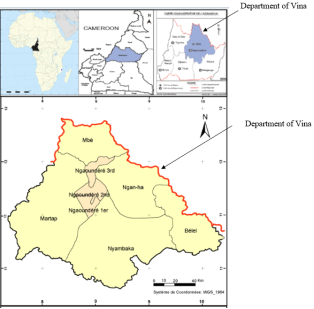
Figure 1.
Map of the study area.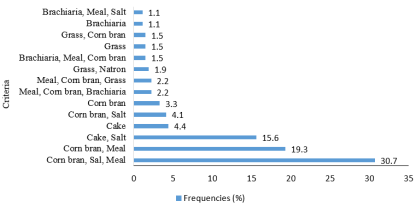
Figure 2.
Major ingredients for the formulation of animal feed in the Department of Vina.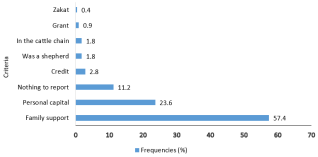
Figure 4.
Representation of the origins of livestock traders’ capital.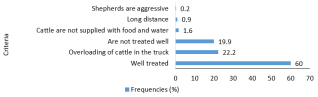
Figure 5.
Representation of the treatment of livestock during transport.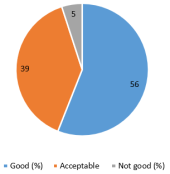
Figure 6.
Level of satisfaction with dignitaries' religious concepts.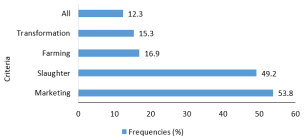
Figure 7.
Breakdown of major stages of non-compliance in the beef chain, according to dignitaries.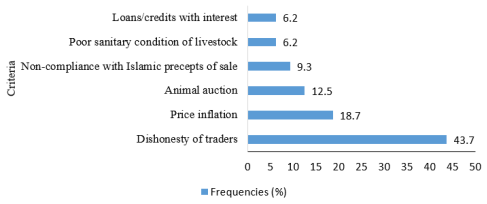
Figure 8.
Breakdown of non-conformities related to marketing in the bovine processing chain in relation to the halal standard in the Department of Vina.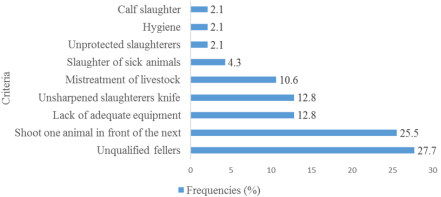
Figure 9.
Breakdown of non-conformities linked to slaughter in the bovine processing chain in relation to the halal standard in the Department of Vina.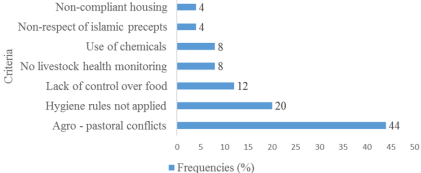
Figure 10.
Breakdown of non-conformities related to farming in the bovine processing chain in relation to the halal standard in Department of Vina.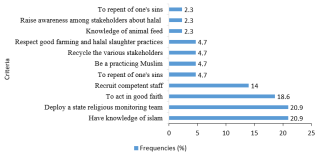
Figure 11.
Breakdown of improvement proposals according to religious dignitaries in the Department of Vina.
Information



 Share This Article
 Twitter
 Linked In
 Facebook
 Copy
Copy Download