1. Introduction
Tourism is one of the world’s fastest-developing industry, contributing to economic growth and employment, as well as facilitating cultural interrelationship
. Recent trends in the industry focus on sustainability, experiential travel, and competitive destination positioning
. As travellers are increasingly environmentally conscious and choosy, understanding how tourists perceive a destination is at the heart of destination development and marketing
| [2] | Ashraf, A., Sardar, S., Rity, N. M., & Bhadra, S. (2025). Segmentation and profile analysis of international tourists: A systematic literature review. Journal of Tourism Quarterly, 7(3–4), 78–96. |
| [38] | Sánchez-Cañizares, S. M., Cabeza-Ramírez, L. J., Muñoz-Fernández, G., & Fuentes-García, F. J. (2021). Impact of the perceived risk from Covid-19 on intention to travel. Current Issues in Tourism, 24(7), 970-984.
https://doi.org/10.1080/13683500.2020.1829571 |
[2, 38]
. Bangladesh has rich cultural diversity and heterogeneous landscapes. The country has started to replace tourism as a means of economic growth
| [19] | Hasan, M. R., Ullah, S., Chowdhury, M., & Hossain, A. (2021). Examining the factors influencing Bangladesh's tourism sector due to COVID-19 pandemic using structural equation modeling. Journal of Public Affairs, 21(4), e2649.
https://doi.org/10.1002/pa.2649 |
[19]
. Though the country had 1.32 million international tourist arrivals in 2019
, its tourism industry is still less developed than other South Asian nations
. Beach tourism, one of its sub-sectors, is highly prominent due to the long coastline, having a few globally exclusive beaches, like Cox’s Bazar-the longest natural sea beach in the world, and Kuakata, Patenga, St. Martin’s Island
| [18] | Hassan, M. M., & Shahnewaz, M. (2014). Measuring tourist service satisfaction at destination: A case study of Cox's Bazar Sea beach, Bangladesh. American Journal of Tourism Management, 3(1), 32-43.
https://doi.org/10.5923/j.tourism.20140301.05 |
[18]
. These places offer a blend of natural beauty, cultural experiences, and recreation, which attract domestic as well as foreign tourists
.
However, despite these prospects, very little is known about tourist perceptions of beach destinations in Bangladesh
| [21] | Hossain, M. S., Mostafa, M. G., & Hasan, M. J. (2021). Factors influencing domestic tourists' satisfaction in Cox's Bazar, Bangladesh. International Journal of Tourism Policy, 11(1), 61-81. https://doi.org/10.1504/IJTP.2021.113180 |
[21]
. There are three main reasons for the importance of these insights. They can be used to reveal the strengths and weaknesses of a destination so that resources can be allocated in an effective way
| [8] | Chen, C. L., & Bau, Y. P. (2016). Establishing a multi-criteria evaluation structure for tourist beaches in Taiwan: A foundation for sustainable beach tourism. Ocean & Coastal Management, 121, 88-96. https://doi.org/10.1016/j.ocecoaman.2015.12.013 |
[8]
. Moreover, they advise on competitive marketing strategies that enhance the positioning of destinations in regional and global markets
. Also, they contribute to sustainable tourism development by harmonizing economic, social, and environmental interests
. Tourists’ perceptions are influenced by infrastructure, safety, cleanliness, hospitality, and destination image
. Similarly, some quality dimensions for beach tourism, such as sand and water quality, crowd level, and diversity of activity, also affect the satisfaction
| [8] | Chen, C. L., & Bau, Y. P. (2016). Establishing a multi-criteria evaluation structure for tourist beaches in Taiwan: A foundation for sustainable beach tourism. Ocean & Coastal Management, 121, 88-96. https://doi.org/10.1016/j.ocecoaman.2015.12.013 |
[8]
. In addition, issues of sustainability are being considered more by tourists nowadays, particularly in terms of conservation and eco-friendliness
| [41] | Schuhmann, P. W., Skeete, R., Waite, R., Lorde, T., Bangwayo-Skeete, P., Oxenford, H. A.,... & Spencer, F. (2019). Visitors' willingness to pay marine conservation fees in Barbados. Tourism Management, 71, 315-326.
https://doi.org/10.1016/j.tourman.2018.10.011 |
[41]
. Current research into Bangladeshi beach tourism predominantly deals narrowly with destination image, service quality, or environment
| [16] | Hasan, M. K., Ismail, A. R., & Islam, M. F. (2019). Assessing service quality of tourist destinations in Bangladesh: An application of TOURQUAL model. International Journal of Tourism Policy, 9(2), 160-180.
https://doi.org/10.1504/IJTP.2019.102524 |
| [17] | Hasan, M. K., Rahman, M. A., & Hossain, M. S. (2020). Sustainable tourism development in Cox's Bazar, Bangladesh: Challenges and opportunities. Tourism Review International, 24(1), 31-47.
https://doi.org/10.3727/154427220X15791346544960 |
| [18] | Hassan, M. M., & Shahnewaz, M. (2014). Measuring tourist service satisfaction at destination: A case study of Cox's Bazar Sea beach, Bangladesh. American Journal of Tourism Management, 3(1), 32-43.
https://doi.org/10.5923/j.tourism.20140301.05 |
[16-18]
and is based largely on quantitative studies, which may overlook more sophisticated views. Thus, inclusive and integrated research on tourist perception of beach tourism can enrich the literature.
The relevant research on tourist perception about beach destinations of Bangladesh can also enrich the literature in the context of the country. Such research has also implications on marketing and management of beach destinations. Practitioners and policymakers may also develop policies on tourist segmentation, target marketing, strategy formulation and modification. This research can also be insightful for the developing countries with similar context of Bangladesh. Local communities and organizations with tourism industry within the developing countries will be much benefitted through the results. The knowledge of travel emotions and tourist preferences could assist local authorities in developing tourism products and services that are more appropriate with what the tourists would like to have when traveling to a certain place, which will elevate customer satisfaction but also loyalty with respect to them, as well as social dimensions correlated with them. Thus, the researchers highlight following research questions.
1.1. Research Questions
1) What are the factors that influence tourists' perceptions in beach destinations?
2) Which factors play most influential role on tourists' perceptions?
1.2. Research Objectives
This research aims to examine how tourists generally view and evaluate Beach destinations in Bangladesh. The other objectives are-
1) To explore the general perceptions of tourists to beach destinations.
2) To identify the key factors influencing tourist perceptions in beach tourism destinations.
3) To analyze the role of each factor on tourist perceptions towards beach tourism.
2. Literature Review
2.1. Tourist Perceptions and Destination Choice
Tourist perception is a prominent driver of destination choice and satisfaction
| [9] | Chi, C. G. Q., & Qu, H. (2008). Examining the structural relationships of destination image, tourist satisfaction and destination loyalty: An integrated approach. Tourism Management, 29(4), 624-636. https://doi.org/10.1016/j.tourman.2007.06.007 |
| [44] | Stylidis, D., Woosnam, K. M., & Ivkov, M. (2020). Explaining perception and behavior construct definitions, operational measures and extended theory of planned behavior studies in tourism. Tourism Review, 75(4), 901-924.
https://doi.org/10.1108/TR-07-2019-0276 |
[9, 44]
. These would be a result of cognitive evaluations, affective responses, and behavioural intentions based on one's knowledge of a place, creating emotions that in turn affect intentions to visit or to recommend
| [4] | Baloglu, S., & McCleary, K. W. (1999). A model of destination image formation. Annals of Tourism Research, 26(4), 868-897. https://doi.org/10.1016/S0160-7383(99)00030-4 |
| [7] | Chen, C. F., & Tsai, D. C. (2007). How destination image and evaluative factors affect behavioral intentions? Tourism Management, 28(4), 1115-1122.
https://doi.org/10.1016/j.tourman.2006.07.007 |
| [39] | Sadar, S., & Rekha, R. S. (2016). Students’ attitude towards beach tourism in Bangladesh: A study on Saint Martin and Cox’s Bazar Sea beaches. Bangladesh Journal of Tourism, 1(1). |
[4, 7, 39]
.
The image of a destination is composed of these dimensions: the natural and built environments, as well as the cultural and social environment that are related to it
. In beach tourism, natural beauty is typically the primary stimulus of positive perceptions; pure sand, clear water, and biodiversity generate a sense of escape and immersion in nature
| [12] | Erman, D., Bakker, M., & Peters, P. (2022). Natural beauty and tourists' motivations: A case study of beach destinations in Southeast Asia. Journal of Travel Research, 61(5), 1033-1048. https://doi.org/10.1177/0047287521999678 |
[12]
. But for hygiene and environmental control, this fall will not be the same. Researchers pointed out that recycling, public attitude, and waste disposal management affect the cleanliness and attractiveness of a beach destination
| [20] | Hoque, M. A., Rahman, M. S., & Hossain, M. S. (2023). Hygiene and sanitation practices at beach destinations: A study of tourist perceptions in Bangladesh. Journal of Environmental Health, 85(7), 18-25. |
| [29] | Memon, J. A., Islam, M. R., & Ahmed, S. (2022). Waste management strategies and their impact on tourist perceptions of hygiene at beach destinations in Bangladesh. Journal of Environmental Management, 320, 115845.
https://doi.org/10.1016/j.jenvman.2022.115845 |
[20, 29]
.
The number of accommodation types, beach distance, quality facilities, and services are among the benefits that shape the perception of tourists regarding Accommodation.
| [22] | Hossain, M. E., Ahmed, S. M., & Haque, M. M. (2022). Accommodation preferences and tourist perceptions: An analysis of beach destinations in Bangladesh. International Journal of Hospitality Management, 98, 102847.
https://doi.org/10.1016/j.ijhm.2022.102847 |
[22]
stress the importance of offering diversified accommodations that satisfy different dishes of tourists’ palates and wallets. Additionally,
| [1] | Alam, M. S., Hossain, M. A., & Khan, M. R. (2023). Sustainable tourism practices in the accommodation sector: Implications for tourist perceptions in Bangladesh. International Journal of Hospitality Management, 99, 102123.
https://doi.org/10.1016/j.ijhm.2023.102123 |
[1]
emphasize the significance of sustainable tourism in relation to accommodation companies (e.g., energy-efficient buildings and green programs) as a driver for tourist motivation and ensuring local responsible tourism development. Perceptions about safety and security have also been shown to influence travel perceptions and destination selection of tourists
| [14] | Fourie, J., Rosselló-Nadal, J., & Santana-Gallego, M. (2020). Fatal attraction: How security threats hurt tourism. Journal of Travel Research, 59(2), 209-219.
https://doi.org/10.1177/0047287519826208 |
[14]
.
| [33] | Rahman, M. S., Haque, M. M., & Khan, M. R. (2022). Safety and security protocols for tourists at beach destinations in Bangladesh. Journal of Travel & Tourism Marketing, 39(6), 731-746.
https://doi.org/10.1080/10548408.2022.2046789 |
[33]
emphasized the importance of implementing rigorous safety protocols and response plans to protect the tourists. On top of that,
| [24] | Islam, M. S., Rahman, M. M., & Akter, S. (2023). Safety and security perceptions of tourists at beach destinations: A case study from Bangladesh. Tourism Management, 97, 104707.
https://doi.org/10.1016/j.tourman.2023.104707 |
[24]
suggested that adequate communication tools, such as proper signs and public education programs, can enhance perceptions related to security/safety at a beach destination. The perceptions of destination ‘safety’ (good or bad), in terms of the risk of crime, political unrest, and health, may determine whether or not tourists choose to visit it
.
Adequate transportation and accessibility are important to attract tourists in beach areas. This includes accessibility to various modes of transportation (i.e., air, road, water), the condition of roads and other transportation infrastructure, as well as how easy it is to get from neighbouring cities or airports into the resort itself."
| [10] | Chowdhury, M. H., Islam, M. R., & Ahmed, S. (2022). Transportation infrastructure and accessibility: Examining the tourist experience at beach destinations in Bangladesh. Tourism Management Perspectives, 41, 100920.
https://doi.org/10.1016/j.tmp.2022.100920 |
[10]
mentioned the importance of investment in transportation infrastructure to improve tourists' experience and provide visitors with efficient travel modes between their residence and a beach destination. Additionally,
| [3] | Atzori, R., Fyall, A., & Miller, G. (2018). Tourist responses to climate change: Potential impacts and adaptation in Florida's coastal destinations. Tourism Management, 69, 12-22.
https://doi.org/10.1016/j.tourman.2018.05.005 |
[3]
stated: sustainable travel modes, including public transportation or sustainable land use arrangements, can help reduce the environmental impact of tourism among tourists. Tourists judge a destination based on the provision and quality of facilities such as accommodation, transport, catering facilities, and tourist information
| [1] | Alam, M. S., Hossain, M. A., & Khan, M. R. (2023). Sustainable tourism practices in the accommodation sector: Implications for tourist perceptions in Bangladesh. International Journal of Hospitality Management, 99, 102123.
https://doi.org/10.1016/j.ijhm.2023.102123 |
[1]
. Destinations having strong infrastructure and quality services tend to create a positive image, which persuades tourists to revisit
| [16] | Hasan, M. K., Ismail, A. R., & Islam, M. F. (2019). Assessing service quality of tourist destinations in Bangladesh: An application of TOURQUAL model. International Journal of Tourism Policy, 9(2), 160-180.
https://doi.org/10.1504/IJTP.2019.102524 |
[16]
.
2.2. Previous Research on Beach Tourism and Tourist Perceptions
Unfortunately, as it might be, given the strategic importance of coastal resources for tourism, so far, beach Tourism in Bangladesh is fragmented due to inadequate characterization and focus. The majority of the literature privileges the tourism industry generally, with beach destinations remaining conceptually marginal.
| [18] | Hassan, M. M., & Shahnewaz, M. (2014). Measuring tourist service satisfaction at destination: A case study of Cox's Bazar Sea beach, Bangladesh. American Journal of Tourism Management, 3(1), 32-43.
https://doi.org/10.5923/j.tourism.20140301.05 |
[18]
, portrayed Cox’s Bazar as the country’s natural showpiece, but their argument was more suggestive than empirically sophisticated. Later studies have tried to cover visitor experiences, but they lack focus. For instance,
| [21] | Hossain, M. S., Mostafa, M. G., & Hasan, M. J. (2021). Factors influencing domestic tourists' satisfaction in Cox's Bazar, Bangladesh. International Journal of Tourism Policy, 11(1), 61-81. https://doi.org/10.1504/IJTP.2021.113180 |
[21]
seem to indicate that satisfaction may be related to natural beauty, safety, and welcome.
The most important predicate associated with positive perceptions has become environmental quality. Cleanliness of both water and sand is common across different contexts related to satisfaction and repeat visitation
| [11] | Dodds, R., & Holmes, M. R. (2019). Beach tourists: What factors satisfy them and drive them to return. Ocean & Coastal Management, 168, 158-166.
https://doi.org/10.1016/j.ocecoaman.2018.10.034 |
| [41] | Schuhmann, P. W., Skeete, R., Waite, R., Lorde, T., Bangwayo-Skeete, P., Oxenford, H. A.,... & Spencer, F. (2019). Visitors' willingness to pay marine conservation fees in Barbados. Tourism Management, 71, 315-326.
https://doi.org/10.1016/j.tourman.2018.10.011 |
[11, 41]
.
| [27] | Marin, V., Palmisani, F., Ivaldi, R., Dursi, R., & Fabiano, M. (2009). Users' perception analysis for sustainable beach management in Italy. Ocean & Coastal Management, 52(5), 268-277. https://doi.org/10.1016/j.ocecoaman.2009.02.001 |
[27]
, also found that tourists were willing to pay a premium for high-quality beaches, leading them to conclude that returning satisfied tourists are also those who conserve. However,
| [19] | Hasan, M. R., Ullah, S., Chowdhury, M., & Hossain, A. (2021). Examining the factors influencing Bangladesh's tourism sector due to COVID-19 pandemic using structural equation modeling. Journal of Public Affairs, 21(4), e2649.
https://doi.org/10.1002/pa.2649 |
[19]
showed that even small amounts of sea-based litter affect willingness to return and would have economic implications. While this evidence base supports the economic justification for environmental management, the majority of studies are localized in their nature, highlighting the importance of cross-cultural validation and replicable models.
Infrastructure and services also have an important role in perception. There is a relationship between toilets, showers, food outlets, and recreational activities, according to
, as well as
| [8] | Chen, C. L., & Bau, Y. P. (2016). Establishing a multi-criteria evaluation structure for tourist beaches in Taiwan: A foundation for sustainable beach tourism. Ocean & Coastal Management, 121, 88-96. https://doi.org/10.1016/j.ocecoaman.2015.12.013 |
[8]
. They claimed that it encouraged tourist comfort while expanding destination appeal. They said it promoted tourist comfort and widened the appeal of destinations.
| [21] | Hossain, M. S., Mostafa, M. G., & Hasan, M. J. (2021). Factors influencing domestic tourists' satisfaction in Cox's Bazar, Bangladesh. International Journal of Tourism Policy, 11(1), 61-81. https://doi.org/10.1504/IJTP.2021.113180 |
[21]
also took walkability as a primary dimension of the built environment, and safety, signage, and connectivity were all contributing to satisfaction. Yet the non-generalizability across other contexts (e.g., in West Bengal or Bangladesh) would suggest that it needs more comparative work on how different tourist groups prioritize amenities.
Perceptions are also significantly influenced by destination image and normative influences.
| [16] | Hasan, M. K., Ismail, A. R., & Islam, M. F. (2019). Assessing service quality of tourist destinations in Bangladesh: An application of TOURQUAL model. International Journal of Tourism Policy, 9(2), 160-180.
https://doi.org/10.1504/IJTP.2019.102524 |
[16]
demonstrated that perceived risk reduces destination image, thereby reducing satisfaction and revisit intention, and pointed out the supremacy of image management rather than risk alone. This dynamic has been supercharged by digital platforms.
| [43] | Sultana, S., Ahmed, S. M., & Islam, M. S. (2023). Pricing strategies and tourist perceptions of value at beach destinations in Bangladesh. Asia Pacific Journal of Tourism Research, 28(4), 367-381.
https://doi.org/10.1080/10941665.2023.1234567 |
[43]
revealed that user-generated content and shared visual images make the leisure tourists adopt eco-friendly behavior; also, it directly influences the tourist behaviour. These results demonstrate the increasing impact of social media on perception formation by being tied to a particular platform (Flickr, Instagram); they fail to generaliz.
In addition, beach experience is affected by risk perception, weather, and thermal comfort.
| [38] | Sánchez-Cañizares, S. M., Cabeza-Ramírez, L. J., Muñoz-Fernández, G., & Fuentes-García, F. J. (2021). Impact of the perceived risk from Covid-19 on intention to travel. Current Issues in Tourism, 24(7), 970-984.
https://doi.org/10.1080/13683500.2020.1829571 |
[38]
noted that risk perception differs by demographic and trait novelty seeking, while
| [28] | Mahmud, M. S., Haque, M. M., & Rahman, M. S. (2022). Supportive facilities and their influence on tourist perceptions at beach destinations in Bangladesh. Journal of Hospitality and Tourism Management, 52, 141-151.
https://doi.org/10.1016/j.jhtm.2022.04.003 |
[28]
stated that perceived comfort may overcome actual climatic conditions, and in urban environments, people accepted higher temperatures than when using the beach. Lastly, community perceptions extend the understanding of the impact of tourism. Studies by
| [27] | Marin, V., Palmisani, F., Ivaldi, R., Dursi, R., & Fabiano, M. (2009). Users' perception analysis for sustainable beach management in Italy. Ocean & Coastal Management, 52(5), 268-277. https://doi.org/10.1016/j.ocecoaman.2009.02.001 |
[27]
emphasized that despite residents’ appreciation for job creation and infrastructure, their concern about pollution, cultural degradation, and seasonality induced instability. These findings indicate that towards sustainable beach tourism, satisfying tourists must be in balance with the well-being of residents, which is yet under-represented in perception studies.
In conclusion, earlier studies overwhelmingly reveal that the quality of environment and infrastructure, as well as destination image, is important to tourist perception. However, there are evident gaps, such as geographic constraints, over-dependence on self-reported data, and a lack of incorporation of sustainability and community perspectives. In the future, cross-cultural and longitudinal studies are therefore needed, in particular to investigate this effect of digital content on behaviour and in developing replicable management models that balance environmental care with satisfying visitors and engaging local community interest. These guidelines are especially applicable to Bangladesh, where coastal tourism is developing at a very fast pace and the development has to be sustainable, inclusive, and resilient.
2.3. Proposed Conceptual Framework and Hypotheses of the Study
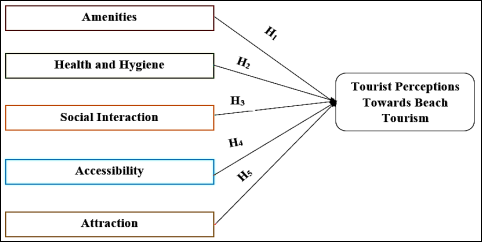
The conceptual framework in this study is built through a review of literature and theoretical perspectives and includes the five main determinants that combine to shape tourists’ perceptions of beach tourism. Each of the five key determinants shapes tourists’ evaluations of their beach tourist experiences; these are: amenities, health and hygiene, commercial and social interaction, accessibility, and attractions. The key determinants are approached from service quality, consumer behaviour dynamics, and destination image theory perspectives. The literature shows that tourists have cognitive and affective responses according to both physical services and experiential services. Amenities are the physical and functional infrastructure related to a destination, for example, bathrooms, signage, pathways, safety systems, and places for recreation. They maintain the overall usability and convenience of a destination while influencing initial perceptions of the destination from the perspective of tourists upon arrival. Many people view amenities and physical infrastructure with their condition and availability as indicators of the professionalism and care of the destination operations management
| [8] | Chen, C. L., & Bau, Y. P. (2016). Establishing a multi-criteria evaluation structure for tourist beaches in Taiwan: A foundation for sustainable beach tourism. Ocean & Coastal Management, 121, 88-96. https://doi.org/10.1016/j.ocecoaman.2015.12.013 |
[8]
. Health and Hygiene, especially after COVID-19, are critical when considering destination perception and safety/trust. Health and hygiene entail sanitation standards for both public and private spaces (e.g., parks, attractions, lodges, restaurants, etc.), waste management practices, and cleanliness of eating and sleeping outlets. Research has demonstrated that visible hygiene practices provide emotional security or feelings of satisfaction
| [3] | Atzori, R., Fyall, A., & Miller, G. (2018). Tourist responses to climate change: Potential impacts and adaptation in Florida's coastal destinations. Tourism Management, 69, 12-22.
https://doi.org/10.1016/j.tourman.2018.05.005 |
| [39] | Sadar, S., & Rekha, R. S. (2016). Students’ attitude towards beach tourism in Bangladesh: A study on Saint Martin and Cox’s Bazar Sea beaches. Bangladesh Journal of Tourism, 1(1). |
[3, 39]
and, thus, are an important part of a destination perception. The Commercial and Social Interaction aspect emphasizes local economic and social engagement opportunities. While shopping and dining options are available, tourists may be more likely to have the opportunity to socially engage and interact with locals and fellow travelers. Social interactions with others can often enhance tourists' characterization of the local culture, as well as their emotional connection to the destination
| [32] | Rahman, M. M., Hossain, M. E., & Akter, S. (2023). Public facilities and their role in shaping tourist perceptions at beach destinations in Bangladesh. Journal of Outdoor Recreation and Tourism, 37, 100526.
https://doi.org/10.1016/j.jort.2022.100526 |
[32]
. These positive commercial and social interactions ultimately help create perceived authenticity, which is essential to creating lasting memories with destinations. Accessibility is referred to as the extent to which tourists can get to and around destinations. Accessibility includes transportation infrastructure such as roads, transit systems, signage, and overall neighborhood navigability.
| [34] | Roca, E., Villares, M., & Ortego, M. I. (2009). Assessing public perceptions on beach quality according to beach users' profile: A case study in the Costa Brava (Spain). Tourism Management, 30(4), 598-607.
https://doi.org/10.1016/j.tourman.2008.10.015 |
[34]
point out that in service quality theory, convenience and accessibility are tremendously important in terms of the overall evaluation and satisfaction. Destinations that are easier to obtain and are either easier to get around seem more organized, more tourist-friendly, and more inviting overall.
Last, Attraction is the coastal experience itself, and it is the fundamental visual and emotional limb of beach tourism. The basics of attraction include the cleanliness of the sand and water, the aesthetic value of the coastal landscape, as well as the image of peace and serenity of the coastal space. Destination Image Theory provides evidence that cognitive judgments and affective impressions regarding the natural beauty of the location are fundamental components of tourist destination images and their behavioural intentions
| [37] | San Martín, H., & Del Bosque, I. A. R. (2008). Exploring the cognitive-affective nature of destination image and the role of psychological factors in its formation. Tourism Management, 29(2), 263-277.
https://doi.org/10.1016/j.tourman.2007.03.012 |
[37]
.
Figure 1. Proposed Conceptual Framework of Tourist Perceptions Towards Beach Tourism.
These five determinants: amenities, standards of cleanliness, social and commercial engagement, ease of accessibility, and the attraction itself- work together to constitute the evaluative process of the tourist. While earlier discussions have identified existing literature to support the component of these five determinants, this framework provides a cohesive approach to advance the study of beach tourism by examining and studying them as a destination. This paper empirically assessed the hypothesized linkages between the five determinants and their influences on tourist perceptions of beach tourism by developing following hypothesis:
H1: Amenities have a significant influence on tourist perception.
H2: Health and hygiene have a significant influence on tourist perception.
H3: Social interaction has a significant influence on tourist perception.
H4: Accessibility has a significant influence on tourist perception.
H5: Attraction has a significant influence on tourist perception.
4. Findings of the Study
4.1. Profile of the Respondents
The study found that almost 70% of the respondents are in the age group 21-30 years, which suggests that there is a significant percentage of youth travellers within domestic tourism in Bangladesh. Most of the respondents were male (81.5%), which supports the findings of other similar studies in the South Asian context that cited immobility and socio-cultural norms shape female participation in pleasure travel. About the occupation of the respondents, students are the highest (45.7%), followed by salaried employees. Households were nearly the same between married and unmarried participants which showed a diversity in travel decisions. The results also revealed that most of the tourist (67.4%) visit the beach from Dhaka and Chittagong division which indicates the preference of urban inhabitants to the beach tourism destinations.
Table 1. Demographic Profile of the Respondents.
Variable | Category | Frequency | Percent |
Gender | Male | 246 | 81.5 |
Female | 56 | 18.5 |
Age | < 20 years | 9 | 3.0 |
21–25 years | 130 | 43.0 |
26–30 years | 77 | 25.5 |
31–35 years | 30 | 9.9 |
36–40 years | 24 | 7.9 |
41–45 years | 5 | 1.7 |
46–50 years | 16 | 5.3 |
> 50 years | 11 | 3.6 |
Education | SSC | 14 | 4.6 |
HSC | 45 | 14.9 |
Graduation | 129 | 42.7 |
Post-Graduation | 106 | 35.1 |
Other | 8 | 2.6 |
Profession | Student | 138 | 45.7 |
Full-time job | 92 | 30.5 |
Part-time job | 16 | 5.3 |
Unemployed | 10 | 3.3 |
Other | 46 | 15.2 |
Income (BDT) | < 10,000 | 34 | 11.3 |
10,001–20,000 | 45 | 14.9 |
20,001–25,000 | 29 | 9.6 |
25,001–30,000 | 53 | 17.5 |
30,001–35,000 | 33 | 10.9 |
35,001–40,000 | 26 | 8.6 |
40,001–45,000 | 16 | 5.3 |
45,001–50,000 | 18 | 6.0 |
≥ 50,000 | 48 | 15.9 |
Marital Status | Married | 140 | 46.4 |
Unmarried | 161 | 53.3 |
Other | 1 | 0.3 |
Division | Dhaka | 105 | 34.8 |
Chittagong | 79 | 26.2 |
Rajshahi | 38 | 12.6 |
Rangpur | 19 | 6.3 |
Khulna | 18 | 6.0 |
Sylhet | 17 | 5.6 |
Barishal | 14 | 4.6 |
Dinajpur | 6 | 2.0 |
Mymensingh | 6 | 2.0 |
4.2. General Perception of Tourists About Different Services of the Cox’s Bazar Sea Beach
This study analysed opinion of the tourist about different service attributes of the Cox’s Bazar Sea beach which is presented in
Table 2. It is found that tourists are mostly amazed with the Natural Attraction (M = 4.55), Sea Waves (M = 4.63), and Public Transport (M = 4.06) of the beach. Free Walkways (M = 3.92) and Cleanliness (M = 3.92) of the beach achieved moderate to high ratings from the tourist. The Accommodation Condition (M = 3.33) and Hygienic Food (M = 3.82) also achieved the similar opinion. The study found low ratings from the tourists about Quality Restaurants (M = 3.10), Washroom Facilities (M = 2.88), and Waste Management (M = 3.12) services of the beach. The tourists also expressed negative opinion about Guide Facilities (M = 2.86) and Price Fairness (M = 2.46). The results revealed moderate opinion of the tourist in the case of Safety and Security (M = 3.14) and Emergency Services (M = 3.06). The tourists have also similar opinion about Host Behaviour (M = 3.18), Parking Facilities (M = 3.22), and Internal Transport (M = 3.78) services. The overall evaluation of the tourists about Cox’s Bazar (M = 3.46, SD = .62) found generally positive under sceptic outlook.
Table 2. General Perception of Tourists about Different Services.
Code | Variables Name | Mean | Standard Deviation |
A1 | Natural Attractions | 4.55 | 0.73 |
A2 | Sea Waves | 4.63 | 0.89 |
A3 | Free Walkway | 3.92 | 1.06 |
A4 | Cleanliness | 3.92 | 1.01 |
A5 | Accommodation Condition | 3.33 | 1.11 |
A6 | Hygienic Food | 3.82 | 1.00 |
A7 | Quality Restaurants | 3.10 | 1.23 |
A8 | Washroom Facilities | 2.88 | 1.32 |
A9 | Waste Management | 3.12 | 1.28 |
A10 | Guide Facility | 2.86 | 1.28 |
A11 | Shopping Facility | 3.44 | 1.24 |
A12 | Price | 2.46 | 1.27 |
A13 | Safety & Security | 3.14 | 1.22 |
A14 | Emergency Services | 3.06 | 1.17 |
A15 | Behavior of the Hosts | 3.18 | 1.25 |
A16 | Public Transportation | 4.06 | 1.01 |
A17 | Internal Transportation | 3.78 | 1.05 |
A18 | Parking Facility | 3.22 | 1.21 |
| Overall Perception | 3.46 | .62 |
4.3. Factors Affecting the Perception of Tourists
An exploratory factor analysis (EFA) with principal component analysis with varimax rotation was undertaken to examine the underlying structure of tourist perceptions of beach tourism. The CFA resulted in a five-factor solution.
explaining a total of 60.43% of the variance. Each factor was kept according to eigenvalues > 1, factor loadings' interpretability, and theoretical consistency from grouped items. All loadings that loaded 50 or above were retained, and the reliability of each factor was examined by Cronbach’s Alpha. Results for each of the factors extracted are given below.
Table 3. Factors Affecting the Perception of Tourists in Cox’s Bazar Sea Beach.
Factor Names | Items | Factor Loading |
1 | 2 | 3 | 4 | 5 |
Amenities | A10 | Guide Facility | .730 | | | | |
A9 | Waste Management | .725 | | | | |
A8 | Washroom Facilities | .723 | | | | |
A13 | Safety & Security | .675 | | | | |
A14 | Emergency Services | .545 | | | | |
Health and Hygiene | A4 | Cleanliness | | .773 | | | |
A5 | Accommodation Condition | | .754 | | | |
A6 | Hygienic Food | | .670 | | | |
A7 | Quality Restaurants | | .591 | | | |
Social Interaction | A11 | Shopping Facility | | | .782 | | |
A12 | Price | | | .646 | | |
A15 | Behavior of the Hosts | | | .547 | | |
Accessibility | A16 | Public Transportation | | | | .784 | |
A17 | Internal Transportation | | | | .720 | |
Attraction | A1 | Natural Attractions | | | | | .813 |
A2 | Sea Waves | | | | | .722 |
A3 | Free Walkway | | | | | .511 |
% of Variance explained by each factor | 30.505 | 9.363 | 7.361 | 6.985 | 6.220 |
Cronbach Alpha | 0.806 | 0.745 | 0.628 | 0.636 | 0.541 |
Factor 1: Amenities
Amenities are the material and service resources that serve tourists' needs: guide facilities, waste management, washroom facilities, safety & security, and emergency services. This factor accounted for 30.51% of the variance with good reliability (Cronbach’s Alpha =.806). Five items loaded above 0.50: guide facility (0.730), waste management (0.725), washroom facilities (0.723), safety and security (0.675), and emergency services (0.545). Results indicate that visitors have a strong preference for assistance, cleanliness, and safety facilities, which is evidence of a homogeneous factor representing overall impressions about beach experiences.
Factor 2: Health and Hygiene
Health and Hygiene accounted for 9.36% of the variance, with reasonable reliability (Cronbach's Alpha =.745). Cleanliness (0.773), accommodation condition (0.754), hygienic food (0.670), and quality restaurants (0.591) backed four strongly loaded items. Hygienic food became the most important factor, followed closely by the condition of accommodation. Food safety and quality also supported the construct, but at a weaker level. The unequivocal separation of loadings reveals a one-dimensional factor that accounts for cohesive tourist evaluations between the same sanitation, health standards, and general environmental security.
Factor 3: Social Interaction
Social Interaction accounted for 7.36% of the variance with moderate reliability (Cronbach’s Alpha =.627). Three items were loaded onto this factor: shopping facility (0.782), price (0.646), and host behavior (0.547). Shopping facilities were found to be the most significant antecedent, and perceptions of value by pricing were second. Host behavior, although subdued, was conceptually significant as it connected commercial transactions and social encounters. Lack of cross loadings supports that a meaningful construct representing the tourists' way of combining economic aspects with interpersonal ones when considering their visit to a beach destination.
Factor 4: Accessibility
Accessibility explained 6.99% of the variance and had acceptable reliability (Cronbach’s Alpha = 0.636). Public Transportation (0.784) and Internal Transportation (0.720) constituted this factor. The relatively high and similar loadings also suggest that tourists treat external accessibility and internal mobility as a single concept. With only two indexes, the factor presented high communalities and a clear distinction between other dimensions and good conceptual validity, that is to say, it was proven as a basic determinant for destination perception.
Factor 5: Attraction
Physical attractiveness accounted for 6.22% of the variance and was the least reliable (Cronbach’s Alpha = 0.541). Natural attraction came 0.813, sea wave 0.722, and free walkway 0.511 as the results. Natural beauty prevailed as the most influential factor, which reaffirms its prime position in destination attraction, and sea waves boosted the experiential aspect. Even though the free walkway was loaded far less, it is possible to influence a spatial accessibility impression. Again, this factor persists in holding conceptually consistent and embraces the significant environmental attraction of beach tourism.
4.4. Role of Each Factor on Tourist Perception
The model summary suggests the above regression holds a remarkably strong capacity for prediction. Its R value is 0.996. This means there is a very high correlation between independent variables and dependent variables. 0.992 in R Square also means that all five predictors: Amenities, Health and Hygiene, Commercial and Social Interaction, Accessibility, Attraction, make the outcome 99.2% predictable. The Adjusted R-squared value of 0.991 confirms this well. This time, the model is robust even after adjusting for the number of variables in the equation. With a low standard error of 0.5740, the accuracy in forecasting is high. That means the model fits the data extremely well; there is only a small deviation between actual and predicted values. Overall, the outcome shows that the selected factors are effective in explaining the perception towards beach tourism.
Table 4. Model Summary of Regression Analysis Predicting Tourist Perception Towards Beach Tourism.
Model Summary |
Model | R | R Square | Adjusted R Square | Std. Error of the Estimate |
1 | .996a | .992 | .991 | .05740 |
Regression Analysis
Table 5. The influence of Each Factor on Tourist Perception Towards Beach Tourism.
Independent Variable | Mean | Standard Deviation | Beta | t | P-value | Hypothesis Supported |
Amenities | 3.0119 | .94295 | .457 | 63.776 | .000 | Supported |
Health and Hygiene | 3.4760 | .84050 | .306 | 46.393 | .000 | Supported |
Social Interaction | 3.0276 | .95040 | .262 | 39.253 | .000 | Supported |
Accessibility | 3.9205 | .87811 | .186 | 31.378 | .000 | Supported |
Attraction | 4.3664 | .56114 | .156 | 27.923 | .000 | Supported |
The Influence of Amenities
Amenities have appeared as the most influential variable in predicting the tourist perception (with SB = 0.457, t-value = 63.776, and p-value < 0.001). This implies a highly significant influence of amenities availability and quality with the overall perception of the beach destination by tourists. The study found moderate mean score (M = 3.01, SD = .94) which means that positive perception constitutes with the service improvement of guide services, waste management, washroom facilities, safety, and emergency response. This finding supports Hypothesis 1 of this study which confirm that amenities have significant influence on tourist perception towards beach tourism.
The Influence of Health and Hygiene
The study found Health and Hygiene as the second most influential factor (β = 0.306, t = 46.393, p < 0.001). The analysis reveals that the factor has strong positive influence on tourist perception. The mean value (M = 3.48, SD = 0.84) of the result also indicate positive perception of tourist towards beach destinations. It also proves that cleanliness and hygiene are important to ensure safety, comfort, and trust of the tourist. This result proves the Hypothesis 2; Health and hygiene have a significant influence on tourist perception.
The Influence of Social Interaction
The standardized beta coefficient (β) of Commercial and Social Interaction was 0.262 (t = 39.253, p < 0.001), indicating that this variable significantly positively affected perceptions of beach tourism in tourists. The mean score of 3.0276 (SD = 0.95040) suggests this is a moderately high satisfaction level in tourists' perception, but the statistical significance of the relationship proves it is also relevant. This factor will include things like shopping facilities, pricing, and attitude of the local hosts, which then contribute to socio-cultural as well as economic aspects of tourism. Results of the regression analyses support also Hypothesis 3 (Commercial and social interaction have a significant influence on tourist perception).
The Influence of Accessibility
Accessibility produced a standardized beta coefficient (β) of 0.186, t-value of 31.378, and p < 0.001 and exerted positive significant influence on a tourists' perception for tourism. The mean score of 3.9205 (SD = 0.87811) was one of the highest observed among all factors. Nevertheless, the lower beta value shows that accessibility can affect satisfaction with post-arrival but has a smaller role than beta in destination selection perception. It includes accessible public and internal transport as well, making it two ways easy for tourists to reach and move here. Consequently, Hypothesis 4 (Accessibility has a significant influence on tourist perception) is supported by the regression analysis results of a significant positive sign. Thus, confirming that accessibility is merely a facilitating but vital component for the construction of tourist perceptions.
The Influence of Attraction
The results of the regression analysis show that there is an influence, more precisely, between Attraction and Tourist Perception, which is statistically significant but limited. The factor had a standardized beta coefficient (β) of 0.156, a t-value of 27.923, and p < 0.001, and was the predictor with the least predictive capacity among the constructs studied. Attraction also posted the highest average score of 4.3664 (SD = 0.56114). This indicates a high level of appreciation by tourists for the natural features which are essentially all scenic in beach destinations such as natural attractions, sea waves and free walkways etc. Attractions are flavourful but the low beta suggests that attractions are things that people care about, experiences they have and expect to be present, but less salience it terms of general perception as compared with service-based or infrastructural components. Thus, Hypothesis 5 (Attraction has a significant influence on tourist perception) is supported as the effect size may not be large, yet the significance level establishes that attractions are a needed but no longer sufficient element in value perception.
5. Discussion of the Study
Demographic profiles of tourist are one of the contexts in which tourist preferences and perceptions need to be interpreted. The predominance of male participants (81.5%) in this study reveals that beach tourism is a gendered practice in Bangladesh, where males are more active than females in the pursuit of leisure travel. This discrepancy is consistent with the results of the earlier study by
| [18] | Hassan, M. M., & Shahnewaz, M. (2014). Measuring tourist service satisfaction at destination: A case study of Cox's Bazar Sea beach, Bangladesh. American Journal of Tourism Management, 3(1), 32-43.
https://doi.org/10.5923/j.tourism.20140301.05 |
[18]
, which also found that cultural norms and security concerns constrained female participation in Cox’s Bazar tourism. Like many under-40-year-old travellers, most tourists were in their 20s and 30s; therefore, it was not surprising that they appeared to prefer active or experience-based travel. Comparable demographic patterns were observed by
| [21] | Hossain, M. S., Mostafa, M. G., & Hasan, M. J. (2021). Factors influencing domestic tourists' satisfaction in Cox's Bazar, Bangladesh. International Journal of Tourism Policy, 11(1), 61-81. https://doi.org/10.1504/IJTP.2021.113180 |
[21]
, who identified the young and the educated as the most domestic tourists in Bangladesh. This group also has higher expectations in terms of hygiene, safety, and service quality. This sample of respondents was possibly more aware of accommodation, cleanliness, and host behaviour standards, as most were graduates, and this is in line with
| [39] | Sadar, S., & Rekha, R. S. (2016). Students’ attitude towards beach tourism in Bangladesh: A study on Saint Martin and Cox’s Bazar Sea beaches. Bangladesh Journal of Tourism, 1(1). |
| [40] | Sardar, S., Phongkhieo, T. N., Kheereemangkla, Y. (2025). Tourism Motivations and Experiences of Visitors to Saint Martin’s Island Marine Protected Area in Bangladesh. EAU Heritage Journal Social Science and Humanities, 15(3). |
[39, 40]
who posit that higher levels of education would mean a higher level of awareness of quality of service while in a tourist destination. The domination of domestic, leisure-motivated travel can also be seen as being in line with the playful nature of Cox’s Bazar, as noted by
| [31] | Rahman, M. A., Hasan, M. K., & Hossain, M. S. (2019). Tourists' perception towards St. Martin's Island, Bangladesh: An empirical study. Tourism Review International, 23(1-2), 59-71. https://doi.org/10.3727/154427219X15633617962419 |
| [32] | Rahman, M. M., Hossain, M. E., & Akter, S. (2023). Public facilities and their role in shaping tourist perceptions at beach destinations in Bangladesh. Journal of Outdoor Recreation and Tourism, 37, 100526.
https://doi.org/10.1016/j.jort.2022.100526 |
[31, 32]
, who noted that people traveling locally emphasize affordability, accessibility, and the need to socialize more than do international tourists when determining a destination.
The components in the regression model of this study were validated by factor analysis with a KMO value higher than 0.8 and Bartlett’s Test indicating that dimension reduction was appropriate. Five factors (Amenities, Health & Hygiene, Social Interaction, Accessibility, and Attraction) were extracted as they helped group the attributes into conceptually coherent clusters. According to this theory, perceptions are not formed in isolation but across domains that are linked to one another. For instance,
showed that destination image is constructed by functional (infrastructures and cleanliness) and psychographic attributes (social interaction and natural beauty). Likewise,
| [9] | Chi, C. G. Q., & Qu, H. (2008). Examining the structural relationships of destination image, tourist satisfaction and destination loyalty: An integrated approach. Tourism Management, 29(4), 624-636. https://doi.org/10.1016/j.tourman.2007.06.007 |
[9]
indicated that perceived value, satisfaction, and loyalty cannot be determined by only a few or a single dimension; instead invest in a multifaceted one. Consistent with these studies, the current factor analysis reveals that tourists in Cox’s Bazar associate cleanliness and food hygiene together under ‘Health and Hygiene’, supporting the assertion by
| [20] | Hoque, M. A., Rahman, M. S., & Hossain, M. S. (2023). Hygiene and sanitation practices at beach destinations: A study of tourist perceptions in Bangladesh. Journal of Environmental Health, 85(7), 18-25. |
[20]
that sanitation is integral to the other hospitality experiences, including accommodation and dining. Further, the clustering of facilities, including safety, waste management, and guide services, corroborates the results by
| [16] | Hasan, M. K., Ismail, A. R., & Islam, M. F. (2019). Assessing service quality of tourist destinations in Bangladesh: An application of TOURQUAL model. International Journal of Tourism Policy, 9(2), 160-180.
https://doi.org/10.1504/IJTP.2019.102524 |
[16]
that supportive facilities are a composite entity contributing to visitor satisfaction at beaches in Bangladesh. The moderate internal consistency of “Attraction” is also reflected by
| [34] | Roca, E., Villares, M., & Ortego, M. I. (2009). Assessing public perceptions on beach quality according to beach users' profile: A case study in the Costa Brava (Spain). Tourism Management, 30(4), 598-607.
https://doi.org/10.1016/j.tourman.2008.10.015 |
[34]
when they argue that, despite the fact that perceptions of natural beauty are universally positive, they can vary significantly among tourists, and that does not always result in stronger loyalty intentions.
To analyse the role of five factors on tourist perception, this study conducted regression analysis. The research found amenities as the most influential factors which suggest increasing amenities and necessary infrastructure to provide positive experience to tourist. The strong relationship also indicates that restroom facilities, waste management, and safety infrastructure play key roles shaping overall perception of tourist. The findings support the research of
| [28] | Mahmud, M. S., Haque, M. M., & Rahman, M. S. (2022). Supportive facilities and their influence on tourist perceptions at beach destinations in Bangladesh. Journal of Hospitality and Tourism Management, 52, 141-151.
https://doi.org/10.1016/j.jhtm.2022.04.003 |
[28]
who found the significant role of basic amenities to ensure tourist satisfaction and destination image.
also found that tourist satisfaction varies with the functional infrastructure like restrooms, emergency services, and associated facilities. In this study, health and hygiene emerged as the second influential predictors that has positive influence on tourist perception. This finding aligns with recent research of
| [42] | Seabra, C., Dolnicar, S., Abrantes, J. L., & Kastenholz, E. (2013). Heterogeneity in risk and safety perceptions of international tourists. Tourism Management, 36, 502-510.
https://doi.org/10.1016/j.tourman.2012.09.008 |
| [43] | Sultana, S., Ahmed, S. M., & Islam, M. S. (2023). Pricing strategies and tourist perceptions of value at beach destinations in Bangladesh. Asia Pacific Journal of Tourism Research, 28(4), 367-381.
https://doi.org/10.1080/10941665.2023.1234567 |
[42, 43]
who found that sanitation, clean food, and well-maintained beach environment are essential for the safety perception of tourist within local communities.
| [19] | Hasan, M. R., Ullah, S., Chowdhury, M., & Hossain, A. (2021). Examining the factors influencing Bangladesh's tourism sector due to COVID-19 pandemic using structural equation modeling. Journal of Public Affairs, 21(4), e2649.
https://doi.org/10.1002/pa.2649 |
[19]
also contended that tourists have come to perceive health-related cues as risk signals, with a particular focus on how certain cues might guide their post-pandemic travel decision-making. Results from this study are consistent with the perception data, where a large percentage of people reported bad food hygiene and living conditions.
Commercial and Social Interaction also had a significant impact on tourist perception by attracting tourists. It was also endorsed that perceptions of how well they paid, ease of shopping, and behaviour during their visit can mould their perception which is supported by
| [23] | Hultman, M., Skarmeas, D., Oghazi, P., & Beheshti, H. M. (2015). Achieving tourist loyalty through destination personality, satisfaction, and identification. Journal of Business Research, 68(11), 2227-2231.
https://doi.org/10.1016/j.jbusres.2015.06.002 |
[23]
, referring to emotional and social aspects as intrinsic components of satisfaction. This also provides further evidence for the findings of
| [40] | Sardar, S., Phongkhieo, T. N., Kheereemangkla, Y. (2025). Tourism Motivations and Experiences of Visitors to Saint Martin’s Island Marine Protected Area in Bangladesh. EAU Heritage Journal Social Science and Humanities, 15(3). |
[40]
. This finding is similar to
, who found that friendly, welcoming hosts can lower the infrastructural weakness through genuine hospitality and cultural immersion. Though the study found highest mean score of accessibility, it has minor influence on the regression model. The regression analysis found that accessibility is important to tourist however it has secondary role in shaping tourist perception.
| [40] | Sardar, S., Phongkhieo, T. N., Kheereemangkla, Y. (2025). Tourism Motivations and Experiences of Visitors to Saint Martin’s Island Marine Protected Area in Bangladesh. EAU Heritage Journal Social Science and Humanities, 15(3). |
[40]
similarly mentioned that accessibility acts as a threshold factor (an important factor for choosing a destination but less important once the journey begins). The perception claims support this view- quite a few tourists mentioned troubles with transport; on the other hand, the majority focused on lesser amenities, facilities, and hygiene.
Interestingly, while Attraction earned the highest ratings in tourists' opinion, its statistical influence on overall perception was relatively modest. This implies that, although natural beauty is highly valued, refer to it as being very much or quite beautiful; sea waves, cliffs, and walkways, these aspects alone cannot be certain of forming strong or enduring positive attitudes. Indeed, while the landscape may attract visitors in the first instance, it is the level of provision of supporting services and environmental management that will influence their experience of and memories about a place. This aligns with
, who suggest that natural features are necessary but not sufficient to form loyalty.
| [3] | Atzori, R., Fyall, A., & Miller, G. (2018). Tourist responses to climate change: Potential impacts and adaptation in Florida's coastal destinations. Tourism Management, 69, 12-22.
https://doi.org/10.1016/j.tourman.2018.05.005 |
[3]
also claimed that attraction is influenced by thermal and bioclimatic comfort, as discomfort regarding hot or humid conditions can impair the pleasure related to visual appeal. The physical comfort of tourists will vary by the type of activities they engage in, and this can affect their overall perception of the experience. It means that only high scenic quality is not sufficient for this unless comfort is at maximum. This suggests that natural attractions easily serve as a near gateway to satisfaction, but not necessarily as dependable predictors.





 Share This Article
 Twitter
 Linked In
 Facebook
 Copy
Copy Download