
The management of laboratory activities has long been a challenge for academic institutions that rely on manual logbook systems. These traditional systems are prone to inefficiencies such as data loss, illegibility of records, and difficulties in monitoring students' progress during laboratory sessions. In light of these issues, the need for a more streamlined, efficient, and secure method for managing laboratory logbooks has become evident. This study focuses on the implementation of an Electronic Laboratory Logbook Management System for the Computer Science Department of Niger State Polytechnic, Zungeru. The aim is to replace the traditional manual system with a digital platform that allows both instructors and students to manage laboratory records seamlessly. The system enables students to record their laboratory activities, track their progress, and submit work online, while instructors can monitor and evaluate students' performance, assign tasks, and generate reports. The system was developed using a combination of web technologies, including PHP for server-side scripting, MySQL for database management, HTML and CSS for front end design, and JavaScript for interactive elements. The system also features role-based access control, ensuring that only authorized users (students, instructors, and administrators) can access specific functionalities. Key functionalities of the system include user authentication and authorization, digital logbook entry, real-time data synchronization, and automated report generation. The system also incorporates a backup feature to safeguard data in case of hardware failures or other unforeseen events. The implementation of this system aims to significantly reduce administrative workload, enhance the accuracy of records, and improve the overall experience of laboratory management. Furthermore, it introduces greater accountability by enabling easy tracking and retrieval of laboratory records, thus improving the overall efficiency of the department’s laboratory operations.
| Published in | International Journal of Information and Communication Sciences (Volume 11, Issue 3) |
| DOI | 10.11648/j.ijics.20261103.11 |
| Page(s) | 70-86 |
| Creative Commons |
This is an Open Access article, distributed under the terms of the Creative Commons Attribution 4.0 International License (http://creativecommons.org/licenses/by/4.0/), which permits unrestricted use, distribution and reproduction in any medium or format, provided the original work is properly cited. |
| Copyright |
Copyright © The Author(s), 2026. Published by Science Publishing Group |
Electronic Laboratory Logbook, Laboratory Management System, Digital Record Management, Student Progress Monitoring, Role-Based Access Control, Data Security
Phase | Objective | Methods | Duration |
|---|---|---|---|
Phase 1 | Requirements Elicitation | Interviews, Questionnaires, Document Analysis | 4 weeks |
Phase 2 | System Development | Agile Development, Iterative Prototyping | 12 weeks |
Phase 3 | System Evaluation | UAT, Performance Testing, Surveys | 4 weeks |
Stratum | Population | Sample Size | Percentage |
|---|---|---|---|
ND I Students | 120 | 57 | 26.9% |
ND II Students | 110 | 52 | 24.5% |
HND I Students | 115 | 54 | 25.5% |
HND II Students | 105 | 49 | 23.1% |
Total Students | 450 | 212 | 100% |
Lecturers | 12 | 12 | 100% |
Technologists | 6 | 6 | 100% |
Administrators | 4 | 4 | 100% |
HOD | 1 | 1 | 100% |
Total Staff | 23 | 23 | 100% |
Metric | Target | Measurement Tool |
|---|---|---|
Page Load Time | <3 seconds | Google PageSpeed Insights |
Concurrent Users | ≥100 | Apache JMeter |
Database Query Response | <500ms | MySQL Query Profiler |
System Uptime | ≥99% | Server Monitoring Logs |
Error Rate | <1% | Error Logs Analysis |
Sprint | Duration | Deliverables |
|---|---|---|
Sprint 1 | 2 weeks | User Authentication Module |
Sprint 2 | 2 weeks | Student Registration & Course Module |
Sprint 3 | 2 weeks | Report Submission Module |
Sprint 4 | 2 weeks | Lecturer Supervision Module |
Sprint 5 | 2 weeks | Admin Management Module |
Sprint 6 | 2 weeks | Reporting & Analytics Module |
Category | Technology | Purpose |
|---|---|---|
Frontend | HTML5, CSS3, JavaScript | User Interface |
Backend | PHP 7.4 | Server-side Logic |
Database | MySQL 8.0 | Data Storage |
Web Server | Apache (XAMPP) | Application Hosting |
Version Control | Git/GitHub | Code Management |
IDE | Visual Studio Code | Development Environment |
Testing | PHP Unit, Selenium | Automated Testing |
Test Type | Objective | Method | Success Criteria |
|---|---|---|---|
Unit | Verify individual components | Automated | 100% pass |
Integration | Verify module interactions | Automated/Manual | 95% pass |
System | Verify end-to-end functionality | Manual | 90% pass |
UAT | Verify user acceptance | Manual | ≥70 SUS |
Performance | Verify system responsiveness | Automated | <3s load time |
Security | Verify access controls | Manual/Automated | No vulnerabilities |
Test ID | Input | Expected Output | Actual Output | Status |
|---|---|---|---|---|
TC-001 | Valid login credentials | Redirect to dashboard | Redirect to dashboard | Pass |
TC-002 | Invalid password | Error message displayed | Error message displayed | Pass |
TC-003 | Submit empty report | Validation error | Validation error | Pass |
TC-004 | View submitted report | Report displayed | Report displayed | Pass |
Metric | Description | Target | Measurement |
|---|---|---|---|
Functionality | Feature completeness | 100% | Requirements traceability matrix |
Usability | Ease of use | SUS ≥70 | SUS questionnaire |
Performance | Response time | <3 seconds | Load testing |
Reliability | System uptime | ≥99% | Monitoring logs |
Security | Access control effectiveness | 100% | Penetration testing |
Efficiency | Time savings | ≥50% reduction | Pre/post comparison |
Construct | Items | Source |
|---|---|---|
Perceived Usefulness | 6 | [19] |
Perceived Ease of Use | 6 | [19] |
Attitude Toward Use | 4 | [19] |
Behavioral Intention | 3 | [19] |
Aspect | Strategy |
|---|---|
Credibility | Member checking, triangulation |
Transferability | Thick description of context |
Dependability | Audit trail, peer review |
Confirmability | Reflexivity, negative case analysis |
Input Field | Description |
|---|---|
Student ID | Unique identification number of the student |
Matriculation Number | Official student registration number |
Full Name | Student's complete name |
Gender | Gender of the student |
Date of Birth | Student's date of birth |
Department | Department where the student is registered |
Programme | Student's academic programme |
Academic Level | Current level of study |
Phone Number | Student's contact number |
Email Address | Student's email address |
Username | Login identification |
Password | Student's authentication password |
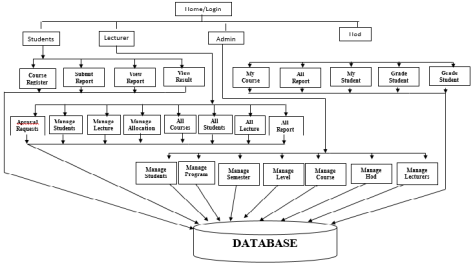
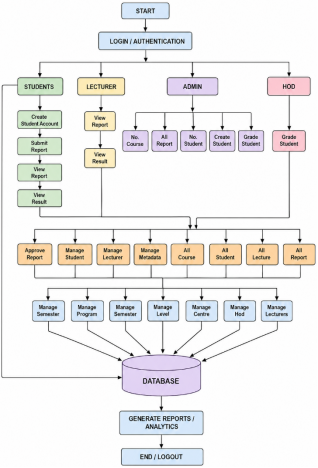
User | Major Responsibilities |
|---|---|
Student | Register courses, submit reports, view reports and results |
Lecturer | Handle academic/lecture activities, reports and results |
HOD | Supervise departmental courses, students, reports and grading |
Admin | Manage students, lecturers, courses, programmes, allocation and reports |
Database | Store and retrieve all system information |
AES-256 | Advanced Encryption Standard with 256-bit Key |
ANOVA | Analysis of Variance |
BM@N | Baryonic Matter at Nuclotron |
CSS | Cascading Style Sheets |
CSS3 | Cascading Style Sheets Version 3 |
DLIS | Digital Laboratory Information System |
DOI | Digital Object Identifier |
e-Log | Electronic Logbook |
e-logbook | Electronic Logbook |
ELLMS | Electronic Laboratory Logbook Management System |
ESPRES | Electronic Logbook System for Postgraduate Research (Expansion Not Stated in the Source) |
FreeIPA | Free Identity, Policy, and Audit |
HND | Higher National Diploma |
HND I | Higher National Diploma Level I |
HND II | Higher National Diploma Level II |
HOD | Head of Department |
HTML | Hypertext Markup Language |
HTML5 | Hypertext Markup Language Version 5 |
IDE | Integrated Development Environment |
IIS | Internet Information Services |
IoT | Internet of Things |
IT | Information Technology |
JINR | Joint Institute for Nuclear Research |
Moodle | Modular Object-Oriented Dynamic Learning Environment |
MySQL | My Structured Query Language (Relational Database Management System) |
ND | National Diploma |
ND I | National Diploma Level I |
ND II | National Diploma Level II |
NICA | Nuclotron-Based Ion Collider fAcility |
ORCID | Open Researcher and Contributor ID |
PEOU | Perceived Ease of Use |
PHP | Hypertext Preprocessor |
PU | Perceived Usefulness |
SQL | Structured Query Language |
SPSS | Statistical Package for the Social Sciences |
STEM | Science, Technology, Engineering, and Mathematics |
SUS | System Usability Scale |
TAM | Technology Acceptance Model |
UAT | User Acceptance Testing |
UTAUT | Unified Theory of Acceptance and Use of Technology |
XAMPP | Cross-Platform Apache, MySQL/MariaDB, PHP, and Perl |
| [1] | A. Abdulazeem and A. Omer, “Using Logbooks to Enhance Students ’ Learning : Lessons From a Mixed-methods Study in an Undergraduate Surgical Rotation,” vol. 16, no. 3, pp. 409-429, 2021, |
| [2] | S. Barteit et al., “Electronic logbooks (e-logbooks) for the continuous assessment of medical licentiates and their medical skill development in the low-resource context of Zambia : A mixed-methods study,” no. November, pp. 1-13, 2022, |
| [3] | M. N. Mokhtar, S. A. Suhaini, F. H. Abdullah, R. Teo, and A. Izaham, “A survey of anaesthetic training logbook management among postgraduate students,” 2024. |
| [4] | U. Ramnarain, A Systematic Review of Research on the Integration of Real and Virtual Laboratories for Inquiry-Based Learning. Springer Nature Switzerland, 2026. |
| [5] | P. Id et al., “A Review of Electronic Engineering Logbooks Throughout the Electrical En- gineering Curriculum A Review of Electronic Engineering Logbooks Throughout the Electrical Engineering Curriculum,” 2016. |
| [6] | S. G. Higgins and M. M. Stevens, “laboratory notebooks in an academic,” vol. 17, no. February, pp. 179-189, 2022, |
| [7] | W. Hussain, W. Ishak, F. M. Yamin, S. Nur, and A. Abdullah, “A Digital Logbook Model for Student Activities Management During Industrial Training,” pp. 9-12, 2025. |
| [8] | W. Setyonugroho, N. Risdiana, A. A. Ch, M. Dian, S. Taher, and A. Khanif, “Exploring the usage of conventional logbooks during the clinical learning practice : A phenomenological study,” vol. 11, no. 2, pp. 124-132, 2023. |
| [9] | A. A. Adekunle, B. L. Abolore, G. Mutiu, and A. M. Olalekan, “Design and Implementation of a Web-Based Laboratory Management System for Efficient Resource Tracking,” vol. 13, no. 2, pp. 19-24, 2024. |
| [10] | W. Wu, H. Yu, X. Chen, M. Wei, V. Papaspyros, and G. Theraulaz, “Laboratory management : digital laboratory information system (DLIS) concept Laboratory management : digital laboratory information system (DLIS) concept,” 2018, |
| [11] | M. Arif, H. Samed, R. Mokhtar, N. Isa, M. A. Rahman, and A. Suhaimi, “Designing an Electronic Logbook System for Monitoring Postgraduate Research Students Progress,” vol. 4, no. 3, pp. 45-53, 2022. |
| [12] | Rahimi, M., Rosman, M., Arshad, I. H., Abdullah, N., Idayu, A., Shukry, M., Alias, N. R., Nur, N., Nik, I., & Fadzil, F. H. (2023). Volume 7 2023 (Vol. 7). |
| [13] | S. Mirici, “Virtual Laboratories and Simulation-Based Learning : Transforming STEM Education in Secondary Schools,” vol. 1, no. 2, pp. 9-19, 2025. |
| [14] | V. Dao, T. Nguyen, and V. Bui, “Development of a laboratory- based learning model via digital platform environment”. |
| [15] | K. V Gertsenberger, A. A. Moshkin, A. I. Chebotov, K. Gertsenberger, A. Moshkin, and A. Chebotov, “DEVELOPMENT OF THE ELECTRONIC LOGBOOK FOR THE BM @ N EXPERIMENT AT NICA,” pp. 175-179, 2019. |
| [16] | L. Stroud, E. Green, and J. Cronje, “A Revision Process That Bridges Qualitative and Quantitative Assessment,” pp. 436-444, 2020, |
| [17] | E. E. Ikechukwu, “Assessment of the Activities of Scavengers in Obio / Akpor Local Government, Rivers State, Nigeria,” no. March, pp. 272-280, 2015. |
| [18] | K. Schwaber and J. Sutherland, “The Scrum Guide,” no. November, 2020. |
| [19] | P. Dany, B. Kenfack, and C. Njei, “Reinforcing of Citizen ’ s Trust in E-Government : The Cameroon ’ s Case,” pp. 77-109, 2024, |
APA Style
Hamidu, S., Kontagora, I. U., Dagah, A. I., Ubandawaki, U., Mohammed, I., et al. (2026). Digital Logbook Management System for Enhancing Laboratory Record-Keeping: A Case Study of Computer Science Department, Niger State Polytechnic Zungeru. International Journal of Information and Communication Sciences, 11(3), 70-86. https://doi.org/10.11648/j.ijics.20261103.11
ACS Style
Hamidu, S.; Kontagora, I. U.; Dagah, A. I.; Ubandawaki, U.; Mohammed, I., et al. Digital Logbook Management System for Enhancing Laboratory Record-Keeping: A Case Study of Computer Science Department, Niger State Polytechnic Zungeru. Int. J. Inf. Commun. Sci. 2026, 11(3), 70-86. doi: 10.11648/j.ijics.20261103.11
AMA Style
Hamidu S, Kontagora IU, Dagah AI, Ubandawaki U, Mohammed I, et al. Digital Logbook Management System for Enhancing Laboratory Record-Keeping: A Case Study of Computer Science Department, Niger State Polytechnic Zungeru. Int J Inf Commun Sci. 2026;11(3):70-86. doi: 10.11648/j.ijics.20261103.11
@article{10.11648/j.ijics.20261103.11,
  author = {Shehu Hamidu and Ibrahim Umar Kontagora and Adamu Isah Dagah and Usman Ubandawaki and Ibrahim Mohammed and Jibrin Usman Lapai},
  title = {Digital Logbook Management System for Enhancing Laboratory Record-Keeping: A Case Study of Computer Science Department, Niger State Polytechnic Zungeru},
  journal = {International Journal of Information and Communication Sciences},
  volume = {11},
  number = {3},
  pages = {70-86},
  doi = {10.11648/j.ijics.20261103.11},
  url = {https://doi.org/10.11648/j.ijics.20261103.11},
  eprint = {https://article.sciencepublishinggroup.com/pdf/10.11648.j.ijics.20261103.11},
  abstract = {The management of laboratory activities has long been a challenge for academic institutions that rely on manual logbook systems. These traditional systems are prone to inefficiencies such as data loss, illegibility of records, and difficulties in monitoring students' progress during laboratory sessions. In light of these issues, the need for a more streamlined, efficient, and secure method for managing laboratory logbooks has become evident. This study focuses on the implementation of an Electronic Laboratory Logbook Management System for the Computer Science Department of Niger State Polytechnic, Zungeru. The aim is to replace the traditional manual system with a digital platform that allows both instructors and students to manage laboratory records seamlessly. The system enables students to record their laboratory activities, track their progress, and submit work online, while instructors can monitor and evaluate students' performance, assign tasks, and generate reports. The system was developed using a combination of web technologies, including PHP for server-side scripting, MySQL for database management, HTML and CSS for front end design, and JavaScript for interactive elements. The system also features role-based access control, ensuring that only authorized users (students, instructors, and administrators) can access specific functionalities. Key functionalities of the system include user authentication and authorization, digital logbook entry, real-time data synchronization, and automated report generation. The system also incorporates a backup feature to safeguard data in case of hardware failures or other unforeseen events. The implementation of this system aims to significantly reduce administrative workload, enhance the accuracy of records, and improve the overall experience of laboratory management. Furthermore, it introduces greater accountability by enabling easy tracking and retrieval of laboratory records, thus improving the overall efficiency of the department’s laboratory operations.},
 year = {2026}
}
TY  - JOUR
T1  - Digital Logbook Management System for Enhancing Laboratory Record-Keeping: A Case Study of Computer Science Department, Niger State Polytechnic Zungeru
AU  - Shehu Hamidu
AU  - Ibrahim Umar Kontagora
AU  - Adamu Isah Dagah
AU  - Usman Ubandawaki
AU  - Ibrahim Mohammed
AU  - Jibrin Usman Lapai
Y1  - 2026/10/20
PY  - 2026
N1  - https://doi.org/10.11648/j.ijics.20261103.11
DO  - 10.11648/j.ijics.20261103.11
T2  - International Journal of Information and Communication Sciences
JF  - International Journal of Information and Communication Sciences
JO  - International Journal of Information and Communication Sciences
SP  - 70
EP  - 86
PB  - Science Publishing Group
SN  - 2575-1719
UR  - https://doi.org/10.11648/j.ijics.20261103.11
AB  - The management of laboratory activities has long been a challenge for academic institutions that rely on manual logbook systems. These traditional systems are prone to inefficiencies such as data loss, illegibility of records, and difficulties in monitoring students' progress during laboratory sessions. In light of these issues, the need for a more streamlined, efficient, and secure method for managing laboratory logbooks has become evident. This study focuses on the implementation of an Electronic Laboratory Logbook Management System for the Computer Science Department of Niger State Polytechnic, Zungeru. The aim is to replace the traditional manual system with a digital platform that allows both instructors and students to manage laboratory records seamlessly. The system enables students to record their laboratory activities, track their progress, and submit work online, while instructors can monitor and evaluate students' performance, assign tasks, and generate reports. The system was developed using a combination of web technologies, including PHP for server-side scripting, MySQL for database management, HTML and CSS for front end design, and JavaScript for interactive elements. The system also features role-based access control, ensuring that only authorized users (students, instructors, and administrators) can access specific functionalities. Key functionalities of the system include user authentication and authorization, digital logbook entry, real-time data synchronization, and automated report generation. The system also incorporates a backup feature to safeguard data in case of hardware failures or other unforeseen events. The implementation of this system aims to significantly reduce administrative workload, enhance the accuracy of records, and improve the overall experience of laboratory management. Furthermore, it introduces greater accountability by enabling easy tracking and retrieval of laboratory records, thus improving the overall efficiency of the department’s laboratory operations.
VL  - 11
IS  - 3
ER  -
Department of Networking and Cloud Computing, Niger State Polytechnic, Zungeru, Nigeria

Information



 Share This Article
 Twitter
 Linked In
 Facebook

 Copy
 Download