
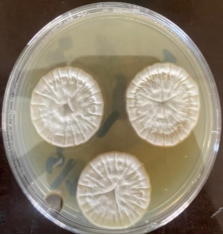
Garri is a fermented cassava (Manihot esculenta Crantz) product which is widely consumed as staple in Nigeria and West Africa. Cassava processing into garri in Nigeria lack quality control. Also, during sales in the markets, garri is displayed in open basins and as a result they are exposed to contamination with dust and microorganisms. The aim of this study was to assess the microbiological safety of Ijebu garri sold in Abeokuta metropolis, Ogun State, Nigeria. Three hundred (300) grams of Ijebu garri was purchased from three major markets in Abeokuta metropolis namely; Lafenwa, Kuto and Itoku markets. Samples were purchased from 10 traders within each market using random sampling. These samples were pooled into a composite per market resulting in 3 composite samples. One (1) gram from each sample was used for fungal and bacteria isolation. Five (5) grams of the sample was sent for complete mycotoxin analysis using LC-MS/MS technique. The total mold counts in garri samples were: 2.5 x 10⁴ CFU/mL (Lafenwa); 6.0 × 10³ CFU/mL (Itokun), and 4.0 × 10⁴ CFU/mL (Kuto). No bacteria colony was isolated from garri. Molecular analyses and characterization identified the presence of toxigenic fungi namely Penicillium spp. (2), Penicillium singorense (3), and Curvularia lunata (3). Mycotoxin results showed all mycotoxins analyzed were less than reporting limits (<RL). The presence of mycotoxigenic fungi in garri suggests a potential public health risks as these can produce multi-mycotoxins under favorable conditions during storage, market display and distribution, which can lead to mycotoxicosis, organ failures, and cancers in humans and animals on consumption.
| Published in | International Journal of Microbiology and Biotechnology (Volume 11, Issue 2) |
| DOI | 10.11648/j.ijmb.20261102.13 |
| Page(s) | 68-75 |
| Creative Commons |
This is an Open Access article, distributed under the terms of the Creative Commons Attribution 4.0 International License (http://creativecommons.org/licenses/by/4.0/), which permits unrestricted use, distribution and reproduction in any medium or format, provided the original work is properly cited. |
| Copyright |
Copyright © The Author(s), 2026. Published by Science Publishing Group |
Garri, Mycotoxigenic Fungi, Mycotoxin, Cassava, Public Health
S/No | Location | Total mold counts (CFU/mL) | % Moisture |
|---|---|---|---|
1. | Lafenwa | 2.5 x 10⁴ | 10% |
2 | Kuto | 4.0 x 10⁴ | 11% |
3 | Itokun | 6.0 x 10³ | 10% |
S/N | Species | Strain | Accession number | % Relatedness |
|---|---|---|---|---|
Penicillium spp | FO5_17 | JN624900.1 | 99.82% | |
Penicillium singorense strain | GO5_20 | PP385020.1 | 99.27% | |
Curvulari lunata strain | HO5_23 | KV806118.1 | 99.62% |
S/No. | Analyte | Results | Units | Analysis date | Reporting limit | Method | Reference |
|---|---|---|---|---|---|---|---|
1. | 15 Acetyl deoxynivalenol | <RL | ppm | 05/16/2025 | 0.1 ppm | LC-MS/MS | Internal SOP.14-168 |
2. | 3-Acetyl Deoxynivalenol | <RL | ppm | 05/16/2025 | 0.1 ppm | LC-MS/MS | Internal SOP.14-168 |
3. | Aflatoxin B1 | <RL | ppm | 05/16/2025 | 1 ppm | LC-MS/MS | Internal SOP.14-168 |
4. | Aflatoxin B2 | <RL | ppm | 05/16/2025 | 1 ppm | LC-MS/MS | Internal SOP.14-168 |
5. | Aflatoxin G1 | <RL | ppm | 05/16/2025 | 1 ppm | LC-MS/MS | Internal SOP.14-168 |
6. | Aflatoxin G2 | <RL | ppm | 05/16/2025 | 1 ppm | LC-MS/MS | Internal SOP.14-168 |
7. | Citrinin | <RL | ppm | 05/16/2025 | 50 ppm | LC-MS/MS | Internal SOP.14-168 |
8. | Diacetoxyscirpenol | <RL | ppm | 05/16/2025 | 100 ppm | LC-MS/MS | Internal SOP.14-168 |
9. | Deoxynivalenol | <RL | ppm | 05/16/2025 | 0.1 ppm | LC-MS/MS | Internal SOP.14-168 |
10. | Fumonisin B1 | <RL | ppm | 05/16/2025 | 0.1 ppm | LC-MS/MS | Internal SOP.14-168 |
11. | Fumonisin B2 | <RL | ppm | 05/16/2025 | 0.1 ppm | LC-MS/MS | Internal SOP.14-168 |
12 | Fumonisin B3 | <RL | ppm | 05/16/2025 | 0.1 ppm | LC-MS/MS | Internal SOP.14-168 |
13. | Fusarenon -X | <RL | ppm | 05/16/2025 | 0.5 ppm | LC-MS/MS | Internal SOP.14-168 |
14. | HT-2 Toxin | <RL | ppm | 05/16/2025 | 5 ppm | LC-MS/MS | Internal SOP.14-168 |
15. | Neosolaniol | <RL | ppm | 05/16/2025 | 20 ppm | LC-MS/MS | Internal SOP.14-168 |
16. | Nivalenol | <RL | ppm | 05/16/2025 | 0.5 ppm | LC-MS/MS | Internal SOP.14-168 |
17. | Ochratoxin A | <RL | ppm | 05/16/2025 | 1 ppm | LC-MS/MS | Internal SOP.14-168 |
18. | T-2 Toxin | <RL | ppm | 05/16/2025 | 5 ppm | LC-MS/MS | Internal SOP.14-168 |
19. | Zearalenone | <RL | ppm | 05/16/2025 | 12.5 ppm | LC-MS/MS | Internal SOP.14-168 |
LC-MS/MS | Liquid Chromatography Tandem Mass Spectrophotometry |
CFU | Colony Forming Units |
<RL | Less Than Reporting Limit |
VRBG | Violet Red Bile Glucose Agar |
PDA | Potato Dextrose Agar |
NA | Nutrient Agar |
USA | United States of America |
| [1] | Borku, A. W. Cassava (Manihot esculenta Crantz): Its nutritional composition insights for future research and development in Ethiopia. Discover Sustainability. 2025, 6, 404. |
| [2] | Oluwole, O., Oatunji, O. O., Odunfa, S. A. A process Technology for conversion of dried cassava chips into gari. Nigerian Food Journal. 2005, 22, 65-77. |
| [3] | FAO. The state of Food Insecurity in the world 2008, Agrifood Economics. Available from: fao.org/agrifood [Accessed 25 August 2025]. |
| [4] | Egesi, C. N., Onyeka, T. J., Ilona, P. Cassava production trends and opportunities in Nigeria. African Journal of Root and Tuber Crops. 2016, 13(1), 34–42. |
| [5] | Ogbe, F. O., Emehute, J. K. U., Legg, J. Screening of Cassava varieties for whitefly populations. In: NRCRI Annual Report, 2007, pp. 30-33. |
| [6] | Obadina, A. O., Oyewole, O. B., Sanni, L. O. Cassava fermentation for safe food production. Food Control. 2019, 20(10), 872–876. |
| [7] | Huc, M., Dossou, J., Adeyemi, O. Solid-state fermentation in garri processing. Journal of Fermentation Technology, 2019, 25(3), 101–109. |
| [8] | Abass, A. B., Dziedzoave, N. T., Alenkhe, B. E., James, B. D. Gari production flow chart. In: Quality Management manual for production of gari. IITA, Ibadan, Nigeria. 2013, p. 7. |
| [9] | Federal Ministry of Agriculture and rural Development (FMARD). National Agriculture and Food Security Strategy, 2010-2020. Abuja, Nigeria, 25 August 2010. |
| [10] | Ighomereho, O. S., Ayoola, A. A Influence of product package and quality on purchase decision of fast-moving consumer goods (FMCG) in Lagos state, Nigeria. UNIZIK Journal of Marketing. 2024, 1(2), 1-18. |
| [11] | AOAC. Official Methods of analysis, 15th Edition. Arlington, VA: Association of Official Analytical Chemists. 1990. |
| [12] | Samson, R. A., Hoekstra, E. S., Frisvad, J. S., Filtenborg, O. “Methods for the detection and isolation of food-borne fungi,’ In: Introduction to Foodborne Fungi, eds. R. A. Samson,, E. S. Heskstra, J. C. Frisvad, and O. Filtenborg (Utrecht: Centraal Bureau voor Schimmel cultures). 1995, pp. 235-242. |
| [13] | Jedidi, I., Mlayeh, A., Bouanene, I. Fungal identification based on colony morphology. African Journal of Mycology, 2018, 13(1), 23–29. |
| [14] | Malachová, A., Sulyok, M., Beltrán, E., Berthiller, F. & Krska, R. Optimization and validation of a quantitative liquid chromatography–tandem mass spectrometric method covering 295 bacterial and fungal metabolites including all regulated mycotoxins in four model food matrices. J. Chromatogr, A. 2014, 1362, 145–156. |
| [15] | Denning, D. W. Global incidence and mortality of severe fungal disease. Lancet Infect. Dis. 2024, 24, e428–e438. |
| [16] | Ezekiel, C. N., Ayeni, K. I., Misihairabgwi, J. M., Oyedele, O. A. Mycotoxin surveillance in cassava products. Toxins. 2020, 12(2), 84. |
| [17] | Adewunmi A. A., Chingoma, G. I. Fermentation and Biocontrol of Mycotoxins in Sorghum bicolor L. Moench Sold in Selected Markets in Abeokuta Metropolis, Ogun State, Nigeria. Nigerian Journal of Microbiology. 2023, 37(2), 6676 – 6682. |
| [18] | Malir, F., Ostry, V. Pfohl-Leszkowicz, A., Malir, J., Toman, J. Ochratoxin A: 50 years of Research. Toxins. 2016, 8(7), 191. |
| [19] | Rout, G. R., Debata, B. K., Das, P. In vitro mass scale propagation of Rosa Hybrida cv. Landora. Current Science, 1989, 58(15), 876-8. |
| [20] | Ogiehor, I. S., Ikenebomeh, M. J., Uwaifo, A. O. Microbial contamination of gari from open markets. Nigerian Journal of Microbiology, 2017, 34(2), 88–95. |
| [21] | Obadina, A. O., Fashanu, A. O., Fapohunda, S. O. Post-processing contamination of garri: A review. Food Safety and Hygiene Journal. 2022, 8(1), 55–62. |
| [22] | Pitt, E., Gallegos, D. Comans, T. Cameron, C. Thornton, L. Exploring the influence of local Food environments on Food behaviors: a systematic review of qualitative literature. Public Health Nutrition. 2017, 20(13), 2393-2405. |
| [23] | Fapohunda, S. O., Ayeni, K. I., Dada, A. Presence of mycotoxins in fermented cassava foods. Mycotoxin Research. 2018, 34(1), 39–46. |
| [24] | Adewunmi, A. A., Fapohunda S. O. Effect of Exposure of Wistar rats to mycotoxigenic fungal-contaminated guinea corn and pearl millet marketed in South West Nigeria. Recent Advances in Food Science; 2022, 5(2), 358-368. |
APA Style
Adewunmi, A. A., Sanyaolu, N. P. (2026). Microbiological Safety of Ijebu Garri (Fermented Manihot esculenta Crantz Flour) Produced and Sold in Abeokuta Metropolis, Nigeria and Its Public Health Implications. International Journal of Microbiology and Biotechnology, 11(2), 68-75. https://doi.org/10.11648/j.ijmb.20261102.13
ACS Style
Adewunmi, A. A.; Sanyaolu, N. P. Microbiological Safety of Ijebu Garri (Fermented Manihot esculenta Crantz Flour) Produced and Sold in Abeokuta Metropolis, Nigeria and Its Public Health Implications. Int. J. Microbiol. Biotechnol. 2026, 11(2), 68-75. doi: 10.11648/j.ijmb.20261102.13
@article{10.11648/j.ijmb.20261102.13,
  author = {Annabella Ademuyiwa Adewunmi and Nifemi Paul Sanyaolu},
  title = {Microbiological Safety of Ijebu Garri (Fermented Manihot esculenta Crantz Flour) Produced and Sold in Abeokuta Metropolis, Nigeria and Its Public Health Implications},
  journal = {International Journal of Microbiology and Biotechnology},
  volume = {11},
  number = {2},
  pages = {68-75},
  doi = {10.11648/j.ijmb.20261102.13},
  url = {https://doi.org/10.11648/j.ijmb.20261102.13},
  eprint = {https://article.sciencepublishinggroup.com/pdf/10.11648.j.ijmb.20261102.13},
  abstract = {Garri is a fermented cassava (Manihot esculenta Crantz) product which is widely consumed as staple in Nigeria and West Africa. Cassava processing into garri in Nigeria lack quality control. Also, during sales in the markets, garri is displayed in open basins and as a result they are exposed to contamination with dust and microorganisms. The aim of this study was to assess the microbiological safety of Ijebu garri sold in Abeokuta metropolis, Ogun State, Nigeria. Three hundred (300) grams of Ijebu garri was purchased from three major markets in Abeokuta metropolis namely; Lafenwa, Kuto and Itoku markets. Samples were purchased from 10 traders within each market using random sampling. These samples were pooled into a composite per market resulting in 3 composite samples. One (1) gram from each sample was used for fungal and bacteria isolation. Five (5) grams of the sample was sent for complete mycotoxin analysis using LC-MS/MS technique. The total mold counts in garri samples were: 2.5 x 10⁴ CFU/mL (Lafenwa); 6.0 × 10³ CFU/mL (Itokun), and 4.0 × 10⁴ CFU/mL (Kuto). No bacteria colony was isolated from garri. Molecular analyses and characterization identified the presence of toxigenic fungi namely Penicillium spp. (2), Penicillium singorense (3), and Curvularia lunata (3). Mycotoxin results showed all mycotoxins analyzed were less than reporting limits (<RL). The presence of mycotoxigenic fungi in garri suggests a potential public health risks as these can produce multi-mycotoxins under favorable conditions during storage, market display and distribution, which can lead to mycotoxicosis, organ failures, and cancers in humans and animals on consumption.},
 year = {2026}
}
TY  - JOUR
T1  - Microbiological Safety of Ijebu Garri (Fermented Manihot esculenta Crantz Flour) Produced and Sold in Abeokuta Metropolis, Nigeria and Its Public Health Implications
AU  - Annabella Ademuyiwa Adewunmi
AU  - Nifemi Paul Sanyaolu
Y1  - 2026/05/18
PY  - 2026
N1  - https://doi.org/10.11648/j.ijmb.20261102.13
DO  - 10.11648/j.ijmb.20261102.13
T2  - International Journal of Microbiology and Biotechnology
JF  - International Journal of Microbiology and Biotechnology
JO  - International Journal of Microbiology and Biotechnology
SP  - 68
EP  - 75
PB  - Science Publishing Group
SN  - 2578-9686
UR  - https://doi.org/10.11648/j.ijmb.20261102.13
AB  - Garri is a fermented cassava (Manihot esculenta Crantz) product which is widely consumed as staple in Nigeria and West Africa. Cassava processing into garri in Nigeria lack quality control. Also, during sales in the markets, garri is displayed in open basins and as a result they are exposed to contamination with dust and microorganisms. The aim of this study was to assess the microbiological safety of Ijebu garri sold in Abeokuta metropolis, Ogun State, Nigeria. Three hundred (300) grams of Ijebu garri was purchased from three major markets in Abeokuta metropolis namely; Lafenwa, Kuto and Itoku markets. Samples were purchased from 10 traders within each market using random sampling. These samples were pooled into a composite per market resulting in 3 composite samples. One (1) gram from each sample was used for fungal and bacteria isolation. Five (5) grams of the sample was sent for complete mycotoxin analysis using LC-MS/MS technique. The total mold counts in garri samples were: 2.5 x 10⁴ CFU/mL (Lafenwa); 6.0 × 10³ CFU/mL (Itokun), and 4.0 × 10⁴ CFU/mL (Kuto). No bacteria colony was isolated from garri. Molecular analyses and characterization identified the presence of toxigenic fungi namely Penicillium spp. (2), Penicillium singorense (3), and Curvularia lunata (3). Mycotoxin results showed all mycotoxins analyzed were less than reporting limits (<RL). The presence of mycotoxigenic fungi in garri suggests a potential public health risks as these can produce multi-mycotoxins under favorable conditions during storage, market display and distribution, which can lead to mycotoxicosis, organ failures, and cancers in humans and animals on consumption.
VL  - 11
IS  - 2
ER  -
Department of Microbiology & Biotechnology, McPherson University, Seriki Sotayo, Nigeria
Department of Microbiology & Biotechnology, McPherson University, Seriki Sotayo, Nigeria

Information



 Share This Article
 Twitter
 Linked In
 Facebook
 Copy
Copy Download