Research Article | | Peer-Reviewed

Petrographical Analysis of Basement Rocks in Ila Orangun Area, Southwestern Nigeria

Received: 5 March 2026     Accepted: 12 June 2026     Published: 11 July 2026
Views:       Downloads:
Abstract

For the purpose of carrying out petrographical analysis on basement rocks mapped in Ila Orangun Area Southwestern Nigeria, it became expedient to use the six (6) lithological units which were identified to be common around the study area. These lithological units include quartzites, granites, granite gneiss, porphyritic granites, amphibolite and pegmatites. The aim of the research is to unravel the mineralogical assemblages in terms of % mineralogical composition under plane and cross polarized lights using modal analysis for each of the rocks that best describes the underlying lithology of the area. Methods adopted for this research include preparing the rock samples for thin sectioning. The procedure of sample preparation include cutting, trimming, lapping and mounting of the rock processed rock samples on glass slides using Canada balsam and araldites. Each glass slides are then mounted on the stage of a petrographical microscope for keen observation and petrographical studies. The results of petrographical analyses show the mineral assemblages of the various rock types in the area which include quartzites as containing quartz, biotite, muscovite and myrmekite. Granite gneiss contains quartz, biotite, orthoclase, myrmekite, microcline, nepheline, hornblende and plagioclase. Pegmatite contains quartz, myrmekite, plagioclase, hornblende, microcline and muscovites. Porphyritic granites were observed to contain quartz, biotite, microcline, orthoclase and tourmaline. Granite contains quartz, biotite, hornblende, plagioclase and orthoclase while Amphibolite schist contains quartz, biotite, hornblende and muscovites. In conclusion, results from the petrographical analysis showed that the rocks are rich in minerals of huge economic significance. Some of these include quartz (SiO2) and muscovites which are both useful in the manufacturing of refractory glassware. It is however, recommended that further studies should be conducted on the microstructural investigation of these rock types which are mapped and retrieved from the study area.

Published in International Journal of Mineral Processing and Extractive Metallurgy (Volume 11, Issue 2)
DOI 10.11648/j.ijmpem.20261102.12
Page(s) 29-43
Creative Commons

This is an Open Access article, distributed under the terms of the Creative Commons Attribution 4.0 International License (http://creativecommons.org/licenses/by/4.0/), which permits unrestricted use, distribution and reproduction in any medium or format, provided the original work is properly cited.

Copyright

Copyright © The Author(s), 2026. Published by Science Publishing Group

Keywords

Petrography, Amphibolite, Ila Orangun, Pegmatites, Plagioclase

1. Introduction
For many years now, the Ilesha Schist Belt in the southwestern part of Nigeria have gained the attention of researchers due to its geological, structural architecture and above all its enormous economic potentials for which it is noted for. This region has been a target for possible gold mineralization, precious and base metals exploration potentials. Two distinct provinces can be recognized in the Nigerian Basement Complex, namely: the western province, approximately west of longitude 80°E, characterized by narrow, sediment-dominated, N-S trending belts. The eastern province which is composed mainly of migmatite-gneiss complex intruded by larger volumes of Pan-African granites and by the Mesozoic ring complexes (Younger Granites) of central Nigeria Ajibade et al., 1987 . The prospect thus leading to mineral resource development in recent times has played an important role for sustainable economic development with rapt attention given to the Ilesha schist belt because of the enormous economic potentials for which it is noted for. The study area, Ila Orangun however falls within the Ilesha Schist Belt and by extension the southwestern basement complex hence, the need to probe the basement rocks in the area for petrographical investigations Jayeola et al., 2023 The essence of petrographical analyses was to unravel the mineral assemblages in each of the rock types which are a representative of the rock types that describes the lithologic units in the area. The aim of this research is to conduct petrographical studies on the rocks to unravel the mineralogical composition of rocks mapped in the study area.
2. The Study Area: Accessibility, Topography, Drainage and Climate
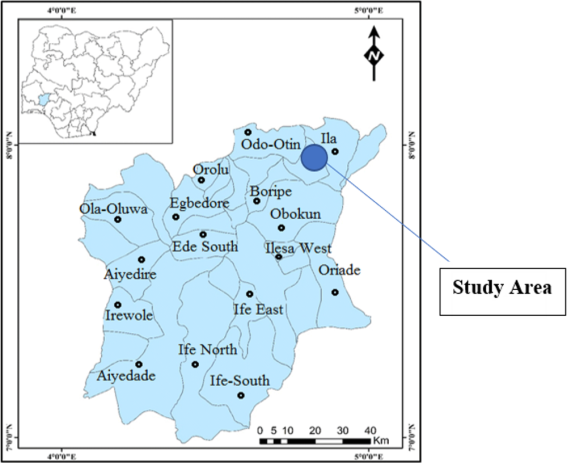
The study area is located within the Ilesha schist belt on a merged map sheet of Ilorin SE (Sheet No. 223) and Ilesha NE (Sheet No. 243). It is located between latitudes 7°54' and 8°001'N and longitudes 4°53' and 5°00'E covering a total estimated area of about 143.745km2. It is geographically located within Osun state in the southwestern part of Nigeria (Figure 1). It is the gateway to both Ekiti and Kwara States and share boundaries with Ora Igbomina and Oke Ila to the North East; Agbamu, Arandun, Omuo-Aran to the North; Oyan to the west; Otan-Ayegbaju to the southwest and Okemesi in Ekiti State to the east. Ila Orangun township is accessible through major roads from Ora Igbomina junction, Otan-Ayegbaju, Ikirun and Ajaba. The various camps and settlements within the area are accessible through footpaths, minor road networks and motorable tracks which are all interconnected (Figures 1 and 2).
The topography being the general relief and landform that is peculiar to the study area depicts a rugged terrain characterized by high ranging hills with very high elevations (Figure 3). The major river in the study area is River Oyi with its various tributaries flowing around the various villages, hamlets and farm settlements spotted within the area. The river was observed to be flowing mostly in the NE-SW directions with the river course being moderately wide and taking its tributaries from the Ayikinugba water falls (Figure 4).
Figure 1. Map of Osun State showing the study area (Inset: Map of Nigeria).
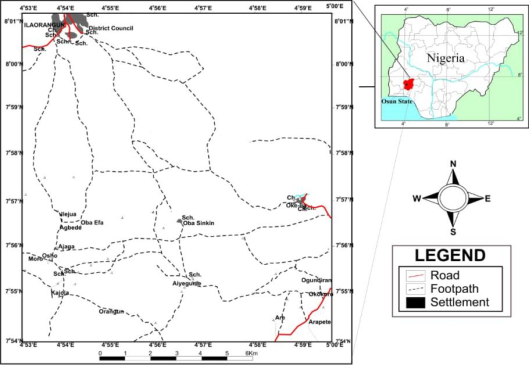
Figure 2. Interconnectivity and accessibility map of the study area (Inset: Map of Nigeria).
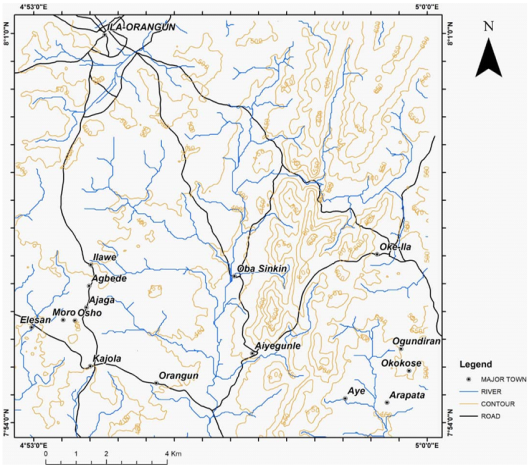
Figure 3. Digitized topographical map sheet of the study area on a scale of 1:50,000 (Federal Surveys Nigeria 1966, Sheet No. 223 & 243 merged).
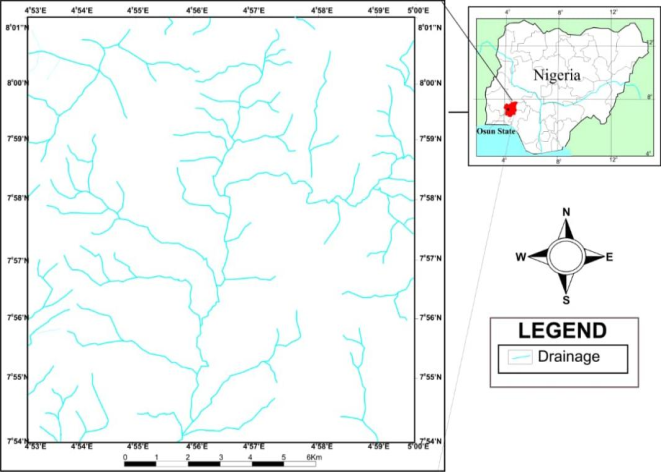
Figure 4. Drainage map of the study area.
Ila Orangun falls within the tropical rain forest and has a humid tropical climate characterized by distinct wet and dry seasons. The wet season extends mostly between March and October while the dry season lasts between November and February. This area has an average temperature of about 29°C. The vegetation is generally depicted by moist deciduous forest.
3. Geologic Settings: Regional and Local
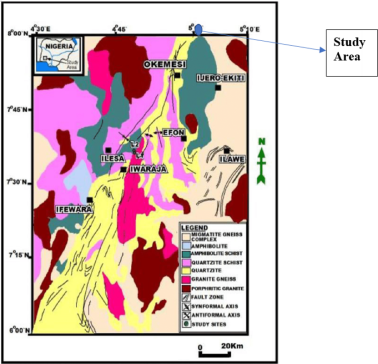
The study area lies within the basement complex and within the southwest basement complex of Nigeria (Figure 5), four major petro-lithological units Dada, 2006 ; Obaje, 2009 are distinguishable namely the Migmatite-Gneiss-Quartzite Complex (Achaean to Early Proterozoic age), the Schist belts (Upper Proterozoic age), the Pan African granitoids (Pan African age) and undeformed acid and basis dykes. The Basement complex in South-western, Nigeria is composed of Migmatite-Gneiss Complex (MGC) that is characterized by grey foliated biotite, acid/biotite hornblende, quartz - feldspathic gneiss of tonalitic to granodioritic composition Rahaman, 1988 ; Mafic to ultramafic component which outcrops as discontinuous boudinage lenses or concordant sheet of amphibolites with minor amount of biotite-rich ultramafic and felsic component, a varied group comprised of pegmatite, aplite, quartz-oligoclase veins, fine-grained granite gneiss, and porphyritic granite. The study area being part of the Ilesha Schist belt, the Nigerian schist belts are exposed predominantly west of longitude 8° within a North-South trending (Figure 7). The lithology of schist belts generally consists of pelitic and semi-pelitic schist, phyllites, quartzites, polymict meta-conglomerate, iron formation, marbles, calcsilicate rocks and subordinate igneous rocks. These rock types occur in varying proportions in different schist belts across Nigeria Rahaman, 1976 ; King and De Swardt, 1949 ; Elueze, 1981 ; Odeyemi, 1988 ; Adekoya, 1996 .
The local geologic setting is described by six (6) lithological units identified in the study area which includes quartzites, granites, granite gneiss, porphyritic granites, amphibolite schists and pegmatites. The most common rock in the area is the quartzite which was observed to be widely distributed within the area but forming hills and ridges of high elevations in the eastern part. Generally, the rocks in the study area are mostly of the granitic and metamorphic origins. (See Figure 6 for modified geological map of the area after NGSA).
Figure 5. Geological Map of Ilesha Schist Belt Showing the Study Area (Modified After Odeyemi, 1993).
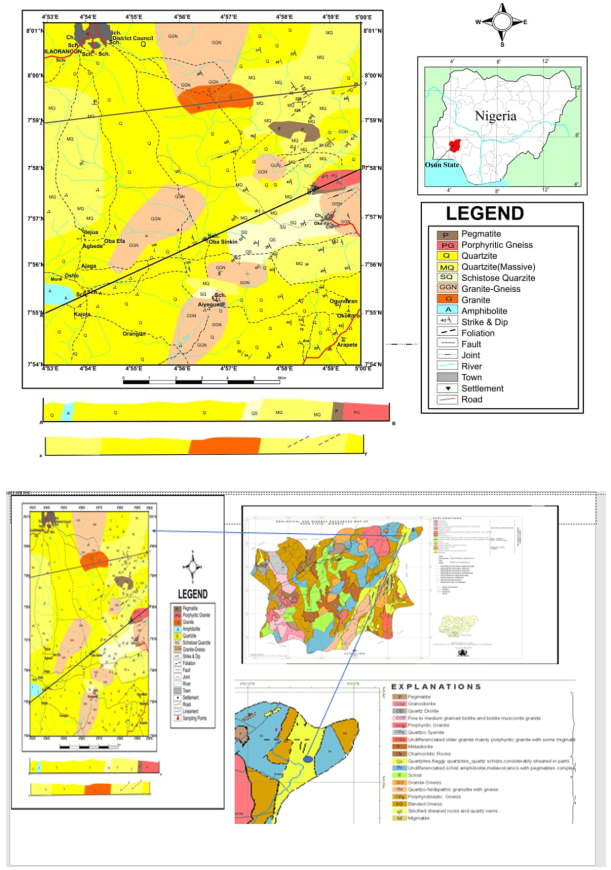
Figure 6. Geological Map of the study area with cross sections and Modified Geological Map (After NGSA, 2006).
4. Materials and Methods
These materials include topographical map sheets with sheet number 223 (Ilorin SE) and sheet number 243 (Ilesha NE) on a scale of 1:50,000, geological hammer (sledge), GPS, compass clinometer, cutlass, digital camera, sample bags, field boot, hand lens, tracing paper, measuring tapes, ruler, protractor, pencil field notebook, marker, paper tape and motorbike for the purpose of easy mobility around the study area. Laboratory research materials put to use for the purpose of petrographical analysis include petrographical microscope, thin sectioning materials and equipment. The manual thin sectioning method was employed for conducting petrographical studies on the selected rock samples which include procedures such as cutting, trimming and grinding, lapping and mounting, covering, washing and labelling. The manual thin sectioning method was employed for conducting petrographical studies on the selected rock samples which include procedures such as cutting, trimming and grinding, lapping and mounting, covering, washing and labelling.
5. Results and Discussion
One of the focuses of this research includes carrying out petrographical studies with the aim of unravelling the possible mineral assemblages that make up the rock composition sampled from the study area. For the purpose of petrographical studies, the collection and use of fresh, good representative samples retrieved from the whole parent rock was closely examined for further laboratory investigation. Hence, for the purpose of the research six (6) good, fresh and quality rock samples were carefully selected from the numerous rock samples collected from the field with each rock sample representing each lithologic unit that underlies the study area (Table 1)
Table 1. Selected rock types from the area for petrographical analysis.

S/N

Location

Latitude (N)

Longitude (E)

Lithology

Texture

Structure

Strike / Dip values

Mineralogy

1

Aiyegunle In front of Baptist church

7⁰ 55'19.4''

04⁰56'59.2''

Quartzite

Medium to fine grained

Planar surface, fracture and lineation.

318/32⁰

Quartz, Biotite, Plagioclase, Feldspar

2

Close to Aba Baba Eko (Inside College of Education Campus)

8⁰00'26.7''

04⁰56'38.6''

Granite Gneiss

Medium to fine grained

Planar surfaces, fracture, foliation.

136/54⁰

Biotite, Quartz, Feldspar and accessory minerals.

3

Obasinkin

7⁰ 56'38.2''

04⁰56'47.5''

Pegmatite

Medium to coarse grained

Quartz vein, Solution holes,

232/50⁰

Quartz, Feldspar,

Biotite, Muscovite.

4

OkeIla (Along Omi Nla)

7⁰ 57'47.9''

04⁰59'33.5''

Porphyritic Granite

Medium to coarse grained

Lineation, Planar surface, Joint.

194/40⁰

Quartz, Biotite, Feldspar.

5

Aba Oyi Adunni

7⁰ 58'19.8''

04⁰58'05.0''

Granite

Medium to fine grained

Planar bedding, Quartz vein, Lineation.

310/32⁰

Biotite, Quartz, Feldspar.

6

Back of Baptist Elementary school, Ajaba

7⁰ 55'27.9''

04⁰53'30.0''

Amphibolite Green Schist

Medium to fine grained

Solution holes, Foliations

358/70⁰

Quartz, Plagioclase.

Note that the petrographical analysis of the selected rock samples were carried out in the petrological laboratory of the Department of Geology, University of Malaya, Malaysia. Six (6) rock samples of different lithologies were carefully selected for petrographical studies. Hence, the results are thus presented below:
1. Sample 1: Quartzite (Aiyegunle, Latitude 7°55'19.4''and Longitude 04°56'59.2'')
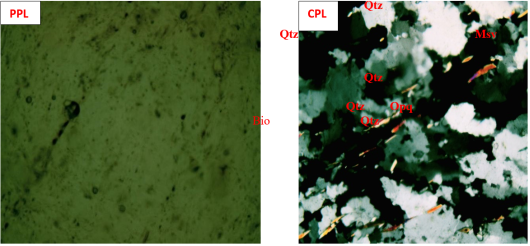
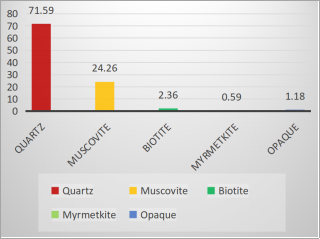
Slide 1 was prepared from quartzite and closely examined under both plane and cross polarized lights of the electron microscope. Under the plane polarized light, no crystal faces were seen except some patches of dark and dark brown features suspected to be minerals. No colour change was observed as the stage was rotated, hence non-pleochroic. However, these features are better seen under the cross polarized light. Under the cross nicol the crystal faces became more obvious and conspicuous to the eyes. Colour changes were observed as minerals crystal faces change from black to white, white to grey and colourless as the stage was continually rotated. The intercrystalline lattice faces are well connected or interconnected but the faces not perfectly formed exhibit crystal shapes ranging from Subhedral to Euhedral. Under cross polarized light they depict polycrystalline quartz typically several interlocking crystal faces which are seen to have been strained. The interlocking crystal faces are good migration pathways for fluid and other gaseous substances capable of forming a second-degree fluid inclusion. Typical cases of subgrain transitions were observed as minute crystal grains transit or migrate from an initial position to the present as they were clearly seen to form strange dark or white spots on existing crystal faces suspected to have occurred as a result of recrystallization. Bulging of mineral crystal faces were seen as dark coloured crystal boundaries bulge into white, grey or colourless boundaries. Pseudo cleavage lines were observed between crystal faces which are parallel to each other and found to play host to strange coloured minerals exhibiting dark brown, marine blue, deep blue, light green and pinkish coloured. All coloured minerals show a needle - like shape and appearing in different directions or preferred orientations along the cleavage line. Twining observed in cases of two-coloured minerals formed side by side with mutual growth. From petrographical studies the mineral count shows quartz (71.59%), muscovite (24.26%) and biotite (2.36%) while other accessory minerals constitute less than 2% of the total possible mineral composition. The dark, grey, white and colourless crystal faces suggest the presence of quartz which are also found in metamorphic rocks. Under the thin section exhibits refractive index of 1.54 -1.55, cleavage not clearly defined as they are seen to be characterized with fractures having random orientations of cracks. It possesses low birefringence, low relief, hence habit is low. It belongs to the 1st Order as colour changes ranges from white to grey. The light to dark brown colour points to the presence of biotite [K(Mg, Fe)3AlSi3O10(OH)2] which under plane polarized light in thin section display light brown and darker brown under cross nicol. Refractive index is 1.54-1.64 and exhibits low to moderate birefringence, moderate relief hence habit is moderate and no extinction. Other coloured minerals such as blue (marine and deep) suggests the presence of viewed under the cross polarized light suggests the presence of fluorite [(CaF2)]. Under thin section, fluorite exhibit colours ranging from bluish to purple to colourless. Refractive index is 1.43, birefringence is isotropic, relief is high and high habit. While the pink-coloured mineral indicates the presence of garnet and andalusite. The colourless minerals could suggest the presence of muscovite which exhibits a form of flaky mineral with a moderate relief, high birefringence of 2nd Order with a tetrahedral to octahedral crystal structure.
Figure 7. Photomicrograph of quartzite under PPL and CPL showing its mineral assemblages. Magnification × 10.
MODAL ANALYSIS
Slide 1 (quartzite) Aiyegunle
Latitude 7° 55' 19.4''
Longitude 04° 56'59.2''
Table 2. Modal Analysis of Sample 1.

Minerals

Composition (%)

Quartz

71.59%

Muscovite

24.26

Biotite

2.36

Myrmekite

0.59

Opaque

1.18

Total

99.98

Figure 8. Bar chart showing % mineral composition of sample 1.
2. Sample 2: Granite Gneiss (Aba Baba Eko, Latitude 8° 00' 26.7''and Longitude 04° 56'38.6'')
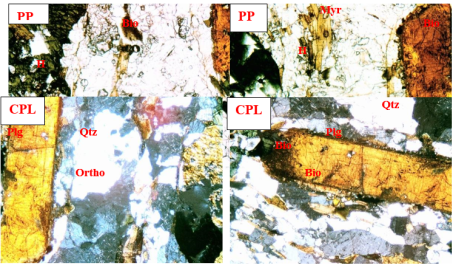
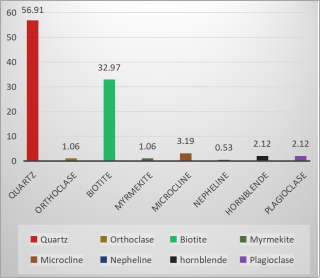
Slide 6 was prepared from granite gneiss. Under the plane polarized light beautiful colour display were observed. They appeared so conspicuous and attractive to the eyes. Clear coloured minerals as deep brown, deep green, yellow colours were found on every section of the slide. A line was observed to divide the slide under thin section into two equal halves running in a preferred orientation or direction. All these attributes spotted under the plane light are better seen under the cross polarized light. With the cross polarized light, similar colour display and other features were now distinct and clearly seen. Dark, grey to colourless display of some minerals were spotted. Mineral faces in their distinct colours are now easily identified. As the stage was rotated dark, grey, white to colourless mineral faces were observed as they slowly change slightly from dark to grey, grey to white and sometimes colourless. Other colour of minerals spotted include light green, pink and light blue. Thick dark brown coloured mineral was seen to be overprinted on the crystal faces as they are formed as an emplacement between crystal boundaries causing some of the crystal faces to have been affected or deformed in the process. This thick brown mineral emplacement suggesting biotite are emplaced in preferred directions and orientations. Other minor occurrences of biotite were also observed to be found in smaller forms in between intercrystal boundaries. Mineral count under the cross nicol shows biotite (32.97%), quartz (56.91%), microcline (3.19%) and other accessory minerals account for about 7% of the entire mineral assemblage which include orthoclase, plagioclase, nepheline, myrmekite and hornblende all making up the rock components as observed under thin section. The dark brown colour points to the presence of biotite [K(Mg,Fe)3AlSi3O10(OH)2] which under plane polarized light in thin section display light brown and darker brown under cross nicol. Refractive index is 1.54-1.64. Biotite exhibits perfect mica cleavage which appears darker when the cleavage is in the E-W. In this case under the cross nicol, the biotite appears as large chunk as they formed a cluster. The light brown colouration is as a result of low Fe content suggesting the reason for its being subtle and clear. The dark, grey, white and colourless crystal faces suggest the presence of quartz which under thin section exhibits refractive index of 1.54 -1.55. It possesses low birefringence, low relief, hence habit is low and belongs to the 1st Order as colour changes ranges from white to grey exhibits low to moderate birefringence, moderate relief hence habit is moderate and no extinction. The colourless suggests the presence of microcline while other coloured minerals such as greenish suggests the present of chlorite, yellow suggests epidote, staurolite and rutile, light blue depicts fluorite and pink suggests andalusite while the possibility of pink muscovite may suggest the possibility of chemical reaction due to the presence of manganese. Summarily, petrographical investigation showed that this rock under thin section has been deformed as it was found to be characterized with severe cases of mineral emplacement.
Figure 9. Photomicrograph of granite gneiss under PPL and CPL showing its mineral assemblages. Magnification × 10.
MODAL ANALYSIS
Slide 2 (Granite Gneiss) Aba Baba Eko
Latitude 8° 00' 26.7''
Longitude 04° 56'38.6''
Table 3. Modal Analysis of Sample 2.

Minerals

Composition (%)

Quartz

56.91

Orthoclase

1.06

Biotite

32.97

Myrmekite

1.06

Microcline

3.19

Nepheline

0.53

hornblende

2.12

Plagioclase

2.12

Total

99.98

Figure 10. Bar chart showing % mineral composition of sample 2.
3. Sample 3: Pegmatite (Obasinkin, Latitude 7° 56' 38.2''and Longitude 04° 56'47.5'')
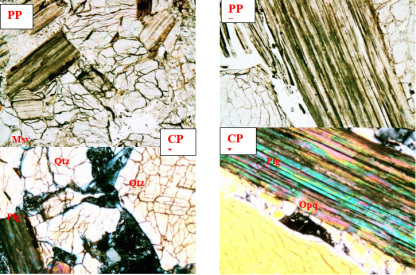
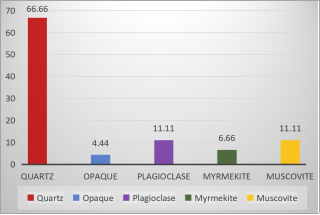
Sample 13 was prepared from pegmatite. Under the cross nicol well-arranged patterns with rough faces were seen as these faces are suspected to be crystal faces of minerals. The images were seen to be very clear and visible as they display brown and some dark patches which are generally non-pleochroic as they didn’t change colours when the stage was rotated. The faces of the minerals were seen to exhibit long thin lines oriented concordantly to the direction of the lines and are to be clearly seen under the cross polarized light. Under the cross nicol the mineral patterns became very conspicuous. They are distinct and easy to identify on the basis of colour display. The various colours display by the minerals include pink, green and brown coloured. In some cases, the colour of crystal faces of minerals were seen changing from dark to white, white to grey and colourless. While the coloured minerals exhibit low birefringence as they didn't switch colours as the stage was being rotated. Well-formed mineral patterns wearing facial lines were clearly seen as they run parallel and concordantly to the direction of the minerals. These facial lines on crystal faces are evidence of cracking possibly influenced by shearing due to tectonic deformation. Minerals seen as both major and accessory exhibit low birefringence, high relief and habit but no extinction. The crystal faces of mineral in some cases exhibit rectangular, triangular and tubular faces with faces being described to be subhedral to anhedral. Elongated and tubular minerals were seen to be overprinted on existing or surrounding crystal faces during the process of recrystallization. The rock under thin section typically shows a highly mineralized rock which confirms the rock as a good host to an agglutination or conglomerate of minerals. Crystal faces were seen to be seriously battered and overprinted with minerals. The mineral count under the cross nicol accounts for quartz (66.66%), plagioclase (11.11%), myrmekite (6.66%), muscovite (11.11%) and traces of biotite with other possible occurring accessory minerals constitute about 4% of the entire mineral assemblage that make up the rock under thin section. The dark, grey, white and colourless crystal faces suggest the presence of quartz which under thin section exhibits refractive index of 1.54 -1.55. It possesses low birefringence, low relief, hence habit is low and belongs to the 1st Order as colour changes ranges from white to grey. The dark brown colour points to the presence of biotite [K(Mg,Fe)3AlSi3O10(OH)2]. The colourless suggests the presence of muscovite with microcline, plagioclase, olivine, apatite and sillimanite which make up the accessory minerals possibly present in the rock as examined under thin section. Other coloured minerals such as light to pale green suggests the present of orthopyroxene and clinopyroxene. The orthopyroxene has a refractive index of 1.67-1.73 with moderate relief. while the clinopyroxene display high refractive index of 1.66-1.76 with moderate to high relief and birefringence moderately high up to II Order. Green coloured mineral suggests the present of chlorite, yellow suggests epidote, staurolite and rutile, and pink suggests andalusite while the possibility of pink muscovite may suggest the possibility of chemical reaction due to the presence of manganese. The colourless suggests the presence of muscovite, microcline and possibly other colourless minerals like olivine and sillimanite. However, the rock under thin section typically shows a highly mineralized rock which confirms the rock as a good host to an agglutination or conglomerate of economic minerals.
Figure 11. Photomicrograph of pegmatite under PPL and CPL showing its mineral assemblages. Magnification × 1.
MODAL ANALYSIS
Slide 3 (Pegmatite) Obasinkin
Latitude 7° 56' 38.2''
Longitude 04° 56'47.5''
Table 4. Modal Analysis of Sample 3.

Minerals

Composition (%)

Myrmekite

6.66

Opaque

4.44

Plagioclase

11.11

Quartz

66.66

Total

99.98

Figure 12. Bar chart showing % mineral composition of sample 3.
4. Sample 4: Porphyritic Granite (Oke Ila, Latitude 7° 57' 47.9''and Longitude 04° 59'33.5'')
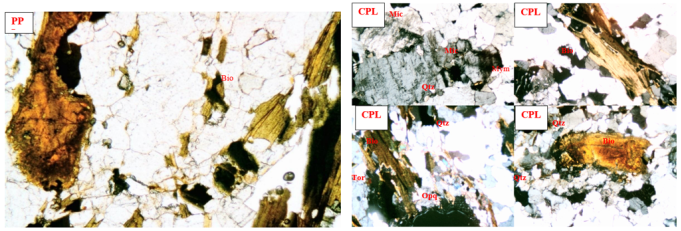
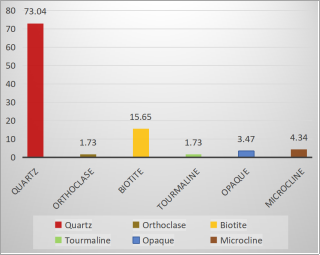
Sample 20 was prepared from porphyritic granite which when viewed under the plane polarized light display light to dark brown coloured features which were clearly distinct and identified under the light. They were seen to be elongated and forming interesting patterns scattered on all sections of the slide. These brown coloured features were seen to align in preferred direction or orientation but surrounded by crystal faces which were traceable but are better viewed under the cross polarized light. Under the cross nicol, the brown-coloured minerals became conspicuous and clearly visible to the eyes. They were seen to be emplaced along intercrystal boundaries and some on the crystal faces. Within the brown-coloured minerals are tiny flints or spikes of coloured minerals exhibiting greenish, bluish and pinkish looks. Crystal faces were seen to slightly change from dark to white, white to grey and to colourless. Crystal faces were seen to be interlocking, forming continuous loops of crystals with common boundaries. Subgrain transition was evident from tiny spots of either dark or white coloured minerals scattered on the faces of surrounding crystal faces. Where massive emplacement of mineral is observed, crystal faces of existing minerals are deformed to give way for minerals to be formed. No twinning was observed. Mineral count under the cross nicol accounts for biotite (15.65%), quartz (73.04%) and microcline (4.34%) while accessory minerals which include orthoclase, tourmaline and opaque minerals constitute about 7% of the entire mineral assemblage that make up the rock under thin section. The dark brown colour points to the presence of biotite [K (Mg, Fe)3AlSi3O10(OH)2] which under plane polarized light in thin section display light brown and darker brown under cross nicol with a refractive index of 1.54-1.64. The dark, grey, white and colourless crystal faces suggest the presence of quartz which under thin section exhibits refractive index of 1.54 -1.55. It possesses low birefringence, low relief, hence habit is low and belongs to the 1st Order as colour changes ranges from white to grey.
The colourless suggests the presence of muscovite, microcline and possibly other colourless minerals like olivine and sillimanite. The blue colour may suggest the presence of fluorite. The greenish yellow points at epidote with a refractive index 1.71-1.79, high birefringence, high relief and habit, no extinction and up to the III Order. The pink suggests andalusite while the possibility of pink muscovite may suggest the possibility of chemical reaction due to the presence of manganese. The opaque minerals neither transmit nor reflect lights which may suggest an ore mineral.
Figure 13. Photomicrograph of porphyritic granite under PPL and CPL showing its mineral assemblages. Magnification × 10.
MODAL ANALYSIS
Slide 4 (Porphyritic Granite) Oke Ila
Latitude 7° 57' 47.9''
Longitude 04° 59'33.5''
Table 5. Modal Analysis of Sample 4.

Minerals

Composition (%)

Microcline

4.34

Orthoclase

1.73

Biotite

15.65

Tourmaline

1.73

Opaque

3.47

Quartz

73.04

Total

99.96

Figure 14. Bar chart showing % mineral composition of sample 4.
5. Sample 5: Granite (Aba Oyi Aduni, Latitude 7° 58' 19.8''and Longitude 04° 58'05.0'')
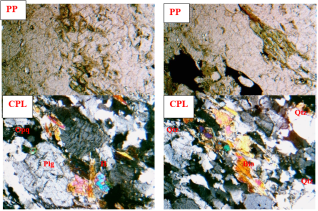
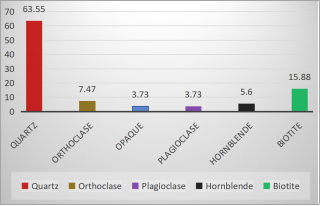
Sample 29 was prepared from granite which when examined under the plane polarized light, brown-coloured features suspected to be minerals with some attributes of opaque minerals were spotted. Both brown and the opaque features did not change colour as the stage was rotated but surrounded by traceable patterns suspected to be crystal faces. Under cross nicol, colourful display of minerals was spotted to include pink, green (dark green), light yellow, dark brown and very dark coloured mineral suspected to be opaque which did not transmit light at all under both plane and cross polarized lights. Coloured minerals were very visible and minerals named base on their colour properties and other optical properties. The various minerals formed were seen to be emplaced between intercrystal boundaries as a result of metamorphic process. Crystal faces were seen to switch slowly between dark, white, grey and colourless in some cases. Other colours displayed by minerals include purple and pink. Crystal faces were seen bulging into one another and characterized by subgrain transition. Irregular shape patterns were exhibited by the crystal faces described as being wavy or zig zag forming intercrystalline boundaries while crystal shapes are subhedral to anhedral. Faces of some minerals display parallel linings called lamellae and some weak crystal faces display a granular texture. Generally, the coloured minerals exhibit low birefringence, low relief and habit, Hence, no extinction. Mineral count under the cross nicol accounts for biotite (15.88%), quartz (63.55%), orthoclase (7.47%), hornblende (5.60%) and plagioclase (3.73%) while other accessory minerals including opaque minerals accounts for 3% of the total mineral assemblage that make up the rock composition under thin section. The dark, grey, white and colourless crystal faces suggest the presence of quartz. The dark brown colour points to the presence of biotite [K(Mg,Fe)3AlSi3O10(OH)2]. The blue under thin section may suggest the presence of fluorite, tourmaline, glaucophane and the green suggest the presence of chlorite. The purple colour under thin section may also suggest the presence of fluorite and tourmaline. The yellow suggests the presence of epidote, staurolite and rutile. The blue under thin section may suggest the presence of fluorite, tourmaline, glaucophane and Na amphiboles. Green coloured mineral suggests the presence of chlorite, orthopyroxene and clinopyroxene. The opaque minerals suggest the presence of magnetite, ilmenite, pyrites and isotropic minerals such as garnets and spinel.
Figure 15. Photomicrograph of granite under PPL and CPL showing its mineral assemblages. Magnification × 10.
MODAL ANALYSIS
Slide 5 (Granite) Aba Oyi Aduni
Latitude 7° 58' 19.8''
Longitude 04° 58'05.0''
Table 6. Modal Analysis of Sample 5.

Minerals

Composition (%)

Biotite

15.88

Orthoclase

7.47

Opaque

3.73

Plagioclase

3.73

Hornblende

5.60

Quartz

63.55

Total

99.96

Figure 16. Bar chart showing % mineral composition of sample 5.
6. Sample 6: Amphibolite schists (Ajaba, Latitude 7° 55' 27.9''and Longitude 04° 53'30.0'')
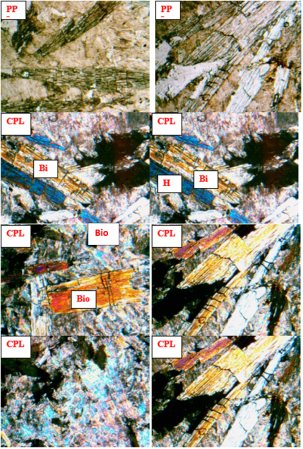
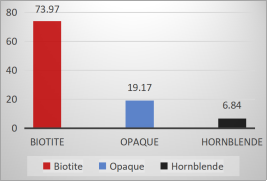
Sample 31 was prepared from amphibolite greenschist which when examined under the plane polarized light display traceable light brown-coloured features observed to be clumsy and cloudy under the plane light. Some sort of elongated patterns was seen running in a preferred direction or orientation and being surrounded by traceable patches which could be crystal faces. However, as the stage was rotated no visible colour change was observed. Hence, non-pleochroic. Under the cross nicol a colourful display of coloured minerals was very clear and visible as colours observed under the light became distinct. The slide under the thin section showed coloured minerals exhibiting irregular patterns on all sections of the slide. The minerals in some cases were seen to have been fractured as clearly visible fracture lines were evident connoting weak mineral faces as a result of high temperature during metamorphism. Most of the minerals exhibit elongated, tabular and rectangular forms which would have been formed as a result of thermal effect. When further overstretched in their present state by internal or external forces, it is susceptible to further crack or deformation. Green coloured minerals were seen as patches randomly scattered within the face of the entire slide under the cross nicol. Light green to bluish-green colour display were observed under the light. However, no single display of crystal faces of minerals was spotted at all. This possibly implies that the crystal faces have been totally deformed due to the massive emplacement of minerals as a result of high-grade metamorphism it was exposed to in the geologic past. This effect of metamorphism may have been associated with high temperature capable of melting a large chunk of the crystal lattice of the minerals. The rock under thin section displayed coloured minerals that exhibit low birefringence as they do not switch between two or more colours, high relief and habit. Mineral count under the cross nicol accounts for biotite (73.97%) while hornblende and other accessory minerals accounts for about 26% of the total mineral assemblage that make up the rock composition under thin section. The dark brown colour points to the presence of biotite [K (Mg, Fe)3AlSi3O10(OH)2]. The dark, grey, white and colourless crystal faces suggest the presence of quartz which under thin section exhibits refractive index of 1.54 -1.55. Green coloured mineral suggests the presence of chlorite, orthopyroxene and clinopyroxene. The pink suggests andalusite while the possibility of pink muscovite may suggest the possibility of chemical reaction due to the presence of manganese. The bluish green suggests the presence of actinolite which is Fe rich. Actinolite is noted to exhibit moderate birefringence, moderate relief and up to the II Order. This mineral is very common in low grade metamorphic rocks. They are known to be characterized by elongated crystals, weak colours.
Figure 17. Photomicrograph of amphibolite greenschist under PPL and CPL showing its mineral assemblages. Magnification × 10.
MODAL ANALYSIS
Slide 6 (Amphibolite) Ajaba
Latitude 7° 55' 27.9''
Longitude 04° 53'30.0''
Table 7. Modal Analysis of Sample 6.

Minerals

Composition (%)

Biotite

73.97

Opaque

19.17

Hornblende

6.84

Total

99.98

Figure 18. Bar chart % mineral composition of sample 6.

6. Conclusion and Recommendation
It can therefore be concluded that the geological mapping conducted on the study area was effective as it provided an update on the rock types, occurrence and their distributions. The outcome of the ground truthing confirmed the major rock types as quartzites, granites, granite gneiss, porphyritic granites, pegmatites and amphibolite greenschists. However, the most dominant rock type being quartzites of both massive and schistose types. The results of petrographical analyses show the mineral assemblages of the various rock types in the area which include quartzites as containing quartz, biotite, muscovite and myrmekite. Granite gneiss contains quartz, biotite, orthoclase, myrmekite, microcline, nepheline, hornblende and plagioclase. Pegmatite contains quartz, myrmekite, plagioclase, hornblende, microcline and muscovites. Porphyritic granites were observed to contain quartz, biotite, microcline, orthoclase and tourmaline. Granite contains quartz, biotite, hornblende, plagioclase and orthoclase while Amphibolite schist contains quartz, biotite, hornblende and muscovites. The pegmatites from thin section probe involving petrographical studies were found to be highly mineralized. It is therefore recommended that further studies should be specifically carried out with focus on the pegmatites within the study area which will unravel mineralization potential of the pegmatite in Ila Orangun, southwestern Nigeria.
Abbreviations

GPS

Global Positioning System

Acknowledgments
The author sincerely acknowledges the support received from the Tertiary Education Trust Fund (TETFund) Nigeria for providing financial support which was judiciously utilized for the execution of this research.
Author Contributions
Jayeola Afolabi Olubunmi: Conceptualization, Formal analysis, Funding, Methodology, Project administration, Writing – original draft
Conflicts of Interest
There is no conflict of interest in the drafting and submission of the research article for publication in your journal. The paper was research initiated and executed solely by the author.
References
[1] Adekoya, J. A. (1996). The Nigeria Schist Belts: Age and Depositional Environment: Implication from Associated Banded Iron Formation. In Journal of Geology and Mining Research, 32(1), 35-46.
[2] Ajibade, A. C., Woakes M., & Rahaman, M. A. (1987). Proterozoic crustal development in Pan-African regime of Nigeria: In A. Croner (ed.) Proterozoic Lithospheric Evolution Geodynamics, 17(3), 259-231.
[3] Dada S. S. (2006). Proterozoic Evolution of Nigeria. In Oshin O.(ed) The Basement Complex of Nigeria and Its Mineral Resources. Akin Jinad and Co. Ibadan, 7(2), 29-44.
[4] Elueze, A. A. (1981). Petrography and Geochemistry of Metasedimentary Rocks of the Schist Belt of Ilesha Area, Southwestern Nigeria. Journal of Nigeria Mining and Geosciences Society, 18(1), 5-7.
[5] King, B. C. and Swardt, A. M. J, (1949). "The geology of the Osi area, Ilorin Province" Geological Survey Nigeria Bulletin, 20(1): 22-26.
[6] Obaje, N. G. (2009): Geology and Mineral Resources of Nigeria. London; Springer Dordretcht Heidelberg, 8(2), 5-14.
[7] Odeyemi, I. B. (1988): Lithostratigraphic and Structural Relationships of the Upper Precambrian Metasediments in Igarra Area, Western Nigeria. The Precambrian Geology of Nigeria, Geological Survey of Kaduna, 10(2), 111-123.
[8] Rahaman, M. A. (1988): Recent Advances in the Study of the Basement Complex of Nigeria in Precambrian Geology of Nigeria. In Geological Survey of Nigeria Publication, 7(4), 11-43.
[9] Rahaman, M. A. (1976): Review of the Basement Geology of SW Nigeria. In Geology of Nigeria. Elizabeth Publishing Company Nigeria, 8(1), 41-58.
[10] Jayeola, A. O., Ayodele, O. S., Olususi, J. I. (2023). Petrology and Petrochemistry of Basement Rocks in Ila Orangun Area Southwestern Nigeria. Published in British Journal of Earth Sciences Research, 11(5), 48-88.
Cite This Article
  • APA Style

    Olubunmi, J. A. (2026). Petrographical Analysis of Basement Rocks in Ila Orangun Area, Southwestern Nigeria. International Journal of Mineral Processing and Extractive Metallurgy, 11(2), 29-43. https://doi.org/10.11648/j.ijmpem.20261102.12

    Copy | Download

    ACS Style

    Olubunmi, J. A. Petrographical Analysis of Basement Rocks in Ila Orangun Area, Southwestern Nigeria. Int. J. Miner. Process. Extr. Metall. 2026, 11(2), 29-43. doi: 10.11648/j.ijmpem.20261102.12

    Copy | Download

    AMA Style

    Olubunmi JA. Petrographical Analysis of Basement Rocks in Ila Orangun Area, Southwestern Nigeria. Int J Miner Process Extr Metall. 2026;11(2):29-43. doi: 10.11648/j.ijmpem.20261102.12

    Copy | Download

  • @article{10.11648/j.ijmpem.20261102.12,
      author = {Jayeola Afolabi Olubunmi},
      title = {Petrographical Analysis of Basement Rocks in Ila Orangun Area, Southwestern Nigeria},
      journal = {International Journal of Mineral Processing and Extractive Metallurgy},
      volume = {11},
      number = {2},
      pages = {29-43},
      doi = {10.11648/j.ijmpem.20261102.12},
      url = {https://doi.org/10.11648/j.ijmpem.20261102.12},
      eprint = {https://article.sciencepublishinggroup.com/pdf/10.11648.j.ijmpem.20261102.12},
      abstract = {For the purpose of carrying out petrographical analysis on basement rocks mapped in Ila Orangun Area Southwestern Nigeria, it became expedient to use the six (6) lithological units which were identified to be common around the study area. These lithological units include quartzites, granites, granite gneiss, porphyritic granites, amphibolite and pegmatites. The aim of the research is to unravel the mineralogical assemblages in terms of % mineralogical composition under plane and cross polarized lights using modal analysis for each of the rocks that best describes the underlying lithology of the area. Methods adopted for this research include preparing the rock samples for thin sectioning. The procedure of sample preparation include cutting, trimming, lapping and mounting of the rock processed rock samples on glass slides using Canada balsam and araldites. Each glass slides are then mounted on the stage of a petrographical microscope for keen observation and petrographical studies. The results of petrographical analyses show the mineral assemblages of the various rock types in the area which include quartzites as containing quartz, biotite, muscovite and myrmekite. Granite gneiss contains quartz, biotite, orthoclase, myrmekite, microcline, nepheline, hornblende and plagioclase. Pegmatite contains quartz, myrmekite, plagioclase, hornblende, microcline and muscovites. Porphyritic granites were observed to contain quartz, biotite, microcline, orthoclase and tourmaline. Granite contains quartz, biotite, hornblende, plagioclase and orthoclase while Amphibolite schist contains quartz, biotite, hornblende and muscovites. In conclusion, results from the petrographical analysis showed that the rocks are rich in minerals of huge economic significance. Some of these include quartz (SiO2) and muscovites which are both useful in the manufacturing of refractory glassware. It is however, recommended that further studies should be conducted on the microstructural investigation of these rock types which are mapped and retrieved from the study area.},
     year = {2026}
    }
    

    Copy | Download

  • TY  - JOUR
    T1  - Petrographical Analysis of Basement Rocks in Ila Orangun Area, Southwestern Nigeria
    AU  - Jayeola Afolabi Olubunmi
    Y1  - 2026/07/11
    PY  - 2026
    N1  - https://doi.org/10.11648/j.ijmpem.20261102.12
    DO  - 10.11648/j.ijmpem.20261102.12
    T2  - International Journal of Mineral Processing and Extractive Metallurgy
    JF  - International Journal of Mineral Processing and Extractive Metallurgy
    JO  - International Journal of Mineral Processing and Extractive Metallurgy
    SP  - 29
    EP  - 43
    PB  - Science Publishing Group
    SN  - 2575-1859
    UR  - https://doi.org/10.11648/j.ijmpem.20261102.12
    AB  - For the purpose of carrying out petrographical analysis on basement rocks mapped in Ila Orangun Area Southwestern Nigeria, it became expedient to use the six (6) lithological units which were identified to be common around the study area. These lithological units include quartzites, granites, granite gneiss, porphyritic granites, amphibolite and pegmatites. The aim of the research is to unravel the mineralogical assemblages in terms of % mineralogical composition under plane and cross polarized lights using modal analysis for each of the rocks that best describes the underlying lithology of the area. Methods adopted for this research include preparing the rock samples for thin sectioning. The procedure of sample preparation include cutting, trimming, lapping and mounting of the rock processed rock samples on glass slides using Canada balsam and araldites. Each glass slides are then mounted on the stage of a petrographical microscope for keen observation and petrographical studies. The results of petrographical analyses show the mineral assemblages of the various rock types in the area which include quartzites as containing quartz, biotite, muscovite and myrmekite. Granite gneiss contains quartz, biotite, orthoclase, myrmekite, microcline, nepheline, hornblende and plagioclase. Pegmatite contains quartz, myrmekite, plagioclase, hornblende, microcline and muscovites. Porphyritic granites were observed to contain quartz, biotite, microcline, orthoclase and tourmaline. Granite contains quartz, biotite, hornblende, plagioclase and orthoclase while Amphibolite schist contains quartz, biotite, hornblende and muscovites. In conclusion, results from the petrographical analysis showed that the rocks are rich in minerals of huge economic significance. Some of these include quartz (SiO2) and muscovites which are both useful in the manufacturing of refractory glassware. It is however, recommended that further studies should be conducted on the microstructural investigation of these rock types which are mapped and retrieved from the study area.
    VL  - 11
    IS  - 2
    ER  - 

    Copy | Download

Author Information